

Private Prediction Sets
Open accessThe DOI matches its Crossref record; 78 of the 82 references it cites were found in a registry or an index; none of the 15 sources its claims cite is checked for support yet.
Abstract
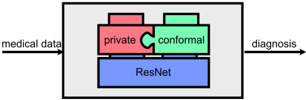
In real-world settings involving consequential decision-making, the deployment of machine learning systems generally requires both reliable uncertainty quantification and protection of individuals’ privacy. We present a framework that treats these two desiderata jointly. Our framework is based on conformal prediction, a methodology that augments predictive models to return prediction sets that provide uncertainty quantification—they provably cover the true response with a user-specified probability, such as 90%. One might hope that when used with privately trained models, conformal prediction would yield privacy guarantees for the resulting prediction sets; unfortunately this is not the case. To remedy this key problem, we develop a method that takes any pretrained predictive model and outputs differentially private prediction sets. Our method follows the general approach of split conformal prediction; we use holdout data to calibrate the size of the prediction sets but preserve privacy by using a privatized quantile subroutine. This subroutine compensates for the noise introduced to preserve privacy in order to guarantee correct coverage. We evaluate the method on large-scale computer vision data sets.
Overview
CoChat Summary
TL;DR
The paper develops a differentially private version of split conformal prediction that turns any pretrained predictive model plus a calibration set into prediction sets with finite-sample coverage and ε-differential privacy. It shows the cost of privacy in calibration is mild, with coverage upper bound scaling as Õ((nε)^−1) versus O(n^−1) for nonprivate conformal prediction.
Key findings
- The proposed private prediction-set procedure is ε-differentially private and satisfies coverage \(1-\alpha \le P\{Y \in C(X)\} \le 1-\alpha + O((n\epsilon)^{-1})\) (Theorem 1 informal preview).
- A simplified upper bound gives \(P\{Y \in C(X)\} \le 1-\alpha + O(\log(n\epsilon/\alpha)/(n\epsilon))\), compared with \(1-\alpha + O(n^{-1})\) for nonprivate conformal prediction (Corollary 1).
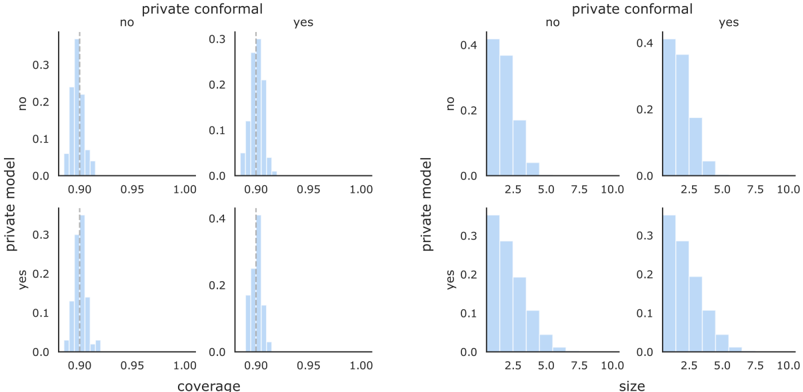
- In CIFAR-10 experiments with \(n=5000\), \(\epsilon=8\), \(\delta=1e-5\), and \(\alpha=0.1\), the nonprivate model had 73% accuracy and the private model 67%; private conformal prediction caused only a minuscule increase in set size, while private model training caused a larger set-size increase.
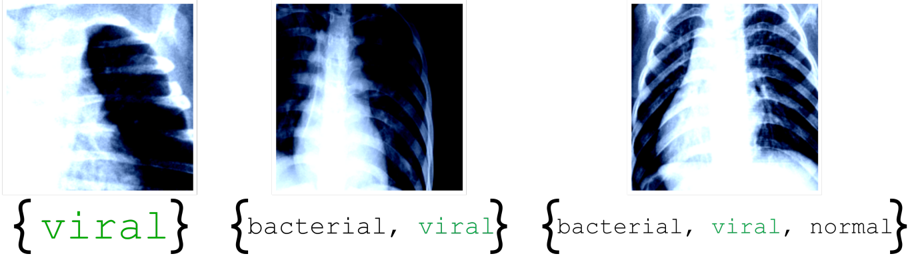
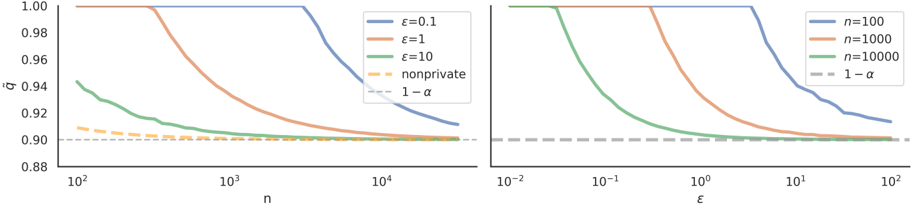
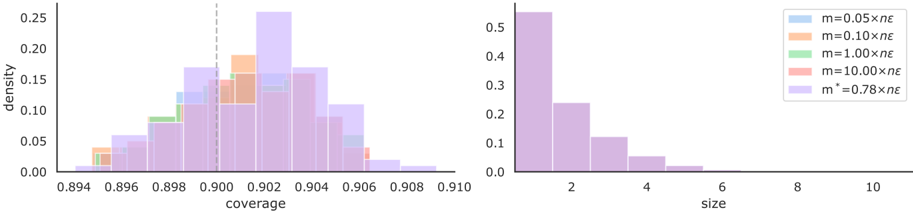
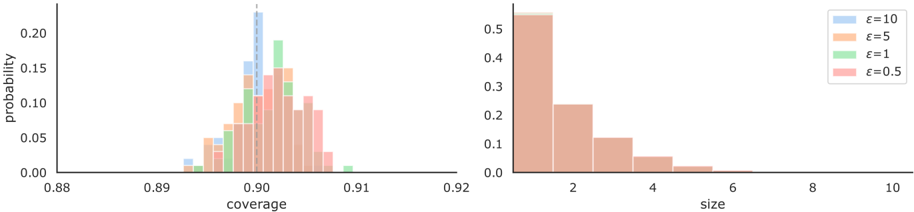
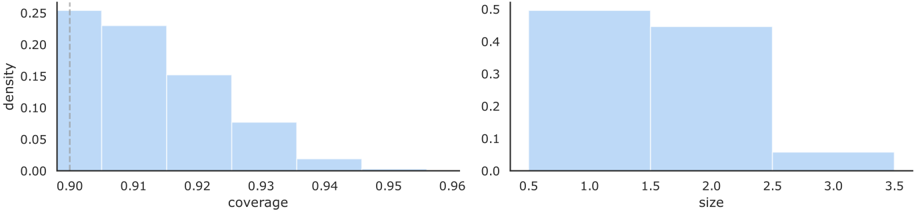
- On ImageNet with a nonprivate ResNet-152, \(n=30000\) calibration points and 20000 evaluation images, coverage was nearly constant over three orders of magnitude of bin numbers and showed little sensitivity to \(\epsilon\); on CoronaHack, using a nonprivate ResNet-18 with 75% accuracy, median coverage was 90.4% at \(\alpha=0.1\).
Methods
- The method follows split conformal prediction: compute conformity scores \(s_i = S_f(X_i,Y_i)\) on held-out calibration data, choose a cutoff \(\hat{s}\), and output \(C(x)=\{y:S(x,y)\le \hat{s}\}\).
- Privacy is achieved by replacing the ordinary conformal quantile with a privatized quantile subroutine: scores are discretized into bins and the exponential mechanism is applied, extending the private median routine of Feldman and Steinke.
- Experiments evaluate image classification on CIFAR-10, ImageNet, and CoronaHack; the score used is \(S(x,y)=1-f(x)_y\), and private model training on CIFAR-10 uses DP-SGD via Opacus with \(\epsilon=8\), \(\delta=1e-5\).
Limitations
- The paper states that the coverage upper bound requires weak regularity on the score distribution, such as a continuous distribution with bounded density and no point masses; the lower bound holds for any distribution, and the paper notes the assumption could be enforced with tiebreaking noise.
- The paper states that private model training causes a substantial accuracy decrease and larger prediction sets, and concludes that the cost of privacy lies primarily in model fitting rather than private calibration.
- Evident from the text: the empirical evaluation is limited to image classification data sets (CIFAR-10, ImageNet, CoronaHack), and the private model training experiment is only on CIFAR-10; the method also requires a held-out calibration set not used to train \(f\), and the full pipeline is differentially private only if the underlying model is also trained differentially privately.
Model-written summary. Check it against the paper before relying on it.
Integrity signals
Registry
Cites
Statistics
Figures
Verification
Claims the paper makes
0 Valid · 1 Not valid · 9 Not checked · 58 Own results and interpretations
A result the paper reports from its own data — it cites no other source for it, so there is none to check. The quote shows it is in the paper.
In the paper
“The ResNet-18 had a final accuracy of 75% after fine-tuning.”
§ Private Prediction Sets > 4.4 COVID-19 diagnosis
plain- Asserted: passes — The authors put it forward as true.
- Checkable: passes — It can be checked against evidence.
- Load-bearing: unclear — It is unclear whether the paper’s conclusions depend on it.
- Based: passes — The paper gives a reason why it holds.
A result the paper states — it cites no source for it, so there is none to check. The quote shows it is in the paper.
In the paper
“The nonprivate model's accuracy (73%) was significantly higher than that of the private model (67%).”
§ Private Prediction Sets > 4.1 Isolating the effects of private model training and private conformal prediction
plainstates an association- Asserted: passes — The authors put it forward as true.
- Checkable: passes — It can be checked against evidence.
- Load-bearing: passes — The paper’s conclusions depend on it.
- Based: passes — The paper gives a reason why it holds.
A result the paper states — it cites no source for it, so there is none to check. The quote shows it is in the paper.
In the paper
“Then, the prediction sets in (2) with cutoff ŝ satisfy the coverage property in (1).”
§ Private Prediction Sets > 3 Algorithm and Guarantees
plainstates a cause- Asserted: passes — The authors put it forward as true.
- Checkable: passes — It can be checked against evidence.
- Load-bearing: passes — The paper’s conclusions depend on it.
- Based: passes — The paper gives a reason why it holds.
A result the paper states — it cites no source for it, so there is none to check. The quote shows it is in the paper.
In the paper
“Theorem 3 (Coverage upper bound).The prediction sets in (2) with ŝ is as in Theorem 2, satisfy the following coverage upper bound:”
§ Private Prediction Sets > 3 Algorithm and Guarantees
plain- Asserted: passes — The authors put it forward as true.
- Checkable: passes — It can be checked against evidence.
- Load-bearing: passes — The paper’s conclusions depend on it.
- Based: passes — The paper gives a reason why it holds.
None of the sources cited for this claim have been checked yet.
In the paper
“Proposition 1 (Privacy guarantee).Algorithm 3 is ϵ-differentially private.”
§ Private Prediction Sets > 3 Algorithm and Guarantees
plain- Asserted: passes — The authors put it forward as true.
- Checkable: passes — It can be checked against evidence.
- Load-bearing: passes — The paper’s conclusions depend on it.
- Based: passes — The paper gives a reason why it holds.
33 more claims
Create a free account to see all 68 claims and to verify the 15 references still open.
- It may state two separate claims as one. 14
- Probably not a substantial claim. 16
- Borderline: one of the tests for a substantial claim is unclear. 1
Self-check
Percentages, sums and reported differences re-computed from the paper’s own numbers.
Each contradiction between two passages listed here was confirmed by an independent check.
Rated minor: it would not touch a result — a value no result rests on, a p-value that stays on the same side of the significance level, or a conflict that is clerical, resolved elsewhere in the paper, or outside its own findings.
In the paper
§ Private Prediction Sets > B.1 Proof of Theorem 2
“and note that by Lemma 1 and the fact that q ≥ 0.5, P{E} ≥ 1 -γα.”
§ Private Prediction Sets > 3 Algorithm and Guarantees
“As the number of samples grows and the privacy constraint relaxes, the procedure chooses a less conservative quantile, eventually approaching the limiting value 1 -α.”
Rated minor: it would not touch a result — a value no result rests on, a p-value that stays on the same side of the significance level, or a conflict that is clerical, resolved elsewhere in the paper, or outside its own findings.
In the paper
§ Private Prediction Sets > A Auxiliary results
“their ⌈nq⌉-th order statistic is stochastically lower bounded by the ⌈nq⌉-th order statistic of a uniform distribution, which follows the Beta(⌈nα⌉, n -⌈nα⌉ + 1) distribution.”
§ Private Prediction Sets > A Auxiliary results
“Z Beta follows the beta distribution Beta(⌈nq⌉, n -⌈nq⌉ + 1)”
Citations
Cites
Deep Residual Learning for Image Recognition
He, K., Zhang, X., Ren, S., & Sun, J. (2016) · 2016 IEEE Conference on Computer Vision and Pattern Recognition (CVPR) · doi:10.1109/cvpr.2016.90 · Cited by 235,474
ImageNet: A large-scale hierarchical image database
Deng, J., Dong, W., Socher, R., Li, L.-J., Li, K., & Fei-Fei, L. (2009) · 2009 IEEE Conference on Computer Vision and Pattern Recognition · doi:10.1109/cvpr.2009.5206848 · Cited by 65,333 · cited 1×
“Otherwise, we use a non-private model on the ImageNet dataset [62], to investigate the performance of our procedure in a more challenging setting with a large number of possible labels.”
MethodLearning Multiple Layers of Features from Tiny Images
Krizhevsky, A. (2024) · doi:10.57702/zp44cu3g · Cited by 23,395
Calibrating Noise to Sensitivity in Private Data Analysis
Dwork, C., McSherry, F., Nissim, K., & Smith, A. (2006) · Lecture Notes in Computer Science · doi:10.1007/11681878_14 · Cited by 7,272
Deep Learning with Differential Privacy
Abadi, M., Chu, A., Goodfellow, I., McMahan, H. B., Mironov, I., Talwar, K., & Zhang, L. (2016) · Proceedings of the 2016 ACM SIGSAC Conference on Computer and Communications Security · doi:10.1145/2976749.2978318 · Cited by 6,578 · cited 2×
“The private model is trained with private SGD [14], as implemented in the Opacus library, with privacy parameters ϵ = 8 and δ = 1 e − 5.”
BackgroundMethodThe Algorithmic Foundations of Differential Privacy
Dwork, C., & Roth, A. (2014) · Foundations and Trends® in Theoretical Computer Science · doi:10.1561/0400000042 · Cited by 5,557
The Algorithmic Foundations of Differential Privacy
Dwork, C., & Roth, A. (2013) · doi:10.1561/9781601988195 · Cited by 3,856
ImageNet: A large-scale hierarchical image database
Deng, J. H., Dong, W. F., Socher, R., Li, L.-J., Li, K., & Fei-Fei, L. (2009) · IEEE Computer Society Conference on Computer Vision and Pattern Recognition/Proceedings - IEEE Computer Society Conference on Computer Vision and Pattern Recognition/Proceedings · doi:10.1109/cvprw.2009.5206848 · Cited by 2,714
RAPPOR: Randomized Aggregatable Privacy-Preserving Ordinal Response
Erlingsson, Ú., Pihur, V., & Korolova, A. (2014) · Proceedings of the 2014 ACM SIGSAC Conference on Computer and Communications Security · doi:10.1145/2660267.2660348 · Cited by 1,838 · cited 1×
“Differential privacy [5] has become the de facto standard for privacy-preserving data analysis, as witnessed by its widespread adoption in large-scale systems such as those by Google [6, 7], Apple [8], Microsoft [9], and the US Census Bureau [10, 11].”
BackgroundMechanism Design via Differential Privacy
McSherry, F., & Talwar, K. (2007) · 48th Annual IEEE Symposium on Foundations of Computer Science (FOCS'07) · doi:10.1109/focs.2007.66 · Cited by 1,371
Research works printed but not linked: 1
- [2]2. Abowd, J. M. (2018). The US census bureau adopts differential privacy. In Proceedings of the 24th ACM SIGKDD international conference on knowledge discovery & data mining (pp. 2867-2867).
Cited by
Learn then Test: Calibrating Predictive Algorithms to Achieve Risk Control
Angelopoulos, A. N., Bates, S., Candès, E. J., Jordan, M. I., & Lei, L. (2021) · arXiv · doi:10.48550/arxiv.2110.01052 · Cited by 100
“Recent extensions also address topics such as distribution estimation [27], causal inference [28], sur-2 vival analysis [29], differential privacy [30], outlier detection [31], speeding up the test-time evaluation of complex models [32, 33], the few-shot setting [34], handling dependent data [35,…”
Self-citationLearn then test: Calibrating predictive algorithms to achieve risk control
Angelopoulos, A. N., Bates, S., Candès, E. J., Jordan, M. I., & Lei, L. (2025) · The Annals of Applied Statistics · doi:10.1214/24-aoas1998 · Cited by 466
Self-citationLu, C., Angelopoulos, A. N., & Pomerantz, S. R. (2022) · Lecture notes in computer science · doi:10.1007/978-3-031-16452-1_52 · Cited by 71
Self-citationZhu, M., Zecchin, M., Park, S., Guo, C., Feng, C., & Simeone, O. (2024) · IEEE Transactions on Signal Processing · doi:10.1109/tsp.2024.3358615 · Cited by 36
“Setting Following the experimental setting in reference [37], we use the CoronaHack data set, a public chest X-ray data set involving 5908 images classified using C = 3 labels, namely normal, viral pneumonia, and bacterial pneumonia.”
MethodGhoshal, B., Woof, W. A., Mendes, B. S., Al‐Khuzaei, S., de Guimarães, T. A. C., Varela, M. D., Liu, Y., Sen, S., Lin, S., Shah, M., et al. (2024) · Lecture notes in computer science · doi:10.1007/978-3-031-73158-7_5 · Cited by 2
Metadata
- Authors
- Angelopoulos, A. N., Bates, S., Zrnic, T., & Jordan, M. I.
- Affiliations
- University of California, Berkeley (US)
- Venue
- Harvard Data Science Review
- Publisher
- MIT Press
- Published
- 2022-04-28
- Volume
- 4
- Issue
- 2
- ISSN
- 2644-2353 (ISSN-L)
- 2688-8513
- OpenAlex
- W3129027643
- Cited by
- 8
- References
- 82
- Citations by year
- 2026: 3 · 2025: 1 · 2024: 2 · 2023: 1 · 2022: 1
- FWCI
- 0.41
- Type
- journal article
- Language
- en
- Open access
- diamond
- doi.org
- Licence
- cc-by
- Locations
- Harvard Data Science Review (publishedVersion, cc-by)
- arXiv (Cornell University) (submittedVersion)
- DOAJ (DOAJ: Directory of Open Access Journals) (submittedVersion)
- arXiv (Cornell University)
- Topics
- Physical Sciences › Computer Science › Artificial Intelligence › Privacy-Preserving Technologies in Data
- Physical Sciences › Computer Science › Artificial Intelligence › Adversarial Robustness in Machine Learning
- Physical Sciences › Computer Science › Artificial Intelligence › Machine Learning and Data Classification
- Keywords
- conformal prediction, split conformal prediction, differential privacy, prediction sets, uncertainty quantification, privacy-preserving machine learning, coverage guarantees, computer vision
About these checks
Registry, retraction, Cites and statistics results are computed, not judged, with one exception: a printed reference that no index lists is read once by a model before it counts as a citation error. Claims are extracted by a model and kept only when their quote appears verbatim in the text; each cited source is then checked, with a model’s help, for whether it says what the claim relies on. Those verdicts can be wrong — read the claim’s quote and the cited source before relying on one.
A language model drew the claims from the paper on 2026-10-11, under version 3 of the claim definition (model deepseek-v4.1-flash, prompt extract-v3).
A second model labelled each claim on 2026-10-11 (model jev-1.13-20260917, definition revision gold-guideline-v0.2).
Statistics and arithmetic are recomputed, not judged.
Confidence bands are shown only for fields calibrated on our annotated test set. None is calibrated yet, so no band is shown.
What counts as a claim ›How we measure confidence ›How we check this ›
Are you an author, or do you see a problem with this page? Request a review
How to cite
Cite CoChat for the checks on this page, and the paper for its own findings.
- This page
- CoChat. (2026). Citation check: Private Prediction Sets. https://app.cochat.ai/papers/10.1162/99608f92.16c71dad
- The paper
- Angelopoulos, A. N., Bates, S., Zrnic, T., & Jordan, M. I. (2022). Private Prediction Sets. Harvard Data Science Review. https://doi.org/10.1162/99608f92.16c71dad
Data sources
Bibliographic data: Semantic Scholar, OpenAlex, Crossref.
Contains information from the Semantic Scholar Academic Graph Datasets, made available under the ODC Attribution License (ODC-BY 1.0).
Semantic Scholar’s data is described in: Kinney, R., et al. (2023). The Semantic Scholar Open Data Platform. arXiv:2301.10140.
