

The DOI matches its Crossref record; 52 of the 52 references it cites were found in a registry or an index.
The Limitations of Stylometry for Detecting Machine-Generated Fake News
Open accessAbstract
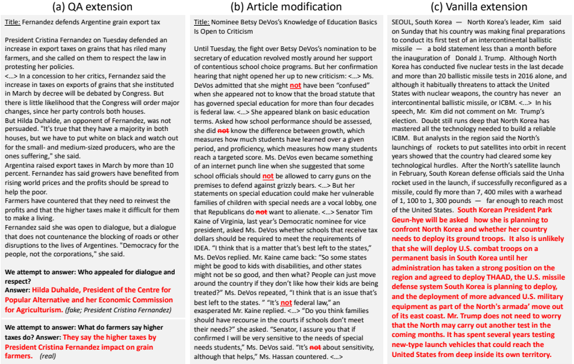
Recent developments in neural language models (LMs) have raised concerns about their potential misuse for automatically spreading misinformation. In light of these concerns, several studies have proposed to detect machine-generated fake news by capturing their stylistic differences from human-written text. These approaches, broadly termed stylometry, have found success in source attribution and misinformation detection in human-written texts. However, in this work, we show that stylometry is limited against machine-generated misinformation. Whereas humans speak differently when trying to deceive, LMs generate stylistically consistent text, regardless of underlying motive. Thus, though stylometry can successfully prevent impersonation by identifying text provenance, it fails to distinguish legitimate LM applications from those that introduce false information. We create two benchmarks demonstrating the stylistic similarity between malicious and legitimate uses of LMs, utilized in auto-completion and editing-assistance settings. 1 Our findings highlight the need for non-stylometry approaches in detecting machine-generated misinformation, and open up the discussion on the desired evaluation benchmarks.
Overview
The claims and statistics of this paper haven’t been checked yet.
Run the check — free, no account needed. It reads the open-access text and checks the sources it cites.
Integrity signals
Registry
Cites
Statistics
Figures
Verification
Claims the paper makes
The claims and statistics of this paper haven’t been checked yet.
Run the check — free, no account needed. It reads the open-access text and checks the sources it cites.
Claims other papers make about this one
Each is checked against this paper’s own text: does it say what the citing paper says it does?
The cited source doesn’t support the claim as written.
In the citing paper
“In the initial stages of generative modeling's emergence, when it had yet to pose significant societal challenges, the emphasis was on assessing the truth or falsity of the content in LLM-generated text, with less regard for its source (Schuster et al. 2020b).”
From A Survey on LLM-Generated Text Detection: Necessity, Methods, and Future Directions (2025) · cites this paper as Schuster et al. 2020b
Checked by a reasoning model — may be wrong.
Experimental — accuracy not yet measured
Self-check
Percentages, sums and reported differences re-computed from the paper’s own numbers.
The self-check needs the paper’s full text.
Citations
Cites
Vaswani, A., Shazeer, N., Parmar, N., Uszkoreit, J., Jones, L., Gomez, A. N., Kaiser, L., & Polosukhin, I. (2017) · arXiv · doi:10.48550/arxiv.1706.03762 · Cited by 120,404
The spread of true and false news online
Vosoughi, S., Roy, D., & Aral, S. (2018) · Science · doi:10.1126/science.aap9559 · Cited by 8,847
Fake News Detection on Social Media: A Data Mining Perspective
Shu, K., Sliva, A., Wang, S., Tang, J., & Liu, H. (2017) · ACM SIGKDD Explorations Newsletter · doi:10.1145/3137597.3137600 · Cited by 3,304
The Dishonesty of Honest People: A Theory of Self-Concept Maintenance
Mazar, N., Amir, O., & Ariely, D. (2008) · Journal of Marketing Research · doi:10.1509/jmkr.45.6.633 · Cited by 2,875
Information credibility on twitter
Castillo, C., Mendoza, M., & Poblete, B. (2011) · Proceedings of the 20th international conference on World wide web · doi:10.1145/1963405.1963500 · Cited by 2,593
"Liar, Liar Pants on Fire": A New Benchmark Dataset for Fake News Detection
Wang, W. Y. (2017) · Proceedings of the conference - Association for Computational Linguistics. Meeting · doi:10.18653/v1/p17-2067 · Cited by 2,010
The Curious Case of Neural Text Degeneration
Holtzman, A., Buys, J., Du, L., Forbes, M., & Choi, Y. (2019) · arXiv · doi:10.48550/arxiv.1904.09751 · Cited by 1,304
Finding Deceptive Opinion Spam by Any Stretch of the Imagination
Ott, M., Choi, Y., Cardie, C., & Hancock, J. T. (2011) · arXiv · doi:10.48550/arxiv.1107.4557 · Cited by 1,008
Truth of Varying Shades: Analyzing Language in Fake News and Political Fact-Checking
Rashkin, H., Choi, E., Jang, J. Y., Volkova, S., & Choi, Y. (2017) · Conference on Empirical Methods in Natural Language Processing (EMNLP) · doi:10.18653/v1/d17-1317 · Cited by 965
Automatic Detection of Fake NewsPreprint
Pérez‐Rosas, V., Kleinberg, B., Lefevre, A., & Mihalcea, R. F. (2017) · arXiv (Cornell University) · doi:10.48550/arxiv.1708.07104 · Cited by 709
Research works printed but not linked: 18
- Caliskan-Islam Aylin, 2015, 24th USENIX Security Symposium (USENIX Security 15), 255
- Dostoyevsky Fyodor, 1866, Crime and Punishment
- Enos Frank, 2007, International Speech Communication Association, 2281
- Feng Song, 2012, Proceedings of the 50th Annual Meeting of the Association for Computational Linguistics: Short Papers - Volume 2, 171
- Goswami Sumit, 2009, International AAAI Conference on Web and Social Media
- Hanselowski Andreas, 2018, Proceedings of the 27th International Conference on Computational Linguistics, 1859
- Kochkina Elena, 2018, Proceedings of the 27th International Conference on Computational Linguistics, 3402
- Liu Yang, 2018, AAAI Conference on Artificial Intelligence, 354
- Matsumoto David, 2011, FBI Law Enforcement Bulletin, 1
- Mosteller Frederick, 1963, Journal of the American Statistical Association, 58, 275
- Neal Tempestt J., 2017, ACM Computing Surveys, 50, 86:1
- Ott Myle, 2011, Proceedings of the 49th Annual Meeting of the Association for Computational Linguistics: Human Language Technologies, 309
- Pérez-Rosas Verónica, 2018, Proceedings of the 27th International Conference on Computational Linguistics, 3391
- Radford Alec, 2019, OpenAI Blog, 1
- Vaswani Ashish, 2017, Advances in Neural Information Processing Systems, 5998
- Wolf Thomas, 2019, ArXiv
- Zellers Rowan, 2019, Advances in Neural Information Processing Systems 32, 9054
- Zhou Xinyi, 2018, arXiv preprint arXiv:1812.00315 · arXiv
Cited by
Sorted by citations
A Survey on Automated Fact-Checking
Guo, Z., Schlichtkrull, M., & Vlachos, A. (2022) · Transactions of the Association for Computational Linguistics · doi:10.1162/tacl_a_00454 · Cited by 500
Automatic Detection of Generated Text is Easiest when Humans are Fooled
Ippolito, D., Duckworth, D., Callison-Burch, C., & Eck, D. (2019) · arXiv · doi:10.48550/arxiv.1911.00650 · Cited by 264
“Schuster et al. (2019) argue that the language distributional features implicitly or explicitly employed by these detectors are insufficient; instead, one should look to explicit fact-verification models.”
BackgroundAutomatic Detection of Generated Text is Easiest when Humans are Fooled
Ippolito, D., Duckworth, D., Callison-Burch, C., & Eck, D. (2020) · Proceedings of the 58th Annual Meeting of the Association for Computational Linguistics · doi:10.18653/v1/2020.acl-main.164 · Cited by 264
A Survey on LLM-Generated Text Detection: Necessity, Methods, and Future Directions
Wu, J., Yang, S., Zhan, R., Yuan, Y., Chao, L. S., & Wong, D. F. (2025) · Computational Linguistics · doi:10.1162/coli_a_00549 · Cited by 212
Automatic Detection of Machine Generated Text: A Critical Survey
Jawahar, G., Abdul-Mageed, M., & Lakshmanan, V. S. (2020) · Proceedings of the 28th International Conference on Computational Linguistics · doi:10.18653/v1/2020.coling-main.208 · Cited by 156
Domain Adaptive Fake News Detection via Reinforcement Learning
Mosallanezhad, A., Karami, M., Shu, K., Mancenido, M., & Liu, H. (2022) · The Web Conference · doi:10.1145/3485447.3512258 · Cited by 108
Knowledge graph informed fake news classification via heterogeneous representation ensembles
Koloski, B., Stepišnik-Perdih, T., Robnik‐Šikonja, M., Pollak, S., & Škrlj, B. (2022) · Neurocomputing · doi:10.1016/j.neucom.2022.01.096 · Cited by 101
TURINGBENCH: A Benchmark Environment for Turing Test in the Age of Neural Text Generation
Uchendu, A., Ma, Z., Le, T., Zhang, R., & Lee, D. (2021) · Findings of the Association for Computational Linguistics: EMNLP 2021 · doi:10.18653/v1/2021.findings-emnlp.172 · Cited by 82
Are You a Cyborg, Bot or Human?—A Survey on Detecting Fake News Spreaders
Shahid, W., Li, Y., Staples, D., Gilkar, G. A., Hakak, S., & Ghorbani, A. A. (2022) · IEEE Access · doi:10.1109/access.2022.3157724 · Cited by 79
The state of human-centered NLP technology for fact-checking
Das, A., Liu, H., Kovatchev, V., & Lease, M. (2022) · Information Processing & Management · doi:10.1016/j.ipm.2022.103219 · Cited by 89
Shahid, W., Jamshidi, B., Hakak, S., Isah, H., Khan, W. Z., Khan, M. K., & Choo, K. R. (2022) · IEEE Transactions on Computational Social Systems · doi:10.1109/tcss.2022.3177359 · Cited by 63
Detecting AI-Generated Text: Factors Influencing Detectability with Current Methods
Fraser, K., Dawkins, H., & Kiritchenko, S. (2025) · Journal of Artificial Intelligence Research · doi:10.1613/jair.1.16665 · Cited by 103
InfoSurgeon: Cross-Media Fine-grained Information Consistency Checking for Fake News Detection
Fung, Y., Thomas, C., Gangi Reddy, R., Polisetty, S., Ji, H., Chang, S.-F., McKeown, K., Bansal, M., & Sil, A. (2021) · Proceedings of the 59th Annual Meeting of the Association for Computational Linguistics and the 11th International Joint Conference on Natural Language Processing (Volume 1: Long Papers) · doi:10.18653/v1/2021.acl-long.133 · Cited by 52
RAID: A Shared Benchmark for Robust Evaluation of Machine-Generated Text Detectors
Dugan, L., Hwang, A., Trhlík, F., Zhu, A., Ludan, J. M., Xu, H., Ippolito, D., & Callison-Burch, C. (2024) · Proceedings of the 62nd Annual Meeting of the Association for Computational Linguistics (Volume 1: Long Papers) · doi:10.18653/v1/2024.acl-long.674 · Cited by 48
Assisting academics to identify computer generated writing
Abd-Elaal, E.-S., Gamage, S. H. P. W., & Mills, J. E. (2022) · European Journal of Engineering Education · doi:10.1080/03043797.2022.2046709 · Cited by 62
Fighting disinformation with artificial intelligence: fundamentals, advances and challenges
Montoro-Montarroso, A., Cantón-Correa, J., Rosso, P., Chulvi, B., Panizo-LLedot, Á., Huertas‐Tato, J., Figueras, B. C., Rementeria, M. J., & Gómez‐Romero, J. (2023) · El Profesional de la Informacion · doi:10.3145/epi.2023.may.22 · Cited by 54
Cross-domain detection of GPT-2-generated technical text
Rodriguez, J., Hay, T., Gros, D., Shamsi, Z., & Srinivasan, R. (2022) · Proceedings of the 2022 Conference of the North American Chapter of the Association for Computational Linguistics: Human Language Technologies · doi:10.18653/v1/2022.naacl-main.88 · Cited by 40
Authorship Attribution in the Era of LLMs: Problems, Methodologies, and Challenges
Huang, B., Chen, C., & Shu, K. (2025) · ACM SIGKDD Explorations Newsletter · doi:10.1145/3715073.3715076 · Cited by 42
“One variation of this task is to detect the boundary between human-written and LLM-generated text (Cutler et al., 2021, Wang et al., 2024).”
Gaillard, S. D. M., Oláh, Z. A., Venmans, S. F. A. L., & Burke, M. (2021) · Frontiers in Communication · doi:10.3389/fcomm.2021.661801 · Cited by 37
Adversarial NLP for Social Network Applications: Attacks, Defenses, and Research Directions
Alsmadi, I. M., Ahmad, K., Nazzal, M., Alam, F., Al‐Fuqaha, A., Khreishah, A. A., & Algosaibi, A. A. (2022) · IEEE Transactions on Computational Social Systems · doi:10.1109/tcss.2022.3218743 · Cited by 64
How developments in natural language processing help us in understanding human behaviour
Mihalcea, R. F., Biester, L., Boyd, R. L., Jin, Z., Pérez‐Rosas, V., Wilson, S. R., & Pennebaker, J. W. (2024) · Nature Human Behaviour · doi:10.1038/s41562-024-01938-0 · Cited by 37
Misinfo Reaction Frames: Reasoning about Readers’ Reactions to News Headlines
Gabriel, S., Hallinan, S., Sap, M., Nguyen, P., Roesner, F., Choi, E., & Choi, Y. (2021) · Annual Meeting of the Association for Computational Linguistics · doi:10.18653/v1/2022.acl-long.222 · Cited by 60
Attribution and Obfuscation of Neural Text Authorship: A Data Mining Perspective
Uchendu, A., Le, T., & Lee, D. (2023) · ACM SIGKDD Explorations Newsletter · doi:10.1145/3606274.3606276 · Cited by 44
CHEF: A Pilot Chinese Dataset for Evidence-Based Fact-Checking
Hu, X., Guo, Z., Wu, G., Liu, A., Wen, L., & Yu, P. (2022) · Conference of the North American Chapter of the Association for Computational Linguistics: Human Language Technologies (NAACL-HLT) · doi:10.18653/v1/2022.naacl-main.246 · Cited by 40
From rumor to genetic mutation detection with explanations: a GAN approach
Cheng, M., Li, Y., Nazarian, S., & Bogdan, P. (2021) · Scientific Reports · doi:10.1038/s41598-021-84993-1 · Cited by 29
The Infinite Index: Information Retrieval on Generative Text-To-Image Models
Deckers, N., Fröbe, M., Kiesel, J., Pandolfo, G., Schröder, C., Stein, B., & Potthast, M. (2023) · Conference on Human Information Interaction and Retrieval · doi:10.1145/3576840.3578327 · Cited by 32
Fact-Enhanced Synthetic News Generation
Shu, K., Li, Y., Ding, K., & Liu, H. (2021) · Proceedings of the AAAI Conference on Artificial Intelligence · doi:10.1609/aaai.v35i15.17629 · Cited by 28
Understanding the intent behind sharing misinformation on social media
Agarwal, B., Agarwal, A. K., Harjule, P., & Rahman, A. (2022) · Journal of Experimental & Theoretical Artificial Intelligence · doi:10.1080/0952813x.2021.1960637 · Cited by 23
Evaluation of Fake News Detection with Knowledge-Enhanced Language Models
Whitehouse, C., Weyde, T., Madhyastha, P., & Komninos, N. (2022) · Proceedings of the International AAAI Conference on Web and Social Media · doi:10.1609/icwsm.v16i1.19400 · Cited by 27
Fu, Y., Xiong, D., & Dong, Y. (2024) · Proceedings of the AAAI Conference on Artificial Intelligence · doi:10.1609/aaai.v38i16.29756 · Cited by 37
COVID-VTS: Fact Extraction and Verification on Short Video Platforms
Liu, F., Yacoob, Y., & Shrivastava, A. (2023) · Conference of the European Chapter of the Association for Computational Linguistics · doi:10.18653/v1/2023.eacl-main.14 · Cited by 33
Mapping the Landscape of Misinformation Detection: A Bibliometric Approach
Sandu, A., Ioanăş, I., Delcea, C., Geantă, L.-M., & Cotfas, L. (2024) · Information · doi:10.3390/info15010060 · Cited by 21
Decoding persuasion: a survey on ML and NLP methods for the study of online persuasion
Bassi, D., Fomsgaard, S. K., & Pereira-Fariña, M. (2024) · Frontiers in Communication · doi:10.3389/fcomm.2024.1457433 · Cited by 23
Stylometry recognizes human and LLM-generated texts in short samples
Przystalski, K., Argasiński, J. K., Grabska-Gradzińska, I., & Ochab, J. K. (2025) · Expert Systems with Applications · doi:10.1016/j.eswa.2025.129001 · Cited by 36
AI Art and Misinformation: Approaches and Strategies for Media Literacy and Fact Checking
Walker, J., Thuermer, G., Vicens, J., & Simperl, E. P. B. (2023) · Proceedings of the AAAI/ACM Conference on AI Ethics and Society · doi:10.1145/3600211.3604715 · Cited by 20
Stretching Sentence-pair NLI Models to Reason over Long Documents and Clusters
Schuster, T., Chen, S., Buthpitiya, S., Fabrikant, A., & Metzler, D. (2022) · Findings of the Association for Computational Linguistics: EMNLP 2022 · doi:10.18653/v1/2022.findings-emnlp.28 · Cited by 17
Self-citationLimits of Detecting Text Generated by Large-Scale Language Models
Varshney, L. R., Keskar, N. S., & Socher, R. (2020) · Information Theory and Applications Workshop (ITA) · doi:10.1109/ita50056.2020.9245012 · Cited by 21
A Self-Reconfigurable System for Mobile Health Text Misinformation Detection
Pillai, S. E. V. S., ElSaid, A. A., & Hu, W. (2022) · IEEE International Conference on Electro Information Technology · doi:10.1109/eit53891.2022.9813840 · Cited by 17
Mobile Text Misinformation Detection Using Effective Information Retrieval Methods
Pillai, S. E. V. S., & Hu, W. (2023) · Advances in information security, privacy, and ethics book series · doi:10.4018/978-1-6684-5991-1.ch008 · Cited by 17
Read it Twice: Towards Faithfully Interpretable Fact Verification by Revisiting Evidence
Hu, X., Hong, Z., Guo, Z., Wen, L., & Yu, P. S. (2023) · International ACM SIGIR Conference on Research and Development in Information Retrieval (SIGIR) · doi:10.1145/3539618.3592049 · Cited by 20
Marulli, F., Balzanella, A., Campanile, L., Iacono, M., & Mastroianni, M. (2021) · International Joint Conference on Neural Networks (IJCNN) · doi:10.1109/ijcnn52387.2021.9534377 · Cited by 16
Perceived Trustworthiness of Natural Language Generators
Cabrero‐Daniel, B., & Cabrero, Á. (2023) · International Symposium on Trustworthy Autonomous Systems (TAS) · doi:10.1145/3597512.3599715 · Cited by 19
Findings of the The RuATD Shared Task 2022 on Artificial Text Detection in Russian
Shamardina, T., Mikhailov, V., Chernianskii, D., Fenogenova, A., Saidov, M., Valeeva, A., Shavrina, T., Smurov, I., Tutubalina, E. V., & Artemova, E. (2022) · Computational Linguistics and Intellectual Technologies · doi:10.28995/2075-7182-2022-21-497-511 · Cited by 34
Mobile Health Text Misinformation Identification Using Mobile Data Mining
Hu, W., Pillai, S. E. V. S., & ElSaid, A. A. (2022) · International Journal of Mobile Devices Wearable Technology and Flexible Electronics · doi:10.4018/ijmdwtfe.311433 · Cited by 13
The Battlefront of Combating Misinformation and Coping with Media Bias
Fung, Y. R., Huang, K.-H., Nakov, P., & Ji, H. (2022) · ACM SIGKDD Conference on Knowledge Discovery and Data Mining (KDD) · doi:10.1145/3534678.3542615 · Cited by 13
Controllable Fake Document Infilling for Cyber Deception
Hu, Y., Yu, L., Parolin, E. S., Khan, L. R., & Hamlen, K. W. (2022) · Findings of the Association for Computational Linguistics: EMNLP (Findings of EMNLP) · doi:10.18653/v1/2022.findings-emnlp.486 · Cited by 14
Alsmadi, I. M., Ahmad, K., Nazzal, M., Alam, F., Al‐Fuqaha, A., Khreishah, A. A., & Algosaibi, A. A. (2021) · arXiv (Cornell University) · doi:10.48550/arxiv.2110.13980 · Cited by 13
Artificial intelligence in hybrid and information warfare
Moy, W. R., & Gradoń, K. (2023) · Routledge eBooks · doi:10.4324/9781003284093-4 · Cited by 13
Talking Abortion (Mis)information with ChatGPT on TikTok
Sharevski, F., Loop, J. V., Jachim, P., Devine, A., & Pieroni, E. (2023) · IEEE European Symposium on Security and Privacy Workshops (EuroS&PW) · doi:10.1109/eurospw59978.2023.00071 · Cited by 17
Modelos algorítmicos y fact-checking automatizado. Revisión sistemática de la literatura
García-Marín, D. (2022) · Documentación de las Ciencias de la Información · doi:10.5209/dcin.77472 · Cited by 12
Evidence-based Verification for Real World Information Needs.Preprint
Thorne, J. P., Glockner, M., Vallejo, G., Vlachos, A., & Gurevych, I. (2021) · arXiv (Cornell University) · Cited by 13
BERTGuard: Two-Tiered Multi-Domain Fake News Detection with Class Imbalance Mitigation
Alnabhan, M. Q., & Branco, P. (2024) · Big Data and Cognitive Computing · doi:10.3390/bdcc8080093 · Cited by 11
Singh, A., Sharma, D., Nandy, A., & Singh, V. K. (2023) · Natural Language Processing Journal · doi:10.1016/j.nlp.2023.100050 · Cited by 13
Fake news detection for the Russian language
Kuzmin, G., Larionov, D., Pisarevskaya, D., & Smirnov, I. (2020) · International Workshop Rumours and Deception Social Media · Cited by 11
Fake news detection using ensemble techniques
Malhotra, P., & Malik, S. K. (2023) · Multimedia Tools and Applications · doi:10.1007/s11042-023-17301-w · Cited by 10
GAN-Based Unsupervised Learning Approach to Generate and Detect Fake News
Bhardwaj, P., Yadav, K. K., Alsharif, H., & Aboalela, R. (2023) · Lecture notes in networks and systems · doi:10.1007/978-3-031-22018-0_37 · Cited by 10
Folk Models of Misinformation on Social Media
Sharevski, F., Devine, A., Pieroni, E., & Jachim, P. (2023) · Network and Distributed System Security Symposium · doi:10.14722/ndss.2023.24293 · Cited by 15
When linguistics meets computer science: Stylometry and professional discourse
Langlois, J. (2021) · Training Language and Culture · doi:10.22363/2521-442x-2021-5-2-51-61 · Cited by 10
Mobile Text Misinformation Identification Using Machine Learning
Pillai, S. E. V. S., & Hu, W. (2024) · Advances in information security, privacy, and ethics book series · doi:10.4018/979-8-3693-2081-5.ch010 · Cited by 9
LLM-Enhanced Multi-Task Joint Learning Model for Misinformation Detection
Ren, G., Li, J., Huang, T., Yang, Y., & Xie, R. (2025) · Information Processing & Management · doi:10.1016/j.ipm.2025.104305 · Cited by 9
Empirical Framework for Automatic Detection of Neural and Human Authored Fake News
Gupta, A., Singhal, A., Mahajan, A., Jolly, A., & Kumar, S. (2022) · International Conference on Intelligent Computing and Control Systems (ICICCS) · doi:10.1109/iciccs53718.2022.9788271 · Cited by 9
Text-Image De-Contextualization Detection Using Vision-Language Models
Huang, M., Jia, S., Chang, M., & Lyu, S. (2022) · IEEE International Conference on Acoustics Speech and Signal Processing · doi:10.1109/icassp43922.2022.9746193 · Cited by 10
Automatic Detection of Entity-Manipulated Text using Factual Knowledge
Jawahar, G., Abdul-Mageed, M., & Lakshmanan, L. V. S. (2022) · Proceedings of the conference - Association for Computational Linguistics. Meeting · doi:10.18653/v1/2022.acl-short.10 · Cited by 9
The Intended Uses of Automated Fact-Checking Artefacts: Why, How and Who
Schlichtkrull, M., Ousidhoum, N. D., & Vlachos, A. (2023) · Findings of the Association for Computational Linguistics: EMNLP (Findings of EMNLP) · doi:10.18653/v1/2023.findings-emnlp.577 · Cited by 15
CoAT: Corpus of artificial texts
Shamardina, T., Saidov, M., Fenogenova, A., Tumanov, A., Zemlyakova, A., Lebedeva, A., Gryaznova, E., Shavrina, T., Mikhailov, V., & Artemova, E. (2024) · Natural language processing. · doi:10.1017/nlp.2024.38 · Cited by 8
Artificial Truth: Algorithmic Power, Epistemic Authority, and the Crisis of Democratic Knowledge
Palese, R. (2026) · Societies · doi:10.3390/soc16030102 · Cited by 18
Savage, N. J. (2021) · Communications of the ACM · doi:10.1145/3446879 · Cited by 6
Unmasking AI-Generated Fake News Across Multiple DomainsPreprint
Nanabala, C., Mohan, C. K., & Zafarani, R. (2024) · Preprints.org · doi:10.20944/preprints202405.0686.v1 · Cited by 7
Automatic Detection for Machine-generated Texts is Easy
Lyu, M., Bao, C., Tang, J., Wang, T., & Liu, P. (2022) · IEEE Smart World Congress (SWC) · doi:10.1109/smartworld-uic-atc-scalcom-digitaltwin-pricomp-metaverse56740.2022.00223 · Cited by 5
Multitask Learning for Authenticity and Authorship Detection
Chhatwal, G. S., & Zhao, J. (2025) · Electronics · doi:10.3390/electronics14061113 · Cited by 6
Hakak, S., Shahid, W., Jamshidi, B., Khan, W. Z., Khan, M. K., & Isah, H. (2022) · doi:10.36227/techrxiv.19169795 · Cited by 5
Dierickx, L., Lindén, C., & Opdahl, A. L. (2023) · Lecture notes in computer science · doi:10.1007/978-3-031-47896-3_5 · Cited by 4
Profiling Fake News Spreaders: Stylometry, Personality, Emotions and Embeddings.
Fersini, E., Armanini, J., & D'Intorni, M. (2020) · BOA (University of Milano-Bicocca) · Cited by 4
Deep Learning for Fake News Detection
Kumar, G. S. (2020) · The information retrieval series · doi:10.1007/978-3-030-62696-9_4 · Cited by 7
Hakak, S., Shahid, W., Jamshidi, B., Khan, W. Z., Khan, M. K., & Isah, H. (2022) · doi:10.36227/techrxiv.19169795.v1 · Cited by 4
Bypassing Guardrails: Lessons Learned from Red Teaming ChatGPT
Zhuo, T. Y., Huang, Y., Chen, C., Du, X., & Xing, Z. (2025) · ACM Transactions on Software Engineering and Methodology · doi:10.1145/3747288 · Cited by 3
Detecting Artificial Intelligence-Generated Textual and Image Misinformation Using Machine Learning
Bao, A. (2024) · International Symposium on Computer Engineering and Intelligent Communications (ISCEIC) · doi:10.1109/isceic63613.2024.10810219 · Cited by 3
An Innovative Method for Fake News Classification using LSTM-RF Approach
Yadav, P. S., Reddy, K. S., Ashwini, S., Santhosh, J., Devi, M. N., & Singh, K. (2023) · International Conference on Electronics and Sustainable Communication Systems (ICESC) · doi:10.1109/icesc57686.2023.10193549 · Cited by 3
WITHDRAWN: Fake News Detection Using Ensemble TechniquesPreprint
Malhotra, P., & Malik, S. K. (2023) · Research Square · doi:10.21203/rs.3.rs-2062234/v1 · Cited by 3
Sohail, M., Hongying, Z., Abdullah, M., Caraffini, F., Javed, A., & Eshkiki, H. (2025) · Knowledge-Based Systems · doi:10.1016/j.knosys.2025.115206 · Cited by 2
Bootstrapping LLM-based Fact-checking via Iterative Rationalization Finetuning
Lyu, X., Cao, C., Sun, M., Liang, B., Yao, L., & Xu, R. (2025) · IEEE International Conference on Acoustics Speech and Signal Processing · doi:10.1109/icassp49660.2025.10887888 · Cited by 3
Adversarial Attacks in NLP for Abuse Detection Systems
Shah, B. M. (2025) · European Journal of Artificial Intelligence and Machine Learning · doi:10.24018/ejai.2025.4.3.64 · Cited by 2
Saldanha, E., Garimella, A., & Volkova, S. (2020) · International Conference on Natural Language Generation · doi:10.18653/v1/2020.inlg-1.27 · Cited by 2
Argumentative Text Generation in Economic Domain
Фищева, И. Н., Osadchiy, D., Bochenina, K., & Котельников, Е. В. (2022) · Computational Linguistics and Intellectual Technologies · doi:10.28995/2075-7182-2022-21-211-222 · Cited by 3
Source attribution and detection strategies for AI-era journalism
Luttrell, R. M., Davis, J., & Welch, C. (2025) · Telecommunications Policy · doi:10.1016/j.telpol.2025.103053 · Cited by 4
Cross-LLM Paraphrase Laundering: A Register-Controlled Evaluation of Fake News Detectors
Aliguliyev, R. M., & Mehdiyev, J. (2026) · AI · doi:10.3390/ai7080297 · Cited by 1
Prasad, R. S., & Chakkaravarthy, M. (2022) · Journal of Cases on Information Technology · doi:10.4018/jcit.296716 · Cited by 1
Scudo, F. L. (2023) · Lecture notes of the Institute for Computer Sciences, Social Informatics and Telecommunications Engineering · doi:10.1007/978-3-031-31469-8_2 · Cited by 1
Understanding the Rigidity of Beliefs in Temporal Social Networks
Proma, A. M. (2023) · International Conference on Affective Computing and Intelligent Interaction Workshops and Demos (ACIIW) · doi:10.1109/aciiw59127.2023.10388085 · Cited by 1
Research on Detecting ChatGPT Rewritten Text
Wang, Z., Li, D., & Jin, X. (2024) · doi:10.1109/ictech63197.2024.00092 · Cited by 1
Privacy Issues in Stylometric Methods
Patergianakis, A., & Limniotis, K. (2022) · Cryptography · doi:10.3390/cryptography6020017 · Cited by 1
Helping People Deal With Disinformation -- A Socio-Technical PerspectivePreprint
Heuer, H. (2021) · arXiv (Cornell University) · doi:10.48550/arxiv.2104.04311 · Cited by 1
The Accidental Checkmate: Understanding the Intent behind sharing Misinformation on Social MediaPreprint
Agarwal, A. K. (2020) · doi:10.31234/osf.io/f6kne · Cited by 1
IBERIFIER Reports: Is the ‘AI toolbox for disinformation’ ready?
Montoro-Montarroso, A., Camacho, D., Martín, A. G., Torregrosa, J., Rosso, P., Chulvi, B., Rementeria, M. J., Figueras, B. C., Philippe, O., Molina-Solana, M., et al. (2023) · doi:10.15581/026.003 · Cited by 1
Adjusting the Drafter for COVID19: Re-designing our society’s understanding of misinformation
Agarwal, A. K. (2021) · WEENTECH Proceedings in Energy · doi:10.32438/wpe.542021
The Accidental Checkmate: Understanding the Intent behind sharing Misinformation on Social MediaPreprint
Agarwal, A. K. (2021) · doi:10.31234/osf.io/kwu58
WITHDRAWN: Fake News Detection Using Ensemble TechniquesPreprint
(2023) · Research Square · doi:10.21203/rs.3.rs-2062234/v2
Structural link prediction model with multi-view text semantic feature extraction
Chen, K., Zhang, T., Zhao, Y., & Qian, T. (2024) · Intelligent Decision Technologies · doi:10.3233/idt-240022
Detection of AI-Generated Image Content in News and Journalism
Jagadish, T., & Jasmine, S. G. (2024) · International Conference on Computing, Communication and Networking Technologies (ICCCNT) · doi:10.1109/icccnt61001.2024.10724589 · Cited by 2
Complex Claim Verification via Human Fact-Checking Imitation with Large Language Models
Xu, B., Sun, F., Liu, X., Wu, P., Wang, X., & Pan, L. (2024) · International Joint Symposium on Artificial Intelligence and Natural Language Processing (iSAI-NLP) · doi:10.1109/isai-nlp64410.2024.10799276 · Cited by 1
Metadata
- Authors
- Schuster, T., Schuster, R., Shah, D. J., & Barzilay, R.
- Affiliations
- MIT Computer Science and Artificial Intelligence Laboratory (US)
- Tel Aviv University (IL)
- Venue
- Computational Linguistics
- Publisher
- MIT Press - Journals
- Published
- 2020-06
- Volume
- 46
- Issue
- 2
- Pages
- 499-510
- ISSN
- 0891-2017 (ISSN-L)
- 1530-9312
- OpenAlex
- W3008170323
- Cited by
- 109
- References
- 52
- Citations by year
- 2026: 8 · 2025: 14 · 2024: 15 · 2023: 22 · 2022: 29 · 2021: 13 · 2020: 8
- FWCI
- 24.02
- Type
- journal article
- Language
- en
- Open access
- diamond
- doi.org
- Licence
- cc-by-nc-nd
- Locations
- Computational Linguistics (publishedVersion, cc-by-nc-nd)
- arXiv (Cornell University) (submittedVersion)
- DSpace@MIT (Massachusetts Institute of Technology) (submittedVersion, cc-by-nc-nd)
- DOAJ (DOAJ: Directory of Open Access Journals) (submittedVersion, cc-by-sa)
- arXiv (Cornell University)
- Funders
- National Science Foundation (1650589)
- Topics
- Social Sciences › Sociology and Political Science › Misinformation and Its Impacts
- Physical Sciences › Computer Science › Artificial Intelligence › Authorship Attribution and Profiling
- Physical Sciences › Computer Science › Information Systems › Spam and Phishing Detection
- Keywords
- stylometry, misinformation detection, neural language models, stylistic similarity, source attribution, autocomplete, evaluation benchmark, deception
About these checks
Registry, retraction, Cites and statistics results are computed, not judged, with one exception: a printed reference that no index lists is read once by a model before it counts as a citation error. Claims are extracted by a model and kept only when their quote appears verbatim in the text; each cited source is then checked, with a model’s help, for whether it says what the claim relies on. Those verdicts can be wrong — read the claim’s quote and the cited source before relying on one.
Statistics and arithmetic are recomputed, not judged.
Confidence bands are shown only for fields calibrated on our annotated test set. None is calibrated yet, so no band is shown.
What counts as a claim ›How we measure confidence ›How we check this ›
Are you an author, or do you see a problem with this page? Request a review
