

A Survey on LLM-Generated Text Detection: Necessity, Methods, and Future Directions
Open accessThe DOI matches its Crossref record; 308 of the 310 references it cites were found in a registry or an index; 71 of the 197 sources its claims cite were checked for support.
Abstract
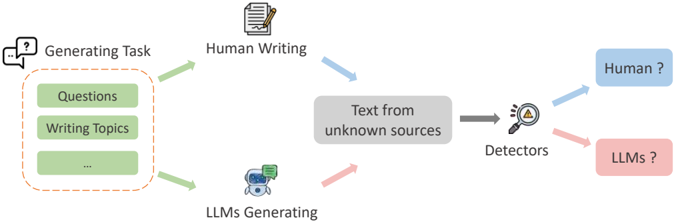
The remarkable ability of large language models (LLMs) to comprehend, interpret, and generate complex language has rapidly integrated LLM-generated text into various aspects of daily life, where users increasingly accept it. However, the growing reliance on LLMs underscores the urgent need for effective detection mechanisms to identify LLM-generated text. Such mechanisms are critical to mitigating misuse and safeguarding domains like artistic expression and social networks from potential negative consequences. LLM-generated text detection, conceptualized as a binary classification task, seeks to determine whether an LLM produced a given text. Recent advances in this field stem from innovations in watermarking techniques, statistics-based detectors, and neural-based detectors. Human-assisted methods also play a crucial role. In this survey, we consolidate recent research breakthroughs in this field, emphasizing the urgent need to strengthen detector research. Additionally, we review existing datasets, highlighting their limitations and developmental requirements. Furthermore, we examine various LLM-generated text detection paradigms, shedding light on challenges like out-of-distribution problems, potential attacks, real-world data issues, and ineffective evaluation frameworks. Finally, we outline intriguing directions for future research in LLM-generated text detection to advance responsible artificial intelligence. This survey aims to provide a clear and comprehensive introduction for newcomers while offering seasoned researchers valuable updates in the field.1
Overview
CoChat Summary
TL;DR
This survey reviews LLM-generated text detection, organizing methods into watermarking, statistics-based, neural-based, and human-assisted approaches, and argues robust detectors are urgently needed. It synthesizes datasets, benchmarks, evaluation metrics, and open challenges, concluding with future research directions.
Key findings
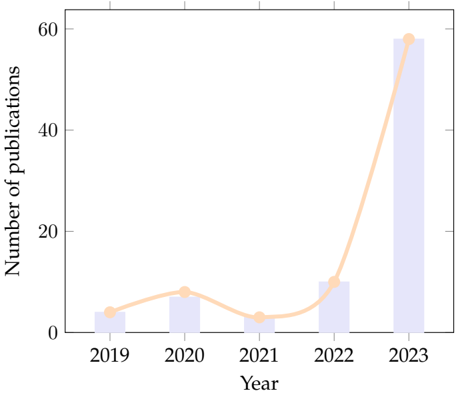
- The survey’s systematic literature review screened work up to November 2023 and identified 83 pertinent pieces of literature; most relevant research appeared in 2023.
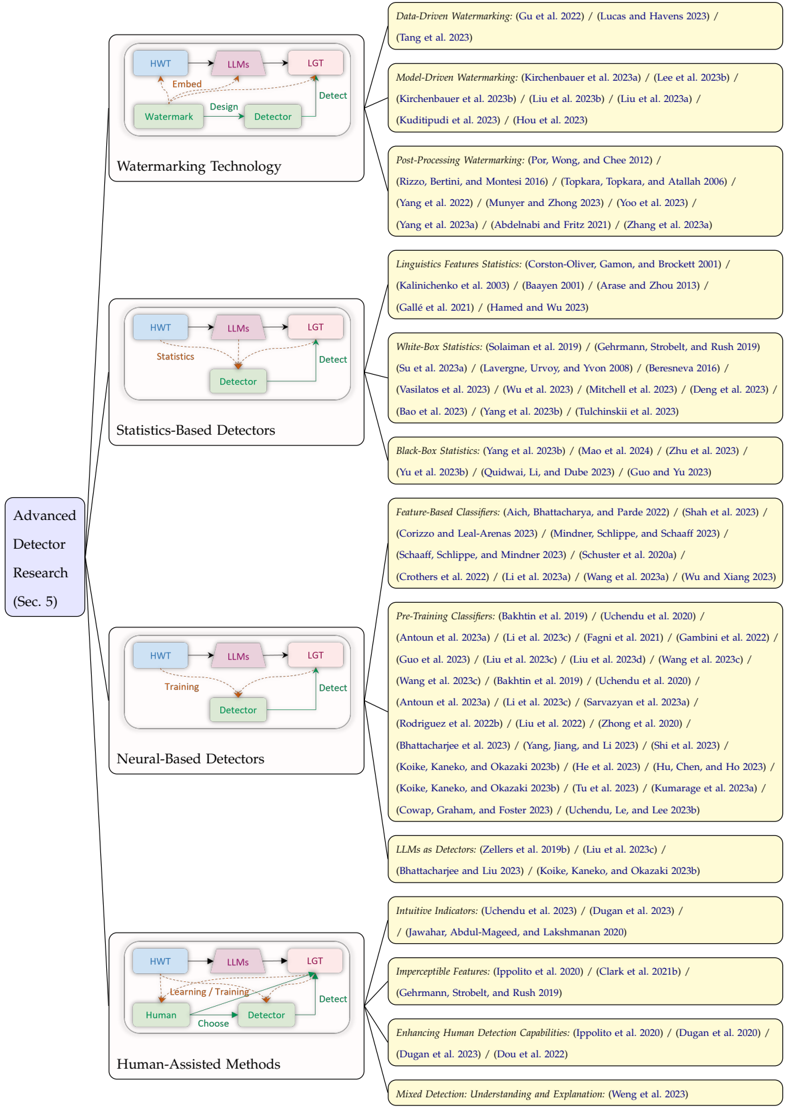
- Detection methods are categorized into watermarking (data-driven, model-driven, post-processing), statistics-based (linguistic features, white-box, black-box), neural-based (feature classifiers, pre-trained classifiers, LLMs as detectors), and human-assisted methods.
- It reports that current detectors face out-of-distribution problems (cross-domain, cross-lingual, cross-LLMs), attacks (paraphrase, adversarial, prompt, training threat models), real-world data issues (mixed/human-edited text, data ambiguity), model-size effects, and a lack of effective evaluation framework.
- It cites selected performance figures from reviewed work: Hamed and Wu’s bigram-based system identified 98 of 100 LLM-written academic papers; LLMDet achieved 98.54% classification accuracy; GHOSTBUSTER achieved an average F1 of 99.0; fine-tuned BERT-family models averaged about 95% in-domain accuracy.
Methods
- Design: a systematic literature review following Kitchenham’s SLR framework, guided by the research question of prevailing LLM-generated text detection methods and their main challenges.
- Data: searches across Google Scholar, arXiv, Scopus, Web of Science, IEEE Xplore, Springer Link, ACL Anthology, and ACM Digital Library using Boolean search terms; focused on publicly accessible articles before November 2023; after de-duplication and manual screening, 83 works were included.
- Analysis: synthesizes datasets and benchmarks, detector paradigms, evaluation metrics, important issues, and future directions; no primary experiments are conducted.
Limitations
- Stated: current datasets and benchmarks are limited in attack types, domains, tasks, LLMs, and languages, and suffer from temporal staleness; there is a lack of effective evaluation framework; no detection technique is acknowledged as infallible; data ambiguity is not formally addressed by existing studies.
- Stated: the paper argues prior reviews are insufficient in depth and comprehensiveness, but it does not state limitations of its own survey.
- Evident: as a survey, it presents no new empirical validation, and its coverage is bounded by the search terms, databases, and the November 2023 cutoff with 83 included works.
Model-written summary. Check it against the paper before relying on it.
Integrity signals
Registry
Cites
Statistics
Figures
Verification
Claims the paper makes
50 Valid · 21 Not valid · 106 Not checked · 68 Own results and interpretations
At least one cited source doesn’t support this claim or points to a different paper, and none confirmed it — see the verdicts below.
In the paper
“In the initial stages of generative modeling's emergence, when it had yet to pose significant societal challenges, the emphasis was on assessing the truth or falsity of the content in LLM-generated text, with less regard for its source (Schuster et al. 2020b).”
What the sources say
- Disputedcites Schuster et al. 2020b sourceExperimental — accuracy not yet measured
The Introduction (page not supplied) describes earlier approaches as focusing on stylistic differences and identifying whether text was machine-generated, then calls this paper’s veracity-based benchmark the first of its kind. That is contrary to the claim that the early emphasis was on truth or falsity rather than source. (LLM, conf=0.86)
Checked by a reasoning model — may be wrong.
plain- Asserted: passes — The authors put it forward as true.
- Checkable: passes — It can be checked against evidence.
- Load-bearing: unclear — It is unclear whether the paper’s conclusions depend on it.
- Based: passes — The paper gives a reason why it holds.
- Disputed
The cited sources that could be checked couldn’t confirm or dispute this claim.
In the paper
“However, it is pertinent to note some limitations of the HC3 dataset, such as the lack of diversity in prompts used for data creation.”
What the sources say
- Could not verifycites Guo et al. 2023 sourceExperimental — accuracy not yet measured
Section 4.1 (Dataset; page unavailable) describes a PubMedQA-based dataset and its two sets of generation instructions. Section 6 (Limitations and Future Work; page unavailable) discusses limitations of AuthentiGPT, but neither section addresses HC3 or a lack of diversity in prompts used to create it. Searches for HC3 and prompt diversity found no passage supporting the claim. (LLM, conf=0.74)
plain- Asserted: passes — The authors put it forward as true.
- Checkable: passes — It can be checked against evidence.
- Load-bearing: unclear — It is unclear whether the paper’s conclusions depend on it.
- Based: passes — The paper gives a reason why it holds.
- Could not verify
The cited sources support only part of this claim — read each source’s verdict below.
In the paper
“undermine technical expertise (Rodriguez et al. 2022a; Aliman and Kester 2021)”
What the sources say
- Partly supportedcites Rodriguez et al. 2022a sourceExperimental — accuracy not yet measured
The Abstract says convincing synthetic text can undermine genuine research, and the Introduction says synthetic technical texts could hinder the scientific process. Those passages support a threat to scientific work, but they do not specifically say that technical expertise itself is undermined. (LLM, conf=0.78)
- Not matchedcites Aliman and Kester 2021
Couldn’t be matched to a paper in Crossref, so it can’t be checked.
plainstates a cause- Asserted: passes — The authors put it forward as true.
- Checkable: passes — It can be checked against evidence.
- Load-bearing: passes — The paper’s conclusions depend on it.
- Based: passes — The paper gives a reason why it holds.
- Partly supported
The cited sources support only part of this claim — read each source’s verdict below.
In the paper
“promote plagiarism (Lee et al. 2023a)”
What the sources say
- Partly supportedcites Lee et al. 2023a sourceExperimental — accuracy not yet measured
The Introduction (page unavailable) identifies code plagiarism as a concern associated with advances in AI code generation. It lists code vulnerabilities separately, however, and does not say that those vulnerabilities promote plagiarism. (LLM, conf=0.76)
plainstates a possible cause- Asserted: passes — The authors put it forward as true.
- Checkable: passes — It can be checked against evidence.
- Load-bearing: passes — The paper’s conclusions depend on it.
- Based: passes — The paper gives a reason why it holds.
- Partly supported
The cited sources that could be checked couldn’t confirm or dispute this claim.
In the paper
“The Human ChatGPT Comparison Corpus (HC3) (Guo et al. 2023) stands as one of the initial open-source efforts to compare ChatGPT-generated text with human-written text.”
What the sources say
- Could not verifycites Guo et al. 2023 sourceExperimental — accuracy not yet measured
The Dataset section describes a PubMedQA-based comparison of human-written and GPT-generated text, not HC3. Searches for “HC3,” “Human ChatGPT Comparison Corpus,” and the claimed early open-source comparison found no passage addressing HC3 or its status among early efforts. (LLM, conf=0.76)
plain- Asserted: passes — The authors put it forward as true.
- Checkable: passes — It can be checked against evidence.
- Load-bearing: unclear — It is unclear whether the paper’s conclusions depend on it.
- Based: passes — The paper gives a reason why it holds.
- Could not verify
64 more claims · 20 with their cited sources checked
Create a free account to see all 245 claims and to verify the 16 references still open.
- Probably not a substantial claim. 119
- It may state two separate claims as one. 92
Self-check
Percentages, sums and reported differences re-computed from the paper’s own numbers.
Each contradiction between two passages listed here was confirmed by an independent check.
Rated minor: it would not touch a result — a value no result rests on, a p-value that stays on the same side of the significance level, or a conflict that is clerical, resolved elsewhere in the paper, or outside its own findings.
In the paper
§ 4.1 Training · p. 17
“| Yelp Dataset (Asghar 2016) | 700k |”
§ 4.1 Training · p. 19
“It comprises 1.5 million review text samples.”
Rated minor: it would not touch a result — a value no result rests on, a p-value that stays on the same side of the significance level, or a conflict that is clerical, resolved elsewhere in the paper, or outside its own findings.
In the paper
§ 6. Evaluation Metrics · p. 38
“False Positive (FP) refers to the result of the positive category (LLM-generate text) incorrectly classified by the model.”
§ 6. Evaluation Metrics · p. 40
“The FPR refers to the proportion of all actual human-written samples that are incorrectly detected as LLM-generated samples.”
Rated minor: it would not touch a result — a value no result rests on, a p-value that stays on the same side of the significance level, or a conflict that is clerical, resolved elsewhere in the paper, or outside its own findings.
In the paper
§ 4.1 Training · p. 17
“| Climate Change Dataset (Littman and Wrubel 2019) | 4m |”
§ 4.1 Training · p. 19
“This dataset houses the tweet IDs for 39.6 million tweets related to climate change.”
Rated minor: it would not touch a result — a value no result rests on, a p-value that stays on the same side of the significance level, or a conflict that is clerical, resolved elsewhere in the paper, or outside its own findings.
In the paper
§ 4.1 Training · p. 17
“| TOEFL11 (Blanchard et al. 2013) | 12k |”
§ 4.1 Training · p. 18
“it encompasses 1.1k essay samples across 11 languages: Arabic, Chinese, French, German, Hindi, Italian, Japanese, Korean, Spanish, Telugu, and Turkish.”
Rated minor: it would not touch a result — a value no result rests on, a p-value that stays on the same side of the significance level, or a conflict that is clerical, resolved elsewhere in the paper, or outside its own findings.
In the paper
§ 4.2 Evaluation Benchmarks · p. 21
“| MULTITuDE (Macko et al. 2023) | train test | ~4k ~3k | ~40k ~26k”
§ 4.2 Evaluation Benchmarks · p. 22
“This dataset consists of 74k machine-generated texts and 7k human-written texts across 11 languages”
4 more findings
Create a free account to see every finding of this check.
Citations
Cites
BERT: Pre-training of Deep Bidirectional Transformers for Language Understanding
Devlin, J., Chang, M.-W., Lee, K., & Toutanova, K. (2019) · Proceedings of the 2019 Conference of the North American Chapter of the Association for Computational Linguistics: Human Language Technologies, Volume 1 (Long and Short Papers) · doi:10.18653/v1/n19-1423 · Cited by 54,325
Language Models are Few-Shot Learners
Brown, T. B., Mann, B., Ryder, N., Subbiah, M., Kaplan, J., Dhariwal, P., Neelakantan, A., Shyam, P., Sastry, G., Askell, A., et al. (2020) · arXiv · doi:10.48550/arxiv.2005.14165 · Cited by 23,372
Self-citationGenerative adversarial networks
Goodfellow, I., Pouget-Abadie, J., Mirza, M., Xu, B., Warde-Farley, D., Ozair, S., Courville, A., & Bengio, Y. (2020) · Communications of the ACM · doi:10.1145/3422622 · Cited by 18,384
Sequence to Sequence Learning with Neural Networks
Sutskever, I., Vinyals, O., & Le, Q. V. (2014) · arXiv · doi:10.48550/arxiv.1409.3215 · Cited by 17,766
RoBERTa: A Robustly Optimized BERT Pretraining Approach
Liu, Y., Ott, M., Goyal, N., Du, J., Joshi, M., Chen, D., Levy, O., Lewis, M., Zettlemoyer, L., & Stoyanov, V. (2019) · arXiv · doi:10.48550/arxiv.1907.11692 · Cited by 16,515
Exploring the Limits of Transfer Learning with a Unified Text-to-Text Transformer
Raffel, C., Shazeer, N., Roberts, A., Lee, K., Narang, S., Matena, M., Zhou, Y., Li, W., & Liu, P. J. (2019) · arXiv · doi:10.48550/arxiv.1910.10683 · Cited by 10,929
Proximal Policy Optimization Algorithms
Schulman, J., Wolski, F., Dhariwal, P., Radford, A., & Klimov, O. (2017) · arXiv · doi:10.48550/arxiv.1707.06347 · Cited by 10,625
ChatGPT for Good? On Opportunities and Challenges of Large Language Models for Education
Kasneci, E., Seßler, K., Küchemann, S., Bannert, M., Dementieva, D., Fischer, F., Gasser, U., Groh, G., Günnemann, S., Hüllermeier, E., et al. (2023) · doi:10.35542/osf.io/5er8f · Cited by 7,552
ChatGPT for good? On opportunities and challenges of large language models for education
Kasneci, E., Sessler, K., Küchemann, S., Bannert, M., Dementieva, D., Fischer, F., Gasser, U., Groh, G., Günnemann, S., Hüllermeier, E., et al. (2023) · Learning and Individual Differences · doi:10.1016/j.lindif.2023.102274 · Cited by 7,326
XLNet: Generalized Autoregressive Pretraining for Language Understanding
Yang, Z., Dai, Z., Yang, Y., Carbonell, J., Salakhutdinov, R., & Le, Q. V. (2019) · arXiv · doi:10.48550/arxiv.1906.08237 · Cited by 6,687
Research works printed but not linked: 22
- Aich, 2022, Demystifying neural fake news via linguistic feature-based interpretation, 6586
- Christian, 2023, CNET secretly used AI on articles that didn’t disclose that fact, staff say, Futurism
- Cui, 2023, ChatLaw: Open-source legal large language model with integrated external knowledge bases, ArXiv preprint
- Deng, 2023, Efficient detection of LLM-generated texts with a Bayesian surrogate model, ArXiv preprint
- Dong, 2023, A survey for in-context learning, ArXiv preprint
- Giorgi, 2023, “I slept like a baby”: Using human traits to characterize deceptive ChatGPT and human text, 23
- Guo, 2020, Wiki-40B: Multilingual language model dataset, 2440
- He, 2023, Empirical analysis of beam search curse and search errors with model errors in neural machine translation, 91
- Kalinichenko, 2003, Digital libraries: Advanced methods and technologies, digital collections, D-Lib Magazine, 9, 1082
- Kitchenham, Barbara and StuartCharters. 2007. Guidelines for performing systematic literature reviews in software engineering. Technical Report, EBSE Technical Report EBSE-2007-01. pages 1–57. https://legacyfileshare.elsevier.com/promis_misc/525444systematicreviewsguide.pdf
- Kuditipudi, 2024, Robust distortion-free watermarks for language models, Transactions on Machine Learning Research
- Lambert, 2022, Illustrating reinforcement learning from human feedback (RLHF), HuggingFace Blog
- Liu, 2023, A private watermark for large language models, ArXiv preprint
- Liu, 2023, Check me if you can: Detecting ChatGPT-generated academic writing using CheckGPT, ArXiv preprint
- Ma, 2023, AI vs. human–differentiation analysis of scientific content generation, arXiv
- McCarthy, Philip M. 2005. An Assessment of the Range and Usefulness of Lexical Diversity Measures and the Potential of the Measure of Textual, Lexical Diversity (MTLD). Ph.D. thesis, The University of Memphis.
- Nicks, 2023, Language model detectors are easily optimized against
- Pagnoni, 2022, Threat scenarios and best practices to detect neural fake news, 1233
- Piccolo, 2023, Many bioinformatics programming tasks can be automated with ChatGPT, ArXiv preprint
- Radford, 2019, Language models are unsupervised multitask learners, OpenAI Blog, 1, 9
- Yan, 2023, Detection of AI-generated essays in writing assessment, Psychological Testing and Assessment Modeling, 65, 125
- Yu, 2023, GPT paternity test: GPT generated text detection with GPT genetic inheritance, ArXiv preprint
Cited by
Items 101–183 of 183
ADAPTIVE INTERFACES IN AI-POWERED ART GALLERIES
Sharma, T., Sharma, A., Anwar, S. R., Seth, K., Singh, T., & Choudhary, D. (2025) · ShodhKosh Journal of Visual and Performing Arts · doi:10.29121/shodhkosh.v6.i3s.2025.6820
Detection of Large Language Model-Generated Text: A Comprehensive Review
Mostafa, D., Ismail, S., & Aref, M. M. (2025) · International Conference on Intelligent Computing and Information Systems (ICICIS) · doi:10.1109/icicis66182.2025.11313124 · Cited by 2
Codetector: A Framework for Zero-Shot Detection of AI-Generated Code
Adham, N., Duwe, H., & Hoos, H. H. (2026) · Lecture notes in computer science · doi:10.1007/978-3-032-09192-5_11 · Cited by 2
In-depth survey of the technologies to combat disinformation
Rodríguez-González, L. I., Arias-González, M., Armenteros-Cosme, P., Mateos-Plaza, S., & Hernández, J. C. (2025) · IEEE International Conference on Frontiers Technology of Information and Computer (ICFTIC) · doi:10.1109/icftic68075.2025.11324595
“One promising approach is watermarking, which involves embedding identifiable patterns in the text, whether at the data level, at the model level (by manipulating token probabilities), or through post-processing [63].”
Multi-Agent System: Efficient Cross-Domain Text Creation
Jia, Y. (2025) · International Conference on Machine Learning and Computer Application (ICMLCA) · doi:10.1109/icmlca66850.2025.11336723
“These systems generate coherent, sophisticated content, driving a notable surge in artificial intelligence (AI)-produced material [10].”
Detecting the Invisible: Adversarial Strategies for AI-Generated Text in the LLM Era
Fredson, K. A., Tjendra, Y. P., Suryadi, L. F., & Suri, P. A. (2025) · International Conference on Information and Communications Technology (ICOIACT) · doi:10.1109/icoiact67584.2025.11345089 · Cited by 1
“The confluence of both concerns leads to a situation where institutions will experience increased difficulty in assessing students’ true understanding [9].”
García-Campos, J. M., Lara-Romero, A. W., Mayor, V., & Calvillo‐Arbizu, J. (2026) · Data · doi:10.3390/data11020029 · Cited by 2
“Therefore, detecting synthetic text has emerged as a critical research area [3], particularly in journalism, education, medicine, and digital security, where the authenticity and reliability of information are paramount.”
Bao, T., Nayeem, M. T., Zhao, Y., et al. (2026) · SSRN Electronic Journal · doi:10.2139/ssrn.6170131
Machine Learning-Based Detection of AI-Generated Text via Stylistic and Statistical Feature Modeling
Schäfer, K., & Steinebach, M. (2025) · IEEE International Conference on Trust, Security and Privacy in Computing and Communications (TrustCom) · doi:10.1109/trustcom66490.2025.00134
“Another survey was conducted by Wu et al. [15] on LLM-generated text.”
InfluentialLLM-Powered Customer Segmentation for E-Commerce Dynamic Pricing
Kumari, A., & Mohan Kumar., S. (2025) · International Conference on Computational Intelligence and Communication Networks (CICN) · doi:10.1109/cicn67655.2025.11368272
Han, Z., Chen, J., Chen, G., & Fu, C. (2025) · International Conference on Advanced Cloud and Big Data · doi:10.1109/cbd69312.2025.00069
“These emerging threats have raised significant concerns in both natural language processing and computer vision research communities, prompting the development of numerous deepfake detection models for multimodal content [4] [5] [6].”
A Survey of the Applications of Large Language Models in the Educational Sector
Muchina, F. E., Damle, A., Yadav, S., Kaushik, A., & Morris, D. B. (2026) · Advances in computational intelligence and robotics book series · doi:10.4018/979-8-3373-9195-3.ch006
Ink, Algorithms, and Imagination: The New Writing Trinity
Pathak, A., & Quttainah, M. A. (2026) · Advances in computational intelligence and robotics book series · doi:10.4018/979-8-3373-5601-3.ch002
Research on Large Language Model Text Source Detection Based on Domain Adaptive Fine-Tuning
Nan, Z., & Wang, Y. (2025) · International Conference on Computer Science, Electronic Information Engineering and Intelligent Control Technology (CEI) · doi:10.1109/cei66465.2025.11398514
Unveiling large language models generated texts: A multi-level fine-grained detection framework
Xu, W., Tao, Z., Chen, R., Xi, D., & Li, Z. (2026) · Decision Support Systems · doi:10.1016/j.dss.2026.114655 · Cited by 11
MDD-TD: A dataset of large language model text source and content authenticity detection
Li, S., & Ning, M. A. (2026) · China Scientific Data · doi:10.11922/11-6035.csd.2025.0191.zh
Angelier, V. A. (2026) · SSRN Electronic Journal · doi:10.2139/ssrn.6356858
Cheng, H., Wang, K., Wang, Q., Liu, T., & Sheng, K. (2026) · Engineering Applications of Artificial Intelligence · doi:10.1016/j.engappai.2026.114670 · Cited by 4
Liu, Y., Shao, S., Guo, S., Wang, C., Yang, C., & Zang, Z. (2026) · IEEE Transactions on Network Science and Engineering · doi:10.1109/tnse.2026.3680460 · Cited by 1
Decoding AI authorship: can LLMs truly mimic human style across literature and politics?
Alsadhan, N. A. (2026) · Digital Scholarship in the Humanities · doi:10.1093/llc/fqag040 · Cited by 3
Lu, Z., Lim, G., & Yin, M. (2026) · CHI Conference on Human Factors in Computing Systems · doi:10.1145/3772318.3790442 · Cited by 3
“Moreover, even state-of-the-art detection algorithms still struggle to reliably distinguish between human-written and LLM-generated comments [146].”
Low-Resource Single-Pass Paraphrasing Attacks on AI-Generated Text DetectionPreprint
Rydell, F., Öberg, S., Kanestad, L., et al. (2026) · SSRN Electronic Journal · doi:10.2139/ssrn.6568454
Meem, S. J., Samsuddoha, M., Momo, S. J., Erfan, M., & Ahmed, M. M. (2026) · Applied Soft Computing · doi:10.1016/j.asoc.2026.116261
Generative AI and Investment Research: Evidence from Analyst ReportsPreprint
Huang, S. X., Hugon, A., Zhang, T., & Zheng, W. (2026) · SSRN Electronic Journal · doi:10.2139/ssrn.6682498 · Cited by 3
Feature-Based Approach for Identifying AI-Generated Text
Thiruveedhula, R., Ramaraju, S., Pusuluri, G. P., Kumar, R. A., Ali, S. O., Devender Nayak, N., & Rambabu, M. (2026) · Contemporary Computing Innovations Conference (CCIC) · doi:10.1109/ccic68129.2026.11486061
Li, B., Yang, X., Shi, T., Meng, L., & Zhao, C. (2026) · Multimedia Systems · doi:10.1007/s00530-026-02333-7
“For remote sensing image captioning, Wu et al. [38] implemented prompt optimization through adversarial loss to refine text descrip - tions from large language models, improving accuracy and readability without additional data training.”
Yi script character detection in ancient manuscripts using a dual branch transformer
Ding, X., Li, Z., Yu, H., & Zhang, J. (2026) · npj Heritage Science · doi:10.1038/s40494-026-02596-3 · Cited by 1
Sami, A. A., Debnath, G., Dey, R., & Chowdhury, A. N. (2025) · International Conference on Computer and Information Technology (ICCIT) · doi:10.1109/iccit68739.2025.11491067 · Cited by 1
Yoon, S.-Y., & Kwon, H. (2026) · Lecture notes in computer science · doi:10.1007/978-981-95-8034-7_4
A survey on fake review detection: From pre-trained language models to large language models
Yang, F., Chen, H., Yu, X., Zhang, M., Xiao, X., & Deng, M. (2026) · Information Fusion · doi:10.1016/j.inffus.2026.104715
“Wu et al. [253] summarized current technological pathways into three categories covering probability feature-based methods, model comparison-based methods, and watermark and statistical detection-based methods, providing a methodological framework for constructing interpretable review detection…”
We Should Move from "Was This AI-Generated?" to "Was AI Used Appropriately?"Preprint
Diaz-Rodriguez, J. (2026) · SSRN Electronic Journal · doi:10.2139/ssrn.6730639
Developing a Machine Learning Model to Detect AI-Generated Text in Arabic and English Languages
Alsehli, S., & Al-Sarem, M. (2026) · Lecture notes on data engineering and communications technologies · doi:10.1007/978-3-032-23021-8_10
GenAI Humanizers in Academic Writing: A Novel Ethical Risk Detection Model Using Machine Learning
Ghosal, I., Rajak, R., Saxena, R., Vijai, A., Kaloria, S., & Sheikh, M. F. A. (2026) · Lecture notes in networks and systems · doi:10.1007/978-3-032-25955-4_36
A unified multimodal framework for jointly detecting news veracity and generation provenance
Li, X., Zhang, Q., Hou, H., Fan, X., Li, L., Yang, T., & Zhu, C. (2026) · Expert Systems with Applications · doi:10.1016/j.eswa.2026.132967 · Cited by 1
GenAI幻觉与认知卸载:商科课程过程性考核的失效归因与对策建议
Pang, F., 刘荣芹, & 蒋辉 (2026) · 教育与教法 · doi:10.71411/jyyjx.2026.v1i4.1402
Mixture of Experts Approach for Cross-Lingual Detection of AI-Generated Arabic Text
Zita, K., Nehar, A., Khelil, A., Bellaouar, S., & Cherroun, H. (2026) · International Conference on Intelligent Environments (IE) · doi:10.1109/ie69249.2026.11539043 · Cited by 1
“Prior research on AI-generated text detection has focused predominantly on monolingual settings, particularly English or other high-resource languages [3], frequently neglecting the complexities introduced by cross-lingual contexts.”
Rose, R. (2026) · SSRN Electronic Journal · doi:10.2139/ssrn.6879243
A Hybrid Stylometric and Transformer-Based Framework for Detecting AI-Generated Text
Kanwal, R., Mirza, Q. U. A. Z. Z., Ashraf, H., Jhanjhi, N., & Dewi, T. (2026) · IEEE International Conference on Secure IoT, Assured and Trusted Computing (SATC) · doi:10.1109/satc69565.2026.11542512
“…embeddings (for semantic/contextual discrimination) and uses ensemble classifiers (Random Forest for combined features; logistic regression as a transparent baseline) is a promising middle ground - one that aligns with Opara [8], Prova [7], Yadagiri et al. [3], and the surveys [4],[6].”
InfluentialDistinguishing Human and AI-Generated Text: A BiLSTM-Based Deep Learning Approach
Sumaya, S. T., Arnob, H. I., Ahmed, A., Sultana, A., & Rifat, A. A. S. (2026) · IEEE International Conference on Quantum Photonics, Artificial Intelligence & Networking (QPAIN) · doi:10.1109/qpain69676.2026.11546461
“Wu et al. [2] emphasize strong models and varying dataloads to discover continuously growing, fine-tuned big language models in their survey.”
Mostafa, D., Ismail, S., & Aref, M. M. (2026) · Cybernetics and Information Technologies · doi:10.2478/cait-2026-0019
Bradley, A. F., & Marín, M. D. M. P. (2026) · AI-Linguistica Linguistic Studies on AI-Generated Texts and Discourses · doi:10.62408/ai-ling.v4i1.39
“Indeed, AI detection systems have been shown to habitually misclassify the writing of students as machine-generated despite student work being wholly human-authored, especially in the case of L2 language learners or users with non-standard linguistic styles (Liang et al. 2023; Wu et al. 2025).”
Tuan, C. V., Trang, M. X., Nguyen, T.-C., Ngo, V.-D., & Luong, T. V. (2026) · Neural Computing and Applications · doi:10.1007/s00521-026-12249-y
“The advent of deep learning, especially sequence-to-sequence architectures [6] and subsequently transformer-based LLMs [7, 8], has significantly improved the quality of abstractive summarization [ 9, 10].”
Zeng, X., Wang, Q., Peng, C., & Cao, X. (2026) · Engineering Construction & Architectural Management · doi:10.1108/ecam-12-2025-1945
Zample, S. S., & Kaushik, A. (2026) · Knowledge and Information Systems · doi:10.1007/s10115-026-02831-0
“Surveys [20, 32] emphasize adaptive ensembles for 2025 threats.”
The Due Process Deficit: Auditing AI Governance in U.S. Higher Education
Teleki, M., Choi, A. S. G., Duray, A., Liu, H., Zhang, J., Dong, X., Da Silva, D., Koenecke, A., & Caverlee, J. (2026) · Proceedings of the 2026 ACM Conference on Fairness, Accountability, and Transparency · doi:10.1145/3805689.3812328
Hong, C.-D., Chen, Y.-P., & Yu, F. (2026) · Information Processing & Management · doi:10.1016/j.ipm.2026.104998
PromptFishing: Active Hallucination Inducement to Distinguish LLMs From Humans
Chen, B., Li, G., Wu, J., Li, J., & Fang, H. (2026) · IEEE Transactions on Information Forensics and Security · doi:10.1109/tifs.2026.3709099
Self-citationTowards Reliable Detection of LLM-Generated Text Using a Multi-Feature Adaptive Framework
Mostafa, D., Ismail, S., & Aref, M. M. (2026) · International Conference on Machine Intelligence and Smart Innovation (ICMISI) · doi:10.1109/icmisi69868.2026.11584229
“Neural-based techniques use the power of pretrained transformers [11,12] to analyze text, thus producing accurate results; however, they consume significant amounts of computing resources and require massive datasets for training [9,10].”
InfluentialAI detection risks undermining academic integrity
Zhang, S., & Lv, X. (2026) · Nature Human Behaviour · doi:10.1038/s41562-026-02528-y
LLM-Recognizer: Generative–Discriminative Feature Fusion for Sentence-Level Detection
Wu, Y., & Li, X. (2026) · Lecture notes in computer science · doi:10.1007/978-981-92-3444-8_37
Data Augmentation for Fake Review Detection Based on Large Language Model with Multi-stage Prompting
Li, Q., Chen, J., & Zhang, W. (2026) · Journal of Systems Science and Systems Engineering · doi:10.1007/s11518-026-5731-y
Advancing Machine-generated Text Detection: A Comprehensive Evaluation of Transformer-based Models
Sharimbayev, B., & Kadyrov, S. (2026) · Journal of Advances in Information Technology · doi:10.12720/jait.17.7.1321-1330
“For instance, transformer models have shown to struggle in maintaining performance when the input text is paraphrased or when there is an addition of adversarial noise to the input text [5, 7, 8].”
InfluentialLow-resource single-pass paraphrasing attacks on AI-generated text detection
Rydell, F., Hansen, P., Kanestad, L., Ljungar, A., & Öberg, S. (2026) · Intelligent Systems with Applications · doi:10.1016/j.iswa.2026.200710
Detection of AI-Obfuscated, AI-Refined, and Humanized AI-Generated Text: A Systematic Review
Sharimbayev, B., & Kadyrov, S. (2026) · Engineering Technology & Applied Science Research · doi:10.48084/etasr.20040 · Cited by 1
“This survey reviews the AI-text detection literature from 2023 onward [5, 6] and observes that past works consider humanization as a subfield within robustness research.”
Chen, W., Guo, Z., Wang, K., Chang, X., Fan, Q., Chen, J., & Wu, F. (2026) · Expert Systems with Applications · doi:10.1016/j.eswa.2026.133998
RadioLLM-V2: Prototype-Augmented Large Language Models for Few-Shot Cognitive Radio Sensing
Li, J., Huang, M., Yang, J., & Xiao, Z. (2026) · IEEE Transactions on Cognitive Communications and Networking · doi:10.1109/tccn.2026.3724175
Synthetic Media: Deepfakes, AI-Generated Content, and Authenticity in the Digital Society
Voinea, D. V. (2026) · Encyclopedia · doi:10.3390/encyclopedia6080175 · Cited by 1
Artificial intelligence and the automation of looping effects
Shim, J. (2026) · Philosophical Psychology · doi:10.1080/09515089.2026.2717350
Alluri, N., Gottumukkala, P. S. V., & Indukuri, H. (2026) · AI · doi:10.3390/ai7080319
“…[5], now produce fluent essays, explanations, dialogues, tutorials, peer-review-style commentary, and source code that often resembles human writing at the surface level, making authorship attribution a growing challenge for education, online information ecosystems, and software engineering [6].”
A Systematic Review and Comparative Analysis of AI-Generated Text Detection in Education
Daoudi, H., Riad, M., Salhi, I., Gouraguine, S., & Qbadou, M. (2026) · International Conference on Circuit, Systems and Communication (ICCSC) · doi:10.1109/iccsc71566.2026.11650035
“Unlike existing research, which focuses on technical metrics in laboratory settings [1], [3], this review targets the educational deployment context by evaluating detection approaches along three underexplored dimensions: robustness to LLM evolution, reliability under real-world academic…”
InfluentialIslait, R., & Alhawamdeh, M. M. (2026) · IEEE Jordan Conference on Applied Electrical Engineering and Computing Technologies · doi:10.1109/aeect69724.2026.11657814
Li, L., Yu, H., & Kunc, M. (2026) · Annals of Operations Research · doi:10.1007/s10479-026-07398-1
S.Ajithkumar, V.Ramesh, Renukadevi, S., Deepan, S., Dhanasekar, S. D., & Kathir, S. S. (2026) · International Conference on Intelligent and Sustainable Electronics & Computing Technologies (INSECT) · doi:10.1109/insect68872.2026.11663863
“The proposed DeBERTa-based model in contrast achieves higher mean accuracy 0.978 with smaller standard deviation of 0.0096 which demonstrates better consistency in the model across repeated experiments as indicated in the stability analysis table [18] (2025).”
InfluentialCombining probabilistic features and semantic features for AI-Generated text detection
Yu, Y., & Gao, W. (2026) · International Journal of Scientific Research and Management (IJSRM) · doi:10.18535/ijsrm/v14i09.ec01
Meng, D., & Gonsalves, T. (2026) · Neural Networks · doi:10.1016/j.neunet.2026.109562
Jiang, Y., Dale, R., & Lu, H. (2026) · SSRN Electronic Journal · doi:10.2139/ssrn.7411385
A Multi-stage Framework for Detection and Attribution of LLM-Generated Text
Long, V. M. T., Chan, R. C. B., & Truong-Huu, T. (2026) · Lecture notes of the Institute for Computer Sciences, Social Informatics and Telecommunications Engineering · doi:10.1007/978-3-032-37274-1_5
AnchorMark: Preventing Watermark Collapse in LLMS via Anchor-Based Resynchronization
Sa, Q., Zhang, Y., You, W., Ma, C., Shan, Y., Sun, Y., Gu, Q., & Liu, W. (2026) · IEEE International Conference on Web Services (ICWS) · doi:10.1109/icws72778.2026.00019
“Text watermarking has become a pivotal technique for provenance tracking in Large Language Models (LLMs) [6].”
Jia, X., Wang, W., Xu, L., Sun, Y., & Zhang, B. (2026) · PeerJ Computer Science · doi:10.7717/peerj-cs.4077
Kopanov, K., & Atanasova, T. V. (2026) · Information · doi:10.3390/info17090883
Raynaud, M., Raynaud, L., Truchot, A., & Loupy, A. (2026) · Computers in Human Behavior Reports · doi:10.1016/j.chbr.2026.101303
Bao, T., Nayeem, M. T., Zhao, Y., Rafiei, D., & Zhang, C. (2026) · Knowledge-Based Systems · doi:10.1016/j.knosys.2026.117011
Authorship after AI? Responsibility moves first in a stepwise disclosure experiment
Shiozaki, R. (2026) · Journal of Documentation · doi:10.1108/jd-06-2026-0344
Angelier, V. A. (2026) · AI and Ethics · doi:10.1007/s43681-026-01376-w · Cited by 2
Detecting AI-Generated Kazakh text with a specialised small encoder
Ulasbekov, A., Kadyrov, S., & Sharimbayev, B. (2026) · IEEE International Conference on Artificial Intelligence Implementation & Applications (ICAIIA) · doi:10.1109/icaiia70172.2026.11691758
“Two surveys [14], [15] outline threat models, types of detectors, and open challenges in this area.”
Gwinnutt, J. M., de Oliveira, R., Haviland, M. J., Heidt, J., Eldridge, E. H., Pereira, L. M., Bratton, E., Nanavati, J., & Mack, C. D. (2026) · Pharmacoepidemiology and Drug Safety · doi:10.1002/pds.70452
Brodacki, M., & Plechawska–Wójcik, M. (2026) · Journal of Computer Sciences Institute · doi:10.35784/jcsi.9810
“As a result, it is becoming increasingly difficult to distinguish between content created by humans and text automatically generated by artificial intelligence systems [2, 3].”
Saddhono, K., Stanislaus, S., Mahdi, U., Zahra, S. F., Idris, I. I. N., & Fahmi, R. (2026) · IGI Global eBooks · doi:10.4018/979-8-2600-1383-0.ch006
Against mandatory prompt disclosure in AI-assisted scholarship
Earp, B. D., Schüklenk, U., Savulescu, J., & Mann, S. P. (2026) · AI & Society · doi:10.1007/s00146-026-03326-w · Cited by 1
Modal Fingerprints: Detecting Malicious Text through Multi-Context Phrase Analysis
Ma, T. (2026) · International Conference on Artificial Intelligence, Digital Media and Education · doi:10.1145/3839592.3839734
“This aligns with findings that AI-generated texts often un-deruse stance markers such as deontic modals compared to human writing, particularly in instructional or applied discourse [3, 4].”
SAMP: source-aware multi-prototype learning for machine-generated text detection
Xu, Y., Yang, W., Yin, Y., Lv, H., Wang, Z., He, J., Jia, X., & Wang, X. (2026) · Journal of King Saud University - Computer and Information Sciences · doi:10.1007/s44443-026-01331-z
“…including standard discriminative classi fi ers and alternative OOD-oriented formulations, mainly emphasize coarse human – machine separation, leaving intra-class representation geometry insuf fi ciently modeled (Kirchenbauer et al. 2023; Mitchell et al. 2023; Wu et al. 2025; Zeng et al. 2025).”
InfluentialAI in the Design Thinking Toolbox: What to Recommend, When, and Why
Macedo, I., Meireles, M. A. C., Barreto, H., Steinmacher, I., Maldonado, J. C., Gadelha, B., & Conte, T. U. (2025) · Simpósio Brasileiro de Engenharia de Software (SBES) · doi:10.5753/sbes.2025.11538 · Cited by 2
“Models such as GPT-4, CodeLlama, and Codex have demonstrated the ability to understand natural language, interpret technical contexts, and generate software artifacts with increasing levels of accuracy [26].”
A Cascaded Method for Detecting LLM-Generated Text in the Wild
Zhi, L., Cai, M., & Fang, L. (2025) · International Conference on Intelligent Perception and Pattern Recognition (IPPR) · doi:10.1109/ippr66507.2025.11198463
Metadata
- Authors
- Wu, J., Yang, S., Zhan, R., Yuan, Y., Chao, L. S., & Wong, D. F.
- Affiliations
- University of Macau (MO)
- Peking University (CN)
- Venue
- Computational Linguistics
- Publisher
- MIT Press
- Published
- 2025
- Volume
- 51
- Issue
- 1
- Pages
- 275-338
- ISSN
- 0891-2017 (ISSN-L)
- 1530-9312
- OpenAlex
- W4406236959
- Cited by
- 212
- References
- 257
- Citations by year
- 2026: 106 · 2025: 91
- FWCI
- 79.02
- Type
- journal article
- Language
- en
- Open access
- diamond
- doi.org
- Licence
- Locations
- Computational Linguistics (publishedVersion, cc-by-nc-nd)
- arXiv (Cornell University) (submittedVersion, cc-by)
- arXiv (Cornell University) (cc-by)
- Funders
- United Mitochondrial Disease Foundation
- Universidade de Macau
- Fundo para o Desenvolvimento das Ciências e da Tecnologia (FDCT/060/2022/AFJ, FDCT/0070/2022/AMJ)
- State Administration for Science, Technology and Industry for National Defense
- Topics
- Physical Sciences › Computer Science › Artificial Intelligence › Authorship Attribution and Profiling
- Physical Sciences › Computer Science › Computer Vision and Pattern Recognition › Digital Media Forensic Detection
- Physical Sciences › Computer Science › Artificial Intelligence › Topic Modeling
- Keywords
- LLM-generated text detection, large language models, watermarking, detection dataset, out-of-distribution detection, adversarial attacks, evaluation framework, responsible AI
About these checks
Registry, retraction, Cites and statistics results are computed, not judged, with one exception: a printed reference that no index lists is read once by a model before it counts as a citation error. Claims are extracted by a model and kept only when their quote appears verbatim in the text; each cited source is then checked, with a model’s help, for whether it says what the claim relies on. Those verdicts can be wrong — read the claim’s quote and the cited source before relying on one.
The claim verdicts this report counts are experimental: their accuracy is not yet measured.
A language model drew the claims from the paper on 2026-10-26, under version 3 of the claim definition (model deepseek-v4.1-flash, prompt extract-v3).
A second model labelled each claim on 2026-10-26 (model jev-1.13-20260917, definition revision gold-guideline-v0.2).
Cited sources are checked with a language model’s help (gpt-6-sol).
Statistics and arithmetic are recomputed, not judged.
Confidence bands are shown only for fields calibrated on our annotated test set. None is calibrated yet, so no band is shown.
What counts as a claim ›How we measure confidence ›How we check this ›
Are you an author, or do you see a problem with this page? Request a review
Data sources
Bibliographic data: Semantic Scholar, OpenAlex, Crossref.
Contains information from the Semantic Scholar Academic Graph Datasets, made available under the ODC Attribution License (ODC-BY 1.0).
Semantic Scholar’s data is described in: Kinney, R., et al. (2023). The Semantic Scholar Open Data Platform. arXiv:2301.10140.
