

A Survey on LLM-Generated Text Detection: Necessity, Methods, and Future Directions
Open accessThe DOI matches its Crossref record; 308 of the 310 references it cites were found in a registry or an index; 71 of the 197 sources its claims cite were checked for support.
Abstract
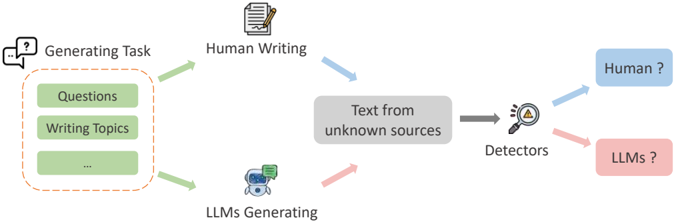
The remarkable ability of large language models (LLMs) to comprehend, interpret, and generate complex language has rapidly integrated LLM-generated text into various aspects of daily life, where users increasingly accept it. However, the growing reliance on LLMs underscores the urgent need for effective detection mechanisms to identify LLM-generated text. Such mechanisms are critical to mitigating misuse and safeguarding domains like artistic expression and social networks from potential negative consequences. LLM-generated text detection, conceptualized as a binary classification task, seeks to determine whether an LLM produced a given text. Recent advances in this field stem from innovations in watermarking techniques, statistics-based detectors, and neural-based detectors. Human-assisted methods also play a crucial role. In this survey, we consolidate recent research breakthroughs in this field, emphasizing the urgent need to strengthen detector research. Additionally, we review existing datasets, highlighting their limitations and developmental requirements. Furthermore, we examine various LLM-generated text detection paradigms, shedding light on challenges like out-of-distribution problems, potential attacks, real-world data issues, and ineffective evaluation frameworks. Finally, we outline intriguing directions for future research in LLM-generated text detection to advance responsible artificial intelligence. This survey aims to provide a clear and comprehensive introduction for newcomers while offering seasoned researchers valuable updates in the field.1
Overview
CoChat Summary
TL;DR
This survey reviews LLM-generated text detection, organizing methods into watermarking, statistics-based, neural-based, and human-assisted approaches, and argues robust detectors are urgently needed. It synthesizes datasets, benchmarks, evaluation metrics, and open challenges, concluding with future research directions.
Key findings
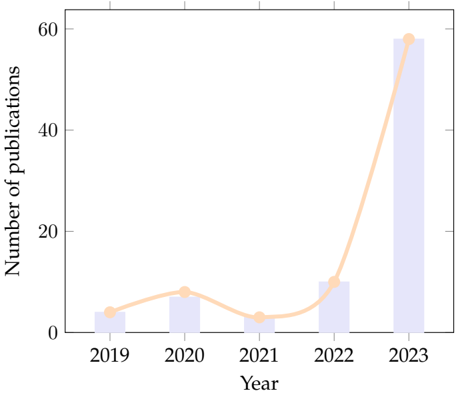
- The survey’s systematic literature review screened work up to November 2023 and identified 83 pertinent pieces of literature; most relevant research appeared in 2023.
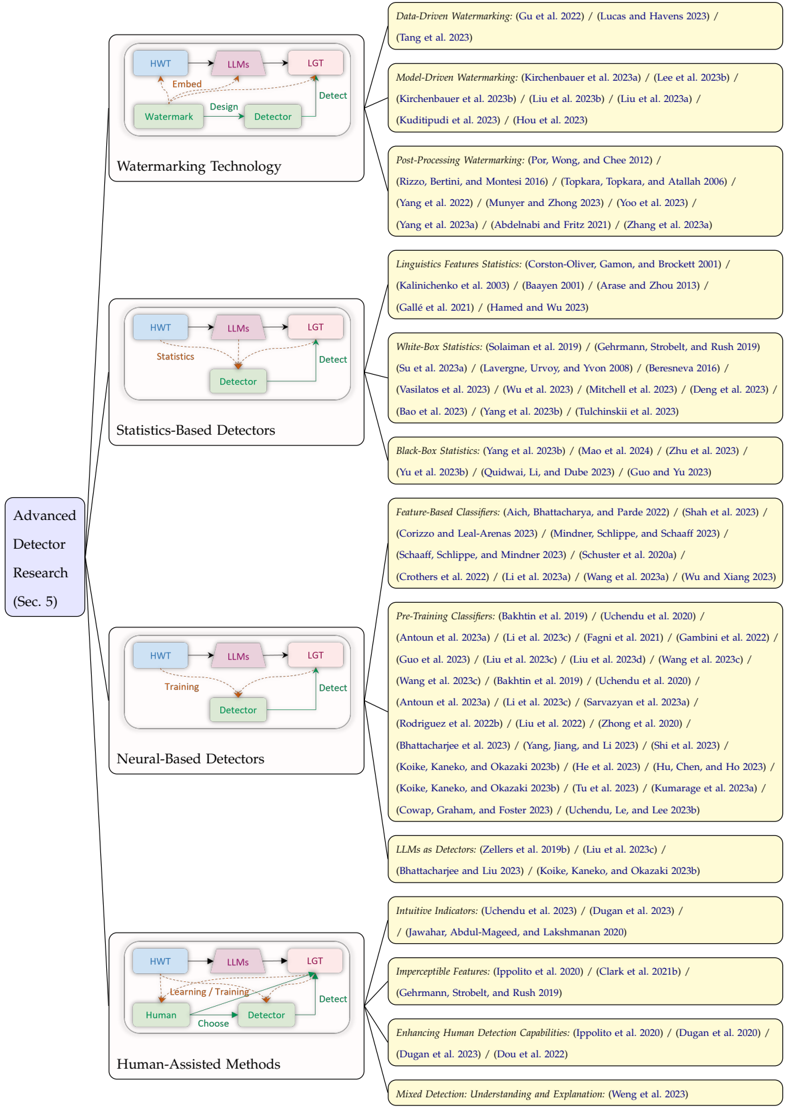
- Detection methods are categorized into watermarking (data-driven, model-driven, post-processing), statistics-based (linguistic features, white-box, black-box), neural-based (feature classifiers, pre-trained classifiers, LLMs as detectors), and human-assisted methods.
- It reports that current detectors face out-of-distribution problems (cross-domain, cross-lingual, cross-LLMs), attacks (paraphrase, adversarial, prompt, training threat models), real-world data issues (mixed/human-edited text, data ambiguity), model-size effects, and a lack of effective evaluation framework.
- It cites selected performance figures from reviewed work: Hamed and Wu’s bigram-based system identified 98 of 100 LLM-written academic papers; LLMDet achieved 98.54% classification accuracy; GHOSTBUSTER achieved an average F1 of 99.0; fine-tuned BERT-family models averaged about 95% in-domain accuracy.
Methods
- Design: a systematic literature review following Kitchenham’s SLR framework, guided by the research question of prevailing LLM-generated text detection methods and their main challenges.
- Data: searches across Google Scholar, arXiv, Scopus, Web of Science, IEEE Xplore, Springer Link, ACL Anthology, and ACM Digital Library using Boolean search terms; focused on publicly accessible articles before November 2023; after de-duplication and manual screening, 83 works were included.
- Analysis: synthesizes datasets and benchmarks, detector paradigms, evaluation metrics, important issues, and future directions; no primary experiments are conducted.
Limitations
- Stated: current datasets and benchmarks are limited in attack types, domains, tasks, LLMs, and languages, and suffer from temporal staleness; there is a lack of effective evaluation framework; no detection technique is acknowledged as infallible; data ambiguity is not formally addressed by existing studies.
- Stated: the paper argues prior reviews are insufficient in depth and comprehensiveness, but it does not state limitations of its own survey.
- Evident: as a survey, it presents no new empirical validation, and its coverage is bounded by the search terms, databases, and the November 2023 cutoff with 83 included works.
Model-written summary. Check it against the paper before relying on it.
Integrity signals
Registry
Cites
Statistics
Figures
Verification
Claims the paper makes
50 Valid · 21 Not valid · 106 Not checked · 68 Own results and interpretations
At least one cited source doesn’t support this claim or points to a different paper, and none confirmed it — see the verdicts below.
In the paper
“In the initial stages of generative modeling's emergence, when it had yet to pose significant societal challenges, the emphasis was on assessing the truth or falsity of the content in LLM-generated text, with less regard for its source (Schuster et al. 2020b).”
What the sources say
- Disputedcites Schuster et al. 2020b sourceExperimental — accuracy not yet measured
The Introduction (page not supplied) describes earlier approaches as focusing on stylistic differences and identifying whether text was machine-generated, then calls this paper’s veracity-based benchmark the first of its kind. That is contrary to the claim that the early emphasis was on truth or falsity rather than source. (LLM, conf=0.86)
Checked by a reasoning model — may be wrong.
plain- Asserted: passes — The authors put it forward as true.
- Checkable: passes — It can be checked against evidence.
- Load-bearing: unclear — It is unclear whether the paper’s conclusions depend on it.
- Based: passes — The paper gives a reason why it holds.
- Disputed
The cited sources that could be checked couldn’t confirm or dispute this claim.
In the paper
“However, it is pertinent to note some limitations of the HC3 dataset, such as the lack of diversity in prompts used for data creation.”
What the sources say
- Could not verifycites Guo et al. 2023 sourceExperimental — accuracy not yet measured
Section 4.1 (Dataset; page unavailable) describes a PubMedQA-based dataset and its two sets of generation instructions. Section 6 (Limitations and Future Work; page unavailable) discusses limitations of AuthentiGPT, but neither section addresses HC3 or a lack of diversity in prompts used to create it. Searches for HC3 and prompt diversity found no passage supporting the claim. (LLM, conf=0.74)
plain- Asserted: passes — The authors put it forward as true.
- Checkable: passes — It can be checked against evidence.
- Load-bearing: unclear — It is unclear whether the paper’s conclusions depend on it.
- Based: passes — The paper gives a reason why it holds.
- Could not verify
The cited sources support only part of this claim — read each source’s verdict below.
In the paper
“undermine technical expertise (Rodriguez et al. 2022a; Aliman and Kester 2021)”
What the sources say
- Partly supportedcites Rodriguez et al. 2022a sourceExperimental — accuracy not yet measured
The Abstract says convincing synthetic text can undermine genuine research, and the Introduction says synthetic technical texts could hinder the scientific process. Those passages support a threat to scientific work, but they do not specifically say that technical expertise itself is undermined. (LLM, conf=0.78)
- Not matchedcites Aliman and Kester 2021
Couldn’t be matched to a paper in Crossref, so it can’t be checked.
plainstates a cause- Asserted: passes — The authors put it forward as true.
- Checkable: passes — It can be checked against evidence.
- Load-bearing: passes — The paper’s conclusions depend on it.
- Based: passes — The paper gives a reason why it holds.
- Partly supported
The cited sources support only part of this claim — read each source’s verdict below.
In the paper
“promote plagiarism (Lee et al. 2023a)”
What the sources say
- Partly supportedcites Lee et al. 2023a sourceExperimental — accuracy not yet measured
The Introduction (page unavailable) identifies code plagiarism as a concern associated with advances in AI code generation. It lists code vulnerabilities separately, however, and does not say that those vulnerabilities promote plagiarism. (LLM, conf=0.76)
plainstates a possible cause- Asserted: passes — The authors put it forward as true.
- Checkable: passes — It can be checked against evidence.
- Load-bearing: passes — The paper’s conclusions depend on it.
- Based: passes — The paper gives a reason why it holds.
- Partly supported
The cited sources that could be checked couldn’t confirm or dispute this claim.
In the paper
“The Human ChatGPT Comparison Corpus (HC3) (Guo et al. 2023) stands as one of the initial open-source efforts to compare ChatGPT-generated text with human-written text.”
What the sources say
- Could not verifycites Guo et al. 2023 sourceExperimental — accuracy not yet measured
The Dataset section describes a PubMedQA-based comparison of human-written and GPT-generated text, not HC3. Searches for “HC3,” “Human ChatGPT Comparison Corpus,” and the claimed early open-source comparison found no passage addressing HC3 or its status among early efforts. (LLM, conf=0.76)
plain- Asserted: passes — The authors put it forward as true.
- Checkable: passes — It can be checked against evidence.
- Load-bearing: unclear — It is unclear whether the paper’s conclusions depend on it.
- Based: passes — The paper gives a reason why it holds.
- Could not verify
64 more claims · 20 with their cited sources checked
Create a free account to see all 245 claims and to verify the 16 references still open.
- Probably not a substantial claim. 119
- It may state two separate claims as one. 92
Self-check
Percentages, sums and reported differences re-computed from the paper’s own numbers.
Each contradiction between two passages listed here was confirmed by an independent check.
Rated minor: it would not touch a result — a value no result rests on, a p-value that stays on the same side of the significance level, or a conflict that is clerical, resolved elsewhere in the paper, or outside its own findings.
In the paper
§ 4.1 Training · p. 17
“| Yelp Dataset (Asghar 2016) | 700k |”
§ 4.1 Training · p. 19
“It comprises 1.5 million review text samples.”
Rated minor: it would not touch a result — a value no result rests on, a p-value that stays on the same side of the significance level, or a conflict that is clerical, resolved elsewhere in the paper, or outside its own findings.
In the paper
§ 6. Evaluation Metrics · p. 38
“False Positive (FP) refers to the result of the positive category (LLM-generate text) incorrectly classified by the model.”
§ 6. Evaluation Metrics · p. 40
“The FPR refers to the proportion of all actual human-written samples that are incorrectly detected as LLM-generated samples.”
Rated minor: it would not touch a result — a value no result rests on, a p-value that stays on the same side of the significance level, or a conflict that is clerical, resolved elsewhere in the paper, or outside its own findings.
In the paper
§ 4.1 Training · p. 17
“| Climate Change Dataset (Littman and Wrubel 2019) | 4m |”
§ 4.1 Training · p. 19
“This dataset houses the tweet IDs for 39.6 million tweets related to climate change.”
Rated minor: it would not touch a result — a value no result rests on, a p-value that stays on the same side of the significance level, or a conflict that is clerical, resolved elsewhere in the paper, or outside its own findings.
In the paper
§ 4.1 Training · p. 17
“| TOEFL11 (Blanchard et al. 2013) | 12k |”
§ 4.1 Training · p. 18
“it encompasses 1.1k essay samples across 11 languages: Arabic, Chinese, French, German, Hindi, Italian, Japanese, Korean, Spanish, Telugu, and Turkish.”
Rated minor: it would not touch a result — a value no result rests on, a p-value that stays on the same side of the significance level, or a conflict that is clerical, resolved elsewhere in the paper, or outside its own findings.
In the paper
§ 4.2 Evaluation Benchmarks · p. 21
“| MULTITuDE (Macko et al. 2023) | train test | ~4k ~3k | ~40k ~26k”
§ 4.2 Evaluation Benchmarks · p. 22
“This dataset consists of 74k machine-generated texts and 7k human-written texts across 11 languages”
4 more findings
Create a free account to see every finding of this check.
Citations
Cites
BERT: Pre-training of Deep Bidirectional Transformers for Language Understanding
Devlin, J., Chang, M.-W., Lee, K., & Toutanova, K. (2019) · Proceedings of the 2019 Conference of the North American Chapter of the Association for Computational Linguistics: Human Language Technologies, Volume 1 (Long and Short Papers) · doi:10.18653/v1/n19-1423 · Cited by 54,325
Language Models are Few-Shot Learners
Brown, T. B., Mann, B., Ryder, N., Subbiah, M., Kaplan, J., Dhariwal, P., Neelakantan, A., Shyam, P., Sastry, G., Askell, A., et al. (2020) · arXiv · doi:10.48550/arxiv.2005.14165 · Cited by 23,372
Self-citationGenerative adversarial networks
Goodfellow, I., Pouget-Abadie, J., Mirza, M., Xu, B., Warde-Farley, D., Ozair, S., Courville, A., & Bengio, Y. (2020) · Communications of the ACM · doi:10.1145/3422622 · Cited by 18,384
Sequence to Sequence Learning with Neural Networks
Sutskever, I., Vinyals, O., & Le, Q. V. (2014) · arXiv · doi:10.48550/arxiv.1409.3215 · Cited by 17,766
RoBERTa: A Robustly Optimized BERT Pretraining Approach
Liu, Y., Ott, M., Goyal, N., Du, J., Joshi, M., Chen, D., Levy, O., Lewis, M., Zettlemoyer, L., & Stoyanov, V. (2019) · arXiv · doi:10.48550/arxiv.1907.11692 · Cited by 16,515
Exploring the Limits of Transfer Learning with a Unified Text-to-Text Transformer
Raffel, C., Shazeer, N., Roberts, A., Lee, K., Narang, S., Matena, M., Zhou, Y., Li, W., & Liu, P. J. (2019) · arXiv · doi:10.48550/arxiv.1910.10683 · Cited by 10,929
Proximal Policy Optimization Algorithms
Schulman, J., Wolski, F., Dhariwal, P., Radford, A., & Klimov, O. (2017) · arXiv · doi:10.48550/arxiv.1707.06347 · Cited by 10,625
ChatGPT for Good? On Opportunities and Challenges of Large Language Models for Education
Kasneci, E., Seßler, K., Küchemann, S., Bannert, M., Dementieva, D., Fischer, F., Gasser, U., Groh, G., Günnemann, S., Hüllermeier, E., et al. (2023) · doi:10.35542/osf.io/5er8f · Cited by 7,552
ChatGPT for good? On opportunities and challenges of large language models for education
Kasneci, E., Sessler, K., Küchemann, S., Bannert, M., Dementieva, D., Fischer, F., Gasser, U., Groh, G., Günnemann, S., Hüllermeier, E., et al. (2023) · Learning and Individual Differences · doi:10.1016/j.lindif.2023.102274 · Cited by 7,326
XLNet: Generalized Autoregressive Pretraining for Language Understanding
Yang, Z., Dai, Z., Yang, Y., Carbonell, J., Salakhutdinov, R., & Le, Q. V. (2019) · arXiv · doi:10.48550/arxiv.1906.08237 · Cited by 6,687
Research works printed but not linked: 22
- Aich, 2022, Demystifying neural fake news via linguistic feature-based interpretation, 6586
- Christian, 2023, CNET secretly used AI on articles that didn’t disclose that fact, staff say, Futurism
- Cui, 2023, ChatLaw: Open-source legal large language model with integrated external knowledge bases, ArXiv preprint
- Deng, 2023, Efficient detection of LLM-generated texts with a Bayesian surrogate model, ArXiv preprint
- Dong, 2023, A survey for in-context learning, ArXiv preprint
- Giorgi, 2023, “I slept like a baby”: Using human traits to characterize deceptive ChatGPT and human text, 23
- Guo, 2020, Wiki-40B: Multilingual language model dataset, 2440
- He, 2023, Empirical analysis of beam search curse and search errors with model errors in neural machine translation, 91
- Kalinichenko, 2003, Digital libraries: Advanced methods and technologies, digital collections, D-Lib Magazine, 9, 1082
- Kitchenham, Barbara and StuartCharters. 2007. Guidelines for performing systematic literature reviews in software engineering. Technical Report, EBSE Technical Report EBSE-2007-01. pages 1–57. https://legacyfileshare.elsevier.com/promis_misc/525444systematicreviewsguide.pdf
- Kuditipudi, 2024, Robust distortion-free watermarks for language models, Transactions on Machine Learning Research
- Lambert, 2022, Illustrating reinforcement learning from human feedback (RLHF), HuggingFace Blog
- Liu, 2023, A private watermark for large language models, ArXiv preprint
- Liu, 2023, Check me if you can: Detecting ChatGPT-generated academic writing using CheckGPT, ArXiv preprint
- Ma, 2023, AI vs. human–differentiation analysis of scientific content generation, arXiv
- McCarthy, Philip M. 2005. An Assessment of the Range and Usefulness of Lexical Diversity Measures and the Potential of the Measure of Textual, Lexical Diversity (MTLD). Ph.D. thesis, The University of Memphis.
- Nicks, 2023, Language model detectors are easily optimized against
- Pagnoni, 2022, Threat scenarios and best practices to detect neural fake news, 1233
- Piccolo, 2023, Many bioinformatics programming tasks can be automated with ChatGPT, ArXiv preprint
- Radford, 2019, Language models are unsupervised multitask learners, OpenAI Blog, 1, 9
- Yan, 2023, Detection of AI-generated essays in writing assessment, Psychological Testing and Assessment Modeling, 65, 125
- Yu, 2023, GPT paternity test: GPT generated text detection with GPT genetic inheritance, ArXiv preprint
Cited by
LLM Evaluators Recognize and Favor Their Own Generations
Panickssery, A., Bowman, S. R., & Feng, S. (2024) · arXiv · doi:10.48550/arxiv.2404.13076 · Cited by 559
Scalable watermarking for identifying large language model outputs
Dathathri, S., See, A., Ghaisas, S., Huang, P.-S., McAdam, R., Welbl, J., Bachani, V., Kaskasoli, A., Stanforth, R., Matejovicova, T., et al. (2024) · Nature · doi:10.1038/s41586-024-08025-4 · Cited by 132
Lyu, W., Wang, Y., Chung, T. (., Sun, Y., & Zhang, Y. (2024) · Proceedings of the Eleventh ACM Conference on Learning @ Scale · doi:10.1145/3657604.3662036 · Cited by 131
Mohammadabadi, S. M. S., Kara, B. C., Eyüpoğlu, C., Uzay, C., Tosun, M. S., & Karakuş, O. (2025) · Electronics · doi:10.3390/electronics14183580 · Cited by 91
Wu, Z., Dong, Y., Li, Y., & Shi, B. (2025) · European Journal of Operational Research · doi:10.1016/j.ejor.2025.04.032 · Cited by 42
Embeddings from language models are good learners for single-cell data analysis
Liu, T., Chen, T., Zheng, W., Luo, X., Chen, Y. T., & Zhao, H. (2026) · Patterns · doi:10.1016/j.patter.2025.101431 · Cited by 44
Evaluating the accuracy and reliability of AI content detectors in academic contexts
Hadra, M., Cambridge, K., & Mesbah, M. (2026) · International Journal for Educational Integrity · doi:10.1007/s40979-026-00213-1 · Cited by 27
“Human text distribution and GenAI text distribution refer to statistical patterns of texts written by humans versus those generated by GenAI models (Wu et al. 2025).”
A Comprehensive Survey of Fake Text Detection on Misinformation and LM-Generated Texts
Kwon, S.-C., & Jang, B. (2025) · IEEE Access · doi:10.1109/access.2025.3538805 · Cited by 37
Collu, M. G., Salviati, U., Confalonieri, R., Conti, M., & Apruzzese, G. (2025) · arXiv · doi:10.48550/arxiv.2508.20863 · Cited by 22
Jiang, F., Pan, C., Dong, L., Wang, K., Debbah, M. A., Niyato, D. T., & Han, Z. (2026) · IEEE Communications Surveys & Tutorials · doi:10.1109/comst.2026.3660844 · Cited by 80
Srba, I., Razuvayevskaya, O., Leite, J. A., Moro, R., Schlicht, I. B., Tonelli, S., García, F. M., Lottmann, S. B., Teyssou, D., Porcellini, V., et al. (2026) · ACM Transactions on Intelligent Systems and Technology · doi:10.1145/3770077 · Cited by 19
Between Lines of Code: Unraveling the Distinct Patterns of Machine and Human Programmers
Shi, Y., Zhang, H., Wan, C., & Gu, X. (2025) · ACM/IEEE International Conference on Software Engineering: Companion Proceedings (ICSE-Companion) · doi:10.1109/icse55347.2025.00005 · Cited by 67
“The main limitations of our work lie in the following two aspects: Firstly, due to the time and computational constraints, we only focus on a set of LLMs within 7B parameters for both empirical analysis and the machine-generated code detection task.”
(2024) · Journal of Applied Learning & Teaching · doi:10.37074/jalt.2024.7.1.33 · Cited by 16
Divekar, R. R., Gonzalez, L., Guerra, S., Boos, N., & Divekar, R. (2025) · TechTrends · doi:10.1007/s11528-025-01095-9 · Cited by 27
“…may be necessary in some contexts, we advise against relying on AI detection software, as research (Casal & Kessler, 2023; Fleckenstein et al., 2024; Wu et al., 2025) consistently demonstrates that neither humans nor machines can reliably distinguish between AI-generated and human-written content.”
Advancements in AI-Generated Content Forensics: A Systematic Literature Review
Xu, Q., Mu, W., Li, J., Sun, T., & Jiang, X. (2025) · ACM Computing Surveys · doi:10.1145/3760526 · Cited by 26
Reades, J., Hu, Y., Tranos, E., & Delmelle, E. C. (2025) · Nature Cities · doi:10.1038/s44284-025-00314-x · Cited by 20
“The answer to such a question is clearly likely to depend on the nature of a particular study, but future research will certainly need to explore how to detect text generated by LLMs 96 .”
AI-Powered System to Facilitate Personalized Adaptive Learning in Digital Transformation
Yao, Y., & González–Vélez, H. (2025) · Applied Sciences · doi:10.3390/app15094989 · Cited by 29
Yin, Z., & Wang, S. (2025) · Knowledge-Based Systems · doi:10.1016/j.knosys.2025.115123 · Cited by 26
AI detecting AI in academic writing: Why most AI detector findings are false
Tsigaris, P., & Teixeira da Silva, J. A. (2026) · Next Research · doi:10.1016/j.nexres.2026.101396 · Cited by 11
Jin, W., Gai, T., Jin, F., Fujita, H., & Wu, J. (2026) · Advanced Engineering Informatics · doi:10.1016/j.aei.2025.104304 · Cited by 12
Self-citationDecoding LLMs' verbal deception in online reviews
Huang, Y., Zhou, J., Dong, W., Li, W., Chi, M., Jiang, C., Wang, W., & Deng, S. (2025) · Decision Support Systems · doi:10.1016/j.dss.2025.114529 · Cited by 11
Rinderknecht, E., Engelmann, S. U., Saberi, V., Kirschner, C., Kravchuk, A. P., Schmelzer, A., Breyer, J., Goßler, C., Mayr, R., Gilfrich, C. P., et al. (2025) · Journal of Medical Internet Research · doi:10.2196/76598 · Cited by 6
A Practical Synthesis of Detecting AI-Generated Textual, Visual, and Audio Content
Cao, L. (2025) · IEEE ... International Conference on Data Mining workshops · doi:10.1109/icdmw69685.2025.00170 · Cited by 26
Naumov, V., Zagirova, D., Lin, S., Xie, Y., Gou, W., Urban, A., Tikhonova, N., Alawi, K., Durymanov, M., Galkin, F., et al. (2025) · doi:10.1101/2025.03.06.641840 · Cited by 5
Artificial intelligence content detection techniques using watermarking: A survey
Kumar, N., & Singh, A. K. (2025) · Image and Vision Computing · doi:10.1016/j.imavis.2025.105728 · Cited by 8
Can We Trust AI Content Detection Tools for Critical Decision-Making?
Wakjira, T. G., Tijani, I. A., Alam, M. S., Mashal, M., & Hasan, K. (2025) · Information · doi:10.3390/info16100904 · Cited by 9
“Wu et al. [12] highlighted that the introduction of autoregressive models significantly improved the complexity of detection by reducing the statistical differences between human-and machine-authored text.”
Auditing the Shadows: A Review of Methods to Detect Shared Training Data in Large Language Models
Naser, M. Z. (2025) · ACM Computing Surveys · doi:10.1145/3774897 · Cited by 9
Survey of uncertainty estimation in LLMs - Sources, methods, applications, and challenges
He, J., Yu, L., Li, C., Yang, R., Chen, F., Li, K., Zhang, M., Lei, S., Zhang, X., Beigi, M., et al. (2025) · Information Fusion · doi:10.1016/j.inffus.2025.104057 · Cited by 26
Evaluating the Explainability of Large Language Models for Ethical Decision Making
Miguel, G. S. S., Griffith, H., Silva, J., & Rathore, H. (2025) · International Conference on Consumer Electronics · doi:10.1109/icce63647.2025.10929891 · Cited by 5
Crash Scene to Resolution: LLM-based Agents Driven for Efficient Traffic Accident Handling
Huo, S., Rong, H., Zhou, Y., Zuo, H., Liu, D., Li, Z., Wang, M., & Jiang, H. (2025) · ACM Transactions on Internet of Things · doi:10.1145/3766899 · Cited by 6
Ahmadpanah, S. H. (2025) · Computing · doi:10.1007/s00607-025-01609-6 · Cited by 6
“LLMs have exceptional abilities in complex reasoning, planning, and natural language understanding, in contrast to traditional machine learning models that are best at pattern recognition [18–25].”
A Survey of Hallucination in Large Language Models
何, 金. (2026) · Artificial Intelligence and Robotics Research · doi:10.12677/airr.2026.151016 · Cited by 5
Adversarial Attacks and Defenses on Large Language Models: A Systematic Review
Li, R., Liu, J., Zhen, J., Bao, Y., Qiang, Y., Xu, Y., Gu, Y., Jin, Y., Yu, D., He, Y., et al. (2025) · IEEE International Conference on Big Data and Artificial Intelligence (BDAI) · doi:10.1109/bdai66031.2025.11325628 · Cited by 6
“However, as highlighted by Wu et al. [138], current limitations in dataset volume, complexity, and resource-intensive curation processes present major bottlenecks for developing effective detectors and evaluation metrics—challenges that demand innovative approaches to data resource design.”
Preacher: Paper-to-Video Agentic System
Liu, J., Yang, L., Luo, H., Wang, F., Li, H., & Wang, M. (2025) · IEEE/CVF International Conference on Computer Vision (ICCV) · doi:10.1109/iccv51701.2025.01591 · Cited by 15
A Contrastive Semantic Watermarking Framework for Large Language Models
Wang, J., Chang, X., Xiao, C., & Zhang, L. (2025) · Symmetry · doi:10.3390/sym17071124 · Cited by 2
Watermarking Fine-Tuning Datasets for Robust Provenance
Gergov, I., & Tsochev, G. (2025) · Applied Sciences · doi:10.3390/app151910457 · Cited by 2
Technique for Identifying Texts Generated by Large Language Models
Fedotova, A., & Romanov, A. (2025) · Informatics and Automation · doi:10.15622/ia.24.5.7 · Cited by 2
Li, Z., & Zhang, Q. (2025) · Lecture notes in computer science · doi:10.1007/978-981-95-2725-0_3 · Cited by 5
Dual-branch approach for AI-generated scientific content detection
Alhijawi, B., Jarrar, R., Awajan, S., & AbuAlRub, A. (2026) · Knowledge-Based Systems · doi:10.1016/j.knosys.2026.115440 · Cited by 2
Mahmud, A., Rawajfih, Y., & Arnold, R. D. (2025) · IEEE Annual Information Technology, Electronics and Mobile Communication Conference (IEMCON) · doi:10.1109/iemcon67450.2025.11381067 · Cited by 2
“Recent work (e.g., [12]) further explores detection/attribution trade-offs under evolving LLMs; the proposed focus is complementary in emphasizing language-agnostic features and forensic applicability with Common Vulnerabilities and Exposures (CVE) validation.”
SCIS-Demo: A Demonstration System for Semantically Guided Detection Evasion in LLM-Generated Text
Li, Z., Zhu, Y. Q., & Qiang, J. (2025) · IEEE ... International Conference on Data Mining workshops · doi:10.1109/icdmw69685.2025.00309 · Cited by 2
“Recent research have broadly classified attack strategies aimed at evading detectors of machine-generated text into three main categories: perturbation attacks, data mixing attacks, and paraphrasing attacks [7]–[9].”
The New Editorial Gatekeepers: Understanding LLM-Based Interfaces, Their Benefits, Risks and Design
Floridi, L. (2026) · Philosophy & Technology · doi:10.1007/s13347-026-01068-7 · Cited by 5
“A growing body of evidence suggests current detectors are far from foolproof (Wu et al. 2025), not least because the same LLMs can help to hide their traces.”
Fine grained representation learning for low resource Yi script detection and dataset construction
Sun, H., Ding, X., Yu, H., Yang, Z., & Zhang, J. (2026) · npj Heritage Science · doi:10.1038/s40494-026-02418-6 · Cited by 3
A Novel Security Framework against Prompt Injection Attacks
Zhao, Y., & Li, X. (2025) · International Conference on Computer Communication and Artificial Intelligence (CCAI) · doi:10.1109/ccai65422.2025.11189427 · Cited by 3
“These models typically consist of a large number of parameters and are trained on massive corpora to learn the structure, grammar, semantics, and some common knowledge of language [5].”
Interactive Disaster Training Scenario Generation System with Large Language Models
Asami, K., Hiroi, K., & Hatayama, M. (2025) · IFIP advances in information and communication technology · doi:10.1007/978-3-031-97115-0_7 · Cited by 1
Sentences Based Adversarial Attack on AI-Generated Text Detectors
Tu, R., Kang, X., Tan, C. W., Chi, C., & Lam, K. (2025) · IEEE Transactions on Big Data · doi:10.1109/tbdata.2025.3600034 · Cited by 4
Using KeyGraph and ChatGPT to Detect and Track Topics Related to AI Ethics in Media Outlets
Li, W.-H., & Yu, H. (2025) · Mathematics · doi:10.3390/math13172698 · Cited by 2
Identifying AI-Generated Text Sources via Linguistic Style Fingerprints
Feng, W. (2025) · International Conference on Computer Science and Blockchain (CCSB) · doi:10.1109/ccsb66722.2025.11154215 · Cited by 2
“For instance, on information-saturated social platforms, merely determining whether content is AI-generated is insufficient for governance needs; the more granular question of which model generated the content has become a regulatory imperative [8].”
Evaluating reasoning large language models on rumor generation, detection, and debunking tasks
Hu, Y., & Tian, X. (2025) · iScience · doi:10.1016/j.isci.2025.113690 · Cited by 6
Do LLMs dream of antique hermeneutics? Critical remarks on automated text interpretation
Dörpinghaus, J., & Tiemann, M. (2025) · Annals of Computer Science and Information Systems · doi:10.15439/2025f2839 · Cited by 3
“This is a common debate also in the field of AI-generated text detection, see [56].”
Reducing hallucination in MLLMs for action recognition with adaptive masking and dual prompting
Hong, M., Sun, B., He, J. Y. D., Zhang, Y., & Li, Y. (2025) · Neurocomputing · doi:10.1016/j.neucom.2025.131861 · Cited by 4
Krishnan, K., & Easwarakumar, K. S. (2025) · Scientific Reports · doi:10.1038/s41598-025-21145-9 · Cited by 3
CSRD2025: A Large-Scale Synthetic Radio Dataset for Spectrum Sensing in Wireless Communications
Chang, S., Sun, R., He, J., Huang, S., Yu, K., & Feng, Z. (2025) · IEEE Journal on Selected Areas in Communications · doi:10.1109/jsac.2025.3641910 · Cited by 7
A survey of the state of the art in conversational question answering systems
Perera, M. M., Mahmood, A., Wijethilake, K. E., Islam, F., Tahermazandarani, M., & Sheng, Q. Z. (2025) · Knowledge and Information Systems · doi:10.1007/s10115-025-02620-1 · Cited by 5
“A well-constructed dataset enables the ConvQA system to model multi-turn interactions, resolve contextual dependencies, and handle real-world phenomena, i.e., ambiguity, topic shifts, and ellipsis.”
Efficient detection of AI-generated scientific abstracts with a lightweight transformer
Zhang, C., & Zhou, W. (2026) · Scientific Reports · doi:10.1038/s41598-026-35203-3 · Cited by 3
“Prior work on machine-generated text detection spans supervised classifiers fine-tuned on labeled human/AI corpora 5,6 , and zero-shot/statistical detectors that exploit differences in token likelihood patterns or probability curvature (e.g., GLTR 2 , DetectGPT 4 ).”
Identifying Bots Through LLM-Generated Text in Open Narrative Responses: A Proof-of-Concept Study
Claassen, J., Höhne, J. K., Bach, R. L., & Haensch, A. (2026) · Social Science Computer Review · doi:10.1177/08944393251408022 · Cited by 4
SBASH: a Framework for Designing and Evaluating RAG vs. Prompt-Tuned LLM Honeypots
Adebimpe, A., Neukirchen, H., & Welsh, T. (2025) · International Conference on Foundation and Large Language Models (FLLM) · doi:10.1109/fllm67465.2025.11391242 · Cited by 6
Human or Machine? A Survey on Machine-Generated Text Detection
Ahmad, Z., Torres-Ruiz, M. J., Mahmood, A., Quintero, R., Ameer, I., & Bölücü, N. (2026) · IEEE Access · doi:10.1109/access.2026.3666781 · Cited by 8
H2A-BPMN: A Hierarchical and Hybrid Agent Framework for Industrial BPMN Automated Modeling
Xu, Q., Zhang, Y., Tang, H., Ran, Q., Gao, H., & Xu, Y. (2026) · Lecture notes of the Institute for Computer Sciences, Social Informatics and Telecommunications Engineering · doi:10.1007/978-3-032-21171-2_10 · Cited by 2
Reshaping The Narrative: Linguistic Evolution And Reception In Online Storytelling Communities
He, M., Xie, H., Nie, Z., Jiang, W., & Gu, W. (2026) · CHI Conference Extended Abstracts on Human Factors in Computing Systems (CHI EA) · doi:10.1145/3772363.3798496 · Cited by 1
Attribution-Driven Explainable Intrusion Detection with Encoder-Based Large Language Models
Biswas, U., Hasan, S., Farhan, S. M., Pillai, N., & Gudla, C. (2026) · IEEE SoutheastCon · doi:10.1109/southeastcon63549.2026.11476386 · Cited by 3
Liu, Y., & Zhang, X. (2026) · Neural Computing and Applications · doi:10.1007/s00521-026-12082-3 · Cited by 1
“Classical machine learning (ML) models such as Logistic Regression, Naïve Bayes, Support Vector Machines (SVM), and Random Forest (RF) have long been established in natural language processing tasks due to their efficiency, ease of implementation, and interpretabil - ity [ 17 ].”
Exploiting Language Model and Semantic Analysis for Actively Tracing Textual Information Provenance
Chen, H., Shuai, H., Chen, Y., & Wu, H. (2026) · Signal Image and Video Processing · doi:10.1007/s11760-026-05363-w · Cited by 1
Deepfakes: A comprehensive survey on techniques, challenges and future directions
Usmani, S., Kumar, S., & Sadhya, D. (2026) · Computers & Electrical Engineering · doi:10.1016/j.compeleceng.2026.111210 · Cited by 3
FM-LLM: A Lightweight Multimodal LLM with Simulation-Augmented Data for Mechanical Fault Diagnosis
Gao, Y., Ding, B., Zhang, G., Chen, Z., Lin, H., Li, W., & Liu, Q. (2026) · Chinese Journal of Mechanical Engineering · doi:10.1016/j.cjme.2026.100333 · Cited by 1
Chekhovich, Y. V. (2026) · Историческая информатика · doi:10.7256/2585-7797.2026.2.80266 · Cited by 2
Yang, L., & Long, T. (2026) · International Journal of Digital Law and Governance · doi:10.1515/ijdlg-2026-0010 · Cited by 2
GLM-WPP: Leveraging generative large model for accurate water pressure prediction
Tao, Y., Dai, J., Xu, X., Ma, L., Tian, J., Meng, E., & Yan, D. (2025) · Journal of Information and Intelligence · doi:10.1016/j.jiixd.2025.07.001 · Cited by 1
Detecting LLM-Generated Short Answers and Effects on Learner Performance
Bhushan, S., Thomas, D. R., Borchers, C., Raghuvanshi, I., Abboud, R., Gatz, E., Gupta, S., & Koedinger, K. R. (2025) · Lecture notes in computer science · doi:10.1007/978-3-032-03870-8_4 · Cited by 7
An Efficient Finetuning Method for LLM generated text detection in Power Grid
Jiang, Y., Li, J., Zhang, X., Xu, W., Liang, Z., Yang, Y., Huang, K., & Bi, L. (2025) · IEEE/CIC International Conference on Communications in China (ICCC) · doi:10.1109/iccc65529.2025.11148942 · Cited by 2
“Therefore, the detection system needs to be highly generalized, capable of identifying LLM-generated content across multiple document categories [7].”
Zhi, L., Fang, L., & Cai, M. (2025) · International Conference on Intelligent Perception and Pattern Recognition (IPPR) · doi:10.1109/ippr66507.2025.11198205 · Cited by 1
AI or Human? Understanding Perceptions of Embodied Robots with LLMs
Hriscu, L., Sanfeliu, A., & Garrell, A. (2025) · IEEE RO-MAN · doi:10.1109/ro-man63969.2025.11217802 · Cited by 1
“Along similar lines, researchers have also examined the detection of artificially generated content [27], [28], [29].”
Toward Reliable Detection of LLM-Generated Texts: A Comprehensive Evaluation Framework with CUDRT
Tao, Z., Chen, Y., Xi, D., li, Z., & Xu, W. X. (2025) · ACM Transactions on Intelligent Systems and Technology · doi:10.1145/3779427 · Cited by 22
Tao, Y., Ryan, M., Bialy, F., & Zhang, X. (2026) · Research Square (preprint) · doi:10.21203/rs.3.rs-10029667/v1
Toward Robust Generative AI Text Detection: Generalizable Neural Model
Abburi, H., Pudota, N., Veeramani, B., Bowen, E., & Bhattacharya, S. (2024) · International Conference on Machine Learning and Applications · doi:10.1109/icmla61862.2024.00255 · Cited by 4
Multi-Object Grasp Planning with Vision-Language Models for Laboratory Automation
Hu, Y., Tian, J., & Liu, D. (2025) · International Conference on Advanced Algorithms and Control Engineering (ICAACE) · doi:10.1109/icaace65325.2025.11020484
“In recent years, the rapid development of large language models, especially the rise of Vision-Language Models (VLMs) [13], [14], has provided new approaches to image understanding and robotic operation planning [15]–[17].”
Johnsi, R., & Kumar, G. B. (2026) · Frontiers in Artificial Intelligence · doi:10.21203/rs.3.rs-6619776/v1
REISD: Detecting LLM-generated text via iterative semantic difference
Qian, K., Du, Y., & Yang, C. (2026) · Neurocomputing · doi:10.1016/j.neucom.2026.133656
Unpacking the Decision Logic of LLM-based Agents: Evidence from the Newsvendor ProblemPreprint
Zhang, X., & Cavusoglu, H. (2025) · SSRN Electronic Journal · doi:10.2139/ssrn.5337019 · Cited by 4
Evaluating the Accuracy of AI Content DetectorsPreprint
YILDIZ, F. E., Karaarslan, E., & Aydın, Ö. (2025) · SSRN Electronic Journal · doi:10.2139/ssrn.5364392
Zhang, X., Lee, M., Zhou, M., & Lee, G. M. (2025) · SSRN Electronic Journal · doi:10.2139/ssrn.5357471 · Cited by 1
Multi-Dimensional Analysis of LLM Models with Synthetic Data on Early Marriage Prevention
Imaaduddin, M. Y., Wijaya, R., & Kosala, G. (2025) · IEEE International Conference on Artificial Intelligence for Learning and Optimization (ICoAILO) · doi:10.1109/icoailo66760.2025.11155930
“LLMs are trained using large amounts of text data from various sources, such as books, articles, and websites, to learn language patterns, sentence structure, and context in depth [12].”
Batch, B., & Sulzer, M. (2025) · Springer eBooks · doi:10.1007/978-3-031-99754-9_6
Large Language Models as Search Engines: Societal Challenges
Sadeddine, Z., Maxwell, W., Varoquaux, G. P., & Suchanek, F. M. (2025) · ACM SIGIR Forum · doi:10.1145/3769733.3769746 · Cited by 6
Paiola, P. H., Garcia, G. L., Manesco, J. R. R., de Miranda, L. M., de Salvo, M. P., & Papa, J. P. (2025) · IEEE International Forum on Research and Technology for Society and Industry (RTSI) · doi:10.1109/rtsi64020.2025.11212469
“A survey by Thafar et al. [14] highlights the importance of identifying machine-generated text and ensuring transparency in its application; it aligns with the growing demand for explainability in LLM-driven systems, where understanding the rationale behind model outputs is critical for…”
Wang, Y., Chen, Z., Yu, X., & Yang, S. (2025) · Lecture notes in computer science · doi:10.1007/978-981-95-3352-7_24
Self-citationOverview of the NLPCC 2025 Shared Task 1: LLM-Generated Text Detection
Wu, J., Zhan, R., Wang, Q., Yuan, Y., Chao, L. S., & Wong, D. F. (2025) · Lecture notes in computer science · doi:10.1007/978-981-95-3352-7_21 · Cited by 3
Self-citationWhen Less is More: Minimal Prompts with LoRA for LLM Text Detection
Wang, S., Fang, R., Li, M., He, Z., & Song, S. (2025) · Lecture notes in computer science · doi:10.1007/978-981-95-3352-7_22 · Cited by 1
Hirosawa, T., Harada, Y., & Shimizu, T. (2025) · AI & Society · doi:10.1007/s00146-025-02750-8 · Cited by 2
Dingfelder, P., & Rieß, C. (2025) · Lecture notes in computer science · doi:10.1007/978-3-032-10759-6_16
How Well Do Llms Imitate Human Writing Style?
Jemama, R., & Kumar, R. (2025) · IEEE Annual Ubiquitous Computing, Electronics & Mobile Communication Conference (UEMCON) · doi:10.1109/uemcon67449.2025.11267719 · Cited by 5
An exploratory study on LLM-generated code and comments in code repositories
Ji, Y., Wang, J., Zhou, Y. X., Chen, F., & Yang, H. (2026) · Journal of Systems and Software · doi:10.1016/j.jss.2026.113026 · Cited by 1
“There are various existing zero-shot methods for detecting LLM-generated content, which can mainly be categorized into three types: statistical-based meth-ods, perturbation-based methods, and model-comparison-based methods [28, 36].”
Detection of AI-Generated texts with BERT variants
Balara, V., & Machová, K. (2025) · International Conference on Emerging eLearning Technologies and Applications (ICETA) · doi:10.1109/iceta67772.2025.11280096
“As the studies in this field continue, a large amount of benchmark datasets was created and is continually expanding [30], serving as a basis for detection tool training.”
Suresh, K., Kumar, S., Siddik, S., Charaan, R. M. D., Santhoshkumar, S. P., & Sasikumar, M. (2025) · Asian Conference on Innovation in Technology (ASIANCON) · doi:10.1109/asiancon66527.2025.11280636
“The survey also explores potential directions for future research in this area, such as developing more robust DRAFT detection algorithms to address evolving LLM capabilities [10].”
Why it’s so hard to tell if a piece of text was written by AI – even for AI
Tewari, A. (2025) · The Conversation · doi:10.64628/aai.ksptdekuu
Salnikov, E., & Bonch-Osmolovskaya, A. (2025) · Journal of language and Education · doi:10.17323/jle.2025.22211 · Cited by 2
“A wide range of detection methods has been proposed, yet none of them offers a universal and sufficiently robust solution (Wu et al., 2025; Tang et al., 2024, Sadasivan et al., 2023).”
Wang, Z., Ren, Y., Zhao, G., Zhu, X., Li, H., & Cao, Y. (2025) · Lecture notes in computer science · doi:10.1007/978-981-95-3352-7_23 · Cited by 1
A Review of the Use of Large Language Models to Generate Synthetic Cybersecurity Datasets
Gadsby, J., & Sabrina, F. (2025) · International Telecommunication Networks and Applications Conference (ITNAC) · doi:10.1109/itnac66378.2025.11302633 · Cited by 1
“LLMs are well-suited to generating various types of data relevant to cybersecurity datasets, particularly given their primary application in processing and generating natural language text [12] [13].”
Buhnila, I. (2025) · Langages · doi:10.3917/lang.240.0023 · Cited by 1
Automatic generation of ESL learning materials based on CEFR levels using reinforcement-tuned LLMs
Zuo, Y. (2025) · Discover Artificial Intelligence · doi:10.1007/s44163-025-00762-3 · Cited by 3
“In summary, prior research highlights the trajectory from rule-based systems toward LLM-driven solutions, with each stage offering improvements yet leaving crucial limitations unresolved [24].”
Metadata
- Authors
- Wu, J., Yang, S., Zhan, R., Yuan, Y., Chao, L. S., & Wong, D. F.
- Affiliations
- University of Macau (MO)
- Peking University (CN)
- Venue
- Computational Linguistics
- Publisher
- MIT Press
- Published
- 2025
- Volume
- 51
- Issue
- 1
- Pages
- 275-338
- ISSN
- 0891-2017 (ISSN-L)
- 1530-9312
- OpenAlex
- W4406236959
- Cited by
- 212
- References
- 257
- Citations by year
- 2026: 106 · 2025: 91
- FWCI
- 79.02
- Type
- journal article
- Language
- en
- Open access
- diamond
- doi.org
- Licence
- Locations
- Computational Linguistics (publishedVersion, cc-by-nc-nd)
- arXiv (Cornell University) (submittedVersion, cc-by)
- arXiv (Cornell University) (cc-by)
- Funders
- United Mitochondrial Disease Foundation
- Universidade de Macau
- Fundo para o Desenvolvimento das Ciências e da Tecnologia (FDCT/060/2022/AFJ, FDCT/0070/2022/AMJ)
- State Administration for Science, Technology and Industry for National Defense
- Topics
- Physical Sciences › Computer Science › Artificial Intelligence › Authorship Attribution and Profiling
- Physical Sciences › Computer Science › Computer Vision and Pattern Recognition › Digital Media Forensic Detection
- Physical Sciences › Computer Science › Artificial Intelligence › Topic Modeling
- Keywords
- LLM-generated text detection, large language models, watermarking, detection dataset, out-of-distribution detection, adversarial attacks, evaluation framework, responsible AI
About these checks
Registry, retraction, Cites and statistics results are computed, not judged, with one exception: a printed reference that no index lists is read once by a model before it counts as a citation error. Claims are extracted by a model and kept only when their quote appears verbatim in the text; each cited source is then checked, with a model’s help, for whether it says what the claim relies on. Those verdicts can be wrong — read the claim’s quote and the cited source before relying on one.
The claim verdicts this report counts are experimental: their accuracy is not yet measured.
A language model drew the claims from the paper on 2026-10-26, under version 3 of the claim definition (model deepseek-v4.1-flash, prompt extract-v3).
A second model labelled each claim on 2026-10-26 (model jev-1.13-20260917, definition revision gold-guideline-v0.2).
Cited sources are checked with a language model’s help (gpt-6-sol).
Statistics and arithmetic are recomputed, not judged.
Confidence bands are shown only for fields calibrated on our annotated test set. None is calibrated yet, so no band is shown.
What counts as a claim ›How we measure confidence ›How we check this ›
Are you an author, or do you see a problem with this page? Request a review
Data sources
Bibliographic data: Semantic Scholar, OpenAlex, Crossref.
Contains information from the Semantic Scholar Academic Graph Datasets, made available under the ODC Attribution License (ODC-BY 1.0).
Semantic Scholar’s data is described in: Kinney, R., et al. (2023). The Semantic Scholar Open Data Platform. arXiv:2301.10140.
