

A Systematic Assessment of “Axial Age” Proposals Using Global Comparative Historical Evidence
Open accessPublished version of a preprint
The DOI matches its Crossref record; 160 of the 160 references it cites were found in a registry or an index; none of the 139 sources its claims cite is checked for support yet.
Abstract
Proponents of the Axial Age contend that parallel cultural developments between 800 and 200 BCE in what is today China, Greece, India, Iran, and Israel-Palestine constitute the global historical turning point toward modernity. The Axial Age concept is well-known and influential, but deficiencies in the historical evidence and sociological analysis available have thwarted efforts to evaluate the concept’s major global contentions. As a result, the Axial Age concept remains controversial. Seshat: Global History Databank provides new tools for examining this topic in social formations across Afro-Eurasia during the first two millennia BCE and first millennium CE, allowing scholars to empirically evaluate the varied and contrasting claims researchers have put forward. Results undercut the notion of a specific “age” of axiality limited to a specific geo-temporal localization. Critical traits offered as evidence of an axial transformation by proponents of the Axial Age concept appeared across Afro-Eurasia hundreds, and in some cases thousands, of years prior to the proposed Axial Age. Our analysis raises important questions for future evaluations of this period and points the way toward empirically-led, historical-sociological investigations of the ideological and institutional foundations of complex societies.
Overview
CoChat Summary
TL;DR
The paper systematically tests Axial Age claims against Seshat global historical data and finds little support for a single, geographically and temporally bounded Axial Age, though some moralizing and institutional developments did occur in the expected late-first-millennium BCE contexts. It argues axial traits appeared earlier, elsewhere, and unevenly, so the concept should be disaggregated and re-examined.
Key findings
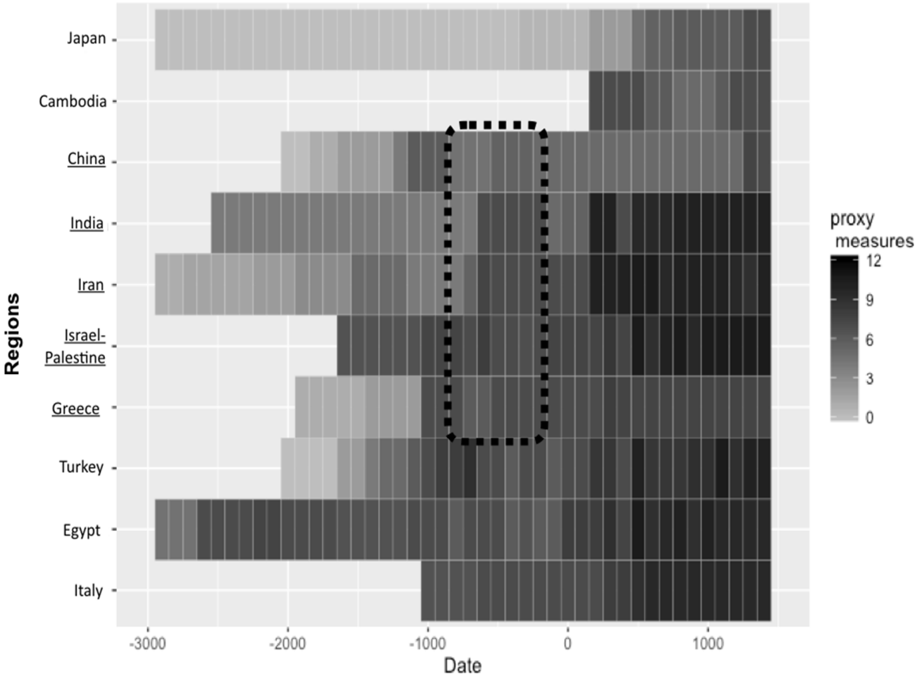
- Across 10 Afro-Eurasian regions and 12 proxy measures, the authors find “very little support” for many Axial Age characterizations; there was “no single, well-defined, and bounded Axial Age” and no clear synchrony.
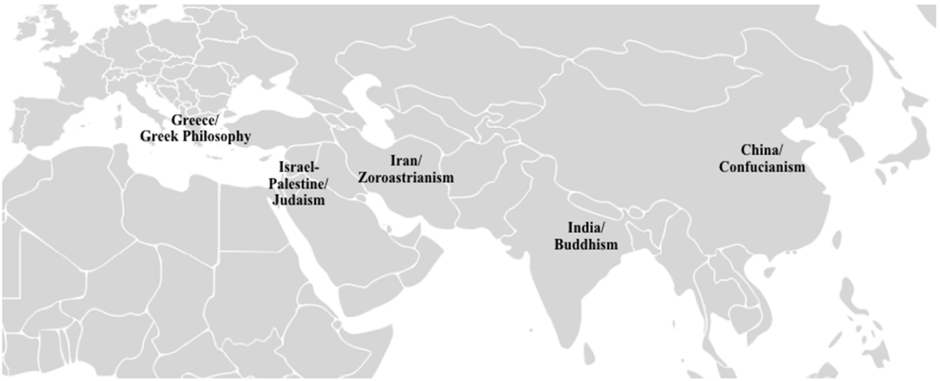
- In the 5 conventional axial regions (Greece, Israel-Palestine, Iran, India, China), key proxies appear in the latter half of the first millennium BCE, but many are also present before 800–200 BCE; for example, Zoroastrian, Israel-Palestine, Indian, and Chinese ideologies show axial traits earlier.
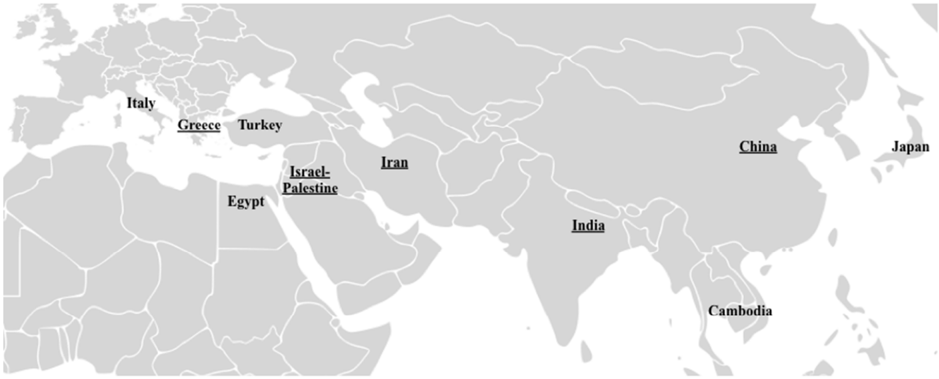
- In 5 allegedly non-axial regions (Italy, Turkey, Egypt, Cambodia, Japan), axial-type traits also appear before and/or after the supposed age; Egypt, Turkey, and Italy show axial-type transformations well before the axial sages, while Cambodia and Japan show complicated later patterns.
- Some axial claims receive support: important moralizing ideologies and institutional reforms (formal law, constraints on rulers, bureaucracy) appear in many places, but unevenly and in fits and starts; the authors note supposed universal egalitarianism did not extend to women.
Methods
- Design: Cliodynamic, systematic comparative historical assessment using Seshat: Global History Databank; sample of 10 regions—5 conventional axial (Greece, Israel-Palestine, Iran, India, China) and 5 non-axial (Italy, Turkey, Egypt, Cambodia, Japan)—tracked from the third millennium BCE to the second millennium CE.
- Data/measures: 12 proxy measures for axial traits (e.g., moralistic punishment, moralizing norms, prosociality, moralizing omniscient supernatural beings, rulers not gods, equality, formal legal code, constraints on executive, full-time bureaucrats, impeachment), coded present=1, absent=0, or unknown at 100-year intervals.
- Analysis: time-series of proxy presence/absence per region, summing proxies to trace the number of axial traits over time; Seshat combines primary/secondary literature and domain-expert consultation.
Limitations
- Stated: proxies are “rather crude” and not exhaustive; cognitive states and second-order thinking are impossible to measure directly; missing data and lack of reliable evidence for some regions/periods constrain assessment; future work is needed on more proxies, regions, and causal mechanisms.
- Stated: some proxies collapse distinct phenomena (e.g., prosociality includes infrastructure and charity) and institutional proxies do not capture religious administration.
- Evident from text: the 10-region sample is not global; present/absent coding may oversimplify variation; reliance on expert judgment and scholarly debates introduces uncertainty; the study is primarily descriptive/comparative and does not establish causal direction.
Model-written summary. Check it against the paper before relying on it.
Integrity signals
Registry
Cites
Statistics
Figures
Verification
Claims the paper makes
0 Valid · 40 Not valid · 83 Not checked · 114 Own results and interpretations
In the paper
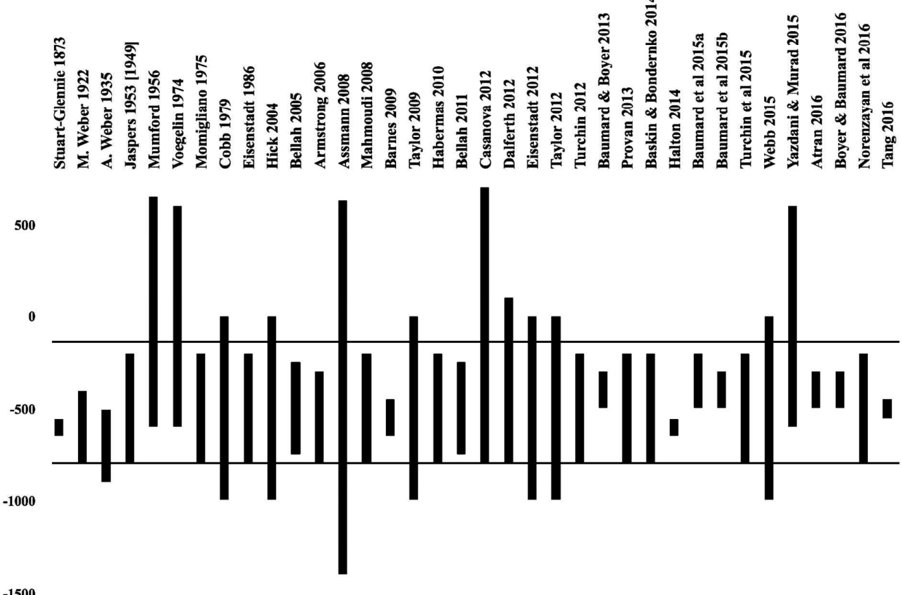
“The range of temporal boundaries offered for the Axial Age, however, varies widely across treatments, from 1400 BCE to 650 CE, as demonstrated in Figure 1.”
What the sources say
- Not matchedcites Figure 1
This doesn’t read as a citation we can look up.
boosted- Asserted: passes — The authors put it forward as true.
- Checkable: passes — It can be checked against evidence.
- Load-bearing: passes — The paper’s conclusions depend on it.
- Based: passes — The paper gives a reason why it holds.
- Not matched
None of the sources cited for this claim could be matched to a paper, so there is nothing to check it against.
In the paper
“Thus, the temporal duration assigned to the Axial Age fluctuates widely from approximately two hundred years (e.g., 500 -300 BCE; Baumard, Hyafil and Boyer 2015) to over 2,000 years (e.g., 600 BCE -650 CE; Mumford 1956).”
What the sources say
- Not matchedcites Baumard, Hyafil and Boyer 2015
More than one paper fits this citation.
- Not matchedcites Mumford 1956
An author–year citation the paper’s reference list doesn’t settle. We don’t search these by name.
plain- Asserted: passes — The authors put it forward as true.
- Checkable: passes — It can be checked against evidence.
- Load-bearing: unclear — It is unclear whether the paper’s conclusions depend on it.
- Based: passes — The paper gives a reason why it holds.
- Not matched
A result the paper states — it cites no source for it, so there is none to check. The quote shows it is in the paper.
In the paper
“It is clear too that important ideological, religious, and/or cognitive developments are associated closely with radical reforms of the social, cultural, and political institutions in many of the societies under question.”
boostedstates an association- Asserted: passes — The authors put it forward as true.
- Checkable: passes — It can be checked against evidence.
- Load-bearing: passes — The paper’s conclusions depend on it.
- Based: passes — The paper gives a reason why it holds.
A result the paper states — it cites no source for it, so there is none to check. The quote shows it is in the paper.
In the paper
“We see clearly that new religio-philosophiocal ideologies with greater emphasis on moralizing principles emerged in a handful of regions across Afro-Eurasia.”
boosted- Asserted: passes — The authors put it forward as true.
- Checkable: passes — It can be checked against evidence.
- Load-bearing: passes — The paper’s conclusions depend on it.
- Based: passes — The paper gives a reason why it holds.
A result the paper reports from its own data — it cites no other source for it, so there is none to check. The quote shows it is in the paper.
In the paper
“In partial support of the Axial Age concept, crucial proxies are indeed present in the 5 core axial regions (Greece, Israel-Palestine, Iran, India, China) during the latter half of the first century BCE, as expected.”
boosted- Asserted: passes — The authors put it forward as true.
- Checkable: passes — It can be checked against evidence.
- Load-bearing: passes — The paper’s conclusions depend on it.
- Based: passes — The paper gives a reason why it holds.
70 more claims
Create a free account to see all 237 claims and to verify the 71 references still open.
- Probably not a substantial claim. 98
- It may state two separate claims as one. 92
Self-check
Percentages, sums and reported differences re-computed from the paper’s own numbers.
Each contradiction between two passages listed here was confirmed by an independent check.
Rated minor: it would not touch a result — a value no result rests on, a p-value that stays on the same side of the significance level, or a conflict that is clerical, resolved elsewhere in the paper, or outside its own findings.
In the paper
§ INTELLECTUAL HISTORY OF THE AXIAL AGE
“According to Stuart-Glennie's early formulation, a 'Moral Revolution' could be readily identified around 600 BCE”
§ 7
“John Stuart-Glennie's theory of the 'Moral Revolution' of the mid-first century BCE”
Rated minor: it would not touch a result — a value no result rests on, a p-value that stays on the same side of the significance level, or a conflict that is clerical, resolved elsewhere in the paper, or outside its own findings.
In the paper
“over 2,000 years (e.g., 600 BCE -650 CE; Mumford 1956)”
Reported 2000 · recomputed 1250
Rated minor: it would not touch a result — a value no result rests on, a p-value that stays on the same side of the significance level, or a conflict that is clerical, resolved elsewhere in the paper, or outside its own findings.
In the paper
§ Historical Inquiry Should Focus on a Handful of Seemingly Extraordinary Individuals
“the birth of Siddhartha Gautama sometime in the mid-first century BCE”
§ 3. INDIA
“The rise of Buddhism after the birth of the Gautama Buddha in eastern India sometime in the mid-first millennium BCE”
Citations
Cites
Economy and Society: An Outline of Interpretive Sociology
Poggi, G. (1969) · Sociology · doi:10.1177/003803856900300342 · Cited by 6,769
Origins of the modern mind: three stages in the evolution of culture and cognition
(1992) · Choice Reviews Online · doi:10.5860/choice.29-4184 · Cited by 2,427
Culture and the evolution of human cooperation
Boyd, R., & Richerson, P. J. (2009) · Philosophical Transactions of the Royal Society B: Biological Sciences · doi:10.1098/rstb.2009.0134 · Cited by 1,034
Alien Wisdom: The Limits of Hellenization
Momigliano, A. (1975) · Cambridge University Press eBooks · doi:10.1017/cbo9780511583773 · Cited by 979
The cultural evolution of prosocial religions
Norenzayan, A., Shariff, A. F., Gervais, W. M., Willard, A. K., McNamara, R. A., Slingerland, E., & Henrich, J. (2016) · Behavioral and Brain Sciences · doi:10.1017/s0140525x14001356 · Cited by 934
Religion in Human Evolution: From the Paleolithic to the Axial Age
Bellah, R. N. (2011) · Harvard University Press eBooks · doi:10.4159/harvard.9780674063099 · Cited by 883
The Origin and Goal of History.
Mandelbaum, M., & Jaspers, K. (1954) · The Philosophical Review · doi:10.2307/2182303 · Cited by 871
Origins and Diversity of Axial Age Civilizations, The
(1986) · State University of New York Press eBooks · doi:10.1353/book10189 · Cited by 739
Mesoudi, A. (2011) · doi:10.7208/chicago/9780226520452.001.0001 · Cited by 711
The Axial Age and Its Consequences
Bellah, R. N., & Joas, H. (2012) · Harvard University Press eBooks · doi:10.4159/harvard.9780674067400 · Cited by 635
Why the West rules - for now the patterns of history and what they reveal about the future
Morris, I. (2010) · Cited by 593
Frequency of word-use predicts rates of lexical evolution throughout Indo-European history
Pagel, M., Atkinson, Q. D., & Meade, A. (2007) · Nature · doi:10.1038/nature06176 · Cited by 571
Why the West rules--for now: the patterns of history, and what they reveal about the future
(2011) · Choice Reviews Online · doi:10.5860/choice.48-6438 · Cited by 567
The Evolution of Human Societies: From Foraging Group to Agrarian State, Second Edition
Johnson, A. W., & Earle, T. (2000) · doi:10.1515/9780804764513 · Cited by 510
The Ties That Bind Us: Ritual, Fusion, and Identification
Whitehouse, H., & Lanman, J. A. (2014) · Current Anthropology · doi:10.1086/678698 · Cited by 509
Self-citationBeyond Belief: Essays on Religion in a Post-Traditional World
Ahlstrom, S. E., & Bellah, R. (1977) · The American Historical Review · doi:10.2307/1865315 · Cited by 475
The axial age: the emergence of transcendental visions and the rise of clerics
Eisenstadt, S. N. (1982) · European Journal of Sociology · doi:10.1017/s0003975600003908 · Cited by 465
Alien Wisdom: The Limits of Hellenization
Starr, C. G., & Momigliano, A. (1976) · The American Historical Review · doi:10.2307/1852890 · Cited by 430
The Silk Roads: a new history of the world
Frankopan, P. (2016) · Choice Reviews Online · doi:10.5860/choice.197592 · Cited by 416
An Awareness of What Is Missing: Faith and Reason in a Post-Secular Age
Kramer, M. P. (2011) · Common Knowledge · doi:10.1215/0961754x-1305427 · Cited by 407
The Evolution of Human Societies: From Foraging Group to Agrarian State
Nolan, P. D., Johnson, A. W., & Earle, T. (1988) · Contemporary Sociology · doi:10.2307/2069400 · Cited by 401
Empires of the Silk Road: a history of Central Eurasia from the Bronze Age to the present
Prott, L. V. (2010) · The International Journal of Nautical Archaeology · doi:10.1111/j.1095-9270.2009.00260_11.x · Cited by 354
A Theory of the Self for the Sociology of Morality
Stets, J. E., & Carter, M. J. (2012) · American Sociological Review · doi:10.1177/0003122411433762 · Cited by 339
Hick, J. (2004) · Palgrave Macmillan UK eBooks · doi:10.1057/9780230510678 · Cited by 339
Empires of the Silk Road: A History of Central Eurasia from the Bronze Age to the Present
Beckwith, C. I. (2009) · Princeton University Press eBooks · doi:10.1515/9781400829941 · Cited by 329
Does altruism exist?: culture, genes, and the welfare of others
(2015) · Choice Reviews Online · doi:10.5860/choice.189552 · Cited by 282
1 The Axial Age Debate as Religious Discourse
Joas, H. (2012) · Harvard University Press eBooks · doi:10.2307/j.ctt2jbs61.4 · Cited by 279
Turchin, P., Currie, T. E., Whitehouse, H., François, P., Feeney, K., Mullins, D., Hoyer, D., Collins, C., Grohmann, S., Savage, P., et al. (2018) · Proceedings of the National Academy of Sciences · doi:10.1073/pnas.1708800115 · Cited by 276
Self-citationBeyond Belief: Essays on Religion in a Post-Traditional World.
Gladden, J. W., & Bellah, R. N. (1971) · American Sociological Review · doi:10.2307/2093609 · Cited by 270
Empire of honour: the art of government in the Roman world
(1998) · Choice Reviews Online · doi:10.5860/choice.35-4013 · Cited by 265
The ancient Near East: history, society and economy
(2014) · Choice Reviews Online · doi:10.5860/choice.52-1006 · Cited by 254
The early Chinese empires: Qin and Han
(2008) · Choice Reviews Online · doi:10.5860/choice.45-3348 · Cited by 252
Cultural Memory and the Myth of the Axial Age
ASSMANN, J. (2012) · The Axial Age and Its Consequences · doi:10.2307/j.ctt2jbs61.18 · Cited by 243
War, space, and the evolution of Old World complex societies
Turchin, P., Currie, T. E., Turner, E. A. L., & Gavrilets, S. (2013) · Proceedings of the National Academy of Sciences · doi:10.1073/pnas.1308825110 · Cited by 238
Self-citationFrom Cyrus to Alexander: A History of the Persian Empire
Briant, P. (2002) · doi:10.1515/9781575065748 · Cited by 237
Baumard, N., & Boyer, P. (2013) · Trends in Cognitive Sciences · doi:10.1016/j.tics.2013.04.003 · Cited by 230 · cited 12×
“The rise and continuing popularity of the major moralizing world-religions highlighted by Axial Age proponents (especially Christianity and Islam) need to be properly explained without relying on imprecise appeals to the heritage of earlier religious developments in Greece and the Levant.”
BackgroundInfluentialIncreased Affluence Explains the Emergence of Ascetic Wisdoms and Moralizing Religions
Baumard, N., Hyafil, A., Morris, I., & Boyer, P. (2015) · Current Biology · doi:10.1016/j.cub.2014.10.063 · Cited by 219
Vom Ursprung und Ziel der Geschichte
Kohn, H., & Jaspers, K. (1951) · The American Historical Review · doi:10.1086/ahr/56.2.327 · Cited by 219
Cultural evolution : society, technology, language, and religion
Richerson, P. J., & Christiansen, M. H. (2013) · ANU Open Research (Australian National University) · Cited by 218
what is axial about the axial age?
Bellah, R. Ν. (2005) · European Journal of Sociology · doi:10.1017/s0003975605000032 · Cited by 204
Early mainland Southeast Asia: from first humans to Angkor
(2015) · Choice Reviews Online · doi:10.5860/choice.186350 · Cited by 194
The Shang: China’s First Historical Dynasty
Keightley, D. N. (1999) · Cambridge University Press eBooks · doi:10.1017/chol9780521470308.006 · Cited by 184
Religion and Ritual in Ancient Egypt
Teeter, E. (2011) · doi:10.1017/cbo9780511780462 · Cited by 177
An Awareness of What is Missing: Faith and Reason in a Post-secular Age
Habermas, J., & Cronin, C. (2010) · Cited by 174
Japanese civilization a comparative view
Eisenstadt, S. N. (1997) · Business Horizons · doi:10.1016/s0007-6813(97)90077-x · Cited by 148
Everyday Life in Ancient Mesopotamia
Bottéro, J. (2001) · Edinburgh University Press eBooks · doi:10.3366/edinburgh/9780748613878.001.0001 · Cited by 138
Hsü, C.-Y. (1999) · Cambridge University Press eBooks · doi:10.1017/chol9780521470308.010 · Cited by 134
Does altruism exist? culture, genes, and the welfare of others
Wilson, D. S. (2015) · Cited by 132
Hansen, V. (2012) · Cited by 130
Cambodian Buddhism: history and practice
(2005) · Choice Reviews Online · doi:10.5860/choice.43-0256 · Cited by 124
Life and Society in the Hittite World
Bryce, T. (2002) · doi:10.1093/oso/9780199241705.001.0001 · Cited by 124
Of God and Gods: Egypt, Israel, and the Rise of Monotheism
Doak, B. R. (2009) · Religion · doi:10.1016/j.religion.2009.10.008 · Cited by 112
Language Diversity as a Resource for Understanding Cultural Evolution
Evans, N. (2013) · Cultural Evolution · doi:10.7551/mitpress/9780262019750.003.0013 · Cited by 111
Fabian, D. K., & Flatt, T. (2011) · reroDoc Digital Library · Cited by 109
Archaeology and World Religion
Insoll, T. (2002) · Routledge eBooks · doi:10.4324/9780203463673 · Cited by 104
2 What Was the Axial Revolution?
Taylor, C. E. (2012) · Harvard University Press eBooks · doi:10.2307/j.ctt2jbs61.5 · Cited by 101
Turchin, P. (2008) · Nature · doi:10.1038/454034a · Cited by 100
Self-citationThe Amarna Period And The Later New Kingdom ( c .1352–1069 BC)
Dijk, J. V. (2000) · Oxford University Press eBooks · doi:10.1093/oso/9780198150343.003.0010 · Cited by 100
China's pragmatic nationalism: Is it manageable?
Zhao, S. (2005) · The Washington Quarterly · doi:10.1162/016366005774859670 · Cited by 94
The Persian Gulf or the Red Sea? Two axes in ancient Indian Ocean trade, where to go and why
Seland, E. H. (2011) · World Archaeology · doi:10.1080/00438243.2011.605844 · Cited by 93
Kulturgeschichte als Kultursoziologie
Weber, A. (1935) · doi:10.24448/ethz-891 · Cited by 90
Of God and gods: Egypt, Israel, and the rise of monotheism
(2008) · Choice Reviews Online · doi:10.5860/choice.46-1414 · Cited by 86
Warring States Political History
Lewis, M. (1999) · The Cambridge History of Ancient China · doi:10.1017/chol9780521470308.011 · Cited by 83
An Interpretation of Religion: Human Responses to the Transcendent
Netland, H. A., & Evangelical Philosophical Society (2007) · Philosophia Christi · doi:10.5840/pc20079239 · Cited by 80
Inventing the axial age: the origins and uses of a historical concept
Boy, J. D., & Torpey, J. C. (2013) · Theory and Society · doi:10.1007/s11186-013-9193-0 · Cited by 78
THE GREAT TRANSFORMATION : The World in the Time of Buddha, Socrates, Confucius and Jeremiah
Armstrong, K. (2006) · Cited by 77
Toward an Ethical Theory of Organizing
Yazdani, N., & Murad, H. S. (2014) · Journal of Business Ethics · doi:10.1007/s10551-014-2049-3 · Cited by 74
Baines, J. (1995) · Ancient Egyptian Kingship · doi:10.1163/9789004676701_010 · Cited by 72
Dalferth, I. U. (2012) · Harvard University Press eBooks · doi:10.2307/j.ctt2jbs61.10 · Cited by 72
Currie, T. E., Bogaard, A., Cesaretti, R., Edwards, N. R., François, P., Holden, P. B., Hoyer, D., Korotayev, A., Manning, J., García, J. C. M., et al. (2015) · Cliodynamics The Journal of Quantitative History and Cultural Evolution · doi:10.21237/c7clio6127473 · Cited by 66
Self-citationUnruly gods: divinity and society in China
(1997) · Choice Reviews Online · doi:10.5860/choice.34-4023 · Cited by 65
King and Court in Ancient Persia 559 to 331 BCE
Llewellyn-Jones, L. (2013) · doi:10.1515/9780748677108 · Cited by 64
Russell, J. R., & Malandra, W. W. (1985) · Journal of the American Oriental Society · doi:10.2307/601567 · Cited by 58
Clifford, R. J. (1990) · Bulletin of the American Schools of Oriental Research · doi:10.2307/1357208 · Cited by 56
Material security, life history, and moralistic religions: A cross-cultural examination
Purzycki, B. G., Ross, C. T., Apicella, C. L., Atkinson, Q. D., Cohen, E. E. A., McNamara, R. A., Willard, A. K., Xygalatas, D., Norenzayan, A., & Henrich, J. (2018) · PLoS ONE · doi:10.1371/journal.pone.0193856 · Cited by 55
Larson, J. (2016) · doi:10.4324/9781315647012 · Cited by 55
Haunting the Buddha: Indian Popular Religion and the Formation of Buddhism
DeCaroli, R. (2004) · doi:10.1093/0195168380.001.0001 · Cited by 53
Religion in Human Evolution: From the Paleolithic to the Axial Age
Laughlin, C. D. (2012) · Time and Mind · doi:10.2752/175169712x13376094321570 · Cited by 51
New Kingdom and Third Intermediate Period, 1552–664 BC
O’Connor, D. H. (1983) · Cambridge University Press eBooks · doi:10.1017/cbo9780511607868.004 · Cited by 44
Convenient Myths: The Axial Age, Dark Green Religion, and the World that Never Was
Provan, I. (2013) · Project Muse (Johns Hopkins University) · Cited by 44
Haunting the Buddha: Indian popular religions and the formation of Buddhism
(2005) · Choice Reviews Online · doi:10.5860/choice.42-5210 · Cited by 43
Abrutyn, S. B. (2014) · Comparative Sociology · doi:10.1163/15691330-12341300 · Cited by 43
What changed during the axial age: Cognitive styles or reward systems?
Baumard, N., Hyafil, A., & Boyer, P. (2015) · Communicative & Integrative Biology · doi:10.1080/19420889.2015.1046657 · Cited by 42
From the Axial Age to the Moral Revolution
Halton, E. (2014) · Palgrave Macmillan US eBooks · doi:10.1057/9781137473509 · Cited by 42
Kulturgeschichte als Kultursoziologie.
Becker, H., Weber, A., Steiger, G. N., Smith, P., & Barnes, H. E. (1936) · American Sociological Review · doi:10.2307/2084496 · Cited by 41
What Was the Axial Revolution?
(2014) · Harvard University Press eBooks · doi:10.2307/j.ctv1nnwhw0.18 · Cited by 41
Moral Values in the Ancient World
Ferguson, J. (2016) · Routledge eBooks · doi:10.4324/9781315473338 · Cited by 40
Between facts and myth: Karl Jaspers and the actuality of the axial age
Smith, A. J. (2015) · Bijdragen · doi:10.1080/21692327.2015.1136794 · Cited by 38
Toward Cliodynamics – an Analytical, Predictive Science of History
Turchin, P. (2011) · Cliodynamics The Journal of Quantitative History and Cultural Evolution · doi:10.21237/c7clio21210 · Cited by 38
Self-citationSeshat: The Global History Databank
Turchin, P., Brennan, R., Currie, T., Feeney, K., Francois, P., Hoyer, D., Manning, J., Marciniak, A., Mullins, D., Palmisano, A., et al. (2015) · Cliodynamics: The Journal of Quantitative History and Cultural Evolution · doi:10.21237/c7clio6127917 · Cited by 35
Self-citationRobert Bellah on the origins of religion. A Critical Review
Stroumsa, G. G. (2012) · Revue de l histoire des religions · doi:10.4000/rhr.7976 · Cited by 35
Vom Ursprung und Ziel der Geschichte
Kestenberg, L., & Jaspers, K. (1952) · Books Abroad · doi:10.2307/40090722 · Cited by 35
Palomar’s Questions. The Axial Age Hypothesis, European Modernity and Historical Contingency
Wagner, P. (2005) · BRILL eBooks · doi:10.1163/9789047405788_007 · Cited by 34
The structure of Christian existence
Cobb, J. B. (1967) · Cited by 33
Орескес, Н., & Conway, E. M. (2014) · Columbia University Press eBooks · doi:10.7312/columbia/9780231169547.003.0006 · Cited by 33
Holt, J. D. (2023) · Bloomsbury Publishing Plc eBooks · doi:10.5040/9781350330269 · Cited by 31
Coriolanus: Myth, History and Performance
Cornell, T. J., Braund, D. C., & Gill, C. (2003) · Research Explorer (The University of Manchester) · Cited by 29
Kulturgeschichte Als Kultursoziologie
M., D., & Weber, A. (1936) · International Affairs · doi:10.1093/ia/15.4.577a · Cited by 28
Moral Values in the Ancient World
Hoerber, R. G., & Ferguson, J. F. (1959) · The Classical World · doi:10.2307/4344200 · Cited by 27
Law in Pre‐Modern Zoroastrianism
Macuch, M. (2015) · Wiley eBooks · doi:10.1002/9781118785539.ch17 · Cited by 25
Old Kingdom, Middle Kingdom and Second Intermediate Period c . 2686–1552 BC
Kemp, B. J. (1983) · Ancient Egypt · doi:10.1017/cbo9780511607868.003 · Cited by 25
Of God and Gods: Egypt, Israel, and the Rise of Monotheism
Assmann, J. (2008) · doi:10.2307/jj.36132606 · Cited by 23
Historical dictionary of Shinto
(2002) · Choice Reviews Online · doi:10.5860/choice.39-5533 · Cited by 21
Greek Religion: Continuity and Change in the Hellenistic Period
Mikalson, J. D. (2006) · The Cambridge Companion to the Hellenistic World · doi:10.1017/ccol0521828791.011 · Cited by 21
Finley, M. (2002) · Wiley eBooks · doi:10.1002/9780470756188.ch5 · Cited by 20
Eisenstadt, S. Ν. (2021) · Análise Social · doi:10.31447/as00032573.2011199.01 · Cited by 18
ARNASON, J. P. (2012) · The Axial Age and Its Consequences · doi:10.2307/j.ctt2jbs61.17 · Cited by 18
The religious and intellectual background
Loewe, M. A. N. (1986) · Cambridge University Press eBooks · doi:10.1017/chol9780521243278.014 · Cited by 18
The Axial Ages of World History: Lessons for the 21st Century
Bondarenko, D. M., & Baskin, K. (2014) · Cited by 18
In the morningland : or, The law of the origin and transformation of Christianity /
Glennie, J. S. S. (1873) · University of Michigan Library Repository · Cited by 18
The Axial Age and its Interpreters: Reopening a Debate
Arnason, J. P. (2005) · Axial Civilizations and World History · doi:10.1163/9789047405788_005 · Cited by 17
5 The Axial Age in Global History: Cultural Crystallizations and Societal Transformations
Wittrock, B. (2012) · Harvard University Press eBooks · doi:10.2307/j.ctt2jbs61.8 · Cited by 17
Introduction: Demarcating East Central Europe
Árnason, J. P. (2005) · European Journal of Social Theory · doi:10.1177/1368431005056419 · Cited by 15
13 Righ teous Rebels: When, Where, and Why?
Runciman, W. G. (2012) · Harvard University Press eBooks · doi:10.4159/harvard.9780674067400.c13 · Cited by 15
Noll, K. L. (2006) · Religion Compass · doi:10.1111/j.1749-8171.2006.00010.x · Cited by 15
Cantera, A. (2015) · The Wiley Blackwell Companion to Zoroastrianism · doi:10.1002/9781118785539.ch19 · Cited by 15
Takeshi, M., & Goodwin, J. (1993) · The Cambridge History of Japan · doi:10.1017/chol9780521223522.009 · Cited by 14
Introduction: History, Theory and Interpretation
Árnason, J. P., Eisenstadt, S. Ν., & Wittrock, B. (2005) · BRILL eBooks · doi:10.1163/9789047405788_004 · Cited by 14
Historical Dictionary of Ancient Southeast Asia
Miksic, J. N. (2006) · Cited by 13
A quantitative philology of introspection
Diuk, C. G., Slezak, D. F., Raskovsky, I., Sigman, M., & Cecchi, G. A. (2012) · Frontiers in Integrative Neuroscience · doi:10.3389/fnint.2012.00080 · Cited by 13
The “Axial Period”: What Was It and What Does It Signify?
Black, A. (2008) · The Review of Politics · doi:10.1017/s0034670508000168 · Cited by 13
Cambodian Buddhism: history and practice
Harris, E. J. (2017) · doi:10.1515/9780824861766 · Cited by 13
The Making of the Ancestors: Late Shang Religion and Its Legacy
Keightley, D. N. (2004) · Religion and Chinese Society · doi:10.2307/j.ctv1z7kkfn.4 · Cited by 12
Zarathustra’s time and homeland: Geographical perspectives
Grenet, F. (2015) · HAL · Cited by 12
Nqreña, C. F. (2010) · Oxford University Press eBooks · doi:10.1093/oxfordhb/9780199211524.013.0034 · Cited by 10
Religion, the Axial Age, and Secular Modernity in Bellah’s Theory of Religious Evolution
CASANOVA, J. (2012) · The Axial Age and Its Consequences · doi:10.2307/j.ctt2jbs61.11 · Cited by 9
The ontogeny of discourse structure mimics the development of literaturePreprint
Mota, N. B., Pinheiro, S., Sigman, M., Slezak, D. F., Cecchi, G., Copelli, M., & Ribeiro, S. T. G. (2016) · Americanae (AECID Library) · doi:10.48550/arxiv.1612.09268 · Cited by 9
The Axial Age and the Problems of the Twentieth Century: Du Bois, Jaspers, and Universal History
Boy, J. D. (2015) · The American Sociologist · doi:10.1007/s12108-015-9254-0 · Cited by 8
Deep Cosmopolis: Rethinking World Politics and Globalisation
Webb, A. K. (2015) · Routledge eBooks · doi:10.4324/9781315709703 · Cited by 8
Ancient monarchies and empires
Finer, S. (1997) · Oxford University Press eBooks · Cited by 7
Religion and empire in the Axial Age
Turchin, P. (2012) · Religion Brain & Behavior · doi:10.1080/2153599x.2012.721220 · Cited by 7
Self-citationThe pious Foundations of the Zoroastrians
Boyce, M. (1968) · Bulletin of the School of Oriental and African Studies · doi:10.1017/s0041977x00146518 · Cited by 7
The Axial Age in Global History : Cultural Crystallizations and Societal Transformations
Wittrock, B. (2012) · Cited by 7
EISENSTADT, S. N. (2012) · The Axial Age and Its Consequences · doi:10.2307/j.ctt2jbs61.14 · Cited by 7
Urban Religion in the Middle and Late Republic
Orlin, E. (2007) · A Companion to Roman Religion · doi:10.1002/9780470690970.ch5 · Cited by 6
Projecting WEIRD features on ancient religions
Boyer, P., & Baumard, N. (2016) · Behavioral and Brain Sciences · doi:10.1017/s0140525x15000369 · Cited by 6
Anthology of Philosophical and Cultural Issues: An exploration into new frontiers
Tang, Y. (2016) · China academic library · doi:10.1007/978-981-10-1869-5 · Cited by 6
The Axial Age in world history
Wittrock, B. (2015) · The Cambridge World History · doi:10.1017/cbo9781139059251.007 · Cited by 6
Axial Civilizations and the Axial Age Reconsidered
Eisenstadt, S. N. (2005) · Axial Civilizations and World History · doi:10.1163/9789047405788_026 · Cited by 6
Skjærvø, P. O. (2014) · Religion Compass · doi:10.1111/rec3.12110 · Cited by 5
5. Some Remarks on Early State Formation in Cambodia
(1986) · Southeast Asia in the 9th to 14th Centuries · doi:10.1355/9789814377935-008 · Cited by 5
The Three Axial Ages: Moral, Material, Mental
Torpey, J. C. (2019) · Rutgers University Press eBooks · doi:10.36019/9780813590547 · Cited by 5
From the Axial Age to the New Age: Religion as a Dynamic of World History
Tucker, C. H. (1994) · The History Teacher · doi:10.2307/494508 · Cited by 4
Humans and Gods: The Theme of Self-Divinization in Early China and Early Greece
Puett, M. (2012) · State University of New York Press eBooks · doi:10.2307/jj.18255343.6 · Cited by 4
Anquetil-Duperron, M. (.-H., & v628-v551, Z. (1771) · Cited by 4
Cultural Evolution and Cliodynamics
Turchin, P. (2014) · Cliodynamics The Journal of Quantitative History and Cultural Evolution · doi:10.21237/c7clio5125308 · Cited by 3
Self-citationPermanence of Change: Contemporary Sociological and Bahá’í Perspectives on Modernity
Mahmoudi, H. (2008) · The Journal of Bahá’í Studies · doi:10.31581/jbs-18.1-4.2(2008 · Cited by 3
A Historical Database of Sociocultural Evolution
Turchin, P., Whitehouse, H., Francois, P., Slingerland, E., & Collard, M. (2012) · Cliodynamics: The Journal of Quantitative History and Cultural Evolution · doi:10.21237/c7clio3215770 · Cited by 2
Self-citationA Collective Object for the Sociology of Morality Project
Ližardo, O. (2016) · Contemporary Sociology A Journal of Reviews · doi:10.1177/0094306116629409a · Cited by 2
Moralizing religions: Prosocial or a privilege of wealth?
Atran, S. (2016) · Behavioral and Brain Sciences · doi:10.1017/s0140525x15000321 · Cited by 2
Barnes, M. H. (2009) · doi:10.1093/acprof:oso/9780195396270.001.0001 · Cited by 2
Rose, J. (2015) · The Wiley Blackwell Companion to Zoroastrianism · doi:10.1002/9781118785539.ch16 · Cited by 2
Righteous Rebels: When, Where, and Why?
Runciman, W. G. (2012) · Harvard University Press eBooks · doi:10.2307/j.ctt2jbs61.16 · Cited by 2
A Macroscope for Global History: Seshat Global History Databank, a methodological overview
François, P., Manning, J. G., Whitehouse, H., Brennan, R., Currie, T., Feeney, K., & Turchin, P. (2016) · Digital Humanities Quarterly · doi:10.63744/e3j3d5qsvq99 · Cited by 1
Self-citationAronson, D. R. (2006) · Wiley eBooks · doi:10.1002/9781118268315.ch0 · Cited by 1
Scheid, J. (2011) · Oxford Handbooks Online · doi:10.1093/oxfordhb/9780195188004.013.0025
Historical Dictionary of Shinto
Picken, S. D. B. (2010) · doi:10.5040/9798216416135
Unruly gods divinity and society in China
Shaḥar, M. (1996)
(2001) · UCL Discovery (University College London)
Research works printed but not linked: 38
- Anđelković, Branislav. 2011. "Political organization of Egypt in the Predynastic period." Pp. 25-32 in Before the Pyramids: The Origins of Egyptian Civilization, edited by E. Teeter. Oriental Institute of the University of Chicago.
- Anthony Andrew. 2014. “Rebecca Newberger Goldstein: ‘Science Is Our Best Answer, but It Takes a Philosophical Argument to Prove That.’” October 19, The Guardian.
- 10.4159/harvard.9780674067400.c14 · doi:10.4159/harvard.9780674067400.c14
- Beard, Mary, John A. North and Simon Price. 1998. Religions of Rome, Vol. 1: Cambridge University Press.
- Calhoun Craig. 2016. “Are We Really Living in the Age of the Second Renaissance?” June 12, New Statesman.
- 10.4159/harvard.9780674067400.c8 · doi:10.4159/harvard.9780674067400.c8
- Coningham Robin. 2017. Interview with the authors. January 26. Oxford UK
- Eisenstadt, Shmuel N. 1986a. "The Axial Age Breakthroughs: Their Characteristics and Origins." Pp. 1-28 in The Origins and Diversity of Axial Age Civilizations, SUNY series in Near Eastern studies, edited by S. N. Eisenstadt. SSUNY Press. · DOI · Paper page
- 10.4159/harvard.9780674067400.c11 · doi:10.4159/harvard.9780674067400.c11
- Elkana, Yehuda. 1986. "The emergence of second-order thinking in classical Greece." Pp. 40-64 in The Origins and Diversity of Axial Age Civilizations, edited by S. N. Eisenstadt. SUNY Press.
- Eisenstadt, Shmuel N. 1986b. "Introduction: The Axial Age Breakthrough in Ancient Greece," Pp. 29-39 in The Origins and Diversity of Axial Age Civilizations, edited by S. N. Eisenstadt. SSUNY Press.
- Fabian Daniel, Flatt Thomas. 2012. “Life History Evolution.” Nature Education Knowledge 3(8):1–7.
- Goldman, Leon. 2012, "Women II: In the Avesta" Encyclopædia Iranica, online edition. Retrieved 19 May, 2016 (http://www.iranicaonline.org/articles/women-ii-avesta).
- Gardels Nathan. 2017. “How Science Is Resurrecting the Religious Imagination.” The Huffington Post, December 6.
- Hoffner, H.A. 2006. "The Royal Cult in Hatti." Pp. 132-51 in Text, Artefact and Image: Revealing Ancient Israelite Religion, edited by G. B. a. T. Lewis. Brown Judaic Studies.
- Jaspers, Karl. 1948. "The Axial Age of Human History." Commentary 6:430.
- Kant, Anjani. 2003. Women and the Law: APH Publishing.
- Larsen Jennifer. 2017. Interview with the authors. January 26. Oxford UK.
- Lasaulx, Ernst von. 1856. Neuer Versuch einer alten auf die Wahrheit der Thatsachen gegründeten Philosophie der Geschichte: J.G. Cotta.
- Llewellyn-Jones, Lloyd. 2013. King and Court in Ancient Persia: Edinburgh University Press.
- Mumford, Lewis. 1956. The Transformations of Man: Harper and Row.
- Schmitt, Rüdiger. 1983. "Achaemenid Dynasty," Encyclopaedia Iranica 4(1):414-26.
- Schwartz, Benjamin I. 1975. Wisdom, Revelation, and Doubt: Perspectives on the first millennium BC: Daedalus.
- Shaked, Shaul. 1998, "Eschatology i: In Zoroastrianism and Zoroastrian Influence." Encyclopædia Iranica, online edition. Retrieved 19 May, 2016 (http://www.iranicaonline.org/articles/women-ii-avesta).
- Spencer, Herbert. 1892. The Study of Sociology, Vol. 5: Kegan Paul, Trench, Trübner and Company.
- Stein, Burton. 2010. A History of India, Vol. 10: John Wiley & Sons.
- Strauss, Victor von. 1870. Lao-Tse's Tao Te King. Leipzig: Fleischer.
- Taylor Charles. 2009. A Secular Age. Cambridge, MA: Harvard University Press.
- 10.4159/harvard.9780674067400.c2 · doi:10.4159/harvard.9780674067400.c2
- ter Haar Barend. 2017. Interview with the authors. January 26. Oxford UK.
- Thonemann Peter. 2016. “A Radical Retelling of Ancient History: From Carthage and Rome through Iran and Afghanistan to Xianyang and the Ganges Basin.” December 9, Wall Street Journal.
- Turchin, Peter. 2015. Ultrasociety: How 10,000 Years of War Made Humans the Greatest Cooperators on Earth: Berets Books.
- Uhalde, Kevin. 2012. "Justice and Equality." Pp. 764-79 in The Oxford Handbook of Late Antiquity, edited by S. F. Johnson. Oxford University Press.
- Voegelin, Eric. 1974. Order and History, Vol. 4: Lousiana State University Press.
- Wallace Vesna. 2017. Interview with the authors. January 26. Oxford UK.
- Weber, Max. 1922. Gesammelte Aufsätze zur Religions-soziologie: Tübingen: Verlag von JCB Mohr.
- Whaling, Frank. 2009. Understanding Hinduism: Dunedin.
- Wilfong, Terry G. 2010. "Gender in Ancient Egypt." Pp. 164-79 in Egyptian Archaeology, edited by W. Wendrich. Wiley-Blackwell.
Cited by
RETRACTED ARTICLE: Complex societies precede moralizing gods throughout world history
Whitehouse, H., François, P., Savage, P. E., Currie, T. E., Feeney, K. C., Cioni, E., Purcell, R., Ross, R. M., Larson, J., Baines, J., et al. (2019) · Nature · doi:10.1038/s41586-019-1043-4 · Cited by 250
Self-citationRetractedTurchin, P., Whitehouse, H., Larson, J., Cioni, E., Reddish, J., Hoyer, D., Savage, P. E., Covey, R. A., Baines, J., Altaweel, M. R., et al. (2022) · Religion Brain & Behavior · doi:10.1080/2153599x.2022.2065345 · Cited by 117
Self-citationMiddle Republican Connectivities
Peralta, D.-E. P., & Bernard, S. (2022) · The Journal of Roman Studies · doi:10.1017/s0075435821000915 · Cited by 82
Concept Mover’s Distance: measuring concept engagement via word embeddings in texts
Stoltz, D. S., & Taylor, M. A. (2019) · Journal of Computational Social Science · doi:10.1007/s42001-019-00048-6 · Cited by 75
What is Your Estimand? Defining the Target Quantity Connects Statistical Evidence to TheoryPreprint
Lundberg, I., Johnson, R., & Stewart, B. (2020) · SocArXiv (OSF Preprints) · doi:10.31235/osf.io/ba67n · Cited by 61
Metadata
- Authors
- Mullins, D. A., Hoyer, D., Collins, C., Currie, T., Feeney, K., François, P., Savage, P. E., Whitehouse, H., & Turchin, P.
- Affiliations
- University of London (GB)
- George Brown College (CA)
- University of Exeter (GB)
- Trinity College Dublin (IE)
- University of Oxford (GB)
- Keio University Shonan Fujisawa (JP)
- University of Connecticut (US)
- Corresponding author
- Mullins, Daniel Austin
- ORCID
- Venue
- American Sociological Review
- Publisher
- SAGE Publications
- Published
- 2018-05-08
- Volume
- 83
- Issue
- 3
- Pages
- 596-626
- ISSN
- 0003-1224 (ISSN-L)
- 1939-8271
- OpenAlex
- W2799404671
- Cited by
- 65
- References
- 160
- Citations by year
- 2026: 14 · 2025: 11 · 2024: 3 · 2023: 7 · 2022: 10 · 2021: 7 · 2020: 6 · 2019: 4 · 2018: 3
- FWCI
- 44.40
- Type
- journal article
- Language
- en
- Open access
- green
- doi.org
- Licence
- cc-by
- journals.sagepub.com/page/policies/text-and-data-mining-license (tdm)
- Locations
- American Sociological Review (publishedVersion)
- SocArXiv (OSF Preprints) (submittedVersion, cc-by)
- Oxford University Research Archive (ORA) (University of Oxford) (acceptedVersion)
- Open Research Exeter (University of Exeter) (submittedVersion)
- Figshare (submittedVersion)
- SocArXiv (OSF Preprints) (submittedVersion)
- OSF Preprints (OSF Preprints) (submittedVersion)
- Funders
- The Evolution Institute (Seshat: Global History Databank)
- H2020 European Research Council (694986)
- Templeton World Charity Foundation (Cognitive and Cultural Foundations of Religion and)
- John Templeton Foundation (Axial-Age Religions and the Z-Curve of Human Egali)
- Horizon 2020 Framework Programme (644055)
- Tricoastal Foundation (The Deep Roots of the Modern World: The Cultural E)
- Economic and Social Research Council (Ritual, Community, & Conflict REF RES-060-25-0085)
- Topics
- Social Sciences › Arts and Humanities › History › Globalization, Historical Perspectives, and International Relations
- Social Sciences › Sociology and Political Science › Global History, Politics, and Ideology
- Social Sciences › Arts and Humanities › History › Philosophy, History, and Historiography
- Keywords
- Axial Age, Afro-Eurasia, historical turning points, comparative historical analysis, social formation, complex societies, institutional foundations, ideological foundations, ancient civilizations
About these checks
Registry, retraction, Cites and statistics results are computed, not judged, with one exception: a printed reference that no index lists is read once by a model before it counts as a citation error. Claims are extracted by a model and kept only when their quote appears verbatim in the text; each cited source is then checked, with a model’s help, for whether it says what the claim relies on. Those verdicts can be wrong — read the claim’s quote and the cited source before relying on one.
A language model drew the claims from the paper on 2026-11-18, under version 3 of the claim definition (model deepseek-v4.1-flash, prompt extract-v3).
A second model labelled each claim on 2026-11-18 (model jev-1.13-20260917, definition revision gold-guideline-v0.2).
Statistics and arithmetic are recomputed, not judged.
Confidence bands are shown only for fields calibrated on our annotated test set. None is calibrated yet, so no band is shown.
What counts as a claim ›How we measure confidence ›How we check this ›
Are you an author, or do you see a problem with this page? Request a review
Data sources
Bibliographic data: Semantic Scholar, OpenAlex, Crossref.
Contains information from the Semantic Scholar Academic Graph Datasets, made available under the ODC Attribution License (ODC-BY 1.0).
Semantic Scholar’s data is described in: Kinney, R., et al. (2023). The Semantic Scholar Open Data Platform. arXiv:2301.10140.
