

An Assessment of the Current Level of Implementation of the Core Elements of Antimicrobial Stewardship Programs in Public Hospitals in Ghana
Open accessThe DOI matches its Crossref record; 64 of the 64 references it cites were found in a registry or an index; none of the 58 sources its claims cite is checked for support yet.
Abstract
Introduction: Antimicrobial resistance (AMR) is becoming a threat to global public health. Antimicrobial stewardship (AMS) program (ASP) is one of the 5 strategic areas in the Ghana National Action Plan to fight this menace. Assessment of the core elements of ASP in a hospital setting has been identified as a pragmatic way of identifying the barriers and facilitators for its effective implementation. Method: The World Health Organization’s toolkit for assessment of the 7 core elements of ASP in hospitals in low and middle income countries was used for this situational analysis of public hospitals in 2 regions of Ghana. The core elements included leadership commitment, accountability and responsibility, pharmacy expertize, AMS actions and interventions, education and training, and periodic monitoring and surveillance. Data collected using a checklist were imported into STATA version 14 for descriptive and bivariate analyses. Results: 15 public hospitals were assessed with the toolkit. Most of them were primary health care facilities (n = 12, 80.0%), had bed capacities between 100 and 199 beds, less than 50 medical doctors (n = 12, 80.0%), less than 5 pharmacists (n = 10, 66.7%), and between 100 and 199 nurses. Performances in 4 out of the 7 core elements were most deficient and they included leadership commitment, pharmacy expertize, AMS actions (interventions) implemented, monitoring and surveillance of antibiotic use, and bacteria resistance rates. Pharmacist-led ASPs were also found to be associated with their formal training on AMS. Key barriers identified included lack of skilled human resources, lack of available time for AMS-related duties and poor laboratory infrastructure. Conclusion: There was sub-optimal performance for almost all the core elements of ASP in the public hospitals in Ghana hampered mostly by lack of skilled human and financial resources. Pharmacists must be empowered through formal training and certificate programs in infectious disease management and AMS principles and strategies to enhance their contribution toward ASPs in hospitals. The results from this study should encourage nationwide assessment of ASPs across hospital settings in Ghana to better evaluate the level of their implementation and address potential barriers to guide AMS policies and ASP strategy development toward the fight against AMR.
Overview
CoChat Summary
TL;DR
In a cross-sectional survey of 15 public hospitals in Ghana’s Greater Accra and Volta regions, implementation of the WHO/CDC antimicrobial stewardship core elements was suboptimal, especially leadership commitment, pharmacy expertise, AMS actions, and monitoring/surveillance. Pharmacist-led AMS activities were associated with formal AMS training and several program structures, while lack of skilled human resources, staff time, and laboratory support were key barriers.
Key findings
- Of 15 public hospitals, most were primary care facilities (n = 12, 80.0%), had 100–199 beds (n = 7, 46.7%), fewer than 50 medical doctors (n = 12, 80.0%), and fewer than 5 pharmacists (n = 10, 66.7%).
- Leadership and accountability were limited: management identified AMS as a priority in 6/15 (40.0%), had an AMS annual action plan in 5/15 (33.3%), dedicated AMS staff in 3/15 (20.0%), and dedicated financial support in 3/15 (20.0%); an AMS team was present in 5/15 (33.3%), of which 3/5 (60.0%) were DTC subcommittees and all 5 had dedicated leaders/champions.
- Pharmacy expertise and AMS actions were variable: a pharmacist led AMS activities in 8/15 (53.3%), a pharmacist was formally trained in AMS in 7/15 (46.7%), pharmacy-only ward rounds occurred in 3/15 (20.0%), locally-based standard treatment guidelines existed in 7/15 (46.7%), an approved antibiotic formulary in 12/15 (80.0%), a restricted antibiotic formulary in 3/15 (20.0%), an antimicrobial policy in 4/15 (26.7%), standardized prescription charts/records in 4/15 (26.7%), and multidisciplinary ward rounds in 2/15 (15.4%).
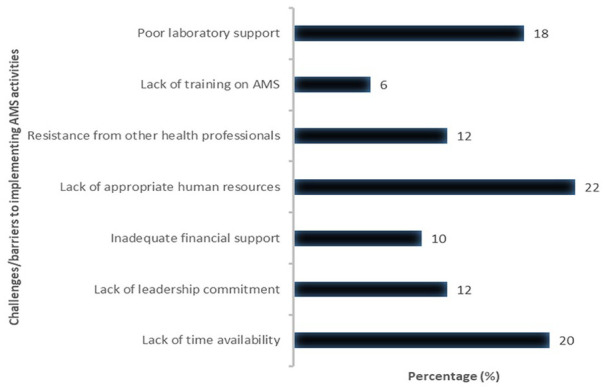
- Monitoring, reporting, and barriers: audit of antibiotic use was done in 6/15 (40.0%), monitoring of quantity/type of antibiotic use in 6/15 (40.0%), monitoring of susceptibility/resistance in 3/15 (20.0%), antibiogram development in 3/15 (20.0%), feedback on antibiotic use in 10/15 (66.7%), and feedback on resistance/susceptibility in 5/15 (33.3%). Pharmacist-led AMS was associated with formal AMS training (P = .001), AMS action plan (P = .026), regular activity reports (P = .007), and approved antibiotic formulary (P = .026). Reported barriers were lack of human resources (73.3%), staff time availability (66.7%), and poor laboratory support (60.0%).
Methods
- Cross-sectional survey in 2 of Ghana’s 16 administrative regions (Greater Accra and Volta) among 15 public hospitals; all primary, secondary, and tertiary hospitals in the selected regions were included, and a web-based Google questionnaire was distributed through hospital administrators to a representative with in-depth knowledge of AMS operations.
- The questionnaire was adapted from the WHO practical toolkit for ASPs in LMICs and the CDC Core Elements of Hospital Antibiotic Stewardship Programs, pre-tested among 4 experts, and covered facility characteristics, the 7 core elements, and barriers; most responses were “Yes,” “No,” or “Not sure.”
- Data were imported into Microsoft Excel and then STATA version 14 for descriptive and bivariate analysis using Fisher exact test; ethical clearance was obtained from the University of KwaZulu-Natal and the Ghana Health Service.
Limitations
- Stated in the paper: the study was limited to public hospitals, conducted in only 2 of 16 administrative regions that may differ socio-economically and culturally, and did not segregate data by facility site and size to determine statistical differences in implementation of the 7 core elements.
- Evident from the text: the cross-sectional, self-administered survey relied on one hospital representative per facility, which may introduce reporting or social desirability bias and lacks independent validation.
- Evident from the text: the small sample of 15 hospitals and purposive selection of two regions limit generalizability to all Ghanaian hospitals, and the cross-sectional design cannot establish causality.
Model-written summary. Check it against the paper before relying on it.
Integrity signals
Registry
Cites
Statistics
Figures
Verification
Claims the paper makes
0 Valid · 0 Not valid · 20 Not checked · 61 Own results and interpretations
A result the paper reports from its own data — it cites no other source for it, so there is none to check. The quote shows it is in the paper.
In the paper
“Only 20.0% (n = 3) of the facilities monitor antibiotic susceptibility and resistance rates for key bacteria periodically”
§ An Assessment of the Current Level of Implementation of the Core Elements of Antimicrobial Stewardship Programs in Public Hospitals in Ghana > Results > The Core Element of Monitoring and Surveillance of AMS Activates
plainn = 3- Asserted: passes — The authors put it forward as true.
- Checkable: passes — It can be checked against evidence.
- Load-bearing: passes — The paper’s conclusions depend on it.
- Based: passes — The paper gives a reason why it holds.
A result the paper reports from its own data — it cites no other source for it, so there is none to check. The quote shows it is in the paper.
In the paper
“About one-fourth (n = 4, 26.7%) of the participating health facilities reported that they had antimicrobial policies that guide their prescribing of antibiotics”
§ An Assessment of the Current Level of Implementation of the Core Elements of Antimicrobial Stewardship Programs in Public Hospitals in Ghana > Results > The Core Element of the Extent of Implementation of AMS Actions and Interventions
plainn = 4- Asserted: passes — The authors put it forward as true.
- Checkable: passes — It can be checked against evidence.
- Load-bearing: passes — The paper’s conclusions depend on it.
- Based: passes — The paper gives a reason why it holds.
A result the paper reports from its own data — it cites no other source for it, so there is none to check. The quote shows it is in the paper.
In the paper
“the healthcare facility having an AMS action plan for the year (P = .026)”
§ An Assessment of the Current Level of Implementation of the Core Elements of Antimicrobial Stewardship Programs in Public Hospitals in Ghana > Results > The Association Between Pharmacist-led AMS Activities and Some ASP Core Elements
plainstates an association- Asserted: passes — The authors put it forward as true.
- Checkable: passes — It can be checked against evidence.
- Load-bearing: unclear — It is unclear whether the paper’s conclusions depend on it.
- Based: passes — The paper gives a reason why it holds.
A result the paper reports from its own data — it cites no other source for it, so there is none to check. The quote shows it is in the paper.
In the paper
“Just over half (n = 8, 53.3%) of the participating health facilities had a pharmacist (s) responsible for leading the implementation of AMS activities to promote the rational use of antibiotics.”
§ An Assessment of the Current Level of Implementation of the Core Elements of Antimicrobial Stewardship Programs in Public Hospitals in Ghana > Results > The Core Element of Pharmacy Expertize on AMS
plainn = 8- Asserted: passes — The authors put it forward as true.
- Checkable: passes — It can be checked against evidence.
- Load-bearing: unclear — It is unclear whether the paper’s conclusions depend on it.
- Based: passes — The paper gives a reason why it holds.
A result the paper reports from its own data — it cites no other source for it, so there is none to check. The quote shows it is in the paper.
In the paper
“facilities with AMS teams in place who are able to produce and disseminate regular activity reports to all key stakeholders (P = .007)”
§ An Assessment of the Current Level of Implementation of the Core Elements of Antimicrobial Stewardship Programs in Public Hospitals in Ghana > Results > The Association Between Pharmacist-led AMS Activities and Some ASP Core Elements
plainstates an association- Asserted: passes — The authors put it forward as true.
- Checkable: passes — It can be checked against evidence.
- Load-bearing: unclear — It is unclear whether the paper’s conclusions depend on it.
- Based: passes — The paper gives a reason why it holds.
47 more claims
Create a free account to see all 81 claims and to verify the 58 references still open.
- Probably not a substantial claim. 20
- It may state two separate claims as one. 15
- The quote only partly states this claim. 2
Self-check
Percentages, sums and reported differences re-computed from the paper’s own numbers.
Each contradiction between two passages listed here was confirmed by an independent check.
Rated major: it would touch a result — a value a result rests on, reported and recomputed p-values on opposite sides of the significance level, two passages that conflict with no sign which is right, or a cited work retracted before this paper was published.
In the paper
§ An Assessment of the Current Level of Implementation of the Core Elements of Antimicrobial Stewardship Programs in Public Hospitals in Ghana > Results > The Association Between Pharmacist-led AMS Activities and Some ASP Core Elements
“AMS produces and disseminate regular activity report (n = 5) | AMS produces and disseminate regular activity report (n = 5) | AMS produces and disseminate regular activity report (n = 5) | AMS produces and disseminate regular activity report (n = 5) | .007*”
§ An Assessment of the Current Level of Implementation of the Core Elements of Antimicrobial Stewardship Programs in Public Hospitals in Ghana > Results > The Association Between Pharmacist-led AMS Activities and Some ASP Core Elements
“| Yes | 3 (60.0) | 0 (0.0) | 3 (100.0) | | | No | 2 (40.0) | 0 (0.0) | 2 (100.0) | |”
Rated major: it would touch a result — a value a result rests on, reported and recomputed p-values on opposite sides of the significance level, two passages that conflict with no sign which is right, or a cited work retracted before this paper was published.
In the paper
§ An Assessment of the Current Level of Implementation of the Core Elements of Antimicrobial Stewardship Programs in Public Hospitals in Ghana > Results > The Association Between Pharmacist-led AMS Activities and Some ASP Core Elements
“Facility has formulary with a list of approved antibiotics (n = 15) | Facility has formulary with a list of approved antibiotics (n = 15) | Facility has formulary with a list of approved antibiotics (n = 15) | Facility has formulary with a list of approved antibiotics (n = 15) | .026*”
§ An Assessment of the Current Level of Implementation of the Core Elements of Antimicrobial Stewardship Programs in Public Hospitals in Ghana > Results > The Association Between Pharmacist-led AMS Activities and Some ASP Core Elements
“| Yes | 12 (80.0) | 6 (50.0) | 6 (50.0) | | | No | 3 (20.0) | 1 (33.3) | 2 (66.7) | |”
Rated minor: it would not touch a result — a value no result rests on, a p-value that stays on the same side of the significance level, or a conflict that is clerical, resolved elsewhere in the paper, or outside its own findings.
In the paper
“| No | 8 (43.3) | 4 (50.0) | 4 (50.0) | |”
§ An Assessment of the Current Level of Implementation of the Core Elements of Antimicrobial Stewardship Programs in Public Hospitals in Ghana > Results > The Association Between Pharmacist-led AMS Activities and Some ASP Core Elements
Reported 43.3 · recomputed 53.333333
Rated minor: it would not touch a result — a value no result rests on, a p-value that stays on the same side of the significance level, or a conflict that is clerical, resolved elsewhere in the paper, or outside its own findings.
In the paper
“| No | 8 (43.3) | 7 (87.5) | 1 (12.5) | |”
§ An Assessment of the Current Level of Implementation of the Core Elements of Antimicrobial Stewardship Programs in Public Hospitals in Ghana > Results > The Association Between Pharmacist-led AMS Activities and Some ASP Core Elements
Reported 43.3 · recomputed 53.333333
Rated minor: it would not touch a result — a value no result rests on, a p-value that stays on the same side of the significance level, or a conflict that is clerical, resolved elsewhere in the paper, or outside its own findings.
In the paper
§ An Assessment of the Current Level of Implementation of the Core Elements of Antimicrobial Stewardship Programs in Public Hospitals in Ghana > Introduction
“The 7 core elements of ASP in the toolkit comprise of leadership commitment, accountability and responsibilities, AMS actions and interventions, education and training, monitoring and surveillance, and reporting and feedback.”
§ An Assessment of the Current Level of Implementation of the Core Elements of Antimicrobial Stewardship Programs in Public Hospitals in Ghana > Results > The Core Element of Pharmacy Expertize on AMS
“### The Core Element of Pharmacy Expertize on AMS”
5 more findings
Create a free account to see every finding of this check.
Citations
Cites
Global burden of bacterial antimicrobial resistance in 2019: a systematic analysis
Murray, C. J. L., Ikuta, K. S., Sharara, F., Swetschinski, L., Robles Aguilar, G., Gray, A., Han, C., Bisignano, C., Rao, P., Wool, E., et al. (2022) · The Lancet · doi:10.1016/s0140-6736(21)02724-0 · Cited by 16,316
(2016) · Cited by 2,888
Antimicrobial Resistance: Implications and Costs
Dadgostar, P. (2019) · Infection and Drug Resistance · doi:10.2147/idr.s234610 · Cited by 2,024
Interventions to improve antibiotic prescribing practices for hospital inpatients
Davey, P., Brown, E., Charani, E., Fenelon, L., Gould, I. M., Holmes, A., Ramsay, C. R., Wiffen, P. J., & Wilcox, M. (2013) · Cochrane Database of Systematic Reviews · doi:10.1002/14651858.cd003543.pub3 · Cited by 1,864
Stemming the Superbug Tide: Just A Few Dollars More
OECD (2018) · OECD Health Policy Studies · doi:10.1787/9789264307599-en · Cited by 748
Pollack, L. A., & Srinivasan, A. (2014) · Clinical Infectious Diseases · doi:10.1093/cid/ciu542 · Cited by 574
Antibiotic stewardship in low- and middle-income countries: the same but different?
Cox, J. A., Vlieghe, E., Mendelson, M., Wertheim, H., Ndegwa, L., Villegas, M. V., Gould, I., & Levy Hara, G. (2017) · Clinical Microbiology and Infection · doi:10.1016/j.cmi.2017.07.010 · Cited by 529 · cited 7×
“15,21,47 This suggests that pharmacists must be empowered through formal training and certificate programs in infectious disease management and AMS principles and strategies to enhance their contribution toward ASPs in hospitals.”
BackgroundMethodInfluentialValue of hospital antimicrobial stewardship programs [ASPs]: a systematic review
Nathwani, D., Varghese, D., Stephens, J., Ansari, W., Martin, S., & Charbonneau, C. (2019) · Antimicrobial Resistance & Infection Control · doi:10.1186/s13756-019-0471-0 · Cited by 457
Karanika, S., Paudel, S., Grigoras, C., Kalbasi, A., & Mylonakis, E. (2016) · Antimicrobial Agents and Chemotherapy · doi:10.1128/aac.00825-16 · Cited by 402
An international cross-sectional survey of antimicrobial stewardship programmes in hospitals
Howard, P., Pulcini, C., Levy Hara, G., West, R. M., Gould, I. M., Harbarth, S., & Nathwani, D. (2015) · Journal of Antimicrobial Chemotherapy · doi:10.1093/jac/dku497 · Cited by 271
Cited by
Antimicrobial stewardship from a One Health perspective
James, R. S., Hardefeldt, L. Y., Ierano, C., Charani, E., Dowson, L., Elkins, S., & Thursky, K. (2025) · Nature Reviews Microbiology · doi:10.1038/s41579-025-01233-3 · Cited by 59
Mudenda, S., Mufwambi, W., & Mohamed, S. (2024) · Pharmacology & Pharmacy · doi:10.4236/pp.2024.1512024 · Cited by 20
Mudenda, S., Hakayuwa, C. M., Lubanga, A. F., Kasanga, M., Daka, V., Salachi, K. I., Mwaba, M., Chileshe, C., Champo, M., Kamayani, M., et al. (2025) · Pharmacology & Pharmacy · doi:10.4236/pp.2025.167014 · Cited by 18
Wesangula, E., Chizimu, J. Y., Mapunjo, S., Mudenda, S., Seni, J., Mitambo, C., Yamba, K., Gashegu, M., Nhantumbo, A. A., Francis, E. N., et al. (2025) · Antibiotics · doi:10.3390/antibiotics14030266 · Cited by 17
de Lima, A. C. B., Buabeng, K. O., Sakyi, M., Chadwala, H. M., Devereaux, N., Mitambo, C., Mugo‐Sitati, C., Njuhigu, J., Revathi, G., Tanui, E., et al. (2025) · Antibiotics · doi:10.3390/antibiotics14080794 · Cited by 10
Metadata
- Authors
- Sefah, I. A., Chetty, S., Yamoah, P., Godman, B., & Bangalee, V.
- Affiliations
- University of Health and Allied Sciences (GH)
- University of the Witwatersrand (ZA)
- University of Strathclyde (GB)
- University of KwaZulu-Natal (ZA)
- Corresponding author
- Sefah, Israel Abebrese
- Venue
- Hospital Pharmacy
- Publisher
- SAGE Publications
- Published
- 2024-02-15
- Volume
- 59
- Issue
- 3
- Pages
- 367-377
- ISSN
- 0018-5787 (ISSN-L)
- 1945-1253
- PMC
- PMC11097926
- OpenAlex
- W4391840878
- Cited by
- 20
- References
- 64
- Citations by year
- 2026: 7 · 2025: 11 · 2024: 2
- FWCI
- 5.01
- Type
- journal article
- Language
- en
- Open access
- hybrid
- doi.org
- Licence
- cc-by-nc
- creativecommons.org/licenses/by-nc/4.0/ (vor)
- journals.sagepub.com/page/policies/text-and-data-mining-license (tdm)
- Locations
- Hospital Pharmacy (publishedVersion, cc-by-nc)
- PubMed Central (publishedVersion, cc-by-nc)
- PubMed (publishedVersion)
- Strathprints: The University of Strathclyde institutional repository (University of Strathclyde) (acceptedVersion, cc-by-nc)
- Topics
- Health Sciences › Medicine › Infectious Diseases › Antibiotic Use and Resistance
- Health Sciences › Medicine › Infectious Diseases › Infection Control in Healthcare
- Health Sciences › Medicine › Surgery › Surgical site infection prevention
- Keywords
- antimicrobial stewardship programs, antimicrobial resistance, public hospitals, Ghana, leadership commitment, bacterial resistance surveillance, pharmacy education, implementation barriers, human resources for health, laboratory facilities
About these checks
Registry, retraction, Cites and statistics results are computed, not judged, with one exception: a printed reference that no index lists is read once by a model before it counts as a citation error. Claims are extracted by a model and kept only when their quote appears verbatim in the text; each cited source is then checked, with a model’s help, for whether it says what the claim relies on. Those verdicts can be wrong — read the claim’s quote and the cited source before relying on one.
A language model drew the claims from the paper on 2026-11-23, under version 3 of the claim definition (model deepseek-v4.1-flash, prompt extract-v3).
A second model labelled each claim on 2026-11-23 (model jev-1.13-20260917, definition revision gold-guideline-v0.2).
Statistics and arithmetic are recomputed, not judged.
Confidence bands are shown only for fields calibrated on our annotated test set. None is calibrated yet, so no band is shown.
What counts as a claim ›How we measure confidence ›How we check this ›
Are you an author, or do you see a problem with this page? Request a review
How to cite
Cite CoChat for the checks on this page, and the paper for its own findings.
- This page
- CoChat. (2026). Citation check: An Assessment of the Current Level of Implementation of the Core Elements of Antimicrobial Stewardship Programs in Public Hospitals in Ghana. https://app.cochat.ai/papers/10.1177/00185787231224066
- The paper
- Sefah, I. A., Chetty, S., Yamoah, P., Godman, B., & Bangalee, V. (2024). An Assessment of the Current Level of Implementation of the Core Elements of Antimicrobial Stewardship Programs in Public Hospitals in Ghana. Hospital Pharmacy. https://doi.org/10.1177/00185787231224066
Data sources
Bibliographic data: Semantic Scholar, OpenAlex, Crossref.
Contains information from the Semantic Scholar Academic Graph Datasets, made available under the ODC Attribution License (ODC-BY 1.0).
Semantic Scholar’s data is described in: Kinney, R., et al. (2023). The Semantic Scholar Open Data Platform. arXiv:2301.10140.
