

Increased clinical and economic burden associated with peripheral intravenous catheter-related complications: analysis of a US hospital discharge database
Open accessThe DOI matches its Crossref record; 32 of the 33 references it cites were found in a registry or an index.
Abstract
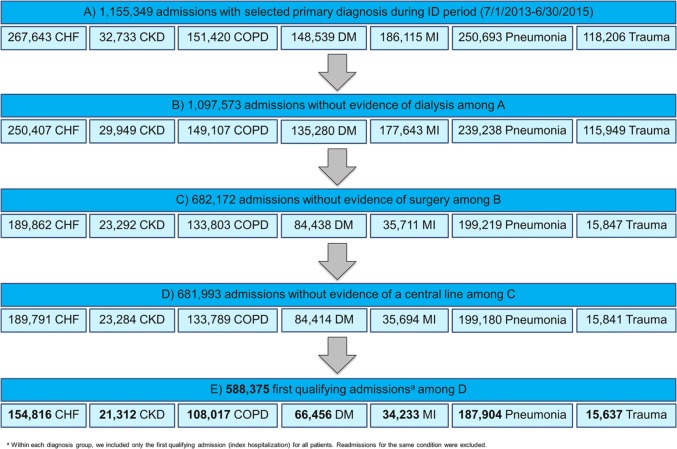
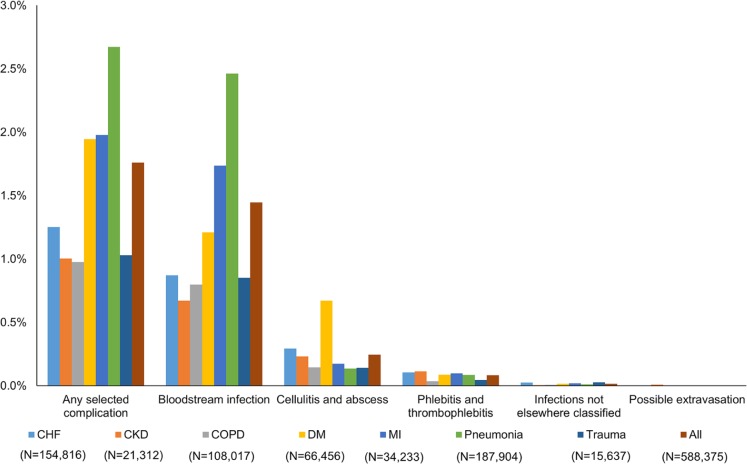
The burden of complications associated with peripheral intravenous use is underevaluated, in part, due to the broad use, inconsistent coding, and lack of mandatory reporting of these devices. This study aimed to analyze the clinical and economic impact of peripheral intravenous–related complications on hospitalized patients. This analysis of Premier Perspective ® Database US hospital discharge records included admissions occurring between July 1, 2013 and June 30, 2015 for pneumonia, chronic obstructive pulmonary disease, myocardial infarction, congestive heart failure, chronic kidney disease, diabetes with complications, and major trauma (hip, spinal, cranial fractures). Admissions were assumed to include a peripheral intravenous. Admissions involving surgery, dialysis, or central venous lines were excluded. Multivariable analyses compared inpatient length of stay, cost, admission to intensive care unit, and discharge status of patients with versus without peripheral intravenous–related complications (bloodstream infection, cellulitis, thrombophlebitis, other infection, or extravasation). Models were conducted separately for congestive heart failure, chronic obstructive pulmonary disease, diabetes with complications, and overall (all 7 diagnoses) and adjusted for demographics, comorbidities, and hospital characteristics. We identified 588 375 qualifying admissions: mean (SD), age 66.1 (20.6) years; 52.4% female; and 95.2% urgent/emergent admissions. Overall, 1.76% of patients (n = 10 354) had peripheral intravenous–related complications. In adjusted analyses between patients with versus without peripheral intravenous complications, the mean (95% confidence interval) inpatient length of stay was 5.9 (5.8-6.0) days versus 3.9 (3.9-3.9) days; mean hospitalization cost was $10 895 ($10 738-$11 052) versus $7009 ($6988-$7031). Patients with complications were less likely to be discharged home versus those without (62.4% [58.6%-66.1%] vs 77.6% [74.6%-80.5%]) and were more likely to have died (3.6% [2.9%-4.2%] vs 0.7% [0.6%-0.9%]). Models restricted to single admitting diagnosis were consistent with overall results. Patients with peripheral intravenous–related complications have longer length of stay, higher costs, and greater risk of death than patients without such complications; this is true across diagnosis groups of interest. Future research should focus on reducing these complications to improve clinical and economic outcomes.
Overview
The claims and statistics of this paper haven’t been checked yet.
Free: it reads the open-access text and checks the first 5 claims that cite a source we can check. Create a free account to check every claim.
Integrity signals
Registry
Cites
Statistics
Figures
Verification
Claims the paper makes
The claims and statistics of this paper haven’t been checked yet.
Free: it reads the open-access text and checks the first 5 claims that cite a source we can check. Create a free account to check every claim.
Self-check
Percentages, sums and reported differences re-computed from the paper’s own numbers.
The self-check needs the paper’s full text.
Citations
Cites
Guidelines for the Prevention of Intravascular Catheter-related Infections
O'Grady, N. P., Alexander, M., Burns, L. A., Dellinger, E. P., Garland, J., Heard, S. O., Lipsett, P. A., Masur, H., Mermel, L. A., Pearson, M. L., et al. (2011) · Clinical Infectious Diseases · doi:10.1093/cid/cir257 · Cited by 4,699
Maki, D. G., Kluger, D. M., & Crnich, C. J. (2006) · Mayo Clinic Proceedings · doi:10.4065/81.9.1159 · Cited by 1,549
Guidelines for the management of intravascular catheter-related infections
Mermel, L. A., Farr, B. M., Sherertz, R. J., Raad, I. I., O'Grady, N., Harris, J. S., & Craven, D. E. (2001) · Clinical Infectious Diseases · doi:10.1086/320001 · Cited by 1,449
Pittet, D. (1994) · JAMA · doi:10.1001/jama.1994.03510440058033 · Cited by 926
Scott, R. D. (2009) · Cited by 757
Marschall, J., Mermel, L. A., Fakih, M., Hadaway, L., Kallen, A., O’Grady, N. P., Pettis, A. M., Rupp, M. E., Sandora, T., Maragakis, L. L., et al. (2014) · Infection Control & Hospital Epidemiology · doi:10.1086/676533 · Cited by 550
Rickard, C. M., Webster, J., Wallis, M. C., Marsh, N., McGrail, M. R., French, V., Foster, L., Gallagher, P., Gowardman, J. R., Zhang, L., et al. (2012) · The Lancet · doi:10.1016/s0140-6736(12)61082-4 · Cited by 428
Blot, S. I., Depuydt, P., Annemans, L., Benoit, D., Hoste, E., De Waele, J. J., Decruyenaere, J., Vogelaers, D., Colardyn, F., & Vandewoude, K. H. (2005) · Clinical Infectious Diseases · doi:10.1086/497833 · Cited by 409
Firstenberg, M., Kornbau, C., Lee, K., & Hughes, G. (2015) · International Journal of Critical Illness and Injury Science · doi:10.4103/2229-5151.164940 · Cited by 327
Clinically-indicated replacement versus routine replacement of peripheral venous catheters
Webster, J., Osborne, S., Rickard, C. M., & New, K. (2013) · Cochrane Database of Systematic Reviews · doi:10.1002/14651858.cd007798.pub3 · Cited by 313
Research works printed but not linked: 2
- Crnich C Maki D Infections caused by intravascular devices: epidemiology, pathogenesis, diagnosis, prevention, and treatment. In: Grota P et al, eds. APIC Text of Infection Control and Epidemiology. Vol 1 2nd ed. Washington, DC: Association for Professionals in Infection Control and Epidemiology, Inc; 2005: 2421- 2426.
- Johnson & Johnson. Clinical Input on PIV BOI Study Plan Meeting. Beverly Hills, CA: Centers for Medicare & Medicaid, 2016.
Cited by
Peripheral intravenous catheter infection and failure: A systematic review and meta-analysis
Marsh, N. M., Larsen, E. N., Ullman, A. J., Mihala, G., Cooke, M. L., Chopra, V., Ray‐Barruel, G., & Rickard, C. M. (2023) · International Journal of Nursing Studies · doi:10.1016/j.ijnurstu.2023.104673 · Cited by 160
Best practice in the use of peripheral venous catheters: A scoping review and expert consensus
Zingg, W., Barton, A., Bitmead, J., Eggimann, P., Pujol, M., Simon, A., & Tatzel, J. (2023) · Infection Prevention in Practice · doi:10.1016/j.infpip.2023.100271 · Cited by 85
Guénézan, J., Marjanovic, N. S., Drugeon, B., Neill, R. O., Liuu, É., Roblot, F., Palazzo, P., Bironneau, V., Prevost, F., Paul, J. A., et al. (2021) · The Lancet Infectious Diseases · doi:10.1016/s1473-3099(20)30738-6 · Cited by 68
Drugeon, B., Guénézan, J., Pichon, M., Devos, A., Fouassin, X., Neveu, A., Boinot, L., Pratt, V., & Mimoz, O. (2023) · Journal of Hospital Infection · doi:10.1016/j.jhin.2023.02.012 · Cited by 50
Minimising Blood Stream Infection: Developing New Materials for Intravascular Catheters
Casimero, C., Ruddock, T., Hegarty, C., Barber, R., Devine, A., & Davis, J. (2020) · Medicines · doi:10.3390/medicines7090049 · Cited by 29
Indarwati, F., Munday, J., & Keogh, S. J. (2023) · Journal of Pediatric Nursing · doi:10.1016/j.pedn.2023.08.009 · Cited by 34
Lu, H., Yang, Q., Tian, B., Lyu, Y., Zheng, X., & Xin, X. (2021) · International Journal of Nursing Practice · doi:10.1111/ijn.12976 · Cited by 21
A Review of Best Practices Related to Intravenous Line Management for Nurses
Panepinto, R., Harris, J., & Wellette, J. N. (2021) · Nursing Clinics of North America · doi:10.1016/j.cnur.2021.05.001 · Cited by 17
Dwell Time and Risk of Bloodstream Infection With Peripheral Intravenous Catheters
Zanella, M.-C., Catho, G., Jackson, H., Lotfinejad, N., Sauvan, V., Chraïti, M., Zingg, W., Harbarth, S., & Buetti, N. (2025) · JAMA Network Open · doi:10.1001/jamanetworkopen.2025.7202 · Cited by 15
Mechanical deformation of elastomer medical devices can enable microbial surface colonization
van den Berg, D., Asker, D., Awad, T. S., Lavielle, N., & Hatton, B. D. (2023) · Scientific Reports · doi:10.1038/s41598-023-34217-5 · Cited by 21
Maunoury, F., Drugeon, B., Boisson, M., Marjanovic, N. S., Couvreur, R., Mimoz, O., Guénézan, J., & Study, O. B. O. T. C.-3. (2022) · PLoS ONE · doi:10.1371/journal.pone.0269750 · Cited by 16
Bahl, A., Johnson, S., Mielke, N., & Karabon, P. (2021) · PLoS ONE · doi:10.1371/journal.pone.0253243 · Cited by 15
Zhang, S., Lingle, B. S., & Phelps, S. (2022) · Journal of Infusion Nursing · doi:10.1097/nan.0000000000000467 · Cited by 13
CE: Evidence-Based Practice for Peripheral Intravenous Catheter Management
Ray‐Barruel, G., & Alexander, M. (2022) · AJN American Journal of Nursing · doi:10.1097/01.naj.0000905568.37179.01 · Cited by 15
Calleja, R., Mielke, N., Lee, R., Johnson, S. M., & Bahl, A. (2023) · Journal of Emergency Nursing · doi:10.1016/j.jen.2023.06.001 · Cited by 11
Bahl, A., Haddad, L., Hoerauf, K., Mares, A., & Alsbrooks, K. (2023) · International Journal of Nursing and Health Care Research · doi:10.29011/2688-9501.101436 · Cited by 22
Bahl, A., Xing, Y., Gibson, S. M., & DiLoreto, E. (2024) · PLoS ONE · doi:10.1371/journal.pone.0310676 · Cited by 10
Schultz, M. A., Walden, R. L., Cato, K., Coviak, C. P., Cruz, C., D’Agostino, F., Douthit, B. J., Forbes, T. H., Gao, G., Lee, M. A., et al. (2021) · CIN Computers Informatics Nursing · doi:10.1097/cin.0000000000000705 · Cited by 12
“…modeling methods include risk prediction algorithm development, 60 linear regression, 61 multivariate statistical analysis using SEM, 62 multivariable logistic regression, 60,61,63 – 66 negative binomial-logit hurdle regression, 67 geospatial analytic methods, 55 and a network analysis approach.”
MethodOperation STICK: A vascular access specialty program for the generalist emergency medicine clinician
Bahl, A., Mielke, N., DiLoreto, E., & Gibson, S. M. (2024) · The Journal of Vascular Access · doi:10.1177/11297298231222060 · Cited by 9
Bahl, A., Mielke, N., Xing, Y., DiLoreto, E., Zimmerman, T., & Gibson, S. M. (2024) · The Journal of Vascular Access · doi:10.1177/11297298231219776 · Cited by 11
“2,7,10 Overall, poor PIVC performance represents a significant burden to the modern healthcare system that requires immediate solutions.”
Faltoni, M., Catho, G., Pianca, E., Obama, B. M., Zanella, M.-C., Chraïti, M., Fortchantre, L., Harbarth, S., & Buetti, N. (2023) · Clinical Microbiology and Infection · doi:10.1016/j.cmi.2023.12.018 · Cited by 6
Best practice in the use of peripheral venous catheters: A consensus from French experts
Mimoz, O., Debonne, A., Glanard, A., Keïta-Perse, O., & Lucet, J. (2024) · Infectious Diseases Now · doi:10.1016/j.idnow.2024.104923 · Cited by 8
Myths Glorify What Reality Neglects: Efficacy and Safety of Chlorhexidine Gluconate
Drugeon, B., Rickard, C. M., Buetti, N., Guénézan, J., & Mimoz, O. (2025) · Current Infectious Disease Reports · doi:10.1007/s11908-025-00865-z · Cited by 9
“These infections can lead to severe complications, longer hospital stays, increased mortality and higher hospital costs [1–5].”
Mielke, N., Xing, Y., Gibson, S. M., DiLoreto, E., & Bahl, A. (2023) · Therapeutics and Clinical Risk Management · doi:10.2147/tcrm.s435628 · Cited by 5
Çiftçi, M., Akgün, M., & Demirdağ, H. (2024) · European Archives of Medical Research · doi:10.4274/eamr.galenos.2023.48278 · Cited by 7
Implementation of the I-DECIDED® tool for PIVC assessment and decision making: discussion paper
Ray‐Barruel, G., Silva, T. L., & Rocha, P. K. (2025) · British Journal of Nursing · doi:10.12968/bjon.2025.0013 · Cited by 4
Tegegne, B., Checkole, D., Wuhib, M., Zeru, L. M., Yalew, Z. M., Ademe, S., Shiferaw, M. L., & Edmealem, A. (2025) · BMC Nursing · doi:10.1186/s12912-025-03484-0 · Cited by 6
Schults, J. A., Ball, D. L., Sullivan, C. M., Rossow, N., Ray‐Barruel, G., Walker, R., Stantić, B., & Rickard, C. M. (2022) · Frontiers in Medicine · doi:10.3389/fmed.2022.962130 · Cited by 4
Bogale, A. D., Ali, M. S., Yohannes, S., Tsehay, Y. T., Mulatu, S., & Zewdie, A. (2024) · BMC Nursing · doi:10.1186/s12912-024-01737-y · Cited by 4
“Still, the problem is a major public health problem, and it affects the health of the patient, and the quality of health care [13].”
BackgroundDrugeon, B., Rickard, C. M., Schults, J. A., Guénézan, J., & Mimoz, O. (2025) · Journal of Infection and Public Health · doi:10.1016/j.jiph.2025.102851 · Cited by 4
Krath, J., Fredskilde, J., Christensen, S. K., Baltsen, C. D., Valentin, K., Offersen, R., & Juhl‐Olsen, P. (2024) · Acta Anaesthesiologica Scandinavica · doi:10.1111/aas.14517 · Cited by 7
Torné‐Ruiz, A., Sanromà‐Ortíz, M., Corral‐Nuñez, A., Medel, D., Roca, J., & García‐Expósito, J. (2024) · Nursing Open · doi:10.1002/nop2.2229 · Cited by 3
“…(Xu et al., 2023 ), the incidence of which is underestimated due to the frequent and daily use of catheters at the point- of-care level, the challenge of identifying complications, the inconsistent use of PVC-associated procedural codes and the voluntary nature of PVC reporting (Lim et al., 2019 ).”
BackgroundDoll, M. S., Aprile, D. C. B., Gonçalves, A. L. P., Silva, B. S. M., Kusahara, D. M., & Lopes, C. T. (2024) · Journal of Infusion Nursing · doi:10.1097/nan.0000000000000571 · Cited by 5
“2,3 4-8 These complications are associated with prolonged hospital stays, escalating costs, and an elevated risk of mortality.”
Tadros, A. R., Prausnitz, M. R., & Felner, E. I. (2025) · Drug Delivery and Translational Research · doi:10.1007/s13346-025-01899-5 · Cited by 3
“More than 20 billion injections are administered annually across the world, and in the United States, over 200 million intravenous catheters are placed annually [7, 8].”
Drugeon, B., Mihala, G., Schults, J. A., Bigaud, B., Guénézan, J., Batiot, G., Barker, N., Marjanovic, N. S., Buetti, N., & Mimoz, O. (2026) · JAMA Network Open · doi:10.1001/jamanetworkopen.2025.58954 · Cited by 3
Integration of Riboflavin-Modified Carbon Fiber Mesh Electrode Systems in a 3D-Printed Catheter Hub
Casimero, C., Smith, R. B., & Davis, J. (2023) · Micromachines · doi:10.3390/mi15010079 · Cited by 2
“It has been estimated that some 300 million peripheral intravascular catheters (PIVCs) are inserted annually in the US, along with 3–5 million central venous catheters (CVCs) [1,2].”
BackgroundAssessment of peripheral venous catheters microbiota and its association with phlebitis
Lopes, G. F., Oliveira, V. D. C., Monteiro, R. M., Domingues, P. C. A., Bim, F. L., Bim, L. L., da Silva, G. B. F., dos Santos, A. P., Nascimento, C. R. R., de Andrade, D., et al. (2024) · Infection Disease & Health · doi:10.1016/j.idh.2024.07.005 · Cited by 5
Bahl, A., Hijazi, M. A., & Chen, N. (2022) · PLoS ONE · doi:10.1371/journal.pone.0262793 · Cited by 3
Care for peripheral intravenous catheter: an audit in two French university hospitals
Gardes, S., Pandini, A., Tazarourte, K., Liard, C., Deschamps, F., Verbist, P., Nancey, S., Cotte, E., Potinet, V., Vanhems, P., et al. (2025) · European Journal of Clinical Microbiology & Infectious Diseases · doi:10.1007/s10096-025-05243-0 · Cited by 1
Piriz, M., Rombauts, A., Roch, N., Cortes-Palacios, A. P., Fernandez-Piqueras, E., Serrano-Condal, S., Taltavull-Menendez, M., Grillo, S., Simonetti, A. F., Llorach, P. D., et al. (2025) · Journal of Hospital Infection · doi:10.1016/j.jhin.2025.09.009 · Cited by 1
Drugeon, B., Rickard, C. M., Peters, N., Chopra, V., & Mimoz, O. (2025) · Journal of Advanced Nursing · doi:10.1111/jan.70347 · Cited by 2
“These practices contribute to patient discomfort, increased workload and resource waste (Drugeon et al. 2023; Lim et al. 2019; Maunoury et al. 2022; González López et al. 2014).”
Beyene, Z., Zeleke, H., Ayenew, T., Abebe, M., Kefie, M., Edmealem, A., & Amha, H. (2025) · PLoS ONE · doi:10.1371/journal.pone.0336176 · Cited by 1
Coleman, K., Bonamer, J., Benham, C., Szmania, T., & Williams, K. (2025) · Journal for Nurses in Professional Development · doi:10.1097/nnd.0000000000001206 · Cited by 1
Olivares, A., Schuhler‐Husson, C., Zine, Y., & Drouin, S. (2026) · Healthcare Technology Letters · doi:10.1049/htl2.70040 · Cited by 2
Siniscalchi, C., Basaglia, M., Meschi, T., Cerundolo, N., & Micco, P. D. (2026) · Journal of Blood Medicine · doi:10.2147/jbm.s601961 · Cited by 1
“9 Infectious complications also matter.”
The potential role of through the needle PIVC insertion in reducing early catheter contamination
Anstett, M., & Brainard, R. E. (2023) · British Journal of Nursing · doi:10.12968/bjon.2023.32.14.s30 · Cited by 1
Difficult intravenous access (DIVA) in the adult population: an umbrella review
Torné-Ruiz, A., Delgado, M., Moreno, S., Corral-Núñez, A., Cemeli, T., & Roca, J. (2026) · BMJ Open · doi:10.1136/bmjopen-2026-121458
“8 To mitigate these negative consequences and improve the experience of the patient, many strategies have been explored to improve the treatment of a person with DIVA.”
Qi, M., He, J., & Yan, J. (2020) · American Journal of Nursing Science · doi:10.11648/j.ajns.20200906.18
“The PIVCs of the patients were removed after symptoms of bloodstream infection, and the tip of the catheters was cut 1-2centimetres, while retaining used and unused infusion devices and drugs by the patients for bacterial culture.”
BackgroundInfluentialRay‐Barruel, G. (2021) · Vascular Access · doi:10.5737/cvaa-153714 · Cited by 1
“…are common; up to two-thirds of PIVCs (Marsh et al, 2021; Marsh et al, 2018) and one-fourth of CVADs (Takashima et al, 2018) cease to function before treatment is complete, resulting in painful and time-consuming additional insertion procedures,which also increases hospital costs (Lim et al, 2019).”
BackgroundThe Potential Role of through the Needle PIVC Insertion in Reducing Early Catheter ContaminationCE
Anstett, M., & Brainard, R. E. (2023) · Journal of the Association for Vascular Access · doi:10.2309/java-d-22-00028
Ribeiro, S., Valente, S., Sousa, S. S., Lopes, M., Abreu, N., & Alves, E. (2023) · Jornal Brasileiro de Economia da Saúde · doi:10.21115/jbes.v15.n1.p71-80 · Cited by 7
Soloway, L. E., & Karpanen, T. J. (2023) · Journal of the Association for Vascular Access · doi:10.2309/java-d-23-00015
Marsh, N. M., Larsen, E. N., & Ullman, A. J. (2024) · International Journal of Nursing Studies · doi:10.1016/j.ijnurstu.2024.104727
Implementation of Clinical Decision Support to Identify and Improve Treatment for Severe PIVIE
Thompson, S. A., Wood, S., Parker, A., Kandswamy, S., & Orenstein, E. W. (2024) · Studies in health technology and informatics · doi:10.3233/shti240106
Implementation of the I-DECIDED® Tool for PIVC Assessment and Decision Making: Discussion Paper
Ray‐Barruel, G., Silva, T. L., & Rocha, P. K. (2024) · Journal of the Association for Vascular Access · doi:10.2309/java-d-24-00016
Moureau, N., & Kaufman, L. (2025) · The Journal of Vascular Access · doi:10.1177/11297298241313414 · Cited by 2
“28 This is the first study testing newer flashback technologies to measure and compare the performance in a vessel during insertion and the cost of first-stick failure.”
Force-Sensitive Resistors for Detecting Peripheral IV Failure
Wilson, D. M., Guio, L., & Valentine, G. C. (2025) · IEEE Sensors Letters · doi:10.1109/lsens.2025.3605173
“These PIV infiltration and extravasation events (PIVIEs) are common, with failure rates between 35% and 50% in adults [3] often leading to extended hospital stays, increased costs, and worse patient outcomes [4].”
Cihanger, F., & TAŞKIRAN, N. (2025) · The Journal of Vascular Access · doi:10.1177/11297298251369910
Safe Use and Maintenance of Intravenous Cannulas: A Review of Nursing Practice
Alruwaili, H. M. Q., Ruwaili, L. F. R. A., Alruwaili, M. M. M., Alrewily, M. Q. O. M., Alruwaili, M. R., Alshammari, A. T. S., Alenezi, R. S. H., Alruwaili, F. A. G. S., Alruwaili, S. A. K., Alhamazani, H. J. R., et al. (2024) · International Journal of Computational and Experimental Science and Engineering · doi:10.22399/ijcesen.4441
“Involving patients in the decision-making process, such as discussing preferred insertion sites when possible, can improve cooperation and satisfaction [33].”
Textile Sensors for Detecting Swelling Linked to Peripheral IV Failure
Wilson, D. M., Guio, L., & Valentine, G. (2025) · Proceedings of IEEE Sensors/Proceedings of IEEE Sensors ... · doi:10.1109/sensors59705.2025.11330318
“1), making it a prime target for early detection [5].”
Peripheral Intravenous Catheters in Hospitalized Surgical Patients: A US Real-World Data Analysis
Moon, R., Gayle, J. A., Pitts, S., David, J., Jacobs, K. M., & Rosenthal, N. A. (2026) · Journal of health economics and outcomes research · doi:10.36469/001c.156489
Tekin, A., Halpern, G. A., Gowda, D. M., Bansal, V., Schuchard, A., Jogunčić, A., Schulte, P., Odeyemi, Y., Ahmad, S., Madsen, B., et al. (2026) · BMJ Open · doi:10.1136/bmjopen-2026-117846
Self-citationDavy, G., Nassiri, F., Dumas, V., Beyssen, P., Herpe, G., & Alleyrat, C. (2026) · BMJ Open · doi:10.1136/bmjopen-2026-124434
Metadata
- Authors
- Lim, S., Gangoli, G., Adams, E., Hyde, R., Broder, M. S., Chang, E., Reddy, S. R., Tarbox, M. H., Bentley, T., Ovington, L., & Danker, W.
- Affiliations
- Ethicon, Inc., Somerville, NJ, USA
- Johnson & Johnson (United States) (US)
- Partnership for Health Analytic Research (US)
- Corresponding author
- Gangoli, Gaurav
- ORCID
- Venue
- INQUIRY: The Journal of Health Care Organization, Provision, and Financing
- Publisher
- SAGE Publications
- Published
- 2019-01
- Volume
- 56
- Pages
- 46958019875562-46958019875562
- ISSN
- 0046-9580 (ISSN-L)
- 1945-7243
- PMC
- PMC6747868
- OpenAlex
- W2974263064
- Cited by
- 66
- References
- 33
- Citations by year
- 2026: 7 · 2025: 15 · 2024: 15 · 2023: 15 · 2022: 5 · 2021: 7 · 2020: 2
- FWCI
- 5.13
- Type
- journal article
- Language
- en
- Open access
- gold
- doi.org
- Licence
- cc-by-nc
- journals.sagepub.com/page/policies/text-and-data-mining-license (tdm)
- Locations
- INQUIRY The Journal of Health Care Organization Provision and Financing (publishedVersion, cc-by-nc)
- PubMed Central (publishedVersion, cc-by-nc)
- PubMed (publishedVersion)
- DOAJ (DOAJ: Directory of Open Access Journals) (submittedVersion, cc-by-sa)
- Funders
- ethicon
- Topics
- Health Sciences › Medicine › Critical Care and Intensive Care Medicine › Central Venous Catheters and Hemodialysis
- Health Sciences › Medicine › Internal Medicine › Venous Thromboembolism Diagnosis and Management
- Health Sciences › Medicine › Cardiology and Cardiovascular Medicine › Infective Endocarditis Diagnosis and Management
- Keywords
- peripheral intravenous catheters, catheter-related complications, bloodstream infection, cellulitis, thrombophlebitis, extravasation, length of hospital stay, hospital costs, mortality, discharge disposition, intensive care unit admission, congestive heart failure, chronic obstructive pulmonary disease, hospital discharge data, economic burden, clinical burden, quality of care, patient safety, nosocomial infections
- MeSH terms
- Aged, Catheterization, Peripheral, Female, Hospitalization, Humans, Length of Stay, Male, Patient Discharge, Retrospective Studies, United States, Databases, Factual, Infection Control, Hospital Costs
About these checks
Registry, retraction, Cites and statistics results are computed, not judged, with one exception: a printed reference that no index lists is read once by a model before it counts as a citation error. Claims are extracted by a model and kept only when their quote appears verbatim in the text; each cited source is then checked, with a model’s help, for whether it says what the claim relies on. Those verdicts can be wrong — read the claim’s quote and the cited source before relying on one.
Statistics and arithmetic are recomputed, not judged.
Confidence bands are shown only for fields calibrated on our annotated test set. None is calibrated yet, so no band is shown.
What counts as a claim ›How we measure confidence ›How we check this ›
Are you an author, or do you see a problem with this page? Request a review
Data sources
Bibliographic data: Semantic Scholar, OpenAlex, Crossref.
Contains information from the Semantic Scholar Academic Graph Datasets, made available under the ODC Attribution License (ODC-BY 1.0).
Semantic Scholar’s data is described in: Kinney, R., et al. (2023). The Semantic Scholar Open Data Platform. arXiv:2301.10140.
