

The DOI matches its Crossref record; 30 of the 30 references it cites were found in a registry or an index.
Communication and Low Mood (CALM): a randomized controlled trial of behavioural therapy for stroke patients with aphasia
Open accessAbstract
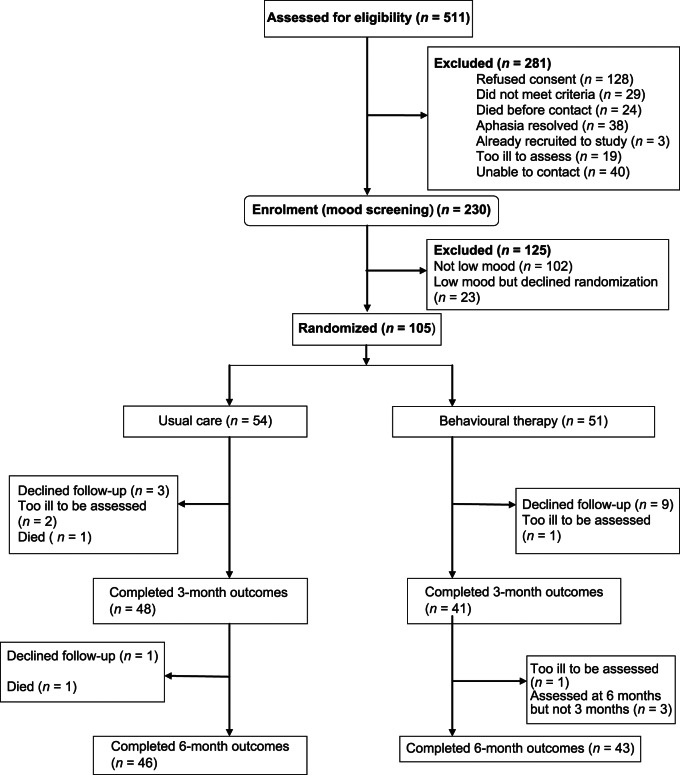
Objective: The aim was to evaluate behavioural therapy as a treatment for low mood in people with aphasia. Design: A randomized controlled trial comparing behavioural therapy plus usual care with a usual care control. Potential participants with aphasia after stroke were screened for the presence of low mood. Those who met the criteria and gave consent were randomly allocated. Setting: Participants were recruited from hospital wards, community rehabilitation, speech and language therapy services and stroke groups. Subjects: Of 511 people with aphasia identified, 105 had low mood and were recruited. Interventions: Behavioural therapy was offered for up to three months. Outcomes were assessed three and six months after random allocation. Main measures: Stroke Aphasic Depression Questionnaire, Visual Analog Mood Scales ‘sad’ item, and Visual Analogue Self-Esteem Scale. Results: Participants were aged 29 to 94 years (mean 67.0, SD 13.5) and 66 (63%) were men. Regression analysis showed that at three months, when baseline values and communication impairment were controlled for, group allocation was a significant predictor of the Stroke Aphasic Depression Questionnaire ( P < 0.05), visual analogue ‘sad’ ( P = 0.03), and Visual Analogue Self-Esteem Scale ( P < 0.01). At six months, group alone was a significant predictor of the Stroke Aphasic Depression Questionnaire ( P < 0.05), and remained significant when baseline values were controlled for ( P = 0.02). Mean Stroke Aphasic Depression Questionnaire 10-item hospital version scores decreased from baseline to six months by six points in the intervention group as compared with an increase of 1.9 points in the control group. Conclusions: Behavioural therapy seemed to improve the mood of people with aphasia.
Overview
The claims and statistics of this paper haven’t been checked yet.
Run the check — free, no account needed. It reads the open-access text and checks the sources it cites.
Integrity signals
Registry
Cites
Statistics
Figures
Verification
Claims the paper makes
The claims and statistics of this paper haven’t been checked yet.
Run the check — free, no account needed. It reads the open-access text and checks the sources it cites.
Claims other papers make about this one
Each is checked against this paper’s own text: does it say what the citing paper says it does?
The cited source says what the claim attributes to it.
In the citing paper
“Behavioural therapy, compared with TAU in an RCT, produced significant improvements in self-reported and observer-rated mood and selfesteem at 3 months in stroke survivors with aphasia and low mood (Thomas, Walker, Macniven, Haworth, & Lincoln, 2013).”
From Brief group‐based acceptance and commitment therapy for stroke survivors. (2019) · cites this paper as Thomas et al., 2013
Self-check
Percentages, sums and reported differences re-computed from the paper’s own numbers.
The self-check needs the paper’s full text.
Citations
Cites
Analysis of serial measurements in medical research.
Matthews, J. N. S., Altman, D. G., Campbell, M. J., & Royston, P. J. (1990) · BMJ · doi:10.1136/bmj.300.6719.230 · Cited by 3,137
The Barthel ADL Index: A reliability study
Collin, C., Wade, D. T., Davies, S., & Horne, V. (1988) · International Disability Studies · doi:10.3109/09638288809164103 · Cited by 2,740
Frequency of Depression After Stroke: A Systematic Review of Observational Studies
Hackett, M. L., Yapa, C., Parag, V., & Anderson, C. S. (2005) · Stroke · doi:10.1161/01.str.0000165928.19135.35 · Cited by 1,464
Validation of a Caregiver Strain Index
Robinson, B. C. (1983) · Journal of Gerontology · doi:10.1093/geronj/38.3.344 · Cited by 1,426
Behavioral Treatment of Depression in Dementia Patients: A Controlled Clinical Trial
Teri, L. L., Logsdon, R. G., Uomoto, J. M., & McCurry, S. M. (1997) · The Journals of Gerontology Series B · doi:10.1093/geronb/52b.4.p159 · Cited by 641
Aphasia, Depression, and Non-Verbal Cognitive Impairment in Ischaemic Stroke
Kauhanen, M.-L., Korpelainen, J. T., Hiltunen, P., Määttä, R., Mononen, H., Brusin, E., Sotaniemi, K. A., & Myllylä, V. V. (2000) · Cerebrovascular Diseases · doi:10.1159/000016107 · Cited by 452
Interventions for treating depression after stroke
Hackett, M. L., Anderson, C. S., House, A., & Xia, J. (2008) · Cochrane Database of Systematic Reviews · doi:10.1002/14651858.cd003437.pub3 · Cited by 387
Pinquart, M., Duberstein, P. R., & Lyness, J. M. (2007) · Aging & Mental Health · doi:10.1080/13607860701529635 · Cited by 328
Interventions for Treating Depression After Stroke
Hackett, M. L., Anderson, C. S., House, A. O., & Xia, J. (2009) · Stroke · doi:10.1161/strokeaha.109.547059 · Cited by 275
Cognitive Behavioral Psychotherapy for Depression Following Stroke: A Randomized Controlled Trial
Lincoln, N. B., & Flannaghan, T. (2003) · Stroke · doi:10.1161/01.str.0000044167.44670.55 · Cited by 232
Self-citation
Research works printed but not linked: 4
- Hackett ML, 2008, Cochrane Database Syst Rev, CD003437
- Syder D, 1993, Sheffield screening test for acquired language disorders
- Stern RA, 1997, Visual Analog Mood Scales professional manual
- Enderby P, 1997, Frenchay Aphasia Screening Test
Cited by
Sorted by citations
Heart Disease and Stroke Statistics—2017 Update: A Report From the American Heart Association
Benjamin, E. J., Blaha, M. J., Chiuve, S. E., Cushman, M., Das, S. R., Deo, R., de Ferranti, S. D., Floyd, J., Fornage, M., Gillespie, C., et al. (2017) · Circulation · doi:10.1161/cir.0000000000000485 · Cited by 12,591
Heart Disease and Stroke Statistics—2019 Update: A Report From the American Heart Association
Benjamin, E. J., Muntner, P., Alonso, A., Bittencourt, M. S., Callaway, C. W., Carson, A. P., Chamberlain, A. M., Chang, A. R., Cheng, S., Das, S. R., et al. (2019) · Circulation · doi:10.1161/cir.0000000000000659 · Cited by 9,036
Heart disease and stroke statistics-2018 update: a report from the american heart association
Benjamin, E. J., Virani, S. S., Callaway, C. W., Chamberlain, A. M., Chang, A. R., Cheng, S., Chiuve, S. E., Cushman, M., Delling, F. N., Deo, R., et al. (2018) · Circulation · doi:10.1161/cir.0000000000000558 · Cited by 7,146
Towfighi, A., Ovbiagele, B. I., Husseini, N. E., Hackett, M. L., Jorge, R. E., D, B. M. K. M., Mitchell, P. H., Skolarus, L. E., Whooley, M. A., & Williams, L. S. (2016) · Stroke · doi:10.1161/str.0000000000000113 · Cited by 824
Post-stroke depression: A 2020 updated review
Medeiros, G. C., Roy, D., Kontos, N. J., & Beach, S. R. (2020) · General Hospital Psychiatry · doi:10.1016/j.genhosppsych.2020.06.011 · Cited by 590
Lanctôt, K. L., Lindsay, M. P., Smith, E. E., Sahlas, D. J., Foley, N. C., Gubitz, G. J., Austin, M., Ball, K., Bhogal, S. K., Blake, T. M., et al. (2019) · International Journal of Stroke · doi:10.1177/1747493019847334 · Cited by 256
Baker, C., Worrall, L., Rose, M., Hudson, K., Ryan, B., & O’Byrne, L. (2018) · Disability and Rehabilitation · doi:10.1080/09638288.2017.1315181 · Cited by 186
Wray, F., & Clarke, D. J. (2017) · BMJ Open · doi:10.1136/bmjopen-2017-017944 · Cited by 126
Prevalence of anxiety in people with aphasia after stroke
Morris, R. C., Eccles, A., Ryan, B., & Kneebone, I. (2017) · Aphasiology · doi:10.1080/02687038.2017.1304633 · Cited by 111
Brief group‐based acceptance and commitment therapy for stroke survivors.
Majumdar, S., & Morris, R. (2019) · British Journal of Clinical Psychology · doi:10.1111/bjc.12198 · Cited by 107
Predictors of Poststroke Aphasia Recovery
Collaborators, T. R. A. R. O. P. W. A. A. S. (., Ali, M., VandenBerg, K., Williams, L. J., Williams, L. R., Abo, M., Becker, F., Bowen, A., Brandenburg, C., Breitenstein, C., et al. (2021) · Stroke · doi:10.1161/strokeaha.120.031162 · Cited by 117
Self-citationStepped psychological care after stroke
Kneebone, I. (2015) · Disability and Rehabilitation · doi:10.3109/09638288.2015.1107764 · Cited by 97
Baker, C., Worrall, L. E., Rose, M. L., & Ryan, B. (2019) · Aphasiology · doi:10.1080/02687038.2019.1673304 · Cited by 100
Treatment of Post-Stroke Depression
STARKSTEIN, S. E., & Hayhow, B. (2019) · Current Treatment Options in Neurology · doi:10.1007/s11940-019-0570-5 · Cited by 87
Clinical Pathways in Stroke Rehabilitation
Platz, T. (2021) · Springer eBooks · doi:10.1007/978-3-030-58505-1 · Cited by 80
Positive PsychoTherapy in ABI Rehab (PoPsTAR): A pilot randomised controlled trial
Cullen, B., Pownall, J., Cummings, J., Baylan, S., Broomfield, N., Haig, C., Kersel, D., Murray, H., & Evans, J. J. (2018) · Neuropsychological Rehabilitation · doi:10.1080/09602011.2015.1131722 · Cited by 73
Allida, S. M., Cox, K. L., Hsieh, C., Lang, H., House, A. O., & Hackett, M. L. (2020) · Cochrane Database of Systematic Reviews · doi:10.1002/14651858.cd003437.pub4 · Cited by 74
Stroke health professionals’ management of depression after post-stroke aphasia: a qualitative study
Baker, C., Worrall, L. E., Rose, M. L., & Ryan, B. (2019) · Disability and Rehabilitation · doi:10.1080/09638288.2019.1621394 · Cited by 80
Worrall, L. E., Ryan, B., Hudson, K., Kneebone, I., Simmons‐Mackie, N. N., Khan, A., Hoffmann, T., Power, E., Togher, L., & Rose, M. L. (2016) · Trials · doi:10.1186/s13063-016-1257-9 · Cited by 80
Behavioural activation therapy for post-stroke depression: the BEADS feasibility RCT
Thomas, S., Drummond, A. E., Lincoln, N. B., Palmer, R., das Nair, R., Latimer, N. R., Hackney, G., Mandefield, L., Walters, S. J., Hatton, R. D., et al. (2019) · Health Technology Assessment · doi:10.3310/hta23470 · Cited by 67
Self-citationKristinsson, S., den Ouden, D., Rorden, C., Newman‐Norlund, R., Neils‐Strunjas, J., & Fridriksson, J. (2022) · Journal of Stroke · doi:10.5853/jos.2022.01102 · Cited by 67
Quality of Life in Aphasia: State of the Art
Hilari, K., Cruice, M. N., Sorin‐Peters, R., & Worrall, L. E. (2015) · Folia Phoniatrica et Logopaedica · doi:10.1159/000440997 · Cited by 55
A Framework to Support Cognitive Behavior Therapy for Emotional Disorder After Stroke
Kneebone, I. (2015) · Cognitive and Behavioral Practice · doi:10.1016/j.cbpra.2015.02.001 · Cited by 52
Baker, C., Rose, M. L., Ryan, B., & Worrall, L. E. (2020) · Topics in Stroke Rehabilitation · doi:10.1080/10749357.2020.1849952 · Cited by 51
Post-stroke depression: Chaos to exposition
Sarkar, A., Sarmah, D., Datta, A., Kaur, H., Jagtap, P., Raut, S., Shah, B., Singh, U., Baidya, F., Bohra, M., et al. (2020) · Brain Research Bulletin · doi:10.1016/j.brainresbull.2020.12.012 · Cited by 55
Depression in Poststroke Aphasia
Laures-Gore, J. S., Dotson, V. M., & Belagaje, S. R. (2020) · American Journal of Speech-Language Pathology · doi:10.1044/2020_ajslp-20-00040 · Cited by 47
Kirkness, C. J., Cain, K. C., Becker, K. J., Tirschwell, D., Buzaitis, A., Weisman, P., McKenzie, S., Teri, L. L., Kohen, R., Veith, R. C., et al. (2017) · BMC Research Notes · doi:10.1186/s13104-017-2819-y · Cited by 45
Hancock, A., Northcott, S., Hobson, H., & Clarke, M. (2022) · International Journal of Language & Communication Disorders · doi:10.1111/1460-6984.12767 · Cited by 48
Northcott, S., Burns, K., Simpson, A., & Hilari, K. (2015) · Folia Phoniatrica et Logopaedica · doi:10.1159/000439217 · Cited by 43
The Big Five personality factors and psychological well-being following stroke: a systematic review
Dwan, T., & Ownsworth, T. (2017) · Disability and Rehabilitation · doi:10.1080/09638288.2017.1419382 · Cited by 54
Street, A. J., Zhang, J., Pethers, S., Wiffen, L., Bond, K., & Palmer, H. S. (2020) · Topics in Stroke Rehabilitation · doi:10.1080/10749357.2020.1729585 · Cited by 38
Honkalampi, K. M., Urhonen, H.-R., & Virtanen, M. (2024) · Psychotherapy Research · doi:10.1080/10503307.2024.2301972 · Cited by 40
When Words Fail: Providing Effective Psychological Treatment for Depression in Persons with Aphasia
Pietro, M. J. S., Marks, D. R., & Mullen, A. (2019) · Journal of Clinical Psychology in Medical Settings · doi:10.1007/s10880-019-09608-4 · Cited by 35
Management of post-stroke mood and emotional disturbances
Kim, J. S. (2017) · Expert Review of Neurotherapeutics · doi:10.1080/14737175.2017.1395281 · Cited by 35
Cruice, M., Woolf, C., Caute, A., Monnelly, K., Wilson, S., & Marshall, J. (2021) · Aphasiology · doi:10.1080/02687038.2020.1795076 · Cited by 34
Marshall, J., Caute, A., Chadd, K., Cruice, M., Monnelly, K., Wilson, S., & Woolf, C. (2019) · International Journal of Language & Communication Disorders · doi:10.1111/1460-6984.12391 · Cited by 38
Ellis‐Hill, C., Thomas, S., Gracey, F., Lamont‐Robinson, C., Cant, R., Marques, E. M. R., Thomas, P., Grant, M., Nunn, S., Paling, T., et al. (2019) · BMJ Open · doi:10.1136/bmjopen-2017-021098 · Cited by 32
Self-citationRyan, B., Bohan, J. K., & Kneebone, I. (2019) · International Journal of Language & Communication Disorders · doi:10.1111/1460-6984.12476 · Cited by 32
Treating anxiety after stroke using cognitive-behaviour therapy: Two cases
Kneebone, I., & Jeffries, F. W. (2013) · Neuropsychological Rehabilitation · doi:10.1080/09602011.2013.820135 · Cited by 32
Ryan, B., Hudson, K., Worrall, L. E., Simmons‐Mackie, N. N., Thomas, E., Finch, E., Clark, K., & Lethlean, J. (2017) · Brain Impairment · doi:10.1017/brimp.2017.5 · Cited by 31
Brady, M., Ali, M., VandenBerg, K., Williams, L. J., Williams, L. R., Abo, M., Becker, F., Bowen, A., Brandenburg, C., Breitenstein, C., et al. (2022) · Health and Social Care Delivery Research · doi:10.3310/rtlh7522 · Cited by 35
Self-citationAllida, S. M., Hsieh, C., Cox, K. L., Patel, K., Rouncefield‐Swales, A., Lightbody, C. E., House, A. O., & Hackett, M. L. (2023) · Cochrane Database of Systematic Reviews · doi:10.1002/14651858.cd003437.pub5 · Cited by 29
Group cognitive behavioural therapy for stroke survivors with depression and their carers
Ward, S. K., Turner, A., Hambridge, J. A., Halpin, S. A., Valentine, M. E., Sweetapple, A. L., White, J. H., & Hackett, M. L. (2016) · Topics in Stroke Rehabilitation · doi:10.1080/10749357.2016.1143706 · Cited by 28
Hilari, K., Klippi, A., Constantinidou, F., Horton, S., Penn, C., Raymer, A. M., Wallace, S. J., Žemva, N., & Worrall, L. E. (2015) · Folia Phoniatrica et Logopaedica · doi:10.1159/000434748 · Cited by 28
What can virtual reality offer to stroke patients? A narrative review of the literature
Szczepańska-Gieracha, J., Cieślik, B., Rutkowski, S., Kiper, P., & Turolla, A. (2020) · NeuroRehabilitation · doi:10.3233/nre-203209 · Cited by 26
Eccles, A., Morris, R. C., & Kneebone, I. (2016) · Clinical Rehabilitation · doi:10.1177/0269215516644311 · Cited by 26
Ryan, B. J., Clunne, S. M., Baker, C. J., Shiggins, C., Rose, M. L., & Kneebone, I. I. (2022) · Disability and Rehabilitation · doi:10.1080/09638288.2021.1925752 · Cited by 25
A comprehensive overview of post-stroke depression treatment options
Raggi, A., Serretti, A., & Ferri, R. (2023) · International Clinical Psychopharmacology · doi:10.1097/yic.0000000000000532 · Cited by 24
An aphasia research agenda – a consensus statement from the collaboration of aphasia trialists
Ali, M., Soroli, E., Jesus, L. M. T., Cruice, M. N., Isaksen, J., Visch-Brink, E. G., Grohmann, K. Κ., Jagoe, C., Kukkonen, T., Varlokosta, S., et al. (2021) · Aphasiology · doi:10.1080/02687038.2021.1957081 · Cited by 24
Spectrum of neuropsychiatric symptoms in chronic post-stroke aphasia
Edelkraut, L., López-Barroso, D., Torres‐Prioris, M. J., STARKSTEIN, S. E., Jorge, R. E., Aloisi, J., Berthier, M. L., & Dávila, G. (2022) · World Journal of Psychiatry · doi:10.5498/wjp.v12.i3.450 · Cited by 26
Questionnaire assessment of usual practice in mood and cognitive assessment in Scottish stroke units
Lees, R. A., Broomfield, N. M., & Quinn, T. J. (2013) · Disability and Rehabilitation · doi:10.3109/09638288.2013.791728 · Cited by 24
Stroke Action Plan for Europe 2018–2030 (SAP-E): mid-term review and update
Christensen, H., Pezzella, F. R., Roaldsen, M. B., Tomek, A., Wilkie, A., Christensen, L. M., Dichgans, M., Drummond, A. E., Laatikainen, T. K., Molina, C. A., et al. (2026) · European Stroke Journal · doi:10.1093/esj/aakaf026 · Cited by 24
Self-citationCounseling and Care Partner Training in Primary Progressive Aphasia
Schaffer, K. M., & Henry, M. L. (2021) · Perspectives of the ASHA Special Interest Groups · doi:10.1044/2021_persp-20-00296 · Cited by 22
Kootker, J. A., Rasquin, S. M. C., Smits, P., Geurts, A. C. H., Heugten, C. M. V., & Fasotti, L. (2014) · Clinical Rehabilitation · doi:10.1177/0269215514559987 · Cited by 22
Emotional adjustment post-stroke: A qualitative study of an online stroke community
Smith, F. E., Jones, C., Gracey, F., Mullis, R., Coulson, N., & Simoni, A. D. (2019) · Neuropsychological Rehabilitation · doi:10.1080/09602011.2019.1702561 · Cited by 21
Development of the “Kalmer” relaxation intervention: co-design with stroke survivors with aphasia
El-Helou, R., Ryan, B., & Kneebone, I. (2022) · Disability and Rehabilitation · doi:10.1080/09638288.2022.2069294 · Cited by 20
Thomas, S., Coates, E. J., das Nair, R., Lincoln, N. B., Cooper, C. L., Palmer, R., Walters, S. J., Latimer, N. R., England, T. J., Mandefield, L., et al. (2016) · Pilot and Feasibility Studies · doi:10.1186/s40814-016-0072-0 · Cited by 25
Self-citationThomas, S., Russell, C., Seed, R., Worthington, E. J., Walker, M. F., Macniven, J. A. B., & Lincoln, N. B. (2013) · Clinical Rehabilitation · doi:10.1177/0269215513489579 · Cited by 19
Self-citationNeuropsychiatric Complications after Stroke
Nemani, K., & Gurin, L. J. (2021) · Seminars in Neurology · doi:10.1055/s-0040-1722723 · Cited by 25
Gandy, M., Woldhuis, T., Wu, W., Youssef, M., Bisby, M. A., Dear, B. F., Heriseanu, A. I., & Scott, A. J. (2024) · Psychological Medicine · doi:10.1017/s0033291724001995 · Cited by 20
Caute, A., Woolf, C., Wilson, S., Stokes, C., Monnelly, K., Cruice, M., Bacon, K., & Marshall, J. (2019) · Journal of Speech, Language, and Hearing Research · doi:10.1044/2019_jslhr-l-18-0484 · Cited by 20
Personalized Biomarkers and Neuropsychological Status Can Predict Post-Stroke Fatigue
Zhang, H., Liu, G., Zhang, L., & Wei, W. (2023) · Brain Sciences · doi:10.3390/brainsci13020295 · Cited by 17
Gertler, P., & Tate, R. L. (2019) · Neuropsychological Rehabilitation · doi:10.1080/09602011.2019.1696212 · Cited by 19
Longitudinal Trajectories of Post-Stroke Depression Symptom Subgroups
Ashaie, S. A., Funkhouser, C. J., Kermani, R. J. N., Cherney, L. R., & Shankman, S. A. (2022) · Neurorehabilitation and neural repair · doi:10.1177/15459683221143464 · Cited by 18
A pilot randomized controlled trial of self-help relaxation to reduce post-stroke depression
Golding, K., Fife‐Schaw, C., & Kneebone, I. (2017) · Clinical Rehabilitation · doi:10.1177/0269215517741947 · Cited by 16
Clunne, S. J., Ryan, B., Hill, A. J., Brandenburg, C., & Kneebone, I. (2018) · Journal of Medical Internet Research · doi:10.2196/jmir.9864 · Cited by 16
Anticipated and imagined futures: prospective cognition and depressed mood following brain injury
Murphy, F. C., Peers, P. V., Blackwell, S. E., Holmes, E. A., & Manly, T. (2018) · British Journal of Clinical Psychology · doi:10.1111/bjc.12202 · Cited by 15
Prevalence of Behavioral Health Problems Among Adults With and Without Communication Disabilities
Stransky, M. L., Oshita, J. Y., & Morris, M. A. (2020) · The Journal of the American Board of Family Medicine · doi:10.3122/jabfm.2020.06.200216 · Cited by 13
Stahl, B., Millrose, S., Denzler, P., Lucchese, G., Jacobi, F., & Flöel, A. (2022) · Stroke · doi:10.1161/strokeaha.122.039995 · Cited by 14
Oates, L., Moghaddam, N. G., Evangelou, N., & das Nair, R. (2019) · Clinical Rehabilitation · doi:10.1177/0269215519896404 · Cited by 9
Wang, X., Thiel, L., & de Graff, N. (2022) · Healthcare · doi:10.3390/healthcare10081409 · Cited by 14
Wants Talk Psychotherapy but Cannot Talk: EMDR for Post-stroke Depression with Expressive Aphasia.
Guina, J., & Guina, C. (2018) · PubMed Central · Cited by 14
Kusec, A., Murphy, F. C., Peers, P. V., Lawrence, C., Cameron, E., Morton, C., Bateman, A., Watson, P., & Manly, T. (2020) · Pilot and Feasibility Studies · doi:10.1186/s40814-020-00660-8 · Cited by 13
Iwasaki, N., Ryan, B., Worrall, L. E., Rose, M. L., & Baker, C. (2022) · Aphasiology · doi:10.1080/02687038.2021.2015746 · Cited by 13
Supporting Mental Health in People Living With Aphasia: A Call to Action
Strong, K. A. (2023) · Perspectives of the ASHA Special Interest Groups · doi:10.1044/2023_persp-23-00042 · Cited by 13
Baker, C., Thomas, S., Tjokrowijoto, P., Ryan, B., Kneebone, I., & Stolwyk, R. J. (2024) · Healthcare · doi:10.3390/healthcare12070771 · Cited by 13
Self-citationHumphreys, I., Thomas, S., Phillips, C., & Lincoln, N. (2015) · Clinical Rehabilitation · doi:10.1177/0269215514537656 · Cited by 13
Self-citationNicklas, L., Albiston, M., Dunbar, M., Gillies, A. C., Hislop, J., Moffat, H., & Thomson, J. (2022) · BMC Health Services Research · doi:10.1186/s12913-022-08158-0 · Cited by 14
Kusec, A., Methley, A. M., Murphy, F. C., Peers, P. V., Carmona, E., & Manly, T. (2023) · BMC Psychology · doi:10.1186/s40359-023-01230-2 · Cited by 12
Ryan, B., Kneebone, I., Rose, M. L., Togher, L., Power, E., Hoffmann, T., Khan, A., Simmons‐Mackie, N. N., Carragher, M., & Worrall, L. E. (2023) · International Journal of Stroke · doi:10.1177/17474930231176718 · Cited by 12
Jaywant, A., & Keenan, A. (2023) · Physical Medicine and Rehabilitation Clinics of North America · doi:10.1016/j.pmr.2023.06.028 · Cited by 13
Cognition, Emotion and Fatigue Post-stroke
Heugten, C. M. V., & Wilson, B. A. (2021) · Springer eBooks · doi:10.1007/978-3-030-58505-1_12 · Cited by 14
Kenah, K., Bernhardt, J. A., Spratt, N. J., Oldmeadow, C. J., & Janssen, H. (2022) · Neuropsychological Rehabilitation · doi:10.1080/09602011.2022.2030761 · Cited by 12
Dipper, L. T., Devane, N., Barnard, R., Botting, N., Boyle, M., Cockayne, L., Hersh, D., Magdalani, C., Marshall, J., Swinburn, K., et al. (2024) · PLoS ONE · doi:10.1371/journal.pone.0304385 · Cited by 13
Clegg, A. J., Hill, J. E., Mullin, D. S., Harris, C., Smith, C. J., Lightbody, C. E., Dwan, K., Cooney, G. M., Mead, G. E., & Watkins, C. L. (2026) · Cochrane Database of Systematic Reviews · doi:10.1002/14651858.cd004366.pub7 · Cited by 12
Hayashi, H., Gravier, M., Gustavson, K., & Bernstein-Ellis, E. (2023) · Journal of Communication Disorders · doi:10.1016/j.jcomdis.2023.106365 · Cited by 10
Baker, C., Ryan, B., Rose, M. L., Kneebone, I., Thomas, S., Wong, D. K., & Wallace, S. J. (2024) · Brain Impairment · doi:10.1071/ib23091 · Cited by 11
Self-citationAnalysis of the concept of powerlessness in individuals with stroke
Silva, R., Lima, Á., Barreto, N. T., Viana, A. V., Butcher, H. K., & Martins, V. (2017) · Investigación y Educación en Enfermería · doi:10.17533/udea.iee.v35n3a07 · Cited by 10
Athanasou, J. A. (2019) · Psychological Thought · doi:10.5964/psyct.v12i2.370 · Cited by 10
Yisma, E., Yisma, E., Hillier, S., Gillam, M., Gray, R., & Jones, M. (2024) · BJPsych Open · doi:10.1192/bjo.2024.721 · Cited by 10
Berthier, M. L., Edelkraut, L., Mohr, B., Friedemann Pulvermüller, A., STARKSTEIN, S. E., Green, C., & Dávila, G. (2020) · Neuropsychological Rehabilitation · doi:10.1080/09602011.2020.1809463 · Cited by 9
Tjokrowijoto, P., Thomas, S., Kneebone, I., Ryan, B., & Stolwyk, R. J. (2024) · Neuropsychological Rehabilitation · doi:10.1080/09602011.2024.2331840 · Cited by 8
Self-citationFörster, A., Ozer, S., Crocker, T. F., House, A. O., Hewison, J., Roberts, E., Dickerson, J., Carter, G., Hulme, C. T., Fay, M., et al. (2021) · Programme Grants for Applied Research · doi:10.3310/pgfar09030 · Cited by 9
Verbal communication disorders in brain damaged post-stroke patients in Benin
Kpadonou, G. T., Alagnide, E., Natta, D. D. N., Houngbédji, G. M., & Adjaka, N. (2013) · Annals of Physical and Rehabilitation Medicine · doi:10.1016/j.rehab.2013.08.004 · Cited by 8
Northcott, S., Simpson, A., Thomas, S., Hirani, S. P., Flood, C., & Hilari, K. (2019) · AMRC Open Research · doi:10.12688/amrcopenres.12873.2 · Cited by 9
Self-citationNorthcott, S., Comer, A., Roper, A., Davis, L., & Hilari, K. (2025) · Health Expectations · doi:10.1111/hex.70303 · Cited by 6
Gillespie, D. C., & Cadden, A. P. (2013) · Journal of Nursing Education and Practice · doi:10.5430/jnep.v3n10p150 · Cited by 6
Shi, D., Chong, Y., Li, Y.-T., & Cheng, H.-Y. (2025) · Clinical Rehabilitation · doi:10.1177/02692155251345126
Escher, A., McKinnon, S., & Berger, S. (2021) · British Journal of Occupational Therapy · doi:10.1177/03080226211057835 · Cited by 5
People with aphasia living alone: A scoping review
Sherratt, S. (2023) · Aphasiology · doi:10.1080/02687038.2023.2227403 · Cited by 6
Metadata
- Authors
- Thomas, S. A., Walker, M. F., Macniven, J. A., Haworth, H., & Lincoln, N. B.
- Affiliations
- University of Nottingham (GB)
- Nottingham University Hospitals NHS Trust (GB)
- Nottinghamshire Healthcare NHS Foundation Trust (GB)
- Corresponding author
- Thomas, Shirley A
- Venue
- Clinical Rehabilitation
- Publisher
- SAGE Publications
- Published
- 2012-10-11
- Volume
- 27
- Issue
- 5
- Pages
- 398-408
- ISSN
- 0269-2155 (ISSN-L)
- 1477-0873
- PMC
- PMC3652643
- OpenAlex
- W2095758871
- Cited by
- 149
- References
- 30
- Citations by year
- 2026: 9 · 2025: 10 · 2024: 16 · 2023: 18 · 2022: 12 · 2021: 10 · 2020: 13 · 2019: 19 · 2018: 7 · 2017: 11 · 2016: 9 · 2015: 5 · 2014: 4 · 2013: 5
- FWCI
- 4.74
- Type
- journal article
- Language
- en
- Open access
- hybrid
- doi.org
- Locations
- Clinical Rehabilitation (publishedVersion, cc-by-nc)
- Europe PMC (PubMed Central) (publishedVersion, cc-by)
- PubMed Central (publishedVersion, cc-by)
- PubMed (publishedVersion)
- Nottingham ePrints (University of Nottingham) (submittedVersion, cc-by-nc)
- Repository@Nottingham (University of Nottingham) (submittedVersion, cc-by)
- Funders
- National Institute for Health and Care Research (NF-SI-0512-10092)
- Stroke Association
- Topics
- Health Sciences › Medicine › Rehabilitation › Stroke Rehabilitation and Recovery
- Social Sciences › Psychology › Experimental and Cognitive Psychology › Anxiety, Depression, Psychometrics, Treatment, Cognitive Processes
- Health Sciences › Medicine › Psychiatry and Mental health › Dementia and Cognitive Impairment Research
- Keywords
- aphasia, stroke, depressive mood, behavior therapy, depression, self-esteem, communication disorders, mood
- MeSH terms
- Stroke Rehabilitation, Adult, Aged, Aged, 80 and over, Aphasia, Female, Humans, Male, Middle Aged, Regression Analysis, ROC Curve, Self Concept, Cognitive Behavioral Therapy, Statistics, Nonparametric, Mood Disorders, Stroke, Visual Analog Scale
About these checks
Registry, retraction, Cites and statistics results are computed, not judged, with one exception: a printed reference that no index lists is read once by a model before it counts as a citation error. Claims are extracted by a model and kept only when their quote appears verbatim in the text; each cited source is then checked, with a model’s help, for whether it says what the claim relies on. Those verdicts can be wrong — read the claim’s quote and the cited source before relying on one.
Statistics and arithmetic are recomputed, not judged.
Confidence bands are shown only for fields calibrated on our annotated test set. None is calibrated yet, so no band is shown.
What counts as a claim ›How we measure confidence ›How we check this ›
Are you an author, or do you see a problem with this page? Request a review
