

Imminence of death among hospital inpatients: Prevalent cohort study
Open accessThe DOI matches its Crossref record; 19 of the 20 references it cites were found in a registry or an index.
Abstract
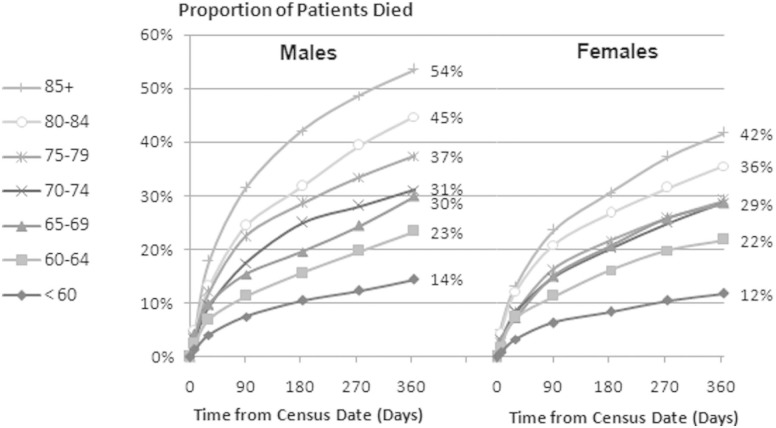
Background: There is a dearth of evidence on the proportion of the hospital population at any one time, that is in the last year of life, and therefore on how hospital policies and services can be oriented to their needs. Aim: To establish the likelihood of death within 12 months of a cohort of hospital inpatients on a given census date. Design: Prevalent cohort study. Participants: In total, 10,743 inpatients in 25 Scottish teaching and general hospitals on 31 March 2010. Results: In all, 3098 (28.8%) patients died during follow-up: 2.9% by 7 days, 8.9% by 30 days, 16.0% by 3 months, 21.2% by 6 months, 25.5% by 9 months and 28.8% by 12 months. Deaths during the index admission accounted for 32.3% of all deaths during the follow-up year. Mortality rose steeply with age and was three times higher at 1 year for patients aged 85 years and over compared to those who were under 60 years (45.6% vs 13.1%; p < 0.001). In multivariate analyses, men were more likely to die than women (odds ratio: 1.18, 95% confidence interval: 0.95–1.47) as were older patients (odds ratio: 4.99, 95% confidence interval: 3.94–6.33 for those who were 85 years and over compared to those who were under 60 years), deprived patients (odds ratio: 1.17, 95% confidence interval: 1.01–1.35 for most deprived compared to least deprived quintile) and those admitted to a medical specialty (odds ratio: 3.13, 95% confidence interval: 2.48–4.00 compared to surgical patients). Conclusion: Large numbers of hospital inpatients have entered the last year of their lives. Such data could assist in advocacy for these patients and should influence end-of-life care strategies in hospital.
Overview
CoChat Summary
TL;DR
This prevalent cohort study found that among 10,743 inpatients in 25 Scottish teaching and general hospitals on 31 March 2010, 28.8% died within 12 months and 9.3% died during the index admission. The likelihood of death rose steeply with age and was higher for patients admitted to medical specialties and those from more deprived areas.
Key findings
- Of 10,743 inpatients, 2.9% died within 7 days, 8.9% by 30 days, 16.0% by 3 months, 21.2% by 6 months, 25.5% by 9 months, and 28.8% by 12 months.
- Death during the index admission occurred in 9.3% of patients and accounted for 1,001 of 3,098 deaths (32.3%) over the 12-month follow-up; about 70% of deaths (2,147/3,098) occurred more than 30 days after the census date.
- Mortality at 1 year was 45.6% for patients aged 85 years and over versus 13.1% for those under 60 years (p < 0.001).
- In multivariate analyses, higher odds of 1-year death were seen for age 85+ vs under 60 (OR 4.99, 95% CI 3.94–6.33), most deprived vs least deprived quintile (OR 1.17, 95% CI 1.01–1.35), and medical vs surgical admission (OR 3.13, 95% CI 2.48–4.00); male sex was not clearly associated (OR 1.18, 95% CI 0.95–1.47).
Methods
- Prevalent cohort study using a census of inpatients in 25 Scottish teaching and general hospitals on 31 March 2010; included 10,743 inpatients, excluding geriatric long stay.
- Linked hospital data from SMR01 with national death registration data from the National Records of Scotland to identify deaths over 12 months.
- Summarized mortality at multiple time points and used univariate and multivariate logistic regression in R 3.0.1, adjusting for age, gender, deprivation (SIMD09 quintiles), and medical vs surgical specialty.
Limitations
- The paper states it did not assess clinical or health predictors such as diagnosis, co-morbidities, or previous use of services.
- The authors note the prevalent cohort design creates length-biased sampling, so results are not meaningful for individual patients and may differ from an incident admission sample.
- Evident from the text: the study is limited to teaching and large general hospitals in Scotland, so generalizability beyond that setting is not established in the paper.
Model-written summary. Check it against the paper before relying on it.
Integrity signals
Registry
Cites
Statistics
Figures
Verification
Claims the paper makes
0 Valid · 0 Not valid · 0 Not checked · 21 Own results and interpretations
A result the paper reports from its own data — it cites no other source for it, so there is none to check. The quote shows it is in the paper.
In the paper
“deprived patients (odds ratio: 1.17, 95% confidence interval: 1.01–1.35 for most deprived compared to least deprived quintile)”
- Also stated in: § Results · plain
“deprived patients (OR: 1.17, 95% CI: 1.01–1.35 for most deprived compared to least deprived quintile)”
§ Imminence of death among hospital inpatients: Prevalent cohort study > Abstract > Results:
plainstates an association- Asserted: passes — The authors put it forward as true.
- Checkable: passes — It can be checked against evidence.
- Load-bearing: unclear — It is unclear whether the paper’s conclusions depend on it.
- Based: passes — The paper gives a reason why it holds.
- Rests on 2 assumptions not shown here.
- Also stated in: § Results · plain
A result the paper reports from its own data — it cites no other source for it, so there is none to check. The quote shows it is in the paper.
In the paper
“In multivariate analyses, men were more likely to die than women (odds ratio: 1.18, 95% confidence interval: 0.95–1.47)”
- Also stated in: § Results · plain
“In multivariate analyses, men were more likely to die than women (odds ratio (OR): 1.18, 95% confidence interval (CI): 0.95–1.47)”
§ Imminence of death among hospital inpatients: Prevalent cohort study > Abstract > Results:
plainstates an association- Asserted: passes — The authors put it forward as true.
- Checkable: passes — It can be checked against evidence.
- Load-bearing: unclear — It is unclear whether the paper’s conclusions depend on it.
- Based: passes — The paper gives a reason why it holds.
- Rests on 2 assumptions not shown here.
- Also stated in: § Results · plain
A result the paper reports from its own data — it cites no other source for it, so there is none to check. The quote shows it is in the paper.
In the paper
“and those admitted to a medical specialty (odds ratio: 3.13, 95% confidence interval: 2.48–4.00 compared to surgical patients).”
- Also stated in: § Results · plain
“and those admitted to a medical specialty (OR: 3.13, 95% CI: 2.48–4.00 compared to surgical patients).”
§ Imminence of death among hospital inpatients: Prevalent cohort study > Abstract > Results:
plainstates an association- Asserted: passes — The authors put it forward as true.
- Checkable: passes — It can be checked against evidence.
- Load-bearing: unclear — It is unclear whether the paper’s conclusions depend on it.
- Based: passes — The paper gives a reason why it holds.
- Rests on 2 assumptions not shown here.
- Also stated in: § Results · plain
A result the paper reports from its own data — it cites no other source for it, so there is none to check. The quote shows it is in the paper.
In the paper
“The 2097 patients who survived the index admission but died within 12 months of the census date required a further 4231 hospital stays (subsequent to the index stay) between 31 March 2010 and their respective dates of death.”
§ Imminence of death among hospital inpatients: Prevalent cohort study > Results
plainn = 2,097- Asserted: passes — The authors put it forward as true.
- Checkable: passes — It can be checked against evidence.
- Load-bearing: unclear — It is unclear whether the paper’s conclusions depend on it.
- Based: passes — The paper gives a reason why it holds.
- Rests on 2 assumptions not shown here.
A result the paper reports from its own data — it cites no other source for it, so there is none to check. The quote shows it is in the paper.
In the paper
“The univariate logistic regression showed that every 1 year increase in age at the census date was associated with a 1.04 fold increase in the mortality odds.”
§ Imminence of death among hospital inpatients: Prevalent cohort study > Results
plainstates an association- Asserted: passes — The authors put it forward as true.
- Checkable: passes — It can be checked against evidence.
- Load-bearing: unclear — It is unclear whether the paper’s conclusions depend on it.
- Based: passes — The paper gives a reason why it holds.
- Rests on 2 assumptions not shown here.
10 more claims
Create a free account to see all 21 claims and every source verdict.
- It may state two separate claims as one. 5
- Probably not a substantial claim. 2
Claims other papers make about this one
Each is checked against this paper’s own text: does it say what the citing paper says it does?
The cited source says what the claim attributes to it.
In the citing paper
“This is all the more surprising because a study in Scotland suggests that 28.8% of inpatients will die within the next 12 months (3), indicating that there is a degree to which these deaths are anticipatable and could be planned for.”
From Recognizing the Dying Patient, When Less Could be More: A Diagnostic Framework for Shared Decision-Making at the End of Life (2020) · cites this paper as [3]
Citations
Cites
Steinhauser, K. E. (2000) · JAMA · doi:10.1001/jama.284.19.2476 · Cited by 2,514
Detering, K. M., Hancock, A. D., Reade, M. C., & Silvester, W. (2010) · BMJ · doi:10.1136/bmj.c1345 · Cited by 2,332
Broad, J. B., Gott, M., Kim, H., Boyd, M., Chen, H., & Connolly, M. J. (2013) · International Journal of Public Health · doi:10.1007/s00038-012-0394-5 · Cited by 479
Cohen, J., Houttekier, D., Onwuteaka-Philipsen, B., Miccinesi, G., Addington-Hall, J., Kaasa, S., Bilsen, J., & Deliens, L. (2010) · Journal of Clinical Oncology · doi:10.1200/jco.2009.23.2850 · Cited by 233
Transitions to palliative care in acute hospitals in England: qualitative study: Table 1
Gott, M., Ingleton, C., Bennett, M. I., & Gardiner, C. (2011) · BMJ Supportive & Palliative Care · doi:10.1136/bmj.d1773 · Cited by 157
A Public Health Perspective on End of Life Care
Cohen, J., & Deliëns, L. (2012) · Oxford University Press eBooks · doi:10.1093/acprof:oso/9780199599400.001.0001 · Cited by 139
Dying in an acute hospital setting: the challenges and solutions
Al-Qurainy, R., Collis, E., & Feuer, D. (2009) · International Journal of Clinical Practice · doi:10.1111/j.1742-1241.2008.01991.x · Cited by 118
Gardiner, C., Gott, M., Ingleton, C., Seymour, J. E., Cobb, M., Noble, B., Bennett, M., & Ryan, T. (2012) · Palliative Medicine · doi:10.1177/0269216312447592 · Cited by 110
Living with Ageing and Dying – Palliative and End of Life Care for Older People
(2011) · International Journal of Health Care Quality Assurance · doi:10.1108/ijhcqa.2011.06224gaa.014 · Cited by 96 · cited 1×
“23 Two key barriers were identified: (1) the internal momentum of the hospital towards cure inhibited clinicians from standing back and thinking about the overall goals that should inform patient care and (2) decisionmaking was consultant led, with junior members of the team and particularly nursing colleagues much le…”
BackgroundHow People Die in Hospital General Wards: A Descriptive Study
Toscani, F., Di Giulio, P., Brunelli, C., Miccinesi, G., & Laquintana, D. (2005) · Journal of Pain and Symptom Management · doi:10.1016/j.jpainsymman.2005.01.013 · Cited by 95
Cited by
Virdun, C., Luckett, T., Davidson, P. M., & Phillips, J. (2015) · Palliative Medicine · doi:10.1177/0269216315583032 · Cited by 271
Virdun, C., Luckett, T., Lorenz, K., Davidson, P. M., & Phillips, J. L. (2016) · Palliative Medicine · doi:10.1177/0269216316673547 · Cited by 148
“Maintenance of sense of self was the additional patient theme, while the four additional family themes were as follows: (1) maintenance of patient safety, (2) preparation for death, (3) care extending to the family after patient death and (4) enabling patient choice at the end of life.”
BackgroundCenteno, C., Garralda, E., Carrasco, J. M., der Eerden, M. D. H.-V., Aldridge, M. D., Stevenson, D. G., Meier, D. E., & Hasselaar, J. G. J. (2017) · Journal of Palliative Medicine · doi:10.1089/jpm.2017.0039 · Cited by 126
Detering, K. M., Buck, K., Ruseckaite, R., Kelly, H., Sellars, M., Sinclair, C., Clayton, J. M., & Nolte, L. (2019) · BMJ Open · doi:10.1136/bmjopen-2018-025255 · Cited by 106
What does ‘complex’ mean in palliative care? Triangulating qualitative findings from 3 settings
Carduff, E., Johnston, S., Winstanley, C., Morrish, J., Murray, S. A., Spiller, J. A., & Finucane, A. (2018) · BMC Palliative Care · doi:10.1186/s12904-017-0259-z · Cited by 90
“Seventy-five percent of people have at least one admission to hospital in their last year of life [12].”
BackgroundO’Callaghan, A., Laking, G. R., Frey, R. A., Robinson, J., & Gott, M. (2014) · Palliative Medicine · doi:10.1177/0269216314536089 · Cited by 81
Dying in acute hospitals: voices of bereaved relatives
Coimín, D. Ó., Prizeman, G., Korn, B., Donnelly, S., & Hynes, G. (2019) · BMC Palliative Care · doi:10.1186/s12904-019-0464-z · Cited by 88
Collier, A., Sorensen, R. J., & Iedema, R. A. M. (2015) · International Journal for Quality in Health Care · doi:10.1093/intqhc/mzv095 · Cited by 73
Interreceptoral junctions in the teleost retina.
Witkovsky, P., Shakib, M., & Ripps, H. (1974) · PubMed · Cited by 65
Mitchell, G. K., Senior, H., Rhee, J., Ware, R. S., Young, S., Teo, P. C., Murray, S. A., Boyd, K. J., & Clayton, J. M. (2017) · Palliative Medicine · doi:10.1177/0269216317698621 · Cited by 58
“condition to trigger an assessment of the risk of dying.[17] Practice computers could be”
BackgroundMilnes, S. L., Orford, N. R., Berkeley, L., Lambert, N., Simpson, N., Elderkin, T., Corke, C. F., & Bailey, M. (2015) · BMJ Supportive & Palliative Care · doi:10.1136/bmjspcare-2015-000864 · Cited by 49
Mason, S. R., Ling, J., Stănciulescu, L., Payne, C., Paal, P., Albu, S., Noguera, A., Boeriu, E., Poroch, V., Elsner, F., et al. (2020) · Journal of Palliative Medicine · doi:10.1089/jpm.2020.0119 · Cited by 51
van Seben, R., Reichardt, L. A., Essink, D. R., Munster, B. C. V., Bosch, J. A., & Buurman, B. M. (2018) · The Gerontologist · doi:10.1093/geront/gnx192 · Cited by 60
Richards, N. (2017) · Sociology Compass · doi:10.1111/soc4.12456 · Cited by 63
“In the UK, research suggests that at any one time, nearly 30% of hospital inpatients are likely to die within the next year (Clark et al., 2014; Gott et al., 2013) and that for inpatients who are over 85 years old, this proportion increases to 45% (Clark et al., 2014).”
BackgroundRobinson, J., Gott, M., Gardiner, C., & Ingleton, C. (2015) · Palliative Medicine · doi:10.1177/0269216315575841 · Cited by 48
Virdun, C., Luckett, T., Lorenz, K., Davidson, P. M., & Phillips, J. L. (2020) · Palliative Medicine · doi:10.1177/0269216320947570 · Cited by 76
Nevin, M., Hynes, G., & Smith, V. A. (2020) · Palliative Medicine · doi:10.1177/0269216319899335 · Cited by 59
Fløjstrup, M., Henriksen, D. P., & Brabrand, M. (2017) · European Journal of Internal Medicine · doi:10.1016/j.ejim.2017.09.035 · Cited by 48
Predictors of place of death in South West Scotland 2000–2010: Retrospective cohort study
Black, H. L., Waugh, C., Munoz-Arroyo, R., et al. (2016) · Palliative Medicine · doi:10.1177/0269216315627122 · Cited by 44
Self-citationWalker, S., Gibbins, J. L., Barclay, S. I. G., Adams, A., Paes, P., Chandratilake, M. N., Gishen, F., Lodge, P., & Wee, B. (2016) · Palliative Medicine · doi:10.1177/0269216315627125 · Cited by 48
Healthcare use and costs in the last year of life: a national population data linkage study
Diernberger, K., Luta, X., Bowden, J., Fallon, M., Droney, J., Lemmon, E., Gray, E., Marti, J., & Hall, P. S. (2021) · BMJ Supportive & Palliative Care · doi:10.1136/bmjspcare-2020-002708 · Cited by 47
Flierman, I., Nugteren, I. C., van Seben, R., Buurman, B. M., & Willems, D. L. (2019) · BMC Palliative Care · doi:10.1186/s12904-019-0439-0 · Cited by 53
Death within 1 year among emergency medical admissions to Scottish hospitals: incident cohort study
Moore, E., Munoz-Arroyo, R., Schofield, L., Radley, A., Clark, D., & Isles, C. (2018) · BMJ Open · doi:10.1136/bmjopen-2017-021432 · Cited by 37
“IntroDuCtIon We have previously shown high 12-month mortality among Scottish hospital inpatients indicating that, for many individuals, admission to hospital is a sentinel event marking the transition to the last year of their lives.(1) 2 Nearly 1 in 10 patients died during admission, and almost 1 in 3 patients had di…”
BackgroundResultInfluentialSelf-citationvan Seben, R., Covinsky, K. E., Reichardt, L. A., Aarden, J. J., van der Schaaf, M., van der Esch, M., Engelbert, R., Twisk, J. W. R., Bosch, J. A., & Buurman, B. M. (2020) · The Journals of Gerontology Series A · doi:10.1093/gerona/glaa039 · Cited by 47
“Additionally, over 30% of patients require another unplanned hospitalization in the first 90 days postdischarge (5), and postdischarge mortality rates within this same timeframe are as high as 16% (6).”
BackgroundPivodic, L., Pardon, K., Miccinesi, G., Alonso, T. V., Moreels, S., Donker, G., Arrieta, E., Onwuteaka-Philipsen, B. D., Deliëns, L., & den Block, L. V. (2015) · Journal of Epidemiology & Community Health · doi:10.1136/jech-2015-206073 · Cited by 51
Primary palliative care needs urgent attention
Mitchell, S., Tan, A., Moine, S., Dale, J. R., & Murray, S. A. (2019) · BMJ · doi:10.1136/bmj.l1827 · Cited by 39
Population-based, person-centred end-of-life care: time for a rethink
Thomas, K., & Gray, S. M. (2018) · British Journal of General Practice · doi:10.3399/bjgp18x694925 · Cited by 38
Medical morbidity and mortality conferences: past, present and future
George, J. (2016) · Postgraduate Medical Journal · doi:10.1136/postgradmedj-2016-134103 · Cited by 37
Haavisto, E., Soikkeli‐Jalonen, A., Tonteri, M., & Hupli, M. (2020) · Scandinavian Journal of Caring Sciences · doi:10.1111/scs.12874 · Cited by 70
Mayland, C. R., Mulholland, H., Gambles, M., Ellershaw, J., & Stewart, K. (2017) · BMJ Supportive & Palliative Care · doi:10.1136/bmjspcare-2014-000810 · Cited by 35
Rapid response teams improve outcomes: yes
Jones, D., Rubulotta, F. M., & Welch, J. (2016) · Intensive Care Medicine · doi:10.1007/s00134-016-4219-5 · Cited by 37
“This is probably because a large proportion of hospital admissions are often patients in their last year of life [8].”
BackgroundTanderup, A., Ryg, J., Rosholm, J., & Lassen, A. T. (2019) · BMJ Open · doi:10.1136/bmjopen-2018-026881 · Cited by 31
Voltz, R., Dust, G., Schippel, N., Hamacher, S., Payne, S. A., Scholten, N., Pfaff, H., Rietz, C., & Strupp, J. (2020) · BMJ Open · doi:10.1136/bmjopen-2019-035988 · Cited by 33
Nausea and vomiting in palliative care
Leach, C. (2019) · Clinical Medicine · doi:10.7861/clinmedicine.19-4-299 · Cited by 29
Identification of hospital patients in need of palliative care – a predictive score
Meffert, C., Rücker, G., Hatami, I., & Becker, G. (2016) · BMC Palliative Care · doi:10.1186/s12904-016-0094-7 · Cited by 36
“A current study quantified the number of hospital patients who are within the last year of life by connecting data from the hospital system with national death registration data [21].”
BackgroundMethodWang, S. S.-C., Huang, C., Feng, R., et al. (2018) · Journal of the Formosan Medical Association · doi:10.1016/j.jfma.2018.10.004 · Cited by 26
Bielinska, A.-M., Archer, S., Obanobi, A., Soosipillai, G., Darzi, A. W., Riley, J., & Urch, C. (2021) · PLoS ONE · doi:10.1371/journal.pone.0247874 · Cited by 30
“8% of inpatients died within 12 months [14] and another reporting a 22.”
BackgroundResultInfluentialPalliative and end-of-life care research in Scotland 2006–2015: a systematic scoping review
Finucane, A., Carduff, E., Lugton, J., et al. (2018) · BMC Palliative Care · doi:10.1186/s12904-017-0266-0 · Cited by 25
“Scottish research has shown that, on any given day, a significant proportion of hospital inpatients are in the last year of life [9], and there are many studies exploring palliative care in hospital settings [10–14].”
BackgroundSelf-citationBeeknoo, N., & Jones, R. (2016) · Journal of Advances in Medicine and Medical Research · doi:10.9734/bjmmr/2017/29984 · Cited by 25
“A medical admission had double the risk of death within one year [28].”
BackgroundFutility and appropriateness: challenging words, important concepts
Taylor, D. R., & Lightbody, C. J. (2018) · Postgraduate Medical Journal · doi:10.1136/postgradmedj-2018-135581 · Cited by 24
Impact of implementation of the National Early Warning Score on patients and staff
Farenden, S., Gamble, D. T., & Welch, J. (2017) · British Journal of Hospital Medicine · doi:10.12968/hmed.2017.78.3.132 · Cited by 23
Lightbody, C. J., Campbell, J. N., Herbison, G. P., Osborne, H. K., Radley, A., & Taylor, D. R. (2018) · BMJ Open · doi:10.1136/bmjopen-2018-024264 · Cited by 20
“IntrODuCtIOn Around 30% of patients admitted to acute hospitals in Scotland are in the last year of life, and nearly 10% die during the index admission.(1) In all, nearly 30 000 patients die in Scottish hospitals per annum, representing just over half of all deaths.”
BackgroundSPACE, O. B. O., Evans, C., Potts, L. C., Dalrymple, U., Pring, A., Verne, J., Higginson, I. J., & Gao, W. (2021) · BMC Medicine · doi:10.1186/s12916-021-01912-x · Cited by 21
Flierman, I., van Rijn, M., Willems, D. L., et al. (2020) · International Journal of Nursing Studies · doi:10.1016/j.ijnurstu.2020.103609 · Cited by 16
Determinants of Post-acute Care Costs in Acutely Hospitalized Older Adults: The Hospital-ADL Study
Ribbink, M. E., van Seben, R., Reichardt, L. A., Aarden, J. J., van der Schaaf, M., van der Esch, M., Engelbert, R., Twisk, J. W. R., Bosch, J. A., Vroomen, J. L. M., et al. (2019) · Journal of the American Medical Directors Association · doi:10.1016/j.jamda.2019.03.013 · Cited by 21
Bristowe, K., Carey, I., Hopper, A., Shouls, S., Prentice, W. M., Higginson, I. J., & Koffman, J. (2017) · Palliative Medicine · doi:10.1177/0269216317711336 · Cited by 16
McEwan, K., Girling, M., Bate, A., Atkinson, J., Clarke, A., & Dalkin, S. M. (2023) · International Journal of Social Research Methodology · doi:10.1080/13645579.2023.2184920 · Cited by 21
“…but, for patients and their families, there is a chronic under-representation of services to support people as they reach the end-of-life, particularly a shortage of out-of-hours services (Bone et al., 2016; Butler et al., 2018; Clark et al., 2014, Hensen et al, 2016, Robinson et al., 2014).”
BackgroundPolypharmacy in Older Patients
Woodford, H. J. (2024) · British Journal of Hospital Medicine · doi:10.12968/hmed.2024.0388 · Cited by 23
“It has been estimated that around 46% of people aged over 85 who are admitted non-electively to hospital will die within the following year (Clark et al, 2014).”
Bielinska, A.-M., Archer, S., Darzi, A. W., & Urch, C. (2022) · BMJ Open · doi:10.1136/bmjopen-2021-055347 · Cited by 21
Safe and effective prescribing for symptom management in palliative care
Harris, D. (2019) · British Journal of Hospital Medicine · doi:10.12968/hmed.2019.80.12.c184 · Cited by 15
End of life decision planning in the perioperative setting: the elephant in the room?
Blackwood, D. H., Santhirapala, R., Mythen, M. G., & Walker, D. A. (2015) · British Journal of Anaesthesia · doi:10.1093/bja/aev209 · Cited by 17
Wilder-Smith, A. J., Gillespie, T., & Taylor, D. R. (2019) · The Journal of the Royal College of Physicians of Edinburgh · doi:10.4997/jrcpe.2019.304 · Cited by 15
Weil, A., Weldon, S. M., Kronfli, M., Watkins, B., Kneebone, R. L., Bello, F., & Cox, S. (2018) · Nurse Education Today · doi:10.1016/j.nedt.2018.08.022 · Cited by 17
“This is particularly significant as approximately 30% of acute UK hospital admissions are in the last year of life and 50% of all UK deaths occur in hospital (Office for National Statistics, 2015; Clark et al., 2014).”
BackgroundCancer centre supportive oncology service: health economic evaluation
Stewart, E., Tavabie, S., McGovern, C., et al. (2022) · BMJ Supportive & Palliative Care · doi:10.1136/spcare-2022-003716 · Cited by 13
Herzog, S. M., Jenny, M. A., Nickel, C. H., Nieves-Ortega, R., & Bingisser, R. M. (2020) · PLoS ONE · doi:10.1371/journal.pone.0239902 · Cited by 12
Raubenheimer, P. J., Day, C., Abdullah, F., Manning, K., Cupido, C., & Peter, J. (2019) · BMC Palliative Care · doi:10.1186/s12904-019-0487-5 · Cited by 12
Predicting 1‐Year Mortality in Older Hospitalized Patients: External Validation of the HOMR Model
Curtin, D., Dahly, D. L., van Smeden, M., O’Donnell, D., Doyle, D., Gallagher, P., & O’Mahony, D. (2019) · Journal of the American Geriatrics Society · doi:10.1111/jgs.15958 · Cited by 14
Likelihood of Death Within One Year Among a National Cohort of Hospital Inpatients in Scotland
Clark, D., Schofield, L., Graham, F. M., Isles, C., Gott, M., & Jarlbæk, L. (2016) · Journal of Pain and Symptom Management · doi:10.1016/j.jpainsymman.2016.05.007 · Cited by 15
Self-citationGeographic variation of inpatient care costs at the end of life
Geue, C., Wu, O. Y., Leyland, A. H., et al. (2016) · Age and Ageing · doi:10.1093/ageing/afw040 · Cited by 12
“A recent study from Scotland accentuates this issue and found that at any one time 30% of patients in hospital are in the last year of their life and highlights the importance of developing appropriate care plans [21].”
BackgroundEnd-of-life care for frail older people
Harwood, R., & Enguell, H. (2019) · BMJ Supportive & Palliative Care · doi:10.1136/bmjspcare-2019-001953 · Cited by 11
Hospital beds per death how does the UK compare globally?
Jones, R. (2018) · British Journal of Healthcare Management · doi:10.12968/bjhc.2018.24.12.617 · Cited by 11
“It is known that an adult admission by a person of any age to a medical specialty is associated with an increased risk of death in the next 12 months (Clark et al, 2014; Flojstrup et al, 2017).”
BackgroundLikelihood of death among hospital inpatients in New Zealand: prevalent cohort study
Gott, M., Broad, J., Zhang, X., et al. (2017) · BMJ Open · doi:10.1136/bmjopen-2017-016880 · Cited by 11
Self-citationStewart-Lord, A., Baillie, L., Green, L. E., et al. (2022) · BMJ Open · doi:10.1136/bmjopen-2022-066832 · Cited by 10
The Gold Standards Framework Hospital programme: implementation and progress
Thomas, K., Wilson, J. A., & Clifford, C. (2022) · International Journal of Palliative Nursing · doi:10.12968/ijpn.2022.28.4.172 · Cited by 11
Flierman, I., van Rijn, M., de Meij, M. A., Poels, M., Niezink, D. M., Willems, D. L., & Buurman, B. M. (2020) · Pilot and Feasibility Studies · doi:10.1186/s40814-020-00676-0 · Cited by 7
Organizing end of life in hospital palliative care: A Canadian example
Krawczyk, M. (2019) · Social Science & Medicine · doi:10.1016/j.socscimed.2019.112493 · Cited by 12
Gafer, N., Gebre, N. T., Jabeen, I., Ashrafizadeh, H., Rassouli, M., & Mahmoud, L. (2024) · BMC Palliative Care · doi:10.1186/s12904-024-01590-5 · Cited by 13
End-of-life and immediate postdeath acute hospital interventions: scoping review
Green, L., Stewart-Lord, A., & Baillie, L. (2022) · BMJ Supportive & Palliative Care · doi:10.1136/spcare-2021-003511 · Cited by 10
Beiranvand, S., Rassouli, M., Hazrati, M., et al. (2022) · Frontiers in Psychology · doi:10.3389/fpsyg.2022.807621 · Cited by 9
“In many communities, this type of care is provided by hospice centers and specialty end-of-life care teams (Clark et al., 2014).”
BackgroundMilnes, S. L., Mantzaridis, Y., Simpson, N., Dunning, T. L., Kerr, D. C., Ostaszkiewicz, J., Keely, G., Corke, C. F., & Orford, N. R. (2021) · Critical Care and Resuscitation · doi:10.51893/2021.1.oa7 · Cited by 13
“1,48 This is important in terms of care planning, as it suggests that interventions and supports which lead to a patient returning to a preferred place of residence should be prioritised independent of likelihood of survival.”
BackgroundBouttell, J., Gonzalez, N. J., Geue, C., Lightbody, C. J., & Taylor, D. R. (2020) · International Journal for Quality in Health Care · doi:10.1093/intqhc/mzaa132 · Cited by 7
Editorial: Palliation and the caring hospital - filling the gap
Levack, P. (2014) · The Journal of the Royal College of Physicians of Edinburgh · doi:10.4997/jrcpe.2014.201 · Cited by 9
Kalsi, D., Ward, J., Lee, R., Wee, B., Fulford, K. W., & Handa, A. (2020) · Journal of Patient Experience · doi:10.1177/2374373519869153 · Cited by 8
“8% of inpatients will die within the next 12 months (3), indicating that there is a degree to which these deaths are anticipatable and could be planned for.”
BackgroundSpacey, A., Heaslip, V., & Szczepura, K. R. (2023) · Radiography · doi:10.1016/j.radi.2023.10.019 · Cited by 9
“This is important as hospitals still represent the most common place of death across Europe, 9,11,12 Clark et al. 13 identi fi ed that almost 30 % of inpatients in a UK hospital died within 12 months of being hospitalised and were frequent users of inpatients services, such as medical imaging.”
BackgroundShort- and long-term mortality following acute medical admission
Conway, R. P., Byrne, D., O’Riordan, D. M. R., et al. (2023) · QJM · doi:10.1093/qjmed/hcad181 · Cited by 8
Pettifer, A., & Hughes, S. (2023) · Palliative Medicine · doi:10.1177/02692163231164452 · Cited by 7
Palliative care in hospital: Why is it so difficult?
Taylor, R., & Chadwick, S. (2015) · Palliative Medicine · doi:10.1177/0269216315600996 · Cited by 9
Clark, K. J., Collier, A., & Currow, D. C. (2014) · Australian Health Review · doi:10.1071/ah14175 · Cited by 8
Assisted dying, moral distress, and conscientious objection
Cavanagh, J., Spiller, J. A., & Taylor, D. R. (2024) · The Lancet · doi:10.1016/s0140-6736(23)01910-4 · Cited by 7
Tanzi, S., Martucci, G., Autelitano, C., Alquati, S., Peruselli, C., & Artioli, G. (2022) · BMC Palliative Care · doi:10.1186/s12904-022-00968-7 · Cited by 8
“Moreover, hospitals have a major role to play in the delivery of non-specialist palliative care [20].”
Frailty for neurologists: a practical guide
Pollock, L., & Smith, M. D. (2021) · Practical Neurology · doi:10.1136/practneurol-2021-003047 · Cited by 7
Jones, R. (2020) · The International Journal of Health Planning and Management · doi:10.1002/hpm.3094 · Cited by 7
Rai, A., & Mason, S. R. (2019) · BMC Palliative Care · doi:10.1186/s12904-019-0460-3 · Cited by 8
Are we getting it wrong? Perspectives on the future of palliative care in hospitals
Gott, M., & Robinson, J. (2018) · Palliative Medicine · doi:10.1177/0269216318809539 · Cited by 7
Bielinska, A.-M., Soosaipillai, G., Riley, J., Darzi, A. W., Urch, C., & Archer, S. (2022) · PLoS ONE · doi:10.1371/journal.pone.0273894 · Cited by 6
Variation in hospital cost trajectories at the end of life by age, multimorbidity and cancer typePreprint
Diernberger, K., Luta, X., Bowden, J., et al. (2022) · medRxiv · doi:10.1101/2022.02.22.22271323 · Cited by 6
McEwan, K., Atkinson, J., Clarke, A., Bate, A., Jeffery, C., & Dalkin, S. M. (2024) · BMC Palliative Care · doi:10.1186/s12904-024-01610-4 · Cited by 9
Messmer, A. S., BAERTSCH, G., & Cioccari, L. (2024) · Minerva Anestesiologica · doi:10.23736/s0375-9393.24.17876-5 · Cited by 6
Johnston, B. M., Miller, M., Normand, C. E. M., Cardona, M., May, P., & Lowney, A. C. (2024) · BMC Palliative Care · doi:10.1186/s12904-024-01384-9 · Cited by 6
“Indeed, a quarter of patients in acute hospitals in the UK are thought to be in the last year of life [5].”
BackgroundNelson, M. L. A., Saragosa, M., Singh, H., & Yi, J. (2024) · International Journal of Integrated Care · doi:10.5334/ijic.7670 · Cited by 8
Red Cell Distribution Width as a Prognostic Indicator in Acute Medical Admissions
Conway, R. P., Byrne, D., O’Riordan, D. M. R., & Silke, B. (2023) · Journal of Clinical Medicine · doi:10.3390/jcm12165424 · Cited by 6
“audited Scottish hospitals on two nominated dates in different years and reported 1-year mortality in the age range 75–79 years to be 33% but with further increases at higher ages [29,30].”
BackgroundHospice care delivery system requirements
Beiranvand, S., Rassouli, M., Hazrati, M., et al. (2022) · International Journal of Palliative Nursing · doi:10.12968/ijpn.2022.28.12.562 · Cited by 5
Bielinska, A.-M., Archer, S., Soosaipillai, G., Riley, J., Darzi, A. W., & Urch, C. (2020) · Journal of Health Psychology · doi:10.1177/1359105320926547 · Cited by 5
“This is crucial for both older adults and their loved ones, since an estimated 20–30 per cent of hospitalised adults are in their last year of life, with mortality rising with age (Bielinska et al., 2017b; Clark et al., 2014).”
BackgroundCaruso, R., Rocco, G., Dellafiore, F., Brognoli, G., Magon, A., Conte, G., Pittella, F., & Stievano, A. (2019) · Applied Nursing Research · doi:10.1016/j.apnr.2019.01.001 · Cited by 6
Ethical issues for older people in the emergency department
Maile, E. L., Harrison, J. K., Chikura, G., Russ, K., & Conroy, S. (2016) · European Geriatric Medicine · doi:10.1016/j.eurger.2016.02.005 · Cited by 5
“In people aged 85+, admission to hospital is associated (but not causally) with a mortality rate of 46% at one year [2]; some of this might be avoidable.”
BackgroundJones, R. (2016) · Fractal Geometry and Nonlinear Analysis in Medicine and Biology · doi:10.15761/fgnamb.1000116 · Cited by 5
“This risk increases rapidly above age 60 [10].”
BackgroundMortality meetings in geriatric medicine: strategies for improvement
Dunbar, J. M., & George, J. M. (2015) · BMJ Quality Improvement Reports · doi:10.1136/bmjquality.u202625.w3247 · Cited by 5
“Almost one in ten patients in teaching or general hospitals die within thirty days of admission.[1] This is higher for older age groups and patients admitted to medical and elderly care wards.”
BackgroundScreening for End-of-Life in Acute Hospitals: A Cross-Sectional Survey
To, T. H. M., Hakendorf, P. H., & Currow, D. C. (2024) · American Journal of Hospice and Palliative Medicine® · doi:10.1177/10499091231226299 · Cited by 4
Implementation of treatment escalation plans in an old age psychiatry inpatient hospital
Chua, A. Y. T., Ghanchi, A., Makh, S. K., et al. (2021) · BMJ Open Quality · doi:10.1136/bmjoq-2021-001640 · Cited by 4
Tavabie, S., Berglund, A., Barclay, D. R., et al. (2021) · American Journal of Hospice and Palliative Medicine® · doi:10.1177/10499091211027815 · Cited by 4
“It is estimated that 1 in 3 adult hospital inpatients in the UK is in the last year of life, with 1 in 10 likely to die while admitted.(1,2) As a result, physicians responsible for the care of these people are supported by specialist palliative care teams who can advise on holistic care, the role of medications and fu…”
Background
Metadata
- Authors
- Clark, D., Armstrong, M., Allan, A., Graham, F., Carnon, A., & Isles, C.
- Affiliations
- University of Glasgow (GB)
- National Health Service Scotland (GB)
- NHS Dumfries and Galloway (GB)
- Galway Clinic (IE)
- Dumfries and Galloway Royal Infirmary (GB)
- Corresponding author
- Clark, David
- ORCID
- Clark, David
- Venue
- Palliative Medicine
- Publisher
- SAGE Publications
- Published
- 2014-03-17
- Volume
- 28
- Issue
- 6
- Pages
- 474-479
- ISSN
- 0269-2163 (ISSN-L)
- 1477-030X
- PMC
- PMC4845030
- OpenAlex
- W2141558534
- Cited by
- 178
- References
- 20
- Citations by year
- 2026: 3 · 2025: 14 · 2024: 22 · 2023: 10 · 2022: 12 · 2021: 12 · 2020: 17 · 2019: 20 · 2018: 16 · 2017: 15 · 2016: 19 · 2015: 11 · 2014: 6
- FWCI
- 16.92
- Type
- journal article
- Language
- en
- Open access
- hybrid
- doi.org
- Licence
- cc-by
- journals.sagepub.com/page/policies/text-and-data-mining-license (tdm)
- Locations
- Palliative Medicine (publishedVersion, cc-by)
- PubMed Central (publishedVersion, cc-by)
- PubMed (publishedVersion)
- ENLIGHTEN (Jurnal Bimbingan dan Konseling Islam) (acceptedVersion)
- Topics
- Health Sciences › Medicine › Public Health, Environmental and Occupational Health › Palliative Care and End-of-Life Issues
- Social Sciences › Demography › Insurance, Mortality, Demography, Risk Management
- Health Sciences › Medicine › Geriatrics and Gerontology › Frailty in Older Adults
- Keywords
- last year of life, hospitalized patients, mortality, end-of-life care, age and mortality, sex differences in mortality, socioeconomic deprivation
About these checks
Registry, retraction, Cites and statistics results are computed, not judged, with one exception: a printed reference that no index lists is read once by a model before it counts as a citation error. Claims are extracted by a model and kept only when their quote appears verbatim in the text; each cited source is then checked, with a model’s help, for whether it says what the claim relies on. Those verdicts can be wrong — read the claim’s quote and the cited source before relying on one.
A language model drew the claims from the paper on 2026-10-11, under version 3 of the claim definition (model deepseek-v4.1-flash, prompt extract-v3).
A second model labelled each claim on 2026-10-11 (model jev-1.13-20260917, definition revision gold-guideline-v0.2).
Statistics and arithmetic are recomputed, not judged.
Confidence bands are shown only for fields calibrated on our annotated test set. None is calibrated yet, so no band is shown.
What counts as a claim ›How we measure confidence ›How we check this ›
Are you an author, or do you see a problem with this page? Request a review
Data sources
Bibliographic data: Semantic Scholar, OpenAlex, Crossref.
Contains information from the Semantic Scholar Academic Graph Datasets, made available under the ODC Attribution License (ODC-BY 1.0).
Semantic Scholar’s data is described in: Kinney, R., et al. (2023). The Semantic Scholar Open Data Platform. arXiv:2301.10140.
