

Kinetics and 28-day test–retest repeatability and reproducibility of [ 11 C]UCB-J PET brain imaging
Open accessThe DOI matches its Crossref record; 33 of the 33 references it cites were found in a registry or an index.
Abstract
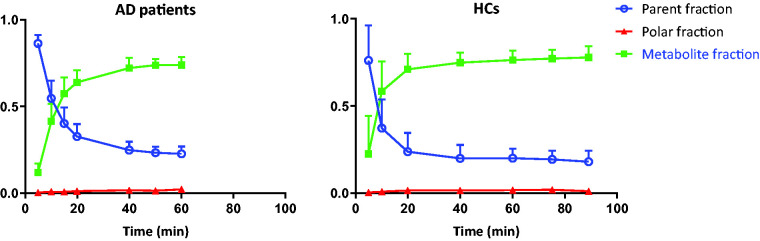
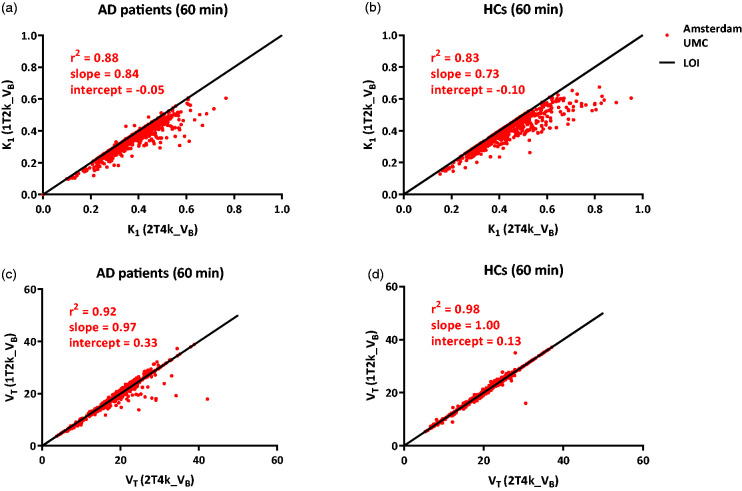
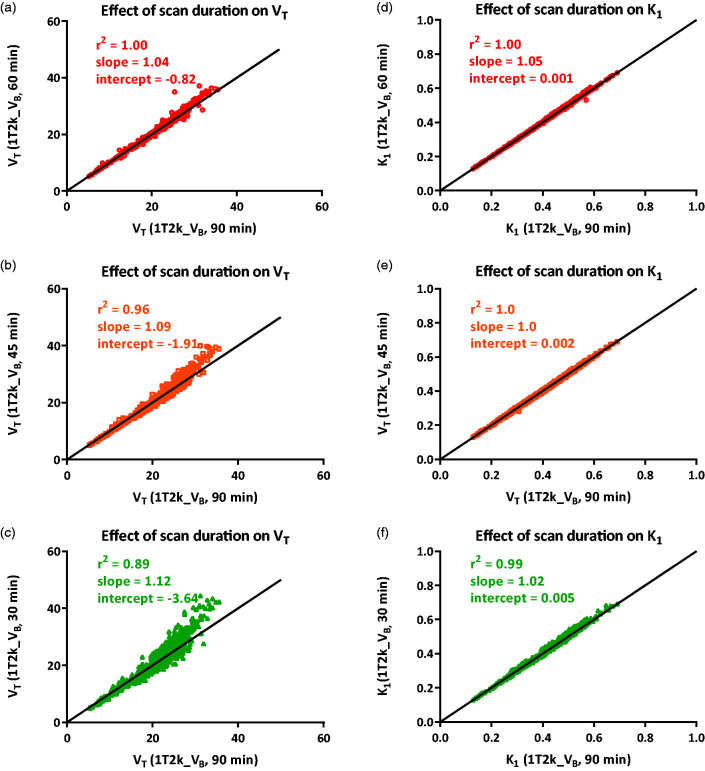
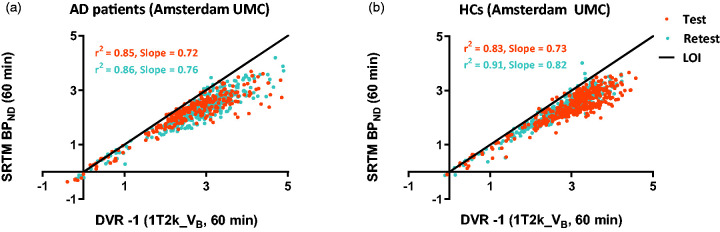
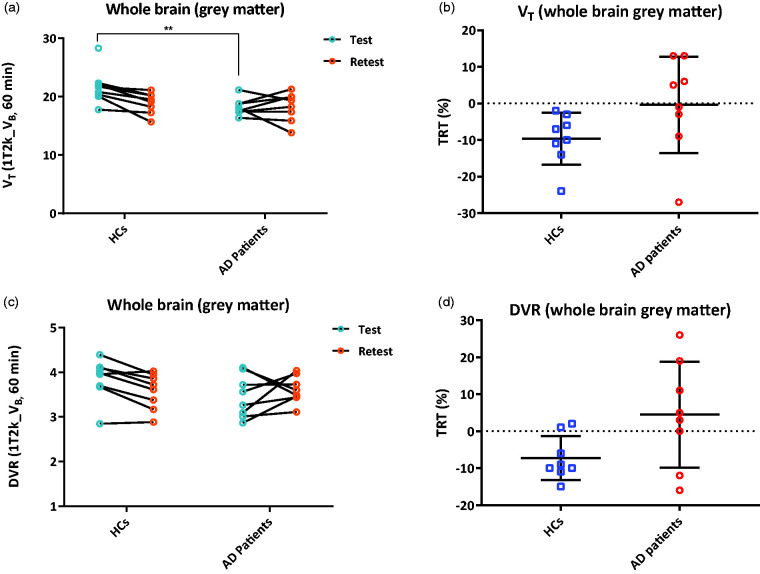
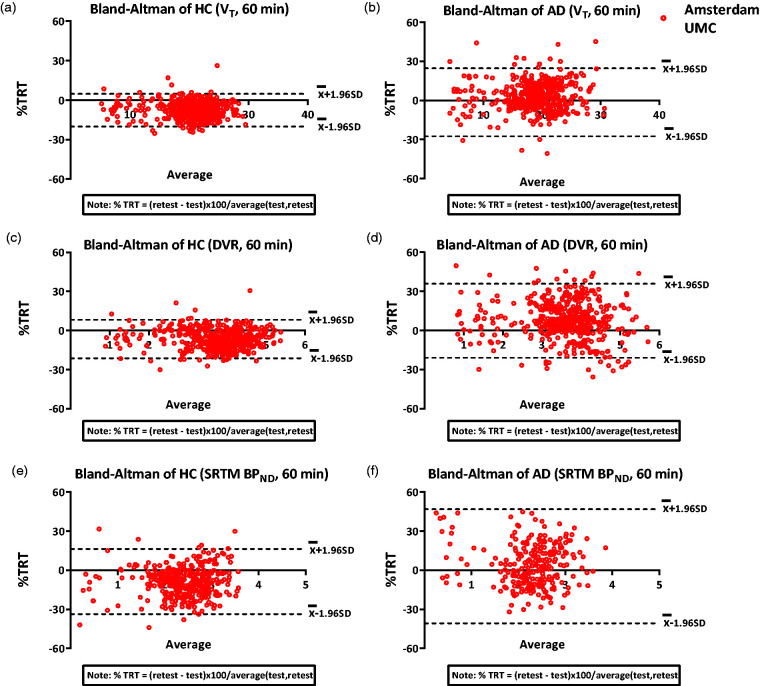
[ 11 C]UCB-J is a novel radioligand that binds to synaptic vesicle glycoprotein 2A (SV2A). The main objective of this study was to determine the 28-day test–retest repeatability (TRT) of quantitative [ 11 C]UCB-J brain positron emission tomography (PET) imaging in Alzheimer’s disease (AD) patients and healthy controls (HCs). Nine HCs and eight AD patients underwent two 60 min dynamic [ 11 C]UCB-J PET scans with arterial sampling with an interval of 28 days. The optimal tracer kinetic model was assessed using the Akaike criteria (AIC). Micro-/macro-parameters such as tracer delivery (K 1 ) and volume of distribution (V T ) were estimated using the optimal model. Data were also analysed for simplified reference tissue model (SRTM) with centrum semi-ovale (white matter) as reference region. Based on AIC, both 1T2k_V B and 2T4k_V B described the [ 11 C]UCB-J kinetics equally well. Analysis showed that whole-brain grey matter TRT for V T , DVR and SRTM BP ND were –2.2% ± 8.5, 0.4% ± 12.0 and –8.0% ± 10.2, averaged over all subjects. [ 11 C]UCB-J kinetics can be well described by a 1T2k_V B model, and a 60 min scan duration was sufficient to obtain reliable estimates for both plasma input and reference tissue models. TRT for V T , DVR and BP ND was <15% (1SD) averaged over all subjects and indicates adequate quantitative repeatability of [ 11 C]UCB-J PET.
Overview
The claims and statistics of this paper haven’t been checked yet.
Free: it reads the open-access text and checks the first 5 claims that cite a source we can check. Create a free account to check every claim.
Integrity signals
Registry
Cites
Statistics
Figures
Verification
Claims the paper makes
The claims and statistics of this paper haven’t been checked yet.
Free: it reads the open-access text and checks the first 5 claims that cite a source we can check. Create a free account to check every claim.
Claims other papers make about this one
Each is checked against this paper’s own text: does it say what the citing paper says it does?
The cited source says what the claim attributes to it.
In the citing paper
“The present study design also eliminates issues of long-term test-retest bias which has been reported to occur with [11C]UCB-J PET in some instances [59].”
From Effects of escitalopram on synaptic density in the healthy human brain: a randomized controlled trial (2023) · cites this paper as [59]
Self-check
Percentages, sums and reported differences re-computed from the paper’s own numbers.
The self-check needs the paper’s full text.
Citations
Cites
McKhann, G. M., Knopman, D. S., Chertkow, H., Hyman, B. T., Jack, C. R., Kawas, C. H., Klunk, W. E., Koroshetz, W. J., Manly, J. J., Mayeux, R., et al. (2011) · Alzheimer's & Dementia · doi:10.1016/j.jalz.2011.03.005 · Cited by 18,657
Self-citationTerry, R. D., Masliah, E., Salmon, D. P., Butters, N., DeTeresa, R., Hill, R., Hansen, L. A., & Katzman, R. (1991) · Annals of Neurology · doi:10.1002/ana.410300410 · Cited by 4,397 · cited 1×
“with synaptic loss in the association cortex and limbic system.(7,8) Synaptic disruption is thought to be associated with toxic b-amyloid or tau oligomers and is already observed in the earliest clinical stages of AD.”
Synapse loss in frontal cortex biopsies in Alzheimer's disease: Correlation with cognitive severity
DeKosky, S. T., & Scheff, S. W. (1990) · Annals of Neurology · doi:10.1002/ana.410270502 · Cited by 2,376 · cited 1×
“with synaptic loss in the association cortex and limbic system.(7,8) Synaptic disruption is thought to be associated with toxic b-amyloid or tau oligomers and is already observed in the earliest clinical stages of AD.”
BackgroundSimplified Reference Tissue Model for PET Receptor Studies
Lammertsma, A. A., & Hume, S. P. (1996) · NeuroImage · doi:10.1006/nimg.1996.0066 · Cited by 2,021
The stressed synapse: the impact of stress and glucocorticoids on glutamate transmission
Popoli, M., Yan, Z., McEwen, B. S., & Sanacora, G. (2012) · Nature Reviews Neuroscience · doi:10.1038/nrn3138 · Cited by 1,393 · cited 1×
“A possible hypothesis is that there is an increase in the number of synaptic vesicles that are already transported to the membrane and ready to be released, also called the readily releasable pool (RRP) of vesicles.(29) The increase in the number of synaptic vesicles could be true for the test scan due to stress of un…”
BackgroundHammers, A., Allom, R., Koepp, M. J., Free, S. L., Myers, R., Lemieux, L., Mitchell, T. N., Brooks, D. J., & Duncan, J. S. (2003) · Human Brain Mapping · doi:10.1002/hbm.10123 · Cited by 1,286
Loss of mTOR-Dependent Macroautophagy Causes Autistic-like Synaptic Pruning Deficits
Tang, G., Gudsnuk, K., Kuo, S.-H., Cotrina, M. L., Rosoklija, G., Sosunov, A., Sonders, M. S., Kanter, E., Castagna, C., Yamamoto, A., et al. (2014) · Neuron · doi:10.1016/j.neuron.2014.07.040 · Cited by 1,146
Imaging synaptic density in the living human brain
Finnema, S. J., Nabulsi, N. B., Eid, T., Detyniecki, K., Lin, S.-F., Chen, M.-K., Dhaher, R., Matuskey, D., Baum, E., Holden, D., et al. (2016) · Science Translational Medicine · doi:10.1126/scitranslmed.aaf6667 · Cited by 575 · cited 1×
“The first-in-human [(11)C]UCB-J positron emission tomography (PET) study showed comparable results.(11) Quantification of specific binding of [(11)C]UCB-J with a validated tracer kinetic model is crucial in clinical studies not only for identification of early synaptic pathology in cross-sectional studies but also for…”
Positron Emission Tomography Compartmental Models
Gunn, R. N., Gunn, S. R., & Cunningham, V. J. (2001) · Journal of Cerebral Blood Flow & Metabolism · doi:10.1097/00004647-200106000-00002 · Cited by 502
Differential expression of synaptic vesicle protein 2 (SV2) isoforms
Bajjalieh, S., Frantz, G., Weimann, J., McConnell, S., & Scheller, R. (1994) · The Journal of Neuroscience · doi:10.1523/jneurosci.14-09-05223.1994 · Cited by 440 · cited 2×
“SV2A is a member of a small family of synaptic vesicle proteins and is the most widespread isoform present in glutamatergic and GABAergic neurons.(10) [(11)C]UCB-J binds to SV2a in pre-synaptic terminals and, therefore, could reflect synaptic density.”
Background
Cited by
Neuroimaging in schizophrenia: an overview of findings and their implications for synaptic changes
Howes, O. D., Cummings, C., Chapman, G. E., & Shatalina, E. (2022) · Neuropsychopharmacology · doi:10.1038/s41386-022-01426-x · Cited by 171
In vivo tau pathology is associated with synaptic loss and altered synaptic function
Coomans, E. M., Schoonhoven, D. N., Tuncel, H., Verfaillie, S. C. J., Wolters, E. E., Boellaard, R., Ossenkoppele, R., den Braber, A., Scheper, W., Schober, P., et al. (2021) · Alzheimer's Research & Therapy · doi:10.1186/s13195-021-00772-0 · Cited by 100
“sampling was inserted in order to obtain a metabolite corrected plasma input function for full quantification of [(11)C]UCB-J [30].”
MethodSelf-citationImaging Synaptic Density: The Next Holy Grail of Neuroscience?
Serrano, M. E., Kim, E., Petrinovic, M. M., Turkheimer, F., & Cash, D. (2022) · Frontiers in Neuroscience · doi:10.3389/fnins.2022.796129 · Cited by 67
“Furthermore, SV2A PET tracers are increasingly used in clinical research, where they have been successfully used to map out synaptic changes in AD and Progressive Supranuclear Palsy (Passamonti et al., 2017; Holland et al., 2020, 2021; O’Dell et al., 2021; Tuncel et al., 2021) as well as in other conditions such as de…”
MethodJohansen, A., Armand, S., Plavén-Sigray, P., Nasser, A., Ozenne, B., Petersen, I. N., Keller, S. H., Madsen, J., Beliveau, V., Møller, K., et al. (2023) · Molecular Psychiatry · doi:10.1038/s41380-023-02285-8 · Cited by 53
Escitalopram increases synaptic density in the human brain over weeks: A randomized controlled trial
(2023) · doi:10.21203/rs.3.rs-2989150/v1 · Cited by 53
Vanderlinden, G., Ceccarini, J., Vande Casteele, T., Michiels, L., Lemmens, R., Triau, E., Serdons, K., Tournoy, J., Koole, M., Vandenbulcke, M., et al. (2022) · Molecular Psychiatry · doi:10.1038/s41380-022-01672-x · Cited by 47
PET Agents in Dementia: An Overview
van Waarde, A., Marcolini, S., Deyn, P. P. D., & Dierckx, R. (2021) · Seminars in Nuclear Medicine · doi:10.1053/j.semnuclmed.2020.12.008 · Cited by 40
Synaptic changes in psychiatric and neurological disorders: State-of-the art of in vivo imaging
Howes, O., Marcinkowska, J., Turkheimer, F. E., & Carr, R. (2025) · Neuropsychopharmacology · doi:10.1038/s41386-024-01943-x · Cited by 34
“However, one study conducted [ 11 C]UCB-J PET scans performed four weeks apart [28] showing comparable low variability to shorter-term studies in three outcome measures, with volume of distribution, distribution volume ratio and nondisplaceable binding potential in total grey matter (GM) showing…”
BackgroundResultVisser, M., O’Brien, J. T., & Mak, E. (2024) · Ageing Research Reviews · doi:10.1016/j.arr.2024.102197 · Cited by 28
“1TC-derived V T estimates, MA1 may also be considered appropriate (Mansur et al., 2020; Naganawa et al., 2021).”
BackgroundMethodLongitudinal Imaging of Regional Brain Volumes, SV2A, and Glucose Metabolism In Huntington's Disease
Delva, A., Laere, K. V., & Vandenberghe, W. (2023) · Movement Disorders · doi:10.1002/mds.29501 · Cited by 26
Holland, N., Jones, P. S., Savulich, G., Naessens, M., Malpetti, M., Whiteside, D. J., Street, D., Swann, P., Hong, Y. T., Fryer, T. D., et al. (2023) · Movement Disorders · doi:10.1002/mds.29421 · Cited by 26
Xiong, M., Roshanbin, S., Rokka, J., Schlein, E., Ingelsson, M., Sehlin, D., Eriksson, J., & Syvänen, S. (2021) · NeuroImage · doi:10.1016/j.neuroimage.2021.118302 · Cited by 24
Mikkelsen, J. D., Kaad, S., Aripaka, S. S., & Finsen, B. R. (2023) · Neurobiology of Aging · doi:10.1016/j.neurobiolaging.2023.05.003 · Cited by 24
Current status of PET tracers for the early diagnosis of Alzheimer's disease
Li, Y., Liu, T., Zeng, Q., & Cui, M. (2024) · TrAC Trends in Analytical Chemistry · doi:10.1016/j.trac.2024.117546 · Cited by 20
Longitudinal Synaptic Density PET with 11C‐UCB‐J 6 Months After Ischemic Stroke
Michiels, L., Thijs, L., Mertens, N., Coremans, M., Vandenbulcke, M., Verheyden, G., Koole, M. J. B., Laere, K. V., & Lemmens, R. (2022) · Annals of Neurology · doi:10.1002/ana.26593 · Cited by 14
Longitudinal synaptic loss versus tau Braak staging in amnestic mild cognitive impairment
Vanderlinden, G., Koole, M. J. B., Michiels, L., Lemmens, R., Vandenbulcke, M., & Laere, K. V. (2024) · Alzheimer s & Dementia · doi:10.1002/alz.14412 · Cited by 20
“41 42–46 Moreover, reference region SUV showed no significant longitudinal differences (data not shown), indicating that it is unlikely that reference region SUV changes would have biased the longitudinal SUVR changes.”
Validation and test–retest repeatability performance of parametric methods for [11C]UCB-J PET
Tuncel, H., Boellaard, R., Coomans, E. M., Hollander-Meeuwsen, M. D., de Vries, E. F. J., Glaudemans, A. W. J. M., Feltes, P. K., García, D. V., Verfaillie, S. C. J., Wolters, E. E., et al. (2022) · EJNMMI Research · doi:10.1186/s13550-021-00874-8 · Cited by 9
“In our recent study [10], a good correlation between regional estimates of SRTM (NLR) BPND and plasma input (NLR) DVR was observed but also with an underestimation of approximately 25% [10].”
BackgroundMethodResultSelf-citationShatalina, E., Onwordi, E. C., Whitehurst, T., Whittington, A., Mansur, A., Arumuham, A., Statton, B. K., Berry, A., Marques, T. R., Gunn, R. N., et al. (2024) · Imaging Neuroscience · doi:10.1162/imag_a_00190 · Cited by 9
Preclinical validation and kinetic modelling of the SV2A PET ligand [ 18 F]UCB-J in mice
Everix, L., Elvas, F., Miranda, A., Khetarpal, V. K., Liu, L., Bard, J., Staelens, S. G., & Bertoglio, D. (2024) · Journal of Cerebral Blood Flow & Metabolism · doi:10.1177/0271678x241304923 · Cited by 4
Hernández‐Martín, N., Balayeva, T., Naganawa, M., Asch, R., Huang, Y. H., Carson, R. E., Gallezot, J., & Cai, Z. (2026) · Journal of Nuclear Medicine · doi:10.2967/jnumed.125.271207 · Cited by 3
“Consequently, simpli fi ed reference tissue models (SRTMs) have been tested as a noninvasive method for quantifying SV2A in the brain ( 13 , 20 – 22 ).”
Khattar, N., Matuskey, D., Gallezot, J., Naganawa, M., Holmes, S. E., Sadabad, F. E., Mayeli, M., Esterlis, I., van Dyck, C. H., Mecca, A. P., et al. (2026) · Journal of Cerebral Blood Flow & Metabolism · doi:10.1177/0271678x261441071 · Cited by 3
“This is in agreement with a study by Tuncel et al., 27 in which the 28-day test-retest repeatability of [ 11 C]UCB-J PET was evaluated, demonstrating a TRV variability of V T ranging from 4.2% to 6.8%.”
InfluentialKhattar, N., Matuskey, D., Gallezot, J., Naganawa, M., Holmes, S. E., Sadabad, F. E., Mayeli, M., Esterlis, I., van Dyck, C. H., Mecca, A. P., et al. (2025) · bioRxiv (Cold Spring Harbor Laboratory) · doi:10.1101/2025.10.15.682460 · Cited by 1
Application of SV2A PET in neurodegenerative disorders
Chen, D., & JIANG, H. (2024) · Scientia Sinica Vitae · doi:10.1360/ssv-2024-0086
Psilocybin’s effect on human brain synaptic plasticityPreprint
Knudsen, G. M., Johansen, A., Plavén‐Sigray, P., Madsen, M. K., Søndergaard, A., Messell, C., Geisler, M., Nasser, A., McCulloch, D. E.-W., Beliveau, V., et al. (2025) · Research Square · doi:10.21203/rs.3.rs-7469144/v1
Tuncel, H., Boellaard, R., Coomans, E. M., Hollander-Meeuwsen, M. D., de Vries, E. F. J., Glaudemans, A. W. J. M., Feltes, P. K., García, D. V., Verfaillie, S. C. J., Wolters, E. E., et al. (2022) · Figshare · doi:10.6084/m9.figshare.19029033
Self-citationTuncel, H., Boellaard, R., Coomans, E. M., Hollander-Meeuwsen, M. D., de Vries, E. F. J., Glaudemans, A. W. J. M., Feltes, P. K., García, D. V., Verfaillie, S. C. J., Wolters, E. E., et al. (2022) · Figshare · doi:10.6084/m9.figshare.19029039
Self-citationTuncel, H., Boellaard, R., Coomans, E. M., Hollander-Meeuwsen, M. D., de Vries, E. F. J., Glaudemans, A. W. J. M., Feltes, P. K., García, D. V., Verfaillie, S. C. J., Wolters, E. E., et al. (2022) · Figshare · doi:10.6084/m9.figshare.19029045
Self-citationTuncel, H., Boellaard, R., Coomans, E. M., Hollander-Meeuwsen, M. D., de Vries, E. F. J., Glaudemans, A. W. J. M., Feltes, P. K., García, D. V., Verfaillie, S. C. J., Wolters, E. E., et al. (2022) · Figshare · doi:10.6084/m9.figshare.19029057
Self-citationTuncel, H., Boellaard, R., Coomans, E. M., Hollander-Meeuwsen, M. D., de Vries, E. F. J., Glaudemans, A. W. J. M., Feltes, P. K., García, D. V., Verfaillie, S. C. J., Wolters, E. E., et al. (2022) · Figshare · doi:10.6084/m9.figshare.19029066
Self-citationTuncel, H., Boellaard, R., Coomans, E. M., Hollander-Meeuwsen, M. D., de Vries, E. F. J., Glaudemans, A. W. J. M., Feltes, P. K., García, D. V., Verfaillie, S. C. J., Wolters, E. E., et al. (2022) · Figshare · doi:10.6084/m9.figshare.19029024
Self-citationTuncel, H., Boellaard, R., Coomans, E. M., Hollander-Meeuwsen, M. D., de Vries, E. F. J., Glaudemans, A. W. J. M., Feltes, P. K., García, D. V., Verfaillie, S. C. J., Wolters, E. E., et al. (2022) · Figshare · doi:10.6084/m9.figshare.19029018
Self-citationTuncel, H., Boellaard, R., Coomans, E. M., Hollander-Meeuwsen, M. D., de Vries, E. F. J., Glaudemans, A. W. J. M., Feltes, P. K., García, D. V., Verfaillie, S. C. J., Wolters, E. E., et al. (2022) · Figshare · doi:10.6084/m9.figshare.19029051
Self-citationTuncel, H., Boellaard, R., Coomans, E. M., Hollander-Meeuwsen, M. D., de Vries, E. F. J., Glaudemans, A. W. J. M., Feltes, P. K., García, D. V., Verfaillie, S. C. J., Wolters, E. E., et al. (2022) · Figshare · doi:10.6084/m9.figshare.19029021
Self-citationTuncel, H., Boellaard, R., Coomans, E. M., Hollander-Meeuwsen, M. D., de Vries, E. F. J., Glaudemans, A. W. J. M., Feltes, P. K., García, D. V., Verfaillie, S. C. J., Wolters, E. E., et al. (2022) · Figshare · doi:10.6084/m9.figshare.19029036
Self-citationTuncel, H., Boellaard, R., Coomans, E. M., Hollander-Meeuwsen, M. D., de Vries, E. F. J., Glaudemans, A. W. J. M., Feltes, P. K., García, D. V., Verfaillie, S. C. J., Wolters, E. E., et al. (2022) · Figshare · doi:10.6084/m9.figshare.19029048
Self-citationTuncel, H., Boellaard, R., Coomans, E. M., Hollander-Meeuwsen, M. D., de Vries, E. F. J., Glaudemans, A. W. J. M., Feltes, P. K., García, D. V., Verfaillie, S. C. J., Wolters, E. E., et al. (2022) · Figshare · doi:10.6084/m9.figshare.19029012
Self-citationTuncel, H., Boellaard, R., Coomans, E. M., Hollander-Meeuwsen, M. D., de Vries, E. F. J., Glaudemans, A. W. J. M., Feltes, P. K., García, D. V., Verfaillie, S. C. J., Wolters, E. E., et al. (2022) · Figshare · doi:10.6084/m9.figshare.19029006
Self-citationTuncel, H., Boellaard, R., Coomans, E. M., Hollander-Meeuwsen, M. D., de Vries, E. F. J., Glaudemans, A. W. J. M., Feltes, P. K., García, D. V., Verfaillie, S. C. J., Wolters, E. E., et al. (2022) · Figshare · doi:10.6084/m9.figshare.19029015
Self-citationTuncel, H., Boellaard, R., Coomans, E. M., Hollander-Meeuwsen, M. D., de Vries, E. F. J., Glaudemans, A. W. J. M., Feltes, P. K., García, D. V., Verfaillie, S. C. J., Wolters, E. E., et al. (2022) · Figshare · doi:10.6084/m9.figshare.19029027
Self-citationTuncel, H., Boellaard, R., Coomans, E. M., Hollander-Meeuwsen, M. D., de Vries, E. F. J., Glaudemans, A. W. J. M., Feltes, P. K., García, D. V., Verfaillie, S. C. J., Wolters, E. E., et al. (2022) · Figshare · doi:10.6084/m9.figshare.19029042
Self-citationTuncel, H., Boellaard, R., Coomans, E. M., Hollander-Meeuwsen, M. D., de Vries, E. F. J., Glaudemans, A. W. J. M., Feltes, P. K., García, D. V., Verfaillie, S. C. J., Wolters, E. E., et al. (2022) · Figshare · doi:10.6084/m9.figshare.19029063
Self-citationTuncel, H., Boellaard, R., Coomans, E. M., Hollander-Meeuwsen, M. D., de Vries, E. F. J., Glaudemans, A. W. J. M., Feltes, P. K., García, D. V., Verfaillie, S. C. J., Wolters, E. E., et al. (2022) · Figshare · doi:10.6084/m9.figshare.19029009
Self-citationTuncel, H., Boellaard, R., Coomans, E. M., Hollander-Meeuwsen, M. D., de Vries, E. F. J., Glaudemans, A. W. J. M., Feltes, P. K., García, D. V., Verfaillie, S. C. J., Wolters, E. E., et al. (2022) · Figshare · doi:10.6084/m9.figshare.19029030
Self-citationTuncel, H., Boellaard, R., Coomans, E. M., Hollander-Meeuwsen, M. D., de Vries, E. F. J., Glaudemans, A. W. J. M., Feltes, P. K., García, D. V., Verfaillie, S. C. J., Wolters, E. E., et al. (2022) · Figshare · doi:10.6084/m9.figshare.19029060
Self-citationTuncel, H., Boellaard, R., Coomans, E. M., Hollander-Meeuwsen, M. D., de Vries, E. F. J., Glaudemans, A. W. J. M., Feltes, P. K., García, D. V., Verfaillie, S. C. J., Wolters, E. E., et al. (2022) · Figshare · doi:10.6084/m9.figshare.19029054
Self-citationEverix, L., Miranda, A., Akkermans, J., Khetarpal, V. K., Liu, L., Bard, J., Staelens, S. G., & Bertoglio, D. (2026) · Journal of Cerebral Blood Flow & Metabolism · doi:10.1177/0271678x261435323
Metadata
- Authors
- Tuncel, H., Boellaard, R., Coomans, E. M., de Vries, E. F., Glaudemans, A. W., Feltes, P. K., García, D. V., Verfaillie, S. C., Wolters, E. E., Sweeney, S. P., Ryan, J. M., Ivarsson, M., Lynch, B. A., Schober, P., Scheltens, P., Schuit, R. C., Windhorst, A. D., De Deyn, P. P., van Berckel, B. N., & Golla, S. S.
- Affiliations
- Amsterdam Neuroscience (NL)
- Department of Nuclear Medicine and Molecular Imaging, University Medical Center, University of Groningen, Groningen, The Netherlands
- University Medical Center Groningen (NL)
- Rodin Therapeutics (United States) (US)
- Amsterdam University Medical Centers (NL)
- Department of Neurology, University of Groningen, University Medical Center Groningen, Groningen, The Netherlands
- Department of Radiology & Nuclear Medicine, Amsterdam Neuroscience, Amsterdam UMC, Amsterdam, The Netherlands
- Corresponding author
- Tuncel, Hayel
- ORCID
- Venue
- Journal of Cerebral Blood Flow & Metabolism
- Publisher
- SAGE Publications
- Published
- 2020-10-08
- Volume
- 41
- Issue
- 6
- Pages
- 1338-1350
- ISSN
- 0271-678X (ISSN-L)
- 1559-7016
- PMC
- PMC8138337
- OpenAlex
- W3092530164
- Cited by
- 45
- References
- 33
- Citations by year
- 2026: 3 · 2025: 2 · 2024: 7 · 2023: 4 · 2022: 26 · 2021: 3
- FWCI
- 6.02
- Type
- journal article
- Language
- en
- Open access
- hybrid
- doi.org
- Locations
- Journal of Cerebral Blood Flow & Metabolism (publishedVersion, cc-by)
- PubMed Central (publishedVersion, cc-by)
- PubMed (publishedVersion)
- Amsterdam UMC (VU Amsterdam) - Institutional Repository (submittedVersion, other-oa)
- University of Groningen research database (University of Groningen / Centre for Information Technology) (submittedVersion, cc-by)
- Data Archiving and Networked Services (DANS) (submittedVersion)
- Data Archiving and Networked Services (DANS) (submittedVersion, other-oa)
- Topics
- Health Sciences › Medicine › Psychiatry and Mental health › Dementia and Cognitive Impairment Research
- Health Sciences › Medicine › Radiology, Nuclear Medicine and Imaging › Medical Imaging Techniques and Applications
- Life Sciences › Neuroscience › Cellular and Molecular Neuroscience › Alzheimer's disease research and treatments
- Keywords
- [11C]UCB-J, SV2A, Alzheimer's disease, test-retest repeatability, reproducibility, tracer kinetics, simplified reference tissue model, volume of distribution, distribution volume ratio, binding potential, dynamic PET, arterial sampling, Akaike information criterion
- MeSH terms
- Aged, Aged, 80 and over, Alzheimer Disease, Female, Humans, Image Interpretation, Computer-Assisted, Kinetics, Male, Membrane Glycoproteins, Middle Aged, Nerve Tissue Proteins, Pyridines, Pyrrolidinones, Reproducibility of Results, Radiopharmaceuticals, Positron-Emission Tomography, Neuroimaging
About these checks
Registry, retraction, Cites and statistics results are computed, not judged, with one exception: a printed reference that no index lists is read once by a model before it counts as a citation error. Claims are extracted by a model and kept only when their quote appears verbatim in the text; each cited source is then checked, with a model’s help, for whether it says what the claim relies on. Those verdicts can be wrong — read the claim’s quote and the cited source before relying on one.
Statistics and arithmetic are recomputed, not judged.
Confidence bands are shown only for fields calibrated on our annotated test set. None is calibrated yet, so no band is shown.
What counts as a claim ›How we measure confidence ›How we check this ›
Are you an author, or do you see a problem with this page? Request a review
Data sources
Bibliographic data: Semantic Scholar, OpenAlex, Crossref.
Contains information from the Semantic Scholar Academic Graph Datasets, made available under the ODC Attribution License (ODC-BY 1.0).
Semantic Scholar’s data is described in: Kinney, R., et al. (2023). The Semantic Scholar Open Data Platform. arXiv:2301.10140.
