

Psychological nursing approach on anxiety and depression of patients with severe urinary incontinence after radical prostatectomy – a pilot study
Open accessThe DOI matches its Crossref record; 37 of the 37 references it cites were found in a registry or an index.
Abstract
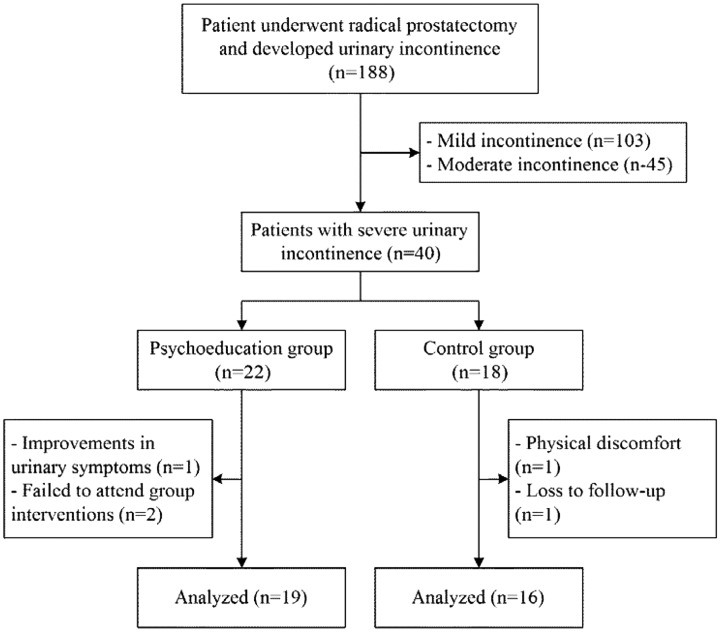
Objective: To implement a psychological intervention programme and explore its effects on anxiety and depression in patients with severe urinary incontinence following radical prostatectomy. Methods: This pilot randomized controlled trial recruited patients that underwent laparoscopic radical prostatectomy. Patients were randomized to conventional nursing and psychoeducation groups. The primary outcome was the levels of anxiety and depression evaluated by the self-rating anxiety scale (SAS) and self-rating depression scale (SDS) at 3 months after urinary catheter removal. The quality of life (secondary outcome) was evaluated using the incontinence-specific quality of life scale (I-QOL). Results: The study analysed 35 patients: 16 received conventional nursing and 19 received a psychoeducational intervention. There were no significant differences in the sociodemographic data and SAS, SDS and I-QOL scores between the two groups at baseline. At 3 months after catheter removal, the SAS and SDS scores in the psychoeducation group were significantly lower compared with the conventional nursing group; and the I-QOL score in the psychoeducation group was significantly higher compared with the conventional nursing group. Conclusion: This pilot study suggests that the psychological nursing intervention improved the symptoms of anxiety and depression, and improved quality of life, in patients with severe urinary incontinence following radical prostatectomy.
Overview
The claims and statistics of this paper haven’t been checked yet.
Free: it reads the open-access text and checks the first 5 claims that cite a source we can check. Create a free account to check every claim.
Integrity signals
Registry
Cites
Statistics
Figures
Verification
Claims the paper makes
The claims and statistics of this paper haven’t been checked yet.
Free: it reads the open-access text and checks the first 5 claims that cite a source we can check. Create a free account to check every claim.
Self-check
Percentages, sums and reported differences re-computed from the paper’s own numbers.
The self-check needs the paper’s full text.
Citations
Cites
Siegel, R. L., Miller, K. D., & Jemal, A. (2015) · CA: A Cancer Journal for Clinicians · doi:10.3322/caac.21254 · Cited by 11,853
Siegel, R., Naishadham, D., & Jemal, A. (2013) · CA A Cancer Journal for Clinicians · doi:10.3322/caac.21166 · Cited by 11,825
Mottet, N., Bellmunt, J., Bolla, M., Briers, E., Cumberbatch, M. G., De Santis, M., Fossati, N., Gross, T., Henry, A. M., Joniau, S., et al. (2017) · European Urology · doi:10.1016/j.eururo.2016.08.003 · Cited by 3,227 · cited 3×
“Although postoperative urinary incontinence does not endanger the life of patients, it profoundly affects their quality of life.(4,5) Psychological interventions have been studied in women,(18,19) but few data are available regarding psychological interventions for urinary incontinence after prostatectomy.”
BackgroundFicarra, V., Novara, G., Rosen, R. C., Artibani, W., Carroll, P. R., Costello, A., Menon, M., Montorsi, F., Patel, V. R., Stolzenburg, J.-U., et al. (2012) · European Urology · doi:10.1016/j.eururo.2012.05.045 · Cited by 1,300
Screening for anxiety and depression: reassessing the utility of the Zung scales
Dunstan, D. A., Scott, N., & Todd, A. K. (2017) · BMC Psychiatry · doi:10.1186/s12888-017-1489-6 · Cited by 461 · cited 3×
“The levels of anxiety were assessed using the Zung self-rating anxiety scale (SAS) and the levels of depression were assessed using the Zung self-rating depression scale (SDS).(20)The quality of life in patients with severe urinary incontinence was evaluated using the incontinencespecific quality of life scale (I-QOL).”
MethodEstimates of cancer incidence and mortality in China, 2013
Zheng, R., Zeng, H., Zhang, S., & Chen, W. (2017) · Chinese Journal of Cancer · doi:10.1186/s40880-017-0234-3 · Cited by 176
Guideline of guidelines: urinary incontinence
Syan, R., & Brucker, B. M. (2015) · British Journal of Urology · doi:10.1111/bju.13187 · Cited by 160 · cited 1×
“The active prevention of postoperative urinary incontinence, accelerating the postoperative recovery of urinary control, helping pain relief and improving the quality of life of patients are crucial features of patient management after prostatectomy.(11) Nevertheless, most of the current studies focus on the physiolog…”
BackgroundMacDonald, R. H., Fink, H. A., Huckabay, C. P., Monga, M., & Wilt, T. J. (2007) · British Journal of Urology · doi:10.1111/j.1464-410x.2007.06913.x · Cited by 136
Quality of Life of Women with Urinary Incontinence: A Systematic Literature Review
Kwon, B. E., Kim, G. Y., Son, Y. J., Roh, Y. S., & You, M. A. (2010) · International Neurourology Journal · doi:10.5213/inj.2010.14.3.133 · Cited by 136 · cited 2×
“A standard score of 53–62 indicated mild depression, 63–72 indicated moderate depression and >72 indicated severe depression.(20,21) The I-QOL includes 22 questions about restrictive behaviour, psychosocial impact, and social barriers, which are evaluated using a 5-point Likert scale.”
MethodProstate cancer: Psychosocial implications and management
Roth, A. J., Weinberger, M. I., & Nelson, C. J. (2008) · Future Oncology · doi:10.2217/14796694.4.4.561 · Cited by 113 · cited 2×
“All of these negative emotions can further aggravate the psychological distress, affecting daily life and resulting in a vicious cycle of negative feelings.(32) Furthermore, after the removal of Figure 1.”
BackgroundProstate cancer: summary of updated NICE guidance
Graham, J., Kirkbride, P., Cann, K., Hasler, E., & Prettyjohns, M. (2014) · BMJ · doi:10.1136/bmj.f7524 · Cited by 105 · cited 3×
“Although postoperative urinary incontinence does not endanger the life of patients, it profoundly affects their quality of life.(4,5) Psychological interventions have been studied in women,(18,19) but few data are available regarding psychological interventions for urinary incontinence after prostatectomy.”
BackgroundPost-radical prostatectomy incontinence: etiology and prevention.
Hoyland, K., Vasdev, N., Abrof, A., & Boustead, G. B. (2014) · PubMed · Cited by 91
The impact of urinary incontinence on self-efficacy and quality of life.
Broome, B. (2003) · Health and Quality of Life Outcomes · doi:10.1186/1477-7525-1-35 · Cited by 86
Psychometric Properties of the SAS, BAI, and S-AI in Chinese University Students
Pang, Z., Tu, D., & Cai, Y. (2019) · Frontiers in Psychology · doi:10.3389/fpsyg.2019.00093 · Cited by 69
Wang, W., Huang, Q. M., Liu, F. P., & Mao, Q. Q. (2014) · BMC Urology · doi:10.1186/1471-2490-14-99 · Cited by 64 · cited 2×
“the urinary catheter, urine overflow causes inconvenience and trouble, and the patients often feel that their body is unclean, even fearing that their body odour will lead them to be discriminated against.(12) Therefore, patients have a sense of shame and inferiority, often reducing their daily activities and social c…”
BackgroundMethodManagement of urinary incontinence
KAPOOR, D. (2006) · CRC Press eBooks · doi:10.1201/b14471-16 · Cited by 53
A Systematic Review of Psychosocial Interventions for Women with Postpartum Stress
Song, J., Kim, T., & Ahn, J. (2015) · Journal of Obstetric, Gynecologic & Neonatal Nursing · doi:10.1111/1552-6909.12541 · Cited by 51
Dieperink, K. B., Johansen, C., Hansen, S., Wagner, L., Andersen, K. K., Minet, L. R., & Hansen, O. (2013) · British Journal of Cancer · doi:10.1038/bjc.2013.679 · Cited by 50 · cited 1×
“Urinary incontinence may also hinder physical and mental rehabilitation after prostatectomy.(10) The active prevention of postoperative urinary incontinence, accelerating the postoperative recovery of urinary control, helping pain relief and improving the quality of life of patients are crucial features of patient man…”
BackgroundPsychosocial impact of urinary incontinence in the elderly population
Hajjar, R. R. (2004) · Clinics in Geriatric Medicine · doi:10.1016/j.cger.2004.04.009 · Cited by 46 · cited 1×
“Therefore, patients have a sense of shame and inferiority, often reducing their daily activities and social communication, leading to loneliness, lack self-confidence and self-efficacy, and their interest in the outside world is decreased, which further results in anxiety and depression.(33) At the same time, shame an…”
BackgroundPost-prostatectomy incontinence: Etiology, evaluation, and management
Singla, N., & Singla, A. K. (2014) · Urology Research and Practice · doi:10.5152/tud.2014.222014 · Cited by 42 · cited 2×
“The prevalence of urinary incontinence after radical prostatectomy is 4–31%,(6) and the occurrence is related to the clinical features of PC, intraoperative injuries, surgical methods and experience of the surgeons.(7,8) Currently, there are no absolute preventive measures and treatments.”
BackgroundCarrier, J., Edwards, D. J., & Harden, J. (2018) · The JBI Database of Systematic Reviews and Implementation Reports · doi:10.11124/jbisrir-2017-003566 · Cited by 37 · cited 1×
“At the same time, shame and embarrassment can prevent patients from seeking medical treatment, which affects their rehabilitation.(34)In the present study, the SAS and SDS were not assessed before prostatectomy because the patients were screened based on the presence of urinary incontinence after removing the urinary…”
BackgroundHodges, P. W., Stafford, R. E., Coughlin, G., Kasza, J., Ashton‐Miller, J. A., Cameron, A. P., Connelly, L. B., & Hall, L. (2019) · BMJ Open · doi:10.1136/bmjopen-2018-028288 · Cited by 34
Personalized medicine: a patient - centered paradigm
Chouchane, L., Mamtani, R., Dallol, A., & Sheikh, J. I. (2011) · Journal of Translational Medicine · doi:10.1186/1479-5876-9-206 · Cited by 33 · cited 1×
“Providing individualized services to patients could ultimately help patients improve their quality of life and the patients feel less let down by the healthcare system, improving their positive feelings.(16) Because of the range of patient conditions, cultural backgrounds and character traits, patients’ attitudes towa…”
BackgroundNguyen, K., Hunter, K. F., & Wagg, A. (2013) · Europe PMC (PubMed Central) · Cited by 30
Lopes, M. H. B. D. M., Higa, R., Cordeiro, S. N., Estapê, N. A. R., D’Ancona, C. A. L., & Turato, E. R. (2011) · Journal of Wound Ostomy and Continence Nursing · doi:10.1097/won.0b013e3182383eeb · Cited by 25 · cited 2×
“In addition, urinary incontinence brings serious psychological distress and economic pressure to both the patients and their family, and the patient experiences a sense of loss and stigma.(26) Self-control of urination cannot be recovered quickly after surgery, leading to irritability, worry, and uncertainty in illnes…”
BackgroundWang, C., Song, Z., Li, S., & Tai, S. (2017) · Supportive Care in Cancer · doi:10.1007/s00520-017-3988-x · Cited by 24
Han, J., Nian, H., Zheng, Z., Zhao, M.-M., Xu, D., & Wang, C. (2017) · Cancer/Radiothérapie · doi:10.1016/j.canrad.2017.04.012 · Cited by 21
Shi, R., Meng, A., Zhou, W.-L., Yu, X., Huang, X., Ji, A., & Chen, L. (2015) · Asian Pacific Journal of Cancer Prevention · doi:10.7314/apjcp.2015.16.16.7117 · Cited by 19
Management of male urinary incontinence
Moore, K., & Lucas, M. (2010) · Indian Journal of Urology · doi:10.4103/0970-1591.65398 · Cited by 17 · cited 1×
“The nurses will teach the patients the methods of managing urinary incontinence, such as wearing a condom catheter and using and replacing urine pads, which improve the patient and family’s sense of control of the disease.(37,38)Another important aspect of the psychoeducation intervention provided by the nurses was to…”
MethodShen, M., Hu, M., & Sun, Z. (2017) · BMJ Open · doi:10.1136/bmjopen-2016-012961 · Cited by 17
Huntley, A. L., King, A. J. L., Moore, T. H., Paterson, C., Persad, R. A., Sharp, D., & Evans, M. A. (2016) · Journal of Advanced Nursing · doi:10.1111/jan.13082 · Cited by 15
Fan, Y., Huang, Z., Zhang, D., Chang, J., Jia, Y., He, S., & Wei, B. (2017) · Journal of obstetrics and gynaecology research · doi:10.1111/jog.13351 · Cited by 15
Wu, L., & Zhang, L. (2017) · PubMed Central · Cited by 13
Wang, W., Lim, J. Y., López, V., Wu, X. V., Lee, C., He, H. G., & Jiang, Y. (2018) · Journal of Advanced Nursing · doi:10.1111/jan.13793 · Cited by 13
Mendes, A., Rodolpho, J. R., & Hoga, L. A. K. (2016) · Applied Nursing Research · doi:10.1016/j.apnr.2016.02.005 · Cited by 8
Schachar, J. S., Williams, K. S., & Winkler, H. A. (2018) · Journal of Mid-life Health · doi:10.4103/jmh.jmh_64_17 · Cited by 5 · cited 1×
“Indeed, urinary incontinence changes the original physiological balance of the patients, leading to restriction of drinking water intake, poor sleep quality, sexual disorder, skin eczema and ulceration, which reduces the comfort and satisfaction with life of the patients, and further aggravates their anxiety and depre…”
BackgroundIncontinence-associated dermatitis from a urinary incontinence perspective
Wilson, M. (2018) · British Journal of Nursing · doi:10.12968/bjon.2018.27.9.s4 · Cited by 5 · cited 2×
“Indeed, urinary incontinence changes the original physiological balance of the patients, leading to restriction of drinking water intake, poor sleep quality, sexual disorder, skin eczema and ulceration, which reduces the comfort and satisfaction with life of the patients, and further aggravates their anxiety and depre…”
Background
Research works printed but not linked: 1
- Abrams P Cardozo L Khoury S, et al Incontinence. 5th ed. Bristol: International Continence Society, 2013.
Cited by
Mundle, R. S., Afenya, E., & Agarwal, N. (2021) · Prostate Cancer and Prostatic Diseases · doi:10.1038/s41391-021-00342-3 · Cited by 49
Nnate, D. A., Anyachukwu, C. C., Igwe, S. E., & Abaraogu, U. O. (2021) · Psycho-Oncology · doi:10.1002/pon.5749 · Cited by 24
Huynh, N. T. T., Fan, S.-Y., & Kao, C. (2022) · Supportive Care in Cancer · doi:10.1007/s00520-022-07085-4 · Cited by 19
“The other instruments were Self-Rating Depression Scale (n = 3) [16, 19, 21], Center for Epidemiologic Studies-Depression (n = 2) [32, 51], and Hamilton Depression Rating Scale (n = 1) [17].”
BackgroundMethodGezginci, E., Göktaş, S., & Ata, A. (2022) · Clinical Rehabilitation · doi:10.1177/02692155221134477 · Cited by 17
“Urinary incontinence can usually cause low selfesteem, anxiety, depression, and social isolation in men after surgery, and this significantly affects the quality of life.(3,5) In this context, education is important to improve patients’ quality of life and to provide”
BackgroundWang, W., Lim, J. Y., López, V., Wu, X. V., Lee, C., He, H. G., & Jiang, Y. (2018) · Journal of Advanced Nursing · doi:10.1111/jan.13793 · Cited by 13
Metadata
- Authors
- Yuan, Y., Hu, Y., Cheng, J.-X., & Ding, P.
- Affiliations
- First Affiliated Hospital of Anhui Medical University (CN)
- Corresponding author
- Ding, Ping
- Venue
- Journal of International Medical Research
- Publisher
- SAGE Publications
- Published
- 2019-09-30
- Volume
- 47
- Issue
- 11
- Pages
- 5689-5701
- ISSN
- 0300-0605 (ISSN-L)
- 1473-2300
- PMC
- PMC6862892
- OpenAlex
- W2977823953
- Semantic Scholar
- 19b818742961994db4b6f12e02cc316952d1cfff
- Cited by
- 33
- References
- 37
- Citations by year
- 2026: 3 · 2025: 6 · 2024: 4 · 2023: 10 · 2022: 7 · 2021: 2
- FWCI
- 0.94
- Type
- journal article
- Language
- en
- Open access
- gold
- doi.org
- Licence
- Locations
- Journal of International Medical Research (publishedVersion, cc-by-nc)
- PubMed Central (publishedVersion, cc-by-nc)
- PubMed (publishedVersion)
- DOAJ (DOAJ: Directory of Open Access Journals) (submittedVersion, cc-by-sa)
- Funders
- National key clinical specialty construction project
- The Fund for the humanities and social sciences of colleges and universities of the Anhui Provincial Department of Education (#SK2017A0171)
- The first batch of science and technology projects in Anhui China in 2017 (#1704a0802173)
- General program of the National Natural Science Foundation Project of China (#N81370856)
- Topics
- Health Sciences › Medicine › Oncology › Cancer survivorship and care
- Health Sciences › Medicine › Urology › Pelvic floor disorders treatments
- Health Sciences › Medicine › Urology › Urinary Bladder and Prostate Research
- Keywords
- psychological nursing intervention, psychoeducation, urinary incontinence, radical prostatectomy, anxiety, depression, quality of life, postoperative complications, prostate cancer
- MeSH terms
- Aged, Anxiety, Depression, Humans, Male, Pilot Projects, Prostatectomy, Psychiatric Nursing, Quality of Life, Socioeconomic Factors, Urinary Incontinence
About these checks
Registry, retraction, Cites and statistics results are computed, not judged, with one exception: a printed reference that no index lists is read once by a model before it counts as a citation error. Claims are extracted by a model and kept only when their quote appears verbatim in the text; each cited source is then checked, with a model’s help, for whether it says what the claim relies on. Those verdicts can be wrong — read the claim’s quote and the cited source before relying on one.
Statistics and arithmetic are recomputed, not judged.
Confidence bands are shown only for fields calibrated on our annotated test set. None is calibrated yet, so no band is shown.
What counts as a claim ›How we measure confidence ›How we check this ›
Are you an author, or do you see a problem with this page? Request a review
Data sources
Bibliographic data: Semantic Scholar, OpenAlex, Crossref.
Contains information from the Semantic Scholar Academic Graph Datasets, made available under the ODC Attribution License (ODC-BY 1.0).
Semantic Scholar’s data is described in: Kinney, R., et al. (2023). The Semantic Scholar Open Data Platform. arXiv:2301.10140.
