

The DOI matches its Crossref record; 1 of the 1 references it cites were found in a registry or an index.
Evaluation of monocyte-to-high-density lipoprotein cholesterol ratio and monocyte-to-lymphocyte ratio in ischemic stroke
Open accessAbstract
Objectives: We aimed to evaluate the diagnostic value of the combination of the monocyte-to-high-density lipoprotein cholesterol ratio (MHR) with the monocyte-to-lymphocyte ratio (MLR) in ischemic stroke patients. Methods: There were 253 patients who were diagnosed with ischemic stroke and 211 healthy subjects enrolled into this retrospective study. Result: MHR and MLR were significantly higher in ischemic stroke patients compared with controls. MHR and MLR remained as independent variables for the presence of ischemic stroke. In receiver operating characteristic analyses, the optimal cut-off values for MHR and MLR were 0.28 and 0.19, respectively. The area under the curve for MHR was 0.777 (sensitivity, 66.01%; specificity, 77.25%), and that for MLR was 0.742 (sensitivity, 70.36%; specificity, 67.77%) in ischemic stroke patients. Moreover, the combination MHR and MLR increased the sensitivity compared with MHR or MLR alone. Conclusion: The present study shows that a high MHR and MLR are each predictive for the risk of ischemic stroke, and together, they exhibit a better diagnostic value compared with each ratio alone.
Overview
The claims and statistics of this paper haven’t been checked yet.
Run the check — free, no account needed. It reads the open-access text and checks the sources it cites.
Integrity signals
Registry
Cites
Statistics
Figures
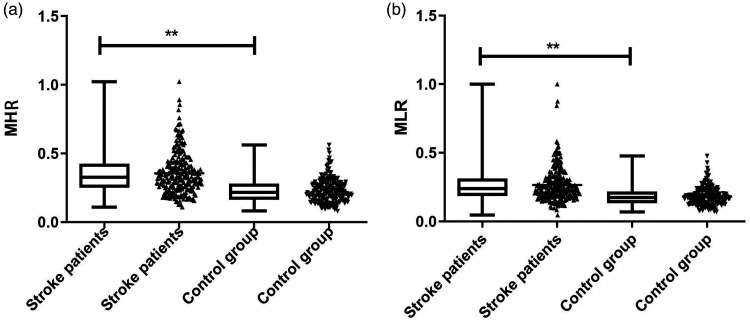
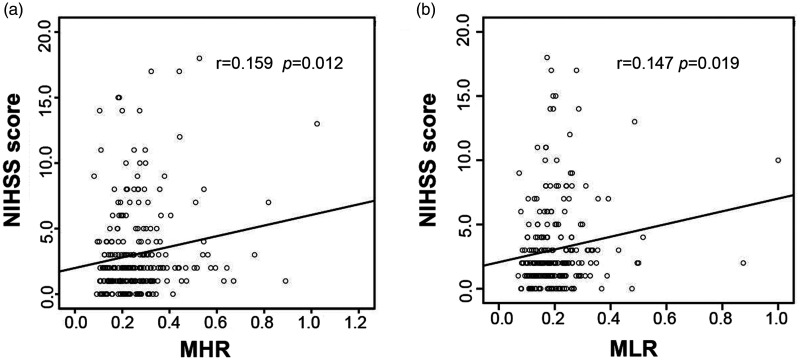
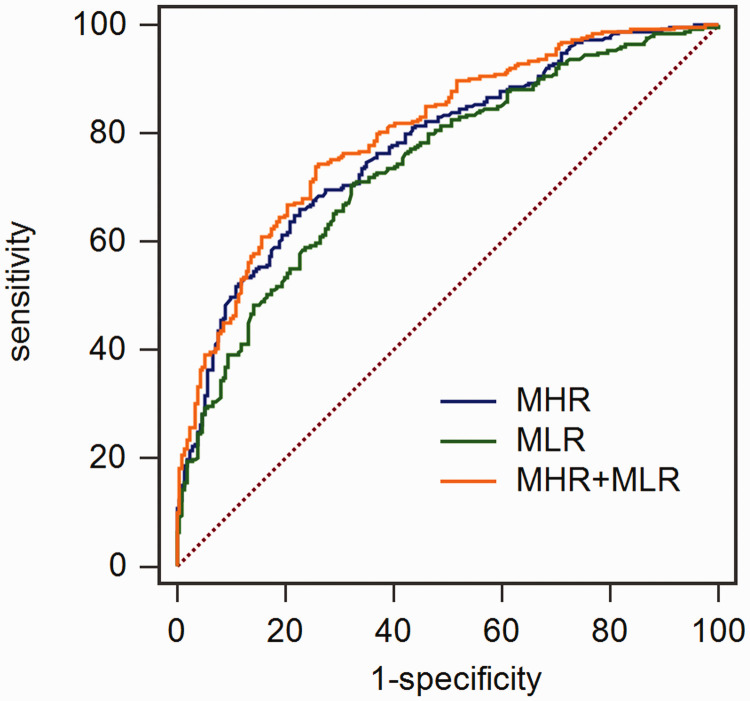
Verification
Claims the paper makes
The claims and statistics of this paper haven’t been checked yet.
Run the check — free, no account needed. It reads the open-access text and checks the sources it cites.
Claims other papers make about this one
Each is checked against this paper’s own text: does it say what the citing paper says it does?
The cited source says what the claim attributes to it.
In the citing paper
“The SII, SIRI, MHR, NHR, LHR, and PHR are considered cost-effective and simple laboratory parameters indicating systemic inflammation in many diseases (18, 19, 21–23, 26, 27, 30–34).”
From Investigation of systemic immune-inflammation index, neutrophil/high-density lipoprotein ratio, lymphocyte/high-density lipoprotein ratio, and monocyte/high-density lipoprotein ratio as indicators of inflammation in patients with schizophrenia and bipolar disorder (2022) · cites this paper as [32]
Self-check
Percentages, sums and reported differences re-computed from the paper’s own numbers.
The self-check needs the paper’s full text.
Citations
Cites
Monocyte/high-density lipoprotein ratio predicts the mortality in ischemic stroke patients
Bolayir, A., Gokce, S. F., Cigdem, B., Bolayir, H. A., Yildiz, O. K., Bolayir, E., & Topaktas, S. A. (2018) · Neurologia i Neurochirurgia Polska · doi:10.1016/j.pjnns.2017.08.011 · Cited by 98
Research works printed but not linked: 42
- 10.1159/000441085 · DOI
- 10.1161/CIRCULATIONAHA.116.025250 · DOI
- 10.1189/jlb.1109766 · DOI · Paper page
- 10.2174/138161212802481200 · DOI
- 10.1186/1471-2377-13-7 · DOI
- 10.1016/j.jstrokecerebrovasdis.2014.02.004 · DOI
- 10.1111/ene.12233 · DOI
- 10.1111/j.1365-2796.2012.02526.x · DOI
- 10.1155/2013/759103 · DOI
- 10.1007/s11064-015-1676-0 · DOI
- 10.1016/j.jacc.2013.09.019 · DOI
- 10.5551/jat.RV17025 · DOI
- 10.1002/jcp.27028 · DOI
- 10.1016/j.jns.2016.11.022 · DOI
- 10.1016/j.jstrokecerebrovasdis.2017.06.019 · DOI
- 10.1186/s12872-017-0507-4 · DOI
- 10.1002/brb3.1429 · DOI
- Hatano S., 1976, Bull World Health Organ, 54, 541
- 10.1080/09273948.2019.1611876 · DOI
- 10.1177/1076029615594002 · DOI
- 10.1016/j.brainres.2016.02.030 · DOI
- 10.1016/S0021-9150(01)00616-5 · DOI
- 10.1161/ATVBAHA.117.309846 · DOI
- 10.1038/jcbfm.2012.88 · DOI
- 10.1007/s00109-015-1317-8 · DOI
- 10.1016/j.neuroscience.2009.04.025 · DOI
- 10.1371/journal.pone.0025863 · DOI
- 10.1155/2017/8526438 · DOI
- 10.3390/ijms17121967 · DOI
- 10.1016/j.atherosclerosis.2013.03.015 · DOI
- 10.1042/CS20080106 · DOI
- 10.2174/092986709787458425 · DOI
- 10.1126/science.1189731 · DOI
- 10.1016/j.bbrc.2014.12.028 · DOI
- 10.1161/CIRCRESAHA.111.300581 · DOI
- 10.1038/ni.2784 · DOI
- 10.1007/s10072-017-3163-7 · DOI
- 10.12659/MSM.907919 · DOI
- 10.1007/s11255-017-1691-y · DOI
- 10.1371/journal.pone.0059602 · DOI
- 10.1093/cvr/cvy261 · DOI
- DeLong ER, DeLong DM and Clarke-Pearson DL. Comparing the areas under two or more correlated receiver operating characteristic curves: a nonparametric approach. Biometrics 1988; 44: 837-845. was added in the reference list. · DOI · Paper page
Cited by
Sorted by citations
Wei, Y., Wang, T., Li, G., Feng, J., Deng, L., Xu, H., Yin, L., Ma, J., Chen, D., & Chen, J. (2022) · Frontiers in Psychiatry · doi:10.3389/fpsyt.2022.941728 · Cited by 99
Department of Psychiatry, D. U. M. F., Uyar, B., Budak, E. A., & Department of Psychiatry, D. U. M. F. (2022) · PSYCHIATRIA DANUBINA · doi:10.24869/psyd.2022.687 · Cited by 12
Metadata
- Authors
- Liu, H., Zhan, F., & Wang, Y.
- Affiliations
- Soochow University (CN)
- Department of Clinical Laboratory, Changzhou Tumor Hospital Affiliated with Soochow University, Jiangsu, China
- Corresponding author
- Liu, Huiling
- Venue
- Journal of International Medical Research
- Publisher
- SAGE Publications
- Published
- 2020-07
- Volume
- 48
- Issue
- 7
- Pages
- 300060520933806-300060520933806
- ISSN
- 0300-0605 (ISSN-L)
- 1473-2300
- PMC
- PMC7361497
- OpenAlex
- W3043176161
- Cited by
- 31
- References
- 1
- Citations by year
- 2026: 1 · 2025: 7 · 2024: 2 · 2023: 8 · 2022: 7 · 2021: 6
- FWCI
- 1.90
- Type
- journal article
- Language
- en
- Open access
- gold
- doi.org
- Licence
- Locations
- Journal of International Medical Research (publishedVersion, cc-by-nc)
- PubMed Central (publishedVersion, cc-by-nc)
- PubMed (publishedVersion)
- DOAJ (DOAJ: Directory of Open Access Journals) (submittedVersion, cc-by-sa)
- Topics
- Health Sciences › Medicine › Oncology › Inflammatory Biomarkers in Disease Prognosis
- Health Sciences › Medicine › Clinical Neurology › Acute Ischemic Stroke Management
- Health Sciences › Medicine › Cardiology and Cardiovascular Medicine › Lipoproteins and Cardiovascular Health
- Keywords
- ischemic stroke, monocyte-to-lymphocyte ratio, inflammatory markers, diagnostic accuracy, cut-off values, combined biomarker prediction
- MeSH terms
- Ischemic Stroke, Brain Ischemia, Humans, Cholesterol, HDL, Lymphocytes, Monocytes, Retrospective Studies, Stroke
About these checks
Registry, retraction, Cites and statistics results are computed, not judged, with one exception: a printed reference that no index lists is read once by a model before it counts as a citation error. Claims are extracted by a model and kept only when their quote appears verbatim in the text; each cited source is then checked, with a model’s help, for whether it says what the claim relies on. Those verdicts can be wrong — read the claim’s quote and the cited source before relying on one.
Statistics and arithmetic are recomputed, not judged.
Confidence bands are shown only for fields calibrated on our annotated test set. None is calibrated yet, so no band is shown.
What counts as a claim ›How we measure confidence ›How we check this ›
Are you an author, or do you see a problem with this page? Request a review
