

Reentry Programs for Adult Male Offender Recidivism and Reintegration: A Systematic Review and Meta-Analysis
Open accessThe DOI matches its Crossref record; 35 of the 35 references it cites were found in a registry or an index; 1 of the 73 sources its claims cite were checked for support.
Abstract
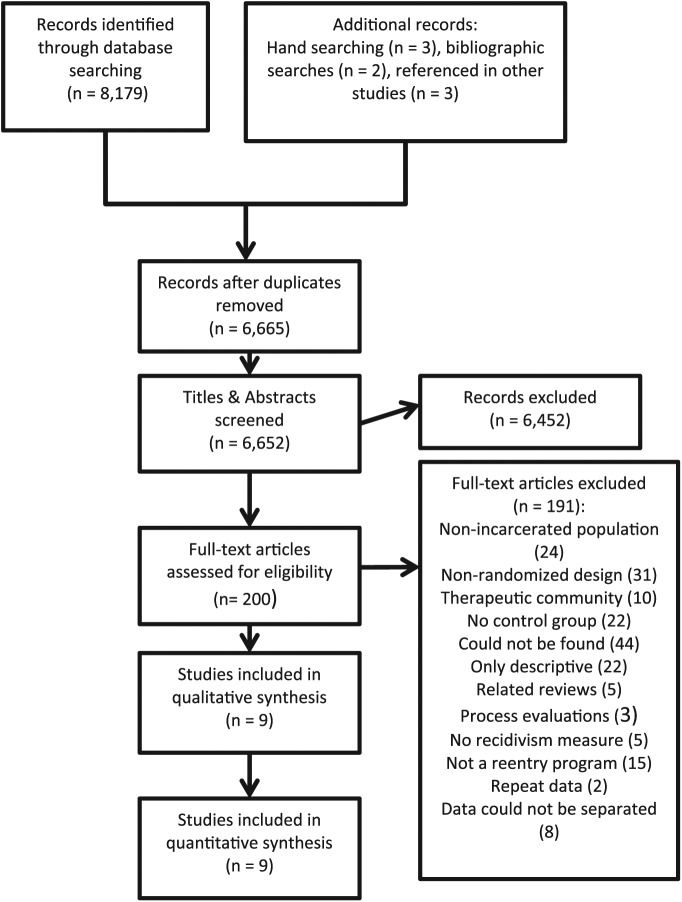
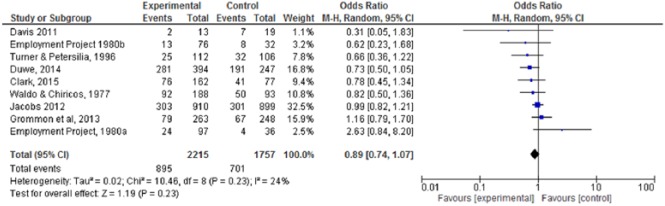
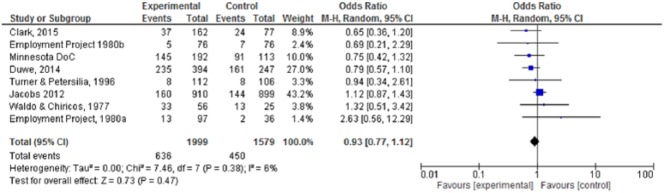
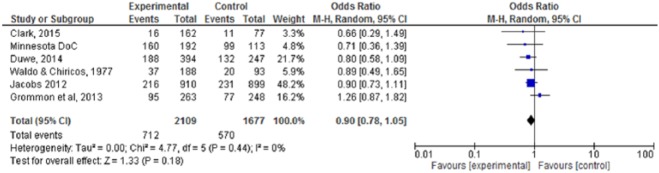
The aim of this review is to assess the effectiveness of reentry programs designed to reduce recidivism and ensure successful reintegration among adult, male offenders. Studies were included if they (a) evaluated a reentry program incorporating elements dealing with the transition from prison to community for adult, male offenders; (b) utilized a randomized controlled design; and (c) measured recidivism as a primary outcome. In addition, secondary outcomes measures of reintegration were also included. The systematic search of 8,179 titles revealed nine randomized controlled evaluations that fulfilled eligibility criteria. The random-effects meta-analysis for rearrest revealed a statistically nonsignificant effect favoring the intervention (odds ratio [OR] = 0.89, 95% confidence interval [CI] [0.74, 1.07]). Similar results were found for reconviction (OR = 0.94, 95% CI [0.77, 1.12]) and reincarceration (OR = 0.90, 95% CI [0.78, 1.05]). Studies reported mixed results of secondary outcomes of reintegration. The results of this review reflect the variability of findings on reducing recidivism. The challenges faced in conducting this review highlight a need for further research and theory development around reentry programs.
Overview
CoChat Summary
TL;DR
This systematic review and random-effects meta-analysis of nine U.S. trials of adult male reentry programs found no statistically significant effects on rearrest, reconviction, or reincarceration. Secondary reintegration outcomes were mixed and limited, and the author calls for better theory, reporting, and process evaluation in reentry research.
Key findings
- Rearrest: pooled OR = 0.89, 95% CI [0.74, 1.07], statistically nonsignificant; six of nine studies favored the intervention, but every confidence interval included 1.
- Reconviction: pooled OR = 0.93, 95% CI [0.77, 1.12] in the results/discussion (the abstract reports OR = 0.94, 95% CI [0.77, 1.12]); nonsignificant.
- Reincarceration: pooled OR = 0.90, 95% CI [0.78, 1.05], nonsignificant.
- Secondary outcomes were mixed: Duwe (2014) found increased odds of accessing employment and housing adequacy, but also more unstable housing (54.1% vs. 35.4%, χ² = 9.73, df = 248, p < .01); employment and substance-use findings were mostly nonsignificant, while two studies reported increased social support.
Methods
- Systematic review and random-effects meta-analysis of studies evaluating reentry programs for formerly incarcerated adult males (age 18+ at release), including programs addressing employment, housing, social support, and/or substance use.
- Searches yielded 8,179 titles; after screening, nine studies met inclusion criteria, conducted from 1977 to 2015, all in the United States with male participants.
- Effect sizes were odds ratios, with preference for longest follow-up and official recidivism statistics; heterogeneity assessed with Q and I². Secondary outcomes were narratively synthesized due to limited data.
Limitations
- Stated: studies were evaluated and coded by only one rater; only English-language studies were found; many full texts, especially government reports, could not be obtained; missing study-quality information remained despite contacting authors.
- Stated: included studies had variable and generally disappointing methodological quality; none reported all six Cochrane Risk of Bias domains, and only four mentioned process evaluations.
- Evident from the text: although the review states it included only RCTs, two included studies (MDOC, 2006; Turner & Petersilia, 1996) are described as “quasi-RCT” designs; the abstract and results also report slightly different reconviction odds ratios (0.94 vs. 0.93).
Model-written summary. Check it against the paper before relying on it.
Integrity signals
Registry
Cites
Statistics
Figures
Verification
Claims the paper makes
1 Valid · 2 Not valid · 49 Not checked · 53 Own results and interpretations
None of the sources cited for this claim have been checked yet.
In the paper
“Two studies used a “quasi-RCT” design (MDOC, 2006; Turner & Petersilia, 1996).”
§ Reentry Programs for Adult Male Offender Recidivism and Reintegration: A Systematic Review and Meta-Analysis > Results > Research Design and Comparison Conditions
What the sources say
- Not matchedcites MDOC, 2006
An author–year citation the paper’s reference list doesn’t settle. We don’t search these by name.
- Not checked — no full text of the sourcecites Turner & Petersilia, 1996 matched to “Work Release in Washington: Effects on Recidivism and Corrections Costs” (1996) source
plain- Asserted: passes — The authors put it forward as true.
- Checkable: passes — It can be checked against evidence.
- Load-bearing: unclear — It is unclear whether the paper’s conclusions depend on it.
- Based: passes — The paper gives a reason why it holds.
- Not matched
A result the paper reports from its own data — it cites no other source for it, so there is none to check. The quote shows it is in the paper.
In the paper
“The systematic search of 8,179 titles revealed nine randomized controlled evaluations that fulfilled eligibility criteria.”
- Also stated in: § Results · plain
“ultimately, nine studies were found which fit the inclusion criteria.”
§ Reentry Programs for Adult Male Offender Recidivism and Reintegration: A Systematic Review and Meta-Analysis > Abstract
plain- Asserted: passes — The authors put it forward as true.
- Checkable: passes — It can be checked against evidence.
- Load-bearing: passes — The paper’s conclusions depend on it.
- Based: passes — The paper gives a reason why it holds.
- Also stated in: § Results · plain
In the paper
“Only one study (Waldo & Chiricos, 1977) reported blinding assessors.”
§ Reentry Programs for Adult Male Offender Recidivism and Reintegration: A Systematic Review and Meta-Analysis > Results > Risk of Bias Appraisal
What the sources say
- Not checked — no full text of the sourcecites Waldo & Chiricos, 1977 matched to “Work Release and Recidivism: An Empirical Evaluation of a Social Policy” (1977) source
plain- Asserted: passes — The authors put it forward as true.
- Checkable: passes — It can be checked against evidence.
- Load-bearing: unclear — It is unclear whether the paper’s conclusions depend on it.
- Based: passes — The paper gives a reason why it holds.
A result the paper reports from its own data — it cites no other source for it, so there is none to check. The quote shows it is in the paper.
In the paper
“and reincarceration (OR = 0.90, 95% CI [0.78, 1.05])”
§ Reentry Programs for Adult Male Offender Recidivism and Reintegration: A Systematic Review and Meta-Analysis > Abstract
plain- Asserted: passes — The authors put it forward as true.
- Checkable: passes — It can be checked against evidence.
- Load-bearing: passes — The paper’s conclusions depend on it.
- Based: passes — The paper gives a reason why it holds.
- Rests on 2 assumptions not shown here.
A result the paper reports from its own data — it cites no other source for it, so there is none to check. The quote shows it is in the paper.
In the paper
“The random-effects meta-analysis for rearrest revealed a statistically nonsignificant effect favoring the intervention (odds ratio [OR] = 0.89, 95% confidence interval [CI] [0.74, 1.07]).”
§ Reentry Programs for Adult Male Offender Recidivism and Reintegration: A Systematic Review and Meta-Analysis > Abstract
plain- Asserted: passes — The authors put it forward as true.
- Checkable: passes — It can be checked against evidence.
- Load-bearing: passes — The paper’s conclusions depend on it.
- Based: passes — The paper gives a reason why it holds.
- Rests on 2 assumptions not shown here.
44 more claims
Create a free account to see all 105 claims and every source verdict.
- Probably not a substantial claim. 25
- It may state two separate claims as one. 37
- The quote only partly states this claim. 2
Self-check
Percentages, sums and reported differences re-computed from the paper’s own numbers.
Each contradiction between two passages listed here was confirmed by an independent check.
Rated minor: it would not touch a result — a value no result rests on, a p-value that stays on the same side of the significance level, or a conflict that is clerical, resolved elsewhere in the paper, or outside its own findings.
In the paper
§ Reentry Programs for Adult Male Offender Recidivism and Reintegration: A Systematic Review and Meta-Analysis > Method
“Due to this knowledge and known existence of RCTs in reentry evaluations, only RCTs will be considered in this review.”
§ Reentry Programs for Adult Male Offender Recidivism and Reintegration: A Systematic Review and Meta-Analysis > Results > Research Design and Comparison Conditions
“Two studies used a “quasi-RCT” design (MDOC, 2006; Turner & Petersilia, 1996).”
Rated minor: it would not touch a result — a value no result rests on, a p-value that stays on the same side of the significance level, or a conflict that is clerical, resolved elsewhere in the paper, or outside its own findings.
In the paper
§ Reentry Programs for Adult Male Offender Recidivism and Reintegration: A Systematic Review and Meta-Analysis > Results > Research Design and Comparison Conditions
“All nine studies reported explicitly that participants had been randomly assigned to either treatment or control group.”
§ Reentry Programs for Adult Male Offender Recidivism and Reintegration: A Systematic Review and Meta-Analysis > Results > Research Design and Comparison Conditions
“More specifically, for 9 months of the 21-month long allocation phase, offenders were not randomly allocated to intervention or control.”
Rated minor: it would not touch a result — a value no result rests on, a p-value that stays on the same side of the significance level, or a conflict that is clerical, resolved elsewhere in the paper, or outside its own findings.
In the paper
“The nine studies were conducted over a span of 30 years, with the first study being conducted in 1977 (Waldo & Chiricos, 1977) and the most recent in 2015 (Clark, 2015).”
§ Reentry Programs for Adult Male Offender Recidivism and Reintegration: A Systematic Review and Meta-Analysis > Results > Study Characteristics
Reported 30 · recomputed 38
Rated minor: it would not touch a result — a value no result rests on, a p-value that stays on the same side of the significance level, or a conflict that is clerical, resolved elsewhere in the paper, or outside its own findings.
In the paper
§ Reentry Programs for Adult Male Offender Recidivism and Reintegration: A Systematic Review and Meta-Analysis > Results > Research Design and Comparison Conditions
“Three studies utilized treatment as usual comparison group”
§ Reentry Programs for Adult Male Offender Recidivism and Reintegration: A Systematic Review and Meta-Analysis > Results > Research Design and Comparison Conditions
“(Clark, 2015; Duwe, 2014; Grommon et al., 2013; MDOC, 2006).”
Rated minor: it would not touch a result — a value no result rests on, a p-value that stays on the same side of the significance level, or a conflict that is clerical, resolved elsewhere in the paper, or outside its own findings.
In the paper
§ Reentry Programs for Adult Male Offender Recidivism and Reintegration: A Systematic Review and Meta-Analysis > Discussion
“Only five of the nine studies had a “reintegration” measurement (employment, housing, substance use, and social support; Davis, 2011; Duwe, 2014; Employment Research Project, 1980; Grommon et al., 2013; Jacobs, 2012).”
§ Reentry Programs for Adult Male Offender Recidivism and Reintegration: A Systematic Review and Meta-Analysis > Discussion
“In the case of the six studies which did report changes in employment, housing, social support, and substance use, mixed results were found.”
1 more finding
Create a free account to see every finding of this check.
Citations
Cites
Cochrane Handbook for Systematic Reviews of Interventions
Tarsilla, M. (2010) · Journal of MultiDisciplinary Evaluation · doi:10.56645/jmde.v6i14.284 · Cited by 5,178
When prisoners come home: parole and prisoner reentry
(2003) · Choice Reviews Online · doi:10.5860/choice.41-2504 · Cited by 1,778
Recidivism of Prisoners Released in 1994
Langan, P. A., & Levin, D. J. (2002) · Federal Sentencing Reporter · doi:10.1525/fsr.2002.15.1.58 · Cited by 1,008
After Crime and Punishment: Pathways to Offender Reintegration
Codd, H. (2005) · Crime Prevention and Community Safety · doi:10.1057/palgrave.cpcs.8140232 · Cited by 564
Prisoner Reentry: What Works, What Does Not, and What Is Promising
Seiter, R. P., & Kadela, K. R. (2003) · Crime & Delinquency · doi:10.1177/0011128703049003002 · Cited by 397 · cited 3×
“Although Seiter and Kadela (2003) report finding positive findings for four types of reentry programs, the evidence they presented was weak.”
BackgroundCOERCION, SOCIAL SUPPORT, AND CRIME: AN EMERGING THEORETICAL CONSENSUS*
COLVIN, M., CULLEN, F. T., & VEN, T. V. (2002) · Criminology · doi:10.1111/j.1745-9125.2002.tb00948.x · Cited by 365
Does research design affect study outcomes in criminal justice?
Weisburd, D., Lum, C. M., & Petrosino, A. (2001) · The ANNALS of the American Academy of Political and Social Science · doi:10.1177/000271620157800104 · Cited by 335
Intervention Research: Developing Social Programs
Fräser, M. W. (2009) · Cited by 217
Intervention Research: Developing Social Programs
Fraser, M. W., Richman, J. M., Galinsky, M. J., & Day, S. H. (2009) · doi:10.1093/oso/9780195325492.001.0001 · Cited by 204
Newton, D. C., Day, A., Giles, M. J., Wodak, J., Graffam, J., & Baldry, E. (2016) · International Journal of Offender Therapy and Comparative Criminology · doi:10.1177/0306624x16645083 · Cited by 163
Research works printed but not linked: 6
- Davis C. P. (2011). Incorporating naturally occurring social support in interventions for former prisons with substance use disorders: A community-based randomized controlled trial (Doctoral dissertation). Available from ProQuest Digital Dissertations. (UMI 3464901)
- Heidemann G. Soydan H. Xie B (2010). Reentry programs for formerly incarcerated women. Manuscript submitted for publication.
- Krienert J. L. Fleisher M. S. (2004). Economic rehabilitation: A reassessment of the link between employment and crime. In Krinert J. L. Fleisher M. S. (Eds.), Crime & employment: Critical issues in crime reduction for corrections (pp. 39- 56). Walnut Creek, CA: AltaMira Press.
- Maloney D. Bazemore G. Hudson J. (2001). The end of probation and the beginning of community justice. Perspectives, 25(3), 24- 30.
- Miller M. Ngugi I. (2009). Impacts of housing supports: Persons with mental illness and ex-offenders. Olympia: Washington State Institute for Public Policy.
- Taxman F. Young D. Bryne J. (2004). With eyes wide open: Formalizing community and social control intervention in offender reintegration programs. In Maruna S. Immarigeon R. (Eds.), After crime and punishment: Pathways to offender reintegration (pp. 233- 260). Cullompton, UK: Willan Publishing.
Cited by
van Gelder, J., Cornet, L. J. M., Zwalua, N. P., Mertens, E. C. A., & van der Schalk, J. (2022) · Scientific Reports · doi:10.1038/s41598-022-06305-5 · Cited by 59
Does the good lives model work? A systematic review of the recidivism evidence
Zeccola, J., Kelty, S. F., & Boer, D. P. (2021) · Journal of Forensic Practice · doi:10.1108/jfp-03-2021-0010 · Cited by 56
Reentry in Practice: Sexual Offending, Self-Narratives, and the Implications of Stigma in Norway
Sandbukt, I. J. (2021) · International Journal of Offender Therapy and Comparative Criminology · doi:10.1177/0306624x211049184 · Cited by 38
Desai, A., Durham, K. E., Burke, S. C., NeMoyer, A., & Heilbrun, K. (2021) · Psychology Public Policy and Law · doi:10.1037/law0000279 · Cited by 29
Silver, I. A., D’Amato, C., & WOOLDREDGE, J. D. (2021) · Journal of Criminal Justice · doi:10.1016/j.jcrimjus.2021.101812 · Cited by 29
Metadata
- Authors
- Berghuis, M.
- Affiliations
- Leiden University (NL)
- Corresponding author
- Berghuis, Maria
- ORCID
- Berghuis, Maria
- Venue
- International Journal of Offender Therapy and Comparative Criminology
- Publisher
- SAGE Publications
- Published
- 2018-06-11
- Volume
- 62
- Issue
- 14
- Pages
- 4655-4676
- ISSN
- 0020-7497 (ISSN-L)
- 0306-624X
- 1552-6933
- PMC
- PMC6139987
- OpenAlex
- W2807816003
- Cited by
- 79
- References
- 33
- Citations by year
- 2026: 10 · 2025: 12 · 2024: 14 · 2023: 8 · 2022: 15 · 2021: 9 · 2020: 7 · 2019: 4
- FWCI
- 1.79
- Type
- journal article
- Language
- en
- Open access
- hybrid
- doi.org
- Licence
- cc-by-nc
- journals.sagepub.com/page/policies/text-and-data-mining-license (tdm)
- Locations
- International Journal of Offender Therapy and Comparative Criminology (publishedVersion, cc-by-nc)
- Europe PMC (PubMed Central) (publishedVersion, cc-by-nc)
- PubMed Central (publishedVersion, cc-by-nc)
- PubMed (publishedVersion)
- Leiden Repository (Leiden University) (submittedVersion)
- Data Archiving and Networked Services (DANS) (submittedVersion, other-oa)
- Topics
- Social Sciences › Sociology and Political Science › Criminal Justice and Corrections Analysis
- Social Sciences › Law › Criminal Justice and Penology
- Social Sciences › Sociology and Political Science › Crime Patterns and Interventions
- Keywords
- prisoner reentry programs, recidivism, prisoner reentry, male offenders, rearrest, reconviction, reincarceration, transition from prison to community, program effectiveness
- MeSH terms
- Recidivism, Adult, Crime, Humans, Male, Prisoners, Recurrence, Criminals
About these checks
Registry, retraction, Cites and statistics results are computed, not judged, with one exception: a printed reference that no index lists is read once by a model before it counts as a citation error. Claims are extracted by a model and kept only when their quote appears verbatim in the text; each cited source is then checked, with a model’s help, for whether it says what the claim relies on. Those verdicts can be wrong — read the claim’s quote and the cited source before relying on one.
A language model drew the claims from the paper on 2026-09-30, under version 3 of the claim definition (model deepseek-v4.1-flash, prompt extract-v3).
A second model labelled each claim on 2026-09-30 (model jev-1.13-20260917, definition revision gold-guideline-v0.2).
Statistics and arithmetic are recomputed, not judged.
Confidence bands are shown only for fields calibrated on our annotated test set. None is calibrated yet, so no band is shown.
What counts as a claim ›How we measure confidence ›How we check this ›
Are you an author, or do you see a problem with this page? Request a review
How to cite
Cite CoChat for the checks on this page, and the paper for its own findings.
- This page
- CoChat. (2026). Citation check: Reentry Programs for Adult Male Offender Recidivism and Reintegration: A Systematic Review and Meta-Analysis. https://app.cochat.ai/papers/10.1177/0306624x18778448
- The paper
- Berghuis, M. (2018). Reentry Programs for Adult Male Offender Recidivism and Reintegration: A Systematic Review and Meta-Analysis. International Journal of Offender Therapy and Comparative Criminology. https://doi.org/10.1177/0306624x18778448
Data sources
Bibliographic data: Semantic Scholar, OpenAlex, Crossref.
Contains information from the Semantic Scholar Academic Graph Datasets, made available under the ODC Attribution License (ODC-BY 1.0).
Semantic Scholar’s data is described in: Kinney, R., et al. (2023). The Semantic Scholar Open Data Platform. arXiv:2301.10140.
