

“But can chatbots understand sex?” Attitudes towards artificial intelligence chatbots amongst sexual and reproductive health professionals: An exploratory mixed-methods study
Open accessThe DOI matches its Crossref record; 27 of the 27 references it cites were found in a registry or an index.
Abstract
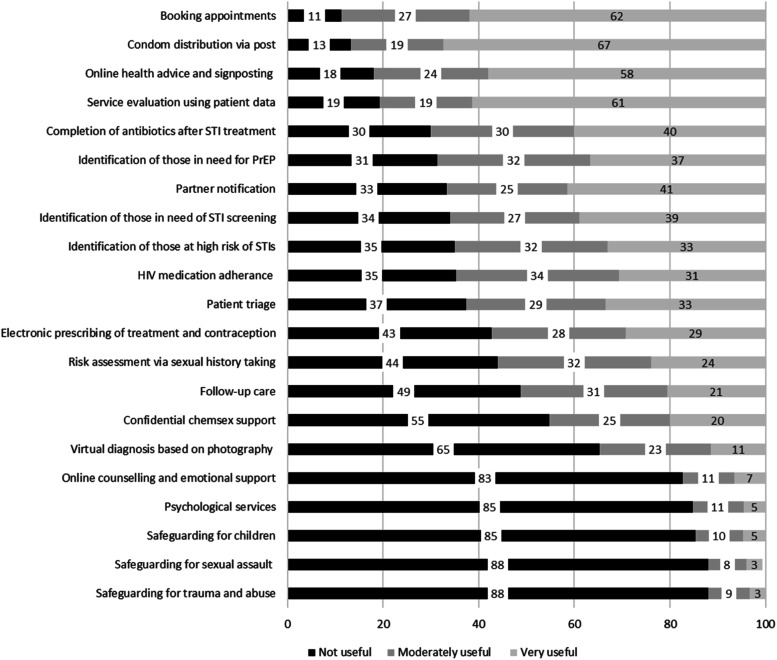
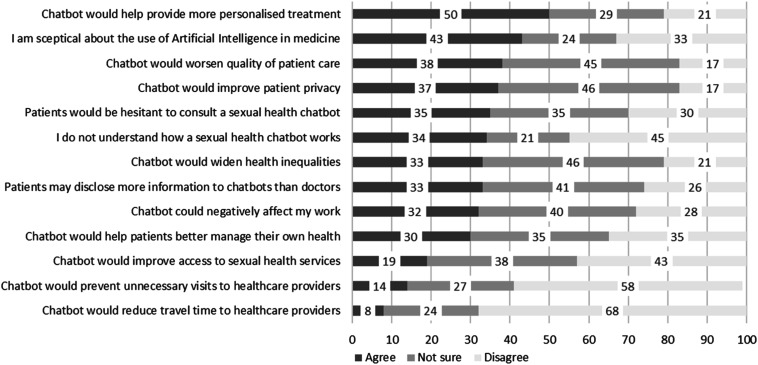
Background: Artificial Intelligence (AI)-enabled chatbots can offer anonymous education about sexual and reproductive health (SRH). Understanding chatbot acceptability and feasibility allows the identification of barriers to the design and implementation. Methods: In 2020, we conducted an online survey and qualitative interviews with SRH professionals recruited online to explore the views on AI, automation and chatbots. Qualitative data were analysed thematically. Results: Amongst 150 respondents (48% specialist doctor/consultant), only 22% perceived chatbots as effective and 24% saw them as ineffective for SRH advice [Mean = 2.91, SD = 0.98, range: 1–5]. Overall, there were mixed attitudes towards SRH chatbots [Mean = 4.03, SD = 0.87, range: 1–7]. Chatbots were most acceptable for appointment booking, general sexual health advice and signposting, but not acceptable for safeguarding, virtual diagnosis, and emotional support. Three themes were identified: “ Moving towards a ‘digital’ age’“, “ AI improving access and service efficacy”, and “ Hesitancy towards AI”. Conclusions: Half of SRH professionals were hesitant about the use of chatbots in SRH services, attributed to concerns about patient safety, and lack of familiarity with this technology. Future studies should explore the role of AI chatbots as supplementary tools for SRH promotion. Chatbot designers need to address the concerns of health professionals to increase acceptability and engagement with AI-enabled services.
Overview
The claims and statistics of this paper haven’t been checked yet.
Free: it reads the open-access text and checks the first 5 claims that cite a source we can check. Create a free account to check every claim.
Integrity signals
Registry
Cites
Statistics
Figures
Verification
Claims the paper makes
The claims and statistics of this paper haven’t been checked yet.
Free: it reads the open-access text and checks the first 5 claims that cite a source we can check. Create a free account to check every claim.
Claims other papers make about this one
Each is checked against this paper’s own text: does it say what the citing paper says it does?
The source backs part of the claim, not all of it — or backs it for a different population, condition or comparison.
In the citing paper
“Positive developments in their interaction with patients are mainly seen through enhanced communication [30, 32] with the ability to provide immediate responses support with chatbots or using AI tools for translating and communicating with patients who speak different languages.”
From Healthcare professionals’ perspectives on artificial intelligence in patient care: a systematic review of hindering and facilitating factors on different levels (2025) · cites this paper as [32]
Experimental — accuracy not yet measuredThe source backs part of the claim, not all of it — or backs it for a different population, condition or comparison.
In the citing paper
“Overall system-wide benefits for patients are seen in an improved access to healthcare services [32, 59, 60, 71], for instance by establishing remote support for patients [34], and by improving population health indicators by supporting measures of disease prevention and health promotion [79].”
From Healthcare professionals’ perspectives on artificial intelligence in patient care: a systematic review of hindering and facilitating factors on different levels (2025) · cites this paper as [32]
Experimental — accuracy not yet measuredThe source backs part of the claim, not all of it — or backs it for a different population, condition or comparison.
In the citing paper
“The main quality of care benefits from AI integration is seen as an overall improvement in clinical outcomes [33, 54, 55, 79, 80, 84] by increasing patient safety [32, 46, 49, 72] and enhancing medical standards [85].”
From Healthcare professionals’ perspectives on artificial intelligence in patient care: a systematic review of hindering and facilitating factors on different levels (2025) · cites this paper as [32]
Experimental — accuracy not yet measuredThe check wasn’t confident either way, so it gives no verdict — never disputed.
In the citing paper
“A handful of studies could be clearly assigned as “natural language processing models” [29–32] or “rule-based expert systems” [33–36].”
From Healthcare professionals’ perspectives on artificial intelligence in patient care: a systematic review of hindering and facilitating factors on different levels (2025) · cites this paper as [32]
Experimental — accuracy not yet measured
Self-check
Percentages, sums and reported differences re-computed from the paper’s own numbers.
The self-check needs the paper’s full text.
Citations
Cites
Using thematic analysis in psychology
Braun, V., & Clarke, V. (2006) · Qualitative Research in Psychology · doi:10.1191/1478088706qp063oa · Cited by 194,414
Conceptualizing AI literacy: An exploratory review
Ng, D. T. K., Leung, J. K. L., Chu, S. K. W., & Qiao, M. S. (2021) · Computers and Education: Artificial Intelligence · doi:10.1016/j.caeai.2021.100041 · Cited by 2,205
Overview of artificial intelligence in medicine
Amisha, Malik, P., Pathania, M., & Rathaur, V. K. (2019) · Journal of Family Medicine and Primary Care · doi:10.4103/jfmpc.jfmpc_440_19 · Cited by 1,106
Nadarzynski, T., Miles, O., Cowie, A., & Ridge, D. (2019) · DIGITAL HEALTH · doi:10.1177/2055207619871808 · Cited by 810 · cited 1×
“Our previous research has demonstrated moderate acceptability of chatbots amongst sexual health patients (40%) and internet users (67%), with 48% expressing willingness to seek specialist advice about sexual health via this technology.(14,15) Our qualitative study on engagement with a dedicated sexual health chatbot f…”
BackgroundSelf-citationXu, L., Sanders, L., Li, K., & Chow, J. C. L. (2021) · JMIR Cancer · doi:10.2196/27850 · Cited by 571
Conversational Agents in Health Care: Scoping Review and Conceptual Analysis
Tudor Car, L., Dhinagaran, D. A., Kyaw, B. M., Kowatsch, T., Joty, S., Theng, Y.-L., & Atun, R. (2020) · Journal of Medical Internet Research · doi:10.2196/17158 · Cited by 553
Abd-Alrazaq, A. A., Rababeh, A., Alajlani, M., Bewick, B. M., & Househ, M. (2020) · Journal of Medical Internet Research · doi:10.2196/16021 · Cited by 503
Physicians’ perceptions of chatbots in health Care: cross-sectional web-based survey
Palanica, A., Flaschner, P., Thommandram, A., Li, M., & Fossat, Y. (2019) · Journal of Medical Internet Research · doi:10.2196/12887 · Cited by 384
Health Care Employees’ Perceptions of the Use of Artificial Intelligence Applications: Survey Study
Abdullah, R., & Fakieh, B. (2020) · Journal of Medical Internet Research · doi:10.2196/17620 · Cited by 286
Oh, Y. J., Zhang, J., Fang, M.-L., & Fukuoka, Y. (2021) · International Journal of Behavioral Nutrition and Physical Activity · doi:10.1186/s12966-021-01224-6 · Cited by 278
Research works printed but not linked: 1
- Kaminski J. Diffusion of innovation theory. Can J Nurs Inform 2011; 6(2): 1– 6.
Cited by
Roles, Users, Benefits, and Limitations of Chatbots in Health Care: Rapid Review
Laymouna, M., Ma, Y., Lessard, D., Schuster, T., Engler, K., & Lebouché, B. (2024) · Journal of Medical Internet Research · doi:10.2196/56930 · Cited by 305
Roles, Users, Benefits, and Limitations of Chatbots in Health Care: Rapid Review (Preprint)
Laymouna, M., Ma, Y., Lessard, D., Schuster, T., Engler, K., & Lebouché, B. (2024) · doi:10.2196/preprints.56930 · Cited by 302
The Impact of Artificial Intelligence on Human Sexuality: A Five-Year Literature Review 2020–2024
Döring, N., Le, T. D., Vowels, L. M., Vowels, M. J., & Marcantonio, T. L. (2024) · Current Sexual Health Reports · doi:10.1007/s11930-024-00397-y · Cited by 65
Henzler, D., Schmidt, S., Koçar, A., Herdegen, S., Lindinger, G. L., Maris, M. T., Bak, M. A. R., Willems, D. L., Tan, H. L., Lauerer, M., et al. (2025) · BMC Health Services Research · doi:10.1186/s12913-025-12664-2 · Cited by 54
“…d c o m p l i c a t i o n s [ 57 , 72 ] Q u a li t y o f c a r e [ 80 ] • P a t i e n t s a f e t y ( r e d u c e m e d i c a l m i s t a k e s ) [ 32 , 46 , 49 , 72 ] • I m p r o v e m e d i c a l s t a n d a r d s [ 85 ] • I m p r o v e m e n t o f c l i n i c a l o u t c o m e s [ 33 , 54 , 55…”
InfluentialLi, S., Mou, Y., & Xu, J. (2024) · International Journal of Human-Computer Interaction · doi:10.1080/10447318.2024.2411619 · Cited by 28
Li, S., Chen, M., Liu, P. L., & Xu, J. (2024) · Health Communication · doi:10.1080/10410236.2024.2423114 · Cited by 24
Deva, R., Ramani, D., Divate, T., Jalota, S., & Ismail, A. (2025) · CHI Conference on Human Factors in Computing Systems · doi:10.1145/3706598.3713362 · Cited by 45
Marcantonio, T. L., Avery, G., Thrash, A., & Leone, R. M. (2024) · The Journal of Sex Research · doi:10.1080/00224499.2024.2396457 · Cited by 22
Unpacking public resistance to health Chatbots: a parallel mediation analysis
Zou, X.-Q., Na, Y.-X., Lai, K.-S., & Liu, G. (2024) · Frontiers in Psychology · doi:10.3389/fpsyg.2024.1276968 · Cited by 18
Sexual health in the era of artificial intelligence: a scoping review of the literature
Chawareb, E. A., Im, B. H., Lu, S., Hammad, M. A. M., Huang, T. R., Chen, H., & Yafi, F. A. (2025) · Sexual Medicine Reviews · doi:10.1093/sxmrev/qeaf009 · Cited by 18
McLeod, J., Estcourt, C. S., MacDonald, J., Gibbs, J., Owusu, M. W., Mapp, F., Márquez, N. G., McInnes-Dean, A., Saunders, J., BLANDFORD, A. E., et al. (2025) · PLoS ONE · doi:10.1371/journal.pone.0315049 · Cited by 17
Nadarzynski, T., Knights, N., Husbands, D., Graham, C. A., Llewellyn, C. D., Buchanan, T., Montgomery, I., Khlafa, N., Tichackova, J., Odeyemi, R., et al. (2024) · Sexual Health · doi:10.1071/sh24058 · Cited by 9
Self-citationNadarzynski, T., Knights, N., Husbands, D., Graham, C. A., Llewellyn, C. D., Buchanan, T., Montgomery, I., Rodriguez, A. S., Ogueri, C., Singh, N., et al. (2025) · PLOS Digital Health · doi:10.1371/journal.pdig.0000724 · Cited by 13
Self-citationThe Role of Large Language Model Chatbots in Sexual Education: An Unmet Need of Research
Mondal, H., & Mondal, S. (2025) · Journal of Psychosexual Health · doi:10.1177/26318318251323714 · Cited by 13
Govathson, C., Chetty-Makkan, C. M., Greener, R., Frade, S., Rech, D., Morris, S., Richard, Y., Mendonca, R., Maricich, N., Long, L. C., et al. (2026) · Frontiers in Digital Health · doi:10.3389/fdgth.2025.1731002 · Cited by 8
Chatbot usage at fast food restaurants in Ghana: Exploring the perception-attitude-behaviour nexus
Osei, B. A., Aflakpui, B. E., Adamtey, F. N. A., & Nutsugbodo, R. Y. (2024) · Tourism and Hospitality Research · doi:10.1177/14673584241303861 · Cited by 6
Vowels, L. M., & Marcantonio, T. L. (2025) · The Journal of Sex Research · doi:10.1080/00224499.2025.2547814 · Cited by 6
Anti-AI Bias Toward Couple Images and Couple Counseling: Findings from Two Experiments
Döring, N. M., & Mohseni, M. R. (2025) · Archives of Sexual Behavior · doi:10.1007/s10508-025-03318-9 · Cited by 9
Uzoma, C., Chukwuedo, G., Isaac, E., Uzoma, V. I., Eneh, S. C., Chinyere, F. P., Precious, O. M., & Onukansi, F. O. (2026) · Frontiers in Digital Health · doi:10.3389/fdgth.2026.1777667 · Cited by 4
González, N. L., Onofre-Rodríguez, D. J., Sanchez, R., Monteiro, J. C. D. S., Benavides-Torres, R. A., & Vega, M. A. M. (2025) · Revista Panamericana de Salud Pública · doi:10.26633/rpsp.2025.22 · Cited by 4
Chatbots and virtual health assistants in patient counseling
Patne, A. Y., Suryawanshi, M. V., & Vinchurkar, K. (2025) · Elsevier eBooks · doi:10.1016/b978-0-443-43823-3.00003-0 · Cited by 2
Bergam, S. J., Bergam, C., & Zanoni, B. C. (2025) · Sex Education · doi:10.1080/14681811.2025.2603261 · Cited by 5
One-Sided Parasociality with AI
Degen, J. L. (2025) · Palgrave Studies in Cyberpsychology. · doi:10.1007/978-3-032-07438-6_5 · Cited by 2
Maguire-Wilkerson, A., Parent, H., Tao, J., & Chan, P. A. (2026) · International Journal of STD & AIDS · doi:10.1177/09564624251411095 · Cited by 1
Chen, M. (2026) · Social Science & Medicine · doi:10.1016/j.socscimed.2026.119296 · Cited by 1
Marcantonio, T. L., Vowels, L. M., LeRoux, S., Bravo, M., Thrash, A., Mueller, A., Niolet, A., Hall, M., Döring, N. M., & Nadarzynski, T. (2026) · The Journal of Sex Research · doi:10.1080/00224499.2026.2686406 · Cited by 1
Self-citationKubitza, E., & Degen, J. L. (2026) · Archives of Sexual Behavior · doi:10.1007/s10508-026-03437-x · Cited by 4
Bergam, S. J., Bergam, C., & Zanoni, B. C. (2025) · Research Square · doi:10.21203/rs.3.rs-6289967/v1 · Cited by 1
Navigating Ethical Challenges of AI Chatbots for Sex Therapy
Fu, M., & Chan, W. (2025) · Oxford University Press eBooks · doi:10.1093/9780198945215.003.0075 · Cited by 2
Letter to the Editor on “Exploring the potential of DeepSeek-R1 in sexual and reproductive”
Tong, W., Zhang, H., & Chen, J. (2025) · Sexual Medicine Reviews · doi:10.1093/sxmrev/qeaf042 · Cited by 1
Mondal, H., Mishra, S. R., Jangra, J., Agrawal, A. K., Nath, S., & Sarkhel, S. (2026) · The Journal of Sexual Medicine · doi:10.1093/jsxmed/qdag028
Demirtaş, F. A., Gümüşay, M., & Ayyıldız, B. (2026) · International Journal of Sexual Health · doi:10.1080/19317611.2026.2746090
Divya, S., Nevarez, N., Levitz, N., Shum, K., & Gust, E. (2026) · doi:10.2196/preprints.114147
Woerner, J. I., Marcantonio, T. L., & Castillo, H. L. (2026) · Archives of Sexual Behavior · doi:10.1007/s10508-026-03594-z
Metadata
- Authors
- Nadarzynski, T., Lunt, A., Knights, N., Bayley, J., & Llewellyn, C.
- Affiliations
- University of Westminster (GB)
- Brighton and Sussex Medical School (GB)
- Barts Health NHS Trust (GB)
- Corresponding author
- Nadarzynski, Tom
- Venue
- International Journal of STD & AIDS
- Publisher
- SAGE Publications
- Published
- 2023-06-03
- Volume
- 34
- Issue
- 11
- Pages
- 809-816
- ISSN
- 0956-4624 (ISSN-L)
- 1758-1052
- PMC
- PMC10561522
- OpenAlex
- W4379260371
- Cited by
- 33
- References
- 27
- Citations by year
- 2026: 10 · 2025: 15 · 2024: 8
- FWCI
- 1.31
- Type
- journal article
- Language
- en
- Open access
- hybrid
- doi.org
- Licence
- Locations
- International Journal of STD & AIDS (publishedVersion, cc-by-nc)
- PubMed Central (publishedVersion, cc-by-nc)
- PubMed (publishedVersion)
- WestminsterResearch (University of Westminster) (acceptedVersion, cc-by-nc)
- Figshare (submittedVersion, cc-by-nc)
- Topics
- Health Sciences › Medicine › Health Informatics › Artificial Intelligence in Healthcare and Education
- Health Sciences › Health Professions › General Health Professions › Mobile Health and mHealth Applications
- Social Sciences › Business, Management and Accounting › Marketing › AI in Service Interactions
- Keywords
- AI chatbots, sexual and reproductive health, clinician attitudes, acceptability, sexual health advice, patient safety, safeguarding, emotional support, appointment scheduling, signposting, digital health services
- MeSH terms
- Sexual Health, Artificial Intelligence, Humans, Sexual Behavior, Reproductive Health Services, Reproductive Health
About these checks
Registry, retraction, Cites and statistics results are computed, not judged, with one exception: a printed reference that no index lists is read once by a model before it counts as a citation error. Claims are extracted by a model and kept only when their quote appears verbatim in the text; each cited source is then checked, with a model’s help, for whether it says what the claim relies on. Those verdicts can be wrong — read the claim’s quote and the cited source before relying on one.
Statistics and arithmetic are recomputed, not judged.
Confidence bands are shown only for fields calibrated on our annotated test set. None is calibrated yet, so no band is shown.
What counts as a claim ›How we measure confidence ›How we check this ›
Are you an author, or do you see a problem with this page? Request a review
Data sources
Bibliographic data: Semantic Scholar, OpenAlex, Crossref.
Contains information from the Semantic Scholar Academic Graph Datasets, made available under the ODC Attribution License (ODC-BY 1.0).
Semantic Scholar’s data is described in: Kinney, R., et al. (2023). The Semantic Scholar Open Data Platform. arXiv:2301.10140.
