

Events per variable (EPV) and the relative performance of different strategies for estimating the out-of-sample validity of logistic regression models
Open accessThe DOI matches its Crossref record; 31 of the 31 references it cites were found in a registry or an index.
Abstract
We conducted an extensive set of empirical analyses to examine the effect of the number of events per variable (EPV) on the relative performance of three different methods for assessing the predictive accuracy of a logistic regression model: apparent performance in the analysis sample, split-sample validation, and optimism correction using bootstrap methods. Using a single dataset of patients hospitalized with heart failure, we compared the estimates of discriminatory performance from these methods to those for a very large independent validation sample arising from the same population. As anticipated, the apparent performance was optimistically biased, with the degree of optimism diminishing as the number of events per variable increased. Differences between the bootstrap-corrected approach and the use of an independent validation sample were minimal once the number of events per variable was at least 20. Split-sample assessment resulted in too pessimistic and highly uncertain estimates of model performance. Apparent performance estimates had lower mean squared error compared to split-sample estimates, but the lowest mean squared error was obtained by bootstrap-corrected optimism estimates. For bias, variance, and mean squared error of the performance estimates, the penalty incurred by using split-sample validation was equivalent to reducing the sample size by a proportion equivalent to the proportion of the sample that was withheld for model validation. In conclusion, split-sample validation is inefficient and apparent performance is too optimistic for internal validation of regression-based prediction models. Modern validation methods, such as bootstrap-based optimism correction, are preferable. While these findings may be unsurprising to many statisticians, the results of the current study reinforce what should be considered good statistical practice in the development and validation of clinical prediction models.
Overview
The claims and statistics of this paper haven’t been checked yet.
Free: it reads the open-access text and checks the first 5 claims that cite a source we can check. Create a free account to check every claim.
Integrity signals
Registry
Cites
Statistics
Figures
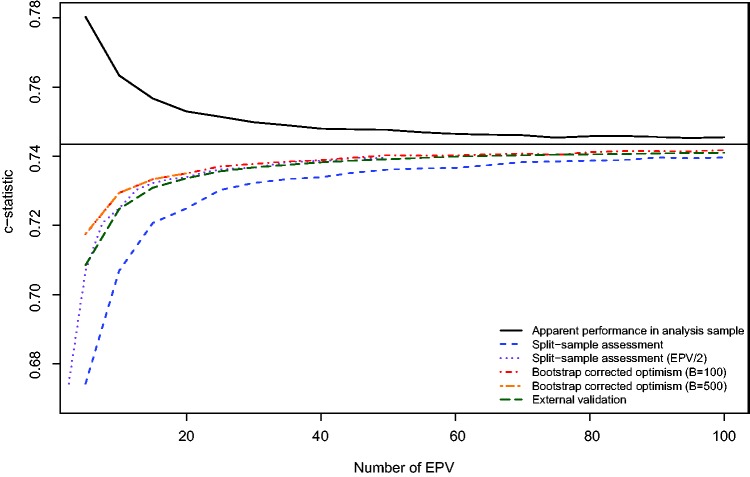
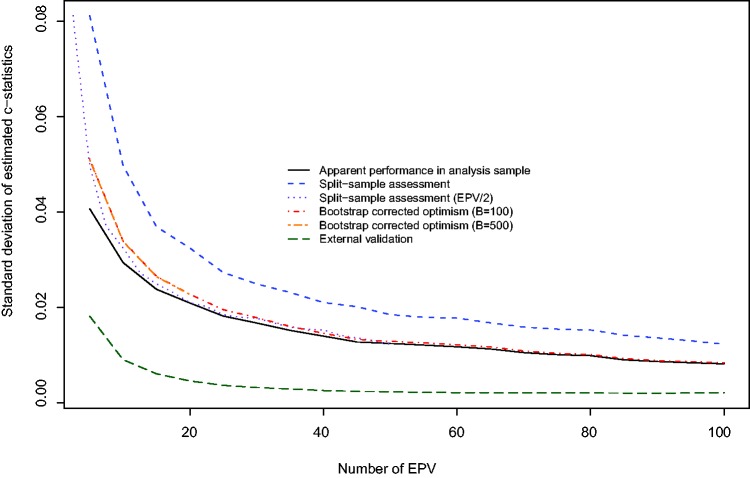
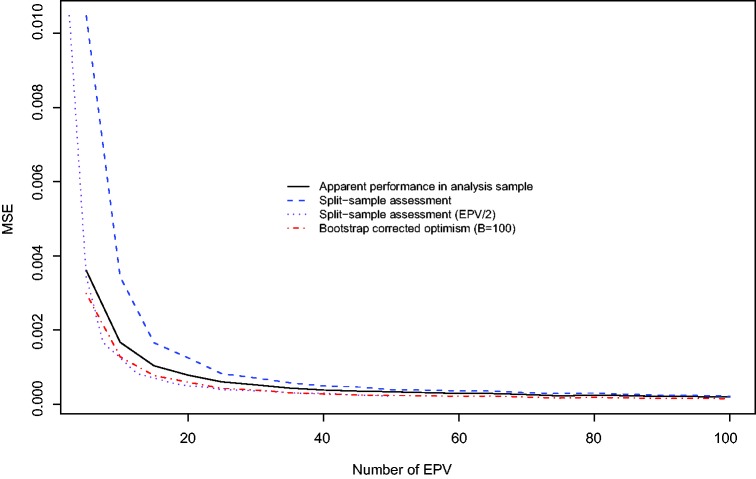
Verification
Claims the paper makes
The claims and statistics of this paper haven’t been checked yet.
Free: it reads the open-access text and checks the first 5 claims that cite a source we can check. Create a free account to check every claim.
Claims other papers make about this one
Each is checked against this paper’s own text: does it say what the citing paper says it does?
The source backs part of the claim, not all of it — or backs it for a different population, condition or comparison.
In the citing paper
“Sample size for estimating calibration depends not on the total sample size but the size of the smaller group, which determines the events per predictor (EPP).65”
From Calibrating machine learning approaches for probability estimation: A comprehensive comparison (2023) · cites this paper as [65]
Experimental — accuracy not yet measuredThe check wasn’t confident either way, so it gives no verdict — never disputed.
In the citing paper
“Harms, especially serious harms, tend to be rare, and such data in nature are more susceptible to random or systematic errors than are common outcomes. 7 8”
From Validity of data extraction in evidence synthesis practice of adverse events: reproducibility study (2022) · cites this paper as [7]
Experimental — accuracy not yet measured
Self-check
Percentages, sums and reported differences re-computed from the paper’s own numbers.
The self-check needs the paper’s full text.
Citations
Cites
Breiman, L. (2001) · Machine Learning · doi:10.1023/a:1010933404324 · Cited by 133,538
An Introduction to the Bootstrap
Efron, B., & Tibshirani, R. J. (1994) · doi:10.1201/9780429246593 · Cited by 40,500
The Elements of Statistical Learning
Hastie, T., Tibshirani, R., & Friedman, J. (2009) · Springer Series in Statistics · doi:10.1007/978-0-387-84858-7 · Cited by 25,970
The Elements of Statistical Learning
Hastie, T., Friedman, J., & Tibshirani, R. (2001) · Springer Series in Statistics · doi:10.1007/978-0-387-21606-5 · Cited by 24,162
Classification and Regression Trees.
Gordon, A. D., Breiman, L., Friedman, J. H., Olshen, R. A., & Stone, C. J. (1984) · Biometrics · doi:10.2307/2530946 · Cited by 23,522
An Introduction to the Bootstrap
Efron, B., & Tibshirani, R. J. (1993) · doi:10.1007/978-1-4899-4541-9 · Cited by 21,230
The Elements of Statistical Learning: Data Mining, Inference, and Prediction
John Lu, Z. Q. (2010) · Journal of the Royal Statistical Society Series A: Statistics in Society · doi:10.1111/j.1467-985x.2010.00646_6.x · Cited by 12,390
Classification And Regression Trees
Breiman, L., Friedman, J. H., Olshen, R. A., & Stone, C. J. (2017) · doi:10.1201/9781315139470 · Cited by 11,417
A simulation study of the number of events per variable in logistic regression analysis
Peduzzi, P., Concato, J., Kemper, E., Holford, T. R., & Feinstein, A. R. (1996) · Journal of Clinical Epidemiology · doi:10.1016/s0895-4356(96)00236-3 · Cited by 9,655 · cited 2×
“A key concept in the development of prediction models for binary outcomes is the number of events per variable (EPV).(8) When outcomes are binary, the number of events is the smaller of the number of subjects who experienced the outcome and the number of subjects who did not experience the outcome.”
BackgroundMethodHarrell, F. E. (2001) · Springer Series in Statistics · doi:10.1007/978-1-4757-3462-1 · Cited by 9,195
Cited by
Items 401–500 of 516
Reina, A. R., Barrera, J. M., Maté, A., Trujillo, J. C., Valdivieso, B., & Gas, M.-E. (2023) · Heliyon · doi:10.1016/j.heliyon.2023.e22878 · Cited by 1
“The optimised LR model, with an EPV [80] of 84.42, showed an accuracy of 77.27%, a specificity of 77%, a precision of 43.07%, a sensitivity of 78,05%, a F1 score of 55.62%, and AUC of 85.12% (Fig.”
MethodInfluentialConsidering bias in a model to predict pressure injuries in ICU patients – Response to Dai et al.
Han, L., Wei, Y., Pei, J., & Ma, Y. (2024) · Intensive and Critical Care Nursing · doi:10.1016/j.iccn.2024.103781
Sahnoon, I., de Barros, A. G., & Kattan, L. (2024) · Lecture notes in civil engineering · doi:10.1007/978-3-031-60419-5_6
Comparative Statistics: Categorical Data
Fabricant, P. D. (2024) · Springer eBooks · doi:10.1007/978-3-031-58380-3_2
Machine Learning for High Sigma Analog Designs (Invited)
Jallepalli, S. (2024) · ACM/IEEE Workshop on Machine Learning for CAD (MLCAD) · doi:10.1145/3670474.3685973 · Cited by 1
“…recommend a minimum EPV of 10 [17] to ensure that all key features are identified, it is widely accepted that EPV needs to be closer to at least 20 or more for a problem with nonlinear dependencies [18-21], especially if we are also interested in ML model accuracy and not just feature extraction.”
Predicting non-response outcomes in prone-positioning for ARDS − Letter on Yan et al.
Chen, L., & Sun, M. (2024) · Intensive and Critical Care Nursing · doi:10.1016/j.iccn.2024.103881
Machine Learning for High Sigma Analog Designs (Invited)
Jallepalli, S. (2024) · ACM/IEEE Workshop on Machine Learning for CAD (MLCAD) · doi:10.1109/mlcad62225.2024.10740260
CEO-Founders and Strategic Dividend PolicyPreprint
Barbopoulos, L. G., & Tzioumis, K. (2024) · SSRN Electronic Journal · doi:10.2139/ssrn.4967939
Yu, X., Wang, X., Li, A., Su, J., Du, W. D., Liu, Y., Zeng, W., Yan, L., & Zhao, Y. (2024) · BMJ Open · doi:10.1136/bmjopen-2023-082072
“Following the 1 in 10 rule, 26 27 the number of independent variables was restricted to ensure at least 10 events per variable (EPV) should exceed 10, although some suggest an EPV of 5–9.”
Prediction models for personalized: Treatment delivery in oncology
Tohidinezhad, F. (2024) · Research Publications (Maastricht University) · doi:10.26481/dis.20250122ft
Allo, I. J. T., Pramudyo, M., & Akbar, M. R. (2025) · Open Access Emergency Medicine · doi:10.2147/oaem.s493878
“Using the “events per variable” (EPV) principle, 34 which recommends a minimum of 10 events per variable to ensure robust statistical power and minimize overfitting, and assuming an expected proportion of in-hospital mortality (P = 11,1%), 14 the required sample size was calculated as follows:…”
Construction and validation of a nomogram for predicting fatigue in climacteric women
Wu, H., Gao, D., Duan, X., Zhang, H., Ren, Y., Dai, Z., & Song, L. (2025) · Menopause The Journal of The North American Menopause Society · doi:10.1097/gme.0000000000002493
The role of GLP1R gene polymorphism in diabetic nephropathy in patients with type 2 diabetes
Gomaa, A. A., Zeid, A. M., & Nagy, I. M. (2025) · Gene Reports · doi:10.1016/j.genrep.2025.102205 · Cited by 1
Haumann, R. G., Płonek, T., Niesten, E. D., Maaskant, J. M., Arens, J., van der Palen, J. A. M., & Halfwerk, F. R. (2025) · Perfusion · doi:10.1177/02676591251334903
“20,21 However, Steyerberg et al. 22 suggests an even higher EPV rate (>20) in populations with a low prevalence of primary outcome.”
Asian American social inequalities in health, acohol use disorder, and chronic medical conditions
Park, D. (2020) · Scholars Archive - University at Albany (University at Albany, State University of New York) · doi:10.54014/472a-tan7
Risk Factors and Management of Stroke in Young
Sahonta, R., & Thomas, A. (2025) · IntechOpen eBooks · doi:10.5772/intechopen.1010307
Predictive models for sex Estimation based on alveolar measurements in a contemporary Italian sample
Tanga, C., & Viciano, J. (2025) · International Journal of Legal Medicine · doi:10.1007/s00414-025-03555-6 · Cited by 1
“While Harrell et al. [ 82 ] suggested 10 to 20 events per predictor variable, Austin and Steyerberg [ 72 ] recommended a minimum of 20 events per predictor variable in binary logistic regression analysis.”
Parmar, J., & Site, P. D. (2025) · Communications in Statistics Case Studies Data Analysis and Applications · doi:10.1080/23737484.2025.2522358 · Cited by 2
Shi, J., & Liu, J. (2025) · Pediatric Transplantation · doi:10.1111/petr.70134
MonLog: MONotonic-Constrained LOGistic Regressions for Automated Safety Curve Design
Melone, A., Kirschner, R. J., Müller, D., Swikir, A., & Haddadin, S. (2025) · Proceedings - IEEE International Conference on Robotics and Automation/Proceedings · doi:10.1109/icra55743.2025.11128207
Lin, Q., & Shen, F. (2025) · Clinical Rheumatology · doi:10.1007/s10067-025-07710-7
Lambert, P. J., Khan, R. A., Pitz, M. W., Singh, H., Chen, H., & Decker, K. (2025) · JMIR AI · doi:10.2196/63767
“This has previously been demonstrated in statistical models when comparing results from split-sampling to bootstrapping [18,19], where split-sampling (ie, reporting the performance of 1 model) required substantially more data than bootstrapping (ie, average across multiple models) to achieve the…”
Khalilizad, M., Javanian, M., Barary, M., Hamzehpour, R., & Ebrahimpour, S. (2025) · PM&R · doi:10.1002/pmrj.70044
Alahdab, F., Shawi, R. E., Ahmed, A. I., Rifai, M. A., & Al-Mallah, M. H. (2025) · Journal of Nuclear Cardiology · doi:10.1016/j.nuclcard.2025.102539 · Cited by 5
Casale, M., & Reisch, R. (2025) · Bulletin of Faculty of Physical Therapy · doi:10.1186/s43161-025-00317-8
“Austin and Steyerberg recommended events per variable of 20 [18].”
Álvarez, L., Santamaria, L.-C., Sánchez, J., & Peláez, L. M. S. (2025) · F1000Research · doi:10.12688/f1000research.167397.1
Wiraszka, Ł. (2025) · Studia Linguistica Universitatis Iagellonicae Cracoviensis · doi:10.4467/20834624sl.25.016.22382
Hameed, J., Ashraf, M. S., Anwar, O. U., Qadeer, M. K., Rehman, A., Imran, M., & Khan, F. R. (2025) · Cureus · doi:10.7759/cureus.98230
“Allowing for 10% missing data and modeling overhead, the targeted N ≈ 267 supports multivariable analyses while respecting modern events-per-variable recommendations and transparent sample size reporting [15-17].”
Yamashita, K., Kawasaki, H., Yamasaki, S., Nakaoka, S., & Menuta, B. F. (2025) · Frontiers in Public Health · doi:10.3389/fpubh.2025.1678686 · Cited by 1
Wang, Y.-Y., Wang, W., Sun, Y., Zhang, W., Zhang, Y., Gao, S., Wu, J., Shen, Y., Zhu, Z.-C., Bai, X.-L., et al. (2025) · World Journal of Pediatrics · doi:10.1007/s12519-025-01006-1
“Therefore, while we acknowledge that 15–20 EPV is a robust ideal, we consider the 10 EPV threshold a methodologically sound and clinically relevant standard in this context [3].”
Li, W., Lü, H., Tang, H., Ma, C., Wei, Z., Jian, R., & Yu, H. (2025) · Discover Oncology · doi:10.1007/s12672-025-04249-6
“Model performance was evaluated using the concordance index (C-index), receiver operating characteristic (ROC) curves, and calibration plots with 1,000 boot-strap resamples to reduce overfitting bias and assess internal validity [24, 25].”
Wolf, J. S., Verri, F. M., Kocar, T. D., Dallmeier, D., Cintean, R., Gebhard, F. T., Bolenz, C., Rahbari, N. N., Mueller‐Stierlin, A. S., Denkinger, M. D., et al. (2025) · BMC Geriatrics · doi:10.1186/s12877-025-06833-5
“Model adequacy was judged by events per variable [22].”
Comprehensive HIV/AIDS knowledge among Rwandan men aged 50–59: evidence from the 2019–20 RDHS
Rugeyo, J., & Kawuki, J. (2025) · AIDS Research and Therapy · doi:10.1186/s12981-025-00825-6
“Precision was conveyed through 95% confidence intervals rather than post-hoc power estimates [29].”
Coley, R. Y., Liao, Q., Simon, N., & Shortreed, S. M. (2023) · Figshare · doi:10.6084/m9.figshare.22616987
Withrow, D. R., Shine, B. S. F., Oke, J., Tamm, A., James, T., Morris, E., Davies, J., Harris, S., East, J. E., & Nicholson, B. D. (2022) · Figshare · doi:10.6084/m9.figshare.19359669
Christodoulou, E., van Smeden, M., Edlinger, M., Timmerman, D., Wanitschek, M. M., Steyerberg, E. W., & CALSTER, B. V. (2021) · Figshare · doi:10.6084/m9.figshare.14256821
Self-citationNavarro, C. L. A., Damen, J. A., Takada, T., Nijman, S. W. J., Dhiman, P., Ma, J., Collins, G. S., Bajpai, R., Riley, R. D., Moons, K. G. M., et al. (2022) · Figshare · doi:10.6084/m9.figshare.18393578
Geroldinger, A., Lusa, L., Nold, M., & Heinze, G. (2023) · Figshare · doi:10.6084/m9.figshare.22729295
Tan, J. Q., Wu, H.-L., Wang, Y.-C., Cata, J. P., Chen, J.-T., Cherng, Y.-G., & Tai, Y.-H. (2023) · Figshare · doi:10.6084/m9.figshare.24454978
Isemann, R., Wild, F., Bronzlik, P., Krauss, J. K., Stueber, T., & Sühs, K. (2026) · Journal of Stroke and Cerebrovascular Diseases · doi:10.1016/j.jstrokecerebrovasdis.2026.108557
Vavassori, V., Pavarini, M., Alborghetti, L., Aimonetto, S., Maggio, A., Landoni, V., Ferrari, P., Bianculli, A., Petrucci, E. T. F., Cicchetti, A., et al. (2026) · ESMO Real World Data and Digital Oncology · doi:10.1016/j.esmorw.2025.100680 · Cited by 2
Sakane, N., Hirota, Y., Yamamoto, A., Miura, J., Takaike, H., Hoshina, S., Toyoda, M., Saito, N., Hosoda, K., Matsubara, M., et al. (2026) · Diabetology International · doi:10.1007/s13340-025-00872-4
Rajan, A. K., Swaminathan, L., Dsa, F. F., Kesarkar, S. V., Fernandes, E. Z., Neeraja, R., (19227996), S. C., Shanbhag, V., Eshwara, V. K., Kunhikatta, V., et al. (2026) · BMC Infectious Diseases · doi:10.1186/s12879-026-12697-w
“Although this is below the conventional threshold of 10, contemporary evidence supports that models incorporating penalization and internal validation can achieve reliable estimates even at EPV as low as 5–9, provided that candidate selection is clinically guided [34, 35].”
Gildor, O. S., Yosef, E., Levin, N., Itshak, A., Vainrib, R., Neheman, A., & Vainrib, M. (2026) · Neurourology and Urodynamics · doi:10.1002/nau.70229
Antibiotic timing and progression to sepsis among patients in the ED for infection
Lin, X., Liu, C., Chen, F., Xie, H., Xie, A., Wang, L., Chen, C., Wang, Z., Weng, J., & Chen, Y. (2026) · European journal of medical research · doi:10.1186/s40001-026-03971-3 · Cited by 2
“Multivariable logistic regression was used in the primary analysis to examine the association between antibiotic timing and subsequent sepsis development, considering a predetermined list of known and potential confounding factors [18, 19].”
Wang, Y., Yang, L., Wu, X., He, Y., Wang, S., Yang, T., Mou, F., Chen, J., & Fang, Y. (2026) · Journal of Affective Disorders · doi:10.1016/j.jad.2026.121401
Sakane, N., Kato, K., Hata, S., Nishimura, E., Araki, R., Kouyama, K., Hatao, M., Matoba, Y., Matsushita, Y., Domichi, M., et al. (2026) · Diabetology International · doi:10.1007/s13340-026-00875-9
Ramos‐Pascual, S., Bonin, N., Viamont-Guerra, M.-R., Saffarini, M., May, O., & Laude, F. (2026) · Journal of Hip Preservation Surgery · doi:10.1093/jhps/hnag009
Statistical considerations in machine learning-based prediction of early childhood caries
Hisham, A. R. B. (2026) · European Archives of Paediatric Dentistry · doi:10.1007/s40368-026-01189-9
Ji, J., Gao, X., Lei, L., Yang, T., Zhou, A., Wang, Y., Chen, L., Cui, Q., & Zhu, Y. (2026) · BMC Public Health · doi:10.1186/s12889-026-26645-5
“Ultimately, 798 complete and valid questionnaires were collected [7, 8].”
Acute kidney injury after heart transplantation: still a shadow after all these years
Mendes, R. B., & Suassuna, J. H. R. (2026) · Brazilian Journal of Nephrology · doi:10.1590/2175-8239-jbn-2026-e006en
“Subsequently, a logistic regression model was constructed with four variables for 24 events, making overfitting virtually inevitable, even in the presence of an apparently satisfactory R 2 coefficient, which may compromise the generalizability of their findings 13 .”
Injúria renal aguda após o transplante cardíaco: ainda uma sombra após todos esses anos
Mendes, R. B., & Suassuna, J. H. R. (2026) · Brazilian Journal of Nephrology · doi:10.1590/2175-8239-jbn-2026-e006pt
A Systematic Review of Multivariate Models for Predicting Fall‐Related Injuries in Older Adults
Cai, Y., Zhu, W., Zhang, X., Wang, C., Liu, S., & Jiang, Y. (2026) · Journal of Nursing Management · doi:10.1155/jonm/1740588
A suspicion index tool to aid the diagnosis and treatment of ASMD
Wiesinger, A., Zimmermann, G., Lauth, W., Muschol, N., Möslinger, D., Konstantopoulou, V., Scholl‐Bürgi, S., Karall, D., Giugliani, R., Mengel, E., et al. (2026) · Orphanet Journal of Rare Diseases · doi:10.1186/s13023-026-04328-z
“A key concept in the development of a prediction model is the number of events per predictor variable (EPV) [10].”
Bonham, E. E., Xu, T. D., Hamilton, K. A., & Muenich, R. L. (2026) · Environmental Research · doi:10.1016/j.envres.2026.124380 · Cited by 1
Predicting Laryngeal Involvement in Pemphigus Vulgaris Using a Clinical Risk Score
Ariel, D., Tsur, N., Mimouni, D., Lotan, T. L., Trieman, G., & Oren‐Shabtai, M. (2026) · JAMA Dermatology · doi:10.1001/jamadermatol.2026.0391
Gedara, M. L. B., Jiang, D., Kim, S., Sanusi, R. A., Sajobi, T. T., & Lix, L. M. (2026) · Quality of Life Research · doi:10.1007/s11136-026-04196-x · Cited by 1
Experiences of LGBTQ + Healthcare Providers in Workplaces in Taiwan: A Cross‐Sectional Survey
Wang, Y., Miao, N., Du, S.-C., You, M., Wang, F. S., Hsu, C., Lee, P., & Tran, N. M. (2026) · Journal of Advanced Nursing · doi:10.1111/jan.70605
Elbanna, F., Saunders, S., D’Amore, C., & Beauchamp, M. (2026) · BMC Geriatrics · doi:10.1186/s12877-026-07417-7
“Internal validation was performed using bootstrap resampling with 1,000 iterations, to assess the stability of model performance estimates and reduce optimism in classification results [33].”
Seroma volume as early indicator for infection in tissue expander-based breast reconstruction
Bruce, B., Kislevitz, M. L., Hinson, C., Sink, M. C., Garibay, M., Nevin, J., Odobescu, A., Sammer, D. M., Sopirala, M. M., & Zhang, A. Y. (2026) · Journal of Plastic Reconstructive & Aesthetic Surgery · doi:10.1016/j.bjps.2026.04.004
Navigating Sample Size Dilemmas in ML-Based Predictive Analytics: A Comprehensive Review
Tang, L., Zhou, Y., Li, C., & Sharma, A. (2026) · ICSA book series in statistics · doi:10.1007/978-3-032-06649-7_2
Wang, Y.-H., Wong, Y. S., Li, R.-T., Huang, C., Lin, H.-Y., Tsai, Y.-W., Lin, Y., Lai, T.-Y., Hsu, C.-C., Jung, C., et al. (2026) · BMC Infectious Diseases · doi:10.1186/s12879-026-13373-9
Liu, X., Chen, X., Liu, L., Gao, Y., & Lv, Y. (2026) · Research Square · doi:10.21203/rs.3.rs-9113833/v1
Guo, Y., & Fennell, D. A. (2026) · Animals · doi:10.3390/ani16091376
“To ensure model stability and avoid overfitting, the suggested minimum of approximately 10 events per predictor variable was followed [53,54], resulting in the merging of a few categories in spatial relationship (e.g., the merge of “Corner” to “Separate distant”) and orientation (e.g., the merge of…”
van der Velden, P. G., Wittmann, L., Das, M., & Grootens, K. P. (2026) · General Hospital Psychiatry · doi:10.1016/j.genhosppsych.2026.05.008
Charles, S., Saru, E., & Aleshinloye, Y. A. (2026) · BMC Medical Informatics and Decision Making · doi:10.1186/s12911-026-03528-8 · Cited by 2
“The Outcome model’s low Brier score (0.0724) indicates relatively small discrepancies between predicted and observed outcomes, consistent with acceptable calibration performance in clinical prediction models [74].”
InfluentialLi, M., Li, Y. Y., Feng, L., Zhang, N., Xu, Z., Zhang, H., & Yorke, J. (2026) · doi:10.2196/preprints.101351
Diagnostic Prediction Models for Depression in Patients With Breast Cancer: A Systematic Review
Yu, X., Zhang, L., Wan, Q., Chen, S., & Wang, X. (2026) · Journal of Clinical Nursing · doi:10.1111/jocn.70365
Deng, X., Xia, J., Liang, Z., & Luo, C. (2026) · Frontiers in Medicine · doi:10.3389/fmed.2026.1855223
“Calibration curves were used to evaluate the consistency between the model’s predicted probabilities and the actual incidence rates (25).”
Liu, H., Huang, M., Yang, Y., Zhao, F., Long, H., & Huang, B. (2026) · Frontiers in Medicine · doi:10.3389/fmed.2026.1789674
Hidayat, R., Fauzia, F., Wibowo, S. A. K., Ariane, A., Partan, R. U., Muthia, P., Warlisti, I. V., Suntoko, B., Pratama, M. Z., Wahono, C. S., et al. (2026) · Therapeutic Advances in Musculoskeletal Disease · doi:10.1177/1759720x261454006
Ingabire, C. G., Battat, R. J., Rex, D. K., Daoud, D. C., Bernard, E. J., Orlicka, K., Leduc, R., D’Aoust, L., Kiow, J. L. C., Michal, V., et al. (2026) · Digestive Diseases and Sciences · doi:10.1007/s10620-026-10050-4
“The sample size was computed for the primary logistic regression, for which a conservative rule of thumb of 15 events per variable implied that a minimum of 60 colonos-copies with at least one detected adenoma were required [16, 17].”
Three-year cardiovascular risk prediction among people who use cocaine or methamphetamine
Harris, R. A., Wang, F., Bilker, W. B., Judy, R., Levin, M. G., Damrauer, S. M., & Hennessy, S. (2026) · Drug and Alcohol Dependence Reports · doi:10.1016/j.dadr.2026.100459 · Cited by 1
“…to the length of the prediction horizon – a relationship observed empirically across risk prediction models evaluated at multiple time points (Rahimi et al., 2014) – C-statistics from our 3-year model are not directly comparable to those from conventional 10-or 30-year models (Austin et al., 2017).”
Boyacı, F., Şahin, M. K., Akçay, M., Yanık, A. M., Yenerçağ, M., Şeker, O. O., Uçar, M., Kokcu, H. I., Ozturk, B., Kaya, E., et al. (2026) · BMC Cardiovascular Disorders · doi:10.1186/s12872-026-06158-0
“With 89 deaths, the events-per-variable (EPV) ratio was 89/9 ≈ 9.9, approaching the commonly recommended minimum of 10 [23].”
InfluentialChe, C., Lin, S., Ma, J., Liu, H., Liu, W., Tan, Z., Chen, X., Zeng, X., Duan, Q., & Cheng, G. (2026) · Frontiers in Oncology · doi:10.3389/fonc.2026.1866690
“Training AUCs, validation AUCs, the optimism gap, events per variable, and bootstrap-corrected optimism were also reported to characterize over fi tting risk (19 – 21).”
Bicknell, R., McLean, A., & Lim, W. K. (2026) · Journal of the American Medical Directors Association · doi:10.1016/j.jamda.2026.106298
TabDDPM-Aug: Adaptive diffusion-based hybrid augmentation for imbalanced tabular classification
Ahmed, T., & Rehman, J. U. (2026) · Expert Systems with Applications · doi:10.1016/j.eswa.2026.133689
Shivgulam, M. E., Halliwell, C., Theou, O., & O'Brien, M. W. (2026) · Archives of Gerontology and Geriatrics · doi:10.1016/j.archger.2026.106363
Gelbach, P. E., Edwards, R. A., Fukuda, Y., & Alexander, J. (2026) · American Heart Journal Plus Cardiology Research and Practice · doi:10.1016/j.ahjo.2026.100838
“We allowed a maximum of 1 predictor per 15 events (deaths) to maintain confidence in our predictors [19].”
Huo, J., Zhang, M. Y., Hu, H., Xu, Y., Liu, S., Chen, J., Zhou, J., Song, S., Sun, M., Hu, G., et al. (2026) · BMC Pregnancy and Childbirth · doi:10.1186/s12884-026-09681-2
“…conservative, with acceptable performance achievable even at EPV values of 5–7 in certain settings [45, 46], and bootstrap internal validation can mitigate overfitting concerns in small samples [47, 48], the reliability of these internal validation procedures may still be limited by only 35 events.”
Eisenbies, M. H., Volk, T. A., Hallen, K. W., Dovčiak, M., Whittaker, J., & Yacht, A. L. V. (2026) · GCB Bioenergy · doi:10.1111/gcbb.70163
“All models passed Hosmer–Lemeshow goodness- of-fit tests ( p > 0.05), but the response profiles and minority events per variable (EPV) suggested some caution should be taken with models L1 in particular, and to a lesser extent L2, L3, L5, and L6 (Austin and Steyerberg 2017).”
InfluentialDeterminants of daily activity value in a cross section of adults feeling pain
Dannecker, E. A., Popejoy, L., & Petroski, G. F. (2026) · Physiotherapy Theory and Practice · doi:10.1080/09593985.2026.2709827
Sang, X., Du, J., Zhao, L., Wang, T., & Wang, H. (2026) · BMC Urology · doi:10.1186/s12894-026-02296-x
“Sample size was considered in relation to the number of outcome events and predictor parameters [11].”
Hwang, U., Xia, P., Fan, T., Wong, A. Y. L., Kwon, O.-Y., & Fu, S. N. (2026) · JMIR mhealth and uhealth · doi:10.2196/92466
“To address events-per-variable (EPV) constraints raised in the literature for prediction model development [30,31], we applied a prespecified, rule-based variable reduction prior to modeling.”
Acute kidney injury and length of ICU stay in diabetic ketoacidosis: a retrospective cohort study
Al‐Azzam, N. Z., Al-Azzam, S. I., Karasneh, R. A., Al-Najjar, M., AlZubi, M. A., Sarieh, A. A., & Al-Azzam, Y. (2026) · Frontiers in Endocrinology · doi:10.3389/fendo.2026.1872959
Steyerberg, E. W., Hackmann, T., CALSTER, B. V., van Smeden, M., & Wynants, L. (2026) · Journal of Clinical Epidemiology · doi:10.1016/j.jclinepi.2026.112461 · Cited by 1
Self-citationPredictive Models for Surgical Site Infection in Colorectal Surgery: A Systematic Review
Liu, W., Yu, H., & Wu, M. (2026) · International Journal of Nursing Studies Advances · doi:10.1016/j.ijnsa.2026.100660
Maximizing stem body size may reduce the risk of postoperative periprosthetic fractures
van Duren, B. H., Firth, A. M., France, J., Nightingale, J., Bloch, B. V., Manktelow, A. R. J., & Higgins, M. A. (2026) · Bone & Joint Open · doi:10.1302/2633-1462.78.bjo-2025-0386.r1
Vergleichende Statistik: Kategoriale Daten
Fabricant, P. D. (2026) · Springer eBooks · doi:10.1007/978-3-032-25094-0_2
Trevena, S., Snell, G. I., Westall, G. P., Asghari-Jafarabadi, M., Shulman, M. A., & Coulson, T. G. (2026) · Clinical Transplantation · doi:10.1111/ctr.70649
“Consideration was given to model complexity based on the number of events per variable (EPV), in an effort to balance parsimony with predictive performance [ 14 ].”
Lee, W. W., Kadoya, N., Katsuta, Y., Hoshino, T., Yamamoto, T., & Jingu, K. (2026) · Radiological Physics and Technology · doi:10.1007/s12194-026-01112-3
Vera-Ponce, V. J., & Ballena-Caicedo, J. (2026) · Epidemiologia · doi:10.3390/epidemiologia7050119
Obeidat, B. (2026) · IEEE Access · doi:10.1109/access.2026.3730327
“It also aligns with contemporary expectations for transparent prediction-model development and validation, including TRIPOD, TRIPOD + AI, and related guidance on machine-learning reporting, bias control, and model evaluation [8], [9], [10], [11], [12], [13], [14].”
Huang, S., Lin, J., Ye, L., Fang, F., Wu, Y., Liang, X., Ran, J., Wei, Z., Hu, F., Lan, Y., et al. (2026) · Frontiers in Nutrition · doi:10.3389/fnut.2026.1933816
Mohammed, M., & Malki, A. (2026) · Frontiers in Cardiovascular Medicine · doi:10.3389/fcvm.2026.1866507
“Sample size adequacy was guided by the events-per-variable (EPV) principle for prediction modeling, which recommends at least 10 outcome events per candidate predictor to minimize overfitting and ensure stable coefficient estimates (13, 36).”
A Systematic Review of Risk Prediction Models for Skin Damage around Enterostomy Sites
穆, 晓. (2026) · Nursing Science · doi:10.12677/ns.2026.159289
Chen, C., Wu, X., Han, T., Zhang, B., Lin, X., Cheng, G., Liu, X., Lu, Y., Zhao, H., Yuan, H., et al. (2026) · Healthcare and Rehabilitation · doi:10.1016/j.hcr.2026.100095
Umer, S. M., Rizvi, G., & Fatima, D. (2026) · American Journal of Geriatric Psychiatry · doi:10.1016/j.jagp.2026.09.004
Metadata
- Authors
- Austin, P. C., & Steyerberg, E. W.
- Affiliations
- University of Toronto (CA)
- Erasmus MC (NL)
- Corresponding author
- Austin, Peter C
- Venue
- Statistical Methods in Medical Research
- Publisher
- SAGE Publications
- Published
- 2014-11-19
- Volume
- 26
- Issue
- 2
- Pages
- 796-808
- ISSN
- 0962-2802 (ISSN-L)
- 1477-0334
- PMC
- PMC5394463
- OpenAlex
- W2100697007
- Cited by
- 516
- References
- 31
- Citations by year
- 2026: 104 · 2025: 77 · 2024: 53 · 2023: 66 · 2022: 55 · 2021: 40 · 2020: 40 · 2019: 26 · 2018: 27 · 2017: 10 · 2016: 9 · 2015: 7
- FWCI
- 9.16
- Type
- journal article
- Language
- en
- Open access
- hybrid
- doi.org
- Licence
- Locations
- Statistical Methods in Medical Research (publishedVersion, cc-by-nc)
- Europe PMC (PubMed Central) (publishedVersion, cc-by-nc)
- PubMed Central (publishedVersion, cc-by-nc)
- PubMed (publishedVersion)
- EUR Research Repository (Erasmus University Rotterdam) (submittedVersion, other-oa)
- RePub (Erasmus University Rotterdam) (submittedVersion, other-oa)
- Funders
- Heart and Stroke Foundation of Canada
- Institute for Clinical Evaluative Sciences
- Ontario Ministry of Health and Long-Term Care
- Canadian Institutes of Health Research (86508, MOP86508)
- National Institute of Neurological Disorders and Stroke (U01NS086294)
- Topics
- Physical Sciences › Mathematics › Statistics and Probability › Statistical Methods in Epidemiology
- Physical Sciences › Mathematics › Statistics and Probability › Statistical Methods and Inference
- Health Sciences › Health Professions › Health Information Management › Artificial Intelligence in Healthcare
- Keywords
- logistic regression, out-of-sample validation, optimism correction, bootstrap validation, split-sample validation, prediction accuracy, heart failure, clinical prediction model, model validation
- MeSH terms
- Cardiovascular Diseases, Data Interpretation, Statistical, Humans, Prognosis, Risk Factors, Reproducibility of Results, Logistic Models, Sample Size, Biostatistics
About these checks
Registry, retraction, Cites and statistics results are computed, not judged, with one exception: a printed reference that no index lists is read once by a model before it counts as a citation error. Claims are extracted by a model and kept only when their quote appears verbatim in the text; each cited source is then checked, with a model’s help, for whether it says what the claim relies on. Those verdicts can be wrong — read the claim’s quote and the cited source before relying on one.
Statistics and arithmetic are recomputed, not judged.
Confidence bands are shown only for fields calibrated on our annotated test set. None is calibrated yet, so no band is shown.
What counts as a claim ›How we measure confidence ›How we check this ›
Are you an author, or do you see a problem with this page? Request a review
Data sources
Bibliographic data: Semantic Scholar, OpenAlex, Crossref.
Contains information from the Semantic Scholar Academic Graph Datasets, made available under the ODC Attribution License (ODC-BY 1.0).
Semantic Scholar’s data is described in: Kinney, R., et al. (2023). The Semantic Scholar Open Data Platform. arXiv:2301.10140.
