

Understanding Perceptual Decisions by Studying Development and Neurodiversity
Open accessThe DOI matches its Crossref record; 23 of the 23 references it cites were found in a registry or an index.
Abstract
A cornerstone of human information processing is how we make decisions about incoming sensory percepts. Much of psychological science has focused on understanding how these judgments operate in skilled adult observers. Although not typically the focus of this research, variability in how adults make these judgments is considerable. Here, we review complementary computational-modeling, electrophysiological-data, eye-tracking, and longitudinal approaches to the study of perceptual decisions across neurotypical development and in neurodivergent individuals. These data highlight multiple parameters and temporal dynamics feeding into how we become skilled adult perceptual decision makers, and they may help explain why we vary so much in how we make perceptual decisions.
Overview
The claims and statistics of this paper haven’t been checked yet.
Free: it reads the open-access text and checks the first 5 claims that cite a source we can check. Create a free account to check every claim.
Integrity signals
Registry
Cites
Statistics
Figures
Verification
Claims the paper makes
The claims and statistics of this paper haven’t been checked yet.
Free: it reads the open-access text and checks the first 5 claims that cite a source we can check. Create a free account to check every claim.
Self-check
Percentages, sums and reported differences re-computed from the paper’s own numbers.
The self-check needs the paper’s full text.
Citations
Cites
The Diffusion Decision Model: Theory and Data for Two-Choice Decision Tasks
Ratcliff, R., & McKoon, G. (2008) · Neural Computation · doi:10.1162/neco.2008.12-06-420 · Cited by 3,059 · cited 1×
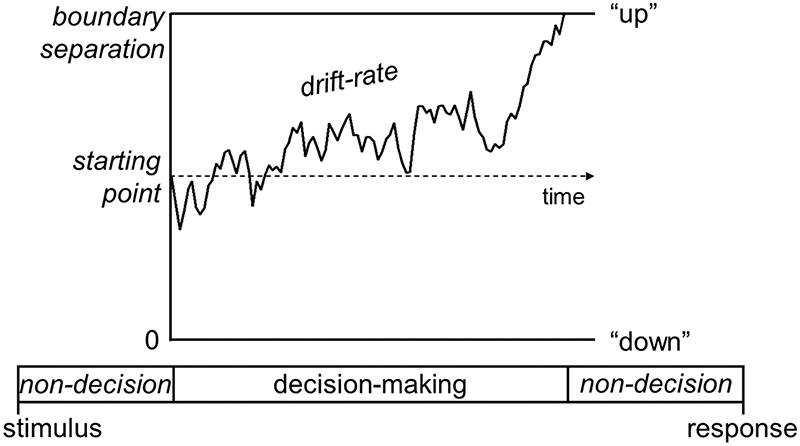
“Complementing these results, we highlighted how multiple parameters differentiate younger children from older children and adults using diffusion modeling (Manning et al., 2021)—a cognitive model that breaks accuracy and response time into distinct processing stages (Ratcliff & McKoon, 2008; Fig.”
BackgroundInternal and External Influences on the Rate of Sensory Evidence Accumulation in the Human Brain
Kelly, S. P., & O'Connell, R. G. (2013) · The Journal of Neuroscience · doi:10.1523/jneurosci.3355-13.2013 · Cited by 455 · cited 1×
“…decision-related component is separable and distinguishable from upstream sensory signals: it predicted response time even when the strength of evidence was held constant, as well as scaling with motion coherence and increasing as a function of time (criteria set out by Kelly & O’Connell, 2013).”
Premembering Experience: A Hierarchy of Time-Scales for Proactive Attention
Nobre, A. C., & Stokes, M. G. (2019) · Neuron · doi:10.1016/j.neuron.2019.08.030 · Cited by 169 · cited 1×
“Attentional biases that depend on information recently encoded into Perceptual Decisions Dynamics: Development and Diversity 7 memory (“memory - guided attention” henceforth) influence incoming percepts, so that our prior history guides perceptual decision making (Nobre & Stokes, 2019).”
Long trajectory for the development of sensitivity to global and biological motion
Hadad, B., Maurer, D. M., & Lewis, T. L. (2011) · Developmental Science · doi:10.1111/j.1467-7687.2011.01078.x · Cited by 162 · cited 1×
“However, children provide a very interesting and far less explored model in which to study the emergence of decision parameters, because they show a protracted development of sensitivity to motion information, with adult-like levels of sensitivity not being reached until mid-to-late childhood (Hadad et al., 2011; Mann…”
BackgroundKelly, S. P., & O’Connell, R. G. (2014) · Journal of Physiology-Paris · doi:10.1016/j.jphysparis.2014.08.003 · Cited by 161 · cited 1×
“…correlates of sensory encoding and decisional processes have been disentangled in non-human animals or in human adults performing these tasks (Kelly & O’Connell, 2015) , making Perceptual Decisions Dynamics: Development and Diversity 4 them useful for deconstructing multiple processes…”
Global Motion Perception in Autism Spectrum Disorder: A Meta-Analysis
der Hallen, R. V., Manning, C., Evers, K., & Wagemans, J. P. (2019) · Journal of Autism and Developmental Disorders · doi:10.1007/s10803-019-04194-8 · Cited by 98
Self-citationCoherence motion perception in developmental dyslexia: a meta‐analysis of behavioral studies
Benassi, M., Simonelli, L., Giovagnoli, S., & Bolzani, R. (2010) · Dyslexia · doi:10.1002/dys.412 · Cited by 78 · cited 1×
“Autism, which affects social communicative and non-social behaviours, and dyslexia, which affects reading ability, are distinct conditions that have both been linked to atypical motion sensitivity (Benassi et al., 2010; van der Hallen et al., 2019).”
Motion perception: a review of developmental changes and the role of early visual experience
Hadad, B., Schwartz, S., Maurer, D., & Lewis, T. L. (2015) · Frontiers in Integrative Neuroscience · doi:10.3389/fnint.2015.00049 · Cited by 55 · cited 1×
“So far, most developmental studies have focused on characterizing the underlying sensory parameters affecting performance (Hadad et al., 2015; Meier & Giaschi, 2014) rather than considering developmental changes in the multiple cognitive processes underlying perceptual decisions.”
BackgroundAveraging, not internal noise, limits the development of coherent motion processing
Manning, C., Dakin, S. C., Tibber, M. S., & Pellicano, E. (2014) · Developmental Cognitive Neuroscience · doi:10.1016/j.dcn.2014.07.004 · Cited by 50 · cited 2×
“For example, Manning et al. (2014) used a computational-modeling technique to investigate contributors to age-related differences in motion-processing ability.”
BackgroundMethodSelf-citationManning, C., Hassall, C. D., Hunt, L. T., Norcia, A. M., Wagenmakers, E., Snowling, M. J., Scerif, G., & Evans, N. J. (2021) · Journal of Neuroscience · doi:10.1523/jneurosci.1232-21.2021 · Cited by 39 · cited 4×
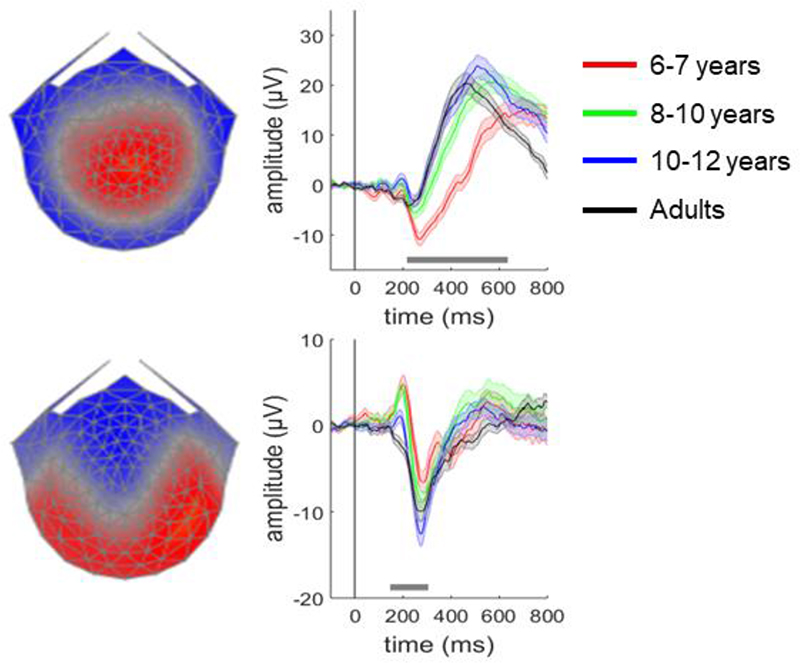
“…as discussed in greater detail later, when we used an EEG processing approach geared to deconvolving stimulus-locked and response-locked signals (Manning et al., 2022 a and b), the late decision-related component in the deconvolved EEG signal correlated with drift rate, suggesting that it quite…”
InfluentialSelf-citation
Research works printed but not linked: 4
- Kelly SP O’Connell RG The neural processes underlying perceptual decision making in humans: recent progress and future directions Journal of Physiology 2015 109 1–3 27 37 25204272
- Manning C Wagenmakers EJ Norcia AM Scerif G Boehm U Perceptual decision-making in children: Age-related differences and EEG correlates Computational Brain & Behavior 2021 4 1 53 69 33604512 PMC7870772 · DOI
- Toffoli L Scerif G Snowling MJ Norcia AM Manning C Global motion evoked potentials in autistic and dyslexic children: A cross-syndrome approach Cortex; a journal devoted to the study of the nervous system and behavior 2021 143 109 126 10.1016/j.cortex.2021.06.018 [Cross-syndrome comparisons in EEG dynamics] 34399308 PMC8500218 · DOI
- Scerif G The developmental dynamics of attention, learning and memory Poeppel D Mangun R Gazzaniga M The Cognitive Neurosciences 6th edition MIT Press 2019 [preparatory and memory-guided effects on attention]
Cited by
Borsotti, V., Begel, A., & Bjørn, P. (2024) · Proceedings of the ACM on Human-Computer Interaction · doi:10.1145/3641011 · Cited by 54
Manning, C. (2024) · Quarterly Journal of Experimental Psychology · doi:10.1177/17470218241264627 · Cited by 8
“Such a transdiagnostic approach may help to understand individual differences more generally (Manning & Scerif, 2023).”
BackgroundSelf-citationYusuf, H., Evans, N. J., Taylor, G. J., Cameron, A., Greenhalgh, J., Thomas, L., Scerif, G., & Manning, C. (2025) · Neurodiversity · doi:10.1177/27546330251370662 · Cited by 1
“We also investigated the role of attention-de fi cit hyper-activity disorder (ADHD) traits in understanding variability across the population (Karalunas et al., 2014; Manning & Scerif, 2023).”
Self-citationMapping Inner Worlds: Understanding Neurodiversity Through Perception
Savickaite, S. (2026) · Springer eBooks · doi:10.1007/978-3-032-19636-1_1
Metadata
- Authors
- Manning, C., & Scerif, G.
- Affiliations
- University of Oxford (GB)
- Corresponding author
- Scerif, Gaia
- Venue
- Current Directions in Psychological Science
- Publisher
- SAGE Publications
- Published
- 2023-04-16
- Volume
- 32
- Issue
- 4
- Pages
- 300-306
- ISSN
- 0963-7214 (ISSN-L)
- 1467-8721
- PMC
- PMC7614885
- OpenAlex
- W4366091645
- Cited by
- 4
- References
- 23
- Citations by year
- 2026: 1 · 2025: 1 · 2024: 2
- FWCI
- 0.60
- Type
- journal article
- Language
- en
- Open access
- Licence
- cc-by
- journals.sagepub.com/page/policies/text-and-data-mining-license (tdm)
- Locations
- Current Directions in Psychological Science (publishedVersion)
- PubMed (publishedVersion)
- CentAUR (University of Reading) (acceptedVersion, cc-by)
- PubMed Central (acceptedVersion, cc-by)
- University of Birmingham Research Portal (University of Birmingham) (submittedVersion)
- Funders
- James S. McDonnell Foundation (Understanding Human Cognition Scholar Award)
- Wellcome Trust (204685/Z/16/Z)
- Topics
- Life Sciences › Neuroscience › Cognitive Neuroscience › Visual perception and processing mechanisms
- Life Sciences › Neuroscience › Cognitive Neuroscience › Neural and Behavioral Psychology Studies
- Life Sciences › Neuroscience › Cognitive Neuroscience › Face Recognition and Perception
- Keywords
- perceptual decision making, perceptual development, neurodiversity, neurodivergent individuals, individual differences, computational modelling, electrophysiology, eye tracking, longitudinal development
About these checks
Registry, retraction, Cites and statistics results are computed, not judged, with one exception: a printed reference that no index lists is read once by a model before it counts as a citation error. Claims are extracted by a model and kept only when their quote appears verbatim in the text; each cited source is then checked, with a model’s help, for whether it says what the claim relies on. Those verdicts can be wrong — read the claim’s quote and the cited source before relying on one.
Statistics and arithmetic are recomputed, not judged.
Confidence bands are shown only for fields calibrated on our annotated test set. None is calibrated yet, so no band is shown.
What counts as a claim ›How we measure confidence ›How we check this ›
Are you an author, or do you see a problem with this page? Request a review
Data sources
Bibliographic data: Semantic Scholar, OpenAlex, Crossref.
Contains information from the Semantic Scholar Academic Graph Datasets, made available under the ODC Attribution License (ODC-BY 1.0).
Semantic Scholar’s data is described in: Kinney, R., et al. (2023). The Semantic Scholar Open Data Platform. arXiv:2301.10140.
