

Emergency department mental health presentations before and during the COVID-19 outbreak in Western Australia
Open accessThe DOI matches its Crossref record; 16 of the 16 references it cites were found in a registry or an index.
Abstract
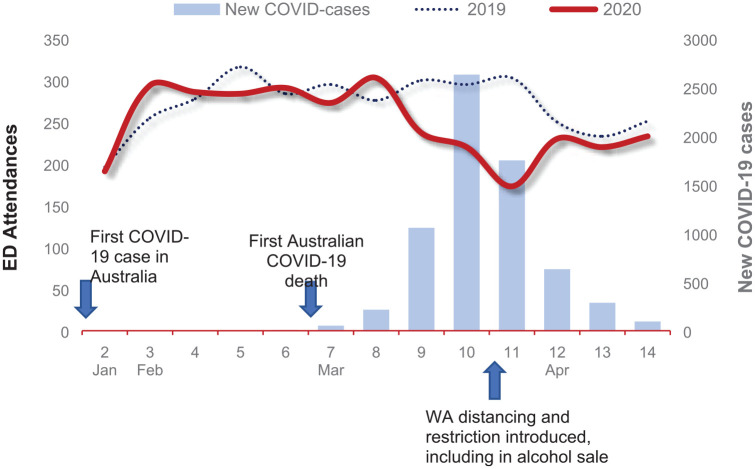
Objective: Coronavirus (COVID-19) has led to high levels of psychological distress in the community. This study aimed to examine whether emergency departments (EDs) also recorded a rise in mental health presentations. Method: Changes in the number, and type, of mental health presentations to Western Australia EDs were examined between January and May 2020, and compared to 2019. Results: Data showed an unexpected decrease in the number of mental health presentations, compared to 2019, which was temporally coincident with the rise in local COVID-19 cases. Presentations for anxiety and panic symptoms, and social and behavioural issues, increased by 11.1% and 6.5%, respectively, but suicidal and self-harm behaviours decreased by 26%. Conclusion: A rise in local COVID-19 cases was associated with a decrease in mental health presentations to EDs. This has important implications for the planning and provision of healthcare services in the current pandemic.
Overview
The claims and statistics of this paper haven’t been checked yet.
Free: it reads the open-access text and checks the first 5 claims that cite a source we can check. Create a free account to check every claim.
Integrity signals
Registry
Cites
Statistics
Figures
Verification
Claims the paper makes
The claims and statistics of this paper haven’t been checked yet.
Free: it reads the open-access text and checks the first 5 claims that cite a source we can check. Create a free account to check every claim.
Claims other papers make about this one
Each is checked against this paper’s own text: does it say what the citing paper says it does?
The source backs part of the claim, not all of it — or backs it for a different population, condition or comparison.
In the citing paper
“Four studies, representing five samples for each of the two pandemic periods analyzed (prepandemic, N=10,326 patients; during pandemic, N=9,396 patients), reported on policereferral rates to PEDs before and during the COVID-19 pandemic (9,13,27,48).”
From Referral of patients to psychiatric emergency departments by police: A systematic review and meta-analysis (2025) · cites this paper as [9]
Experimental — accuracy not yet measuredThe check wasn’t confident either way, so it gives no verdict — never disputed.
In the citing paper
“Using data from four studies (9, 13, 27, 48), we could not establish a significant impact of the COVID-19 pandemic on police referrals to PEDs.”
From Referral of patients to psychiatric emergency departments by police: A systematic review and meta-analysis (2025) · cites this paper as [9]
Experimental — accuracy not yet measured
Self-check
Percentages, sums and reported differences re-computed from the paper’s own numbers.
The self-check needs the paper’s full text.
Citations
Cites
The Environment and Disease: Association or Causation?
Hill, A. B. (1965) · Proceedings of the Royal Society of Medicine · doi:10.1177/003591576505800503 · Cited by 6,974
Holmes, E. A., O'Connor, R. C., Perry, V. H., Tracey, I., Wessely, S., Arseneault, L., Ballard, C., Christensen, H., Cohen Silver, R., Everall, I., et al. (2020) · The Lancet Psychiatry · doi:10.1016/s2215-0366(20)30168-1 · Cited by 5,715
Salari, N., Hosseinian-Far, A., Jalali, R., Vaisi-Raygani, A., Rasoulpoor, S., Mohammadi, M., Rasoulpoor, S., & Khaledi-Paveh, B. (2020) · Globalization and Health · doi:10.1186/s12992-020-00589-w · Cited by 3,560
Suicide risk and prevention during the COVID-19 pandemic
Gunnell, D., Appleby, L., Arensman, E., Hawton, K., John, A., Kapur, N., Khan, M., O'Connor, R. C., Pirkis, J., Appleby, L., et al. (2020) · The Lancet Psychiatry · doi:10.1016/s2215-0366(20)30171-1 · Cited by 1,513
Delayed access or provision of care in Italy resulting from fear of COVID-19
Lazzerini, M., Barbi, E., Apicella, A., Marchetti, F., Cardinale, F., & Trobia, G. (2020) · The Lancet Child & Adolescent Health · doi:10.1016/s2352-4642(20)30108-5 · Cited by 1,299
Garfin, D. R., Silver, R. C., & Holman, E. A. (2020) · Health Psychology · doi:10.1037/hea0000875 · Cited by 1,270
Causation and Causal Inference in Epidemiology
Rothman, K. J., & Greenland, S. (2005) · American Journal of Public Health · doi:10.2105/ajph.2004.059204 · Cited by 1,259
Metzler, B., Siostrzonek, P., Binder, R. K., Bauer, A., & Reinstadler, S. J. (2020) · European Heart Journal · doi:10.1093/eurheartj/ehaa314 · Cited by 634
Social determinants and health behaviors: conceptual frames and empirical advances
Short, S. E., & Mollborn, S. (2015) · Current Opinion in Psychology · doi:10.1016/j.copsyc.2015.05.002 · Cited by 566
Yip, P. S. F., Cheung, Y. T., Chau, P. H., & Law, Y. W. (2010) · Crisis · doi:10.1027/0227-5910/a000015 · Cited by 363
Research works printed but not linked: 6
- 6. Sharp suicide increase expected due to pandemic [press release]. The Royal Australian College of General Practitioners, 07/05/2020, 2020.
- 11. Health Do. Data Dictionary - Emergency Department. Perth: Government of Western Australia, Department of Health; 2020. Available from: https://www.datalinkage-wa.org.au/resources/dataset-information/
- 13. Hoyer C, Ebert A, Szabo K, et al. Decreased utilization of mental health emergency service during the COVID-19 pandemic. Eur Arch Psy Clin Neurosci 2020; 1–3 (in press).
- 16. Wong LE, Hawkins JE, Langness S, et al. Where are all the patients? Addressing Covid-19 fear to encourage sick patients to seek emergency care. NEJM Catalyst Innovations in Care Delivery 2020; 1 (in press).
- 19. Covid-19 Impact Activates First National Emergency Appeal In Lifeline’s 57 Year History [press release]. 29 March 2020, 2020.
- 20. Beyond Blue welcomes funding for new COVID-19 support service [press release]. 2020.
Cited by
Suicide behaviors during the COVID-19 pandemic: A meta-analysis of 54 studies
Dubé, J. P., Smith, M. M., Sherry, S. B., Hewitt, P. L., & Stewart, S. H. (2021) · Psychiatry Research · doi:10.1016/j.psychres.2021.113998 · Cited by 291
John, A., Eyles, E., Webb, R. T., Okolie, C., Schmidt, L., Arensman, E., Hawton, K., O'Connor, R. C., Kapur, N., Moran, P., et al. (2021) · F1000Research · doi:10.12688/f1000research.25522.2 · Cited by 189
The impact of the COVID-19 pandemic on self-harm and suicidal behaviour: a living systematic review
John, A., Okolie, C., Eyles, E., Webb, R. T., Schmidt, L., McGuinness, L. A., Olorisade, B. K., Arensman, E., Hawton, K., Kapur, N., et al. (2020) · F1000Research · doi:10.12688/f1000research.25522.1 · Cited by 178
An integrative review of primary health care nurses’ mental health knowledge gaps and learning needs
McInnes, S., Halcomb, E., Ashley, C., Kean, A., Moxham, L. J., & Patterson, C. (2022) · Collegian Journal of the Royal College of Nursing Australia · doi:10.1016/j.colegn.2021.12.005 · Cited by 71
Mahoney, A. E. J., Elders, A., Li, I., David, C., Haskelberg, H., Guiney, H., & Millard, M. (2021) · Internet Interventions · doi:10.1016/j.invent.2021.100439 · Cited by 51
Shrestha, R., Siwakoti, S., Singh, S., & Shrestha, A. P. (2021) · PLOS ONE · doi:10.1371/journal.pone.0250706 · Cited by 55
“In contrast, a study exploring the mental health presentations in the ED before and during the COVID-19 outbreak in developed world showed decreased suicide and SH [20, 21].”
ResultThe Impact of the COVID-19 Pandemic on Demand for Emergency Ambulances in Victoria, Australia
Andrew, E., Nehme, Z., Stephenson, M., Walker, T., & Smith, K. L. (2021) · Prehospital Emergency Care · doi:10.1080/10903127.2021.1944409 · Cited by 60
“A five-day lockdown involving Stage 4 restrictions was imposed in February 2021 (12-17) to contain a small outbreak.”
BackgroundSteeg, S., John, A. M., Gunnell, D., Kapur, N., Dekel, D., Schmidt, L., Knipe, D. W., Arensman, E., Hawton, K. E., Higgins, J. P. T., et al. (2022) · The British Journal of Psychiatry · doi:10.1192/bjp.2022.79 · Cited by 48
Saunders, N. R., Toulany, A., Deb, B., Strauss, R., Vigod, S. N., Guttmann, A., Chiu, M., Huang, A., Fung, K., Chen, S., et al. (2021) · CMAJ Open · doi:10.9778/cmajo.20210100 · Cited by 48
“28,29 Despite widespread reports of an increased population-wide mental illness burden associated with the COVID-19 pandemic, 2 our findings showed no increase in acute care service use for mental health and substance use disorders after the onset of the pandemic, and, in the case of youth, a…”
Seifert, J., Meissner, C., Birkenstock, A., Bleich, S., Toto, S., Ihlefeld, C., & Zindler, T. (2021) · European Archives of Psychiatry and Clinical Neuroscience · doi:10.1007/s00406-020-01228-6 · Cited by 47
“During the pandemic, a surge in patients presenting with anxiety disorders was observed in Western Australia [17].”
BackgroundResultInfluentialCOVID-19 and mental health in Australia – a scoping review
Zhao, Y., Leach, L., Walsh, E., Batterham, P. J., Calear, A. L., Phillips, C. B., Olsen, A., Doan, T. T., LaBond, C., & Banwell, C. L. (2022) · BMC Public Health · doi:10.1186/s12889-022-13527-9 · Cited by 44
“In terms of suicidal intention, plans or behaviours, data from Queensland showed no change in suspected suicides [39] and in Western Australia, the presentations to emergency departments due to suicide or self-harm decreased significantly during this period [22].”
BackgroundMethodInfluentialCarison, A., Babl, F. E., & O'Donnell, S. M. (2022) · Emergency Medicine Australasia · doi:10.1111/1742-6723.13901 · Cited by 39
Asper, M. M., Osika, W., Dalman, C., Pöllänen, E., Simonsson, O., Flodin, P., Sidorchuk, A., Marchetti, L., Awil, F., Castro, R., et al. (2022) · BJPsych Open · doi:10.1192/bjo.2022.587 · Cited by 43
Yalçın, M., Baş, A., Bilici, R., Özdemir, Y. Ö., Beştepe, E. E., Kurnaz, S., Güneş, M., Kurt, V., & Koyu, E. (2021) · Social Psychiatry and Psychiatric Epidemiology · doi:10.1007/s00127-021-02171-0 · Cited by 36
Jagadheesan, K., Danivas, V., Itrat, Q., Shekaran, L., & Lakra, V. (2021) · Psychiatry Research · doi:10.1016/j.psychres.2021.114081 · Cited by 37
Psychiatric Emergencies During the Covid-19 Pandemic: A 6-Month Observational Study
Lorenzo, R. D., Frattini, N., Dragone, D., Farina, R., Luisi, F., Ferrari, S., Bandiera, G., Rovesti, S., & Ferri, P. (2021) · Neuropsychiatric Disease and Treatment · doi:10.2147/ndt.s307128 · Cited by 33
“) that led to the general reduction in ER of all consultations not related to COVID-19, as reported by other authors during the pandemic.(40,45) Patients with mood disorders probably avoided UPC in ER due to their fear of contamination(63) or, otherwise, they found sufficient care and stabilization in tele-psychiatry.”
ResultLorenzo, R. D., Fiore, G., Bruno, A., Pinelli, M., Bertani, D. E., Falcone, P., Marrama, D., Starace, F., & Ferri, P. (2021) · Psychiatric Quarterly · doi:10.1007/s11126-021-09907-w · Cited by 33
Goldschmidt, T., Kippe, Y., Finck, A., Adam, M., Hamadoun, H., Winkler, J. G., Bermpohl, F., Schouler-Ocak, M., & Gutwinski, S. (2023) · BMC Psychiatry · doi:10.1186/s12888-023-04537-x · Cited by 27
“Our findings differ with previous research concerning mode of attendance, because others do not report [13, 18, 19, 49] or show no significant differences in presentations with police custody between the Covid-19 period and the pre-Covid-19 period [11, 21].”
BackgroundResultInfluentialChanges in nationwide in-hospital stroke care during the first four waves of COVID-19 in Germany
Dengler, J., Prass, K., Palm, F., Hohenstein, S., Pellisier, V., Stoffel, M. H., Hong, B., Meier‐Hellmann, A., Kuhlen, R., Bollmann, A., et al. (2022) · European Stroke Journal · doi:10.1177/23969873221089152 · Cited by 26
Dionisie, V., Ciobanu, A. M., Moisă, E., Manea, M. C., & Puiu, M. G. (2022) · Healthcare · doi:10.3390/healthcare10081570 · Cited by 28
“On the other hand, other studies identified no significant differences in the number of hospitalized patients [14,19,26,27].”
BackgroundKippe, Y. D., Adam, M., Finck, A., Moran, J. K., Schouler‐Ocak, M., Bermpohl, F., Gutwinski, S., & Goldschmidt, T. (2022) · European Archives of Psychiatry and Clinical Neuroscience · doi:10.1007/s00406-022-01486-6 · Cited by 28
Beam Me Out: Review of Emergency Department Telepsychiatry and Lessons Learned During COVID-19
Natafgi, N., Childers, C., Pollak, A., Blackwell, S., Hardeman, S., Cooner, S., Bank, R., Ratliff, B., Gooch, V., Rogers, K., et al. (2021) · Current Psychiatry Reports · doi:10.1007/s11920-021-01282-4 · Cited by 24
Emergency department utilization for mental health conditions before and after the COVID-19 outbreak
Stroever, S. J., Brett, C., Michael, K., & Petrini, J. R. (2021) · The American Journal of Emergency Medicine · doi:10.1016/j.ajem.2021.03.084 · Cited by 24
“Investigators found COVID-19 associated with higher levels of psychiatric distress, increased prevalence of substance use disorders, relapse, and overdose, and increased use of emergency medical services (EMS) for mental health conditions [7-13].”
Patterns of Suicide in the Context of COVID-19: Evidence From Three Australian States
Clapperton, A., Spittal, M. J., Dwyer, J., Garrett, A. C., Kõlves, K., Leske, S., Millar, C., Edwards, B., Stojcevski, V., Crompton, D., et al. (2021) · Frontiers in Psychiatry · doi:10.3389/fpsyt.2021.797601 · Cited by 22
Håkansson, A., & Grudet, C. (2021) · Frontiers in Psychiatry · doi:10.3389/fpsyt.2021.664204 · Cited by 24
“In another study from Western Australia, both alcohol intoxications and “drug abuse” decreased as underlying causes of seeking emergency psychiatric care, whereas the number of drug overdoses remained stable (14).”
BackgroundPerozziello, A., Sousa, D., Aubriot, B., & Masson, V. D. (2023) · BMJ Open · doi:10.1136/bmjopen-2022-064305 · Cited by 24
Suicidal Behavior in the First Wave of the COVID-19 Pandemic
Giner, L., Vera-Varela, C., Vega, D., Zelada, G. M., & Guija, J. A. (2022) · Current Psychiatry Reports · doi:10.1007/s11920-022-01312-9 · Cited by 24
Lorenzo, R. D., Pinelli, M., Bertani, D. E., Cutino, A., Dragone, D., Elia, C., Farina, R., Fiore, G., Luisi, F., Panico, S., et al. (2022) · Frontiers in Psychiatry · doi:10.3389/fpsyt.2022.894939 · Cited by 16
“During the pandemic, many requests for psychiatric emergency care and assessment were due to symptoms related to anxiety disorders (41), which represented the major part of every consultation request (27).”
BackgroundAkkaoui, M. A., Barruel, D., Masson, V. D., Gourévitch, R., & Pham‐Scottez, A. (2025) · International Journal of Emergency Medicine · doi:10.1186/s12245-025-00810-w · Cited by 14
Aymerich, C., Pedruzo, B., de Pablo, G. S., Olazabal, N., Catalán, A., & Torres, M. Á. G. (2024) · Frontiers in Psychiatry · doi:10.3389/fpsyt.2024.1380401 · Cited by 17
One year of psychiatric presentations to a hospital emergency department during COVID-19
Hartnett, Y., Alshurafa, K., McAndrew, J., Daly, D., Alsaffar, M., Cotter, D., Cannon, M. D., MacHale, S., Murphy, K. C., & Barry, H. (2022) · Irish Journal of Psychological Medicine · doi:10.1017/ipm.2022.6 · Cited by 13
Li, H., Chen, X., Pan, J., Li, M., Wang, M., Wang, W., & Wang, Y. (2022) · Healthcare · doi:10.3390/healthcare10081402 · Cited by 12
“Although many studies showed that the utilization of mental health services declined during the pandemic, it is possible that many countries will experience a surge in the need for these services during their post-pandemic period [20].”
BackgroundSvetičič, J., Stapelberg, N. J. C., & Turner, K. A. (2021) · Australasian Psychiatry · doi:10.1177/1039856221992632 · Cited by 11
“1177/1039856221992632 Australasian Psychiatry 2021, Vol 29(3) 333 –336 © The Royal Australian and New Zealand College of Psychiatrists 2021 Article reuse guidelines: sagepub.”
BackgroundMaguire, E., Kavalidou, K., Bannan, N., Doherty, A. M., & Jeffers, A. (2022) · Irish Journal of Psychological Medicine · doi:10.1017/ipm.2022.36 · Cited by 9
“Similar to other studies, we did not observe any changes in the demographics of those presenting during the pandemic (Dragovic et al. 2020; Hawton et al. 2021b; Lee et al. 2021; Shields et al. 2021).”
Adam, M., Moran, J. K., Kippe, Y. D., Schouler‐Ocak, M., Bermpohl, F., Gutwinski, S., & GOLDSCHMIDT, T. J. (2023) · Frontiers in Psychiatry · doi:10.3389/fpsyt.2023.1240703 · Cited by 10
“However, among pED presentations, the number of patients with substance use disorders decreased at the beginning of the pandemic (60, 61).”
BackgroundBrandizzi, M., Polselli, A., Corigliano, V., Tamorri, S. M., Venturini, P., Azzoni, A., Grasso, S., Onofri, A., Pesce, S., Romani, F., et al. (2022) · Annals of General Psychiatry · doi:10.1186/s12991-022-00408-z · Cited by 10
“We also identified frequent attendees of the ED, defined as individuals presenting three or more times within the study period (January 2019–June 2021) [25].”
BackgroundWestern Journal of Emergency Medicine
Lam, J. (2022) · Western Journal of Emergency Medicine · doi:10.5811/westjem.2022.8.59370 · Cited by 9
Sculco, C., Bano, B., Prina, E., Tedeschi, F., Bartucz, M. B., Barbui, C., Purgato, M., & Albanese, E. (2025) · BMJ Open · doi:10.1136/bmjopen-2024-091342 · Cited by 9
McCullough, M., SMALL, M. P., Jayawardena, B., & Hood, S. D. (2024) · PLoS Medicine · doi:10.1371/journal.pmed.1004241 · Cited by 8
Thomas, B., O'Meara, P. F., Edvardsson, K., McCann, D., & Spelten, E. R. (2022) · BMC Emergency Medicine · doi:10.1186/s12873-022-00608-6 · Cited by 8
“In the recent Covid-19 pandemic, two Australian studies have shown an increase in ED presentations for several MBDs in the context of decreasing total ED presentations [26, 27].”
BackgroundBuckley, L., Sterling, M. M., & Elphinston, R. A. (2022) · Pain · doi:10.1097/j.pain.0000000000002724 · Cited by 9
Impact of the COVID-19 Pandemic on Children and Adolescents Presenting With a Psychiatric Emergency
Erjavac, B. W., Rolin, A. I., Gondy, K., Cranford, J. A., Shobassy, A., Biermann, B., Rogers, A. J., & Hong, V. (2022) · Clinical Pediatrics · doi:10.1177/00099228221120288 · Cited by 8
Where in the World Have All the Strokes Gone?
Demaerschalk, B. M. (2021) · Neurology · doi:10.1212/wnl.0000000000011886 · Cited by 7
Feng, Y. R., Valuri, G. M., Morgan, V. A., Preen, D. B., O’Leary, C., Crampin, E. F., & Waterreus, A. J. (2023) · Australian & New Zealand Journal of Psychiatry · doi:10.1177/00048674231172116 · Cited by 7
“The authors decided to restrict the review to a 20-year date range with the upper date (2020) chosen to limit the possible impact of COVID-19 on ED contact and aftercare provisions, given that access to ED care has been reported to be impacted by the pandemic (Dragovic et al., 2020).”
BackgroundJones, P. M., Sweeny, A. L., Branjerdporn, G., Keijzers, G., Marshall, A. P., Huang, Y., Hall, E. J., Ranse, J., Palipana, D. B., Teng, Y. D., et al. (2024) · Asia-Pacific Psychiatry · doi:10.1111/appy.12553 · Cited by 6
“This is consistent with the findings of multiple other studies (Dragovic et al., 2020; Ferrando et al., 2021; G (cid:1) omez-Ramiro et al., 2021; Goncalves-Pinho et al., 2021; Holland et al., 2021; Mukadam et al., 2021; Pikkel Igal et al., 2021; Stein et al., 2020). presentations in our study also…”
ResultEmergency department visits for psychiatric care during the first lockdown in Melbourne
Jagadheesan, K., Danivas, V., Itrat, A., & Lakra, V. (2021) · Australasian Psychiatry · doi:10.1177/10398562211037329 · Cited by 6
Hudson, C., Branjerdporn, G., Hughes, I. P., Todd, J., Bowman, C., Randall, M., & Stapelberg, N. J. C. (2023) · Discover Mental Health · doi:10.1007/s44192-023-00047-0 · Cited by 7
Nosè, M., Gastaldon, C., Acartürk, C., Purgato, M., Ostuzzi, G., & Barbui, C. (2022) · International Review of Psychiatry · doi:10.1080/09540261.2022.2145183 · Cited by 6
“In a recent study in Australia, indicators of worsening community psychological distress in the early months of COVID-19 did not correspond to an increase in emergency department mental health presentations, which were reduced (Dragovic et al., 2020).”
BackgroundThe impact of COVID-19 pandemic and lockdown on emergency psychiatry department admissions
Poyraz, C. A., Bostan, B. U., Ersungur, E. B., & Esen, B. K. (2024) · Medicine · doi:10.1097/md.0000000000036878 · Cited by 7
“[8,32,33] Previously authors suggested that this may be a real decline or it is due to the fact that patients are not presenting to the ED.”
BackgroundKim, J., Rao, N., Collins, A., Eboh, T., Chugh, J., Sheladia, S., & Naguib, T. H. (2023) · Southern Medical Journal · doi:10.14423/smj.0000000000001514 · Cited by 6
Rankin, N. M., Nutbeam, D., Lévesque, J., Ko, H., Jennings, G., Walczak, A., & Jorm, C. M. (2024) · Journal of Health Organization and Management · doi:10.1108/jhom-03-2023-0059 · Cited by 4
O'Sullivan, M. (2022) · International Journal of Mental Health Nursing · doi:10.1111/inm.13054 · Cited by 4
Schneider, P. S., Pantis, M., Preiser, C., Hagmann, D., Barth, G. M., Renner, T. J., & Allgaier, K. (2024) · International Journal of Environmental Research and Public Health · doi:10.3390/ijerph21020216 · Cited by 4
“For the area of substance abuse disorders, studies have described a decrease [38], a consistent appearance [35,38,39], or an increase [34].”
BackgroundResultNakao, S., Katayama, Y., Tanaka, K., Kitamura, T., Hirose, T., Tachino, J., Iwami, T., Shimazu, T., Oda, J., & Matsuoka, T. (2022) · Acute Medicine & Surgery · doi:10.1002/ams2.787 · Cited by 4
Lee, Y. J., Yuh, M. A., Kim, I. S., Cho, B., Woo, S. H., & Hong, S. (2023) · PLoS ONE · doi:10.1371/journal.pone.0286398 · Cited by 4
“A study from Western Australia reported that ED presentations after suicidal behavior and self-harm decreased by 26% during the COVID-19 pandemic [29].”
Goldschmidt, T., Kippe, Y. D., Gutwinski, S., Deutscher, K., Schouler-Ocak, M., & Kroehn-Liedtke, F. (2024) · BMC Psychiatry · doi:10.1186/s12888-024-05903-z · Cited by 3
“Studies from Switzerland, Turkey and Australia cover only the first wave of the COVID-19 pandemic and report, in comparison to the current study, considerably lower rates of presentations BIBP and only minor changes to pre-pandemic times [22, 23, 27].”
Goldschmidt, T., Bermpohl, F., Schreiter, S., van Bergen, A. H., Kupka, R. W., Schouler-Ocak, M., Gutwinski, S., & Deutscher, K. (2025) · Psychiatric Services · doi:10.1176/appi.ps.20240323 · Cited by 2
Zanti, S., & Ma, C. (2024) · Psychiatric Quarterly · doi:10.1007/s11126-024-10103-9 · Cited by 2
The Effect of the COVID-19 Pandemic Lockdown on Self-Harm: A Meta-Analysis
Wang, J., Zhang, X., Deng, H., & Tan, Y. (2025) · ALPHA PSYCHIATRY · doi:10.31083/ap39868 · Cited by 2
“Researchers have provided evidence showing that the rise in local COVID-19 cases is associated with a decrease in psychiatric and mental health emergency presentations in emergency departments [42,43].”
Foroughi, N., Hay, P., & Mannan, H. R. (2023) · Nutrients · doi:10.3390/nu15071676 · Cited by 4
“Although some of the previously published studies present with conflicting evidence, such as reduced self-harm behavior and suicide [1], most studies suggest that the 2019 novel coronavirus (COVID-19) infection has had an overall, substantially negative and significant psychological, financial,…”
ResultNakao, S., Katayama, Y., Kitamura, T., Tanaka, K., Hirose, T., Tachino, J., Iwami, T., Masui, J., Domi, H., Shimazu, T., et al. (2023) · BMJ Open · doi:10.1136/bmjopen-2023-074903 · Cited by 2
Mental health-related presentations to a tertiary emergency department during the COVID-19 pandemic
Lim, E. G., How, A. E. H., Lee, J. Z. H., Ganti, S., & Omar, E. B. (2023) · Singapore Medical Journal · doi:10.4103/singaporemedj.smj-2022-103 · Cited by 2
Comparison of suicide attempt cases admitted to emergency services during COVID-19 and before
Efgan, M. G., Çınaroğlu, O. S., Payza, U., Kanter, E., & Bılgın, S. (2023) · The Annals of Clinical and Analytical Medicine · doi:10.4328/acam.21867 · Cited by 2
“Previous studies have reported an increase in the prevalence of depression, anxiety and sleep disorders and the number of suicide attempts in COVID-19 patients [11,12,13].”
Descriptive study of mental health care users 12 months pre- and post-COVID-19 lockdown
Hlongwane, N. A., & Lowton, K. (2024) · South African Journal of Psychiatry · doi:10.4102/sajpsychiatry.v30i0.2301 · Cited by 2
Buntine, P., Aldridge, E. S., Craig, S. S., Crellin, D., Stella, J., Gill, S. D., Wright, B., Mitchell, R. D., Arendts, G., Rawson, H. A., et al. (2022) · Emergency Medicine Australasia · doi:10.1111/1742-6723.13973 · Cited by 3
Leung, K. F. C., Golzan, M., Egodage, C., Rodda, S., Cracknell, R., Macken, P. L., & Kaushik, S. (2022) · BMC Ophthalmology · doi:10.1186/s12886-022-02271-8 · Cited by 2
Ng, R. W., Emmerig, D., Salter, M. D., Shetty, A., & Gunja, N. (2022) · Emergency Medicine Australasia · doi:10.1111/1742-6723.14070 · Cited by 3
“Accepted 8 August 2022 Key findings • In this Western Sydney cohort, there was a relative increase in toxicology presentations during the COVID-19 pandemic compared to an overall decrease in presentations to ED.”
BackgroundInfluentialFajardo, C., Sciacchitano, S., Pozo-Prados, A. M., Izquierdo, A., Duarte, Á. O., Parada, E. D., Ayuso‐Mateos, J. L., & Torío, I. (2024) · The European Journal of Psychiatry · doi:10.1016/j.ejpsy.2024.100281 · Cited by 1
Covid-19 pandemisinde genel hastane acil servisine başvuran intihar girişimlerinin incelenmesi
Elbay, R. Y., & Fatma Nur, E. R. O. L. (2021) · Anadolu Kliniği Tıp Bilimleri Dergisi · doi:10.21673/anadoluklin.1029391 · Cited by 1
Looi, J. C., Allison, S. C., Bastiampillai, T. J., & Kisely, S. R. (2022) · Australasian Psychiatry · doi:10.1177/10398562221100090 · Cited by 1
“There was a decrease in Western Australia in the first 5 months of 2020 compared to the same period in the previous year.(15) In Melbourne, increases in presentations for psychosis, anxiety or substance use during the 2020 lockdown were matched by decreases in those for mood disorders or suicidal behaviour compared to…”
ResultItrat, A., Jagadheesan, K., Danivas, V., & Lakra, V. (2021) · Indian Journal of Psychiatry · doi:10.4103/indianjpsychiatry.indianjpsychiatry_888_21
“In relation to the question about the reference year, it is not uncommon to use 2019 as a reference year and a select period [2,3] while exploring the effect of COVID-19 pandemic.”
Stress Management in Emergency Nurses during the COVID-19 Pandemic: Scooping Article
Rohimah, A., Prakoso, A. B., Kusuma, R. Y., Jamil, S., Rini, S. S., & Alim, S. (2022) · Jurnal Keperawatan Soedirman · doi:10.20884/1.jks.2022.17.2.5586
Impacts of the Pandemic on Social Determinants of Health in an Academic Emergency Department
Findlay, S., Okoro, U. E., Lee, S., Harland, K. K., Evers, M., Gaffney, E., McCormick, M., & Buresh, C. (2022) · Western Journal of Emergency Medicine · doi:10.5811/westjem.2022.8.56145
Knowles, J. R. P. (2023) · Cronfa (Swansea University) · doi:10.23889/suthesis.63616
A Study of Emergency Room Presentations of Suicidal Behavior Cases during the COVID-19 Pandemic
Ravishankar, V., Suresh, T., Komal, S., & Hongally, C. (2023) · Indian Journal of Social Psychiatry · doi:10.4103/ijsp.ijsp_88_22
Suicide during the global COVID-19 pandemic
Wasserman, D., Iosue, M., & Carli, V. (2024) · Oxford University Press eBooks · doi:10.1093/med/9780198843405.003.0021
The Impact of the COVID-19 Pandemic on Police Involvement in Mental Health Calls for Service
Tartaro, C., & Lu, R. (2024) · Criminal Justice Policy Review · doi:10.1177/08874034241303024
“Emergency room visits and consultations decreased during the COVID lockdowns (Butt et al., 2020; Dragovic et al., 2020; Valitutti et al., 2020).”
Leung, K. F. C., Golzan, M., Egodage, C., Rodda, S., Cracknell, R., Macken, P. L., & Kaushik, S. (2022) · Figshare · doi:10.6084/m9.figshare.19090874
Additional file 1 of COVID-19 and mental health in Australia – a scoping review
Zhao, Y., Leach, L., Walsh, E., Batterham, P. J., Calear, A. L., Phillips, C., Olsen, A., Doan, T., LaBond, C., & Banwell, C. L. (2022) · Figshare · doi:10.6084/m9.figshare.20076570
GOLDSCHMIDT, T. J., Kippe, Y. D., Finck, A., Adam, M., Hamadoun, H., Winkler, J., Bermpohl, F., Schouler-Ocak, M., & Gutwinksi, S. (2024) · Figshare · doi:10.6084/m9.figshare.26561356
Additional file 2 of COVID-19 and mental health in Australia – a scoping review
Zhao, Y., Leach, L., Walsh, E., Batterham, P. J., Calear, A. L., Phillips, C., Olsen, A., Doan, T., LaBond, C., & Banwell, C. (2022) · Figshare · doi:10.6084/m9.figshare.20076573
GOLDSCHMIDT, T. J., Kippe, Y. D., Finck, A., Adam, M., Hamadoun, H., Winkler, J., Bermpohl, F., Schouler-Ocak, M., & Gutwinksi, S. (2024) · Figshare · doi:10.6084/m9.figshare.26561353
Prevención en los trabajos psicóticos: Un abordaje transversal
Aymerich, C. (2024) · Communities in ADDI (University of the Basque Country)
Machado, K., Notejane, M., Farías, F., Mautone, K., Xoyón, E., García, L., Martínez, A., & Garrido, G. (2026) · Archivos de Pediatría del Uruguay · doi:10.31134/ap.97.2.3
Metadata
- Authors
- Dragovic, M., Pascu, V., Hall, T., Ingram, J., & Waters, F.
- Affiliations
- North Metropolitan Health Service, Mental Health, Clinical Research Centre, Australia
- North Metropolitan Health Service (AU)
- The University of Western Australia (AU)
- Venue
- Australasian Psychiatry
- Publisher
- SAGE Publications
- Published
- 2020-09-22
- Volume
- 28
- Issue
- 6
- Pages
- 627-631
- ISSN
- 1039-8562 (ISSN-L)
- 1440-1665
- PMC
- PMC7509241
- OpenAlex
- W3087656017
- Cited by
- 80
- References
- 16
- Citations by year
- 2025: 4 · 2024: 13 · 2023: 13 · 2022: 29 · 2021: 21
- FWCI
- 6.31
- Type
- journal article
- Language
- en
- Open access
- hybrid
- doi.org
- Locations
- Australasian Psychiatry (publishedVersion, cc-by)
- PubMed Central (publishedVersion, cc-by)
- PubMed (publishedVersion)
- UWA Profiles and Research Repository (UWA) (submittedVersion, cc-by)
- Topics
- Social Sciences › Psychology › Clinical Psychology › COVID-19 and Mental Health
- Health Sciences › Medicine › Oncology › COVID-19 and healthcare impacts
- Health Sciences › Medicine › Psychiatry and Mental health › Mental Health Treatment and Access
- Keywords
- COVID-19 pandemic, emergency department visits, mental health presentations, psychological distress, anxiety, panic symptoms, suicide, self-harm, Western Australia, health planning
- MeSH terms
- Betacoronavirus, Correlation of Data, Psychological Distress, COVID-19, SARS-CoV-2, Adult, Anxiety, Mental Disorders, Emergency Service, Hospital, Emergency Services, Psychiatric, Female, Humans, Male, Mental Health, Pneumonia, Viral, Western Australia, Coronavirus Infections, Pandemics
About these checks
Registry, retraction, Cites and statistics results are computed, not judged, with one exception: a printed reference that no index lists is read once by a model before it counts as a citation error. Claims are extracted by a model and kept only when their quote appears verbatim in the text; each cited source is then checked, with a model’s help, for whether it says what the claim relies on. Those verdicts can be wrong — read the claim’s quote and the cited source before relying on one.
Statistics and arithmetic are recomputed, not judged.
Confidence bands are shown only for fields calibrated on our annotated test set. None is calibrated yet, so no band is shown.
What counts as a claim ›How we measure confidence ›How we check this ›
Are you an author, or do you see a problem with this page? Request a review
Data sources
Bibliographic data: Semantic Scholar, OpenAlex, Crossref.
Contains information from the Semantic Scholar Academic Graph Datasets, made available under the ODC Attribution License (ODC-BY 1.0).
Semantic Scholar’s data is described in: Kinney, R., et al. (2023). The Semantic Scholar Open Data Platform. arXiv:2301.10140.
