

The DOI matches its Crossref record; the references it cites are not checked yet.
COVID-19 Pandemic and Water, Sanitation, and Hygiene: Impacts, Challenges, and Mitigation Strategies
Open accessAbstract
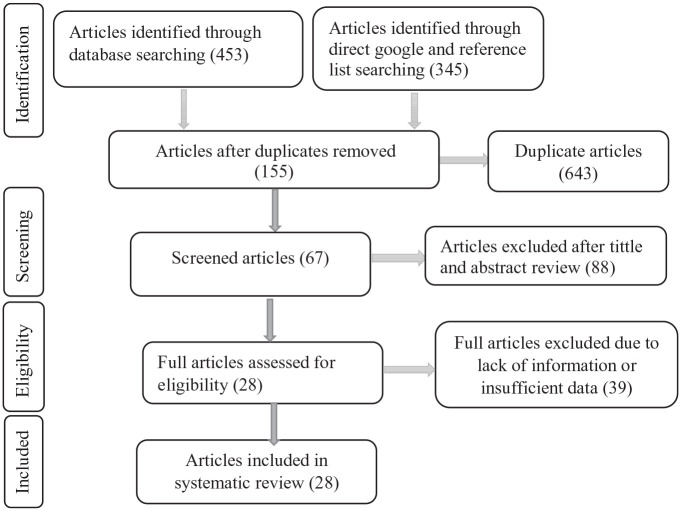
Background: In order to protect public health during the outbreaks of infectious diseases including the pandemic COVID-19, provision of Water, Sanitation, and Hygiene (WASH) services is important. The challenges of inaccessible WASH services along with the pandemic COVID-19 in low-income countries can lead to a devastating problem. Method: A systematic search of published articles was identified using PubMed, Web of Science, and Google Scholar, on relevant studies of COVID-19 and WASH services. Published articles were identified using abstracts and titles of the articles, followed by assessed for eligibility, and screening of the full text reports of relevant studies. Results: Electronic database search identified 798 articles from which 28 full text articles were included in the systematic review. A lack of access to WASH services in households, schools, health care facilities, and other public spaces were the main identified COVID-19 related public health risks. A lack of adequate data and financial shortages were the challenges for mitigating the problems of COVI-19 and WASH services. Conclusion: This systematical review identified the impacts and challenges of COVID-19 in the provision of WASH services. The results implied that COVID-19 has significant impacts on WASH services that can affect the health of the public. Therefore, strengthening and ensuring access to WASH services are important for preventing COVID-19 and realizing human rights. Community engagement also can be used to support for prevention and control of COVID-19. Countries need to be expand their investment in WASH services as an important mechanism for mitigating COVID-19.
Overview
The claims and statistics of this paper haven’t been checked yet.
Run the check — free, no account needed. It reads the open-access text and checks the sources it cites.
Integrity signals
Registry
Cites
Statistics
Figures
Verification
Claims the paper makes
The claims and statistics of this paper haven’t been checked yet.
Run the check — free, no account needed. It reads the open-access text and checks the sources it cites.
Claims other papers make about this one
Each is checked against this paper’s own text: does it say what the citing paper says it does?
The source backs part of the claim, not all of it — or backs it for a different population, condition or comparison.
In the citing paper
“According to Musoke et al. (2018) and Desye (2021), improved handwashing significantly reduces the two leading causes of childhood mortality-diarrhea diseases and acute respiratory infections.”
From The level of implementation of water, sanitation, and hygiene (WASH) practices among the public basic schools in Ghana (2024) · cites this paper as Desye (2021)
Experimental — accuracy not yet measured
Self-check
Percentages, sums and reported differences re-computed from the paper’s own numbers.
The self-check needs the paper’s full text.
Citations
The citation lists haven’t been fetched yet
References 34 · Cited by 70
Research works printed but not linked: 35
- 10.1016/S0140-6736(20)30607-3 · DOI
- 10.1016/j.jhin.2020.01.022 · DOI · Paper page
- 10.1016/j.jhin.2015.08.027 · DOI
- 10.2166/washdev.2019.134 · DOI
- 10.1186/s41182-020-00236-5 · DOI
- Blake M, 2020, Water, Sanitation, and Hygiene Policy in the Time of COVID-19
- 10.1016/S0140-6736(20)30185-9 · DOI · Paper page
- 10.1093/inthealth/ihv073 · DOI
- World Health Organization (WHO) & United Nations Children’s Fund (UNICEF), 2019, Progress on Household Drinking Water, Sanitation and Hygiene 2000-2017. Special Focus on Inequalities
- Roche R, 2017, PLoS One, 12
- 10.2166/washdev.2021.254 · DOI
- 10.1155/2021/6614565 · DOI
- 10.1016/j.resconrec.2020.104947 · DOI
- 10.1177/0734242X20933343 · DOI
- Mitlin D, 2019, Unaffordable and Undrinkable: Rethinking Urban Water Access in the Global South
- 10.1016/j.ijheh.2020.113634 · DOI
- 10.1016/j.scitotenv.2020.140561 · DOI
- 10.1016/j.ijheh.2018.11.005 · DOI
- 10.4103/0974-777X.145247 · DOI
- World Health Organization (WHO), 2020, Considerations for Quarantine of Contacts of COVID-19 Cases. Interim Guidance
- Hutton G, 2016, The Costs of Meeting the 2030 Sustainable Development Goal Targets on Drinking Water Sanitation and Hygiene, 10.1596/K8543 · DOI
- 10.1016/j.watres.2020.116793 · DOI
- 10.1016/j.scitotenv.2020.140370 · DOI
- 10.1016/j.scitotenv.2020.141514 · DOI
- 10.1007/s13762-020-02910-x · DOI
- 10.1177//1420326X20942938 · DOI
- Kumar H, 2020, Environ Dev Sust, 23, 1
- Rodriguez DJ, Serrano HA, Delgado A, Nolasco D, Saltiel G. From Waste to Resource. World Bank; 2020. https://openknowledge.worldbank.org/handle/10986/33436 · DOI
- 10.1016/j.procbio.2020.08.016 · DOI
- 10.1111/j.1365-3156.2006.01568.x · DOI · Paper page
- World Bank. WASH (water, sanitation & hygiene) and COVID-19. WASH interventions for effective COVID19 pandemic response. 2020;101:1. Accessed April 11, 2020. https://www.worldbank.org/en/topic/water/brief/wash-water-sanitation-hygiene-and-covid-19
- 10.1111/j.1365-3156.2006.01734.x · DOI · Paper page
- 10.1016/S1473-3099(03)00606-6 · DOI · Paper page
- United Nations Children’s Fund (UNICEF), 2020, WASH Programme Contribution to COVID-19 Prevention and Response
- 10.1136/bmjgh-2020-003188 · DOI
Metadata
- Authors
- Desye, B.
- Affiliations
- Adigrat University (ET)
- Corresponding author
- Desye, Belay
- ORCID
- Desye, Belay
- Venue
- Environmental Health Insights
- Publisher
- SAGE Publications
- Published
- 2021-01
- Volume
- 15
- Pages
- 11786302211029447-11786302211029447
- ISSN
- 1178-6302 (ISSN-L)
- PMC
- PMC8283044
- OpenAlex
- W3179411544
- Cited by
- 70
- References
- 34
- Citations by year
- 2026: 5 · 2025: 10 · 2024: 15 · 2023: 20 · 2022: 19 · 2021: 1
- FWCI
- 1.83
- Type
- journal article
- Language
- en
- Open access
- gold
- doi.org
- Licence
- Locations
- Environmental Health Insights (publishedVersion, cc-by-nc)
- PubMed Central (publishedVersion, cc-by-nc)
- PubMed (publishedVersion)
- DOAJ (DOAJ: Directory of Open Access Journals) (submittedVersion, cc-by-sa)
- Topics
- Health Sciences › Nursing › Nutrition and Dietetics › Child Nutrition and Water Access
- Social Sciences › Sociology and Political Science › COVID-19 Prevention and Impact
- Physical Sciences › Environmental Science › Water Science and Technology › Water Resource Management and Quality
- Keywords
- COVID-19 pandemic, water, sanitation and hygiene, low-income countries, household sanitation, school sanitation, public health risk, community participation, human rights, COVID-19 prevention and control
About these checks
Registry, retraction, Cites and statistics results are computed, not judged, with one exception: a printed reference that no index lists is read once by a model before it counts as a citation error. Claims are extracted by a model and kept only when their quote appears verbatim in the text; each cited source is then checked, with a model’s help, for whether it says what the claim relies on. Those verdicts can be wrong — read the claim’s quote and the cited source before relying on one.
Statistics and arithmetic are recomputed, not judged.
Confidence bands are shown only for fields calibrated on our annotated test set. None is calibrated yet, so no band is shown.
What counts as a claim ›How we measure confidence ›How we check this ›
Are you an author, or do you see a problem with this page? Request a review
How to cite
Cite CoChat for the checks on this page, and the paper for its own findings.
- This page
- CoChat. (2026). Citation check: COVID-19 Pandemic and Water, Sanitation, and Hygiene: Impacts, Challenges, and Mitigation Strategies. https://app.cochat.ai/papers/10.1177/11786302211029447
- The paper
- Desye, B. (2021). COVID-19 Pandemic and Water, Sanitation, and Hygiene: Impacts, Challenges, and Mitigation Strategies. Environmental Health Insights. https://doi.org/10.1177/11786302211029447
