

The DOI matches its Crossref record; 360 of the 360 references it cites were found in a registry or an index.
Tryptophan Metabolites Along the Microbiota-Gut-Brain Axis: An Interkingdom Communication System Influencing the Gut in Health and Disease
Open accessAbstract
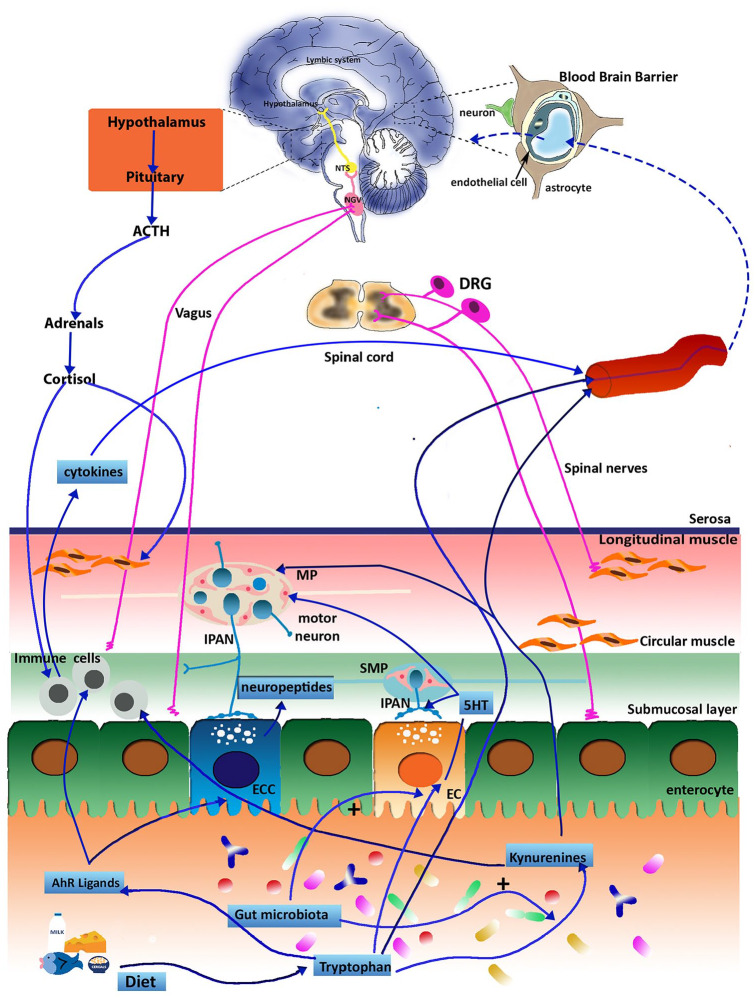
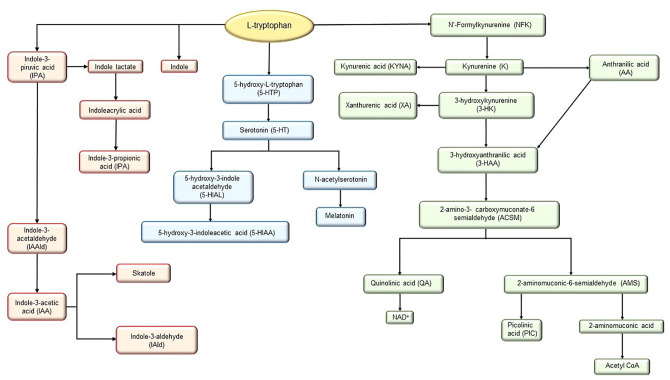
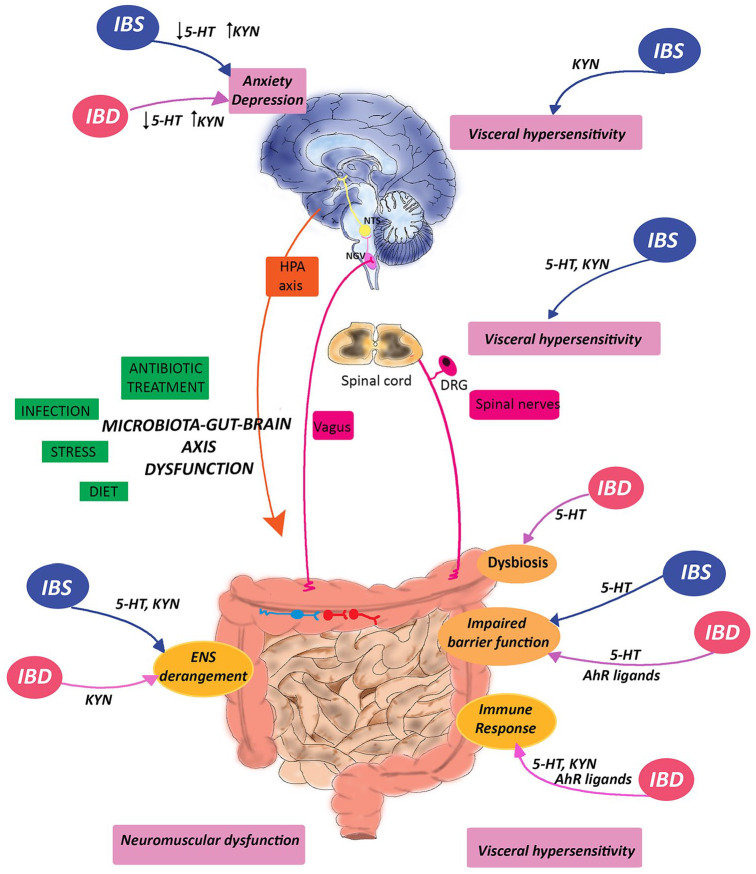
The 'microbiota-gut-brain axis' plays a fundamental role in maintaining host homeostasis, and different immune, hormonal, and neuronal signals participate to this interkingdom communication system between eukaryota and prokaryota. The essential aminoacid tryptophan, as a precursor of several molecules acting at the interface between the host and the microbiota, is fundamental in the modulation of this bidirectional communication axis. In the gut, tryptophan undergoes 3 major metabolic pathways, the 5-HT, kynurenine, and AhR ligand pathways, which may be directly or indirectly controlled by the saprophytic flora. The importance of tryptophan metabolites in the modulation of the gastrointestinal tract is suggested by several preclinical and clinical studies; however, a thorough revision of the available literature has not been accomplished yet. Thus, this review attempts to cover the major aspects on the role of tryptophan metabolites in host-microbiota cross-talk underlaying regulation of gut functions in health conditions and during disease states, with particular attention to 2 major gastrointestinal diseases, such as irritable bowel syndrome (IBS) and inflammatory bowel disease (IBD), both characterized by psychiatric disorders. Research in this area opens the possibility to target tryptophan metabolism to ameliorate the knowledge on the pathogenesis of both diseases, as well as to discover new therapeutic strategies based either on conventional pharmacological approaches or on the use of pre- and probiotics to manipulate the microbial flora.
Overview
The claims and statistics of this paper haven’t been checked yet.
Run the check — free, no account needed. It reads the open-access text and checks the sources it cites.
Integrity signals
Registry
Cites
Statistics
Figures
Verification
Claims the paper makes
The claims and statistics of this paper haven’t been checked yet.
Run the check — free, no account needed. It reads the open-access text and checks the sources it cites.
Claims other papers make about this one
Each is checked against this paper’s own text: does it say what the citing paper says it does?
In the citing paper
“Mounting evidence suggests that the GM modulates the tryptophan and kynurenine pathways and is a humoral route through which the GM may influence cognition at the level of the CNS (206–210).”
From Signalling cognition: The gut microbiota and hypothalamic-pituitary-adrenal axis (2023) · cites this paper as [206]
Self-check
Percentages, sums and reported differences re-computed from the paper’s own numbers.
The self-check needs the paper’s full text.
Citations
Cites
López-Otín, C., Blasco, M. A., Partridge, L., Serrano, M., & Kroemer, G. (2013) · Cell · doi:10.1016/j.cell.2013.05.039 · Cited by 14,982
A human gut microbial gene catalogue established by metagenomic sequencing
MetaHIT Consortium, Qin, J., Li, R., Raes, J., Arumugam, M., Burgdorf, K. S., Manichanh, C., Nielsen, T., Pons, N., Levenez, F., et al. (2010) · Nature · doi:10.1038/nature08821 · Cited by 11,624
Pattern Recognition Receptors and Inflammation
Takeuchi, O., & Akira, S. (2010) · Cell · doi:10.1016/j.cell.2010.01.022 · Cited by 8,895
Human gut microbiome viewed across age and geography
Yatsunenko, T., Rey, F. E., Manary, M. J., Trehan, I., Dominguez-Bello, M. G., Contreras, M., Magris, M., Hidalgo, G., Baldassano, R. N., Anokhin, A. P., et al. (2012) · Nature · doi:10.1038/nature11053 · Cited by 7,815
Changes of Intestinal Functions in Liver Cirrhosis
Fukui, H., & Wiest, R. (2016) · Inflammatory Intestinal Diseases · doi:10.1159/000444436 · Cited by 6,820
Ng, S. C., Shi, H. Y., Hamidi, N., Underwood, F. E., Tang, W., Benchimol, E. I., Panaccione, R., Ghosh, S., Wu, J. C. Y., Chan, F. K. L., et al. (2017) · The Lancet · doi:10.1016/s0140-6736(17)32448-0 · Cited by 6,087
Cryan, J. F., O'Riordan, K. J., Cowan, C. S. M., Sandhu, K. V., Bastiaanssen, T. F. S., Boehme, M., Codagnone, M. G., Cussotto, S., Fulling, C., Golubeva, A. V., et al. (2019) · Physiological Reviews · doi:10.1152/physrev.00018.2018 · Cited by 5,286 · cited 2×
“The epithelium of the gastrointestinal tract contains different types of single sensory/secretory EECs, which represent the largest endocrine system of the human body.151 At least 15 types of EECs have been described, releasing more than 20 peptide hormones involved in the regulation of gut motility, gastric acid secr…”
BackgroundFrank, D. N., St. Amand, A. L., Feldman, R. A., Boedeker, E. C., Harpaz, N., & Pace, N. R. (2007) · Proceedings of the National Academy of Sciences · doi:10.1073/pnas.0706625104 · Cited by 4,611
Mind-altering microorganisms: the impact of the gut microbiota on brain and behaviour
Cryan, J. F., & Dinan, T. G. (2012) · Nature Reviews Neuroscience · doi:10.1038/nrn3346 · Cited by 4,572
Recognition of Commensal Microflora by Toll-Like Receptors Is Required for Intestinal Homeostasis
Rakoff-Nahoum, S., Paglino, J., Eslami-Varzaneh, F., Edberg, S., & Medzhitov, R. (2004) · Cell · doi:10.1016/j.cell.2004.07.002 · Cited by 4,251
Research works printed but not linked: 6
- Carabotti M, 2015, Ann Gastroenterol, 28, 203
- Mulak A, 2004, Med Sci Monit, 10, RA55
- 10.2174/1570159X14666161228122 · DOI
- Abrams GD, 1963, Lab Invest, 12, 355
- Maes M, 2008, Neuro Endocrinol Lett, 29, 902
- 10.1038/nrgastro.2013.105 · DOI · Paper page
Cited by
Sorted by citations
Signalling cognition: The gut microbiota and hypothalamic-pituitary-adrenal axis
Rusch, J. A., Layden, B. T., & Dugas, L. R. (2023) · Frontiers in Endocrinology · doi:10.3389/fendo.2023.1130689 · Cited by 415
Dual Role of Indoles Derived From Intestinal Microbiota on Human Health
Ye, X., Li, H., Anjum, K., Zhong, X., Miao, S., Zheng, G., Liu, W., & Li, L. (2022) · Frontiers in Immunology · doi:10.3389/fimmu.2022.903526 · Cited by 288
The role of probiotics and prebiotics in modulating of the gut-brain axis
Ansari, F., Neshat, M., Pourjafar, H., Jafari, S. M., Samakkhah, S. A., & Mirzakhani, E. (2023) · Frontiers in Nutrition · doi:10.3389/fnut.2023.1173660 · Cited by 230
Kadosh, K. C., Muhardi, L., Parikh, P., Basso, M., Mohamed, H. J. J., Prawitasari, T., Samuel, F. O., Ma, G., & Geurts, J. M. W. (2021) · Nutrients · doi:10.3390/nu13010199 · Cited by 206
Impact of Microbial Metabolites on Microbiota–Gut–Brain Axis in Inflammatory Bowel Disease
Banfi, D., Moro, E., Bosi, A., Bistoletti, M., Cerantola, S., Crema, F., Maggi, F., Giron, M. C., Giaroni, C., & Baj, A. (2021) · International Journal of Molecular Sciences · doi:10.3390/ijms22041623 · Cited by 160
Metadata
- Authors
- Bosi, A., Banfi, D., Bistoletti, M., Giaroni, C., & Baj, A.
- Affiliations
- University of Insubria (IT)
- Corresponding author
- Giaroni, Cristina
- Venue
- International Journal of Tryptophan Research
- Publisher
- SAGE Publications
- Published
- 2020-01
- Volume
- 13
- Pages
- 1178646920928984-1178646920928984
- ISSN
- 1178-6469 (ISSN-L)
- PMC
- PMC7290275
- OpenAlex
- W3034589050
- Cited by
- 221
- References
- 360
- Citations by year
- 2026: 38 · 2025: 35 · 2024: 31 · 2023: 40 · 2022: 41 · 2021: 30 · 2020: 4
- FWCI
- 2.75
- Type
- journal article
- Language
- en
- Open access
- gold
- doi.org
- Licence
- Locations
- International Journal of Tryptophan Research (publishedVersion, cc-by-nc)
- PubMed Central (publishedVersion, cc-by-nc)
- PubMed (publishedVersion)
- DOAJ (DOAJ: Directory of Open Access Journals) (submittedVersion, cc-by-sa)
- IrInSubria (University of Insubria) (submittedVersion)
- Topics
- Life Sciences › Biochemistry, Genetics and Molecular Biology › Molecular Biology › Gut microbiota and health
- Life Sciences › Neuroscience › Biological Psychiatry › Tryptophan and brain disorders
- Health Sciences › Medicine › Gastroenterology › Gastrointestinal motility and disorders
- Keywords
- tryptophan metabolism, microbiota-gut-brain axis, gut microbiota, serotonin pathway, kynurenine pathway, aryl hydrocarbon receptor, irritable bowel syndrome, inflammatory bowel disease, mental illness, prebiotics, probiotics, host-microbe communication
About these checks
Registry, retraction, Cites and statistics results are computed, not judged, with one exception: a printed reference that no index lists is read once by a model before it counts as a citation error. Claims are extracted by a model and kept only when their quote appears verbatim in the text; each cited source is then checked, with a model’s help, for whether it says what the claim relies on. Those verdicts can be wrong — read the claim’s quote and the cited source before relying on one.
Statistics and arithmetic are recomputed, not judged.
Confidence bands are shown only for fields calibrated on our annotated test set. None is calibrated yet, so no band is shown.
What counts as a claim ›How we measure confidence ›How we check this ›
Are you an author, or do you see a problem with this page? Request a review
