

Neural self-representation in autistic women and association with ‘compensatory camouflaging’
Open accessThe DOI matches its Crossref record; 62 of the 62 references it cites were found in a registry or an index.
Abstract
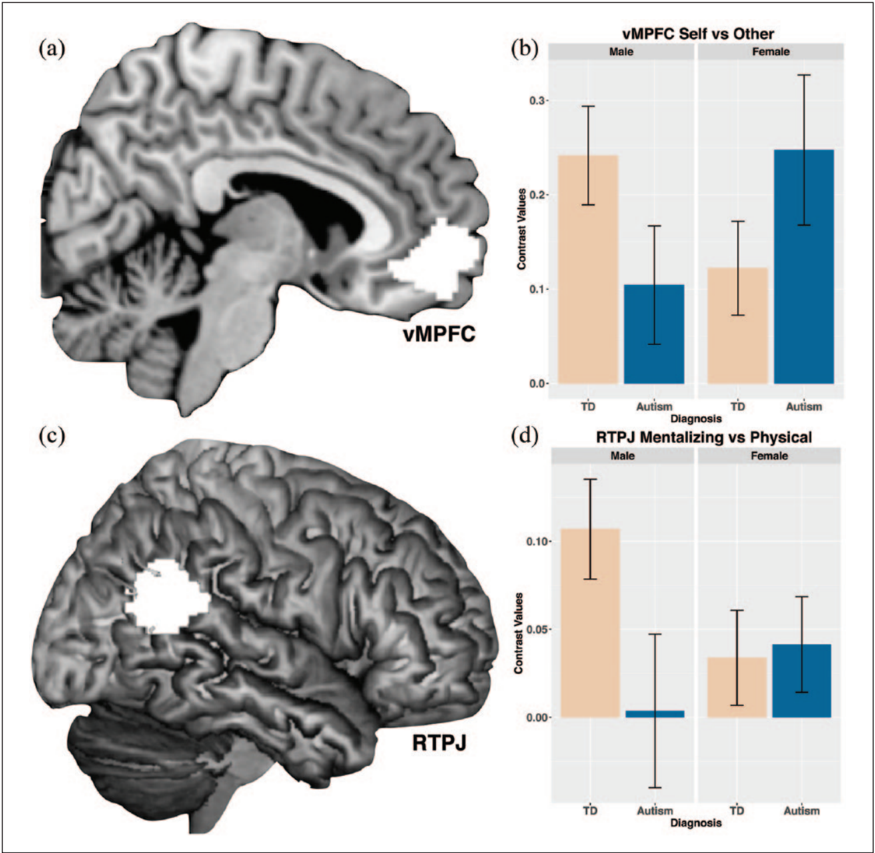
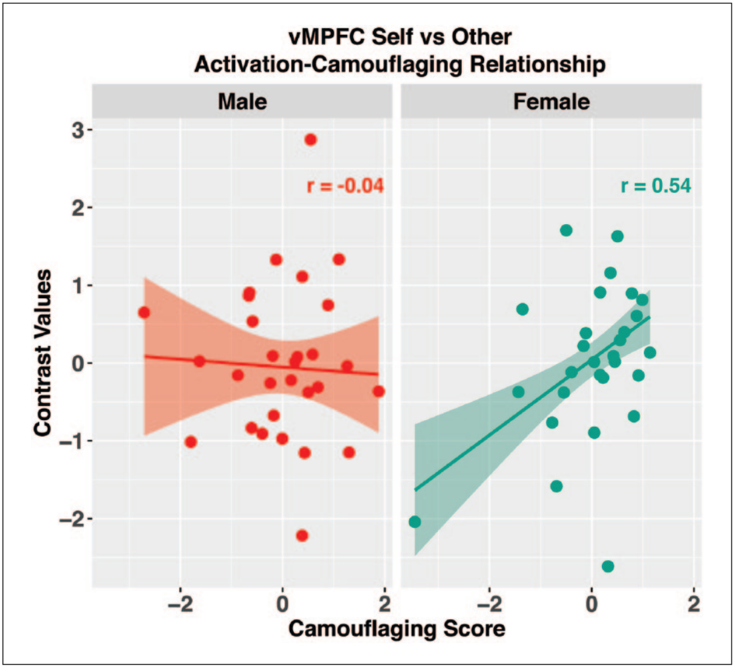
Prior work has revealed sex/gender-dependent autistic characteristics across behavioural and neural/biological domains. It remains unclear whether and how neural sex/gender differences are related to behavioural sex/gender differences in autism. Here, we examined whether atypical neural responses during mentalizing and self-representation are sex/gender-dependent in autistic adults and explored whether ‘camouflaging’ (acting as if behaviourally neurotypical) is associated with sex/gender-dependent neural responses. In total, N = 119 adults (33 typically developing males, 29 autistic males, 29 typically developing females and 28 autistic females) participated in a task-related functional magnetic resonance imaging paradigm to assess neural activation within right temporo-parietal junction and ventromedial prefrontal cortex during mentalizing and self-representation. Camouflaging in autism was quantified as the discrepancy between extrinsic behaviour in social–interpersonal contexts and intrinsic status. While autistic men showed hypoactive right temporo-parietal junction mentalizing and ventromedial prefrontal cortex self-representation responses compared to typically developing men, such neural responses in autistic women were not different from typically developing women. In autistic women only, increasing camouflaging was associated with heightened ventromedial prefrontal cortex self-representation response. There is a lack of impaired neural self-representation and mentalizing in autistic women compared to typically developing women. Camouflaging is heightened in autistic women and may relate to neural self-representation response. These results reveal brain-behaviour relations that help explain sex/gender-heterogeneity in social brain function in autism.
Overview
The claims and statistics of this paper haven’t been checked yet.
Free: it reads the open-access text and checks the first 5 claims that cite a source we can check. Create a free account to check every claim.
Integrity signals
Registry
Cites
Statistics
Figures
Verification
Claims the paper makes
The claims and statistics of this paper haven’t been checked yet.
Free: it reads the open-access text and checks the first 5 claims that cite a source we can check. Create a free account to check every claim.
Claims other papers make about this one
Each is checked against this paper’s own text: does it say what the citing paper says it does?
The cited source says what the claim attributes to it.
In the citing paper
“This has been reported to be more common in females than males and associated with different neural processes (Lai et al. 2019).”
From Barriers to Autism Spectrum Disorder Diagnosis for Young Women and Girls: a Systematic Review (2021) · cites this paper as Lai et al. 2019
Self-check
Percentages, sums and reported differences re-computed from the paper’s own numbers.
The self-check needs the paper’s full text.
Citations
Cites
Lord, C., Rutter, M., & Le Couteur, A. (1994) · Journal of Autism and Developmental Disorders · doi:10.1007/bf02172145 · Cited by 9,065 · cited 6×
“Since all participants were adults, we further considered available information of developmental history to include only those with clinically evident childhood autistic symptoms, for example, from information collected using the Autism Diagnostic Interview–Revised (ADI-R) (Lord et al., 1994) where possible, or from t…”
BackgroundMethodInfluentialLord, C., Risi, S., Lambrecht, L., Cook, E. H., Leventhal, B. L., DiLavore, P. C., Pickles, A., & Rutter, M. (2000) · Journal of Autism and Developmental Disorders · doi:10.1023/a:1005592401947 · Cited by 7,520 · cited 4×
“Finally, all analyses related to the camouflaging index were repeated to check consistency of findings using two other different versions of ADOS score: the Western Psychological Services, WPS-published ‘diagnostic algorithm’ Communication + Social Interaction Total score (Lord et al., 2000) as per our previous public…”
BackgroundMethodInfluentialPower, J. D., Barnes, K. A., Snyder, A. Z., Schlaggar, B. L., & Petersen, S. E. (2012) · NeuroImage · doi:10.1016/j.neuroimage.2011.10.018 · Cited by 7,429 · cited 1×
“Data were evaluated for in-scanner motion effects across groups using mean framewise displacement (FD), mean DVARS and maximal DVARS (Power et al., 2012); there were neither significant diagnosis-by-sex/gender interactions for any of them nor any main effects of Sex/Gender or diagnosis (Table 1).”
MethodBaron-Cohen, S., Wheelwright, S., Skinner, R., Martin, J., & Clubley, E. (2001) · Journal of Autism and Developmental Disorders · doi:10.1023/a:1005653411471 · Cited by 6,450 · cited 2×
“For assessing levels of autism characteristics, we administered the Autism Spectrum Quotient (AQ) (Baron-Cohen et al., 2001), module 4 of the Autism Diagnostic Observation Schedule (ADOS) (Lord et al.”
MethodSelf-citationWhat Is the Male-to-Female Ratio in Autism Spectrum Disorder? A Systematic Review and Meta-Analysis
Loomes, R., Hull, L., & Mandy, W. P. L. (2017) · Journal of the American Academy of Child & Adolescent Psychiatry · doi:10.1016/j.jaac.2017.03.013 · Cited by 2,804 · cited 1×
“However, meta-analyses of epidemiological studies show that with less biased ascertainment, the ratio is around 3:1 (Loomes et al., 2017).”
BackgroundFinding the self? An event-related fMRI study
Kelley, W. M., Macrae, C. N., Wyland, C. L., Caglar, S., Inati, S., & Heatherton, T. F. (2002) · Journal of Cognitive Neuroscience · doi:10.1162/08989290260138672 · Cited by 1,606 · cited 3×
“A main ingredient in these processes is an ability to represent similarities and differences between oneself and others – a function in which vMPFC plays critical roles (Kelley et al., 2002; Mitchell et al., 2006; Moran et al., 2006; Nicolle et al., 2012).”
Background“Putting on My Best Normal”: Social Camouflaging in Adults with Autism Spectrum Conditions
Hull, L., Petrides, K. V., Allison, C., Smith, P., Baron-Cohen, S., Lai, M.-C., & Mandy, W. (2017) · Journal of Autism and Developmental Disorders · doi:10.1007/s10803-017-3166-5 · Cited by 1,365 · cited 10×
“displaying facial expressions of emotion or interest), or deriving rules/guidelines and scripting conversation with others accordingly to get through small talk or to make social chats more enjoyable for their social partners (Hull et al., 2017).”
BackgroundResultInfluentialSelf-citationBaron-Cohen, S., O'Riordan, M., Stone, V., Jones, R., & Plaisted, K. (1999) · Journal of Autism and Developmental Disorders · doi:10.1023/a:1023035012436 · Cited by 1,211 · cited 1×
“An example of this might be ‘keep talking’, which keeps one connected to a listener but may not be sensitive to the context and may result in excessive faux pas (Baron-Cohen et al., 1999; Thiebaut et al., 2016).”
BackgroundSelf-citationSex/Gender Differences and Autism: Setting the Scene for Future Research
Lai, M.-C., Lombardo, M. V., Auyeung, B., Chakrabarti, B., & Baron-Cohen, S. (2015) · Journal of the American Academy of Child & Adolescent Psychiatry · doi:10.1016/j.jaac.2014.10.003 · Cited by 1,120 · cited 9×
“…how sex/gender contributes to the heterogeneity of autism, factorial experimental designs with sex/gender and diagnosis as factors should be utilized to examine sex/gender-similarities and/or differences in autism in contrast to same-sex/gender neurotypical (control) populations (Lai et al., 2015).”
BackgroundMethodInfluentialSelf-citationBargiela, S., Steward, R., & Mandy, W. (2016) · Journal of Autism and Developmental Disorders · doi:10.1007/s10803-016-2872-8 · Cited by 1,087 · cited 5×
“Qualitative studies additionally suggest that camouflaging in autistic individuals may be partly different from the ordinary ‘reputation/impression management’ in neurotypical individuals, owing to its extremely effortful and compensatory nature (Bargiela et al., 2016; Hull et al., 2017).”
BackgroundResultInfluential
Research works printed but not linked: 1
- Lai MC, Ameis SH and Szatmari P (2018) Young women on the autism spectrum. In: Gelbar N (ed.) Adolescents with Autism Spectrum Disorder: a clinical handbook . Oxford: Oxford University Press, pp.289-319.
Cited by
The Female Autism Phenotype and Camouflaging: a Narrative Review
Hull, L., Petrides, K. V., & Mandy, W. (2020) · Review Journal of Autism and Developmental Disorders · doi:10.1007/s40489-020-00197-9 · Cited by 614
Pearson, A., & Rose, K. (2021) · Autism in Adulthood · doi:10.1089/aut.2020.0043 · Cited by 596
“65,71 However, the discrepancy here may not lie with the person, but with how they are conceptualized and operationalized using the tools of measurement.”
Camouflaging in autism: A systematic review
Cook, J., Hull, L., Crane, L., & Mandy, W. (2021) · Clinical Psychology Review · doi:10.1016/j.cpr.2021.102080 · Cited by 554
Barriers to Autism Spectrum Disorder Diagnosis for Young Women and Girls: a Systematic Review
Lockwood Estrin, G., Milner, V., Spain, D., Happé, F., & Colvert, E. (2021) · Review Journal of Autism and Developmental Disorders · doi:10.1007/s40489-020-00225-8 · Cited by 444
Self-citationHappé, F., & Frith, U. (2020) · Journal of Child Psychology and Psychiatry · doi:10.1111/jcpp.13176 · Cited by 438
“The neural basis of camouflaging, and possible sex differences in this, are just beginning to be explored (Lai et al., 2018).”
BackgroundGender differences in self-reported camouflaging in autistic and non-autistic adults
Hull, L., Lai, M.-C., Baron-Cohen, S., Allison, C., Smith, P., Petrides, K., & Mandy, W. (2020) · Autism · doi:10.1177/1362361319864804 · Cited by 337
Self-citationIs social camouflaging associated with anxiety and depression in autistic adults?
Hull, L., Levy, L., Lai, M.-C., Petrides, K. V., Baron-Cohen, S., Allison, C., Smith, P., & Mandy, W. (2021) · Molecular Autism · doi:10.1186/s13229-021-00421-1 · Cited by 337
“Sex-specific mechanisms have also been proposed which may influence the development of neural processes involved in camouflaging, such as activation of neural areas associated with self-representation in autistic females, but not males [59].”
BackgroundSelf-citationCompensatory strategies below the behavioural surface in autism: a qualitative study
Livingston, L. A., Shah, P., & Happé, F. (2019) · The Lancet Psychiatry · doi:10.1016/s2215-0366(19)30224-x · Cited by 311
Sex and gender impacts on the behavioural presentation and recognition of autism
Lai, M.-C., & Szatmari, P. (2020) · Current Opinion in Psychiatry · doi:10.1097/yco.0000000000000575 · Cited by 237
Self-citationBernardin, C. J., Lewis, T., Bell, D., & Kanne, S. (2021) · Autism · doi:10.1177/1362361321997284 · Cited by 185
“Both camouflaging and self-monitoring reflect behavior change with the goal of managing the impression made on others, and the similarities between the two constructs have been noted by researchers (Hull et al., 2019; Lai et al., 2019).”
BackgroundTrakoshis, S., Martínez-Cañada, P., Rocchi, F., Canella, C., You, W., Chakrabarti, B., Ruigrok, A. N., Bullmore, E. T., Suckling, J., Markicevic, M., et al. (2020) · eLife · doi:10.7554/elife.55684 · Cited by 174
Self-citationSocial Camouflaging in Females with Autism Spectrum Disorder: A Systematic Review
Tubío-Fungueiriño, M., Cruz, S., Sampaio, A., Carracedo, A., & Fernández-Prieto, M. (2021) · Journal of Autism and Developmental Disorders · doi:10.1007/s10803-020-04695-x · Cited by 168
Quantifying compensatory strategies in adults with and without diagnosed autism
Livingston, L. A., Shah, P., Milner, V., & Happé, F. (2020) · Molecular Autism · doi:10.1186/s13229-019-0308-y · Cited by 159
McQuaid, G. A., Lee, N., & Wallace, G. L. (2021) · Autism · doi:10.1177/13623613211042131 · Cited by 239
Reconsidering autistic ‘camouflaging’ as transactional impression management
Ai, W., Cunningham, W. A., & Lai, M.-C. (2022) · Trends in Cognitive Sciences · doi:10.1016/j.tics.2022.05.002 · Cited by 140
Self-citationEvans, J. A., Krumrei-Mancuso, E. J., & Rouse, S. V. (2024) · Autism in Adulthood · doi:10.1089/aut.2022.0115 · Cited by 181
Camouflage and masking behavior in adult autism
Alaghband‐Rad, J., Hajikarim‐Hamedani, A., & Motamed, M. (2023) · Frontiers in Psychiatry · doi:10.3389/fpsyt.2023.1108110 · Cited by 205
“(34) 2019 Cyprus, Taiwan, United Kingdom, Canada 119 18–42 52.”
BackgroundSelf-reported camouflaging behaviours used by autistic adults during everyday social interactions
Cook, J., Crane, L., Hull, L., Bourne, L., & Mandy, W. (2022) · Autism · doi:10.1177/13623613211026754 · Cited by 105
“…settings, some autistic individuals are rated as appearing less autistic and more normatively socially skilled than would be expected given their autistic traits and social cognition differences (Corbett et al., 2021; Lai et al., 2017, 2019; Livingston, Colvert, et al., 2019; Schuck et al., 2019).”
BackgroundWalsh, M. J. M., Wallace, G. L., Gallegos, S. M., & Braden, B. B. (2021) · NeuroImage: Clinical · doi:10.1016/j.nicl.2021.102719 · Cited by 97
Cognitive Predictors of Self‐Reported Camouflaging in Autistic Adolescents
Hull, L., Petrides, K. V., & Mandy, W. (2021) · Autism Research · doi:10.1002/aur.2407 · Cited by 90
Trajectories of Autism Symptom Severity Change During Early Childhood
Waizbard-Bartov, E., Ferrer, E., Young, G. S., Heath, B., Rogers, S., Wu Nordahl, C., Solomon, M., & Amaral, D. G. (2021) · Journal of Autism and Developmental Disorders · doi:10.1007/s10803-020-04526-z · Cited by 81
Lombardo, M. V., Eyler, L. T., Moore, A., Datko, M., Barnes, C. C., Cha, D., Courchesne, E., & Pierce, K. (2019) · eLife · doi:10.7554/elife.47427 · Cited by 91
Self-citationJorgenson, C. D., Lewis, T., Rose, C. A., & Kanne, S. M. (2020) · Journal of Autism and Developmental Disorders · doi:10.1007/s10803-020-04491-7 · Cited by 105
Commentary: ‘Camouflaging’ in autistic people – reflection on Fombonne (2020)
Lai, M., Hull, L., Mandy, W., Chakrabarti, B., Nordahl, C. W., Lombardo, M. V., Ameis, S. H., Szatmari, P., Baron‐Cohen, S., Happé, F., et al. (2021) · Journal of Child Psychology and Psychiatry · doi:10.1111/jcpp.13344 · Cited by 78
“We have identified associations with medial prefrontal cortex activation during self-referential cognition (Lai et al., 2019) and neural excitation-inhibition ratio (Trakoshis et al.”
BackgroundSelf-citationUnrelenting Depression and Suicidality in Women with Autistic Traits
South, M., Beck, J. S., Lundwall, R. A., Christensen, M., Cutrer‐Párraga, E. A., Gabrielsen, T. P., Cox, J. C., & Lundwall, R. A. (2019) · Journal of Autism and Developmental Disorders · doi:10.1007/s10803-019-04324-2 · Cited by 90
“Another possible source for sex differences could be an increased degree and intentionality with which females mask autistic traits to appear more “normal,” a phenomenon referred to as “camouflaging behavior” (Cage and Troxell-Whitman 2019; Lai et al. 2018; Schuck et al. 2019).”
BackgroundTowards robust and replicable sex differences in the intrinsic brain function of autism
Floris, D. L., Filho, J. O. A., Lai, M.-C., Giavasis, S., Oldehinkel, M., Mennes, M., Charman, T., Tillmann, J., Dumas, G., Ecker, C., et al. (2021) · Molecular Autism · doi:10.1186/s13229-021-00415-z · Cited by 74
Self-citationPerceived misdiagnosis of psychiatric conditions in autistic adults
Kentrou, V., Livingston, L. A., Grove, R., Hoekstra, R. A., & Begeer, S. (2024) · EClinicalMedicine · doi:10.1016/j.eclinm.2024.102586 · Cited by 114
A Systematic Review of Passing as Non-autistic in Autism Spectrum Disorder
Libsack, E. J., Keenan, E. G., Freden, C. E., Mirmina, J., Iskhakov, N., Krishnathasan, D., & Lerner, M. D. (2021) · Clinical Child and Family Psychology Review · doi:10.1007/s10567-021-00365-1 · Cited by 68
Persistence of Autism Spectrum Disorder From Early Childhood Through School Age
Harstad, E. B., Hanson, E. M., Brewster, S. J., DePillis, R., Milliken, A. L., Aberbach, G., Sideridis, G. D., & Barbaresi, W. J. (2023) · Archives of Pediatrics and Adolescent Medicine · doi:10.1001/jamapediatrics.2023.4003 · Cited by 81
the EU-AIMS LEAP group, Moessnang, C., Baumeister, S., Tillmann, J., Goyard, D., Charman, T., Ambrosino, S., Baron‐Cohen, S., Beckmann, C. F., Bölte, S., et al. (2020) · Molecular Autism · doi:10.1186/s13229-020-0317-x · Cited by 79
“While counterintuitive at first sight, a possible explanation is a greater need for a compensatory recruitment of the dmPFC in younger individuals and with increasing autism traits, an effect that was recently introduced as “camouflaging” in the context of mentalizing [68].”
BackgroundSelf-citationA comparison of methods for measuring camouflaging in autism
Hannon, B., Mandy, W., & Hull, L. (2022) · Autism Research · doi:10.1002/aur.2850 · Cited by 59
“Camouflaging discrepancy (Lai et al., 2017; Lai et al., 2019) This approach was developed to directly measure camouflaging, defined as a “ coping strategy ” used by autistic people (Lai et al., 2017).”
MethodStability of co-occurring psychiatric diagnoses in autistic men and women
Kentrou, V., Oostervink, M., Scheeren, A. M., & Begeer, S. (2021) · Research in Autism · doi:10.1016/j.rasd.2021.101736 · Cited by 65
“Even in cases where women suspect that they might have autism, healthcare professionals may dismiss their concerns and offer little to no additional assessment (Bargiela et al., 2016; Leedham et al., 2019).”
BackgroundResultInfluentialMo, K., Sadoway, T., Bonato, S., Ameis, S. H., Anagnostou, E., Lerch, J. P., Taylor, M. J., & Lai, M.-C. (2021) · NeuroImage: Clinical · doi:10.1016/j.nicl.2021.102811 · Cited by 53
Self-citationFinn, M., Flower, R. L., Leong, H. M., & Hedley, D. (2023) · Autism · doi:10.1177/13623613231153480 · Cited by 69
“Camouflaging can be a form of impression management (Lai et al., 2019; Schneid & Raz, 2020), whereby the goal is to change one’s own behaviour to manage others’ perceptions (Goffman, 1996).”
BackgroundWesteinde, A. V., Cauvet, É., Toro, R., Kuja‐Halkola, R., Neufeld, J., Mevel, K., & Bölte, S. (2019) · Molecular Autism · doi:10.1186/s13229-019-0309-x · Cited by 53
Cummings, K. K., Lawrence, K. E., Hernandez, L. M., Wood, E. T., Bookheimer, S. Y., Dapretto, M., & Green, S. A. (2020) · Autism Research · doi:10.1002/aur.2351 · Cited by 51
“This process of masking sensory symptoms may require prefrontal top-down regulation, and there is evidence to suggest that for women with autism, enhanced camouflaging is associated with increased activation in the prefrontal cortex during a self-representation task [Lai et al., 2018].”
BackgroundSelf‐processing in individuals with autism spectrum disorder
Nijhof, A. D., & Bird, G. (2019) · Autism Research · doi:10.1002/aur.2200 · Cited by 49
“…to change throughout development [Harter, 1999], with visual self-recognition and personal pronoun use emerging around the second year of life [Lewis & Ramsay, 2004], followed by increasing metacognitive self-awareness [Rochat, 2003] and the continuous development of brain regions supporting…”
BackgroundOshima, F., Takahashi, T., Tamura, M., Guan, S., Seto, M., Hull, L., Mandy, W., Tsuchiya, K. J., & Shimizu, E. (2024) · Molecular Autism · doi:10.1186/s13229-023-00579-w · Cited by 47
“This is associated with significant manifestations of mental health deterioration, such as depression, generalised anxiety, social anxiety [20, 21], suicide attempts, and burnout because of exhaustion and fatigue [22].”
BackgroundNeural responsivity to social rewards in autistic female youth
Lawrence, K. E., Hernandez, L. M., Eilbott, J., Jack, A., Aylward, E., Gaab, N., Van Horn, J. D., Bernier, R. A., Geschwind, D. H., McPartland, J. C., et al. (2020) · Translational Psychiatry · doi:10.1038/s41398-020-0824-8 · Cited by 39
Narzisi, A., Fabbri‐Destro, M., Crifaci, G., Scatigna, S., Maugeri, F., Berloffa, S., Fantozzi, P., Prato, A., Muccio, R., Valente, E., et al. (2022) · Journal of Clinical Medicine · doi:10.3390/jcm11061668 · Cited by 47
“In addition, the better score for HF might result as a consequence of the camouflage effect described in subjects with a cognitive level near the normal range [49].”
BackgroundModelling Me, Modelling You: the Autistic Self
Perrykkad, K., & Hohwy, J. (2019) · Review Journal of Autism and Developmental Disorders · doi:10.1007/s40489-019-00173-y · Cited by 44
Olson, L., Mash, L. E., Linke, A. C., Fong, C., Müller, R., & Fishman, I. (2020) · Autism · doi:10.1177/1362361320938194 · Cited by 35
“In addition, while allowing for greater sample sizes of girls and boys with ASDs, the use of multisite data has inevita bly contributed noise (due to distinct phenotypic inclusion/ exclusion criteria, variability between scanners, acquisi tion parameters, etc.), although variability due to site was statistically contr…”
BackgroundInfluentialA systematic review of social camouflaging in autistic adults and youth: Implications and theory
Klein, J. L., Krahn, R., Howe, S. J., Lewis, J., McMorris, C. A., & Macoun, S. J. (2024) · Development and Psychopathology · doi:10.1017/s0954579424001159 · Cited by 48
“Using a discrepancy approach for SC assessment, Lai et al. (2019) found higher levels of SC behavior in autistic females was associated with greater activity in brain regions responsible for self-representation (Lai et al., 2019).”
Lavenne-Collot, N., Tersiguel, M., Dissaux, N., Degrez, C., Bronsard, G., Botbol, M., & Berthoz, A. (2023) · PLoS ONE · doi:10.1371/journal.pone.0275018 · Cited by 35
Social and delay discounting in autism spectrum disorder
Warnell, K. R., Maniscalco, S., Baker, S. M., Yi, R., & Redcay, E. (2019) · Autism Research · doi:10.1002/aur.2085 · Cited by 32
Walsh, M. J. M., Pagni, B. A., Monahan, L., Delaney, S., Smith, C. J., Baxter, L. C., & Braden, B. B. (2022) · Cerebral Cortex · doi:10.1093/cercor/bhac069 · Cited by 30
Gao, S., Wang, X., & Su, Y. (2023) · Psychonomic Bulletin & Review · doi:10.3758/s13423-023-02280-8 · Cited by 47
Xu, L., Zheng, X., Yao, S., Li, J., Fu, M., Li, K., Zhao, W., Li, H., Becker, B., & Kendrick, K. M. (2022) · NeuroImage · doi:10.1016/j.neuroimage.2022.119010 · Cited by 30
Lombardo, M. V., Busuoli, E. M., Schreibman, L., Stahmer, A. C., Pramparo, T., Landi, I., Mandelli, V., Bertelsen, N., Barnes, C. C., Gazestani, V., et al. (2021) · Molecular Psychiatry · doi:10.1038/s41380-021-01239-2 · Cited by 33
Self-citationNeural Correlates of Theory of Mind Are Preserved in Young Women With Anorexia Nervosa
Leslie, M. R., Halls, D., Leppänen, J., Sedgewick, F., Smith, K., Hayward, H., Lang, K., Fonville, L., Simic, M., Mandy, W., et al. (2020) · Frontiers in Psychology · doi:10.3389/fpsyg.2020.568073 · Cited by 33
Self-citationvan der Putten, W., van Rentergem, J. A. A., Radhoe, T. A., Torenvliet, C., Groenman, A. P., Mol, A. J. J., & Geurts, H. M. (2022) · Research in Autism · doi:10.1016/j.rasd.2022.102072 · Cited by 31
Lacroix, A., Dutheil, F., Logemann, A., Cserjesi, R., Peyrin, C., Biro, B., Gomot, M., & Mermillod, M. (2022) · Autism · doi:10.1177/13623613211062776 · Cited by 21
Sensorimotor regulation of facial expression – An untouched frontier
Bress, K. S., & Cascio, C. (2024) · Neuroscience and Biobehavioral Reviews · doi:10.1016/j.neubiorev.2024.105684 · Cited by 22
“There is strong clinical interest in undertsanding the neural basis of expressive supression or masking, as this is widely observed in disorders such as anxiety and autism (Dryman and Heimberg, 2018; Schneider et al., 2013; Kleijsen, 2021; Lai et al., 2019; Walsh et al., 2023).”
BackgroundMcQuaid, G. A., Sadowski, L. Y., Lee, N., & Wallace, G. L. (2024) · Autism in Adulthood · doi:10.1089/aut.2022.0121 · Cited by 26
The social brain in female autism: a structural imaging study of twins
Cauvet, É., Westeinde, A. V., Toro, R., Kuja‐Halkola, R., Neufeld, J., Mevel, K., & Bölte, S. (2020) · Social Cognitive and Affective Neuroscience · doi:10.1093/scan/nsaa064 · Cited by 24
The effect of learning to drum on behavior and brain function in autistic adolescents
Cahart, M., Amad, A., Draper, S. B., Lowry, R., Marino, L., Carey, C., Ginestet, C. E., Smith, M. S., & Williams, S. (2022) · Proceedings of the National Academy of Sciences · doi:10.1073/pnas.2106244119 · Cited by 33
“The medial frontal cortex has also been shown to be involved in facial affect recognition in ASD (87) and self–other representation in the context of compensatory camouflaging in autistic women (88, 89).”
BackgroundSelf-citationBalint, Z. K., Raper, J., Michopoulos, V., Howell, L. H., Gunter, C., Bachevalier, J., & Sánchez, M. M. (2021) · PLoS ONE · doi:10.1371/journal.pone.0235946 · Cited by 20
Camouflaging in autism: a systematic reviewPreprint
Cook, J. M., Hull, L., Crane, L., & Mandy, W. (2021) · OSF Preprints (OSF Preprints) · doi:10.31219/osf.io/u5b9e · Cited by 29
Anxiety and Depression from Adolescence to Old Age in Autism Spectrum Disorder
Uljarević, M., Hedley, D., Cai, R., Hardan, A., & South, M. (2020) · Encyclopedia of Autism Spectrum Disorders · doi:10.1007/978-1-4614-6435-8_102432-1 · Cited by 1
Scheerer, N. E., Aime, H., Boucher, T. Q., & Iarocci, G. (2020) · Autism in Adulthood · doi:10.1089/aut.2019.0062 · Cited by 23
“Together with the results of previous studies, these results suggest that both autistic individuals 6–10 and nonautistic individuals use camouflaging techniques to ‘‘fit-in’’ or mask the undesirable aspects of their social behavior when in social situations.”
Cancino-Barros, I., Villacura-Herrera, C., & Castillo, R. D. (2025) · Scientific Reports · doi:10.1038/s41598-025-06137-z · Cited by 23
“Among the 15 selected studies, four applied the discrepancy method to assess camouflaging behaviors 22,32,34,35 while eleven articles examined them by using the CAT-Q 25,39,43,56–63 .”
A Multimodal Data Driven Rehabilitation Strategy Auxiliary Feedback Method: A Case Study
Zhao, L., Sun, H., Yang, F., Wang, Z., Zhao, Y., Tang, W., & Bu, L. (2022) · IEEE Transactions on Neural Systems and Rehabilitation Engineering · doi:10.1109/tnsre.2022.3170943 · Cited by 19
Differently different?: A commentary on the emerging social cognitive neuroscience of female autism
Rippon, G. (2024) · Biology of Sex Differences · doi:10.1186/s13293-024-00621-3 · Cited by 25
“As camouflaging is a pattern of autistic behaviour that, on average, is more common in females than males, targeting social reward circuits in the context of camouflaging behaviour could advance the understanding of sex/gender differences in autism [127, 128].”
Sex/gender differences in neurology and psychiatry: Autism
Ruigrok, A. N. V., & Lai, M. (2020) · Handbook of clinical neurology · doi:10.1016/b978-0-444-64123-6.00020-5 · Cited by 21
Self-citationQuantitative and Qualitative Sex Modulations in the Brain Anatomy of Autism
Hammill, C. F., Lerch, J. P., Taylor, M. J., Ameis, S. H., Chakravarty, M. M., Szatmári, P., Anagnostou, E. A., & Lai, M. (2021) · Biological Psychiatry Cognitive Neuroscience and Neuroimaging · doi:10.1016/j.bpsc.2021.03.001 · Cited by 19
Self-citationLevels of Self-representation and Their Sociocognitive Correlates in Late-Diagnosed Autistic Adults
Moseley, R. L., Liu, C. H., Gregory, N. J., Smith, P. L., Baron‐Cohen, S., & Sui, J. (2021) · Journal of Autism and Developmental Disorders · doi:10.1007/s10803-021-05251-x · Cited by 21
Self-citationSex modulation of faces prediction error in the autistic brain
Lacroix, A., Harquel, S., Mermillod, M., Garrido, M., Barbosa, L., Vercueil, L., Aleysson, D., Dutheil, F., Kovarski, K., & Gomot, M. (2024) · Communications Biology · doi:10.1038/s42003-024-05807-4 · Cited by 12
“Thank you for this positive feedback.”
Camouflaging and autism: Conceptualisation and methodological issues
Arnold, W. M., Bitsika, V., & Sharpley, C. F. (2026) · Autism · doi:10.1177/13623613261420085 · Cited by 17
Balancing excitation and inhibition in the autistic brain
Pretzsch, C. M., & Floris, D. L. (2020) · eLife · doi:10.7554/elife.60584 · Cited by 10
Towards robust and replicable sex differences in the intrinsic brain function of autismPreprint
Floris, D. L., Filho, J. O. A., Lai, M., Giavasis, S., Oldehinkel, M., Mennes, M., Charman, T., Tillmann, J., Dumas, G., Ecker, C., et al. (2020) · bioRxiv (Cold Spring Harbor Laboratory) · doi:10.1101/2020.06.09.142471 · Cited by 10
Self-citationGillies-Walker, L., Ramzan, N., Rankin, J., Nimbley, E., & Gillespie‐Smith, K. (2022) · Journal of Autism and Developmental Disorders · doi:10.1007/s10803-021-05392-z · Cited by 13
“(Hull et al., 2020; Lai et al., 2019) and that the stress of maintaining a ‘public mask’ can lead to more problems at home (Anderson et al., 2020).”
BackgroundSimantov, T., Lombardo, M. V., Baron‐Cohen, S., & Uzefovsky, F. (2021) · Springer eBooks · doi:10.1007/978-3-030-51890-5_5 · Cited by 15
Self-citationNeuroplasticity in autism spectrum disorder: a systematic review
Laguna, G. G. D. C., Gusmão, A. B. F., Marques, B. O., Bragas, N. B. D. S., Rodrigues, I. B., Melo, R. S., & de Azevedo, K. R. M. (2025) · Dementia & Neuropsychologia · doi:10.1590/1980-5764-dn-2024-0182 · Cited by 16
“This effect is related to a brain-behavior response in the social brain function in autism, which is greater in women, leading them to have a higher propensity to hide social symptoms that would facilitate diagnosis, thus underestimating this prevalence 6-9 .”
Ai, W., Wang, Y. A., Cunningham, W. A., & Lai, M. (2025) · Scientific Reports · doi:10.1038/s41598-025-24899-4 · Cited by 11
“The role of perspective-taking is less conclusive 37 , but initial neuroimaging evidence links together brain areas supporting social inference and perspective-taking with camouflaging/IM in both autistic and neurotypical people 38–40 .”
Self-citationDavies, C., Moosa, M., McKenna, K., Mittal, J., Memis, I., Mittal, R., & Eshraghi, A. A. (2023) · Journal of Clinical Medicine · doi:10.3390/jcm12030927 · Cited by 10
“[35], 2019 U Y Y Y U Y Y U U U Y Leader et al.”
BackgroundInfluentialVitor-Vieira, F., Patriarcha, P. P., Rojas, V. C. T., Parreiras, S. S., Vilela, F. C., & Giusti‐Paiva, A. (2023) · Physiology & Behavior · doi:10.1016/j.physbeh.2023.114432 · Cited by 9
Sex heterogeneity of dynamic brain activity and functional connectivity in autism spectrum disorder
Lu, H., Dong, Q., Gao, L., Xue, Z., Niu, X., Zhou, R., & Guo, X. (2024) · Autism Research · doi:10.1002/aur.3227 · Cited by 8
“…in the ventral medial pre-frontal cortex (forming part of the DMN) was associated with enhanced “ camouflage ” in female autistic subjects, suggesting a possible sex-mediated link between DMN/social brain function and the ability to integrate into society (Lai et al., 2019; Olson et al., 2020).”
“I wish I could just be myself”: Experiences of social camouflaging in adults with ADHD
Mylett, M. L., Boucher, T. Q., & Iarocci, G. (2026) · Research in Neurodiversity · doi:10.1016/j.rin.2026.100018 · Cited by 13
Autonomic and hedonic response to affective touch in autism spectrum disorder
Capiotto, F., Cappi, G. R., Mirlisenna, I., Mazza, A., Cicinelli, G., Lauritano, C., Keller, R., & Monte, O. D. (2024) · Autism Research · doi:10.1002/aur.3143 · Cited by 10
“…that individuals with ASD frequently employ cognitive and behavioral strategies aimed at enhancing their social competences and overcoming social reticence, to better fit into a naturally social environment (Cook et al., 2021; Hull et al., 2017; Lai et al., 2019; Lawson, 2020; Willey, 2014).”
BackgroundMeasuring the Autistic Women’s Experience (AWE)
Groen, Y., Ebert, W. M., Dittner, F. M., Stapert, A. F., Henning, D., Greaves‐Lord, K., Davids, R. C. D., Castelein, S., Baron‐Cohen, S., Allison, C. L., et al. (2023) · International Journal of Environmental Research and Public Health · doi:10.3390/ijerph20247148 · Cited by 9
Self-citationNikolova-Fontaine, K., & Egilson, S. Þ. (2023) · Scandinavian Journal of Disability Research · doi:10.16993/sjdr.1003 · Cited by 5
Beyond the mask: The role of camouflaging in managing an autistic identity for girls and women
Burns, J., & Tierney, S. (2023) · Principles of Gender-Specific Medicine · doi:10.1016/b978-0-323-88534-8.00046-8 · Cited by 8
Sun, Y., Xiao, J., Luoman, L. I., Niu, H., Yiting, Z. H. U., Li, L., Qian, W., Yin, L. I., Zhang, L., Qu, Y., et al. (2024) · Integrative Zoology · doi:10.1111/1749-4877.12907 · Cited by 5
“According to Bullmore, the reason for the higher prevalence of autism in boys than girls might be because girls tend to exhibit less obvious symptoms and are better at concealing their condition (Lai et al. 2019).”
Lu, M., Pang, F., Peng, T., Liu, Y., & Wang, R. (2023) · International Journal of Developmental Disabilities · doi:10.1080/20473869.2023.2181273 · Cited by 8
“This may be explained by the ideation around feeling different and not feeling socially safe to reveal the true self (Lai et al. 2019b).”
InfluentialSelf-reported masking in sexual minority and heterosexual autistic adults
McQuaid, G. A., Lee, N., & Wallace, G. L. (2025) · Autism · doi:10.1177/13623613251335738 · Cited by 7
Hollocks, M. J., McQuaid, G. A., Lee, N., & Wallace, G. L. (2025) · Autism Research · doi:10.1002/aur.70061 · Cited by 5
“Social camouflaging behaviors have been associated with exhaustion, burnout and more mental health challenges in autistic adults (Beck et al. 2020; Cage and Troxell-Whitman 2019; Hull et al. 2019, 2021; Lai et al. 2019), suggesting that social camouflaging can be linked to considerable costs.”
Leaf, J. B., Creem, A. N., Bukszpan, A. R., Hickey, J., & Hillhouse, B. J. (2023) · Education and Training in Autism and Developmental Disabilities · doi:10.1177/215416472305800304 · Cited by 8
“…and compensatory behaviors as it relates to autistics/individuals diagnosed with autism spectrum disorder (ASD; Baldwin & Costley, 2016; Beck et al., 2020; Cage et al., 2016a; Elmose, 2020; Hull et al., 2019; Lai et al., 2019; Perry et al., 2021; Ratto et al., 2018; Wood-Downie et al., 2021).”
Camouflaging in Autism Spectrum Conditions in the Context of Self-Esteem Level
Kossewska, J., & Milczarek, M. (2022) · Psychologia Rozwojowa · doi:10.4467/20843879pr.22.012.17469 · Cited by 4
Torres, J. C., Valle, C. R. D., Aldunate, S. R., & Farías, V. (2021) · Revista de Estudiantes de Terapia Ocupacional · Cited by 8
McQuaid, G. A., Sadowski, L. Y., Lee, N., & Wallace, G. L. (2022) · doi:10.31234/osf.io/q375t · Cited by 3
Hill, J. (2024) · English in Education · doi:10.1080/04250494.2024.2330905 · Cited by 5
“…may be “explicitly learned or implicitly developed” (Hull, Petrides, and Mandy 2020, 309) and are informed by observation of neurotypical social interactions (Lai et al. 2019, 1211), whether in day-to-day social reality or virtually through various media forms, such as television or the radio.”
Yin, J., Xiao, Y., Longhurst, P., Tan, C., Zhao, Y., Huang, Z., Cui, S., Nagata, J. M., & He, J. (2025) · Research in Autism · doi:10.1016/j.reia.2025.202687 · Cited by 3
Zhuang, S., Bougoure, M., Reddrop, S., Dean, L., Naragon‐Gainey, K., Maybery, M. T., Tan, D. W., & Magiati, I. (2025) · Autism in Adulthood · doi:10.1177/25739581251386126 · Cited by 2
Adamo, K., Morgan, J. J., Bengochea, A., Slicker, G., & Hilpert, J. C. (2026) · Research in Neurodiversity · doi:10.1016/j.rin.2026.100022 · Cited by 3
Awadu, J. E., Giordani, B., Sikorskii, A. E., Abbo, C., Fenton, J. I., Zalwango, S. K., & Ezeamama, A. E. (2023) · Nutrients · doi:10.3390/nu15092020 · Cited by 2
“For example, we cannot exclude the possibility that a greater capacity to engage in masking behaviors [50] reduced the likelihood of caregivers observing/reporting behaviors suggestive of milder forms of developmental disorders.”
BackgroundRazzak, R., Li, J., He, S., & Sokhadze, E. M. (2023) · Brain Sciences · doi:10.3390/brainsci13111571 · Cited by 4
Masson, H. L. (2025) · Molecular Autism · doi:10.1186/s13229-025-00644-6 · Cited by 5
“These mechanisms involve enhanced brain responses [63, 92], the activation of additional brain areas [118], and increased connectivity [24, 55].”
Lavenne-Collot, N., Planche, P., & Vaivre‐Douret, L. (2025) · Intelligence · doi:10.1016/j.intell.2025.101935 · Cited by 5
Nayar, K., Bush, L., & Scott, M. (2025) · Springer eBooks · doi:10.1007/978-3-031-87228-0_2 · Cited by 2
Camouflaging Autistic Traits Questionnaire (CAT-Q)
Hull, L., & Mandy, W. (2019) · Springer eBooks · doi:10.1007/978-1-4614-6435-8_102327-1 · Cited by 2
Metadata
- Authors
- Lai, M.-C., Lombardo, M. V., Chakrabarti, B., Ruigrok, A. N., Bullmore, E. T., Suckling, J., Auyeung, B., Happé, F., Szatmari, P., Baron-Cohen, S., Bailey, A. J., Bolton, P. F., Carrington, S., Catani, M., Craig, M. C., Daly, E. M., Deoni, S. C., Ecker, C., Henty, J., Jezzard, P., Johnston, P., Jones, D. K., Madden, A., Mullins, D., Murphy, C. M., Murphy, D. G., Pasco, G., Sadek, S. A., Spain, D., Stewart, R., Wheelwright, S. J., & Williams, S. C.
- Affiliations
- University of Toronto (CA)
- University of Cambridge (GB)
- GlaxoSmithKline (United Kingdom) (GB)
- University of Cambridge, UK
- King’s College London, UK
- University of Toronto, Canada
- Corresponding author
- Lai, Meng-Chuan
- Lombardo, Michael V
- ORCID
- Lai, Meng-Chuan
- Lombardo, Michael V
- Chakrabarti, Bhismadev
- Ruigrok, Amber NV
- Bullmore, Edward T
- Bolton, Patrick F
- Carrington, Sarah
- Catani, Marco
- Craig, Michael C
- Daly, Eileen M
- Deoni, Sean CL
- Ecker, Christine
- Henty, Julian
- Jezzard, Peter
- Jones, Derek K
- Murphy, Clodagh M
- Murphy, Declan GM
- Pasco, Greg
- Spain, Debbie
- Wheelwright, Sally J
- Williams, Steven C
- Venue
- Autism
- Publisher
- SAGE Publications
- Published
- 2018-10-24
- Volume
- 23
- Issue
- 5
- Pages
- 1210-1223
- ISSN
- 1362-3613 (ISSN-L)
- 1461-7005
- PMC
- PMC6589917
- OpenAlex
- W2892828630
- Cited by
- 134
- References
- 62
- Citations by year
- 2026: 14 · 2025: 15 · 2024: 13 · 2023: 18 · 2022: 12 · 2021: 28 · 2020: 23 · 2019: 11
- FWCI
- 9.22
- Type
- journal article
- Language
- en
- Open access
- hybrid
- doi.org
- Licence
- cc-by
- journals.sagepub.com/page/policies/text-and-data-mining-license (tdm)
- Locations
- Autism (publishedVersion, cc-by)
- PubMed Central (publishedVersion, cc-by)
- PubMed (publishedVersion)
- Research Portal (King's College London) (publishedVersion, other-oa)
- Research Explorer (The University of Manchester) (publishedVersion, cc-by)
- CentAUR (University of Reading) (acceptedVersion)
- Research Bank (Australian Catholic University) (submittedVersion, cc-by)
- UCL Discovery (University College London) (submittedVersion)
- Edinburgh Research Explorer (University of Edinburgh) (submittedVersion, cc-by)
- Apollo (University of Cambridge) (submittedVersion, cc-by)
- Apollo (cc-by)
- Funders
- Innovative Medicines Initiative (grant agreement n° 115300)
- Medical Research Council (GO 400061)
- European Research Council (ERC-2017-STG; 755816)
- Topics
- Life Sciences › Neuroscience › Cognitive Neuroscience › Autism Spectrum Disorder Research
- Life Sciences › Biochemistry, Genetics and Molecular Biology › Genetics › Genetics and Neurodevelopmental Disorders
- Social Sciences › Psychology › Social Psychology › Action Observation and Synchronization
- Keywords
- autistic women, camouflaging, self-representation, mentalization, sex and gender differences, right temporoparietal junction, ventromedial prefrontal cortex, social brain
- MeSH terms
- Mentalization, Adolescent, Adult, Autistic Disorder, Brain, Female, Humans, Magnetic Resonance Imaging, Male, Middle Aged, Self Concept, Sex Factors, Social Behavior, Case-Control Studies, Young Adult, Functional Neuroimaging
About these checks
Registry, retraction, Cites and statistics results are computed, not judged, with one exception: a printed reference that no index lists is read once by a model before it counts as a citation error. Claims are extracted by a model and kept only when their quote appears verbatim in the text; each cited source is then checked, with a model’s help, for whether it says what the claim relies on. Those verdicts can be wrong — read the claim’s quote and the cited source before relying on one.
Statistics and arithmetic are recomputed, not judged.
Confidence bands are shown only for fields calibrated on our annotated test set. None is calibrated yet, so no band is shown.
What counts as a claim ›How we measure confidence ›How we check this ›
Are you an author, or do you see a problem with this page? Request a review
Data sources
Bibliographic data: Semantic Scholar, OpenAlex, Crossref.
Contains information from the Semantic Scholar Academic Graph Datasets, made available under the ODC Attribution License (ODC-BY 1.0).
Semantic Scholar’s data is described in: Kinney, R., et al. (2023). The Semantic Scholar Open Data Platform. arXiv:2301.10140.
