

Neural self-representation in autistic women and association with ‘compensatory camouflaging’
Open accessThe DOI matches its Crossref record; 62 of the 62 references it cites were found in a registry or an index.
Abstract
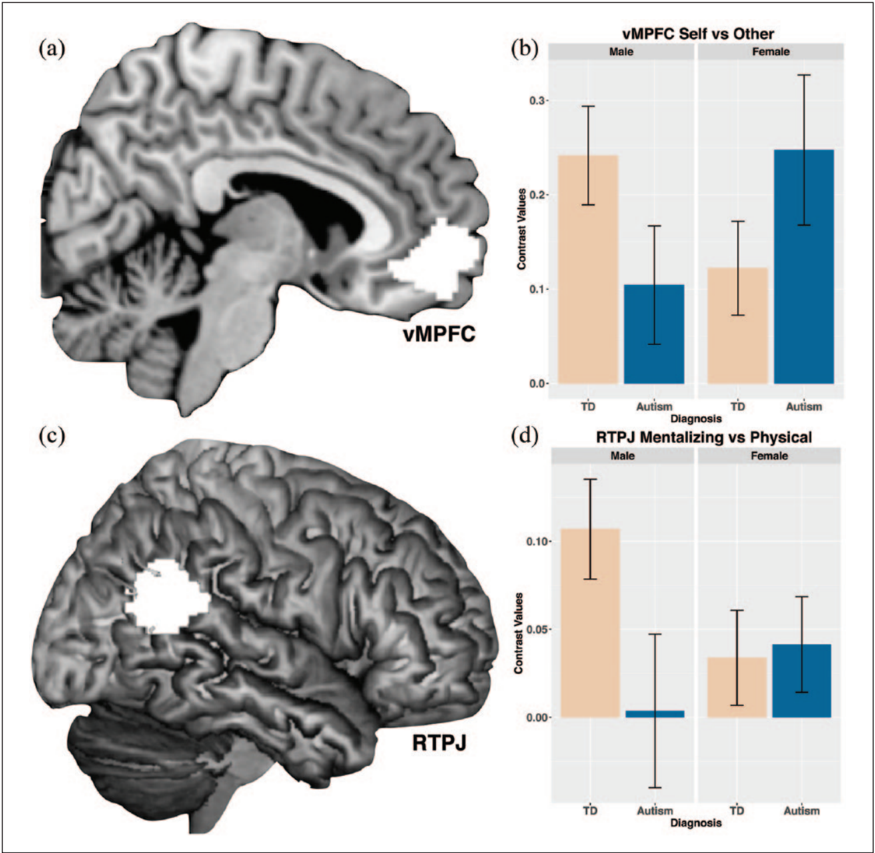
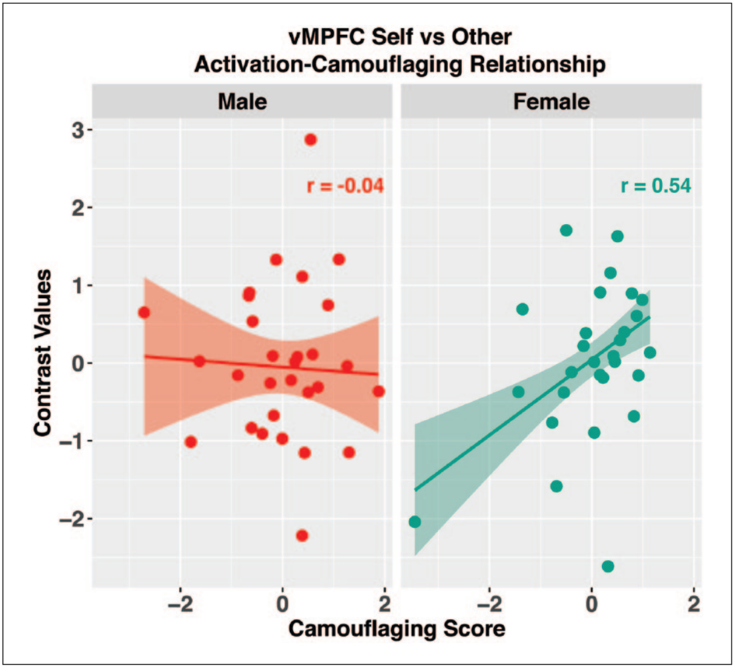
Prior work has revealed sex/gender-dependent autistic characteristics across behavioural and neural/biological domains. It remains unclear whether and how neural sex/gender differences are related to behavioural sex/gender differences in autism. Here, we examined whether atypical neural responses during mentalizing and self-representation are sex/gender-dependent in autistic adults and explored whether ‘camouflaging’ (acting as if behaviourally neurotypical) is associated with sex/gender-dependent neural responses. In total, N = 119 adults (33 typically developing males, 29 autistic males, 29 typically developing females and 28 autistic females) participated in a task-related functional magnetic resonance imaging paradigm to assess neural activation within right temporo-parietal junction and ventromedial prefrontal cortex during mentalizing and self-representation. Camouflaging in autism was quantified as the discrepancy between extrinsic behaviour in social–interpersonal contexts and intrinsic status. While autistic men showed hypoactive right temporo-parietal junction mentalizing and ventromedial prefrontal cortex self-representation responses compared to typically developing men, such neural responses in autistic women were not different from typically developing women. In autistic women only, increasing camouflaging was associated with heightened ventromedial prefrontal cortex self-representation response. There is a lack of impaired neural self-representation and mentalizing in autistic women compared to typically developing women. Camouflaging is heightened in autistic women and may relate to neural self-representation response. These results reveal brain-behaviour relations that help explain sex/gender-heterogeneity in social brain function in autism.
Overview
The claims and statistics of this paper haven’t been checked yet.
Free: it reads the open-access text and checks the first 5 claims that cite a source we can check. Create a free account to check every claim.
Integrity signals
Registry
Cites
Statistics
Figures
Verification
Claims the paper makes
The claims and statistics of this paper haven’t been checked yet.
Free: it reads the open-access text and checks the first 5 claims that cite a source we can check. Create a free account to check every claim.
Claims other papers make about this one
Each is checked against this paper’s own text: does it say what the citing paper says it does?
The cited source says what the claim attributes to it.
In the citing paper
“This has been reported to be more common in females than males and associated with different neural processes (Lai et al. 2019).”
From Barriers to Autism Spectrum Disorder Diagnosis for Young Women and Girls: a Systematic Review (2021) · cites this paper as Lai et al. 2019
Self-check
Percentages, sums and reported differences re-computed from the paper’s own numbers.
The self-check needs the paper’s full text.
Citations
Cites
Lord, C., Rutter, M., & Le Couteur, A. (1994) · Journal of Autism and Developmental Disorders · doi:10.1007/bf02172145 · Cited by 9,065 · cited 6×
“Since all participants were adults, we further considered available information of developmental history to include only those with clinically evident childhood autistic symptoms, for example, from information collected using the Autism Diagnostic Interview–Revised (ADI-R) (Lord et al., 1994) where possible, or from t…”
BackgroundMethodInfluentialLord, C., Risi, S., Lambrecht, L., Cook, E. H., Leventhal, B. L., DiLavore, P. C., Pickles, A., & Rutter, M. (2000) · Journal of Autism and Developmental Disorders · doi:10.1023/a:1005592401947 · Cited by 7,520 · cited 4×
“Finally, all analyses related to the camouflaging index were repeated to check consistency of findings using two other different versions of ADOS score: the Western Psychological Services, WPS-published ‘diagnostic algorithm’ Communication + Social Interaction Total score (Lord et al., 2000) as per our previous public…”
BackgroundMethodInfluentialPower, J. D., Barnes, K. A., Snyder, A. Z., Schlaggar, B. L., & Petersen, S. E. (2012) · NeuroImage · doi:10.1016/j.neuroimage.2011.10.018 · Cited by 7,429 · cited 1×
“Data were evaluated for in-scanner motion effects across groups using mean framewise displacement (FD), mean DVARS and maximal DVARS (Power et al., 2012); there were neither significant diagnosis-by-sex/gender interactions for any of them nor any main effects of Sex/Gender or diagnosis (Table 1).”
MethodBaron-Cohen, S., Wheelwright, S., Skinner, R., Martin, J., & Clubley, E. (2001) · Journal of Autism and Developmental Disorders · doi:10.1023/a:1005653411471 · Cited by 6,450 · cited 2×
“For assessing levels of autism characteristics, we administered the Autism Spectrum Quotient (AQ) (Baron-Cohen et al., 2001), module 4 of the Autism Diagnostic Observation Schedule (ADOS) (Lord et al.”
MethodSelf-citationWhat Is the Male-to-Female Ratio in Autism Spectrum Disorder? A Systematic Review and Meta-Analysis
Loomes, R., Hull, L., & Mandy, W. P. L. (2017) · Journal of the American Academy of Child & Adolescent Psychiatry · doi:10.1016/j.jaac.2017.03.013 · Cited by 2,804 · cited 1×
“However, meta-analyses of epidemiological studies show that with less biased ascertainment, the ratio is around 3:1 (Loomes et al., 2017).”
BackgroundFinding the self? An event-related fMRI study
Kelley, W. M., Macrae, C. N., Wyland, C. L., Caglar, S., Inati, S., & Heatherton, T. F. (2002) · Journal of Cognitive Neuroscience · doi:10.1162/08989290260138672 · Cited by 1,606 · cited 3×
“A main ingredient in these processes is an ability to represent similarities and differences between oneself and others – a function in which vMPFC plays critical roles (Kelley et al., 2002; Mitchell et al., 2006; Moran et al., 2006; Nicolle et al., 2012).”
Background“Putting on My Best Normal”: Social Camouflaging in Adults with Autism Spectrum Conditions
Hull, L., Petrides, K. V., Allison, C., Smith, P., Baron-Cohen, S., Lai, M.-C., & Mandy, W. (2017) · Journal of Autism and Developmental Disorders · doi:10.1007/s10803-017-3166-5 · Cited by 1,365 · cited 10×
“displaying facial expressions of emotion or interest), or deriving rules/guidelines and scripting conversation with others accordingly to get through small talk or to make social chats more enjoyable for their social partners (Hull et al., 2017).”
BackgroundResultInfluentialSelf-citationBaron-Cohen, S., O'Riordan, M., Stone, V., Jones, R., & Plaisted, K. (1999) · Journal of Autism and Developmental Disorders · doi:10.1023/a:1023035012436 · Cited by 1,211 · cited 1×
“An example of this might be ‘keep talking’, which keeps one connected to a listener but may not be sensitive to the context and may result in excessive faux pas (Baron-Cohen et al., 1999; Thiebaut et al., 2016).”
BackgroundSelf-citationSex/Gender Differences and Autism: Setting the Scene for Future Research
Lai, M.-C., Lombardo, M. V., Auyeung, B., Chakrabarti, B., & Baron-Cohen, S. (2015) · Journal of the American Academy of Child & Adolescent Psychiatry · doi:10.1016/j.jaac.2014.10.003 · Cited by 1,120 · cited 9×
“…how sex/gender contributes to the heterogeneity of autism, factorial experimental designs with sex/gender and diagnosis as factors should be utilized to examine sex/gender-similarities and/or differences in autism in contrast to same-sex/gender neurotypical (control) populations (Lai et al., 2015).”
BackgroundMethodInfluentialSelf-citationBargiela, S., Steward, R., & Mandy, W. (2016) · Journal of Autism and Developmental Disorders · doi:10.1007/s10803-016-2872-8 · Cited by 1,087 · cited 5×
“Qualitative studies additionally suggest that camouflaging in autistic individuals may be partly different from the ordinary ‘reputation/impression management’ in neurotypical individuals, owing to its extremely effortful and compensatory nature (Bargiela et al., 2016; Hull et al., 2017).”
BackgroundResultInfluential
Research works printed but not linked: 1
- Lai MC, Ameis SH and Szatmari P (2018) Young women on the autism spectrum. In: Gelbar N (ed.) Adolescents with Autism Spectrum Disorder: a clinical handbook . Oxford: Oxford University Press, pp.289-319.
Cited by
Items 101–135 of 135
Perceived Neurotype of the Other May Affect Self/Other-Representation in Autistic People
Moseley, R. L., Hung, K., & Sui, J. (2025) · Neurodiversity · doi:10.1177/27546330251339560 · Cited by 1
Guo, H., Chen, X., Zhou, A., Kou, J., Lei, Y., Kendrick, K. M., & Xu, L. (2026) · Molecular Autism · doi:10.1186/s13229-026-00710-7 · Cited by 1
Li, X., Zuo, F., Cheng, Y., Perkins, K., & Cao, F. (2026) · Proceedings of the National Academy of Sciences · doi:10.1073/pnas.2617358123 · Cited by 1
Sociocognição em foco: considerações sobre aspectos biológicos e culturais
Santos, M. J., & Panciera, S. D. P. (2020) · Research Society and Development · doi:10.33448/rsd-v9i10.8663
Camouflaging Autistic Traits Questionnaire (CAT-Q)
Hull, L., & Mandy, W. (2021) · Springer eBooks · doi:10.1007/978-3-319-91280-6_102327 · Cited by 3
Social Camouflaging in Adults with ASD
Hull, L., & Mandy, W. (2021) · Springer eBooks · doi:10.1007/978-3-319-91280-6_102389 · Cited by 1
Specific Challenges Faced by Females with Autism Spectrum Disorder
Davis, B. W. (2019) · ScholarsArchive (Brigham Young University) · Cited by 1
Examining Childhood Outcomes in Neonatal Abstinence Syndrome
Conner, K. L. (2021) · UKnowledge (University of Kentucky) · doi:10.13023/etd.2021.332
Sex-Related Neurocircuitry Supporting Camouflaging in Adults with Autism: Female Protection InsightsPreprint
Walsh, M. J. M., Pagni, B. A., Monahan, L., Delaney, S., Smith, C. J., Baxter, L., & Braden, B. B. (2021) · bioRxiv (Cold Spring Harbor Laboratory) · doi:10.1101/2021.11.03.466990
“, selfreport) ASD traits.(18,19) The discrepancy approach has linked greater “camouflaging” in ASDF to reduced cerebellar/medial temporal lobe volumes(18) and increased activation of the medial prefrontal cortex during self-reflection(19).”
BackgroundSex Differences in Autism Spectrum Disorders: A Multidisciplinary ReviewPreprint
Nayar, K., Hunter, S. J., & Scott, M. (2022) · PsyArXiv (OSF Preprints) · doi:10.31234/osf.io/bv5yw · Cited by 2
Social Camouflaging in Adults with ASD
Hull, L., & Mandy, W. (2020) · Springer eBooks · doi:10.1007/978-1-4614-6435-8_102389-1
Social camouflaging and mental health in adolescence: differences by sex and diagnosis
Bernardin, C. J. (2021) · MOspace Institutional Repository (University of Missouri) · doi:10.32469/10355/90961
“Both camouflaging and self-monitoring reflect behavior change with the goal of managing the impression made on others, and the similarities between the two constructs have been noted by researchers (Hull et al., 2019; Lai et al., 2019).”
BackgroundLacroix, A. (2023) · UGA Éditions eBooks · doi:10.4000/books.ugaeditions.29935
Gender differences in sensory sensitivity in ASD patients aged 2 to 15Preprint
Amiri, N. M., & Mehdi, A. (2023) · Research Square · doi:10.21203/rs.3.rs-3132801/v1 · Cited by 1
Xie, Q., Li, X., Lin, L., Weng, X., Wang, S., Zhang, K., Pan, N., & Wang, X. (2024) · Research Square · doi:10.21203/rs.3.rs-4419703/v1
Self-reported Social Camouflaging in Sexual Minority and Heterosexual Autistic AdultsPreprint
McQuaid, G. A., Lee, N., & Wallace, G. L. (2024) · doi:10.31234/osf.io/p2tdy
Jack, C. (2025) · IGI Global eBooks · doi:10.4018/979-8-3693-8044-4.ch014
Guo, H., Chen, X., Zhou, A., Kou, J., Lei, Y., Kendrick, K. M., & Xu, L. (2025) · bioRxiv (Cold Spring Harbor Laboratory) · doi:10.1101/2025.08.22.671791
Ferenc, K. (2025) · Family Upbringing · doi:10.61905/wwr/208456
Floris, D. L., Filho, J. O. A., Lai, M., Giavasis, S., Oldehinkel, M., Mennes, M., Charman, T., Tillmann, J., Dumas, G., Ecker, C., et al. (2021) · Figshare · doi:10.6084/m9.figshare.14140167
Self-citationFloris, D. L., Filho, J. O. A., Lai, M., Giavasis, S., Oldehinkel, M., Mennes, M., Charman, T., Tillmann, J., Dumas, G., Ecker, C., et al. (2021) · Figshare · doi:10.6084/m9.figshare.14140161
Self-citationFloris, D. L., Filho, J. O. A., Lai, M., Giavasis, S., Oldehinkel, M., Mennes, M., Charman, T., Tillmann, J., Dumas, G., Ecker, C., et al. (2021) · Figshare · doi:10.6084/m9.figshare.14140164
Self-citationOshima, F., Takahashi, T., Tamura, M., Guan, S., Seto, M., Hull, L., Mandy, W., Tsuchiya, K., & Shimizu, E. (2024) · Figshare · doi:10.6084/m9.figshare.26660942
Hull, L., Levy, L., Lai, M., Petrides, K. V., Baron‐Cohen, S., Allison, C. L., Smith, P. L., & Mandy, W. (2021) · Figshare · doi:10.6084/m9.figshare.14052675
Self-citationOshima, F., Takahashi, T., Tamura, M., Guan, S., Seto, M., Hull, L., Mandy, W., Tsuchiya, K., & Shimizu, E. (2024) · Figshare · doi:10.6084/m9.figshare.26660939
Klein, J., Krahn, R., Howe, S. J., Cormier, A., Rush, J., Ames, M. E., McMorris, C. A., & Macoun, S. J. (2026) · BMJ Open · doi:10.1136/bmjopen-2025-111221
“20 Schuck and colleagues determined that working memory was not associated with SC behaviour in autistic adults.”
Gao, L., Zhang, A., Liu, J., Cui, D., & Guo, X. (2026) · NeuroImage · doi:10.1016/j.neuroimage.2026.121998 · Cited by 1
Autistic pupils’ experiences of foreign language learning: an interpretative phenomenological study
Langridge, S., & Howard, K. (2026) · Language Learning Journal · doi:10.1080/09571736.2026.2697304
Huang, Y., Wang, Y., Zhang, H.-H., Zhou, M.-W., Su, Z., Cheung, T. C. C., Ungvari, G. S., Smith, R. D., Ng, C. H., & Xiang, Y. (2026) · Journal of Autism and Developmental Disorders · doi:10.1007/s10803-026-07438-6
Wang, Y., Zx, M., Wang, Z., Xu, X., Xia, Z., Zhang, H., Zhang, J., Zong, Y., Ke, X., & Li, Y. (2026) · Frontiers in Psychiatry · doi:10.3389/fpsyt.2026.1743755 · Cited by 1
Gao, L., Dong, Q., Hu, X., Lu, H., Liu, J., & Guo, X. (2026) · Chaos Solitons & Fractals · doi:10.1016/j.chaos.2026.118931
Emotion Regulation Difficulties in Autism‐ PTSD Co‐Occurrence
Fayena, E., Shaked-Ashkenazi, S., Shoval, M., Benhamou, M., Laor, N., Horesh, D., & Golan, O. (2026) · Autism Research · doi:10.1002/aur.70359
Samoilis, G., & Lewis, C. (2026) · Neurodiversity · doi:10.1177/27546330261490701
Goh, C. C. W., & Rizzo, A. S. (2026) · Frontiers in Health Services · doi:10.3389/frhs.2026.1927026
Metadata
- Authors
- Lai, M.-C., Lombardo, M. V., Chakrabarti, B., Ruigrok, A. N., Bullmore, E. T., Suckling, J., Auyeung, B., Happé, F., Szatmari, P., Baron-Cohen, S., Bailey, A. J., Bolton, P. F., Carrington, S., Catani, M., Craig, M. C., Daly, E. M., Deoni, S. C., Ecker, C., Henty, J., Jezzard, P., Johnston, P., Jones, D. K., Madden, A., Mullins, D., Murphy, C. M., Murphy, D. G., Pasco, G., Sadek, S. A., Spain, D., Stewart, R., Wheelwright, S. J., & Williams, S. C.
- Affiliations
- University of Toronto (CA)
- University of Cambridge (GB)
- GlaxoSmithKline (United Kingdom) (GB)
- University of Cambridge, UK
- King’s College London, UK
- University of Toronto, Canada
- Corresponding author
- Lai, Meng-Chuan
- Lombardo, Michael V
- ORCID
- Lai, Meng-Chuan
- Lombardo, Michael V
- Chakrabarti, Bhismadev
- Ruigrok, Amber NV
- Bullmore, Edward T
- Bolton, Patrick F
- Carrington, Sarah
- Catani, Marco
- Craig, Michael C
- Daly, Eileen M
- Deoni, Sean CL
- Ecker, Christine
- Henty, Julian
- Jezzard, Peter
- Jones, Derek K
- Murphy, Clodagh M
- Murphy, Declan GM
- Pasco, Greg
- Spain, Debbie
- Wheelwright, Sally J
- Williams, Steven C
- Venue
- Autism
- Publisher
- SAGE Publications
- Published
- 2018-10-24
- Volume
- 23
- Issue
- 5
- Pages
- 1210-1223
- ISSN
- 1362-3613 (ISSN-L)
- 1461-7005
- PMC
- PMC6589917
- OpenAlex
- W2892828630
- Cited by
- 134
- References
- 62
- Citations by year
- 2026: 14 · 2025: 15 · 2024: 13 · 2023: 18 · 2022: 12 · 2021: 28 · 2020: 23 · 2019: 11
- FWCI
- 9.22
- Type
- journal article
- Language
- en
- Open access
- hybrid
- doi.org
- Licence
- cc-by
- journals.sagepub.com/page/policies/text-and-data-mining-license (tdm)
- Locations
- Autism (publishedVersion, cc-by)
- PubMed Central (publishedVersion, cc-by)
- PubMed (publishedVersion)
- Research Portal (King's College London) (publishedVersion, other-oa)
- Research Explorer (The University of Manchester) (publishedVersion, cc-by)
- CentAUR (University of Reading) (acceptedVersion)
- Research Bank (Australian Catholic University) (submittedVersion, cc-by)
- UCL Discovery (University College London) (submittedVersion)
- Edinburgh Research Explorer (University of Edinburgh) (submittedVersion, cc-by)
- Apollo (University of Cambridge) (submittedVersion, cc-by)
- Apollo (cc-by)
- Funders
- Innovative Medicines Initiative (grant agreement n° 115300)
- Medical Research Council (GO 400061)
- European Research Council (ERC-2017-STG; 755816)
- Topics
- Life Sciences › Neuroscience › Cognitive Neuroscience › Autism Spectrum Disorder Research
- Life Sciences › Biochemistry, Genetics and Molecular Biology › Genetics › Genetics and Neurodevelopmental Disorders
- Social Sciences › Psychology › Social Psychology › Action Observation and Synchronization
- Keywords
- autistic women, camouflaging, self-representation, mentalization, sex and gender differences, right temporoparietal junction, ventromedial prefrontal cortex, social brain
- MeSH terms
- Mentalization, Adolescent, Adult, Autistic Disorder, Brain, Female, Humans, Magnetic Resonance Imaging, Male, Middle Aged, Self Concept, Sex Factors, Social Behavior, Case-Control Studies, Young Adult, Functional Neuroimaging
About these checks
Registry, retraction, Cites and statistics results are computed, not judged, with one exception: a printed reference that no index lists is read once by a model before it counts as a citation error. Claims are extracted by a model and kept only when their quote appears verbatim in the text; each cited source is then checked, with a model’s help, for whether it says what the claim relies on. Those verdicts can be wrong — read the claim’s quote and the cited source before relying on one.
Statistics and arithmetic are recomputed, not judged.
Confidence bands are shown only for fields calibrated on our annotated test set. None is calibrated yet, so no band is shown.
What counts as a claim ›How we measure confidence ›How we check this ›
Are you an author, or do you see a problem with this page? Request a review
Data sources
Bibliographic data: Semantic Scholar, OpenAlex, Crossref.
Contains information from the Semantic Scholar Academic Graph Datasets, made available under the ODC Attribution License (ODC-BY 1.0).
Semantic Scholar’s data is described in: Kinney, R., et al. (2023). The Semantic Scholar Open Data Platform. arXiv:2301.10140.
