

The DOI matches its Crossref record; 69 of the 69 references it cites were found in a registry or an index.
Access to employment: A comparison of autistic, neurodivergent and neurotypical adults’ experiences of hiring processes in the United Kingdom
Open accessAbstract
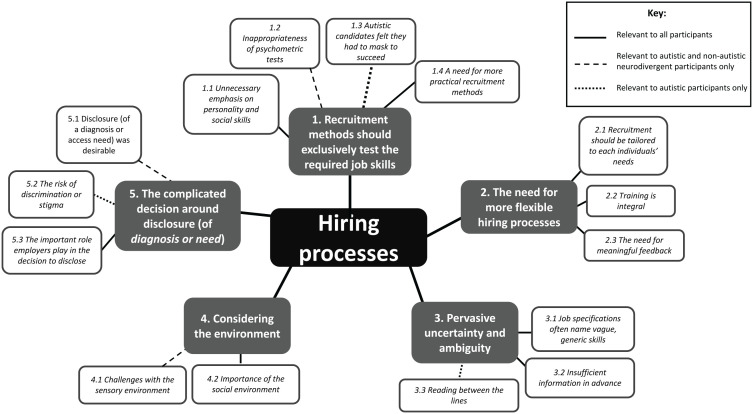
Autistic people face high unemployment rates. One reason for this may be that hiring processes are inaccessible. This study aimed to establish autistic people’s unique experiences of hiring processes in the United Kingdom, by comparing them to the experiences of non-autistic neurodivergent people and neurotypical people. Using qualitative and quantitative data from 225 autistic, 64 non-autistic neurodivergent and 88 neurotypical adults, we identified a series of (dis)similarities in participants’ views and experiences of recruitment for employment. Similarities across the three groups included (1) frustration with the focus on social skills; (2) a perceived need for more flexible hiring processes; (3) a desire for more clarity and (4) the importance of the environment. Participants also acknowledged the important role employers play in one’s decision to disclose a diagnosis or access need. Yet, autistic people faced a set of unique barriers to successful recruitment, over and above those that non-autistic people faced. For example, the perceived pressure to mask autistic traits to succeed and concerns about stigma and discrimination. Participants’ recommendations for improvements included the use of more practical recruitment strategies (e.g. work trials), more clarity about what to expect, and improvements in recruiters’ understanding of the challenges autistic and neurodivergent candidates may face. Lay abstract Autistic people are less likely to have a job than non-autistic people. One reason for this may be that hiring processes (e.g. job applications, interviews) can be challenging for autistic people. To better understand the experiences of hiring processes in the United Kingdom, we asked 225 autistic, 64 neurodivergent (but not autistic) and 64 adults with no reported area of neurodivergence questions about their experiences using an online survey. We found a range of similarities and differences in responses. For example, participants in all three groups were frustrated with the focus on social skills in recruitment and said they wanted more practical methods (e.g. work trials) that help them show their skills and abilities. Autistic and otherwise neurodivergent participants discussed the importance of the environment (e.g. the interview/assessment room) in improving experiences. Participants also discussed how employers can impact whether somebody decides to disclose their diagnosis or needs – or not. Autistic people experienced some barriers to successful recruitment that non-autistic people did not. For example, autistic people felt they had to hide their autistic traits to gain employment and many autistic people were worried about being discriminated against if they disclosed that they were autistic during the hiring process. To make experiences better, our participants said that employers should offer candidates different recruitment methods and give them more information about the hiring process. They also said employers should improve their understanding of autism and other hidden disabilities so they know the challenges that people might face during recruitment.
Overview
The claims and statistics of this paper haven’t been checked yet.
Run the check — free, no account needed. It reads the open-access text and checks the sources it cites.
Integrity signals
Registry
Cites
Statistics
Figures
Verification
Claims the paper makes
The claims and statistics of this paper haven’t been checked yet.
Run the check — free, no account needed. It reads the open-access text and checks the sources it cites.
Claims other papers make about this one
Each is checked against this paper’s own text: does it say what the citing paper says it does?
The cited source says what the claim attributes to it.
In the citing paper
“Recruitment practices, for example, frequently rely on unstructured interaction and social performance, potentially disadvantaging people whose communication styles differ from dominant workplace norms (Davies et al., 2023)”
From The system-level organisational design framework: a neuro-cognitive trait interaction approach to workplace inclusion for autistic people (2026) · cites this paper as Davies et al., 2023
Self-check
Percentages, sums and reported differences re-computed from the paper’s own numbers.
The self-check needs the paper’s full text.
Citations
Cites
Using thematic analysis in psychology
Braun, V., & Clarke, V. (2006) · Qualitative Research in Psychology · doi:10.1191/1478088706qp063oa · Cited by 194,414
Diagnostic and Statistical Manual of Mental Disorders
American Psychiatric Association (2013) · doi:10.1176/appi.books.9780890425596 · Cited by 116,369
Reflecting on reflexive thematic analysis
Braun, V., & Clarke, V. (2019) · Qualitative Research in Sport, Exercise and Health · doi:10.1080/2159676x.2019.1628806 · Cited by 19,677
(1993) · Journal of the American Dietetic Association · doi:10.1016/0002-8223(93)92196-5 · Cited by 12,205
Successful Qualitative Research: A practical guide for beginners
Jamieson, J., Braun, V., & Clarke, V. (2014) · QMiP Bulletin · doi:10.53841/bpsqmip.2014.1.18.39 · Cited by 6,673
What Is the Male-to-Female Ratio in Autism Spectrum Disorder? A Systematic Review and Meta-Analysis
Loomes, R., Hull, L., & Mandy, W. P. L. (2017) · Journal of the American Academy of Child & Adolescent Psychiatry · doi:10.1016/j.jaac.2017.03.013 · Cited by 2,804
Unemployment impairs mental health: Meta-analyses
Paul, K. I., & Moser, K. (2009) · Journal of Vocational Behavior · doi:10.1016/j.jvb.2009.01.001 · Cited by 2,706
Battle, D. E. (2013) · CoDAS · doi:10.1590/s2317-17822013000200017 · Cited by 1,569
Deficit, difference, or both? Autism and neurodiversity.
Kapp, S. K., Gillespie-Lynch, K., Sherman, L. E., & Hutman, T. (2013) · Developmental Psychology · doi:10.1037/a0028353 · Cited by 1,263
Journal of Business and Management
(2013) · Journal of Business and Management · doi:10.12695/jbm · Cited by 995
Research works printed but not linked: 4
- Harper A. (2008). Psychometric tests are now a multi-million-pound business: What lies behind a coach’s decision to use them? International Journal of Evidence Based Coaching & Mentoring, 1, 40–51.
- Honeybourne V. (2019). The neurodiverse workplace: An employer’s guide to managing and working with neurodivergent employees, clients and customers. Jessica Kingsley Publishers.
- 10.1504/JBM.2016.141236 · DOI
- 10.3233/JVR-2003-00193 · DOI
Cited by
Sorted by citations
Neurodivergence, intersectionality, and eating disorders: a lived experience-led narrative review
Cobbaert, L., Millichamp, A., Elwyn, R., Silverstein, S., Schweizer, K., Thomas, E., & Miskovic‐Wheatley, J. (2024) · Journal of Eating Disorders · doi:10.1186/s40337-024-01126-5 · Cited by 88
Finn, M., Flower, R. L., Leong, H. M., & Hedley, D. (2023) · Autism · doi:10.1177/13623613231153480 · Cited by 52
Career progression for autistic people: A scoping review
Davies, J., Romualdez, A. M., Pellicano, E., & Remington, A. (2024) · Autism · doi:10.1177/13623613241236110 · Cited by 52
Self-citationBranicki, L. J., Brammer, S. J., Brosnan, M., García-Lazaro, A., Lattanzio, S., & Newnes, L. (2024) · Human Resource Management · doi:10.1002/hrm.22243 · Cited by 67
Autism, Discrimination and Masking: Disrupting a Recipe for Trauma
Cleary, M. L., West, S., Kornhaber, R. A., & Hungerford, C. L. (2023) · Issues in Mental Health Nursing · doi:10.1080/01612840.2023.2239916 · Cited by 61
Bölte, S., Carpini, J., Black, M. H., Toomingas, A., Jansson, F., Marschik, P. B., Girdler, S., & Jonsson, M. (2024) · Human Resource Management · doi:10.1002/hrm.22259 · Cited by 37
Davies, J., Romualdez, A. M., Malyan, D., Heasman, B., Livesey, A., Walker, A., Pellicano, E., & Remington, A. (2024) · Autism in Adulthood · doi:10.1089/aut.2022.0087 · Cited by 36
Self-citationNeurodivergence and the Workplace: A Systematic Review of the Literature
Vargas-Salas, O., Alcazar-Gonzales, J. C., Fernandez-F, F., Molina-Rodríguez, F. N., Paredes-Velazco, R., & Carcausto-Zea, M. L. (2025) · Journal of Vocational Rehabilitation · doi:10.1177/10522263251337564 · Cited by 27
‘Most people have no idea what autism is’: Unpacking autism disclosure using social media analysis
Edwards, C., Love, A. M. A., Jones, S. C., Cai, R. Y., Nguyen, B. T. H., & Gibbs, V. (2023) · Autism · doi:10.1177/13623613231192133 · Cited by 29
Szulc, J. M. (2024) · Employee Relations · doi:10.1108/er-12-2023-0621 · Cited by 23
Neurodiversity in the healthcare profession
Johnson, J., & Ahluwalia, S. (2024) · Postgraduate Medical Journal · doi:10.1093/postmj/qgae108 · Cited by 22
Erbil, C., Özbilgin, M. F., & Gündoğdu, N. (2025) · Human Resource Management Journal · doi:10.1111/1748-8583.12573 · Cited by 21
McQuaid, G. A., Sadowski, L. Y., Lee, N., & Wallace, G. L. (2023) · Autism in Adulthood · doi:10.1089/aut.2022.0121 · Cited by 25
Collaborative Job Seeking for People with Autism: Challenges and Design Opportunities
Ara, Z., Ganguly, A., Peppard, D., Chung, D., Vučetić, S., Motti, V. G., & Hong, S.-S. (2024) · CHI Conference on Human Factors in Computing Systems · doi:10.1145/3613904.3642197 · Cited by 20
Smethurst, L., Thompson, A. R., & Freeth, M. (2024) · Autism in Adulthood · doi:10.1089/aut.2023.0171 · Cited by 22
Neurodiversity in the workplace: An agenda for research and action
Hartman, L. M., & Hartman, B. L. (2024) · Diversity & Inclusion Research · doi:10.1002/dvr2.70000 · Cited by 19
Mapping the lacunae between neurodivergent individuals and work organizations
Nair, V. S., Kumar, S., & Bhargava, S. (2025) · Acta Psychologica · doi:10.1016/j.actpsy.2025.105133 · Cited by 13
Wood, R. (2023) · Journal of Research in Special Educational Needs · doi:10.1111/1471-3802.12612 · Cited by 13
Maciver, D., Roy, A. S., Johnston, L., Boilson, M., Curnow, E., Johnstone‐Cooke, V., & Rutherford, M. (2025) · Autism · doi:10.1177/13623613251383343 · Cited by 17
Nelson, T. K., & Lichwa, H. (2025) · Educational Psychology in Practice · doi:10.1080/02667363.2025.2541211 · Cited by 14
More Career Development Learning for Neurodivergent Tertiary Education Students: A Case Study
Coffey, J., & Lovegrove, E. (2023) · Journal of Teaching and Learning for Graduate Employability · doi:10.21153/jtlge2023vol14no2art1790 · Cited by 10
How a DEI Climate Can Enable Allies and Support People Who Are Neurodivergent
Dahunsi, O., Robinson, N., Parks, C., & Nittrouer, C. (2024) · Palgrave studies in equity, diversity, inclusion, and indigenization in business · doi:10.1007/978-3-031-55072-0_10 · Cited by 9
Learning from the Experiences of Autistic Professionals Working in Health and Education
Curnow, E., Maciver, D., Johnston, L., Murray, M., Johnstone‐Cooke, V., Utley, I., Jenkins, N. D., Meff, T., Muggleton, J., & Rutherford, M. (2025) · Autism in Adulthood · doi:10.1089/aut.2024.0168 · Cited by 9
Solomon, M., Yon-Hernández, J. A., Ruder, S., Bothra, S., Gonzales, C., Kecskemeti, K., & Takarae, Y. (2023) · Autism Research · doi:10.1002/aur.3009 · Cited by 9
Chammas, C. B., & Hernandez, J. M. D. C. (2025) · International Journal of Training and Development · doi:10.1111/ijtd.12376 · Cited by 9
Understanding Human-AI Misalignment in LLM-Based Job-Seeking Support for Neurodivergent Users
Hall, K., Ma, M., Zhang, X., Swain, V. D., & Kim, J. G. (2025) · International ACM SIGACCESS Conference on Computers and Accessibility (ASSETS) · doi:10.1145/3663547.3746361 · Cited by 8
Koldas, M., Dounavi, K., MacCárthaigh, M., & Dillenburger, K. (2025) · Journal of Autism and Developmental Disorders · doi:10.1007/s10803-025-07139-6 · Cited by 7
Embracing Neurodiversity in the Nursing Workforce
Azar, N. G., & Taha, A. A. (2024) · AJN American Journal of Nursing · doi:10.1097/01.naj.0001094684.03544.03 · Cited by 8
Adu, D. A., Orazalin, N. S., Elmagrhi, M., & Ntim, C. G. (2025) · Journal of Accounting Literature · doi:10.1108/jal-02-2025-0089 · Cited by 6
Clin, É., & Kissine, M. (2023) · Journal of Speech Language and Hearing Research · doi:10.1044/2023_jslhr-23-00002 · Cited by 8
Chen, B. B., & Yakubova, G. (2024) · Autism in Adulthood · doi:10.1089/aut.2023.0092 · Cited by 6
Understanding the barriers to hiring autistic people as perceived by employers in the United Kingdom
Day, M. R., Wood, C., Corker, E., & Freeth, M. (2024) · Autism · doi:10.1177/13623613241301493 · Cited by 9
Tomlinson, M., & Vincent, J. (2025) · Higher Education · doi:10.1007/s10734-025-01451-x · Cited by 5
The unmapped paths: a strength-based inquiry into sustainable neurodivergent careers
Szulc, J. M., & Staniszewska, Z. (2025) · Career Development International · doi:10.1108/cdi-03-2025-0153 · Cited by 6
Johnson, T. D. (2024) · Palgrave studies in equity, diversity, inclusion, and indigenization in business · doi:10.1007/978-3-031-55072-0_5 · Cited by 5
Haldorai, K., Kim, W. G., & Li, J. J. (2025) · International Journal of Hospitality Management · doi:10.1016/j.ijhm.2025.104339 · Cited by 4
Camp, C., & Finlay, J. (2025) · The Journal of Academic Librarianship · doi:10.1016/j.acalib.2025.103115 · Cited by 4
Lee, S., Kim, S. Y., Lee, K., Sim, S., & Park, H.-S. (2025) · Autism · doi:10.1177/13623613251329605 · Cited by 4
Autistic students as partners in the design of tailored employability provision
Coney, K. (2023) · Journal of Teaching and Learning for Graduate Employability · doi:10.21153/jtlge2023vol14no2art1793 · Cited by 4
Miller, H., & Doyle, N. (2025) · Journal of Occupational and Organizational Psychology · doi:10.1111/joop.70040 · Cited by 6
Networks of neuronormativity: Toward a systemic understanding of marginalization in public relations
Reed, J. L., Villamil, A. M., & Branton, S. E. (2025) · Public Relations Review · doi:10.1016/j.pubrev.2025.102610 · Cited by 3
Cole, R. H., Smythe, L., Edwards, M. J., Happe, F. G. E., & Nicholson, T. R. (2025) · Autism · doi:10.1177/13623613251393504 · Cited by 4
Hennekam, S., & Follmer, K. B. (2026) · Organization · doi:10.1177/13505084241295747 · Cited by 3
Curșeu, P. L., Trif, S., van Rijswijk, J., Fodor, O. C., & Manole, E. C. (2026) · Journal of Organizational Effectiveness People and Performance · doi:10.1108/joepp-06-2025-0496 · Cited by 4
South, M., Park, S. Y., & Berman, M. (2025) · Autism in Adulthood · doi:10.1089/aut.2024.0122 · Cited by 4
Szechy, K. A., & O’Donnell, L. A. (2025) · Autism in Adulthood · doi:10.1089/aut.2024.0261 · Cited by 1
Neurodivergent Talent in the Workforce
Mathew, T., Varghese, R., & Latha, K. (2025) · IGI Global eBooks · doi:10.4018/979-8-3373-0350-5.ch007 · Cited by 2
Loizou, M., Percival, J., Bradley, N., Šumilo, D., Arnab, S., Cawston, J., Lameras, P., Brown, J., Pattenden, A., Dolby, T., et al. (2025) · Research in Autism · doi:10.1016/j.reia.2025.202662 · Cited by 2
Sun, Z., Hu, Q., & Guo, J. (2025) · Systems · doi:10.3390/systems13110948 · Cited by 2
Flood, M. (2026) · Applied Psychology · doi:10.1111/apps.70116 · Cited by 3
SEÇİM MÜLAKATLARINDA KAYGI ÖLÇEĞİ (MASI)’NİN TÜRKÇEYE UYARLANMASI: GEÇERLİK VE GÜVENİRLİK ÇALIŞMASI
Turgut, D., Güler, B. K., & Yüzbaşı, D. V. (2024) · Dokuz Eylül Üniversitesi Sosyal Bilimler Enstitüsü Dergisi · doi:10.16953/deusosbil.1378381 · Cited by 2
Vincent, J., Harkry, L., & Hamilton, L. (2024) · Journal of Vocational Rehabilitation · doi:10.3233/jvr-240039 · Cited by 2
Gréaux, M., Katsos, N., & Gibson, J. L. (2023) · doi:10.31234/osf.io/6wj2p · Cited by 2
Harriott, S. A.-M. (2024) · Advances in human resources management and organizational development book series · doi:10.4018/979-8-3693-3876-6.ch001 · Cited by 1
O’Leary, N., George, C. M., Dirani, Z. E., Jenks, R., & Kent, G. (2025) · Maternal and Child Health Journal · doi:10.1007/s10995-025-04161-z · Cited by 1
Applying Social Identity Theory to the Fit and Misfit of Autistic People in the Workplace
Archibald, D., & Spoor, J. R. (2025) · Springer eBooks · doi:10.1007/978-981-96-8208-9_9 · Cited by 1
Muharikah, A., Yossa, N., Turgarini, D., Hazairin, A. N., & Wismayanti, Y. F. (2025) · Social Sciences & Humanities Open · doi:10.1016/j.ssaho.2025.102344 · Cited by 1
Neurodiversity: Integrating evolutionary, philosophical, and sociocultural perspectives
Isacoff, N. M., Imanova, S., Kis-Herczegh, P., Toner, S., Urosevic, T., Varma, V., & Cunff, A. L. (2026) · Research in Autism · doi:10.1016/j.reia.2025.202783 · Cited by 4
Priorities for change for autistic people across Europe
Ikhsan, S. N. B. M., Holt, R., Ruigrok, A. N. V., Man, J., Parsons, T. A., Gibbs, K., Bullock, E., Baranger, A., Allison, C. L., Doherty, M., et al. (2026) · Molecular Autism · doi:10.1186/s13229-026-00706-3 · Cited by 1
Arya, V. (2026) · Journal of Organizational Effectiveness People and Performance · doi:10.1108/joepp-10-2025-0938 · Cited by 2
Griffin, B., Gosrani, R., & Eccles, J. (2026) · Evolutionary Applications · doi:10.1111/eva.70221 · Cited by 1
From inclusion to retention: neurodiversity management and employee turnover intentions
Nadeem, M. A., Alvi, A. K., Malook, S., & Hussain, P. (2026) · Journal of Organizational Effectiveness People and Performance · doi:10.1108/joepp-10-2025-0943 · Cited by 1
Neurodiversity and Organisational Change: Embedding Inclusive Practices in the Workplace
Nagirikandalage, P., Phillips, J., Ogundana, O. M., & Kooli, K. (2026) · Journal of the Knowledge Economy · doi:10.1007/s13132-026-03288-w · Cited by 2
Arnab, S., Varga, M. N., Dolby, T., Pattenden, A., Šumilo, D., Edwards, K. J., Langdon, P. E., & Loizou, M. (2026) · Research in Neurodiversity · doi:10.1016/j.rin.2026.100033 · Cited by 1
Enhancing Interview Preparation for Autistic Job Seekers through Human-AI Collaboration
Garrison, E., MacNeil, S., Hong, S.-S., Ara, Z., Hantula, D. A., & Vučetić, S. (2026) · Proceedings of the ACM on Human-Computer Interaction · doi:10.1145/3816928 · Cited by 1
Challenges in Digital Governance for AI Tools in Supporting Neurodivergent Workers
Baeyaert, J. (2025) · Digital Society · doi:10.1007/s44206-025-00180-z · Cited by 1
Laister, D., Köck, K., Fischer, L., Schenkenfelder, B., Wiesinger, S., Massoumzadeh, M., & Holzinger, D. (2025) · Research Square · doi:10.21203/rs.3.rs-6646902/v1 · Cited by 1
Dark, J. (2026) · Frontiers in Psychology · doi:10.3389/fpsyg.2026.1826284
Neuroinclusion Through Pragmatism: Transforming Neuronormative Organisations Through Co-DesignPreprint
Özbilgin, M. F., Erbil, C., Tekeste, M., & Gündoğdu, N. (2024) · SSRN Electronic Journal · doi:10.2139/ssrn.4791848
Halpern, J. M., Arral, M. L., Lafleur, C., Young, S., Baribault, E., & Gesun, J. (2024) · ASEE Annual Conference & Exposition · doi:10.18260/1-2--48552
Shamas, T. (2024) · Sociological research and innovation · doi:10.32350/sri.21.04
Ashworth, M., Heasman, B., Crane, L., & Remington, A. (2025) · Neurodiversity · doi:10.1177/27546330241311472 · Cited by 1
Self-citationSharing an Example of Neurodiversity Affirmative Hiring
Petty, S., Hanser, C. H., Williams, J. A., & Hamilton, L. (2025) · Autism in Adulthood · doi:10.1089/aut.2024.0134
Universal Design for Neurodiverse in New Zealand Workspaces
Muneer, T., & Burfoot, M. (2025) · Lecture notes in civil engineering · doi:10.1007/978-981-96-4051-5_147
Chalayonnavin, A., & Roongsangjun, T. (2025) · Social Sciences & Humanities Open · doi:10.1016/j.ssaho.2025.101773
Autistic Knowledge in Learning and Teaching
Spiegler, J. (2025) · IGI Global eBooks · doi:10.4018/979-8-3693-8044-4.ch008
Graduates stories of the university living experiences with and without an autism diagnosis
der Mel, L. V., & Moriña, A. (2025) · International Journal of Developmental Disabilities · doi:10.1080/20473869.2025.2555957
Implementation of Inclusive Work Instructions in Manufacturing Processes
Stadnicka, D., Blandino, G., Antonelli, D., & Montagna, F. (2025) · IFAC-PapersOnLine · doi:10.1016/j.ifacol.2025.09.384
Rehmer, L., Rehmer, T., Caruana, N., & Trier, M. (2025) · HMD Praxis der Wirtschaftsinformatik · doi:10.1365/s40702-025-01219-y
İşyerinde Nöroçeşitlilik: Farklı Zihinlerin Gücü
Özkul, R. F., Kaplan, N., Ertek, M. Y., & Özdemir, S. (2025) · Iğdır üniversitesi sosyal bilimler dergisi · doi:10.54600/igdirsosbilder.1619526 · Cited by 1
Reconceptualising Neuroinclusion: A Relational Perspective on Neurodiversity at WorkPreprint
Kavanagh, N., van der Werff, L., & Freeney, Y. M. (2025) · SSRN Electronic Journal · doi:10.2139/ssrn.5646291
The Experience of Autistic Professionals Working in Health and Education: A Systematic Review
Curnow, E., Maciver, D., Meff, T., Muggleton, J., Johnston, L., Gray, A. H., Day, H., Kourti, M., Utley, I., & Rutherford, M. (2025) · Autism in Adulthood · doi:10.1177/25739581251392464
Associations Between Features of Employment and Job Satisfaction Among Autistic Adults
Durrani, E., Moser, C., Mueller, S. B., Libster, N., Vogus, T. J., DaWalt, L. S., & Taylor, J. L. (2026) · Journal of Autism and Developmental Disorders · doi:10.1007/s10803-026-07219-1 · Cited by 1
Budaya sungkan dan basa-basi menghambat komunikasi orang dengan autisme
Yossa, N., & Muharikah, A. (2026) · doi:10.64628/aan.ujuhnn9rp
Heerden, R. V., & Naicker, V. (2026) · EUREKA Social and Humanities · doi:10.21303/2504-5571.2026.004141
Garner, A., & Burns, P. (2026) · Emerald Group Publishing Limited eBooks · doi:10.1108/978-1-80686-387-720261003
Discrimination, self-stigma and microaggressions: perspectives of adults with autism in Slovenia
Žumbar, T., & Lesar, I. (2026) · Advances in Autism · doi:10.1108/aia-11-2025-0121
Feng, H., Ara, Z., Hundt, A., Vučetić, S., Chung, J. J. Y., & Hong, S. R. (2026) · CHI Conference on Human Factors in Computing Systems · doi:10.1145/3772318.3791853
Kane, I., & Tyrrell, K. (2026) · Higher Education Skills and Work-based Learning · doi:10.1108/heswbl-02-2026-0136
Praslova, L. N. (2026) · doi:10.1093/9780197820070.003.0014
Desired Workplace Support: Perspectives of Adults with ADHD and/or Autism
Högstedt, E., Igelström, K. M., Korhonen, L., Ekman, T., Käcker, P., & Björk, M. (2026) · Neurodiversity · doi:10.1177/27546330261456176
Tippavajjula, A. S. L., Shankar, A., & Majumdar, B. (2026) · Acta Psychologica · doi:10.1016/j.actpsy.2026.107352
Inclusion of Autistic Individuals in Public Administration: A Multi-Method Insight from Italy
Alfieri, E., Belluzzo, M., Giaquinto, V., & Amodeo, A. L. (2026) · Trends in Public Health · doi:10.3390/tph1020009
Brice, S., Petrou, A., Hamilton, J., McConachie, H., Couteur, A. S. L., Ingham, B., Wilson, C., Hardy, R., Berney, T., Mason, D., et al. (2026) · Research in Autism · doi:10.1016/j.reia.2026.202963
From goodwill to systems: HR professionals' perspectives on AI and neurodiverse workplace inclusion
Fahim, I., Tamanine, R., Elkansoussi, F., Gharbaoui, A. E., & Alami, H. (2026) · Journal of Organizational Effectiveness People and Performance · doi:10.1108/joepp-10-2025-0909
Tamanine, R., Fahim, I., Karmijn, U. A., Baazizi, Y., & Blila, M. (2026) · Research in Neurodiversity · doi:10.1016/j.rin.2026.100061
Web Design for People on the Autism Spectrum: A Mixed-Methods Study on Digital Barriers
Giesen, J., & Breuninger, J. (2026) · Mensch und Computer (MuC) · doi:10.1145/3820253.3831390
Neurodiversity and artificial intelligence: psychological risk and potential for inclusion
Mansouri, M. (2026) · Occupational Medicine · doi:10.1093/occmed/kqag070
Pal, S. P., & Shah, S. (2026) · SSRN Electronic Journal · doi:10.2139/ssrn.7395139
Yarker, J., & Nielsen, K. (2026) · doi:10.1093/9780197692332.003.0014
Metadata
- Authors
- Davies, J., Heasman, B., Livesey, A., Walker, A., Pellicano, E., & Remington, A.
- Affiliations
- University College London (GB)
- York St John University (GB)
- Neurodiversity Works, UK
- Macquarie University (AU)
- Corresponding author
- Davies, Jade
- Venue
- Autism
- Publisher
- SAGE Publications
- Published
- 2023-01-04
- Volume
- 27
- Issue
- 6
- Pages
- 1746-1763
- ISSN
- 1362-3613 (ISSN-L)
- 1461-7005
- PMC
- PMC10375005
- OpenAlex
- W4313488525
- Cited by
- 105
- References
- 69
- Citations by year
- 2026: 35 · 2025: 38 · 2024: 21 · 2023: 11
- FWCI
- 26.21
- Type
- journal article
- Language
- en
- Open access
- hybrid
- doi.org
- Licence
- Locations
- Autism (publishedVersion, cc-by)
- PubMed Central (publishedVersion, cc-by)
- PubMed (publishedVersion)
- UCL Discovery (University College London) (submittedVersion, cc-by)
- Research at York St John (York St John University) (submittedVersion)
- Funders
- Autistica (7263)
- Topics
- Social Sciences › Education › Disability Education and Employment
- Life Sciences › Neuroscience › Cognitive Neuroscience › Autism Spectrum Disorder Research
- Social Sciences › Business, Management and Accounting › Organizational Behavior and Human Resource Management › Employer Branding and e-HRM
- Keywords
- neurodivergence, employment recruitment, recruitment process, job interviews, masking, stigma, discrimination, unemployment, neurodivergent adults, neurotypical adults, social skills, employer perceptions
- MeSH terms
- Autism Spectrum Disorder, Adult, Autistic Disorder, Employment, United Kingdom, Humans, Job Application
About these checks
Registry, retraction, Cites and statistics results are computed, not judged, with one exception: a printed reference that no index lists is read once by a model before it counts as a citation error. Claims are extracted by a model and kept only when their quote appears verbatim in the text; each cited source is then checked, with a model’s help, for whether it says what the claim relies on. Those verdicts can be wrong — read the claim’s quote and the cited source before relying on one.
Statistics and arithmetic are recomputed, not judged.
Confidence bands are shown only for fields calibrated on our annotated test set. None is calibrated yet, so no band is shown.
What counts as a claim ›How we measure confidence ›How we check this ›
Are you an author, or do you see a problem with this page? Request a review
