

Parent, child, and family outcomes following Acceptance And Commitment Therapy for parents of autistic children: A randomized controlled trial
Open accessThe DOI matches its Crossref record; 65 of the 67 references it cites were found in a registry or an index, and 2 are not checked yet; 11 of the 27 sources its claims cite were checked for support.
Abstract
Emerging research shows that Acceptance and Commitment Therapy (ACT) may improve mental health for caregivers. Parents of autistic children, adolescents, and adults (N = 54) were randomly assigned to either complete a brief group-based ACT intervention or remain on the waitlist. Participants completed surveys immediately prior to randomization, and 3-, 7-, and 17-weeks post-randomization. The primary outcome was depression symptoms and secondary outcomes included stress, goal attainment, positive affect, ACT psychological processes, child mental health, and family functioning. Mixed effects linear models testing Group × Time interaction indicated the Treatment group (n = 27) demonstrated greater post-intervention improvements than the Waitlist group (n = 27) in parent depression (p =.03, d = −0.64) and family distress (p =.04, d = −0.57). Treatment group parents also reported greater short-term gains in positive affect (p =<.001, d = 0.77) and personal goal attainment (p =.007, d = 0.80), compared to the Waitlist group. Although there was no significant Group × Time interaction for other outcomes, stress (b = −2.58, p =.01), defusion (b = −3.78, p =.001), and experiential avoidance (b = −4.22, p =.01) showed improvement for the Treatment group, but not the Waitlist group, at post-intervention. All Treatment group improvements were maintained at follow-up. Results suggest that a brief ACT group intervention is efficacious for improving some aspects of mental health for parents of autistic children. Lay abstract: Parents of autistic children commonly experience difficulties with their own mental health. This study looked at the effects of a brief group-based Acceptance and Commitment Therapy program, developed for parents of autistic children, youth, and adults. ACT focuses on increasing psychological flexibility, which is the ability to be mindful and accepting of difficult thoughts and experiences, shown to be important for mental wellness. Participants included 54 parents of autistic people, ages 3–34. Parents were randomly divided into two groups: a Treatment group that received the intervention right away, and a Waitlist group that completed the program after the Treatment group completed the trial. All parents filled out questionnaires right before the program began, and at 3, 7, and 17 weeks after randomization. Compared to the group that was waiting to participate in the program, parents in the Treatment group reported greater improvements in depression and family distress, and these improvements were still present 4 months later. Parents in the Treatment group also reported short-term improvements in their positive feelings and personal goals, compared to those waiting. Results showed that ACT may help improve some aspects of mental health for parents of autistic children, but further research is recommended. © The Author(s) 2023.
Verified 2026-11-22 · 2 references not checked yet
Overview
CoChat Summary
## TL;DR
This randomized controlled trial found that a brief group ACT workshop improved some parent outcomes for parents of autistic children, especially depression and family distress. Benefits were maintained at 4-month follow-up, while child mental health and overall family functioning did not improve.
## Key findings
- In the primary outcome, the Treatment group showed significant reductions in depression at Time 2 (b = −3.21, p = .001) and Time 3 (b = −2.60, p = .03), with a large then medium Group × Time interaction; the Waitlist group did not improve (Time 2: b = 0.46, p = .51; Time 3: b = 0.08, p = .88).
- Among treatment completers, 10 of 12 parents with baseline depression in the moderate-or-higher range moved to the non-clinical range by Time 2 (83%), and 8 remained non-clinical by Time 3 (67% improvement); in the Waitlist group, 0 of 10 moved to non-clinical by Time 2 and 3 did by Time 3 (30%).
- The Treatment group showed greater short-term gains in goal attainment: 81.9% vs 43.0% at Time 2, with F(1, 461.41) = 7.47, p = .007, d = 0.80; the odds of achieving/exceeding a goal were 5.99 times higher (95% CI: 1.73, 20.70).
- The abstract reports significant post-intervention improvements for the Treatment group in family distress (p = .04, d = −0.57), positive affect (p = < .001, d = 0.77), and depression (p = .03, d = −0.64), and notes that stress, defusion, and experiential avoidance improved for the Treatment group at post-intervention even without a significant Group × Time interaction.
## Methods
- Randomized controlled trial comparing an immediate Treatment group with a Waitlist control; parents were assessed at baseline and at 3, 7, and 17 weeks post-randomization.
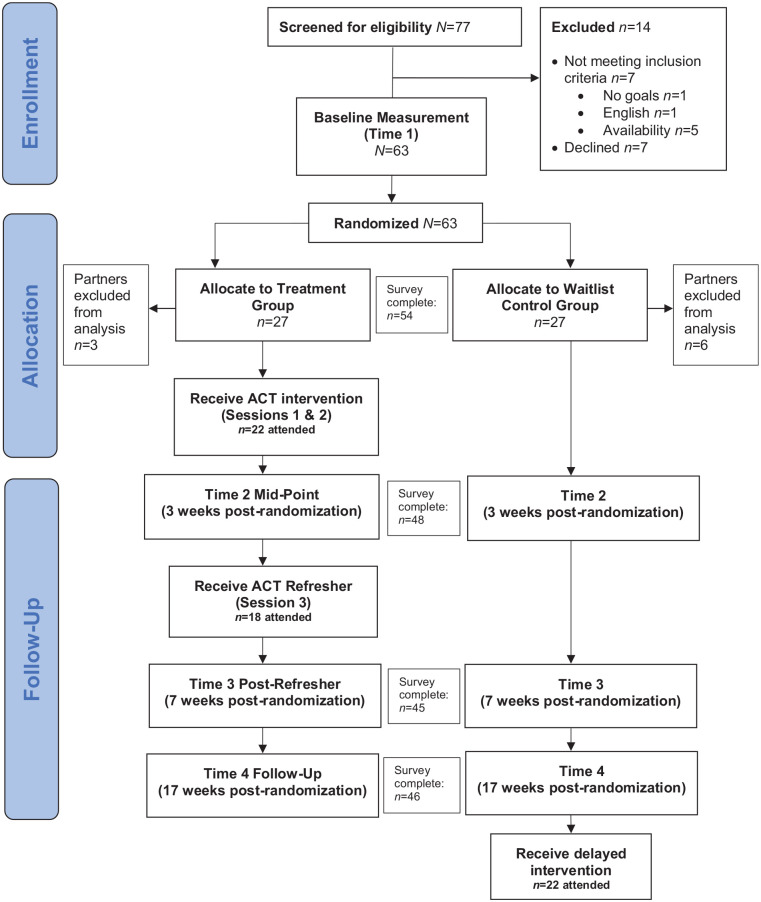
- Sample: 54 parents of autistic children, adolescents, and adults ages 3 to 34 years; 63 were randomized, and 9 partners were excluded from analysis, leaving 27 per group.
- Main analysis: linear mixed effects regression models tested Group × Time interactions for outcomes; goal attainment was analyzed with chi-square methods, and effect sizes were reported as Cohen’s d.
## Limitations
- The paper states that participants were recruited mainly through autism service agencies and many were already receiving supports and services, which may limit generalization to families without supports or unwilling to wait 4 months for the program.
- Only 18 participants completed the full 3-session intervention including the refresher, and all outcomes were based on parent self-report, which could limit validity and the effects captured.
- The sample had high household income and parent education, limited racial/ethnic diversity, and relatively low levels of parent mental health problems; these make the findings less generalizable to parents with less education, different cultural backgrounds, or greater need.
- Evident from the text: the Waitlist group did not receive the intervention until after the final follow-up, so longer-term comparative effects beyond 4 months were not tested.
Model-written summary. Check it against the paper before relying on it.
Integrity signals
Registry
Cites
Statistics
Figures
Verification
Claims the paper makes
10 Valid · 2 Not valid · 8 Not checked · 95 Own results and interpretations
The cited sources support only part of this claim — read each source’s verdict below.
In the paper
“The use of psychological acceptance has also been shown to be an important protective factor in the well-being of parents of autistic children (Jones et al., 2014; Weiss et al., 2012).”
§ Parent, child, and family outcomes following Acceptance And Commitment Therapy for parents of autistic children: A randomized controlled trial > Abstract Emerging research shows that Acceptance and Commitment Therapy (ACT) may improve mental health for caregivers. Parents of autistic children, adolescents, and adults (N = 54) were randomly assigned to either complete a brief group-based ACT intervention or remain on the waitlist. Participants completed surveys immediately prior to randomization, and 3-, 7-, and 17-weeks post-randomization. The primary outcome was depression symptoms and secondary outcomes included stress, goal attainment, positive affect, ACT psychological processes, child mental health, and family functioning. Mixed effects linear models testing Group × Time interaction indicated the Treatment group (n = 27) demonstrated greater post-intervention improvements than the Waitlist group (n = 27) in parent depression (p = .03, d = −0.64) and family distress (p = .04, d = −0.57). Treatment group parents also reported greater short-term gains in positive affect (p =< .001, d = 0.77) and personal goal attainment (p = .007, d = 0.80), compared to the Waitlist group. Although there was no significant Group × Time interaction for other outcomes, stress (b = −2.58, p = .01), defusion (b = −3.78, p = .001), and experiential avoidance (b = −4.22, p = .01) showed improvement for the Treatment group, but not the Waitlist group, at post-intervention. All Treatment group improvements were maintained at follow-up. Results suggest that a brief ACT group intervention is efficacious for improving some aspects of mental health for parents of autistic children. > Lay abstract
What the sources say
- Partly supportedcites Jones et al., 2014 matched to “Child behavior problems and parental well-being in families of children with autism: The mediating role of mindfulness and acceptance” (2014) sourceExperimental — accuracy not yet measured
The Discussion reports that psychological acceptance mediated the association between child behavior problems and maternal anxiety, depression, and stress, as well as paternal depression. It also says the study was cross-sectional and causality cannot be inferred, so describing acceptance as a demonstrated protective factor overstates the finding. (LLM, conf=0.84)
- Not checked — no full text of the sourcecites Weiss et al., 2012 matched to “The impact of child problem behaviors of children with ASD on parent mental health: The mediating role of acceptance and empowerment” (2012) source
boostedstates an association- Asserted: passes — The authors put it forward as true.
- Checkable: passes — It can be checked against evidence.
- Load-bearing: passes — The paper’s conclusions depend on it.
- Based: passes — The paper gives a reason why it holds.
- Partly supported
The cited sources support only part of this claim — read each source’s verdict below.
In the paper
“Avoidance coping, although sometimes adaptive in the short term, is associated with increased stress and mental health problems over time (Hastings et al., 2005).”
§ Parent, child, and family outcomes following Acceptance And Commitment Therapy for parents of autistic children: A randomized controlled trial > Abstract Emerging research shows that Acceptance and Commitment Therapy (ACT) may improve mental health for caregivers. Parents of autistic children, adolescents, and adults (N = 54) were randomly assigned to either complete a brief group-based ACT intervention or remain on the waitlist. Participants completed surveys immediately prior to randomization, and 3-, 7-, and 17-weeks post-randomization. The primary outcome was depression symptoms and secondary outcomes included stress, goal attainment, positive affect, ACT psychological processes, child mental health, and family functioning. Mixed effects linear models testing Group × Time interaction indicated the Treatment group (n = 27) demonstrated greater post-intervention improvements than the Waitlist group (n = 27) in parent depression (p = .03, d = −0.64) and family distress (p = .04, d = −0.57). Treatment group parents also reported greater short-term gains in positive affect (p =< .001, d = 0.77) and personal goal attainment (p = .007, d = 0.80), compared to the Waitlist group. Although there was no significant Group × Time interaction for other outcomes, stress (b = −2.58, p = .01), defusion (b = −3.78, p = .001), and experiential avoidance (b = −4.22, p = .01) showed improvement for the Treatment group, but not the Waitlist group, at post-intervention. All Treatment group improvements were maintained at follow-up. Results suggest that a brief ACT group intervention is efficacious for improving some aspects of mental health for parents of autistic children. > Lay abstract
What the sources say
- Partly supportedcites Hastings et al., 2005 matched to “Coping strategies in mothers and fathers of preschool and school-age children with autism” (2005) sourceExperimental — accuracy not yet measured
The Results (p. 9) report that active avoidance coping in mothers and fathers of children with autism was associated with more stress and anxiety and depression symptoms. Those correlations do not establish that problems increased over time, and the cited passages do not support the sentence’s suggestion that avoidance may be adaptive in the short term. (LLM, conf=0.89)
plainstates an association- Asserted: passes — The authors put it forward as true.
- Checkable: passes — It can be checked against evidence.
- Load-bearing: passes — The paper’s conclusions depend on it.
- Based: passes — The paper gives a reason why it holds.
- Partly supported
The cited sources support only part of this claim — read each source’s verdict below.
In the paper
“As shown in other studies of ACT interventions, some process-related changes take several months to become evident, particularly with respect to behavior change (González-Menéndez et al., 2014; Kohtala et al., 2017).”
§ Parent, child, and family outcomes following Acceptance And Commitment Therapy for parents of autistic children: A randomized controlled trial > Discussion > ACT psychological processes
What the sources say
- Not checked yetcites González-Menéndez et al., 2014 matched to “Long-term outcomes of Acceptance and Commitment Therapy in drug-dependent female inmates: A randomized controlled trial” (2014) source
Checked before — its earlier verdict is held back until a new check runs.
- Partly supportedcites Kohtala et al., 2017 matched to “What happens after five years?: The long-term effects of a four-session Acceptance and Commitment Therapy delivered by student therapists for depressive symptoms” (2017) sourceExperimental — accuracy not yet measured
The Results (page unavailable) report that mindfulness subscales, including acting with awareness, did not change significantly immediately after the ACT intervention but did show significant changes at five-year follow-up. This supports the possibility of later-emerging process changes, but the reported comparisons do not establish that they became evident after several months or specifically demonstrate delayed behavior change. (LLM, conf=0.80)
plain- Asserted: passes — The authors put it forward as true.
- Checkable: passes — It can be checked against evidence.
- Load-bearing: unclear — It is unclear whether the paper’s conclusions depend on it.
- Based: passes — The paper gives a reason why it holds.
- Not checked yet
A result the paper reports from its own data — it cites no other source for it, so there is none to check. The quote shows it is in the paper.
In the paper
“Treatment group parents also reported greater short-term gains in positive affect (p =< .001, d = 0.77) and personal goal attainment (p = .007, d = 0.80), compared to the Waitlist group.”
§ Parent, child, and family outcomes following Acceptance And Commitment Therapy for parents of autistic children: A randomized controlled trial > Abstract Emerging research shows that Acceptance and Commitment Therapy (ACT) may improve mental health for caregivers. Parents of autistic children, adolescents, and adults (N = 54) were randomly assigned to either complete a brief group-based ACT intervention or remain on the waitlist. Participants completed surveys immediately prior to randomization, and 3-, 7-, and 17-weeks post-randomization. The primary outcome was depression symptoms and secondary outcomes included stress, goal attainment, positive affect, ACT psychological processes, child mental health, and family functioning. Mixed effects linear models testing Group × Time interaction indicated the Treatment group (n = 27) demonstrated greater post-intervention improvements than the Waitlist group (n = 27) in parent depression (p = .03, d = −0.64) and family distress (p = .04, d = −0.57). Treatment group parents also reported greater short-term gains in positive affect (p =< .001, d = 0.77) and personal goal attainment (p = .007, d = 0.80), compared to the Waitlist group. Although there was no significant Group × Time interaction for other outcomes, stress (b = −2.58, p = .01), defusion (b = −3.78, p = .001), and experiential avoidance (b = −4.22, p = .01) showed improvement for the Treatment group, but not the Waitlist group, at post-intervention. All Treatment group improvements were maintained at follow-up. Results suggest that a brief ACT group intervention is efficacious for improving some aspects of mental health for parents of autistic children.
plainstates a causen = 27 ·- Asserted: passes — The authors put it forward as true.
- Checkable: passes — It can be checked against evidence.
- Load-bearing: passes — The paper’s conclusions depend on it.
- Based: passes — The paper gives a reason why it holds.
A result the paper reports from its own data — it cites no other source for it, so there is none to check. The quote shows it is in the paper.
In the paper
“Mixed effects linear models testing Group × Time interaction indicated the Treatment group (n = 27) demonstrated greater post-intervention improvements than the Waitlist group (n = 27) in parent depression (p = .03, d = −0.64) and family distress (p = .04, d = −0.57).”
§ Parent, child, and family outcomes following Acceptance And Commitment Therapy for parents of autistic children: A randomized controlled trial > Abstract Emerging research shows that Acceptance and Commitment Therapy (ACT) may improve mental health for caregivers. Parents of autistic children, adolescents, and adults (N = 54) were randomly assigned to either complete a brief group-based ACT intervention or remain on the waitlist. Participants completed surveys immediately prior to randomization, and 3-, 7-, and 17-weeks post-randomization. The primary outcome was depression symptoms and secondary outcomes included stress, goal attainment, positive affect, ACT psychological processes, child mental health, and family functioning. Mixed effects linear models testing Group × Time interaction indicated the Treatment group (n = 27) demonstrated greater post-intervention improvements than the Waitlist group (n = 27) in parent depression (p = .03, d = −0.64) and family distress (p = .04, d = −0.57). Treatment group parents also reported greater short-term gains in positive affect (p =< .001, d = 0.77) and personal goal attainment (p = .007, d = 0.80), compared to the Waitlist group. Although there was no significant Group × Time interaction for other outcomes, stress (b = −2.58, p = .01), defusion (b = −3.78, p = .001), and experiential avoidance (b = −4.22, p = .01) showed improvement for the Treatment group, but not the Waitlist group, at post-intervention. All Treatment group improvements were maintained at follow-up. Results suggest that a brief ACT group intervention is efficacious for improving some aspects of mental health for parents of autistic children.
hedgedstates a causen = 27 ·- Asserted: passes — The authors put it forward as true.
- Checkable: passes — It can be checked against evidence.
- Load-bearing: passes — The paper’s conclusions depend on it.
- Based: passes — The paper gives a reason why it holds.
28 more claims
Create a free account to see all 115 claims and to verify the 1 reference still open.
- Probably not a substantial claim. 46
- It may state two separate claims as one. 47
Claims other papers make about this one
Each is checked against this paper’s own text: does it say what the citing paper says it does?
In the citing paper
“That study reported that a 2-day ACT workshop could produce significant reductions in depressive symptoms immediately after the intervention, but such a significant effect could not be sustained to 10 weeks after the intervention.”
From Acceptance and Commitment Training for Parents of Children With Autism Spectrum Disorder (2026) · cites this paper as [44]
Statistics recomputed
Every reported test result, recomputed from its test statistic and degrees of freedom. A result shows as not adding up only once an independent check has confirmed it.
- Consistentχ²(1) = 2.93reported p = .09 · recomputed p = .087
“χ2 (1) = 2.93, p = .09”
- ConsistentF(1, 461.41) = 7.47reported p = .007 · recomputed p = .007
“F(1, 461.41) = 7.47, p = .007”
- ConsistentF(1, 394.16) = 1.45reported p = .23 · recomputed p = .229
“F(1, 394.16) = 1.45, p = .23”
- ConsistentF(1, 637.51) = 0.12reported p = .73 · recomputed p = .729
“F(1, 637.51) = 0.12, p = .73”
Self-check
Percentages, sums and reported differences re-computed from the paper’s own numbers.
Self-check results appear here once an independent check has confirmed them.
Citations
Cites
(2010) · Cited by 7,034
(1995) · Cited by 6,909
Psychometric properties of the strengths and difficulties questionnaire
GOODMAN, R. (2001) · Journal of the American Academy of Child & Adolescent Psychiatry · doi:10.1097/00004583-200111000-00015 · Cited by 6,813 · cited 1×
“The Strengths & Difficulties Questionnaire (SDQ; Goodman, 2001) assesses mental health difficulties broadly in children and youth.”
BackgroundAcceptance and commitment therapy: model, processes and outcomes
Hayes, S. C., Luoma, J. B., Bond, F. W., Masuda, A., & Lillis, J. (2006) · Behaviour Research and Therapy · doi:10.1016/j.brat.2005.06.006 · Cited by 6,587 · cited 1×
“The ACT framework focuses on helping individuals improve psychological flexibility, which involves increasing openness and mindful awareness in the present moment, and acceptance of difficult experiences (Hayes et al., 2006).”
BackgroundCohen, J. (1992) · Current Directions in Psychological Science · doi:10.1111/1467-8721.ep10768783 · Cited by 5,870
Bond, F. W., Hayes, S. C., Baer, R. A., Carpenter, K. M., Guenole, N., Orcutt, H. K., Waltz, T., & Zettle, R. D. (2011) · Behavior Therapy · doi:10.1016/j.beth.2011.03.007 · Cited by 3,950 · cited 1×
“The Acceptance & Action Ques-tionnaire-II (AAQ-II; Bond et al., 2011) was used to measure psychological flexibility and acceptance.”
MethodTHE McMASTER FAMILY ASSESSMENT DEVICE*
Epstein, N. B., Baldwin, L. M., & Bishop, D. S. (1983) · Journal of Marital and Family Therapy · doi:10.1111/j.1752-0606.1983.tb01497.x · Cited by 3,510 · cited 1×
“The General Functioning subscale of the McMaster Family Assessment Device (FAD; Epstein et al., 1983) was used as a measure of family functioning over the past 2 weeks.”
MethodSimonoff, E., Pickles, A., Charman, T., Chandler, S., Loucas, T., & Baird, G. (2008) · Journal of the American Academy of Child & Adolescent Psychiatry · doi:10.1097/chi.0b013e318179964f · Cited by 3,399 · cited 1×
“Parents of autistic children can experience chronic stressors, including high levels of mental health problems in their autistic youth (e.g. Simonoff et al., 2008).”
BackgroundCrawford, J. R., & Henry, J. D. (2004) · British Journal of Clinical Psychology · doi:10.1348/0144665031752934 · Cited by 2,957 · cited 1×
“The Positive & Negative Affect Schedule (PANAS; Crawford & Henry, 2004) is a 20-item measure that assesses respondents’ experiences of different positive and negative emotions over the past week.”
BackgroundDepression Anxiety Stress Scales
Lovibond, S. H., & Lovibond, P. F. (2011) · PsycTESTS Dataset · doi:10.1037/t01004-000 · Cited by 2,416
Research works printed but not linked: 3
- Fung K. Steel L. Bryce K. Lake J. Lunsky Y. (2018b). Using acceptance and commitment therapy for parents of children with autism (A guide to programs for parenting children with autism spectrum disorder, intellectual disabilities or developmental disabilities: Evidence-based guidance for professionals). Kingsley.
- Hayes S. C. (2005). Get out of your mind and into your life: The new acceptance and commitment therapy. New Harbinger.
- Joekar S. Farid A. A. Birashk B. Gharraee B. Mohammadian M. (2016). Effectiveness of acceptance and commitment therapy in the support of parents of children with high-functioning Autism. International Journal of Humanities and Cultural Studies, 2(4), 2763– 2772.
Cited by
Mo, S., Bu, F., Bao, S., & Yu, Z. (2024) · Clinical Psychology Review · doi:10.1016/j.cpr.2024.102508 · Cited by 20
Ni, L. S., Wai Tong, C., & Kam Ki Stanley, L. (2025) · Autism · doi:10.1177/13623613241311323 · Cited by 19
“Several studies, including two RCTs (Çiçek Gümüş & Öncel, 2023; Maughan et al., 2023) and three pilot RCTs (Hahs et al., 2019; Marino et al., 2021; Zody, 2017), have demonstrated the preliminary effectiveness of ACT in supporting parents of autistic children.”
Leadbitter, K., Harrison, L., Langhorne, S., Ellis, C., Smallman, R. P., Pearson, A., Hackett, L., Kroll, L., Dunkerley, A., Beach, H., et al. (2024) · Autism · doi:10.1177/13623613241274566 · Cited by 12
“Recent small-scale trials have signalled positive effects on parental stress (Marino et al., 2021) and depression and family distress (Maughan et al., 2024).”
Chong, Y. Y., Chien, W. T., Mou, H., Leung, S. P., Wong, O. Y., & Lam, S. Y. (2025) · Clinical & Experimental Allergy · doi:10.1111/cea.70003 · Cited by 9
Wurth, P., Fuermaier, A. B. M., Strand, A. H., & Thorell, L. B. (2025) · Frontiers in Psychiatry · doi:10.3389/fpsyt.2025.1668780 · Cited by 9
Akhtaeva, N. S., Kosherbayeva, L. K., Imamatdinova, A., & Šmigelskas, K. (2024) · Archives of Medical Science · doi:10.5114/aoms/190772 · Cited by 6
“Another randomized trial showed the effectiveness of the Acceptance and Commitment Therapy program, where parents were able to overcome stress more quickly compared to a control group that did not participate there [32].”
Silva, M. R. D. V. C. E., Gaigg, S., Benjamin, L., & Bogosian, A. (2025) · Research in Autism · doi:10.1016/j.reia.2025.202649 · Cited by 6
Yang, T., Wang, Y., Xu, P., & Tao, Y. (2025) · Journal of Autism and Developmental Disorders · doi:10.1007/s10803-025-06790-3 · Cited by 11
Chong, Y. Y., Lam, W. C., Wong, K. S., Wong, C., Lam, P. C. M., Hsu, S. M., & Chien, W. T. (2024) · Journal of Contextual Behavioral Science · doi:10.1016/j.jcbs.2024.100806 · Cited by 5
Acceptance and Commitment Training for Parents of Children With Autism Spectrum Disorder
Li, S. N., & Chien, W. T. (2026) · JAMA Network Open · doi:10.1001/jamanetworkopen.2025.52693 · Cited by 2
Álvarez-Fernández, M.-L., & Rodríguez, C. (2026) · Children · doi:10.3390/children13010099 · Cited by 2
Lake, J. K., Fung, K. P.-L., Steel, L., Magnacca, C., Cardiff, K., Thomson, K. M., Bobbette, N., Redquest, B. K., Bailey, S., & Lunsky, Y. (2024) · Journal of Contextual Behavioral Science · doi:10.1016/j.jcbs.2024.100780 · Cited by 6
Self-citationLim, R. G., Mohamad, F. S., & Voon, S. P. (2025) · Journal of Contextual Behavioral Science · doi:10.1016/j.jcbs.2025.100920 · Cited by 2
Fung, K. P.-L., Lunsky, Y., Thomson, K. M., Steel, L., Mishra, S., Siu, J., Bobbette, N., Magnacca, C., Weiss, J. A., Penner, M., et al. (2025) · JMIR Research Protocols · doi:10.2196/75049 · Cited by 3
“Our earlier work demonstrated the overall efficacy of our workshops among caregivers of people with autism, as implemented in the context of a hospital-based research study [14,16,17].”
Self-citationZhang, P., Wang, M., & Feng, S. (2025) · Humanities and Social Sciences Communications · doi:10.1057/s41599-025-06152-5 · Cited by 3
Zhao, B.-B., Wang, H., Luo, N., et al. (2025) · Journal of Multidisciplinary Healthcare · doi:10.2147/jmdh.s524069 · Cited by 1
“Psychological intervention strategies, such as mindfulness-based stress reduction therapy, 14 acceptance and commitment therapy, 15 and the Satir Model intervention, 16 can be utilized to assist parents in gradually accepting the condition of their child, adjusting to new caregiving roles, and…”
Özer, D. (2026) · Journal of Psychiatric and Mental Health Nursing · doi:10.1111/jpm.70130 · Cited by 1
An affective assessment: incarnate biases in picture captions for autistic children
Ke, Y., & Zhou, X. (2023) · International Journal of Developmental Disabilities · doi:10.1080/20473869.2023.2269325 · Cited by 1
Aguilar, R. R. B., Espinosa, M. L. I., Ruíz, E. J. C., Landgrave, G. C., & Pérez, V. F. (2023) · Ciencia Latina Revista Científica Multidisciplinar · doi:10.37811/cl_rcm.v7i5.8808 · Cited by 4
Li, M., Kong, L., & Wang, C. (2026) · Journal of Autism and Developmental Disorders · doi:10.1007/s10803-026-07384-3
Barbosa, F. C., Tadine, R. M., Rezende, J. D. P., Lopes, G. C. D., & Holmes, A. L. (2024) · Revista de Gestão e Secretariado (Management and Administrative Professional Review) · doi:10.7769/gesec.v15i4.3699 · Cited by 4
Gao, F., Cong, Y., Xiao, M., Xu, Y., Dong, S., Yu, Z., & Han, L. (2024) · Current Psychology · doi:10.1007/s12144-024-06995-2
“Research indicates that parents with higher cognitive defusion abilities exhibit greater psychological flexibility (Maughan et al., 2024).”
Assessment and Intervention in Primary Care Behavioral Health
Robinson, P. J., & Reiter, J. T. (2025) · Springer eBooks · doi:10.1007/978-3-031-72150-2_9
Huang, X., Guan, M., Tomenko, T. R., Тузанкина, И. А., Черешнев, В. А., & Xiao, N. (2025) · Research in Autism · doi:10.1016/j.reia.2025.202640
Wang, W., & He, H. (2025) · Frontiers in Psychology · doi:10.3389/fpsyg.2025.1590489 · Cited by 1
López, C. L. P., Gajardo, C. R., & González, O. H. (2025) · Siglo Cero: Revista Española sobre Discapacidad Intelectual · doi:10.14201/scero.32101
Kafshgari, H. D., Haydari, S., & Bisheh, K. A. N. (2025) · Journal of Health Reports and Technology · doi:10.5812/jhrt-166776
Zhao, S. (2025) · Discover Artificial Intelligence · doi:10.1007/s44163-025-00621-1
Pordel, H., Maddahi, M. E., Heydarinasab, L., & Abbasi, R. (2025) · فصلنامه علوم پزشکی دانشگاه آزاد اسلامی واحد پزشکی تهران · doi:10.61882/iau.35.3.334
Man, L. L., Dahary, H., Mishra, S., Magnacca, C., Steel, L., Lunsky, Y., Porthukaran, A., Siu, J., Bobbette, N., Redquest, B. K., et al. (2026) · JMIR Formative Research · doi:10.2196/86205
Self-citationChong, Y. Y., Chan, J. K. F., Yau, P. T., Li, T. M. H., Fung, K. P., & Chien, W. T. (2026) · International Journal of Nursing Studies · doi:10.1016/j.ijnurstu.2026.105525
Self-citationBagadood, N. H., & Muathen, S. H. (2026) · Clinical Psychology & Psychotherapy · doi:10.1002/cpp.70279
Alharran, A. M., Aldousari, A. H., Alnajdi, S., Alwazzan, L. T., Alsaid, M. A., Alkandari, D. K., Alsalem, K., & Alazemi, W. B. (2026) · The Canadian Journal of Psychiatry · doi:10.1177/07067437261450738 · Cited by 1
Li, H., Mao, Y., & Zhang, J. (2026) · Mindfulness · doi:10.1007/s12671-026-02926-3
Aguirre-Álvarez, T., Rueda-Extremera, M., & Cantero-García, M. (2026) · Journal for the Study of Education and Development Infancia y Aprendizaje · doi:10.1177/02103702261466874
Metadata
- Authors
- Maughan, A. L., Lunsky, Y., Lake, J., Mills, J. S., Fung, K., Steel, L., & Weiss, J. A.
- Affiliations
- York University (CA)
- Centre for Addiction and Mental Health (CA)
- University of Toronto (CA)
- Corresponding author
- Weiss, Jonathan A
- ORCID
- Venue
- Autism
- Publisher
- SAGE Publications
- Published
- 2023-05-11
- Volume
- 28
- Issue
- 2
- Pages
- 367-380
- ISSN
- 1362-3613 (ISSN-L)
- 1461-7005
- PMC
- PMC10851654
- OpenAlex
- W4376132353
- Cited by
- 37
- References
- 65
- Citations by year
- 2026: 12 · 2025: 16 · 2024: 7 · 2023: 2
- FWCI
- 10.74
- Type
- journal article
- Language
- en
- Open access
- hybrid
- doi.org
- Locations
- Autism (publishedVersion, cc-by)
- PubMed Central (publishedVersion, cc-by)
- PubMed (publishedVersion)
- YorkSpace (York University) (submittedVersion, cc-by)
- Funders
- Centre for Addiction and Mental Health
- York University
- Social Sciences and Humanities Research Council of Canada
- Topics
- Social Sciences › Psychology › Clinical Psychology › Mindfulness and Compassion Interventions
- Social Sciences › Psychology › Clinical Psychology › Family and Disability Support Research
- Social Sciences › Psychology › Clinical Psychology › Family Caregiving in Mental Illness
- Keywords
- acceptance and commitment therapy, parents of autistic children, caregiver mental health, depression, stress, family functioning, psychological flexibility, experiential avoidance, defusion, positive affect, goal achievement, brief group intervention, cognitive processes, child mental health, family distress, maintenance of treatment effects, mindfulness, acceptance and commitment
- MeSH terms
- Autism Spectrum Disorder, Adolescent, Adult, Autistic Disorder, Child, Child, Preschool, Humans, Parents, Surveys and Questionnaires, Young Adult, Acceptance and Commitment Therapy
About these checks
Registry, retraction, Cites and statistics results are computed, not judged, with one exception: a printed reference that no index lists is read once by a model before it counts as a citation error. Claims are extracted by a model and kept only when their quote appears verbatim in the text; each cited source is then checked, with a model’s help, for whether it says what the claim relies on. Those verdicts can be wrong — read the claim’s quote and the cited source before relying on one.
The claim verdicts this report counts are experimental: their accuracy is not yet measured.
A language model drew the claims from the paper on 2026-10-11, under version 3 of the claim definition (model deepseek-v4.1-flash, prompt extract-v3).
A second model labelled each claim on 2026-10-11 (model jev-1.13-20260917, definition revision gold-guideline-v0.2).
Cited sources are checked with a language model’s help (gpt-6-sol).
Statistics and arithmetic are recomputed, not judged.
Confidence bands are shown only for fields calibrated on our annotated test set. None is calibrated yet, so no band is shown.
What counts as a claim ›How we measure confidence ›How we check this ›
Are you an author, or do you see a problem with this page? Request a review
Data sources
Bibliographic data: Semantic Scholar, OpenAlex, Crossref.
Contains information from the Semantic Scholar Academic Graph Datasets, made available under the ODC Attribution License (ODC-BY 1.0).
Semantic Scholar’s data is described in: Kinney, R., et al. (2023). The Semantic Scholar Open Data Platform. arXiv:2301.10140.
