

A comparison of COVID-19 epidemiological indicators in Sweden, Norway, Denmark, and Finland
Open accessThe DOI matches its Crossref record; 16 of the 16 references it cites were found in a registry or an index.
Abstract
Aims: To compare the early impact of COVID-19 infections and mortality from February to July 2020 across the Nordic nations of Sweden, Norway, Denmark, and Finland through available public data sources and conduct a descriptive analysis of the potential factors that drove different epidemiological outcomes, with a focus on Sweden’s response. Methods: COVID-19 cases, deaths, tests, case age distribution, and the difference between 2020 all-cause mortality and the average mortality of the previous 5 years were compared across nations. Patterns in cell phone mobility data, testing strategies, and seniors’ care home deaths were also compared. Data for each nation were based on publicly available sources as of July 31, 2020. Results: Compared with its Nordic peers, Sweden had a higher incidence rate across all ages, a higher COVID-19-related death rate only partially explained by population demographics, a higher death rate in seniors’ care, and higher all-cause mortality. Sweden had approximately half as much mobility change as its Nordic neighbours until April and followed similar rates as its neighbours from April to July. Denmark led its Nordic peers in testing rates, while Sweden had the highest cumulative test-positivity rate continuously from mid-March. Conclusions: COVID-19 pushed Sweden’s health system to its capacity, exposed systemic weaknesses in the seniors’ care system, and revealed challenges with implementing effective contact tracing and testing strategies while experiencing a high case burden. Looser government restrictions at the beginning of the outbreak are likely to have played a role in the impact of COVID-19 in Sweden. In an effort to improve epidemic control, Sweden has increased testing rates, implemented more restrictive prevention measures, and increased their intensive care unit bed capacity.
Overview
The claims and statistics of this paper haven’t been checked yet.
Free: it reads the open-access text and checks the first 5 claims that cite a source we can check. Create a free account to check every claim.
Integrity signals
Registry
Cites
Statistics
Figures
Verification
Claims the paper makes
The claims and statistics of this paper haven’t been checked yet.
Free: it reads the open-access text and checks the first 5 claims that cite a source we can check. Create a free account to check every claim.
Claims other papers make about this one
Each is checked against this paper’s own text: does it say what the citing paper says it does?
In the citing paper
“In these two countries, testing and contact tracing strategies, government restrictions, and mobility patterns varied substantially,54 contributing to substantially different SARS-CoV-2 infection outcomes.”
From Estimating global, regional, and national daily and cumulative infections with SARS-CoV-2 through Nov 14, 2021: a statistical analysis (2022) · cites this paper as [54]
Self-check
Percentages, sums and reported differences re-computed from the paper’s own numbers.
The self-check needs the paper’s full text.
Citations
Cites
Canadian Institute for Health Information.
Lalonde, A. (1994) · PubMed · Cited by 4,744
Updated understanding of the outbreak of 2019 novel coronavirus (2019‐nCoV) in Wuhan, China
Wang, W., Tang, J., & Wei, F. (2020) · Journal of Medical Virology · doi:10.1002/jmv.25689 · Cited by 1,480
Fear, lockdown, and diversion: Comparing drivers of pandemic economic decline 2020
Goolsbee, A., & Syverson, C. (2021) · Journal of Public Economics · doi:10.1016/j.jpubeco.2020.104311 · Cited by 749
The variability of critical care bed numbers in Europe
Rhodes, A., Ferdinande, P., Flaatten, H., Guidet, B., Metnitz, P. G., & Moreno, R. P. (2012) · Intensive Care Medicine · doi:10.1007/s00134-012-2627-8 · Cited by 667 · cited 2×
“[23] Rhodes A, Ferdinande P, Flaatten H, et al.”
BackgroundWeinberger, D. M., Chen, J., Cohen, T., Crawford, F. W., Mostashari, F., Olson, D., Pitzer, V. E., Reich, N. G., Russi, M., Simonsen, L., et al. (2020) · JAMA Internal Medicine · doi:10.1001/jamainternmed.2020.3391 · Cited by 485 · cited 2×
“[22] Weinberger DM, Chen J, Cohen T, et al.”
BackgroundNudges against pandemics: Sweden’s COVID-19 containment strategy in perspective
Pierre, J. (2020) · Policy and Society · doi:10.1080/14494035.2020.1783787 · Cited by 239 · cited 3×
“Pierre discusses the institutional arrangements and challenges of the Swedish seniors’ care system that are likely to have contributed towards this failure: decentralized leadership often run at municipal level; privatization; underfunding of public care homes; highly mobile employees who work at multiple facilities;…”
BackgroundPandemic, Shutdown and Consumer Spending: Lessons from Scandinavian Policy Responses to COVID-19Preprint
Andersen, A. L., Hansen, E. T., Johannesen, N., & Sheridan, A. (2020) · RePEc: Research Papers in Economics · doi:10.48550/arxiv.2005.04630 · Cited by 182
Tiirinki, H., Tynkkynen, L.-K., Sovala, M., Atkins, S., Koivusalo, M., Rautiainen, P., Jormanainen, V., & Keskimäki, I. (2020) · Health Policy and Technology · doi:10.1016/j.hlpt.2020.08.005 · Cited by 149 · cited 3×
“[13] Wang W, Tang J and Wei F. Updated understanding of the outbreak of 2019 novel coronavirus (2019-nCoV) in Wuhan, China.”
BackgroundInfluentialFear, Lockdown, and Diversion: Comparing Drivers of Pandemic Economic Decline 2020
Goolsbee, A., & Syverson, C. (2020) · National Bureau of Economic Research · doi:10.3386/w27432 · Cited by 121
COVID-19 and inequality: are we all in this together?
Ali, S., Asaria, M., & Stranges, S. (2020) · Canadian Journal of Public Health · doi:10.17269/s41997-020-00351-0 · Cited by 118 · cited 1×
“Sweden experienced disproportionate incidence among the very elderly and nearly half of all COVIDattributed deaths occurred in seniors’ care homes [1, 29].”
BackgroundSelf-citationPaterlini, M. (2020) · Nature · doi:10.1038/d41586-020-01098-x · Cited by 103
Giesecke, J. (2020) · The Lancet · doi:10.1016/s0140-6736(20)31035-7 · Cited by 90
COVID-19 Pandemic: What Can the West Learn From the East?
Shokoohi, M., Osooli, M., & Stranges, S. (2020) · International Journal of Health Policy and Management · doi:10.34172/ijhpm.2020.85 · Cited by 72
Self-citationJuranek, S., & Zoutman, F. T. (2020) · SSRN Electronic Journal · doi:10.2139/ssrn.3577213 · Cited by 38 · cited 10×
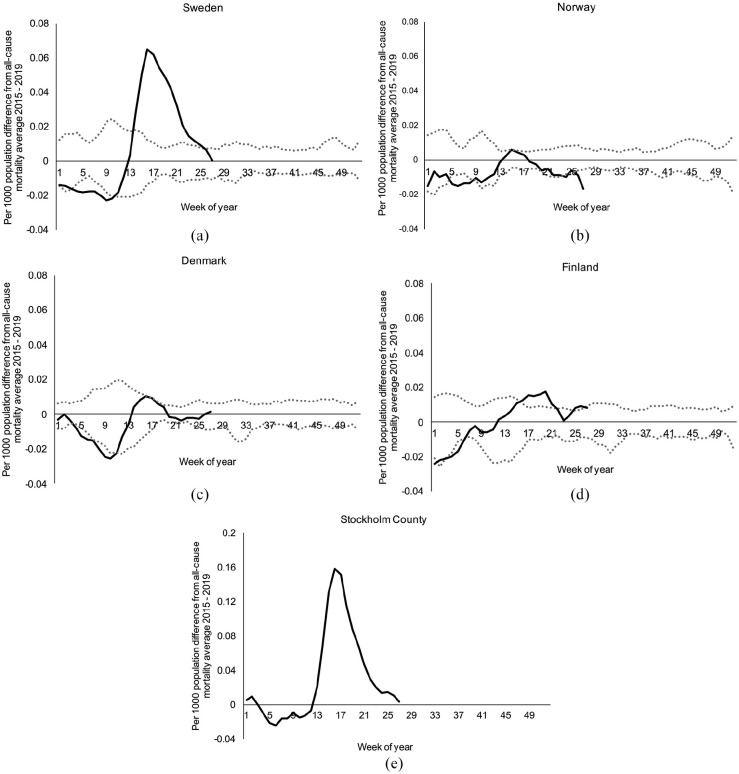
“Beginning in March, all-cause mortality rates increased to rates more consistent with the highest observed weekly mortality rate over the last 5 years.”
BackgroundInfluentialExcess mortality from COVID-19: a commentary on the Italian experience
Pasquariello, P., & Stranges, S. (2020) · International Journal of Public Health · doi:10.1007/s00038-020-01399-y · Cited by 23 · cited 3×
“Given that the median time from first symptoms of COVID-19 to death is 14 days (95% CI: 6–41)[13], government restrictions can be implemented as a form of early response measure to encourage a stronger shift in population behaviour before a rise in cases and deaths occurs [14, 15].”
BackgroundSelf-citationBrynildsrud, O. B., & Eldholm, V. (2020) · medRxiv · doi:10.1101/2020.03.20.20038406 · Cited by 7 · cited 1×
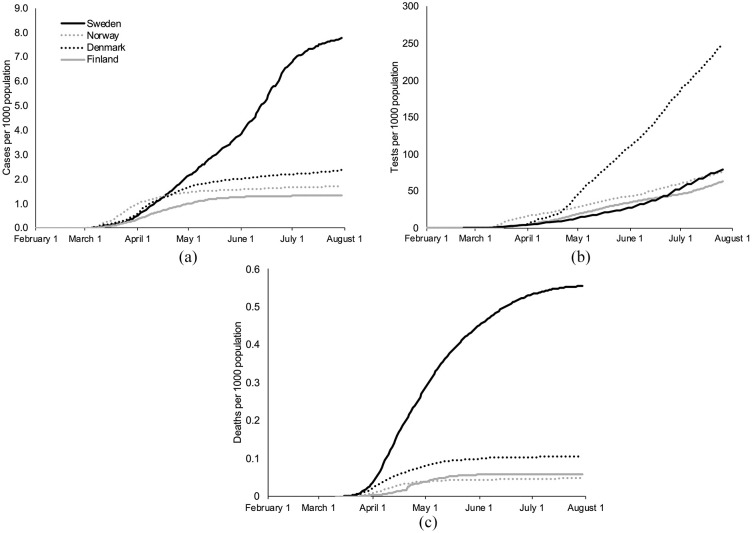
“Though all the Nordic countries were affected, Norway had high connectivity to this region [10], which may have contributed to a COVID-19 increase in cases per capita in March prior to its neighbours (Figure 1).”
Background
Research works printed but not linked: 2
- Tegnell A. Tegnell: Fler åtgärder hade behövts – Nyheter (Ekot) [ Tegnell: More preventive measures were needed], Sveriges Radio, sverigesradio.se/sida/artikel.aspx?programid=83&artikel=7487188 (accessed 14 July 2020).
- Hallengren L. Sweden’s response to COVID-19: April 23 WHO Briefing. Government Offices of Sweden, https://www.government.se/49960e/globalassets/government/dokument/socialdepartementet/powerpoint-presentation-sweden-ministry-of-health-23-april-who-briefing-pdf.pdf (2020, accessed 7 July 2020).
Cited by
Barber, R. M., Sorensen, R. J. D., Pigott, D. M., Bisignano, C., Carter, A., Amlag, J. O., Collins, J. K., Abbafati, C., Adolph, C., Allorant, A., et al. (2022) · The Lancet · doi:10.1016/s0140-6736(22)00484-6 · Cited by 298
“43 In these two countries, testing and contact tracing strategies, government restrictions, and mobility patterns varied substantially, 54 contributing to substantially different SARS-CoV-2 infection outcomes.”
Doomscrolling, Monitoring and Avoiding: News Use in COVID-19 Pandemic Lockdown
Ytre-Arne, B., & Moe, H. (2021) · Journalism Studies · doi:10.1080/1461670x.2021.1952475 · Cited by 207
Pizzato, M., Gerli, A. G., Vecchia, C. L., & Alicandro, G. (2024) · The Lancet Regional Health - Europe · doi:10.1016/j.lanepe.2024.100996 · Cited by 105
Media Use in Digital Everyday Life
Ytre-Arne, B. (2023) · Emerald Group Publishing Limited eBooks · doi:10.1108/9781802623833 · Cited by 89
A new estimation method for COVID-19 time-varying reproduction number using active cases
Hasan, A., Susanto, H., Tjahjono, V. R., Kusdiantara, R., Putri, E. R. M., Nuraini, N., & Hadisoemarto, P. F. (2022) · Scientific Reports · doi:10.1038/s41598-022-10723-w · Cited by 62
Metadata
- Authors
- Yarmol-Matusiak, E. A., Cipriano, L. E., & Stranges, S.
- Affiliations
- Western University (CA)
- Corresponding author
- Cipriano, Lauren E.
- Venue
- Scandinavian Journal of Public Health
- Publisher
- SAGE Publications
- Published
- 2021-01-07
- Volume
- 49
- Issue
- 1
- Pages
- 69-78
- ISSN
- 1403-4948 (ISSN-L)
- 1651-1905
- PMC
- PMC7797349
- OpenAlex
- W3120394932
- Cited by
- 111
- References
- 15
- Citations by year
- 2026: 10 · 2025: 9 · 2024: 19 · 2023: 23 · 2022: 32 · 2021: 18
- FWCI
- 8.97
- Type
- journal article
- Language
- en
- Open access
- hybrid
- doi.org
- Locations
- Scandinavian Journal of Public Health (publishedVersion, cc-by)
- PubMed Central (publishedVersion, cc-by)
- PubMed (publishedVersion)
- Scholarship@Western (Western University) (submittedVersion)
- Funders
- Western University (Catalyst Research Program)
- Topics
- Physical Sciences › Mathematics › Modeling and Simulation › COVID-19 epidemiological studies
- Social Sciences › Sociology and Political Science › COVID-19 Prevention and Impact
- Health Sciences › Medicine › Infectious Diseases › SARS-CoV-2 and COVID-19 Research
- Keywords
- COVID-19 pandemic, epidemiological indicators, Sweden, Norway, Denmark, Finland, all-cause mortality, COVID-19 mortality, case incidence, positivity rate, care home deaths, contact tracing, testing strategies, government restrictions, health system capacity, intensive care capacity, Nordic comparison
- MeSH terms
- COVID-19, COVID-19 Testing, Adolescent, Adult, Aged, Aged, 80 and over, Cause of Death, Child, Child, Preschool, Denmark, Finland, Humans, Infant, Infant, Newborn, Middle Aged, Mortality, Norway, Sweden, Age Distribution, Young Adult
About these checks
Registry, retraction, Cites and statistics results are computed, not judged, with one exception: a printed reference that no index lists is read once by a model before it counts as a citation error. Claims are extracted by a model and kept only when their quote appears verbatim in the text; each cited source is then checked, with a model’s help, for whether it says what the claim relies on. Those verdicts can be wrong — read the claim’s quote and the cited source before relying on one.
Statistics and arithmetic are recomputed, not judged.
Confidence bands are shown only for fields calibrated on our annotated test set. None is calibrated yet, so no band is shown.
What counts as a claim ›How we measure confidence ›How we check this ›
Are you an author, or do you see a problem with this page? Request a review
Data sources
Bibliographic data: Semantic Scholar, OpenAlex, Crossref.
Contains information from the Semantic Scholar Academic Graph Datasets, made available under the ODC Attribution License (ODC-BY 1.0).
Semantic Scholar’s data is described in: Kinney, R., et al. (2023). The Semantic Scholar Open Data Platform. arXiv:2301.10140.
