

Trends in older adults’ alcohol use in Norway 1985–2019
Open accessThe DOI matches its Crossref record; 17 of the 17 references it cites were found in a registry or an index.
Abstract
Aims: To examine the prevalence of and trends in older adults’ (60–79 years) alcohol use in Norway between 1985 and 2019. Methods: Data stem from two repeated cross-sectional surveys in the Norwegian population: Statistics Norway’s Health and Living Conditions Surveys from 1985 ( N = 7799), 1995 ( N = 3518) and 2005 ( N = 6487), and the Norwegian Institute of Public Health’s (NIPH) annual surveys on alcohol, tobacco and drug use from 2012/2013 ( N = 4047), 2014/2015 ( N = 4378), 2016/2017 ( N = 4264) and 2018/2019 ( N = 4330). The following measures were used to examine trends in alcohol use among women and men aged 60 and older: drinking status, drinking frequency, number of drinks per occasion, and frequency of heavy episodic drinking (HED). Results: Between 1985 and 2019, there has been a substantial increase in the proportions of older adults in Norway who drink alcohol and who drink relatively often. The increase was particularly marked between 1985 and 2012/2013, and for elderly women. However, the majority of older adults drink small amounts of alcohol on typical drinking occasions, illustrating that the increased frequency of drinking is not accompanied by a corresponding increase in risky drinking. Conclusions: There has been a marked increase in alcohol use among older adults the past 30 years, particularly among older women, suggesting that the age and gender gap traditionally found in alcohol use in Norway is diminishing. Due to the lower alcohol tolerance among elderly, monitoring the changing trends in alcohol use in this group, as well as the possible consequences of these changes, is important.
Overview
The claims and statistics of this paper haven’t been checked yet.
Free: it reads the open-access text and checks the first 5 claims that cite a source we can check. Create a free account to check every claim.
Integrity signals
Registry
Cites
Statistics
Figures
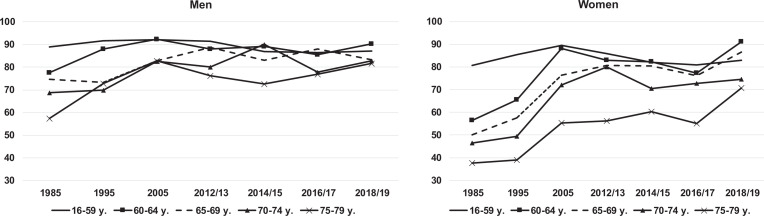
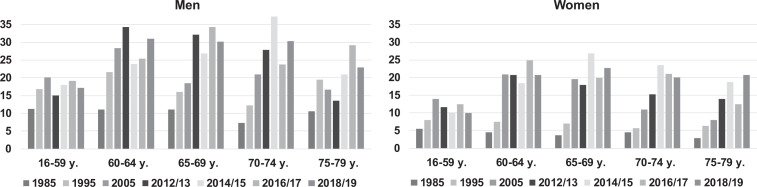
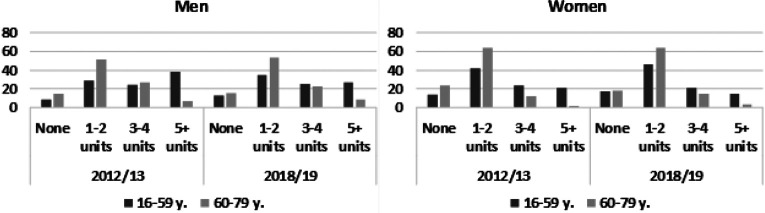
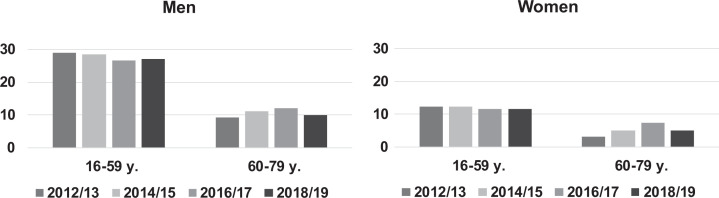
Verification
Claims the paper makes
The claims and statistics of this paper haven’t been checked yet.
Free: it reads the open-access text and checks the first 5 claims that cite a source we can check. Create a free account to check every claim.
Self-check
Percentages, sums and reported differences re-computed from the paper’s own numbers.
The self-check needs the paper’s full text.
Citations
Cites
Meta-analysis of the Impact of 9 Medication Classes on Falls in Elderly Persons
Woolcott, J. C. (2009) · Archives of Internal Medicine · doi:10.1001/archinternmed.2009.357 · Cited by 1,326 · cited 2×
“, heavy episodic drinking (HED), is particularly likely to increase the risk for acute health and social problems as well as the risk for accident injuries such as falls among older adults (Hartikainen et al., 2007; Woolcott et al., 2009).”
BackgroundMedication as a Risk Factor for Falls: Critical Systematic Review
Hartikainen, S., Lonnroos, E., & Louhivuori, K. (2007) · The Journals of Gerontology Series A: Biological Sciences and Medical Sciences · doi:10.1093/gerona/62.10.1172 · Cited by 596 · cited 2×
“For example, older adults often have a decreased tolerance for alcohol, and often suffer from conditions that worsen when drinking alcohol, such as impaired balance and confusion (Hartikainen et al., 2007; Woolcott et al., 2009).”
BackgroundRisks of combined alcohol/medication use in older adults
Moore, A. A., Whiteman, E. J., & Ward, K. T. (2007) · The American Journal of Geriatric Pharmacotherapy · doi:10.1016/j.amjopharm.2007.03.006 · Cited by 307 · cited 3×
“Older women are also more likely to be prescribed medicines (Berg, 2019) that can result in severe consequences when taken concomitantly with alcohol (Moore et al., 2007).”
BackgroundUnderreporting in Alcohol Surveys: Whose Drinking Is Underestimated?
Livingston, M., & Callinan, S. (2015) · Journal of Studies on Alcohol and Drugs · doi:10.15288/jsad.2015.76.158 · Cited by 300 · cited 1×
“Underreporting was more marked for young men and middleaged women and less marked for young women and older women (Livingston & Callinan, 2015).”
BackgroundHan, B. H., Moore, A. A., Sherman, S., Keyes, K. M., & Palamar, J. J. (2017) · Drug and Alcohol Dependence · doi:10.1016/j.drugalcdep.2016.11.003 · Cited by 260
Reducing fall risk in the elderly: risk factors and fall prevention, a systematic review.
Pfortmueller, C. A., Lindner, G., & Exadaktylos, A. (2014) · PubMed · Cited by 223
Sources of Error in Substance Use Prevalence Surveys
Johnson, T. P. (2014) · International Scholarly Research Notices · doi:10.1155/2014/923290 · Cited by 192 · cited 2×
“First, the prevalence of alcohol use is probably underestimated because heavy drinkers are typically underrepresented in surveys, and because alcohol use is underreported by survey respondents in general (Johnson, 2014).”
BackgroundUse and misuse of alcohol among older women.
Blow, F. C., & Barry, K. L. (2002) · PubMed Central · Cited by 133
Women, Aging, and Alcohol Use Disorders
Epstein, E. E., Fischer-Elber, K., & Al-Otaiba, Z. (2007) · Journal of Women & Aging · doi:10.1300/j074v19n01_03 · Cited by 133 · cited 3×
“In addition, because the trends in alcohol use seem to differ between women and men (Bye & Østhus, 2012), and because older women are particularly susceptible to alcohol use (Blow & Barry, 2002; Epstein et al., 2007), gender-specific analyses are warranted.”
BackgroundWilson, S. R., Knowles, S. B., Huang, Q., & Fink, A. (2013) · Journal of General Internal Medicine · doi:10.1007/s11606-013-2577-z · Cited by 63 · cited 3×
“, due to their lower ability to metabolise alcohol compared to men (Blow & Barry, 2002; Epstein et al., 2007; Wilson et al., 2014), older men still drink larger quantities and more often than older women and are thus still at greater risk of harming themselves and others.”
Background
Research works printed but not linked: 12
- 1. Amdam S. (2015. a). Undersøkelse om rusmidler og tobakk 2014. Dokumentasjon [Survey on drugs and tobacco 2014. Documentation report]. Notat 2015/20, Statistisk Sentralbyrå/Statistics Norway, Oslo–Kongsvinger.
- 2. Amdam S. (2015. b). Undersøkelse om rusmidler og tobakk 2015. Dokumentasjon [Survey on drugs and tobacco 2015. Documentation report]. Notat 2015/45, Statistisk Sentralbyrå/Statistics Norway, Oslo–Kongsvinger.
- 4. Babor T. F., Higgins-Biddle J. C., Saunders J. B., Monteiro M. G. (2001). The Alcohol Use Disorders Identification Test: Guidelines for Use in Primary Care. (2nd ed.). Geneva: World Health Organization.
- 7. Blow F. C., Barry K. L. (2002). Alcohol and substance misuse in older adults. Alcohol Research & Health, 26, 308–315.
- 10. Bye E. K., Rossow I. M. (2019). Alkoholbruk i den voksne befolkningen [Alcohol use in the adult population]. In Alkohol i Norge [Alcohol in Norway]. Nettrapport publisert 05.12.19. Folkehelseinstituttet.
- 13. Frydenlund R. (2011). Eldre, alkohol og legemiddelbruk. En kunnskapsoppsummering [Elderly, alcohol and drug use: An overview of research]. Kompetansesenter rus – Oslo, Rusmiddeletaten, Oslo kommune.
- 15. Hallgren M., Högberg P., Andréasson S. (2009). Alcohol consumption among elderly European Union citizens: Health effects, consumption trends and related issues. Swedish National Institute of Public Health.
- 18. Horverak Ø. (2006). Det norske drikkemønsteret – under endring? [The Norwegian drinking pattern – is it changing?]. In Bryhni A. (Ed.), Rusmidler i Norge 2006 [Alcohol and drugs in Norway 2006]. Statens institutt for rusmiddelforskning, Oslo.
- 19. Horverak Ø., Bye E. K. (2007). Det norske drikkemønsteret. En studie basert på intervjudata fra 1973–2004 [The Norwegian drinking pattern: A study based on analyses of survey data from 1973–2004]. Norwegian Institute for Alcohol and Drug Research.
- 29. Løset G. K., Slagsvold B. (2013). Alkohol i eldre år: Hvem drikker mer? [Alcohol in older years: Who drinks more?] In Daatland S. O., Slagsvold B. (Ed.), Vital aldring og samhold mellom generasjoner [Vital aging and intergenerational cohesion] (pp. 52–73). NOVA-rapport 15/13. http://www.hioa.no/Om-HiOA/Senter-for-velferds-ogarbeidslivsforskning/NOVA/Publikasjonar/Rapporter/2013/Vital-aldring-og-samhold-mellom-generasjoner
- 34. Ramm J. (2000). Helseundersøkelsene 1968, 1975, 1985, 1995, 1998 - dokumentasjon og spørreskjema [The health surveys 1968, 1975, 1985, 1995, 1998 – Documentation and questionnaire]. Notat 2000/55. Statistisk Sentralbyrå/Statistics Norway. https://www.ssb.no/a/publikasjoner/pdf/notat_200055/notat_200055.pdf
- 35. Ramstedt M. (2009). Alkoholkonsumtion och alkoholrelaterade problem bland äldre svenskar– hur ser det ut egentligen? [Alcohol consumption and alcohol-related problems among older Swedes – What does it really look like?]. Nordisk alkohol- og narkotikatidskrift, 26, 385–397.
Cited by
Stelander, L. T., Høye, A., Bramness, J. G., Selbæk, G., Lunde, L.-H., Wynn, R., & Grønli, O. (2021) · Substance Abuse Treatment Prevention and Policy · doi:10.1186/s13011-021-00376-9 · Cited by 51
Nadkarni, A., Bhatia, U., Bedendo, A., de Paula, T. C. S., de Andrade Tostes, J. G., Segura-Garcia, L., Tiburcio, M., & Andréasson, S. (2022) · International Journal of Mental Health Systems · doi:10.1186/s13033-022-00548-5 · Cited by 28
Explaining declining hip fracture rates in Norway: a population-based modelling study
Kjeldgaard, H. K., Holvik, K., Abrahamsen, B., Tell, G. S., Meyer, H. E., & O’Flaherty, M. (2023) · The Lancet Regional Health - Europe · doi:10.1016/j.lanepe.2023.100643 · Cited by 18
Comparing older people’s drinking habits in four Nordic countries: Summary of the thematic issue
Tigerstedt, C., Agahi, N., Bye, E. K., Ekholm, O., Härkönen, J., Jensen, H. A. R., Lau, C. J., Mäkelä, P., Moan, I. S., Parikka, S., et al. (2020) · Nordic Studies on Alcohol and Drugs · doi:10.1177/1455072520954326 · Cited by 23
Self-citationStelander, L. T., Høye, A., Bramness, J. G., Wynn, R., & Grønli, O. K. (2022) · BMC Geriatrics · doi:10.1186/s12877-022-02842-w · Cited by 11
Predictors and prevalence of hazardous alcohol use in middle-late to late adulthood in Europe
Tschorn, M., Schulze, S., Förstner, B. R., Holmberg, C., Spallek, J., Heinz, A., & Rapp, M. A. (2022) · Aging & Mental Health · doi:10.1080/13607863.2022.2076208 · Cited by 15
“(2018) observed an increase of 3.4% per year (2000–2016) in binge drinking in the US among OA (65+), and in Norway, the proportion of OA (60+) reporting any heavy episodic drinking within the last year rose from 17% in 1985 to 30% in 2017 (Bye & Moan, 2020).”
BackgroundInfluentialCurrent Interventions for People Living with HIV Who Use Alcohol: Why Gender Matters
Wechsberg, W. M., Browne, F. A., Bonner, C. P., Washio, Y., Howard, B. N., & van der Drift, I. (2021) · Current HIV/AIDS Reports · doi:10.1007/s11904-021-00558-x · Cited by 10
Xie, Z., Zhang, Z., Bi, K., Huang, S., Zhao, M., & Du, J. (2025) · Journal of Affective Disorders · doi:10.1016/j.jad.2025.03.134 · Cited by 9
Age, period and cohort effects on alcohol‐related risky behaviours in Australia from 2001 to 2016
Yuen, W. S., Peacock, A., Man, N. W. Y., Callinan, S., Slade, T. N., Farrell, M., Mattick, R. P., & Livingston, M. (2022) · Addiction · doi:10.1111/add.16061 · Cited by 8
“While the prevalence of alcohol consumption and binge drinking across Europe, North America and Oceania appears to have increased since the early 2000s in people aged 50 years or older [2 – 4], this has not been the case throughout all age groups and birth cohorts.”
BackgroundSantora, L., Byrne, D. G., & Klöckner, C. A. (2022) · Nordic Studies on Alcohol and Drugs · doi:10.1177/14550725211073006 · Cited by 9
“…is often underscored, alcohol-linked deterioration of physical and mental health, especially in older people, is a highly relevant individual and societal threat (Anderson & Scafato, 2010; Behrendt et al., 2021; Bye & Moan, 2020; Emiliussen et al., 2017; Hallgren et al., 2010; Sorock et al., 2006).”
BackgroundLlaha, F., Licaj, I., Sharashova, E., Borch, K. B., & Lukic, M. (2025) · Alcohol and Alcoholism · doi:10.1093/alcalc/agaf005 · Cited by 5
“Western countries, including Norway, are experiencing increases of alcohol consumption among women and older adults (Barry and Blow 2016, Keyes et al. 2019, McCaul et al. 2019, Bye and Moan 2020, Stelander et al. 2021).”
Stelander, L. T., Lorem, G. F., Høye, A., Bramness, J. G., Wynn, R., & Grønli, O. (2023) · Archives of Public Health · doi:10.1186/s13690-023-01035-0 · Cited by 6
Tevik, K., Skråstad, R. B., Benth, J. Š., Selbæk, G., Bergh, S., Eldholm, R. S., Krokstad, S., & Helvik, A. (2024) · PLoS ONE · doi:10.1371/journal.pone.0304714 · Cited by 6
Gender-specific characteristics of alcohol use in community-dwelling older adults in Belgium
van Gils, Y., Dom, G., Dierckx, E., van Alphen, S. P. J., & Franck, E. (2022) · Clinical Gerontologist · doi:10.1080/07317115.2022.2137074 · Cited by 4
“Recently, a noticeable increase in AU among older adults has been observed, especially in older women (Bye & Moan, 2020; Grant et al., 2017).”
BackgroundIntroduction to the special section on drinking patterns in older age
Tigerstedt, C., & Bloomfield, K. (2020) · Nordic Studies on Alcohol and Drugs · doi:10.1177/1455072520967864 · Cited by 2
Nichol, B., Charlton, C., Scott, J., Steer, M., Sattar, Z., & Haighton, C. (2025) · Ageing and Society · doi:10.1017/s0144686x25000145 · Cited by 2
“Concurrently, in recent years there has been a small but steady increase in the amount of alcohol consumed by older adults (Bye and Moan 2020; John 2018).”
Culture and aging: The role of culture, race, and ethnicity
Madarasmi, S., Trinh, N., & Ahmed, I. I. K. (2025) · Oxford University Press eBooks · doi:10.1093/med/9780198874799.003.0001 · Cited by 1
Alcohol, drugs, tobacco and gambling form a lens for the Nordic welfare states’ biggest challenges
Hellman, M. (2023) · Nordic Studies on Alcohol and Drugs · doi:10.1177/14550725231166557 · Cited by 1
“Elderly citizens have a higher use of psychotropic drugs and alcohol consumption than previous generations (e.g., Bye & Moan, 2020).”
BackgroundWho initiates Nordic comparisons?
Hellman, M. (2020) · Nordic Studies on Alcohol and Drugs · doi:10.1177/1455072520973557
Lima, D. W. D. C. (2023) · Digital Library of Theses and Dissertations (Universidade de São Paulo) · doi:10.11606/t.22.2023.tde-09082023-164723 · Cited by 2
Høiland, K., Arnevik, E. A., Nielsen, A. S., & Egeland, J. (2025) · Nordic Journal of Psychiatry · doi:10.1080/08039488.2025.2508415 · Cited by 3
“Older persons are consuming more alcohol, and among women, alcohol use in the group over 60 years has increased by 30% during the last 30 years [10,11].”
Stelander, L. T., Høye, A., Bramness, J. G., Selbæk, G., Lunde, L.-H., Wynn, R., & Grønli, O. (2021) · Figshare · doi:10.6084/m9.figshare.14684752
Stelander, L. T., Høye, A., Bramness, J. G., Selbæk, G., Lunde, L.-H., Wynn, R., & Grønli, O. (2021) · Figshare · doi:10.6084/m9.figshare.14684749
Stelander, L. T., Lorem, G. F., Høye, A., Bramness, J. G., Wynn, R., & Grønli, O. (2023) · Figshare · doi:10.6084/m9.figshare.22605953
Using PEth and AUDIT-4 to Detect Harmful Alcohol Use Among People with Severe Substance Use
Auestad, N., Jørgenrud, B., Bogstrand, S. T., Vallersnes, O., Lerdal, A., & Wüsthoff, L. (2026) · Substance Use & Misuse · doi:10.1080/10826084.2026.2634253
“Alcohol use the previous 12 months was reported by 76% of the participants in our study, similar to the prevalence in European countries, but somewhat lower than the general population in Norway (85% in 2018–2019) (Bye & Moan, 2020).”
Metadata
- Authors
- Bye, E. K., & Moan, I. S.
- Affiliations
- Norwegian Institute of Public Health (NO)
- Corresponding author
- Bye, Elin K
- Venue
- Nordic Studies on Alcohol and Drugs
- Publisher
- SAGE Publications
- Published
- 2020-09-15
- Volume
- 37
- Issue
- 5
- Pages
- 444-458
- ISSN
- 1455-0725 (ISSN-L)
- 1458-6126
- PMC
- PMC8899062
- OpenAlex
- W3088389143
- Cited by
- 26
- References
- 17
- Citations by year
- 2026: 1 · 2025: 5 · 2024: 1 · 2023: 5 · 2022: 7 · 2021: 4 · 2020: 3
- FWCI
- 3.41
- Type
- journal article
- Language
- en
- Open access
- diamond
- doi.org
- Licence
- Locations
- Nordic Studies on Alcohol and Drugs (publishedVersion, cc-by-nc)
- PubMed Central (publishedVersion, cc-by-nc)
- PubMed (publishedVersion)
- NORA - Norwegian Open Research Archives (submittedVersion, other-oa)
- Topics
- Health Sciences › Medicine › Epidemiology › Substance Abuse Treatment and Outcomes
- Health Sciences › Medicine › Pathology and Forensic Medicine › Alcohol Consumption and Health Effects
- Health Sciences › Medicine › Geriatrics and Gerontology › Pharmaceutical Practices and Patient Outcomes
- Keywords
- older adults, alcohol consumption, alcohol consumption trends, binge drinking, drinking frequency, gender differences in drinking, older women, alcohol tolerance, Norway
About these checks
Registry, retraction, Cites and statistics results are computed, not judged, with one exception: a printed reference that no index lists is read once by a model before it counts as a citation error. Claims are extracted by a model and kept only when their quote appears verbatim in the text; each cited source is then checked, with a model’s help, for whether it says what the claim relies on. Those verdicts can be wrong — read the claim’s quote and the cited source before relying on one.
Statistics and arithmetic are recomputed, not judged.
Confidence bands are shown only for fields calibrated on our annotated test set. None is calibrated yet, so no band is shown.
What counts as a claim ›How we measure confidence ›How we check this ›
Are you an author, or do you see a problem with this page? Request a review
Data sources
Bibliographic data: Semantic Scholar, OpenAlex, Crossref.
Contains information from the Semantic Scholar Academic Graph Datasets, made available under the ODC Attribution License (ODC-BY 1.0).
Semantic Scholar’s data is described in: Kinney, R., et al. (2023). The Semantic Scholar Open Data Platform. arXiv:2301.10140.
