

College students’ literacy, ChatGPT activities, educational outcomes, and trust from a digital divide perspective
Open accessThe DOI matches its Crossref record, with a small difference in title or year; 73 of the 73 references it cites were found in a registry or an index; 11 of the 60 sources its claims cite were checked for support.
Abstract
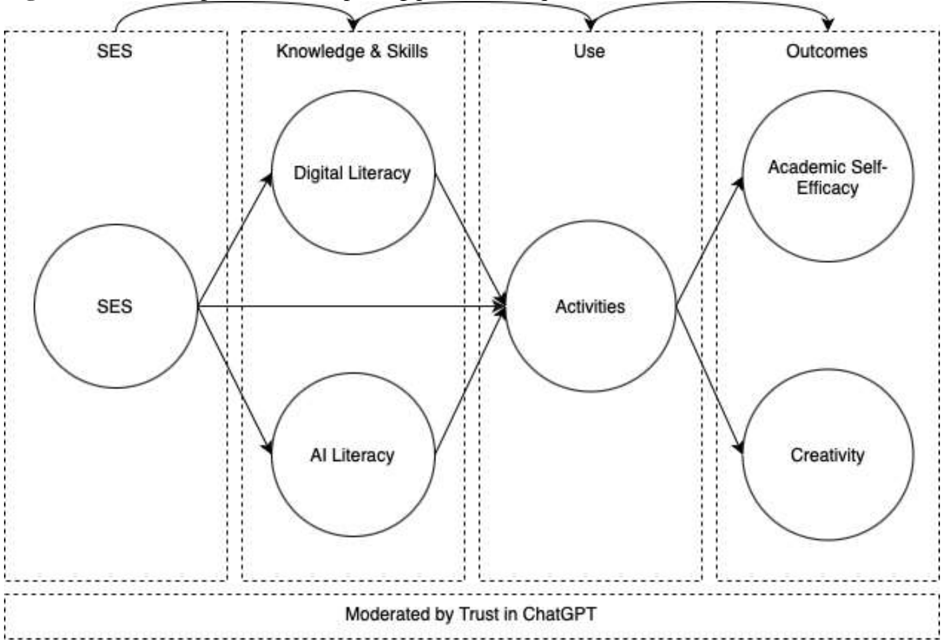
This study investigates the association of socioeconomic status (SES) and digital and AI literacy with types of Chat GPT use by college students, with subsequent implications for academic self-efficacy and creativity, conditioned by trust. Analyses of a survey of U.S. college students (N = 947) show that SES has a greater association with AI literacy than with general digital literacy. Two dimensions of Chat GPT activities emerge: academic support and displacement. Structural equation modeling reveals that AI literacy is positively associated with both activity dimensions, while digital literacy is unexpectedly a negative contributor. Further, academic support is strongly linked to positive outcomes whereas academic displacement is negatively associated. Attitudinal trust in Chat GPT moderates the overall relationships. Our findings suggest that conventional digital inequality persists and evolves with generative AI, traditional digital literacy becomes insufficient in the age of AI, and trust in this new and opaque digital technology influences these relationships.
Overview
CoChat Summary
TL;DR
Applying a digital divide framework to 947 U.S. college ChatGPT users, the study identifies two activity dimensions—academic support and academic displacement—and finds family SES and AI literacy predict greater use while student SES and digital literacy predict less. Support activities are positively associated, and displacement negatively associated, with academic self-efficacy and creativity, with trust moderating several paths.
Key findings
- CFA confirmed two ChatGPT academic activity dimensions: academic support (8 items; Omega = .94) and academic displacement (4 items; Omega = .91).
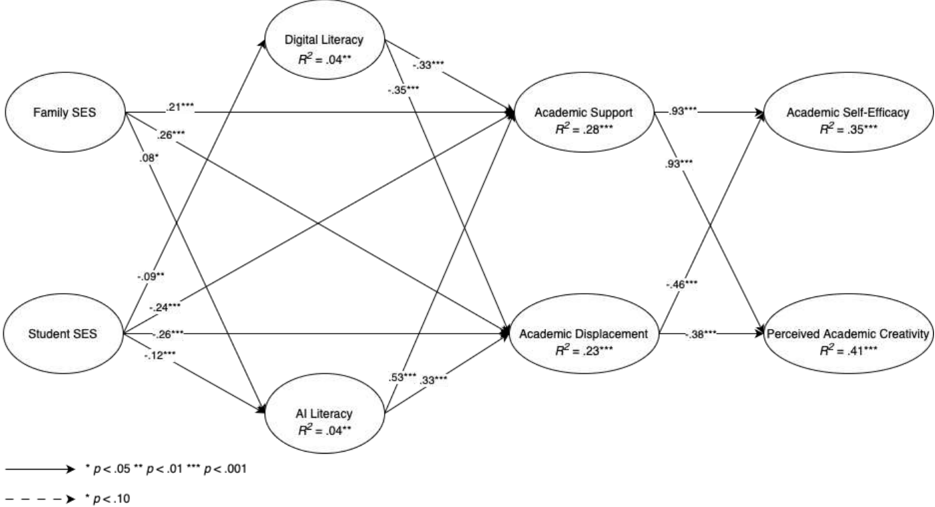
- Family SES was positively associated with AI literacy (β = .08, p = .05), academic support (β = .21, p < .001), and academic displacement (β = .26, p < .001); student SES was negatively associated with digital literacy (β = -.08, p = .01), AI literacy (β = -.12, p = .01), support (β = -.24, p < .001), and displacement (β = -.26, p < .001). H1 was contradicted.
- Digital literacy was negatively related to support (β = -.33, p < .001) and displacement (β = -.35, p < .001); AI literacy was positively related to support (β = .53, p < .001) and displacement (β = .33, p < .001).
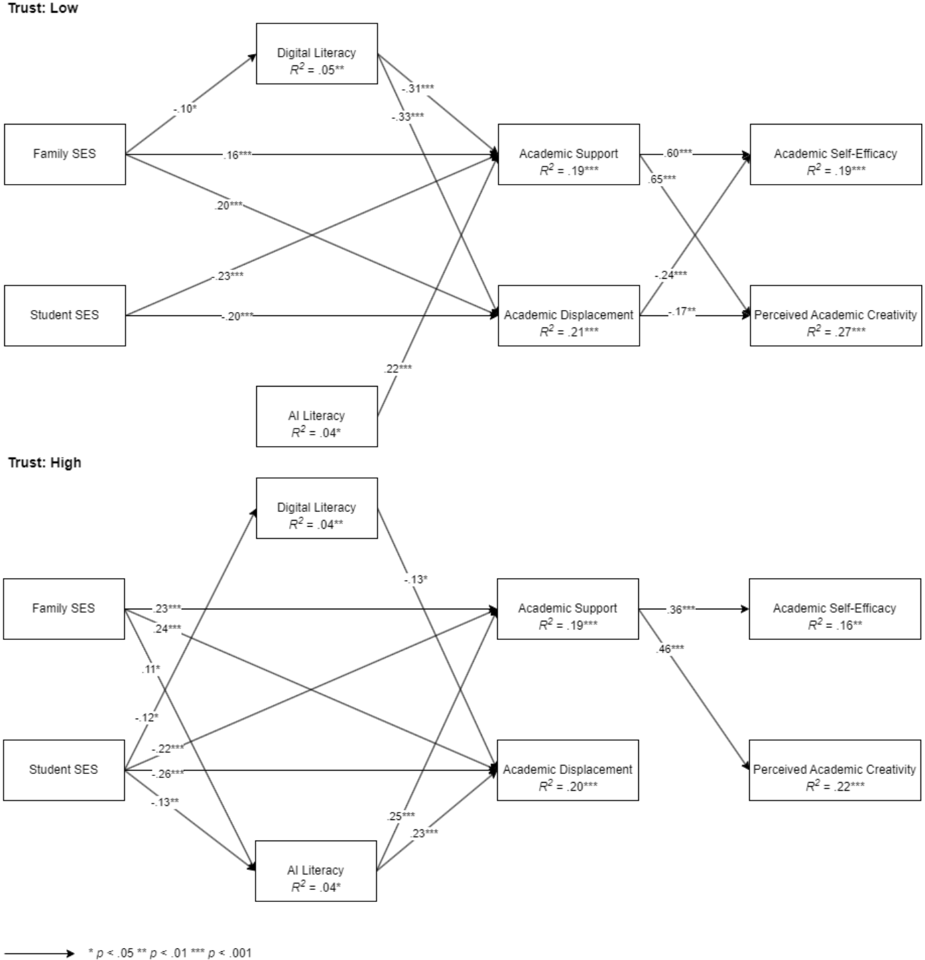
- Support was positively associated with ASE and PAC (β = .93 for both, p < .001), while displacement was negatively associated with ASE (β = -.46, p < .001) and PAC (β = -.38, p < .001). Under low trust, support-outcome links were stronger (ASE β = .60 vs .36; PAC β = .65 vs .46), and displacement was negatively associated with outcomes only under low trust (ASE β = -.24, p < .001; PAC β = -.17, p = .007).
Methods
- Pilot survey N = 360 college students at one university (Oct 9–Nov 14) assessed measurement validity/reliability; full study recruited a purposive, non-representative national sample of 947 U.S. ChatGPT users via Qualtrics in Nov 2023, aged 18–35, from 4-year colleges/universities (excluding city/community colleges, online programs, and international exchange students).
- Measures included SES (7 questions; EFA yielded family SES, 5 items, Omega = .72, and student SES, first-generation status and % loans, Spearman’s rho = .16, p < .001), digital literacy (8 seven-point items, Omega = .90), AI literacy (12 items from Wang et al., second-order Omega = .89 after removing awareness dimension), 12 ChatGPT activity frequencies (5-point scale), ASE (4 items, Omega = .89), PAC (4 items, Omega = .91), and trust (4 items, Omega = .88).
- Analysis used CFA and SEM in Mplus 8.10 with MLR due to non-normality; model fit RMSEA = .04, CFI = .95, SRMR = .07. Moderation was examined via split-sample path analysis (low vs. high trust).
Limitations
- Stated: the full sample was national but not representative of U.S. college students; the study is cross-sectional; future research should use longitudinal data, objective measures of ChatGPT use and outcomes, and qualitative/mixed-methods designs; gender and race/ethnicity divides were not hypothesized and should be explored.
- Stated/evident: split-sample path analysis cannot test the significance of moderation/interaction terms, only provide an overview of path differences.
- Evident: the sample is limited to ChatGPT users aged 18–35 at 4-year colleges/universities, excluding community colleges, online programs, and international exchange students, so findings do not generalize to non-users or those student populations; activity and outcome measures are self-reported (the paper calls for objective measures).
Model-written summary. Check it against the paper before relying on it.
Integrity signals
Registry
Cites
Statistics
Figures
Verification
Claims the paper makes
11 Valid · 0 Not valid · 34 Not checked · 64 Own results and interpretations
The cited sources support only part of this claim — read each source’s verdict below.
In the paper
“We further dropped one item about collaboration and included 8 seven-point Likert items that focus on individuals' digital literacy (Omega = .90).”
What the sources say
- Not matchedcites Ng's (2012)
This doesn’t read as a citation we can look up.
- Partly supportedcites Nikou et al. (2022) matched to “Workplace literacy skills—how information and digital literacy affect adoption of digital technology” (2022) sourceExperimental — accuracy not yet measured
The Measures and survey instruments section says the paper used seven-point Likert items for digital literacy. Its measurement-model discussion and Table 3 show nine retained digital-literacy items, not eight, and Table 3 reports Cronbach’s α = .93 rather than Omega = .90. The citing sentence describes dropping a collaboration item and reports its own reliability estimate; those details are not measurements reported by the cited paper. (LLM, conf=0.88)
plain- Asserted: passes — The authors put it forward as true.
- Checkable: passes — It can be checked against evidence.
- Load-bearing: passes — The paper’s conclusions depend on it.
- Based: passes — The paper gives a reason why it holds.
- Not matched
None of the sources cited for this claim have been checked yet.
In the paper
“Conversely, AI literacy positively contributed to use. Returning to the ongoing debate regarding whether AI-specific literacy is a necessity in the new era (e.g., Ng et al., 2021; Olari and Romeike, 2021; Wang et al., 2022), we find that AI literacy provided stronger explanatory power than conventional digital literacy.”
What the sources say
- Not matchedcites Ng et al., 2021
This doesn’t read as a citation we can look up.
- Not checked — no full text of the sourcecites Olari and Romeike, 2021 matched to “Addressing AI and Data Literacy in Teacher Education: A Review of Existing Educational Frameworks” (2021) source
- Not matchedcites Wang et al., 2022
An author–year citation the paper’s reference list doesn’t settle. We don’t search these by name.
plainstates an association- Asserted: passes — The authors put it forward as true.
- Checkable: passes — It can be checked against evidence.
- Load-bearing: passes — The paper’s conclusions depend on it.
- Based: passes — The paper gives a reason why it holds.
- Rests on an assumption not shown here.
- Not matched
A result the paper reports from its own data — it cites no other source for it, so there is none to check. The quote shows it is in the paper.
In the paper
“Accordingly, two factor scores were generated ( r = .19, p < .001).”
plainstates an association- Asserted: passes — The authors put it forward as true.
- Checkable: passes — It can be checked against evidence.
- Load-bearing: passes — The paper’s conclusions depend on it.
- Based: passes — The paper gives a reason why it holds.
A result the paper reports from its own data — it cites no other source for it, so there is none to check. The quote shows it is in the paper.
In the paper
“For RQ1a, CFA (RMSEA = .07, CFI = .97, SRMR = .03) confirmed two dimensions of ChatGPT use for educational activities revealed by the pilot study: academic support (#1-#8; Omega = .94), and academic displacement (#9-#12; Omega = .91).”
plain- Asserted: passes — The authors put it forward as true.
- Checkable: passes — It can be checked against evidence.
- Load-bearing: passes — The paper’s conclusions depend on it.
- Based: passes — The paper gives a reason why it holds.
A result the paper reports from its own data — it cites no other source for it, so there is none to check. The quote shows it is in the paper.
In the paper
“while the influence of student SES was negative ( β = -.12, p = .01).”
plainstates an association- Asserted: passes — The authors put it forward as true.
- Checkable: passes — It can be checked against evidence.
- Load-bearing: passes — The paper’s conclusions depend on it.
- Based: passes — The paper gives a reason why it holds.
44 more claims
Create a free account to see all 109 claims and to verify the 2 references still open.
- Probably not a substantial claim. 41
- It may state two separate claims as one. 30
- The quote only partly states this claim. 1
Self-check
Percentages, sums and reported differences re-computed from the paper’s own numbers.
Each contradiction between two passages listed here was confirmed by an independent check.
Rated major: it would touch a result — a value a result rests on, reported and recomputed p-values on opposite sides of the significance level, two passages that conflict with no sign which is right, or a cited work retracted before this paper was published.
In the paper
§ Discussion · p. 14
“| RQ3b . How are dimensions of ChatGPT academic activities associated with creativity? | Support positive Displacement positive”
§ Activities with Outcomes · p. 12
“support ( β = .93, p < .001) and displacement ( β = -.38, p < .001) were significantly associated with PAC.”
Rated minor: it would not touch a result — a value no result rests on, a p-value that stays on the same side of the significance level, or a conflict that is clerical, resolved elsewhere in the paper, or outside its own findings.
In the paper
§ Socioeconomic Status · p. 8
“Accordingly, two factor scores were generated ( r = .19, p < .001).”
§ Table 4. Pearson correlations · p. 10
“| 2 Student SES | .206 **”
Rated minor: it would not touch a result — a value no result rests on, a p-value that stays on the same side of the significance level, or a conflict that is clerical, resolved elsewhere in the paper, or outside its own findings.
In the paper
§ College Students' Literacy, ChatGPT Activities, Educational Outcomes and Trust from a Digital Divide Perspective Appendix A: Review and Derivation of SES Measures · p. 24
“These were used to identify the two factors of SES used in this study: Family SES (the first five), and Student SES (the second five).”
§ Socioeconomic Status · p. 8
“The second factor was student SES (first-generation college student status, percentage of student loans; Spearman's rho = .16, p < .001).”
Citations
Cites
Hu, L., & Bentler, P. M. (1999) · Structural Equation Modeling A Multidisciplinary Journal · doi:10.1080/10705519909540118 · Cited by 108,788 · cited 1×
“We performed confirmatory factor analysis (CFA) based on the cutoff values (RMSEA ⩽ .06, SRMR ⩽ .08, and CFI ⩾ .95) proposed by Hu and Bentler (1999).”
Confirmatory factor analysis for applied research
(2007) · Choice Reviews Online · doi:10.5860/choice.44-2769 · Cited by 15,614
ChatGPT for Good? On Opportunities and Challenges of Large Language Models for Education
Kasneci, E., Seßler, K., Küchemann, S., Bannert, M., Dementieva, D., Fischer, F., Gasser, U., Groh, G., Günnemann, S., Hüllermeier, E., et al. (2023) · doi:10.35542/osf.io/5er8f · Cited by 7,552
ChatGPT for good? On opportunities and challenges of large language models for education
Kasneci, E., Sessler, K., Küchemann, S., Bannert, M., Dementieva, D., Fischer, F., Gasser, U., Groh, G., Günnemann, S., Hüllermeier, E., et al. (2023) · Learning and Individual Differences · doi:10.1016/j.lindif.2023.102274 · Cited by 7,326 · cited 3×
“In addition, concerns abound regarding its potential for misuse and overreliance (Fui-Hoon Nah et al., 2023; Kasneci et al., 2023), thereby hindering learning outcomes.”
Voices of the Mind: Sociocultural Approach to Mediated Action
Wertsch, J. V. (1993) · doi:10.4159/9780674045101 · Cited by 4,099
BAİDOO-ANU, D., & OWUSU ANSAH, L. (2023) · Journal of AI · doi:10.61969/jai.1337500 · Cited by 3,939
What is AI Literacy? Competencies and Design Considerations
Long, D., & Magerko, B. (2020) · Proceedings of the 2020 CHI Conference on Human Factors in Computing Systems · doi:10.1145/3313831.3376727 · Cited by 3,241 · cited 1×
“Definitions of AI literacy (e.g. Carter et al., 2020; Cetindamar et al., 2022; Laupichler et al., 2022; Long and Magerko, 2020; Ng et al., 2021) emphasize the need to take both a technical and a social perspective.”
Sallam, M. (2023) · Healthcare · doi:10.3390/healthcare11060887 · Cited by 3,126 · cited 2×
“However, others emphasize that ChatGPT is inherently limited in content quality, accuracy, and validity (Baidoo-Anu et al., 2023; Sallam, 2023), which can mislead students.”
Chatting and cheating: Ensuring academic integrity in the era of ChatGPT
Cotton, D. R. E., Cotton, P. A., & Shipway, J. R. (2024) · Innovations in Education and Teaching International · doi:10.1080/14703297.2023.2190148 · Cited by 3,087 · cited 2×
“Thus, the use of ChatGPT can exacerbate fairness issues by putting non-users at a disadvantage (Cotton et al., 2023), and ultimately reinforcing digital inequality (Fui-Hoon Nah et al., 2023; Mhlanga, 2023).”
Chatting and Cheating. Ensuring academic integrity in the era of ChatGPT
Cotton, D., Cotton, P., & Shipway, J. R. (2023) · doi:10.35542/osf.io/mrz8h · Cited by 3,079
Research works printed but not linked: 3
- Atlas S (2023) ChatGPT for Higher Education and Professional Development: A Guide to Conversational AI. Kingston, RI: University of Rhode Island.
- Dickinson, E. R., & Adelson, J. L. (2014). Exploring the limitations of measures of students' socioeconomic status (SES). Practical Assessment, Research, and Evaluation , 19 (1), 1. https://scholarworks.umass.edu/pare/vol19/iss1/1 DOI: https://doi.org/10.7275/mknad373 · doi:10.7275/mknad373
- Van Dijk, J. (2020). The digital divide . John Wiley & Sons.
Cited by
Wang, F., Li, N., Cheung, A. C. K., & Wong, G. K. W. (2025) · International Journal of Educational Technology in Higher Education · doi:10.1186/s41239-025-00547-9 · Cited by 69
“Some studies have employed descriptive statistics and experimental methods to examine the impact of productivity gains from GenAI use on text generation, grammatical error correction, and sentence and paragraph refinement (e.g., Guo et al., 2023; Zhang et al., 2024b).”
Bewersdorff, A., Nerdel, C., & Zhaı, X. (2025) · Computers and Education Artificial Intelligence · doi:10.1016/j.caeai.2025.100493 · Cited by 49
Yao, J., Zhou, Z., Cui, H., Ouyang, Y., & Han, W. (2025) · BMC Medical Ethics · doi:10.1186/s12910-025-01300-7 · Cited by 28
“This relationship has been validated in various contexts, including educational AI usage, online health information-seeking behavior, and medical auxiliary AI applications [40, 68, 70].”
Zhang, C. (., Wang, L. H., & Rice, R. E. (2025) · Computers and Education Artificial Intelligence · doi:10.1016/j.caeai.2025.100385 · Cited by 29
Self-citationDeng, N., Liu, E. J., & Zhaı, X. (2025) · Lecture notes in computer science · doi:10.1007/978-3-031-98414-3_20 · Cited by 31
Özbay, Ö. (2026) · Osmangazi Journal of Educational Research · doi:10.59409/ojer.1755463 · Cited by 12
Madsen, D. Ø., & Toston, D. M. (2025) · Digital · doi:10.3390/digital5030024 · Cited by 18
“Communities with limited internet access, outdated hardware, or low digital literacy face barriers to using such tools effectively [143,153,154].”
Generative AI, Cognitive Offloading, and Learner Agency in Higher Education: A Scoping Review
Wang, G., Wang, W., Yang, D., & Ren, J. (2026) · Behavioral Sciences · doi:10.3390/bs16071150 · Cited by 20
“Wang and Zhang (2026) proposed that pedagogical partnerships with GenAI may activate two cognitive pathways simultaneously: vigilance and offloading.”
InfluentialHằng, N. P. T., Nguyen, N. T. T., & Huynh, T. B. (2026) · Discover Artificial Intelligence · doi:10.1007/s44163-026-01043-3 · Cited by 14
Navigating the human-AI divide: Boundary work in the age of generative AI
Kim, Y. J., Zhang, X., & Fang, C. (2025) · Computers in Human Behavior Artificial Humans · doi:10.1016/j.chbah.2025.100214 · Cited by 9
Self-citationChen, Z., Guo, W., Zhang, Y., Liu, X., Li, B., & Wang, H. (2026) · International Journal of Human-Computer Interaction · doi:10.1080/10447318.2026.2634251 · Cited by 4
Kurdal, C., & Kaplan, A. (2026) · Kastamonu Eğitim Dergisi · doi:10.24106/kefdergi.1877948 · Cited by 7
The Impact of Age Groups' Attitudes Towards Artificial Intelligence and Data Protection
Kubovics, M. (2025) · International Journal of Business and Economics Research · doi:10.11648/j.ijber.20251403.13 · Cited by 9
Latent profiles of AI literacy among K-12 students: predictors and links to self-regulated learning
Wang, D., Wang, Q., & Zhang, S. (2026) · Frontiers in Psychology · doi:10.3389/fpsyg.2026.1834851 · Cited by 7
“Moreover, compared with the study by Zhang et al. (2024), which focused on students in higher education, our work further extends this relationship to the K-12 context.”
Xue, H., Oh, Y. J., Zhou, X., Zhang, X., & Oxley, B. (2026) · Scientific Reports · doi:10.1038/s41598-026-42465-4 · Cited by 12
“Prior research shows that individuals with higher family socioeconomic status 27 tend to have higher AI literacy, are more likely to use AI for work and education, and use more abstract language in AI conversations 28 .”
Self-citationThe impact of AI usage, literacy and proactive innovation behavior on scholars' mental health
Gao, X., Ding, Y., ZHANG, H., Liang, W., & Zuo, R. (2026) · Industrial Management & Data Systems · doi:10.1108/imds-05-2025-0593 · Cited by 5
Kantek, J., James, D., Arachchi, T. M., & Goggin, G. M. (2026) · Communication Research and Practice · doi:10.1080/22041451.2026.2721183 · Cited by 1
Fu, Z., Liang, X., & Xie, X. (2026) · Current Psychology · doi:10.1007/s12144-026-09580-x · Cited by 1
Who gets to use ChatGPT? A global study on digital access and inequality in higher education
BENCSIK, A., Jenei, S., & Szalai, S. V. M. (2026) · Social Sciences & Humanities Open · doi:10.1016/j.ssaho.2026.102479 · Cited by 9
Teaching with Pride: An Ecological Framework for Writing Teacher Agency in an Ai-Driven EraPreprint
Vaezi, M. (2025) · SSRN Electronic Journal · doi:10.2139/ssrn.5365492 · Cited by 1
Zhang, Z. (2026) · International Journal of Education and Social Development · doi:10.54097/tn5r4821
“The one with a greater literacy is more likely to benefit from it, whereas the one with a lower literacy may fall into passive dependence [9].”
Araujo, T. (2026) · AI & Society · doi:10.1007/s00146-026-03279-0 · Cited by 3
Wiboolyasarin, W., Wiboolyasarin, K., Kamonsawad, R., Tiranant, P., & Jinowat, N. (2026) · Computers & composition/Computers and composition · doi:10.1016/j.compcom.2026.103026 · Cited by 1
Zheng, H., Han, F., Yang, H., Xu, J., Wu, Y., Wu, J., & Li, T. (2026) · Behaviour and Information Technology · doi:10.1080/0144929x.2026.2711024 · Cited by 3
Reyes, C. A. R., Jiménez, K. I. R., Gastelo, N. E. M., & Farroñán, E. V. R. (2026) · Frontiers in Education · doi:10.3389/feduc.2026.1864949
Sun, F., & Li, M. (2026) · Interactive Learning Environments · doi:10.1080/10494820.2026.2689104
Zhang, Z., & An, F. (2026) · Sustainability · doi:10.3390/su18136925
Tan, J., Zhang, S., Li, J., Wang, M., & Wang, M. (2026) · Current Psychology · doi:10.1007/s12144-026-09796-x
“While prior studies drawing on self-determination theory (Zhang et al., 2024 ), conservation of resources theory (Zhou & Peng, 2025 ), and theory of planned behavior (Ji et al., 2025 ) have identified isolated antecedents of creativity (e.g., GenAI use, creative self-efficacy), a systematic account…”
Cao, H., Zhang, Q.-X., Zeng, G., Dong, C., & Li, F. (2026) · 2026 IEEE International Conference on Innovation, Ethics & Emerging Tech in Engineering and Computing Education (IE2C) · doi:10.1109/ie2c69620.2026.11663043
“…route follows the progressive logic of "data collection → sentiment annotation → topic discovery → keyword distinction", striving to fully restore the overall picture of "catalyst" and "crutch" discourse from the three levels of macro distribution, meso theme, and micro vocabulary[16][17].”
Manganello, F., Masi, G., Nico, A., & Boccuzzi, G. (2026) · Frontiers in Human Dynamics · doi:10.3389/fhumd.2026.1787728 · Cited by 1
Suwaidan, H. I. A., Althumairi, A., Al-Rayes, S., & Alkhurayji, K. S. (2026) · JMIR Formative Research · doi:10.2196/79276 · Cited by 3
“According to previous research, higher educational and socioeconomic levels may also affect the use of AI-based applications such as ChatGPT [24-26].”
Generative AI in Engineering Education: Equity-Enhancing Tool or Digital Divide Deepener?
Biswas, R. (2026) · IEEE Global Engineering Education Conference (EDUCON) · doi:10.1109/educon67543.2026.11574391 · Cited by 1
“Emerging evidence also shows that AI literacy and usage patterns vary by socioeconomic background, with more advantaged students reporting higher AI literacy and more sophisticated uses of ChatGPT [17].”
Large language models as a conduit for value shifts in contemporary China
Cao, L., & Dai, L. (2026) · Chinese Sociological Review · doi:10.1080/21620555.2026.2656193
García-Alonso, E.-M. (2026) · Artificial intelligence · doi:10.5772/intechopen.1014994 · Cited by 2
Manganello, F., Boccuzzi, G., Masi, G., Nico, A., & Ragusa, M. (2026) · Zenodo (CERN European Organization for Nuclear Research) · doi:10.5281/zenodo.18893208
Manganello, F., Boccuzzi, G., Masi, G., et al. (2026) · Zenodo (CERN European Organization for Nuclear Research) · doi:10.5281/zenodo.18893209
Wang, Z., van Wetten, S., Segers, E., & Haelermans, C. (2026) · Computers and Education Artificial Intelligence · doi:10.1016/j.caeai.2026.100566 · Cited by 1
Engagement in LLM chatbot-supported learning: The pivotal roles of GenAI competency and emotion
Huang, X., & Zhang, S. (2026) · Computers and Education Artificial Intelligence · doi:10.1016/j.caeai.2026.100559 · Cited by 3
Gössl, A., & Xuan, R. P. (2026) · Springer eBooks · doi:10.1007/978-3-658-51996-4_10
Siibak, A., & Mascheroni, G. (2026) · Studies in childhood and youth · doi:10.1007/978-981-95-8922-7_4
Information, Technological, Computer and ChatGPT Usage among Senior High School Students
Tutor, B. O. D., Jimenez, A. S., Flordeliza, M. A., et al. (2025) · International Conference on Educational Technology (ICET) · doi:10.1109/icet67421.2025.11380614
Bostan, H. (2025) · Comprehensive Health and Biomedical Studies · doi:10.5812/chbs-163495
Zafar, S., Shaheen, F., & Khan, S. A. (2026) · Journal of Political Stability Archive · doi:10.63468/jpsa.4.2.17
Metadata
- Authors
- Zhang, C. (., Rice, R. E., & Wang, L. H.
- Affiliations
- University of California, Santa Barbara, USA
- University of California, Santa Barbara (US)
- Venue
- New Media & Society
- Publisher
- SAGE Publications
- Published
- 2024-12-05
- Volume
- 28
- Issue
- 2
- Pages
- 673-695
- ISSN
- 1461-4448 (ISSN-L)
- 1461-7315
- OpenAlex
- W4405083449
- Semantic Scholar
- aaad1756602c0cf9f6e5b5611a6c4f04359bbd46
- Cited by
- 47
- References
- 61
- Citations by year
- 2026: 36 · 2025: 11
- FWCI
- 17.97
- Type
- journal article
- Language
- en
- Open access
- hybrid
- doi.org
- Licence
- cc-by-nc
- creativecommons.org/licenses/by-nc/4.0/ (vor)
- journals.sagepub.com/page/policies/text-and-data-mining-license (tdm)
- Locations
- New Media & Society (publishedVersion, cc-by-nc)
- eScholarship (California Digital Library) (submittedVersion, cc-by-nc-nd)
- Funders
- The Arthur N. Rupe Endowed Professorship in the Social Effects of Mass Communication
- Topics
- Social Sciences › Education › Artificial Intelligence in Education
- Social Sciences › Education › Digital literacy in education
- Social Sciences › Gender Studies › Gender and Technology in Education
- Keywords
- ChatGPT, generative AI, AI literacy, digital literacy, socioeconomic status, digital divide, trust in AI, university students, academic self-efficacy, creativity, academic support, educational outcomes
About these checks
Registry, retraction, Cites and statistics results are computed, not judged, with one exception: a printed reference that no index lists is read once by a model before it counts as a citation error. Claims are extracted by a model and kept only when their quote appears verbatim in the text; each cited source is then checked, with a model’s help, for whether it says what the claim relies on. Those verdicts can be wrong — read the claim’s quote and the cited source before relying on one.
The claim verdicts this report counts are experimental: their accuracy is not yet measured.
A language model drew the claims from the paper on 2026-10-02, under version 3 of the claim definition (model deepseek-v4.1-flash, prompt extract-v3).
A second model labelled each claim on 2026-10-02 (model jev-1.13-20260917, definition revision gold-guideline-v0.2).
Cited sources are checked with a language model’s help (gpt-6-sol).
Statistics and arithmetic are recomputed, not judged.
Confidence bands are shown only for fields calibrated on our annotated test set. None is calibrated yet, so no band is shown.
What counts as a claim ›How we measure confidence ›How we check this ›
Are you an author, or do you see a problem with this page? Request a review
Data sources
Bibliographic data: Semantic Scholar, OpenAlex, Crossref.
Contains information from the Semantic Scholar Academic Graph Datasets, made available under the ODC Attribution License (ODC-BY 1.0).
Semantic Scholar’s data is described in: Kinney, R., et al. (2023). The Semantic Scholar Open Data Platform. arXiv:2301.10140.
