

Acute Ketamine Infusion in Rat Does Not Affect In Vivo [ 11 C]ABP688 Binding to Metabotropic Glutamate Receptor Subtype 5
Open accessThe DOI matches its Crossref record; 34 of the 34 references it cites were found in a registry or an index.
Abstract
Detecting changes in metabotropic glutamate receptor 5 (mGluR5) availability through molecular imaging with the positron emission tomography (PET) tracer [ 11 C]ABP688 is valuable for studying dysfunctional glutamate transmission associated with neuropsychiatric disorders. Using an infusion protocol in rats, we visualized the acute effect of subanesthetic doses of ketamine on mGluR5 in rat brain. Ketamine is an N-methyl-D-aspartate (NMDA) receptor antagonist known to increase glutamate release. Imaging was performed with a high-affinity PET ligand [ 11 C]ABP688, a negative allosteric modulator of mGluR5. Binding did not change significantly from baseline to ketamine in any region, thereby confirming previous literature with other NMDA receptor antagonists in rodents. Hence, in rats, we could not reproduce the findings in a human setup showing significant decreases in the [ 11 C]ABP688 binding after a ketamine bolus followed by ketamine infusion. Species differences may have contributed to the different findings in the present study of rats. In conclusion, we could not confirm in rats that endogenous glutamate increases by ketamine infusion are reflected in [ 11 C]ABP688 binding decreases as was previously shown for humans.
Overview
The claims and statistics of this paper haven’t been checked yet.
Free: it reads the open-access text and checks the first 5 claims that cite a source we can check. Create a free account to check every claim.
Integrity signals
Registry
Cites
Statistics
Figures
Verification
Claims the paper makes
The claims and statistics of this paper haven’t been checked yet.
Free: it reads the open-access text and checks the first 5 claims that cite a source we can check. Create a free account to check every claim.
Claims other papers make about this one
Each is checked against this paper’s own text: does it say what the citing paper says it does?
In the citing paper
“Interestingly, Kosten and colleagues tried applying [11C]ABP688 in vivo PET in rats to confirm the findings in humans without success (Kosten et al., 2018).”
From A single subanaesthetic dose of the rapid-acting antidepressant S-ketamine raises presynaptic SV2A density in limbic regions of the Wistar Kyoto rat model of depression (2024) · cites this paper as Kosten et al., 2018
Self-check
Percentages, sums and reported differences re-computed from the paper’s own numbers.
The self-check needs the paper’s full text.
Citations
Cites
Moghaddam, B., Adams, B., Verma, A., & Daly, D. (1997) · The Journal of Neuroscience · doi:10.1523/jneurosci.17-08-02921.1997 · Cited by 1,793
Ketamine: 50 Years of Modulating the Mind
Li, L., & Vlisides, P. E. (2016) · Frontiers in Human Neuroscience · doi:10.3389/fnhum.2016.00612 · Cited by 385 · cited 1×
“9 hours,(18,21) we opted for a higher infusion dose than DeLorenzo et al as the metabolism of ketamine in human brain is lower (half-life of *3 hours).(22) On the other hand, with our data, we confirm previous results of Wyckhuys et al(5) and Sandiego et al(4) who also showed that [(11)C]ABP688 BPND did not reflect ch…”
ResultPHARMACOKINETICS AND ANALGESIC EFFECT OF KETAMINE IN MAN
CLEMENTS, J. A., & NIMMO, W. S. (1981) · British Journal of Anaesthesia · doi:10.1093/bja/53.1.27 · Cited by 322
Deschwanden, A., Karolewicz, B., Feyissa, A. M., Treyer, V., Ametamey, S. M., Johayem, A., Burger, C., Auberson, Y. P., Sovago, J., Stockmeier, C. A., et al. (2011) · American Journal of Psychiatry · doi:10.1176/appi.ajp.2011.09111607 · Cited by 278
Potential Neurotoxicity of Ketamine in the Developing Rat Brain
Zou, X., Patterson, T. A., Sadovova, N., Twaddle, N. C., Doerge, D. R., Zhang, X., Fu, X., Hanig, J. P., Paule, M. G., Slikker, W., et al. (2009) · Toxicological Sciences · doi:10.1093/toxsci/kfn270 · Cited by 217
Imaging glutamate in schizophrenia: review of findings and implications for drug discovery
Poels, E. M. P., Kegeles, L. S., Kantrowitz, J. T., Slifstein, M., Javitt, D. C., Lieberman, J. A., Abi-Dargham, A., & Girgis, R. R. (2014) · Molecular Psychiatry · doi:10.1038/mp.2013.136 · Cited by 205
Distribution in the Brain and Metabolism of Ketamine in the Rat after Intravenous Administration
Cohen, M. L., Chan, S.-L., Way, W. L., & Trevor, A. J. (1973) · Anesthesiology · doi:10.1097/00000542-197310000-00003 · Cited by 174
Esterlis, I., DellaGioia, N., Pietrzak, R. H., Matuskey, D., Nabulsi, N., Abdallah, C. G., Yang, J., Pittenger, C., Sanacora, G., Krystal, J. H., et al. (2018) · Molecular Psychiatry · doi:10.1038/mp.2017.58 · Cited by 148
Differential effects of clozapine and haloperidol on ketamine-induced brain metabolic activation
Duncan, G. E., Leipzig, J. N., Mailman, R. B., & Lieberman, J. A. (1998) · Brain Research · doi:10.1016/s0006-8993(98)00926-3 · Cited by 132 · cited 1×
“First, as for the effects of volatile anesthetics on the results of the study, the influence of isoflurane anesthesia on glutamate binding has been assessed in literature.(10,23,24) It was concluded that isoflurane at clinically relevant levels does not have substantial effects on synaptosomal uptake, synaptic membran…”
BackgroundDaggett, L. P., Sacaan, A. I., AKONG, M., Rao, S. P., Hess, S. D., Liaw, C., Urrutia, A., Jachec, C., Ellis, S. B., Dreessen, J., et al. (1995) · Neuropharmacology · doi:10.1016/0028-3908(95)00085-k · Cited by 125
Miyamoto, S., Leipzig, J. N., Lieberman, J. A., & Duncan, G. E. (2000) · Neuropsychopharmacology · doi:10.1016/s0893-133x(99)00127-x · Cited by 115 · cited 1×
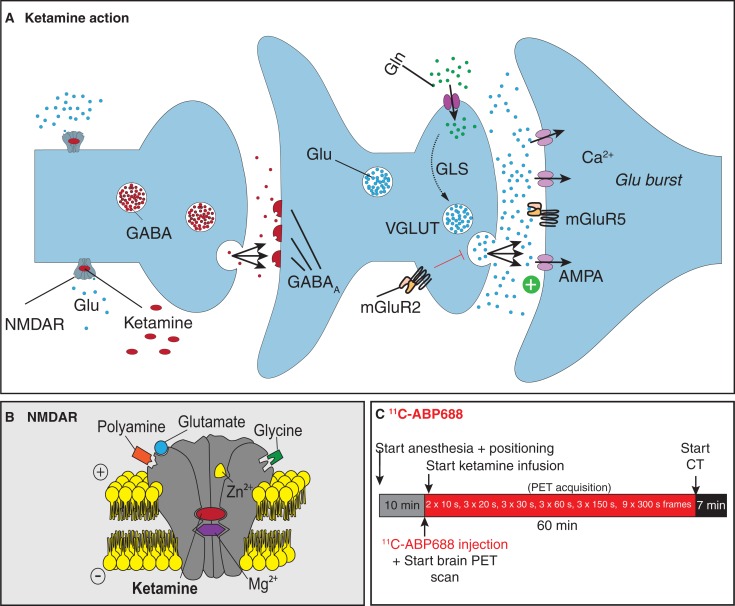
“For ketamine, a concentration of 30 mg/kg was chosen(9,10) as higher concentrations (40 mg/kg) are reported to show loss of excitation.(6,11,12) As ketamine is extremely rapidly eliminated, with a redistribution half-life of around 15 minutes,(6,13) we opted for an infusion paradigm as shown in Figure 1C, where ketami…”
BackgroundDeLorenzo, C., DellaGioia, N., Bloch, M., Sanacora, G., Nabulsi, N., Abdallah, C., Yang, J., Wen, R., Mann, J. J., Krystal, J. H., et al. (2015) · Biological Psychiatry · doi:10.1016/j.biopsych.2014.06.024 · Cited by 105
Rubins, D. J. (2003) · NeuroImage · doi:10.1016/j.neuroimage.2003.07.011 · Cited by 105
Westphalen, R. I., & Hemmings, H. C. (2005) · Journal of Pharmacology and Experimental Therapeutics · doi:10.1124/jpet.105.090647 · Cited by 69 · cited 1×
“Second, in vitro data(25) showed that isoflurane reduces both Ca2þ-independent and Ca2þ-dependent glutamate release, and another study suggested that volatile anesthetics such as isoflurane reduce the ratio of basal glutamate to GABA release, possibly contributing to a net depression of glutamatergic excitation.(26) R…”
BackgroundDeLorenzo, C., Milak, M. S., Brennan, K. G., Kumar, J. S. D., Mann, J. J., & Parsey, R. V. (2011) · European Journal of Nuclear Medicine and Molecular Imaging · doi:10.1007/s00259-010-1723-7 · Cited by 60 · cited 1×
“The nondisplaceable binding potential (BPND) of [ (11)C]ABP688 for the different VOIs was then calculated by use of simplified reference tissue model (SRTM) with the cerebellar cortex as a reference region,(14,15) as previous methods using the whole cerebellum possibly affects the results due to mGluR5 expression in t…”
MethodLarsen, M., Grøndahl, T. Ø., Haugstad, T. S., & Langmoen, I. A. (1994) · Brain Research · doi:10.1016/0006-8993(94)91282-3 · Cited by 56
Metabotropic glutamate receptor 5 binding in patients with obsessive-compulsive disorder
Akkus, F., Terbeck, S., Ametamey, S. M., Rufer, M., Treyer, V., Burger, C., Johayem, A., Mancilla, B. G., Sovago, J., Buck, A., et al. (2014) · The International Journal of Neuropsychopharmacology · doi:10.1017/s1461145714000716 · Cited by 54 · cited 1×
“Detecting changes in receptor availability at the metabotropic glutamate receptor 5 (mGluR5) with the positron emission tomography (PET) allosteric antagonist, [(11)C]ABP688, is valuable for studying dysfunctional glutamate transmission associated with psychiatric illnesses such as schizophrenia,(1) depression,(2) and…”
BackgroundDeLorenzo, C., Gallezot, J.-D., Gardus, J., Yang, J., Planeta, B., Nabulsi, N., Ogden, R. T., Labaree, D. C., Huang, Y. H., Mann, J. J., et al. (2017) · Journal of Cerebral Blood Flow & Metabolism · doi:10.1177/0271678x16673646 · Cited by 54 · cited 1×
“In a later publication, the authors cite evidence suggesting glutamatergic regulation of the circadian cycles that might even cause underestimation of abovementioned ketamine effects.(8,19) A 2017 publication by Esterlis et al repeats the finding of reduced mGluR5 availability in humans following ketamine administrati…”
BackgroundCircadian variation of metabotropic glutamate receptor 5 availability in the rat brain
Elmenhorst, D., Mertens, K., Kroll, T., Oskamp, A., Ermert, J., Elmenhorst, E., Wedekind, F., Beer, S., Coenen, H. H., & Bauer, A. (2016) · Journal of Sleep Research · doi:10.1111/jsr.12432 · Cited by 51 · cited 1×
“In a later publication, the authors cite evidence suggesting glutamatergic regulation of the circadian cycles that might even cause underestimation of abovementioned ketamine effects.(8,19) A 2017 publication by Esterlis et al repeats the finding of reduced mGluR5 availability in humans following ketamine administrati…”
BackgroundWestphalen, R. I., & Hemmings, H. C. (2003) · Anesthesiology · doi:10.1097/00000542-200302000-00016 · Cited by 47 · cited 1×
“First, as for the effects of volatile anesthetics on the results of the study, the influence of isoflurane anesthesia on glutamate binding has been assessed in literature.(10,23,24) It was concluded that isoflurane at clinically relevant levels does not have substantial effects on synaptosomal uptake, synaptic membran…”
BackgroundDeLorenzo, C., Sovago, J., Gardus, J., Xu, J., Yang, J., Behrje, R., Kumar, J. S. D., Devanand, D. P., Pelton, G. H., Mathis, C. A., et al. (2015) · Translational Psychiatry · doi:10.1038/tp.2015.189 · Cited by 45
Wyckhuys, T., Verhaeghe, J. A. J., Wyffels, L., Langlois, X., Schmidt, M. E., Stroobants, S. G., & Staelens, S. G. (2013) · Journal of Nuclear Medicine · doi:10.2967/jnumed.113.121608 · Cited by 43 · cited 2×
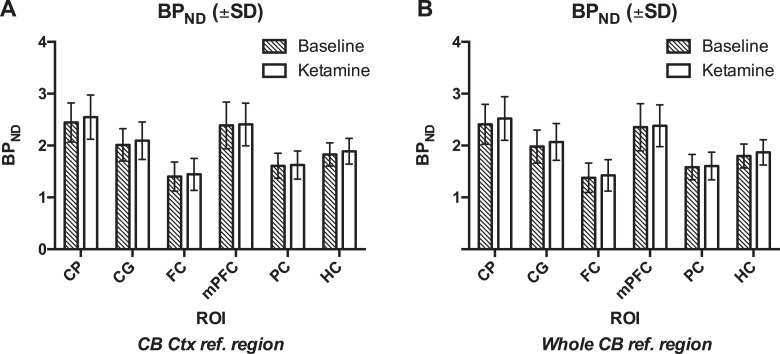
“7% for the BPND in the CP as equally demonstrated in other studies with rats and also primates.(4,5,14) The nonsignificant variations we demonstrate with the current study of 4.”
BackgroundResultSelf-citationSandiego, C. M., Nabulsi, N., Lin, S.-F., Labaree, D., Najafzadeh, S., Huang, Y., Cosgrove, K., & Carson, R. E. (2013) · Synapse · doi:10.1002/syn.21656 · Cited by 41
Dedeurwaerdere, S., Wintmolders, C., Straetemans, R., Pemberton, D. J., & Langlois, X. (2010) · Psychopharmacology · doi:10.1007/s00213-010-2052-z · Cited by 40
Elmenhorst, D., Aliaga, A., Bauer, A., & Rosa‐Neto, P. (2012) · Synapse · doi:10.1002/syn.21542 · Cited by 37 · cited 1×
“7% for the BPND in the CP as equally demonstrated in other studies with rats and also primates.(4,5,14) The nonsignificant variations we demonstrate with the current study of 4.”
ResultBeaurain, M., Salabert, A., Ribeiro, M. J., Arlicot, N., Damier, P., Jeune, F. L., Démonet, J., & Payoux, P. (2019) · Frontiers in Medicine · doi:10.3389/fmed.2019.00268 · Cited by 27
Dedeurwaerdere, S., Wintmolders, C., Vanhoof, G., & Langlois, X. (2011) · Journal of Pharmacology and Experimental Therapeutics · doi:10.1124/jpet.111.182766 · Cited by 26
Fast and Accurate Rat Head Motion Tracking With Point Sources for Awake Brain PET
Miranda, A., Staelens, S. G., Stroobants, S. G., & Verhaeghe, J. A. J. (2017) · IEEE Transactions on Medical Imaging · doi:10.1109/tmi.2017.2667889 · Cited by 24
Self-citationSandiego, C. M., Jin, X., Mulnix, T., Fowles, K., Labaree, D. C., Ropchan, J. R., Huang, Y. H., Cosgrove, K., Castner, S. A., Williams, G. V., et al. (2013) · Journal of Nuclear Medicine · doi:10.2967/jnumed.113.122077 · Cited by 22
Wyckhuys, T., Wyffels, L., Langlois, X., Schmidt, M. E., Stroobants, S. G., & Staelens, S. G. (2014) · Journal of Pharmacology and Experimental Therapeutics · doi:10.1124/jpet.114.213959 · Cited by 16 · cited 1×
“For ketamine, a concentration of 30 mg/kg was chosen(9,10) as higher concentrations (40 mg/kg) are reported to show loss of excitation.(6,11,12) As ketamine is extremely rapidly eliminated, with a redistribution half-life of around 15 minutes,(6,13) we opted for an infusion paradigm as shown in Figure 1C, where ketami…”
BackgroundSelf-citationMiranda, A., Staelens, S. G., Stroobants, S. G., & Verhaeghe, J. A. J. (2017) · Physics in Medicine and Biology · doi:10.1088/1361-6560/aa5a46 · Cited by 12
Self-citationKosten, L., Chowdhury, G. M. I., Mingote, S., Staelens, S. G., Rothman, D. L., Behar, K. L., & Rayport, S. (2019) · Neurochemistry International · doi:10.1016/j.neuint.2019.104508 · Cited by 9
Self-citationSeidemann, T., Spies, C., Morgenstern, R., Wernecke, K., & Netzhammer, N. (2017) · PLoS ONE · doi:10.1371/journal.pone.0169017 · Cited by 7
Molecular Imaging of mGluR5 Availability with [11C]ABP68 in Glutaminase Heterozygous Mice
Kosten, L., Deleye, S., Stroobants, S. G., Wyffels, L., Mingote, S., Rayport, S., & Staelens, S. G. (2018) · Cellular and Molecular Neurobiology · doi:10.1007/s10571-018-0645-y · Cited by 5
Self-citation
Cited by
A Review of Molecular Imaging of Glutamate Receptors
Kim, J., Marton, J., Ametamey, S. M., & Cumming, P. D. (2020) · Molecules · doi:10.3390/molecules25204749 · Cited by 69
DeLorenzo, C., Sovago, J., Gardus, J., Xu, J., Yang, J., Behrje, R., Kumar, J. S. D., Devanand, D. P., Pelton, G. H., Mathis, C. A., et al. (2015) · Translational Psychiatry · doi:10.1038/tp.2015.189 · Cited by 45
Beaurain, M., Salabert, A., Ribeiro, M. J., Arlicot, N., Damier, P., Jeune, F. L., Démonet, J., & Payoux, P. (2019) · Frontiers in Medicine · doi:10.3389/fmed.2019.00268 · Cited by 27
“Thus, whereas ketamine administration decreases [11C]ABP688 binding in vivo in human subjects (229), this result has not been confirmed in rats (230).”
Backgroundde Bartolomeis, A., Avagliano, C., Vellucci, L., D’Ambrosio, L., Manchia, M., D’Urso, G., Buonaguro, E. F., & Iasevoli, F. (2019) · Neuroscience & Biobehavioral Reviews · doi:10.1016/j.neubiorev.2019.08.019 · Cited by 19
A molecular perspective on mGluR5 regulation in the antidepressant effect of ketamine
Elmeseiny, O. S. A., & Müller, H. K. (2024) · Pharmacological Research · doi:10.1016/j.phrs.2024.107081 · Cited by 14
Metadata
- Authors
- Kosten, L., Verhaeghe, J., wyffels, L., Stroobants, S., & Staelens, S.
- Affiliations
- University of Antwerp (BE)
- Corresponding author
- Staelens, Steven
- Venue
- Molecular Imaging
- Publisher
- SAGE Publications
- Published
- 2018-01-01
- Volume
- 17
- Pages
- 1536012118788636-1536012118788636
- ISSN
- 1535-3508 (ISSN-L)
- 1536-0121
- PMC
- PMC6144515
- OpenAlex
- W2890858769
- Cited by
- 17
- References
- 34
- Citations by year
- 2025: 1 · 2024: 3 · 2023: 1 · 2021: 3 · 2020: 4 · 2019: 3 · 2018: 1
- FWCI
- 1.25
- Type
- journal article
- Language
- en
- Open access
- gold
- doi.org
- Licence
- cc-by-nc
- journals.sagepub.com/page/policies/text-and-data-mining-license (tdm)
- Locations
- Molecular Imaging (publishedVersion, cc-by-nc)
- Europe PMC (PubMed Central) (publishedVersion, cc-by-nc)
- PubMed Central (publishedVersion, cc-by-nc)
- PubMed (publishedVersion)
- Lirias (submittedVersion, cc-by-nc)
- DOAJ (DOAJ: Directory of Open Access Journals) (submittedVersion)
- Funders
- Universiteit Antwerpen
- Topics
- Life Sciences › Neuroscience › Cellular and Molecular Neuroscience › Neuroscience and Neuropharmacology Research
- Life Sciences › Neuroscience › Cellular and Molecular Neuroscience › Neurotransmitter Receptor Influence on Behavior
- Health Sciences › Medicine › Radiology, Nuclear Medicine and Imaging › Advanced MRI Techniques and Applications
- Keywords
- ketamine, metabotropic glutamate receptor 5, [11C]ABP688, positron emission tomography, receptor binding, NMDA receptor antagonists, glutamate release, negative allosteric modulators, species differences, rat brain
- MeSH terms
- Animals, Brain, Carbon Radioisotopes, Ketamine, Male, Oximes, Protein Binding, Pyridines, Rats, Sprague-Dawley, Positron-Emission Tomography, Receptor, Metabotropic Glutamate 5
About these checks
Registry, retraction, Cites and statistics results are computed, not judged, with one exception: a printed reference that no index lists is read once by a model before it counts as a citation error. Claims are extracted by a model and kept only when their quote appears verbatim in the text; each cited source is then checked, with a model’s help, for whether it says what the claim relies on. Those verdicts can be wrong — read the claim’s quote and the cited source before relying on one.
Statistics and arithmetic are recomputed, not judged.
Confidence bands are shown only for fields calibrated on our annotated test set. None is calibrated yet, so no band is shown.
What counts as a claim ›How we measure confidence ›How we check this ›
Are you an author, or do you see a problem with this page? Request a review
Data sources
Bibliographic data: Semantic Scholar, OpenAlex, Crossref.
Contains information from the Semantic Scholar Academic Graph Datasets, made available under the ODC Attribution License (ODC-BY 1.0).
Semantic Scholar’s data is described in: Kinney, R., et al. (2023). The Semantic Scholar Open Data Platform. arXiv:2301.10140.
