

A randomized controlled trial of a multicomponent online stress reduction intervention in inflammatory bowel disease
Open accessThe DOI matches its Crossref record; 60 of the 60 references it cites were found in a registry or an index.
Abstract
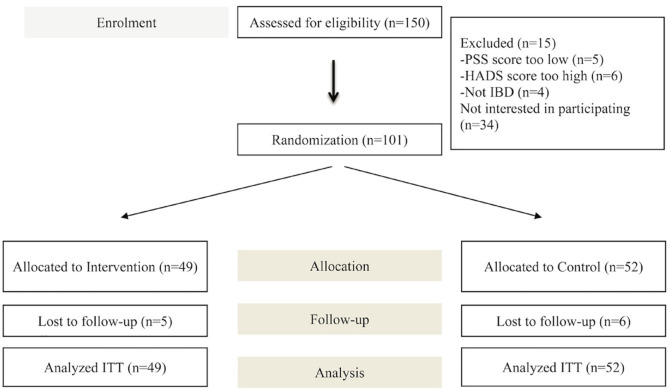
Background: Psychological stress negatively impacts inflammatory bowel disease (IBD) outcomes. Patients have prioritized access to online interventions; yet, the data on these have been limited by mixed in-person/online interventions, low adherence, and non-randomized controlled trial (RCT) design. Objectives: We assessed the efficacy of and adherence to a 12-week online multicomponent stress reduction intervention in IBD. Design: This is a RCT. Methods: Adult participants on stable IBD medical therapy with elevated stress levels from four centers were randomized to intervention or control groups. Intervention participants received a 12-week online program including a weekly yoga, breathwork and meditation video (target 2–3 times/week), a weekly cognitive behavioral therapy/positive psychology informed video activity, and weekly 10-min check-ins by a study team member. Control participants received weekly motivational messages by email. All patients received standard of care IBD therapy. The primary outcome was Cohen’s Perceived Stress Scale (PSS). Secondary outcomes evaluated mental health, resilience, health-related quality of life (HRQoL), symptom indices, acceptability, adherence, and inflammatory biomarkers. Analysis of covariance was used to determine between-group differences. Results: Of 150 screened patients, 101 were randomized to the intervention ( n = 49) and control ( n = 52) groups (mean age: 42.5 ± 14.1 years; M:F 1:3, 48% with ulcerative colitis and 52% with Crohn’s disease). The between-group PSS improved by 22.4% (95% confidence interval, 10.5–34.3, p < 0.001). Significant improvements were seen in mental health, resilience, and HRQoL measures, with a median satisfaction score of 89/100 at the end of the 12 weeks. In the 44/49 patients who completed the intervention, 91% achieved program adherence targets. Conclusion: This 12-week online intervention improved perceived stress, mental health, and HRQoL, but did not impact IBD symptom indices or inflammatory biomarkers. The program was readily adopted and adhered to by participants with high retention rates. After iterative refinement based on participant feedback, future studies will evaluate the impact of a longer/more intense intervention on disease course. Registration: ClinicalTrials.gov Identifier NCT03831750 Plain Language Summary: An online stress reduction intervention in inflammatory bowel disease patients improves stress, mental health, and quality of life People with inflammatory bowel disease (IBD) have high levels of stress, anxiety, and depression. Although IBD patients have expressed the need for online mental wellness interventions, the existing data to support these interventions in IBD are limited. In this trial, 101 IBD patients had the chance to participate in a 12-week online stress reduction intervention. In those patients randomly selected to participate in the online intervention, each week they received the following: a 20- to 30-min yoga, breathwork, and meditation video that they were asked to do 2–3 times a week, a 10- to 20-min mental wellness activity they were asked to do once during the week, and a 10-min telephone check-in with a study team member. Participants who were not selected to use the online intervention received a weekly motivational message by email. In all, 90 of the 101 participants (89%) completed the study with the mean age of participants being 43 years and the majority being females (75%). Ninety-one percent of participants who completed the intervention met the program target of doing the yoga, breathwork, and meditation video at least 2 times per week. Significant improvements were seen in perceived stress (by 22.4%), depression (by 29.5%), anxiety (by 23.7%), resilience (by 10.6%), and quality of life (by 8.9%). No changes were seen in IBD severity or in blood markers of inflammation. In conclusion, this study demonstrates evidence that a 12-week online stress reduction intervention had low dropout rates, high adherence and beneficial effects on stress, mental health, and quality of life measures. Continued feedback will be sought from study participants and our IBD patient partners to refine the intervention and assess the impact in future studies of patients with active IBD, as well as the impact of a longer/more intense intervention.
Overview
The claims and statistics of this paper haven’t been checked yet.
Free: it reads the open-access text and checks the first 5 claims that cite a source we can check. Create a free account to check every claim.
Integrity signals
Registry
Cites
Statistics
Figures
Verification
Claims the paper makes
The claims and statistics of this paper haven’t been checked yet.
Free: it reads the open-access text and checks the first 5 claims that cite a source we can check. Create a free account to check every claim.
Claims other papers make about this one
Each is checked against this paper’s own text: does it say what the citing paper says it does?
The source backs part of the claim, not all of it — or backs it for a different population, condition or comparison.
In the citing paper
“Recent studies examining acceptance and values-based interventions in IBD delivered partially33 or fully13 digitally have demonstrated efficacy in significantly improving psychological distress and HRQoL.”
From Culturally Informed Digital Behavioral Intervention Development for Inflammatory Bowel Disease: A Qualitative Study (2025) · cites this paper as [13]
Experimental — accuracy not yet measuredThe cited source says what the claim attributes to it.
In the citing paper
“Although high-quality evidence suggests psychological improvement with certain digital behavioral interventions in IBD,13 feasibility and acceptability of applying such interventions among IBD patients from racial and ethnic minority groups are lacking.”
From Culturally Informed Digital Behavioral Intervention Development for Inflammatory Bowel Disease: A Qualitative Study (2025) · cites this paper as [13]
Self-check
Percentages, sums and reported differences re-computed from the paper’s own numbers.
The self-check needs the paper’s full text.
Citations
Cites
The Hospital Anxiety and Depression Scale
Zigmond, A. S., & Snaith, R. P. (1983) · Acta Psychiatrica Scandinavica · doi:10.1111/j.1600-0447.1983.tb09716.x · Cited by 47,139
The Pittsburgh Sleep Quality Index: a new instrument for psychiatric practice and research
Buysse, D. J., Reynolds, C. F., Monk, T. H., Berman, S. R., & Kupfer, D. J. (1989) · Psychiatry Research · doi:10.1016/0165-1781(89)90047-4 · Cited by 35,234
A Global Measure of Perceived Stress
Cohen, S., Kamarck, T., & Mermelstein, R. (1983) · Journal of Health and Social Behavior · doi:10.2307/2136404 · Cited by 32,807
EuroQol: a new facility for the measurement of health-related quality of life
(1990) · Health Policy · doi:10.1016/0168-8510(90)90421-9 · Cited by 15,736
Happiness is everything, or is it? Explorations on the meaning of psychological well-being.
Ryff, C. D. (1989) · Journal of Personality and Social Psychology · doi:10.1037/0022-3514.57.6.1069 · Cited by 14,847
Depression and quality of life in older persons: A review
Sivertsen, H., Bjørkløf, G. H., Engedal, K., Selbæk, G., & Helvik, A.-S. (2015) · Dementia and Geriatric Cognitive Disorders · doi:10.1159/000437299 · Cited by 14,152
Development of a new resilience scale: The Connor-Davidson Resilience Scale (CD-RISC)
Connor, K. M., & Davidson, J. R. T. (2003) · Depression and Anxiety · doi:10.1002/da.10113 · Cited by 11,793
Ng, S. C., Shi, H. Y., Hamidi, N., Underwood, F. E., Tang, W., Benchimol, E. I., Panaccione, R., Ghosh, S., Wu, J. C. Y., Chan, F. K. L., et al. (2017) · The Lancet · doi:10.1016/s0140-6736(17)32448-0 · Cited by 6,087 · cited 1×
“Stable therapy was defined as (1) no change in the dose of 5-aminosalicylate or immunomodulator; (2) no change in the dose or frequency of biologic; and (3) maintenance phase of biologic therapy.”
MethodCONSORT 2010 statement: updated guidelines for reporting parallel group randomized trials
Schulz, K. F., Altman, D. G., Moher, D., & for the CONSORT Group* (2010) · Annals of Internal Medicine · doi:10.7326/0003-4819-152-11-201006010-00232 · Cited by 3,824
Ungaro, R., Mehandru, S., Allen, P. B., Peyrin-Biroulet, L., & Colombel, J.-F. (2017) · The Lancet · doi:10.1016/s0140-6736(16)32126-2 · Cited by 3,531
Cited by
Riggott, C., Mikocka-Walus, A., Gracie, D. J., & Ford, A. C. (2023) · The Lancet Gastroenterology & Hepatology · doi:10.1016/s2468-1253(23)00186-3 · Cited by 83
Shchaslyvyi, A. Y., Antonenko, S. V., & Telegeev, G. D. (2024) · International Journal of Environmental Research and Public Health · doi:10.3390/ijerph21081077 · Cited by 73
Seaton, N., Hudson, J. L., Harding, S., Norton, S., Mondelli, V., Jones, A. S. K., & Moss-Morris, R. E. (2024) · EBioMedicine · doi:10.1016/j.ebiom.2023.104910 · Cited by 49
Johnson, E., Corrick, S., Isley, S., Vandermeer, B., Dolgoy, N., Bates, J., Godfrey, E., Soltys, C., Muir, C., Vohra, S., et al. (2024) · PLOS Digital Health · doi:10.1371/journal.pdig.0000435 · Cited by 24
Self-citationWatt, M., Hyde, A. M., Johnson, E., Wright, G. M., Well, S. V., Sadasivan, C., Lee‐Baggley, D., Spence, J. C., Mason, A. L., Ko, H. H., et al. (2023) · Hepatology Communications · doi:10.1097/hc9.0000000000000316 · Cited by 16
Self-citationLin, X., Zheng, J., Zhang, Q., & Li, Y. (2024) · Mental health and physical activity · doi:10.1016/j.mhpa.2024.100587 · Cited by 22
Goren, G., Schwartz, D., Friger, M. D., Sergienko, R., Monsonego, A., Slonim‐Nevo, V., Greenberg, D., Odes, S., & Sarid, O. (2025) · Journal of Clinical Medicine · doi:10.3390/jcm14051569 · Cited by 23
“A review of randomized controlled trials (RCTs) conducted in the past five years highlights that most psychological interventions for CD patients focus either on cognitive-behavioral or mindfulness-based strategies, to reduce distress and improve well-being [65,78–82].”
Gold, S. L., Chiew, B. A., Rajagopalan, V., & Lavallee, C. M. (2023) · Journal of the Canadian Association of Gastroenterology · doi:10.1093/jcag/gwad029 · Cited by 13
Psychological interventions for treatment of inflammatory bowel disease
Tiles-Sar, N., Neuser, J., de Sordi, D., Baltes, A., Preiß, J., Moser, G., & Timmer, A. (2025) · Cochrane Database of Systematic Reviews · doi:10.1002/14651858.cd006913.pub3 · Cited by 20
Liu, S., Sun, B., Tian, W., Zhang, L., Kong, F., Wang, M., Yan, J., & Zhang, A. (2023) · Heliyon · doi:10.1016/j.heliyon.2023.e21013 · Cited by 9
Avest, M. M. T., Huijbers, M. J., Horjus, C. S., Römkens, T. E. H., Witteman, E. M., van Dop, W. A., Dresler, M., Donders, A. R. T., Dijkstra, G. D. H., Nissen, L. H. C., et al. (2025) · Inflammatory Bowel Diseases · doi:10.1093/ibd/izaf116 · Cited by 11
“15,16 There are no studies available in which sleep was measured objectively in IBD patients.”
Lin, K., Cavadino, A., Ow, M., Douglas, M., & Serlachius, A. S. (2025) · Frontiers in Digital Health · doi:10.3389/fdgth.2025.1587765 · Cited by 8
Chappell, K. D., Meakins, D., Marsh-Joyal, M., Bihari, A., Goodman, K. J., Mellédo, J. L., Lim, A., Peerani, F., & Kroeker, K. I. (2024) · JMIR Formative Research · doi:10.2196/53550 · Cited by 7
“…patients in Alberta found that over 80% of respondents were comfortable using virtual care options and agreed they were satisfied with telehealth as a treatment modality [36], and a previous study in the same geographical area with a similar IBD population found no challenges with attrition [37].”
BackgroundResultSelf-citationWatt, M., Peerani, F., Madsen, K. L., Siffledeen, J. S., Kroeker, K. I., Lim, A., Tandon, P., & Hyde, A. M. (2022) · Crohn s & Colitis 360 · doi:10.1093/crocol/otac036 · Cited by 6
Self-citationJohnson, E., Ismond, K. P., Hyde, A. M., Ezekowitz, J. A., Wright, G., Spiers, J. A., Spence, J. C., Thompson, S., McNeely, M. L., Zheng, Y., et al. (2024) · Contemporary Clinical Trials · doi:10.1016/j.cct.2024.107642 · Cited by 6
Self-citationJia, J., Wu, Y., Liu, S., Chen, W., Li, R., Bai, Y., & Hu, L. (2025) · Frontiers in Medicine · doi:10.3389/fmed.2025.1593483 · Cited by 5
Mechanisms of chronic abdominal pain in inflammatory bowel disease and implications for treatment
Defaye, M., Nasser, Y., & Altier, C. (2025) · Nature Reviews Gastroenterology & Hepatology · doi:10.1038/s41575-025-01139-8 · Cited by 7
“Finally, an online yoga intervention in patients with both active and inactive IBD led to an improvement in the perceived stress score, as well as a decrease in anxiety and depression; abdominal pain severity was not measured 222 .”
Corrick, S., Johnson, E., Isley, S., Vandermeer, B., Dolgoy, N. D., Bates, J., Godfrey, E., Soltys, C., Muir, C., Tegg, N. L., et al. (2024) · PLOS mental health. · doi:10.1371/journal.pmen.0000048 · Cited by 7
Self-citationBiomarkers of Response to Internet-Based Psychological Interventions: Systematic Review
Gotti, G., Gabelli, C., Russotto, S., Madeddu, F., Courtet, P., López‐Castromán, J., Zeppegno, P., Gramaglia, C. M., & Calati, R. (2024) · Journal of Medical Internet Research · doi:10.2196/55736 · Cited by 5
“[27,30,34,39,42], α amylase (AA; n=4, 17”
InfluentialRozenberg, D., Logan, S., Sohrabipour, S., Bourgeois, N., Coté, A. T., Deliva, R. D., Souza, A. M. D., de Vries, R., Donald, M., Ferreira, M. D. P., et al. (2025) · Frontiers in Rehabilitation Sciences · doi:10.3389/fresc.2025.1535138 · Cited by 5
Self-citationFloria, D., Fogarasi, B., Tari, E., Szabó, L., Veres, D. S., Bognár, A. S., Beáta, S., Erőss, B. M., Teutsch, B., & Hegyi, P. J. (2025) · Therapeutic Advances in Gastroenterology · doi:10.1177/17562848251386324 · Cited by 6
Greywoode, R., Philippou, A., Ullman, T., & Keefer, L. (2025) · Inflammatory Bowel Diseases · doi:10.1093/ibd/izaf145 · Cited by 3
Meta-analysis of yoga-based mind-body interventions in the management of inflammatory bowel disease
Pan, L., Chen, X., Wu, Y., Zhou, Z., & Xu, D. (2025) · Complementary Therapies in Medicine · doi:10.1016/j.ctim.2025.103287 · Cited by 6
Is it time to introduce health coaching in inflammatory bowel disease management?
Cosentino, S., Bezzio, C., Gilardi, D., Pasquale, N. D., Bernardi, A. D., Manes, G., & Saibeni, S. (2025) · Digestive and Liver Disease · doi:10.1016/j.dld.2025.11.023 · Cited by 1
Jones, A. S. K., Seaton, N., Harding, S., Duff, A., Hudson, J. L., Wroe, A. L., Norton, S., Singh, H., Onih, J., & Moss-Morris, R. E. (2025) · Inflammatory Bowel Diseases · doi:10.1093/ibd/izaf259 · Cited by 2
The feasibility of an innovative online mind-body wellness program for medical students
Ray, C., Jha, S., Watt, M., Hyde, A. M., McGowan, K., Tymchuk, S., & Tandon, P. (2025) · Canadian Medical Education Journal · doi:10.36834/cmej.77658 · Cited by 2
Self-citationImpact of yoga therapy in intestinal disorders
Santacroce, G., Cocchi, A., & Sabatino, A. D. (2026) · Expert Review of Gastroenterology & Hepatology · doi:10.1080/17474124.2026.2628016 · Cited by 1
“Peerani et al. further supported the efficacy of yoga-based interventions through a randomized trial involving 101 IBD participants receiving a 12-week, online multicomponent stress-reduction program [47].”
Hatori, K., Ohba, R., Mizuno, H., Sakagami, K., & Ito, H. (2026) · Japanese Psychological Research · doi:10.1111/jpr.70023
Fromberg, E. B., Brink, M. T., Villumsen, M., Thomsen, T., Poulsen, A., & Aadahl, M. (2026) · BMC Gastroenterology · doi:10.1186/s12876-026-04792-8
“13 studies were published solely as abstracts [33, 40, 48, 52–54, 56–60, 62, 63], while 21 were published as full-text articles [34–39, 41– 47, 49–51, 55, 61, 64–66].”
InfluentialQi-wen, F., Jiang, Y.-L., Ge, X.-Y., & Yang, J.-H. (2026) · World Journal of Psychiatry · doi:10.5498/wjp.119197
Alhasani, M., & Orji, R. (2026) · International Journal of Human-Computer Interaction · doi:10.1080/10447318.2026.2659301
Dmoch, W., Kisielewska, P., Sawicka, J., Chmiela, S., Banas, Z., Dzięcioł, J., Kamińska, G., Bołtralik, N., Hajduk, M., Dzioba, K., et al. (2026) · International Journal of Innovative Technologies in Social Science · doi:10.31435/ijitss.2(50).2026.5032
Zhang, Z., Li, J., Li, L., & Ruan, L. (2026) · Frontiers in Psychiatry · doi:10.3389/fpsyt.2026.1887701
Johnson, E., Hyde, A. M., Corrick, S., Isley, S., Wright, G., Ezekowitz, J. A., Zheng, Y., Lee‐Baggley, D., Spiers, J. A., Spence, J. C., et al. (2026) · PLoS Medicine · doi:10.1371/journal.pmed.1005198
“The eMPower intervention, co-designed with patients [15,16], and informed by the capability, opportunity, motivation-behavior (COM-B) model [17], incorporated 22 behavior change techniques to support adherence (S1 Table) [18].”
Self-citationwang, Z., Shen, Z., Xue, B., Wei, M., Yao, L., Liu, J., Bu, J., Han, X., Luo, H., & Zhuang, Y. (2026) · Research Square · doi:10.21203/rs.3.rs-10537438/v1
Metadata
- Authors
- Peerani, F., Watt, M., Ismond, K. P., Whitlock, R., Ambrosio, L., Hotte, N., Mitchell, N., Bailey, R. J., Kroeker, K., Dieleman, L. A., Siffledeen, J., Lim, A., Wong, K., Halloran, B. P., Baumgart, D. C., Taylor, L., Raman, M., Madsen, K. L., & Tandon, P.
- Affiliations
- University of Alberta (CA)
- Seven Oaks General Hospital (CA)
- University of Calgary (CA)
- Corresponding author
- Tandon, Puneeta
- ORCID
- Venue
- Therapeutic Advances in Gastroenterology
- Publisher
- SAGE Publications
- Published
- 2022-01
- Volume
- 15
- Pages
- 17562848221127238-17562848221127238
- ISSN
- 1756-283X (ISSN-L)
- 1756-2848
- PMC
- PMC9520184
- OpenAlex
- W4300688804
- Cited by
- 35
- References
- 60
- Citations by year
- 2026: 9 · 2025: 13 · 2024: 8 · 2023: 4 · 2022: 1
- FWCI
- 5.74
- Type
- journal article
- Language
- en
- Open access
- gold
- doi.org
- Locations
- Therapeutic Advances in Gastroenterology (publishedVersion, cc-by)
- PubMed Central (publishedVersion, cc-by)
- PubMed (publishedVersion)
- DOAJ (DOAJ: Directory of Open Access Journals) (submittedVersion, cc-by-sa)
- Funders
- American College of Gastroenterology
- university of alberta
- Gastrointestinal and Neuropsychiatric Effects
- canadian institutes of health research
- Topics
- Social Sciences › Psychology › Applied Psychology › Digital Mental Health Interventions
- Social Sciences › Psychology › Clinical Psychology › Mindfulness and Compassion Interventions
- Health Sciences › Medicine › Gastroenterology › Inflammatory Bowel Disease
- Keywords
- inflammatory bowel disease, psychological stress, stress reduction intervention, online intervention, yoga, breathwork, meditation, cognitive behavioral therapy, positive psychology, perceived stress, mental health, resilience, health-related quality of life, intervention adherence, inflammatory markers, digital mental health, anxiety and depression, motivational messages, program acceptability, program refinement
About these checks
Registry, retraction, Cites and statistics results are computed, not judged, with one exception: a printed reference that no index lists is read once by a model before it counts as a citation error. Claims are extracted by a model and kept only when their quote appears verbatim in the text; each cited source is then checked, with a model’s help, for whether it says what the claim relies on. Those verdicts can be wrong — read the claim’s quote and the cited source before relying on one.
Statistics and arithmetic are recomputed, not judged.
Confidence bands are shown only for fields calibrated on our annotated test set. None is calibrated yet, so no band is shown.
What counts as a claim ›How we measure confidence ›How we check this ›
Are you an author, or do you see a problem with this page? Request a review
Data sources
Bibliographic data: Semantic Scholar, OpenAlex, Crossref.
Contains information from the Semantic Scholar Academic Graph Datasets, made available under the ODC Attribution License (ODC-BY 1.0).
Semantic Scholar’s data is described in: Kinney, R., et al. (2023). The Semantic Scholar Open Data Platform. arXiv:2301.10140.
