

The DOI matches its Crossref record; 310 of the 311 references it cites were found in a registry or an index.
Neural Functions of Hypothalamic Oxytocin and its Regulation
Open accessAbstract
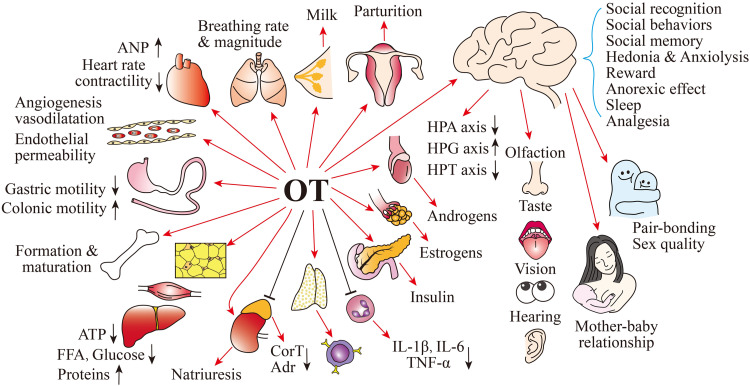
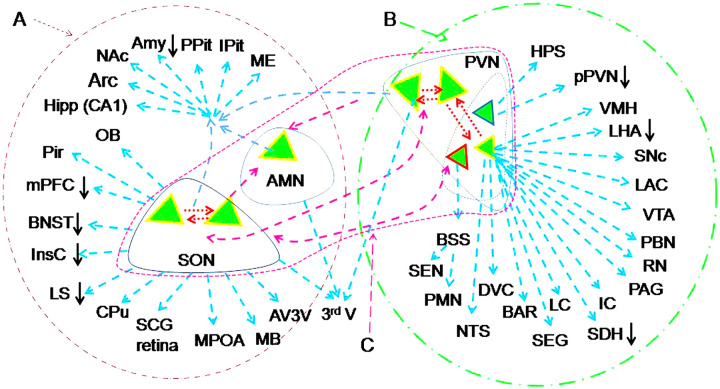
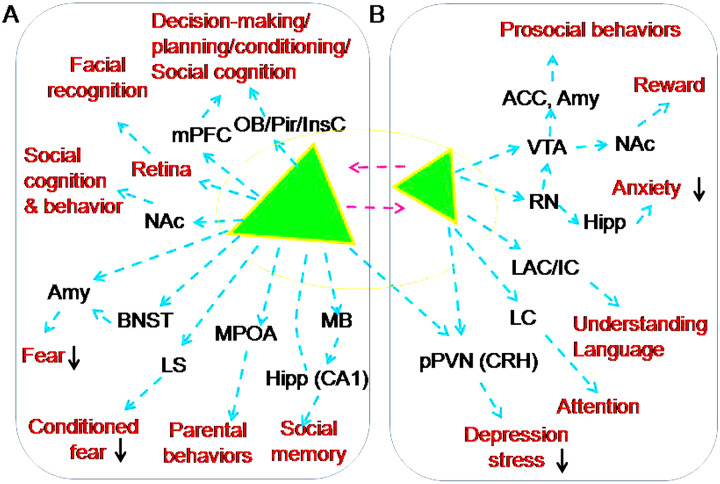
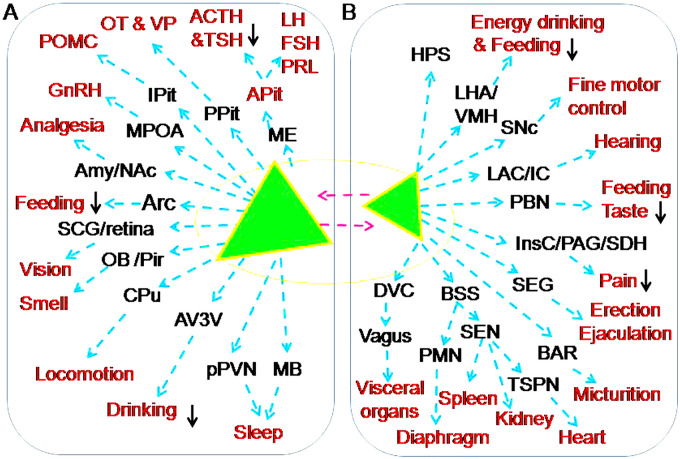
Oxytocin (OT), a nonapeptide, has a variety of functions. Despite extensive studies on OT over past decades, our understanding of its neural functions and their regulation remains incomplete. OT is mainly produced in OT neurons in the supraoptic nucleus (SON), paraventricular nucleus (PVN) and accessory nuclei between the SON and PVN. OT exerts neuromodulatory effects in the brain and spinal cord. While magnocellular OT neurons in the SON and PVN mainly innervate the pituitary and forebrain regions, and parvocellular OT neurons in the PVN innervate brainstem and spinal cord, the two sets of OT neurons have close interactions histologically and functionally. OT expression occurs at early life to promote mental and physical development, while its subsequent decrease in expression in later life stage accompanies aging and diseases. Adaptive changes in this OT system, however, take place under different conditions and upon the maturation of OT release machinery. OT can modulate social recognition and behaviors, learning and memory, emotion, reward, and other higher brain functions. OT also regulates eating and drinking, sleep and wakefulness, nociception and analgesia, sexual behavior, parturition, lactation and other instinctive behaviors. OT regulates the autonomic nervous system, and somatic and specialized senses. Notably, OT can have different modulatory effects on the same function under different conditions. Such divergence may derive from different neural connections, OT receptor gene dimorphism and methylation, and complex interactions with other hormones. In this review, brain functions of OT and their underlying neural mechanisms as well as the perspectives of their clinical usage are presented.
Overview
The claims and statistics of this paper haven’t been checked yet.
Run the check — free, no account needed. It reads the open-access text and checks the sources it cites.
Integrity signals
Registry
Cites
Statistics
Figures
Verification
Claims the paper makes
The claims and statistics of this paper haven’t been checked yet.
Run the check — free, no account needed. It reads the open-access text and checks the sources it cites.
Claims other papers make about this one
Each is checked against this paper’s own text: does it say what the citing paper says it does?
The cited source says what the claim attributes to it.
In the citing paper
“Certain brain regions such as the paraventricular nucleus (PVN) and supraoptic nucleus (SON) of the hypothalamus have been identified as essential components concerning social behaviour (Wang et al., 2022).”
From Convergence of oxytocin and dopamine signalling in neuronal circuits: Insights into the neurobiology of social interactions across species (2024) · cites this paper as Wang et al., 2022
Self-check
Percentages, sums and reported differences re-computed from the paper’s own numbers.
The self-check needs the paper’s full text.
Citations
Cites
International Journal of Molecular Sciences
Soni, N., Ross, A., Nookaew, I., Scheers, N., Gabrielsson, B., & Sandberg, A.-S. (2024) · International Journal of Molecular Sciences · doi:10.3390/ijms · Cited by 10,136
A JOURNAL OF PHARMACOLOGY AND EXPERIMENTAL THERAPEUTICS
Lindemann, L., Jaeschke, G., Michalon, A., Vieira, E., Honer, M., Spooren, W., Porter, R., Hartung, T., Kolczewski, S., Büttelmann, B., et al. (1909) · JAMA · doi:10.1001/jama.1909.02550020033007 · Cited by 7,889
Neurobiology of addiction: a neurocircuitry analysis
Koob, G. F., & Volkow, N. D. (2016) · The Lancet Psychiatry · doi:10.1016/s2215-0366(16)00104-8 · Cited by 3,698 · cited 1×
“These effects are associated with increased release of dopamine and glutamate and the activation of cortical and basal ganglia sites, which modulates the activity of mesolimbic dopaminergic neurons (Koob & Volkow, 2016).”
BackgroundThe oxytocin receptor system: structure, function, and regulation
Gimpl, G., & Fahrenholz, F. (2001) · Physiological Reviews · doi:10.1152/physrev.2001.81.2.629 · Cited by 3,089
Journal of Autism and Developmental Disorders
(2013) · Journal of Autism and Developmental Disorders · doi:10.1007/10803.1573-3432 · Cited by 1,358
Social reward requires coordinated activity of nucleus accumbens oxytocin and serotonin
Dölen, G., Darvishzadeh, A., Huang, K. W., & Malenka, R. C. (2013) · Nature · doi:10.1038/nature12518 · Cited by 1,161
The oxytocin receptor: from intracellular signaling to behavior
Jurek, B., & Neumann, I. D. (2018) · Physiological Reviews · doi:10.1152/physrev.00031.2017 · Cited by 999
British Journal of Pharmacology
Tiffon, C. E., Adams, J. E., van der Fits, L., Wen, S., Townsend, P. A., Ganesan, A., Hodges, E., Vermeer, M. H., & Packham, G. (2010) · British Journal of Pharmacology · doi:10.1111/(issn)1476-5381 · Cited by 920
Oxytocin promotes human ethnocentrism
De Dreu, C. K. W., Greer, L. L., Van Kleef, G. A., Shalvi, S., & Handgraaf, M. J. J. (2011) · Proceedings of the National Academy of Sciences · doi:10.1073/pnas.1015316108 · Cited by 870 · cited 2×
“For example, OT may create intergroup conflict and violence because OT motivates in-group favoritism in humans (De Dreu et al., 2011) and in wild chimpanzees (Samuni et al., 2017).”
BackgroundOxytocin enables maternal behaviour by balancing cortical inhibition
Marlin, B. J., Mitre, M., D’amour, J. A., Chao, M. V., & Froemke, R. C. (2015) · Nature · doi:10.1038/nature14402 · Cited by 744
Cited by
Sorted by citations
Hormonal basis of sex differences in anesthetic sensitivity
Wasilczuk, A. Z., Rinehart, C., Aggarwal, A., Stone, M. E., Mashour, G. A., Avidan, M. S., Kelz, M. B., Proekt, A., ReCCognition Study Group, Basner, M., et al. (2024) · Proceedings of the National Academy of Sciences · doi:10.1073/pnas.2312913120 · Cited by 72
Rappeneau, V., & Castillo Díaz, F. (2024) · Neuroscience & Biobehavioral Reviews · doi:10.1016/j.neubiorev.2024.105675 · Cited by 51
A line attractor encoding a persistent internal state requires neuropeptide signaling
Mountoufaris, G., Nair, A., Yang, B., Kim, D.-W., Vinograd, A., Kim, S., Linderman, S. W., & Anderson, D. J. (2024) · Cell · doi:10.1016/j.cell.2024.08.015 · Cited by 50
Handlin, L., Novembre, G., Lindholm, H., Kämpe, R., Paul, E. R., & Morrison, I. (2023) · eLife · doi:10.7554/elife.81197 · Cited by 33
Coria-Avila, G. A., Herrera-Covarrubias, D., García, L. I., Toledo, R., Hernández, M. E., Paredes-Ramos, P., Corona-Morales, A. A., & Manzo, J. (2022) · Animals · doi:10.3390/ani12243589 · Cited by 25
Metadata
- Authors
- Wang, P., Wang, S. C., Liu, X., Jia, S., Wang, X., Li, T., Yu, J., Parpura, V., & Wang, Y.-F.
- Affiliations
- Harbin Medical University (CN)
- University of California, Irvine (US)
- University of Alabama at Birmingham (US)
- Corresponding author
- Parpura, Vladimir
- Wang, Yu-Feng
- Venue
- ASN Neuro
- Publisher
- Informa UK Limited
- Published
- 2022-01
- Volume
- 14
- Issue
- 1
- Pages
- 17590914221100706-17590914221100706
- ISSN
- 1759-0914 (ISSN-L)
- PMC
- PMC9125079
- OpenAlex
- W4281254264
- Cited by
- 59
- References
- 311
- Citations by year
- 2026: 13 · 2025: 11 · 2024: 14 · 2023: 17 · 2022: 4
- FWCI
- 1.72
- Type
- journal article
- Language
- en
- Open access
- gold
- doi.org
- Licence
- Locations
- ASN NEURO (publishedVersion, cc-by-nc)
- PubMed Central (publishedVersion, cc-by-nc)
- PubMed (publishedVersion)
- DOAJ (DOAJ: Directory of Open Access Journals) (submittedVersion, cc-by-sa)
- Funders
- Fund of the Ministry of Science and Technology of China (G2021011014L)
- National Institute of General Medical Sciences of the National Institutes of Health (R01GM123971)
- Topics
- Life Sciences › Neuroscience › Endocrine and Autonomic Systems › Neuroendocrine regulation and behavior
- Life Sciences › Neuroscience › Cellular and Molecular Neuroscience › Neuropeptides and Animal Physiology
- Life Sciences › Neuroscience › Endocrine and Autonomic Systems › Regulation of Appetite and Obesity
- Keywords
- oxytocin, hypothalamus, supraoptic nucleus, paraventricular nucleus, magnocellular neurons, parvocellular neurons, neuromodulation, social behavior, learning and memory, emotions, reward, sleep and wakefulness, sexual behavior, autonomic nervous system, DNA methylation, hormone crosstalk, aging
- MeSH terms
- Female, Humans, Hypothalamus, Neurons, Oxytocin, Paraventricular Hypothalamic Nucleus, Supraoptic Nucleus
About these checks
Registry, retraction, Cites and statistics results are computed, not judged, with one exception: a printed reference that no index lists is read once by a model before it counts as a citation error. Claims are extracted by a model and kept only when their quote appears verbatim in the text; each cited source is then checked, with a model’s help, for whether it says what the claim relies on. Those verdicts can be wrong — read the claim’s quote and the cited source before relying on one.
Statistics and arithmetic are recomputed, not judged.
Confidence bands are shown only for fields calibrated on our annotated test set. None is calibrated yet, so no band is shown.
What counts as a claim ›How we measure confidence ›How we check this ›
Are you an author, or do you see a problem with this page? Request a review
