

Does Using Social Media Jeopardize Well-Being? The Importance of Separating Within- From Between-Person Effects
Open accessThe DOI matches its Crossref record; 46 of the 46 references it cites were found in a registry or an index.
Abstract
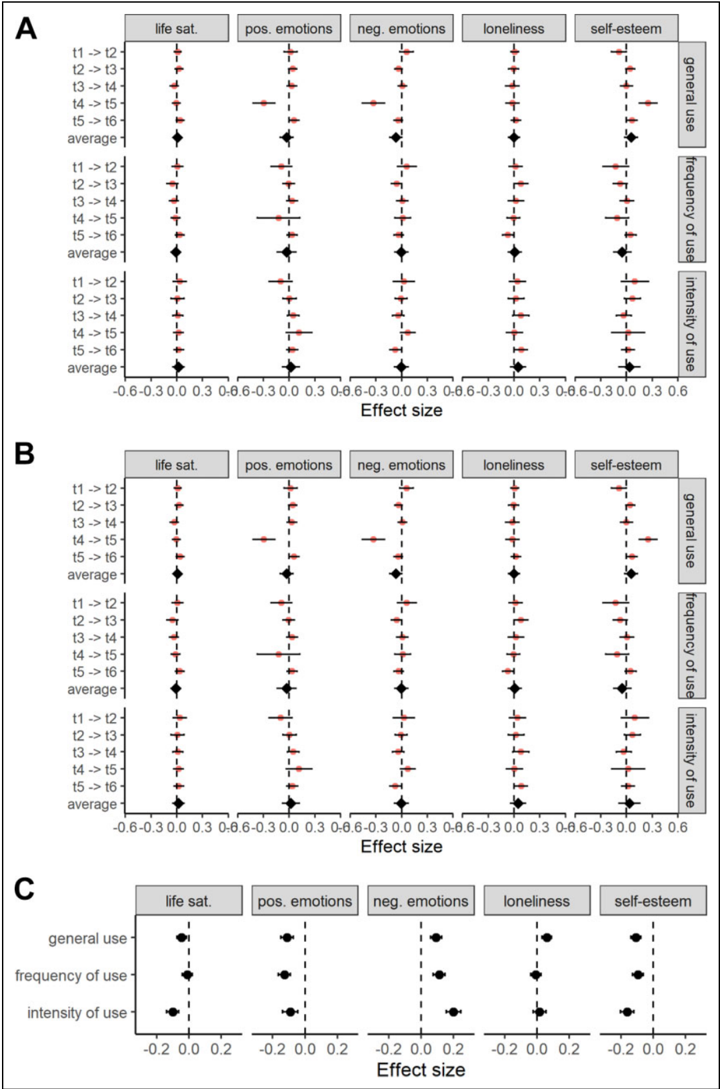
Social networking sites (SNS) are frequently criticized as a driving force behind rising depression rates. Yet empirical studies exploring the associations between SNS use and well-being have been predominantly cross-sectional, while the few existing longitudinal studies provided mixed results. We examined prospective associations between SNS use and multiple indicators of well-being in a nationally representative sample of Dutch adults ( N ∼ 10,000), comprising six waves of annual measures of SNS use and well-being. We used an analytic method that estimated prospective effects of SNS use and well-being while also estimating time-invariant between-person associations between these variables. Between individuals, SNS use was associated with lower well-being. However, within individuals, year-to-year changes in SNS use were not prospectively associated with changes in well-being (or vice versa). Overall, our analyses suggest that the conclusions about the causal impact of social media on rising mental health problems in the population might be premature.
Overview
The claims and statistics of this paper haven’t been checked yet.
Free: it reads the open-access text and checks the first 5 claims that cite a source we can check. Create a free account to check every claim.
Integrity signals
Registry
Cites
Statistics
Figures
Verification
Claims the paper makes
The claims and statistics of this paper haven’t been checked yet.
Free: it reads the open-access text and checks the first 5 claims that cite a source we can check. Create a free account to check every claim.
Claims other papers make about this one
Each is checked against this paper’s own text: does it say what the citing paper says it does?
The cited source says what the claim attributes to it.
In the citing paper
“Echoing this debate, it has been shown that the relationship between social media use and well-being exhibits distinct patterns at the between-person and within-person levels (Stavrova & Denissen, 2021).”
From Navigating Beauty Standards on Social Media: Impact of Appearance Activity on Adolescents’ Body Dissatisfaction (2025) · cites this paper as Stavrova & Denissen, 2021
Self-check
Percentages, sums and reported differences re-computed from the paper’s own numbers.
The self-check needs the paper’s full text.
Citations
Cites
Development and validation of brief measures of positive and negative affect: The PANAS scales.
Watson, D., Clark, L. A., & Tellegen, A. (1988) · Journal of Personality and Social Psychology · doi:10.1037/0022-3514.54.6.1063 · Cited by 32,433 · cited 2×
“In 2012, 2015, and 2017, PANAS and self-esteem measures were administered to a subset of respondents,2 resulting in a smaller number of cases with values on these variables in T a b le 1 .”
MethodThe satisfaction with life scale
Diener, E., Emmons, R. A., Larsen, R. J., & Griffin, S. (1985) · Journal of Personality Assessment · doi:10.1207/s15327752jpa4901_13 · Cited by 31,768
lavaan : An R Package for Structural Equation Modeling
Rosseel, Y. (2012) · Journal of Statistical Software · doi:10.18637/jss.v048.i02 · Cited by 27,955
The control of the false discovery rate in multiple testing under dependency
Benjamini, Y., & Yekutieli, D. (2001) · The Annals of Statistics · doi:10.1214/aos/1013699998 · Cited by 10,490
Internet paradox: A social technology that reduces social involvement and psychological well-being?
Kraut, R., Patterson, M., Lundmark, V., Kiesler, S., Mukophadhyay, T., & Scherlis, W. (1998) · American Psychologist · doi:10.1037/0003-066x.53.9.1017 · Cited by 4,793 · cited 2×
“Consistent with these claims, several longitudinal studies reported a negative effect of initial levels of social media use on subsequent levels of well-being (Booker et al., 2018; Kraut et al., 1998; Kross et al., 2013; Shakya & Christakis, 2017; Verduyn et al., 2015; cf. Dienlin et al., 2017).”
BackgroundResultEcological Correlations and the Behavior of Individuals
Robinson, W. S. (1950) · American Sociological Review · doi:10.2307/2087176 · Cited by 4,513
A critique of the cross-lagged panel model
Hamaker, E. L., Kuiper, R. M., & Grasman, R. P. P. P. (2015) · Psychological Methods · doi:10.1037/a0038889 · Cited by 4,005 · cited 6×
“Most studies used statistical techniques that have been criticized for confounding the effects at between- and withinperson level (Berry & Willoughby, 2017; Hamaker et al., 2015).”
BackgroundMethodInfluentialPersonality, Culture, and Subjective Well-Being: Emotional and Cognitive Evaluations of Life
Diener, E., Oishi, S., & Lucas, R. E. (2003) · Annual Review of Psychology · doi:10.1146/annurev.psych.54.101601.145056 · Cited by 3,434
The Impact of Social Media on Children, Adolescents, and Families
O'Keeffe, G. S., Clarke-Pearson, K., & Council on Communications and Media (2011) · Pediatrics · doi:10.1542/peds.2011-0054 · Cited by 2,943
Why people use social media: a uses and gratifications approach
Whiting, A., & Williams, D. (2013) · Qualitative Market Research: An International Journal · doi:10.1108/qmr-06-2013-0041 · Cited by 1,810 · cited 1×
“In addition, boredom and passing time are one of the most frequently reported reasons for using social media (Whiting & Williams, 2013).”
Research works printed but not linked: 2
- Rosenberg, M. (1979). Conceiving the self . Basic Books.
- Steyer, R., Ferring, D., & Schmitt, M. J. (1992). States and traits in psychological assessment. European Journal of Psychological Assessment , 8 (2), 79-98.
Cited by
Kroencke, L., Harari, G. M., Back, M. D., & Wagner, J. (2023) · Journal of Personality and Social Psychology · doi:10.1037/pspp0000422 · Cited by 107
Boer, M., Stevens, G. W. J. M., Finkenauer, C., & van den Eijnden, R. J. J. M. (2022) · Computers in Human Behavior · doi:10.1016/j.chb.2021.107084 · Cited by 65
Du, J., Kerkhof, P., & van Koningsbruggen, G. M. (2021) · PLOS ONE · doi:10.1371/journal.pone.0255648 · Cited by 54
“However, at the within-person level, no reciprocal association was found between social network sites use and wellbeing [49].”
BackgroundJohannes, N., Nguyen, T.-V., Weinstein, N., & Przybylski, A. K. (2021) · Technology, Mind, and Behavior · doi:10.1037/tmb0000035 · Cited by 53
Social Networking Site Use and Loneliness: A Meta-Analysis
Zhang, L., Li, C., Zhou, T., Li, Q., & Gu, C. (2022) · The Journal of Psychology · doi:10.1080/00223980.2022.2101420 · Cited by 66
“Hence, the time spent on SNSs increases, leading to the decrease in offline social interactions and the quality of real interpersonal relationships gradually deteriorates, resulting in an increased feeling of loneliness (Stavrova & Denissen, 2021).”
BackgroundInfluentialKuper, N., Kroencke, L., Harari, G. M., & Denissen, J. J. A. (2023) · Journal of Personality and Social Psychology · doi:10.1037/pspp0000438 · Cited by 56
Self-citationNo effect of different types of media on well-being
Johannes, N., Dienlin, T., Bakhshi, H., & Przybylski, A. K. (2022) · Scientific Reports · doi:10.1038/s41598-021-03218-7 · Cited by 62
Variation in social media sensitivity across people and contexts
Vaid, S. S., Kroencke, L., Roshanaei, M., Talaifar, S., Hancock, J. T., Back, M. D., Gosling, S. D., Ram, N., & Harari, G. M. (2024) · Scientific Reports · doi:10.1038/s41598-024-55064-y · Cited by 50
“First, some of this past research focused on time domains that do not capture everyday social media sensitivity [e.g., instead studying trends aggregated over months and years: 3,25 ].”
Hall, J. A. (2024) · Annals of the New York Academy of Sciences · doi:10.1111/nyas.15275 · Cited by 41
Paquin, V., Philippe, F. L., Shannon, H., Guimond, S., Ouellet‐Morin, I., & Geoffroy, M. (2023) · Social Psychiatry and Psychiatric Epidemiology · doi:10.1007/s00127-023-02537-6 · Cited by 29
“For example, in 10,000 adults from the general Dutch population followed over 6 years, year-to-year changes in social media use were not prospectively associated with changes in well-being after adjusting for the between-person association [60].”
Arigo, D., Jake‐Schoffman, D. E., & Pagoto, S. (2024) · Journal of Behavioral Medicine · doi:10.1007/s10865-024-00526-x · Cited by 32
Roberts, J. A., Young, P. D., & David, M. E. (2024) · Personality and Social Psychology Bulletin · doi:10.1177/01461672241295870 · Cited by 42
Dumas, T. M., Tremblay, P. F., Ellis, W. E., Millett, G., & Maxwell-Smith, M. A. (2022) · Computers in Human Behavior · doi:10.1016/j.chb.2022.107591 · Cited by 25
Ten Myths About the Effect of Social Media Use on Well-Being
Hall, J. A. (2024) · Journal of Medical Internet Research · doi:10.2196/59585 · Cited by 26
“Research documenting within-person effects has found no association between well-being and social media use [38,55-58].”
Social network use and life satisfaction: a systematic review
Akkaş, C., & Turan, A. H. (2024) · Mental Health and Social Inclusion · doi:10.1108/mhsi-03-2023-0037 · Cited by 19
Ejaz, W., Altay, S., & Naeem, G. (2023) · Digital Health · doi:10.1177/20552076231186075 · Cited by 29
“Third, we measured betweenparticipant differences, which are known to be larger than within-participant differences when it comes to media effects and less likely to reflect causal relationships.(68,69) Fourth, our sample size is relatively small – especially to detect interaction effects – and not representative of t…”
BackgroundHappy Days: Resolving the Structure of Daily Subjective Well-Being, Between and Within Individuals
Busseri, M. A., & Newman, D. B. (2022) · Social Psychological and Personality Science · doi:10.1177/19485506221125416 · Cited by 18
Kvardova, N., Machackova, H., Maes, C., & Vandenbosch, L. (2025) · Journal of Youth and Adolescence · doi:10.1007/s10964-025-02159-y · Cited by 11
“Echoing this debate, it has been shown that the relationship between social media use and well-being exhibits distinct patterns at the between-person and within-person levels (Stavrova & Denissen, 2021).”
Liu, P. L., & Yeo, T. E. D. (2023) · Social Science Computer Review · doi:10.1177/08944393231220487 · Cited by 11
“Consequently, the widespread use of social media has sparked signi fi cant scholarly interest in examining its impact on socio-psychological well-being (Kim & Shen, 2020; Stavrova & Denissen, 2021; Wei & Gao, 2017; Zhao, 2021).”
O’Donnell, K. J., Stuart, J., & Barber, B. L. (2021) · Psychological Reports · doi:10.1177/00332941211054766 · Cited by 13
“Despite the findings that SNS time use is associated with lower mental health, some research has found that those who spend more time on SNS have greater well-being, and specifically, higher levels of life satisfaction (Oh et al., 2014; Stavrova and Denissen, 2020).”
BackgroundPeker, A., & YALÇIN, R. Ü. (2022) · Current Psychology · doi:10.1007/s12144-022-04163-y · Cited by 10
Devos, S., Schreurs, L., Eggermont, S., & Vandenbosch, L. (2023) · New Media & Society · doi:10.1177/14614448231188935 · Cited by 9
“Other recent studies found similar trends (e.g. Stavrova and Denissen, 2021).”
Verbeij, T., Beyens, I., Keijsers, L., & Valkenburg, P. M. (2023) · PsyArXiv (OSF Preprints) · doi:10.31234/osf.io/a9ksb · Cited by 6
Lilly, K. J., Sibley, C. G., & Osborne, D. (2023) · Cyberpsychology Journal of Psychosocial Research on Cyberspace · doi:10.5817/cp2023-5-1 · Cited by 5
“Given that people are spending increasingly more time on social media (Kemp, 2022), it is critical to examine how changes in social media use within individuals affect social comparison processes (see also Stavrova & Denissen, 2020).”
BackgroundZarouali, B. (2025) · Journal of Broadcasting & Electronic Media · doi:10.1080/08838151.2025.2511894 · Cited by 3
“By focusing on within-person effects (Stavrova & Denissen, 2021; Thomas et al., 2021), this study aims to capture the nuanced ways in which individual susceptibility to disinformation may evolve in direct response to exposure to populist content, and vice versa, providing insights beyond the…”
Граждане под короной, или как это делается в Израиле и около
Любов, Е. Б. (2020) · doi:10.32878/devi.20-4-01(6)-55-91 · Cited by 7
The Connectiveness between Assertiveness and Dependence on Social Networks of Future Teachers
Makarevičs, V., & Iliško, D. (2022) · Rural Environment. Education. Personality · doi:10.22616/reep.2022.15.002 · Cited by 4
“However, on a personal level, no relationship has been found between the use of social media sites and one’s well-being (Stavrova & Denissen, 2020).”
BackgroundGugushvili, N., Täht, K., Ruiter, R. A. C., & Verduyn, P. (2025) · Behaviour and Information Technology · doi:10.1080/0144929x.2025.2506661 · Cited by 3
“First evidence is available that the relationships between smartphone use, SNS use and mental health may be di ff erent at the within-person versus between-person level (e.g. Beyens et al. 2024; Bradley and Howard 2023; Houghton et al. 2018; Stavrova & Denissen 2021; Verduyn et al. 2021).”
Religion and Social Media Use: Protective Factors for Youth Well-Being in the Digital Age?
Upenieks, L., & Hill, T. D. (2026) · Journal of Psychology and Theology · doi:10.1177/00916471251404432 · Cited by 4
“…that it contributes, at least in part, to loneliness, depression, and suicidal behavior among young people in the United States (Booker et al., 2018; Kraut et al., 1998; Kross et al., 2013; Shakya & Christakis, 2017; Stavrova & Denissen, 2021; Twenge & Campbell, 2019; Twenge et al., 2018).”
Digital engagement, school burnout and academic performance: Longitudinal within-student relationsPreprint
Hietajärvi, L., Maksniemi, E., Lonka, K., Hakkarainen, K., Alho, K., & Salmela‐Aro, K. (2022) · OSF Preprints (OSF Preprints) · doi:10.31219/osf.io/a2bk7 · Cited by 5
Wang, Y., Linggui, A., & Han, D. (2025) · The International Journal of Aging and Human Development · doi:10.1177/00914150251359478 · Cited by 2
“The widespread use of social media has sparked signi fi cant scholarly interest in examining its impact on socio-psychological well-being (Stavrova & Denissen, 2021; Zhao et al., 2021).”
Nennstiel, R., & Ullrich, R. (2026) · Large-scale Assessments in Education · doi:10.1186/s40536-026-00284-z · Cited by 2
“Fore-most, its cross-sectional structure and non-experimental design preclude direct causal inferences (Jensen et al., 2019; Rutkowski et al., 2024; Smith et al., 2024; Stavrova & Denissen, 2021; Tromholt, 2016).”
Smoktunowicz, E., Białobrzeska, O., & Jakubik, Z. (2023) · New Media & Society · doi:10.1177/14614448231193092 · Cited by 4
“Yet, although more longitudinal designs have emerged (e.g. Stavrova and Denissen, 2021), most of these studies have a cross-sectional design and rarely investigate the mechanisms responsible for the links between social media consumption and well-being outcomes (Dickson et al., 2018).”
Social Cognition Is Grounded in Physical Reality
Cecutti, L., & Lee, S. W. S. (2024) · Oxford University Press eBooks · doi:10.1093/oxfordhb/9780197763414.013.10 · Cited by 1
#ConnectedTeens: Social media use and adolescent wellbeing
Boer, M. (2022) · Utrecht University Repository (Utrecht University) · doi:10.33540/1272 · Cited by 2
Social Media SensitivityPreprint
Vaid, S. S., Kroencke, L., Roshanaei, M., Talaifar, S., Hancock, J. T., Back, M. D., Gosling, S. D., Ram, N., & Harari, G. M. (2023) · doi:10.31234/osf.io/yfp45 · Cited by 1
Schreurs, L., Lee, A. Y., Liu, X., & Hancock, J. T. (2023) · doi:10.31219/osf.io/yznu4 · Cited by 1
Bilston, A., Daniels, S., Hasan, Y., & Schweizer, S. (2026) · doi:10.2196/preprints.94753 · Cited by 1
(2022) · Rural Environment. Education. Personality · doi:10.22616/reep.2022.15
Predictors of Emotional Well-Being on Social Networks in University Students
Gutiérrez-Aguilar, O., Duche-Pérez, A. B., Aguilar, G., & Huanca, S. C. (2026) · Lecture notes in networks and systems · doi:10.1007/978-3-032-10731-2_7
Loneliness in Social Networking Sites Among Young Adults: An Evolutionary Concept Analysis
Behra, D. K., Duffy, A., & Deshpande, Y. (2026) · Issues in Mental Health Nursing · doi:10.1080/01612840.2026.2612954
“Young adults’ reliance on social networking sites can be attributed to the accessibility, availability, and affordability of such platforms, coupled with the promising features of gratifi-cation of individual needs (LaRose et al., 2003; Stavrova & Denissen, 2021; Twenge et al., 2021).”
InfluentialZarouali, B., & Schreurs, L. (2026) · Online Journal of Communication and Media Technologies · doi:10.30935/ojcmt/18591
Smith, T. W., Marquez, G., Dolister, D. A., Uchino, B. N., & Jordan, K. D. (2026) · Journal of Clinical Psychology · doi:10.1002/jclp.70142
Bilston, A., Daniels, S., Hasan, Y., & Schweizer, S. (2026) · JMIR Mental Health · doi:10.2196/94753 · Cited by 1
“Similarly, while social media use has been cross-sectionally associated with lower well-being and greater levels of anxiety and depression in some samples, changes in social media use were unrelated to changes in mental health within the same individuals over time [45-48].”
Burnell, K., Carranza, A. F., Garrett, S. L., Prinstein, M. J., & Telzer, E. H. (2026) · Journal of Adolescence · doi:10.1002/jad.70252
The Problem of Temporal Misalignment in Longitudinal Causal Research
Mulder, J. D., Voelkle, M. C., & Hamaker, E. L. (2026) · Multivariate Behavioral Research · doi:10.1080/00273171.2026.2720347 · Cited by 1
Zhang, Y., & Chang, J. (2026) · Computers in Human Behavior Reports · doi:10.1016/j.chbr.2026.101403
Metadata
- Authors
- Stavrova, O., & Denissen, J.
- Affiliations
- Tilburg University (NL)
- Utrecht University (NL)
- Corresponding author
- Stavrova, Olga
- Venue
- Social Psychological and Personality Science
- Publisher
- SAGE Publications
- Published
- 2020-08-03
- Volume
- 12
- Issue
- 6
- Pages
- 964-973
- ISSN
- 1948-5506 (ISSN-L)
- 1948-5514
- OpenAlex
- W3047223340
- Cited by
- 49
- References
- 44
- Citations by year
- 2026: 11 · 2025: 4 · 2024: 6 · 2023: 10 · 2022: 11 · 2021: 4 · 2020: 3
- FWCI
- 9.36
- Type
- journal article
- Language
- en
- Open access
- hybrid
- doi.org
- Licence
- Locations
- Social Psychological and Personality Science (publishedVersion, cc-by-nc)
- Research portal (Tilburg University) (publishedVersion, cc-by-nc)
- MADOC (University of Mannheim) (acceptedVersion, cc-by-nc)
- Data Archiving and Networked Services (DANS) (submittedVersion, cc-by-nc)
- Utrecht University Repository (Utrecht University) (submittedVersion, other-oa)
- OSF Preprints (OSF Preprints) (submittedVersion)
- Topics
- Social Sciences › Sociology and Political Science › Impact of Technology on Adolescents
- Social Sciences › Psychology › Social Psychology › Mental Health via Writing
- Social Sciences › Psychology › Social Psychology › Psychological Well-being and Life Satisfaction
- Keywords
- social media use, social networking sites, well-being, depression, within-person effects, between-person effects, causal inference, longitudinal associations, mental health
About these checks
Registry, retraction, Cites and statistics results are computed, not judged, with one exception: a printed reference that no index lists is read once by a model before it counts as a citation error. Claims are extracted by a model and kept only when their quote appears verbatim in the text; each cited source is then checked, with a model’s help, for whether it says what the claim relies on. Those verdicts can be wrong — read the claim’s quote and the cited source before relying on one.
Statistics and arithmetic are recomputed, not judged.
Confidence bands are shown only for fields calibrated on our annotated test set. None is calibrated yet, so no band is shown.
What counts as a claim ›How we measure confidence ›How we check this ›
Are you an author, or do you see a problem with this page? Request a review
Data sources
Bibliographic data: Semantic Scholar, OpenAlex, Crossref.
Contains information from the Semantic Scholar Academic Graph Datasets, made available under the ODC Attribution License (ODC-BY 1.0).
Semantic Scholar’s data is described in: Kinney, R., et al. (2023). The Semantic Scholar Open Data Platform. arXiv:2301.10140.
