

Zolpidem prescribing practices before and after Food and Drug Administration required product labeling changes
Open accessThe DOI matches its Crossref record; 14 of the 14 references it cites were found in a registry or an index.
Abstract
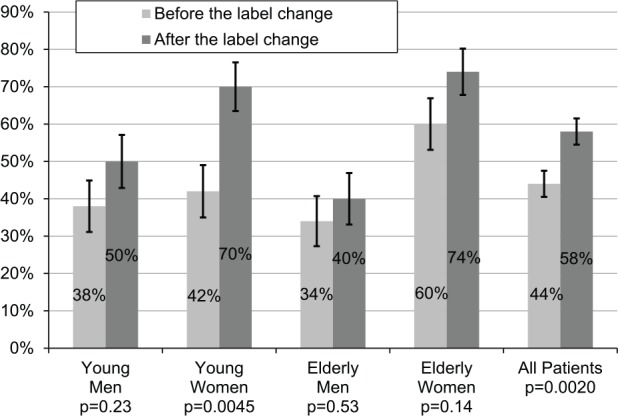
Background: Women have higher morning serum zolpidem concentrations than men after taking an evening dose, potentially leading to increased risk of harm. On 19 April 2013, the United States Food and Drug Administration required labeling changes for zolpidem, recommending an initial dose of no greater than 5 mg (immediate release) or 6.25 mg (controlled release) per night in women. Objectives: The primary objective of this study was to compare prescribing practices before and after the 2013 zolpidem labeling change. A secondary objective was to evaluate serious adverse events potentially related to zolpidem. Methods: Electronic medical records of adults receiving care through the University of Colorado Health system were accessed for study inclusion if patients were provided a first-time prescription for zolpidem either prior to or after the Food and Drug Administration labeling change. Patients were randomly chosen from eight strata based on age, gender, and date of zolpidem initiation (before/after the labeling change). Demographic and zolpidem prescribing data were collected. Low-dose zolpidem was considered 5 mg (immediate release) or 6.25 mg (controlled release) daily or less. Documentation of potentially related serious adverse events within the patients’ records was also evaluated. Results: A total of 400 patients were included in the study. The overall percentage of patients prescribed low-dose zolpidem increased from 44% to 58% after the labeling change (p = 0.0020). In a pre-specified subgroup analysis, the percentage of patients prescribed low-dose zolpidem increased in all groups, including young men (38%–50%, p = 0.23), elderly men (34%–40%, p = 0.53), and elderly women (60%–74%, p = 0.14), but the change was only significant in young women (42%–70%, p = 0.0045). Conclusion: After Food and Drug Administration–mandated labeling changes for zolpidem in 2013, the percentage of overall patients in our health system, and specifically young women, with initial prescriptions for low-dose zolpidem significantly increased as compared to before the labeling change.
Overview
The claims and statistics of this paper haven’t been checked yet.
Free: it reads the open-access text and checks the first 5 claims that cite a source we can check. Create a free account to check every claim.
Integrity signals
Registry
Cites
Statistics
Figures
Verification
Claims the paper makes
The claims and statistics of this paper haven’t been checked yet.
Free: it reads the open-access text and checks the first 5 claims that cite a source we can check. Create a free account to check every claim.
Claims other papers make about this one
Each is checked against this paper’s own text: does it say what the citing paper says it does?
In the citing paper
“In 2013, the FDA recommended a weight-based dosing zolpidem for women due to potential sex-specific impairments38”
From Sex and gender differences and biases in artificial intelligence for biomedicine and healthcare (2020) · cites this paper as [38]
Self-check
Percentages, sums and reported differences re-computed from the paper’s own numbers.
The self-check needs the paper’s full text.
Citations
Cites
Driver sleepiness and risk of serious injury to car occupants: population based case control study
Connor, J., Norton, R., Ameratunga, S., Robinson, E., Civil, I., Dunn, R., Bailey, J., & Jackson, R. (2002) · BMJ · doi:10.1136/bmj.324.7346.1125 · Cited by 748
Fatigue, sleep restriction and driving performance
Philip, P., Sagaspe, P., Moore, N., Taillard, J., Charles, A., Guilleminault, C., & Bioulac, B. (2005) · Accident Analysis & Prevention · doi:10.1016/j.aap.2004.07.007 · Cited by 389
Road accidents caused by drivers falling asleep
Sagberg, F. (1999) · Accident Analysis & Prevention · doi:10.1016/s0001-4575(99)00023-8 · Cited by 301
Greenblatt, D. J., & Roth, T. (2012) · Expert Opinion on Pharmacotherapy · doi:10.1517/14656566.2012.667074 · Cited by 283
Zolpidem and Driving Impairment — Identifying Persons at Risk
Farkas, R. H., Unger, E. F., & Temple, R. (2013) · New England Journal of Medicine · doi:10.1056/nejmp1307972 · Cited by 127
Greenblatt, D. J., Harmatz, J. S., Singh, N. N., Steinberg, F., Roth, T., Moline, M. L., Harris, S. C., & Kapil, R. P. (2014) · The Journal of Clinical Pharmacology · doi:10.1002/jcph.220 · Cited by 107
Olubodun, J. O., Ochs, H. R., Von Moltke, L. L., Roubenoff, R., Hesse, L. M., Harmatz, J. S., Shader, R. I., & Greenblatt, D. J. (2003) · British Journal of Clinical Pharmacology · doi:10.1046/j.0306-5251.2003.01852.x · Cited by 104 · cited 4×
“History of cognitive impairment or dementia, n (%) 4 (2) 7 (3.”
BackgroundInfluentialSedative Hypnotic Medication Use and the Risk of Motor Vehicle Crash
Hansen, R. N., Boudreau, D. M., Ebel, B. E., Grossman, D. C., & Sullivan, S. D. (2015) · American Journal of Public Health · doi:10.2105/ajph.2015.302723 · Cited by 74
Verster, J. C., & Roth, T. G. (2011) · Psychopharmacology · doi:10.1007/s00213-011-2400-7 · Cited by 65
Long-term use of zolpidem increases the risk of major injury: a population-based cohort study
Lai, M.-M., Lin, C.-C., Lin, C.-C., Liu, C.-S., Li, T.-C., & Kao, C.-H. (2014) · Mayo Clinic Proceedings · doi:10.1016/j.mayocp.2014.01.021 · Cited by 58
Research works printed but not linked: 4
- Sanofi-Aventis. Ambien (package insert). Bridgewater, NJ: Sanofi-Aventis, 1992.
- Purdue Pharma. Intermezzo (package insert). Stamford, CT: Purdue Pharma, 2011.
- Farkas RH Clinical review: dosing for zolpidem products (Reference ID: 3137324). Silver Spring, MD: Food and Drug Administration (FDA), 2013, pp. 1– 15.
- Sanofi-Aventis. Ambien (package insert). Bridgewater, NJ: Sanofi-Aventis, 2008.
Cited by
Sex and gender differences and biases in artificial intelligence for biomedicine and healthcare
Cirillo, D., Catuara-Solarz, S., Morey, C., Guney, E., Subirats, L., Mellino, S., Gigante, A., Valencia, A., Rementeria, M. J., Chadha, A. S., et al. (2020) · npj Digital Medicine · doi:10.1038/s41746-020-0288-5 · Cited by 553
Vinarov, Z., Abdallah, M., Agundez, J. A. G., Allegaert, K., Basit, A. W., Braeckmans, M., Ceulemans, J., Corsetti, M., Griffin, B. T., Grimm, M., et al. (2021) · European Journal of Pharmaceutical Sciences · doi:10.1016/j.ejps.2021.105812 · Cited by 359
Impact of gastrointestinal physiology on drug absorption in special populations––An UNGAP review
Stillhart, C., Vučićević, K., Augustijns, P., Basit, A. W., Batchelor, H., Flanagan, T. R., Gesquiere, I., Greupink, R., Keszthelyi, D., Koskinen, M., et al. (2020) · European Journal of Pharmaceutical Sciences · doi:10.1016/j.ejps.2020.105280 · Cited by 320
Let’s talk about sex: Differences in drug therapy in males and females
Madla, C. M., Gavins, F. K. H., Merchant, H. A., Orlu, M., Murdan, S., & Basit, A. W. (2021) · Advanced Drug Delivery Reviews · doi:10.1016/j.addr.2021.05.014 · Cited by 167
Zolpidem and Gender: Are Women Really At Risk?
Greenblatt, D. J., Harmatz, J. S., & Roth, T. (2019) · Journal of Clinical Psychopharmacology · doi:10.1097/jcp.0000000000001026 · Cited by 75
Zolpidem use and risk of suicide: A systematic review and meta-analysis
Khan, H., Garg, A., Yasmeen, Agarwal, N. B., YADAV, D. K., Khan, M. A., & Hussain, S. (2022) · Psychiatry Research · doi:10.1016/j.psychres.2022.114777 · Cited by 48
da Lodi, C. M. T., Landini, M. P., Asunis, E., & Filardo, G. (2022) · Sports Medicine - Open · doi:10.1186/s40798-022-00455-6 · Cited by 45
“Ten years later, researchers pointed out that levels in women were high enough to cause next-morning impairment lowering their performance in tasks that require alertness, including driving, and therefore the FDA started recommending women take half the dose [71, 72].”
BackgroundSharma, M. K., Kainth, S., Kumar, S. A., Bhardwaj, A., -, H. K. A., Maiwall, R., Jamwal, K. D., Shasthry, S. M., Jindal, A., Choudhury, A. K., et al. (2019) · Clinical and Molecular Hepatology · doi:10.3350/cmh.2018.0084 · Cited by 40
“75 mg for women.(5) There are no published randomized controlled studies on efficacy and safety of zolpidem in patients with cirrhosis.”
BackgroundMachado, F. V., Louzada, L. L., Cross, N. E., Camargos, E. F., Dang‐Vu, T. T., & Nóbrega, O. D. T. (2020) · Experimental Gerontology · doi:10.1016/j.exger.2020.110962 · Cited by 32
Tardelli, V. S., Fidalgo, T. M., & Martins, S. S. (2020) · Addictive Behaviors · doi:10.1016/j.addbeh.2020.106606 · Cited by 25
“However, there was a shift towards lower-dose formulations for initial zolpidem prescriptions (Kesselheim et al., 2017; Norman et al., 2017).”
BackgroundDo drug‐related safety warnings have the expected impact on drug therapy? A systematic review
Georgi, U., Lämmel, J., Datzmann, T., Schmitt, J. M., & Deckert, S. (2020) · Pharmacoepidemiology and Drug Safety · doi:10.1002/pds.4968 · Cited by 23
“In 26 studies, a partial change in drug therapy was shown.(27,30,32,33,35-38,45-47,49,53,55,57,59,62,63,66,69,70,74,77,83-85) Unintended effects of a safety warning were examined in six out of 72 studies.”
BackgroundMethodParaiso, R. L. M., Rose, R. H., Fotaki, N., McAllister, M. S., & Dressman, J. (2020) · European Journal of Pharmaceutical Sciences · doi:10.1016/j.ejps.2020.105534 · Cited by 23
“Zolpidem is a non-benzodiazepine hypnotic agent which has been shown to be effective in inducing and maintaining sleep in adults and is one of the most frequently prescribed hypnotics in the world (Norman et al., 2017; Salvà and Costa, 1995).”
Backgroundda Lodi, C. M. T., Salerno, M., Merli, G., Brama, P. A. J., Jenner, F., & Filardo, G. (2022) · Biology of Sex Differences · doi:10.1186/s13293-022-00453-z · Cited by 21
“This drug was approved and commercialized with the same dosage for both sexes and, 10 years later, it was halved by FDA in women due to sex-specific severe side effects [48, 49].”
MethodSatheesh, G., Puthean, S., Sharma, A., Mishra, S. R., Jose, J., Kakkan, S., & Unnikrishnan, M. K. (2020) · Health and Quality of Life Outcomes · doi:10.1186/s12955-020-01379-z · Cited by 20
“Although zolpidem went on to become the most prescribed sedative-hypnotic in the US and UK over the last decade, little has this transition affected the practice in India [30, 31].”
BackgroundMichelson, C., Al‐Abedalla, K., Wagner, J. A., Swede, H., Bernstein, E. R., & Ioannidou, E. (2022) · Journal Of Clinical Periodontology · doi:10.1111/jcpe.13707 · Cited by 19
Wake Up America: National Survey of Patients’ and Physicians’ Views and Attitudes on Insomnia Care
Benca, R. M., Bertisch, S. M., Ahuja, A., Mandelbaum, R., & Krystal, A. D. (2023) · Journal of Clinical Medicine · doi:10.3390/jcm12072498 · Cited by 18
Zolpidem for the Treatment of Dystonia
Badillo, S. P. J., & Jamora, R. D. G. (2019) · Frontiers in Neurology · doi:10.3389/fneur.2019.00779 · Cited by 16
“In April 1992, it was approved by the United States Food and Drug Administration as a hypnotic for patients with sleep disorders, with a recommended dose of 5–10mg to be taken at bedtime (8, 22).”
BackgroundMaternal exposure to zolpidem and risk of specific birth defects
Howley, M. M., Werler, M. M., Fisher, S. C., Tracy, M., Zutphen, A. R. V., Papadopoulos, E. A., Hansen, C. A., Ailes, E. C., Reefhuis, J., Wood, M. E., et al. (2023) · Journal of Sleep Research · doi:10.1111/jsr.13958 · Cited by 10
“Zolpidem (e.g. Ambien ® , Zolpimist ® ) is one of the most commonly prescribed non-benzodiazepines (Creeley & Denton, 2019); it was approved in the USA in 1992 as an immediate-release formulation, and in 2005 as a modified-release formulation (Norman et al., 2017).”
BackgroundCallede, N., Masciotti, T., Casettari, L., Loosveldt, N., & Goole, J. (2022) · International Journal of Pharmaceutics · doi:10.1016/j.ijpharm.2022.121756 · Cited by 9
Zolpidem dependence and withdrawal. A case report of generalized seizures
Eyler, G. E. B., & Castro, J. V. U. (2023) · Revista Colombiana de Psiquiatría (English ed ) · doi:10.1016/j.rcpeng.2021.06.013 · Cited by 8
Severe chronic abuse of zolpidem for over 10 years: a case report and review of similar cases
Moshfeghinia, R., Jazi, K., Kabaranzadghadim, S., Malekpour, M., & Oji, B. (2023) · Frontiers in Psychiatry · doi:10.3389/fpsyt.2023.1252397 · Cited by 8
“In 1992, zolpidem was approved to treat acute insomnia due to its rapid action and few side effects in comparison to benzodiazepines (9, 10).”
BackgroundBosch, P., Lim, S., Staudte, H., Yeo, S., Lee, S., Barisch, P., Perriard, B., & van den Noort, M. (2018) · Medicines · doi:10.3390/medicines5020044 · Cited by 8
“It had previously been found that women have higher morning serum zolpidem concentrations than men after taking an evening dose and this could lead to higher risks of harm [63].”
BackgroundBirnie, K., Stewart, R. J., & Kolliakou, A. (2018) · BMJ Open · doi:10.1136/bmjopen-2018-025216 · Cited by 7
“Further research could also explore differences between genders, given the sex-related pharmacokinetics of zolpidem.(33) This would be valuable information for patients who are known to be at risk of unusual sensory phenomena, where clinicians could make more informed decisions about prescribing.”
BackgroundDependencia y abstinencia de zolpidem. Reporte de un caso de convulsiones generalizadas
Eyler, G. E. B., & Castro, J. V. U. (2021) · Revista Colombiana de Psiquiatría · doi:10.1016/j.rcp.2021.06.007 · Cited by 5
Carvalho, F., Tonon, A. C., Hidalgo, M. P., Martins Costa, M., & Mengue, S. S. (2024) · Frontiers in Pharmacology · doi:10.3389/fphar.2024.1405838 · Cited by 4
Interrupted Time Series Analysis of Changes in Zolpidem Use Due to Media Broadcasts
Yang, B.-R., Heo, K., Yu, Y. M., Yeom, G.-B., Choi, H. D., Lee, J., & Ah, Y. (2021) · International Journal of Environmental Research and Public Health · doi:10.3390/ijerph18105114 · Cited by 4
“The proportion of patients using low-dose zolpidem increased from 44% to 58% after a zolpidem label dose information change [15].”
BackgroundLeonard, J. B., Seung, H., & Klein‐Schwartz, W. (2020) · Pharmacoepidemiology and Drug Safety · doi:10.1002/pds.5136 · Cited by 4
“found an increase in low-dose zolpidem prescribing after the publication of a zolpidem DSC recommending reducing the dose of zolpidem.(16) It is likely that other factors affected the change in benzonatate dose in the 13-19 year-old age group as the poison center community has seen an increase in the overall number of…”
BackgroundZOLPIDEM: UMA REVISÃO INTEGRATIVA SOBRE USO INDISCRIMINADO, DEPENDÊNCIA E EFEITOS COLATERAIS
Lanna, C. C. E., de Paiva, L. R., de Castro, L. R., Pires, S. D. S., & Boroni, F. (2024) · Revista Contemporânea · doi:10.56083/rcv4n12-221 · Cited by 3
Is the regulation of Z-drugs in Brazil in line with scientific research and international standards?
de Barros, V. V., Opaleye, E. S., & Noto, A. R. (2018) · Brazilian Journal of Psychiatry · doi:10.1590/1516-4446-2017-2372 · Cited by 3
Redesigning medicine: integrating sex and gender for better health outcomes
Rajcsanyi, L. S., Jochimsen, M. A., Kindler‐Röhrborn, A., & Hinney, A. (2025) · Naunyn-Schmiedeberg s Archives of Pharmacology · doi:10.1007/s00210-025-04722-7 · Cited by 2
“Consequently, the FDA mandated that females only needed half the dose men received (Bush 2014; Food and Drug Administration (FDA) 2013; Norman et al. 2017).”
Zolpidem and Zolpidem Carboxylic Acid Results from Medication Monitoring
Feng, S., Cummings, O. T., & McIntire, G. L. (2018) · Journal of Analytical Toxicology · doi:10.1093/jat/bky033 · Cited by 1
Evaluating Therapeutics and Interventions Throughout the Female Life Course
Maron, J. L. (2020) · Clinical Therapeutics · doi:10.1016/j.clinthera.2020.02.008 · Cited by 1
Chambe, J., Frisk, M. K., Charton, L., Lefebvre, F., Will, S., Rat, C., & Bourgin, P. (2020) · Journal of Sleep Research · doi:10.1111/jsr.12993
A physiologically based biopharmaceutical analysis of zolpidem
Paraiso, R. L. M. (2021) · Publication Server of Goethe University Frankfurt am Main (Goethe University Frankfurt) · doi:10.21248/gups.61326
Sleep aid use during early pregnancy and the risk of birth defects
Howley, M. M. (2023) · Scholars Archive - University at Albany (University at Albany, State University of New York) · doi:10.54014/648t-176f
Mondini Trissino da Lodi, C., Salerno, M., Merli, G., Brama, P. A. J., Jenner, F., & Filardo, G. (2022) · Figshare · doi:10.6084/m9.figshare.20408856
Sukupuolen vaikutus lääkkeiden farmakokinetiikkaan ja lääkevasteeseen
Mantila, E. (2024) · UTUPub (University of Turku)
Sex-Based Gaps in the Prescription of Cardio-Nephroprotective Medications in CKD
Balafa, O. C., & Androulaki, M. (2026) · Kidney and Dialysis · doi:10.3390/kidneydial6020031
“A hallmark example is the sedative zolpidem; for years, women were prescribed the same dose as men, leading to high rates of next-day cognitive impairment until the FDA eventually recommended halving the female dose [72].”
Metadata
- Authors
- Norman, J. L., Fixen, D. R., Saseen, J. J., Saba, L. M., & Linnebur, S. A.
- Affiliations
- University of Wisconsin–Madison (US)
- University of Colorado Anschutz (US)
- Corresponding author
- Linnebur, Sunny A
- Venue
- SAGE Open Medicine
- Publisher
- SAGE Publications
- Published
- 2017-01-01
- Volume
- 5
- Pages
- 2050312117707687-2050312117707687
- ISSN
- 2050-3121 (ISSN-L)
- PMC
- PMC5423710
- OpenAlex
- W2610509910
- Cited by
- 38
- References
- 14
- Citations by year
- 2026: 1 · 2025: 1 · 2024: 2 · 2023: 5 · 2022: 6 · 2021: 5 · 2020: 10 · 2019: 4 · 2018: 4
- FWCI
- 2.97
- Type
- journal article
- Language
- en
- Open access
- gold
- doi.org
- Licence
- cc-by-nc
- journals.sagepub.com/page/policies/text-and-data-mining-license (tdm)
- Locations
- SAGE Open Medicine (publishedVersion, cc-by-nc)
- Europe PMC (PubMed Central) (publishedVersion, cc-by-nc)
- PubMed Central (publishedVersion, cc-by-nc)
- PubMed (publishedVersion)
- DOAJ (DOAJ: Directory of Open Access Journals) (submittedVersion, cc-by-sa)
- Topics
- Health Sciences › Medicine › Geriatrics and Gerontology › Pharmaceutical Practices and Patient Outcomes
- Social Sciences › Psychology › Experimental and Cognitive Psychology › Sleep and related disorders
- Life Sciences › Pharmacology, Toxicology and Pharmaceutics › Toxicology › Pharmacovigilance and Adverse Drug Reactions
- Keywords
- zolpidem, prescribing patterns, women, young women, sedative-hypnotic drugs, serious adverse events, drug regulation, gender differences in prescribing
About these checks
Registry, retraction, Cites and statistics results are computed, not judged, with one exception: a printed reference that no index lists is read once by a model before it counts as a citation error. Claims are extracted by a model and kept only when their quote appears verbatim in the text; each cited source is then checked, with a model’s help, for whether it says what the claim relies on. Those verdicts can be wrong — read the claim’s quote and the cited source before relying on one.
Statistics and arithmetic are recomputed, not judged.
Confidence bands are shown only for fields calibrated on our annotated test set. None is calibrated yet, so no band is shown.
What counts as a claim ›How we measure confidence ›How we check this ›
Are you an author, or do you see a problem with this page? Request a review
Data sources
Bibliographic data: Semantic Scholar, OpenAlex, Crossref.
Contains information from the Semantic Scholar Academic Graph Datasets, made available under the ODC Attribution License (ODC-BY 1.0).
Semantic Scholar’s data is described in: Kinney, R., et al. (2023). The Semantic Scholar Open Data Platform. arXiv:2301.10140.
