

The DOI matches its Crossref record; 41 of the 42 references it cites were found in a registry or an index.
Seven lessons for interdisciplinary research on interactive digital health interventions
Open accessAbstract
Research and development for interactive digital health interventions requires multi-disciplinary expertise in identifying user needs, and developing and evaluating each intervention. Two of the central areas of expertise required are Health (broadly defined) and Human–Computer Interaction. Although these share some research methods and values, they traditionally have deep differences that can catch people unawares, and make interdisciplinary collaborations challenging, resulting in sub-optimal project outcomes. The most widely discussed is the contrast between formative evaluation (emphasised in Human–Computer Interaction) and summative evaluation (emphasised in Health research). However, the differences extend well beyond this, from the nature of accepted evidence to the culture of reporting. In this paper, we present and discuss seven lessons that we have learned about the contrasting cultures, values, assumptions and practices of Health and Human–Computer Interaction. The lessons are structured according to a research lifecycle, from establishing the state of the art for a given digital intervention, moving through the various (iterative) stages of development, evaluation and deployment, through to reporting research results. Although our focus is on enabling people from different disciplinary backgrounds to work together with better mutual understanding, we also highlight ways in which future research in this interdisciplinary space could be better supported.
Overview
The claims and statistics of this paper haven’t been checked yet.
Run the check — free, no account needed. It reads the open-access text and checks the sources it cites.
Integrity signals
Registry
Cites
Statistics
Figures
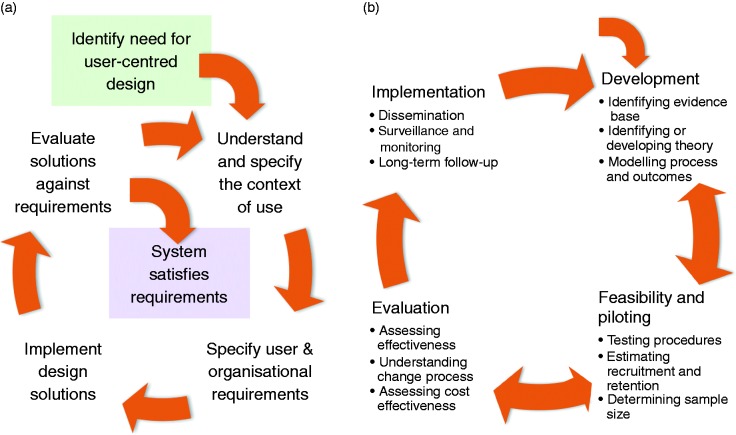
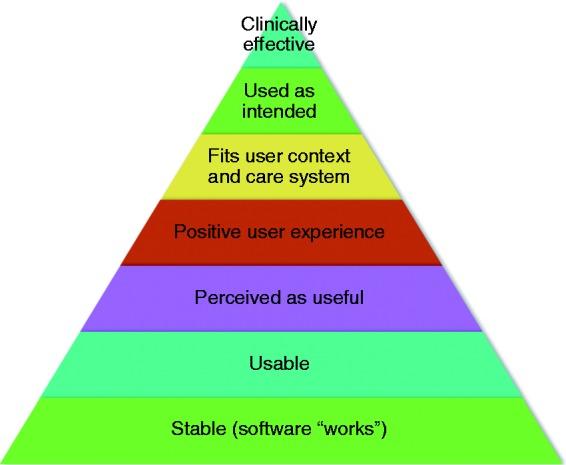
Verification
Claims the paper makes
The claims and statistics of this paper haven’t been checked yet.
Run the check — free, no account needed. It reads the open-access text and checks the sources it cites.
Claims other papers make about this one
Each is checked against this paper’s own text: does it say what the citing paper says it does?
The cited source says what the claim attributes to it.
In the citing paper
“Recent research into digital health intervention development highlights the importance of an iterative, multidisciplinary approach in which the end user is placed at the heart of the system and the technology is grounded in user wants and needs [45-47].”
The cited source says what the claim attributes to it.
In the citing paper
“To ensure tools are convenient and useful in the context of day-to-day life, it is necessary to involve end-users across the design and development process (Mohr et al., 2017; Blandford et al., 2018; Borghouts et al., 2021; Poole, 2013).”
From A text messaging intervention to support the mental health of young adults: User engagement and feedback from a field trial of an intervention prototype (2023) · cites this paper as Blandford et al., 2018
Self-check
Percentages, sums and reported differences re-computed from the paper’s own numbers.
The self-check needs the paper’s full text.
Citations
Cites
Michie, S., van Stralen, M. M., & West, R. (2011) · Implementation Science · doi:10.1186/1748-5908-6-42 · Cited by 13,697
Developing and evaluating complex interventions: the new Medical Research Council guidance
Craig, P., Dieppe, P., Macintyre, S., Michie, S., Nazareth, I., & Petticrew, M. (2008) · BMJ · doi:10.1136/bmj.a1655 · Cited by 10,995
Co-creation and the new landscapes of design
Sanders, E. B.-N., & Stappers, P. J. (2008) · CoDesign · doi:10.1080/15710880701875068 · Cited by 5,561
Systematic reviews in the social sciences: a practical guide
(2006) · Choice Reviews Online · doi:10.5860/choice.43-5664 · Cited by 4,083
Framework for design and evaluation of complex interventions to improve health
Campbell, M. (2000) · BMJ · doi:10.1136/bmj.321.7262.694 · Cited by 3,474 · cited 1×
“Historically, many interactive DHIs developed within Health research base their approach on the early Medical Research Council (MRC) guidance on developing and evaluating complex interventions 3 .”
BackgroundNielsen, J. (1994) · Conference companion on Human factors in computing systems - CHI '94 · doi:10.1145/259963.260531 · Cited by 2,759
Contextual Design: Defining Customer-Centered Systems
Beyer, H. R., & Holtzblatt, K. (1997) · Cited by 2,748
Dixon-Woods, M., Cavers, D., Agarwal, S., Annandale, E., Arthur, A., Harvey, J., Hsu, R., Katbamna, S., Olsen, R., Smith, L., et al. (2006) · BMC Medical Research Methodology · doi:10.1186/1471-2288-6-35 · Cited by 2,289
Eysenbach, G., & CONSORT-EHEALTH Group (2011) · Journal of Medical Internet Research · doi:10.2196/jmir.1923 · Cited by 1,863 · cited 1×
“For example, standards developed for reporting of interactive DHIs 13 tend to focus on RCTs and not on alternative evaluation designs or formative research.”
BackgroundEvidence-Based Medicine: How to Practice and Teach EBM
Satya-Murti, S. (2000) · JAMA · doi:10.1001/jama.284.18.2382 · Cited by 1,645
Research works printed but not linked: 2
- Cresswell KM, 2017, J Roy Soc Med, 1, 014107681771225
- Rogers Y, 2011, Interaction design: Beyond human-computer interaction
Cited by
Sorted by citations
Sanches, P., Janson, A., Karpashevich, P., Nadal, C., Qu, C., Roquet, C. D., Umair, M., Windlin, C., Doherty, G. J., Höök, K., et al. (2019) · CHI Conference on Human Factors in Computing Systems · doi:10.1145/3290605.3300475 · Cited by 248
Bergin, A. D., Vallejos, E. P., Davies, E. B., Daley, D., Ford, T., Harold, G., Hetrick, S., Kidner, M., Long, Y., Merry, S., et al. (2020) · npj Digital Medicine · doi:10.1038/s41746-020-00339-7 · Cited by 157
HCI for health and wellbeing: Challenges and opportunities
Blandford, A. (2019) · International Journal of Human-Computer Studies · doi:10.1016/j.ijhcs.2019.06.007 · Cited by 152
Self-citationThe Development and Use of Chatbots in Public Health: Scoping Review
Wilson, L., & Mărăşoiu, M. (2022) · JMIR Human Factors · doi:10.2196/35882 · Cited by 135
Suijkerbuijk, S., Nap, H. H., Cornelisse, L., IJsselsteijn, W. A., de Kort, Y. A. W., & Minkman, M. M. N. (2019) · Journal of Alzheimer s Disease · doi:10.3233/jad-190050 · Cited by 124
Metadata
- Authors
- Blandford, A., Gibbs, J., Newhouse, N., Perski, O., Singh, A., & Murray, E.
- Affiliations
- University College London (GB)
- The Royal Free Hospital (GB)
- Corresponding author
- Blandford, Ann
- Venue
- DIGITAL HEALTH
- Publisher
- SAGE Publications
- Published
- 2018-01
- Volume
- 4
- Pages
- 2055207618770325-2055207618770325
- ISSN
- 2055-2076 (ISSN-L)
- PMC
- PMC6016567
- OpenAlex
- W2800091779
- Cited by
- 209
- References
- 42
- Citations by year
- 2026: 36 · 2025: 30 · 2024: 28 · 2023: 14 · 2022: 24 · 2021: 24 · 2020: 32 · 2019: 17 · 2018: 4
- FWCI
- 27.34
- Type
- journal article
- Language
- en
- Open access
- gold
- doi.org
- Locations
- Digital Health (publishedVersion, cc-by)
- Europe PMC (PubMed Central) (publishedVersion, cc-by)
- PubMed Central (publishedVersion, cc-by)
- PubMed (publishedVersion)
- DOAJ (DOAJ: Directory of Open Access Journals) (submittedVersion, cc-by-sa)
- Funders
- Engineering and Physical Sciences Research Council (EP/G004560/1)
- Topics
- Social Sciences › Arts and Humanities › History and Philosophy of Science › Interdisciplinary Research and Collaboration
- Physical Sciences › Computer Science › Human-Computer Interaction › Usability and User Interface Design
- Health Sciences › Health Professions › General Health Professions › Mobile Health and mHealth Applications
- Keywords
- interdisciplinary research, human-computer interaction, health research, formative assessment, summative assessment, research culture, research reporting, research lifecycle, user needs, interdisciplinary collaboration
About these checks
Registry, retraction, Cites and statistics results are computed, not judged, with one exception: a printed reference that no index lists is read once by a model before it counts as a citation error. Claims are extracted by a model and kept only when their quote appears verbatim in the text; each cited source is then checked, with a model’s help, for whether it says what the claim relies on. Those verdicts can be wrong — read the claim’s quote and the cited source before relying on one.
Statistics and arithmetic are recomputed, not judged.
Confidence bands are shown only for fields calibrated on our annotated test set. None is calibrated yet, so no band is shown.
What counts as a claim ›How we measure confidence ›How we check this ›
Are you an author, or do you see a problem with this page? Request a review
