

Baseline evaluation of nursing students’ informatics competency for digital health practice: A descriptive exploratory study
Open accessThe DOI matches its Crossref record; 27 of the 28 references it cites were found in a registry or an index, and 1 are not checked yet.
Abstract
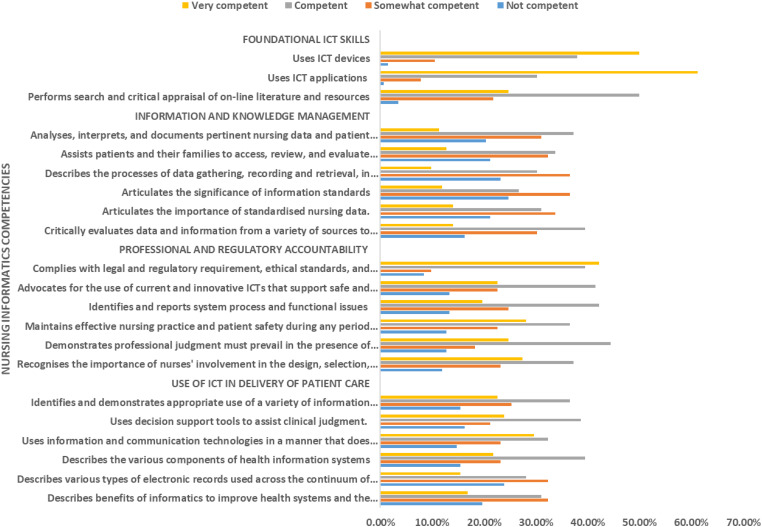
Introduction: The healthcare system is increasingly technology-dependent and proficiency in informatics skills is essential for health professionals to efficiently operate in the contemporary clinical environment. Nurses are major users of digital health technologies and graduates need to be well-prepared and confident to use the different available clinical systems competently as they transition from education to practice. Aim: To explore undergraduate nursing students’ self-perceptions of informatics competence, set within a larger research project. Method: Descriptive, exploratory cross-sectional research design, with online self-assessment survey of undergraduate nursing students ( n = 142). Data were analysed with descriptive, correlation and comparative statistics. Results: Participants’ perceived overall mean informatics competency was at the level of somewhat competent, with only 40.84% ( n = 58) at the level of competent. The highest mean value was in foundational information and communication skills and the lowest in information and knowledge management. Formal informatics education within curriculum was limited and lacked uniformity, as was prior exposure to important simulated informatics tools in preparation for practice. Factors including academic year level, computer experience and previous experience using clinical systems had a significant impact on participants’ perceived informatics competency. Conclusion: Even though informatics competence is vital for clinical practice, with technology becoming pervasive within healthcare, nursing students’ preparedness for digital health was sub-optimal. There were gaps in students’ critical informatics practice knowledge with implications for work readiness of future graduates and nurse education practice.
Overview
The claims and statistics of this paper haven’t been checked yet.
Free: it reads the open-access text and checks the first 5 claims that cite a source we can check. Create a free account to check every claim.
Integrity signals
Registry
Cites
Statistics
Figures
Verification
Claims the paper makes
The claims and statistics of this paper haven’t been checked yet.
Free: it reads the open-access text and checks the first 5 claims that cite a source we can check. Create a free account to check every claim.
Claims other papers make about this one
Each is checked against this paper’s own text: does it say what the citing paper says it does?
The source backs part of the claim, not all of it — or backs it for a different population, condition or comparison.
In the citing paper
“Specifically, 71.1% lack confidence in electronic medical records usage, 55% rate their computing skills as inadequate, and only 40.84% perceive themselves as informatics-competent [6].”
From Enhancing undergraduate nursing informatics literacy through design-based learning: a mixed-methods participatory action research study (2025) · cites this paper as [6]
Experimental — accuracy not yet measured
Self-check
Percentages, sums and reported differences re-computed from the paper’s own numbers.
The self-check needs the paper’s full text.
Citations
Cites
SPSS survival manual: a step by step guide to data analysis using IBM SPSS
(2013) · Australian and New Zealand Journal of Public Health · doi:10.1111/1753-6405.12166 · Cited by 2,716
Educating the nurses of 2025: Technology trends of the next decade
Risling, T. (2017) · Nurse Education in Practice · doi:10.1016/j.nepr.2016.12.007 · Cited by 161 · cited 4×
“These digital health technologies are an integral part of the healthcare environment associated with considerable benefits including the storage and management of vast amounts of health data, coordinated patient care, improved access and quality of patient data and improved interdisciplinary health team communication.…”
BackgroundMethodInfluentialForman, T. M., Armor, D. A., & Miller, A. S. (2019) · Nursing Education Perspectives · doi:10.1097/01.nep.0000000000000588 · Cited by 110 · cited 2×
“systems across healthcare and all-important emphasis on collaborative care from health team members.(3,14) More significantly, as highlighted by Kleib et al.”
BackgroundStudent Nurses' Digital Literacy Levels: Lessons for Curricula
Brown, J. A., Morgan, A., Mason, J., Pope, N., & Bosco, A. M. (2020) · CIN Computers Informatics Nursing · doi:10.1097/cin.0000000000000615 · Cited by 88 · cited 5×
“Another study about digital literacy among nursing students in an Australian university showed that only 55% (n = 84) considered their overall applied computing skills as competent for clinical settings.(20) In addition, although health professions students have reported high levels of basic, everyday digital literacy…”
BackgroundResultInfluentialFactors Associated With Canadian Nurses' Informatics Competency
Kleib, M., & Nagle, L. (2018) · CIN: Computers, Informatics, Nursing · doi:10.1097/cin.0000000000000434 · Cited by 72
Are Future Nurses Ready for Digital Health?
Kleib, M., Nagle, L., Furlong, K. E., Paul, P., Wisnesky, U. D., & Ali, S. (2022) · Nurse Educator · doi:10.1097/nne.0000000000001199 · Cited by 68 · cited 2×
“The use of simulated or academic EMRs within the nursing curricula can be valuable practical teaching and learning tools in preparation for technologies used in the clinical context.(28,39) The current study revealed year level, computer experience and previous EMR experience had a significant impact on students’ perc…”
BackgroundMethodLokmic‐Tomkins, Z., Choo, D., Foley, P., Dix, S., Wong, P., & Brand, G. (2022) · Nurse Education Today · doi:10.1016/j.nedt.2022.105308 · Cited by 62 · cited 3×
“Furthermore, despite being digitally savvy, and students generally accepting digital technologies positively, there are reported deficits in confidence to use clinical systems.(23) Previous examinations of nursing students’ perceived informatics knowledge showed that they were predominantly at a basic level, and stude…”
BackgroundResultNursing informatics competencies: assessment of undergraduate and graduate nursing students
Choi, J., & Martinis, J. E. D. (2013) · Journal of Clinical Nursing · doi:10.1111/jocn.12188 · Cited by 60
Use of academic electronic medical records in nurse education: A scoping review
Raghunathan, K., McKenna, L., & Peddle, M. (2021) · Nurse Education Today · doi:10.1016/j.nedt.2021.104889 · Cited by 59 · cited 1×
“Progressively, curriculum reforms to integrate informatics content and increased investment into learning technologies, such as simulated EMRs, have been associated with educational interventions to improve students’ readiness for digital practice.(14,15) However, significant gaps in nursing graduates’ readiness for t…”
BackgroundSelf-citationShin, E. H., Cummings, E. A., & Ford, K. (2017) · Contemporary Nurse · doi:10.1080/10376178.2017.1393317 · Cited by 55
Research works printed but not linked: 13
- Australian Digital Health Agency (ADHA). Australia’s National Digital Health Strategy. Canberra: Australian Government; 2018.
- Foster M Sethares K. Current strategies to implement informatics into the nursing curriculum: an integrative review. Online J Nursing Inf. 2017; 21: 4–1.
- Saratan C Borycki E, M. Kushniruk A, W. Information management competencies for practicing nurses and new graduates. Knowl Manage e-Learning. 2015; 7: 378– 394.
- Miller L Stimely ME Matheny PM, et al. Novice nurse preparedness to effectively use electronic health records in acute care settings: critical informatics knowledge and skill gaps. Online J Nursing Inf. 2014; 18: 1– 24.
- Mitchell J. Electronic documentation: assessment of newly graduated nurses’ competency and confidence levels. Online J Nursing Inf. 2015; 19: 1– 6.
- Lam MK Hines M Lowe R, et al. Preparedness for eHealth: health sciences students’ knowledge, skills, and confidence. J Inf Technol Educ. 2016; 15: 305– 334.
- Strahan B. Self-assessment of nursing informatics competencies for pre-licensure nursing students. J Inf Nursing. 2017; 2: 14– 18.
- Zamarripa-Zoucha A. Evaluation of nursing students’ informatics competency using an adapted self-assessment of nursing informatics competency scale (SANICS) tool. Thesis. The Ohio State University, Columbus Ohio USA, 2015.
- Australian Digital Health Agency (ADHA). National nursing and midwifery digital health capability framework. Sydney NSW: Australian Government, 2020.
- Australian Nursing and Midwifery Federation (ANMF). National informatics standards for nurses and midwives. Melbourne: ANMF, 2015.
- Krishna R Maithreyi R Surapaneni KM. Research bias: a review for medical students. J Clin Diagn Res [Serial Online] 2010; 4: 2320– 2324.
- Belchez CA. Informatics and faculty intraprofessional assessment and gap analysis of current integration of informatics competencies in a baccalaureate nursing program. Thesis. ProQuest Dissertations Publishing, University of Kansas: Kansas USA, 2019.
- Kleib M Olson K. Evaluation of an informatics educational intervention to enhance informatics competence among baccalaureate nursing students. Knowl Manage e-Learning. 2015; 7: 395– 411.
Cited by
Ng, L., Osborne, S. R., Eley, R. M., Tuckett, A. G., & Walker, J. (2024) · Collegian Journal of the Royal College of Nursing Australia · doi:10.1016/j.colegn.2023.12.006 · Cited by 31
Tumuhimbise, W., Theuring, S., Atukunda, E. C., Godfrey, M. R., Babirye, D., Kaggwa, F., Rogers, M., Gerald, K., Nuwematsiko, R., Wanyana, I., et al. (2025) · Discover Education · doi:10.1007/s44217-025-00793-z · Cited by 27
“…such as data protection and artificial intelligence used in digital health [16, 37, 50, 51], which subsequently results in poor digital health skills [5, 38, 41, 43, 46, 49, 53, 55]; negative attitudes toward digital health [41, 46]; and a lack of awareness of the need for digital health [51].”
InfluentialNational survey on understanding nursing academics' perspectives on digital health education
Zhao, L., Abdolkhani, R., Walter, R., Petersen, S., Butler-Henderson, K. A., & Livesay, K. (2024) · Journal of Advanced Nursing · doi:10.1111/jan.16163 · Cited by 22
Roux, L. Z. L., Bimerew, M. S., & Chipps, J. A. (2024) · BMC Nursing · doi:10.1186/s12912-024-02614-4 · Cited by 19
Wang, C., Yu, Y., Chen, Y., & Jin, C. (2025) · BMC Medical Education · doi:10.1186/s12909-025-07125-7 · Cited by 13
“A study conducted in Australia has revealed the current non-optimistic situation of nursing students’informatics competency, with only 40.84% of students achieved a"competent"level [7].”
InfluentialShen, M., Feng, Z., Shen, Y., & Shi, Z. (2025) · BMC Nursing · doi:10.1186/s12912-025-03927-8 · Cited by 12
“Specifically, 71.1% lack confidence in electronic medical records usage, 55% rate their computing skills as inadequate, and only 40.84% perceive themselves as informatics-competent [6].”
InfluentialKleib, M., Arnaert, A., Nagle, L., Sugars, R., & Costa, D. D. (2024) · JMIR Medical Education · doi:10.2196/53258 · Cited by 13
“Other research has identified an urgent need for explicit and consistent teaching about digital health (existing and emerging technologies) concepts and their integration into clinical care [18,35,36].”
BackgroundInfluentialAnalysis of Readiness For Implementation of Electronic Medical Records Using DOQ-IT Method
Widiyanto, W. W., Sulistyati, H. S., & Zahroh, S. U. (2023) · International Journal of Computer and Information System (IJCIS) · doi:10.29040/ijcis.v4i4.146 · Cited by 7
“The assessment was carried out in 11 items[17], [18], namely:”
MethodFrom Digital Health Literacy to a Digital and Data Capabilities Approach to Sexual Health
Albury, K., & Mannix, S. (2025) · Sexuality Research and Social Policy · doi:10.1007/s13178-025-01110-x · Cited by 6
Ayed, A., Malak, M. Z., Mohammad, K., Alanazi, A., Ejheisheh, M. A., Batran, A., Alafi, M., & Obiedate, K. M. (2026) · Nursing in Critical Care · doi:10.1111/nicc.70497 · Cited by 4
“This level may be explained by the limited availability of formal or comprehensive informatics training during nurses' academic or professional education, resulting in many nurses developing informatics skills through self-directed learning or job experience [26].”
Mollart, L. J., Stubbs, M. A., Noble, D., Koizumi, N., & Crowfoot, G. (2025) · Clinical Simulation in Nursing · doi:10.1016/j.ecns.2025.101792 · Cited by 4
Exploring Australian nursing and midwifery informatics roles: A scoping review
Jedwab, R. M., Langtree, T., LoPresti, K. C., Jones, A. J., & Dobroff, N. K. (2025) · Collegian Journal of the Royal College of Nursing Australia · doi:10.1016/j.colegn.2025.01.002 · Cited by 2
Webb, C., Dabkowski, E., Allen, L., Missen, K., & Dekker, E. (2025) · Teaching and learning in nursing · doi:10.1016/j.teln.2025.08.010 · Cited by 2
Harerimana, A., Wicking, K., Biedermann, N., & Yates, K. (2025) · International Journal of Nursing Sciences · doi:10.1016/j.ijnss.2025.12.004 · Cited by 2
“Empirical studies report that nursing students frequently demonstrate low baseline competency in clinical informatics and information management, while curricular adoption remains slow and fragmented [15,21,31].”
Alnomasy, N., Alrashedi, H., Alsayed, S., Pangket, P. P., & Alsayed, R. (2026) · JMIR Nursing · doi:10.2196/85283 · Cited by 2
“Furthermore, programs should incorporate simulated or laboratory-based experiences that replicate authentic informatics tasks such as data retrieval, clinical decision-making, and regulatory documentation [21].”
Lokmic‐Tomkins, Z., Raghunathan, K., Almond, H. M., Booth, R. G., McBride, S. G., Tietze, M. F., Honey, M. L. L., Procter, P. M., Peddle, M., & McKenna, L. (2024) · Studies in health technology and informatics · doi:10.3233/shti240125 · Cited by 2
Self-citationJallad, S. T., Sawalha, R., & Awamleh, F. T. (2025) · CIN Computers Informatics Nursing · doi:10.1097/cin.0000000000001330 · Cited by 4
Psychometric Analysis of a Nursing Informatics Competencies Survey
Miller, K., Schuler, M., Thrift, J. R., Taylor, K. A., Urquhart, B. B., Gaffney, M. K., & Boice, O. (2025) · CIN Computers Informatics Nursing · doi:10.1097/cin.0000000000001325 · Cited by 1
Abbasi, R., Ghafari, F., Farrahi, R., Ram, M., & Seghaleh, M. M. (2025) · Journal of Medical Education Development · doi:10.61882/edcj.18.2.46 · Cited by 1
“These include decreased efficiency and wasted time, an increased likelihood of errors (such as incorrect data entry) [19], reduced motivation and job satisfaction [20], underutilization of the system's full capabilities [21, 22], and challenges in identifying and resolving technical issues [23].”
Mannix, S., & Albury, K. (2026) · BMC Health Services Research · doi:10.1186/s12913-025-13970-5 · Cited by 2
“Additionally, university health educators report a lack of confidence in teaching digital health subjects [37]; and an absence of standardisation across currently available courses [19, 38].”
Belchez, C. A., Kunkel, D. E., Kulhanek, B. J., Tietze, M. F., & Pinekenstein, B. J. (2026) · Nurse Educator · doi:10.1097/nne.0000000000002117 · Cited by 2
Alnomasy, N., Alrashedi, H., Alsayed, S., Pangket, P. P., Hashish, E. A. A., Alsayed, R., & Mostoles, R. (2026) · JMIR Nursing · doi:10.2196/88075 · Cited by 1
“Internationally, studies validating the tool have provided evidence for its reliability and validity across multiple nursing populations in Canada [13,14] and have demonstrated high levels of reliability during adaptation efforts in Australia [15].”
Ngangue, P., Saouadogo, I., Kaboré, S. S., Douglas, M. M., Bationo, N., Seu, J., & Ly, B. A. (2024) · medRxiv · doi:10.1101/2024.03.29.24305086 · Cited by 1
“The healthcare system is increasingly technology-dependent, and informatics skills are essential for HCPs to operate efficiently in the contemporary clinical environment (Raghunathan, McKenna, & Peddle, 2023).”
BackgroundHalid, M., & Susilo, B. B. B. (2025) · Majallah-i dānishkadah-i pizishkī.Dānishgāh-i ̒ulūm-i pizishkī va khadamāt-i bihdāshtī- darmānī-i Tihrān./Majallah-i dānishkadah-i pizishkī.Dānishgāh-i ̒ulūm-i pizishkī va khadamāt-i bihdāshtī- darmānī-i Tihrān. · doi:10.61186/edcj.18.1.87 · Cited by 1
Sugiarto, D. W., & Rachmawati, A. (2025) · Media Publikasi Promosi Kesehatan Indonesia (MPPKI) · doi:10.56338/mppki.v8i5.7131
“The study by Ragunathan et al. also revealed that year level of study, experience using computers, and experience using electronic medical records had a significant impact on students' perceptions of competency related to informatics skills (17).”
Ergezen, F. D., Şenol, Ş., & Kök, A. Y. (2025) · CIN Computers Informatics Nursing · doi:10.1097/cin.0000000000001358 · Cited by 1
Sofia, B., Luca, F., & Giulia, R. (2022) · Journal of integrative nursing and palliative care · doi:10.51847/ro7wxh7mpg
Hau, H. T. M., & Sen, H. T. N. (2026) · Research Medical Journal · doi:10.33165/rmj.2027.e277280
Saraç, E., & Yıldız, E. (2026) · Türkiye Halk Sağlığı Dergisi · doi:10.20518/tjph.1629397
Digital Health Technology and the New Graduate Nurse: A Scoping Review Protocol
Ryan, M., Cole, V., Duchscher, J. E. B., Booth, R. G., & Lalonde, M. (2026) · Nursing Reports · doi:10.3390/nursrep16030090
“Nursing students are challenged to meet entry-level competencies for digital health practice [6,7], but the experiences and abilities of NGNs are yet to be explored as it relates to these competencies.”
Liu, Z., Zhang, Y., Li, X., Wei, X., Yang, Z., Zhu, T., Chen, B., Li, X., Li, S., Tang, X., et al. (2026) · Research Square · doi:10.21203/rs.3.rs-8757170/v1
Investigation of Dental Students’ Knowledge Levels on Artificial Intelligence
Ozturk, A. U., Altundağ, D. G., Motiei, S., Ghatari, R., & Sadry, S. (2026) · Current Research in Dental Sciences · doi:10.17567/currresdentsci.1527838
Implementation of a Validated Digital Competence E-Learning Program in Graduate Nursing Students
Adif, S. A., Yen, M., Natashia, D., Tran, L. T. K., & Hadi, M. (2026) · CIN Computers Informatics Nursing · doi:10.1097/cin.0000000000001561
Lv, Y., Li, M., Yue, Y., Hallensleben, C., Dai, H., & Shen, H. (2026) · Nursing Reports · doi:10.3390/nursrep16080268
“The present findings are broadly consistent with international studies in which nursing students reported moderate overall NI competence and particular weaknesses in applied skills [1,24].”
InfluentialPerceived competence of Nigerian nursing students in ICT usage for academic and research purposes
Akingbade, O., Atekoja, O. E., Afolalu, O. O., Jolayemi, K. I., Adewumi, O. T., Adeyeye, S. O., Oyewumi, Z. O., Tola, Y. O., Eminiken, O., & Esan, D. T. (2026) · International Journal of Africa Nursing Sciences · doi:10.1016/j.ijans.2026.101156
Çalışkan, F. (2026) · Frontiers in Public Health · doi:10.3389/fpubh.2026.1948572
“Since digital health technologies are an integral part of healthcare services, nurses must possess not only technical digital skills but also the ability to access, evaluate, interpret, and effectively use digital information in clinical practice (43).”
Thuy, L. T., Giang, N. H., Hoai, N. T. Y., My, T. T., Trinh, L. H., & Oanh, T. T. H. (2026) · Education in Medicine Journal · doi:10.21315/eimj2026.18.3.16
“This finding is consistent with Raghunathan et al. (19), who reported that fewer than half of nursing students in Australia achieved a competent level of informatics proficiency (19).”
Choudhry, A., Sharma, R., & Choudhry, N. (2026) · Sarvodaya International Journal of Medicine · doi:10.4103/sijm.sijm_39_26
PERSEPSI DAN KEMAMPUAN INFORMATIKA KEPERAWATAN PADA MAHASISWA SARJANA KEPERAWATAN
Yusuf, S., & Amal, A. A. (2025) · Alauddin Scientific Journal of Nursing · doi:10.24252/asjn.v6i2.60899
Metadata
- Authors
- Raghunathan, K., McKenna, L., & Peddle, M.
- Affiliations
- La Trobe University (AU)
- Deakin University (AU)
- Corresponding author
- Raghunathan, Kalpana
- Venue
- DIGITAL HEALTH
- Publisher
- SAGE Publications
- Published
- 2023-01
- Volume
- 9
- Pages
- 20552076231179051-20552076231179051
- ISSN
- 2055-2076 (ISSN-L)
- PMC
- PMC10236246
- OpenAlex
- W4378908938
- Cited by
- 37
- References
- 21
- Citations by year
- 2026: 14 · 2025: 15 · 2024: 6 · 2023: 1
- FWCI
- 8.45
- Type
- journal article
- Language
- en
- Open access
- gold
- doi.org
- Locations
- Digital Health (publishedVersion, cc-by)
- PubMed Central (publishedVersion, cc-by)
- PubMed (publishedVersion)
- DOAJ (DOAJ: Directory of Open Access Journals) (submittedVersion, cc-by-sa)
- Figshare (submittedVersion, cc-by)
- Funders
- Australian Government (Research Training Program Scholarship)
- Topics
- Social Sciences › Education › Digital literacy in education
- Health Sciences › Nursing › Leadership and Management › Healthcare Education and Workforce Issues
- Social Sciences › Education › Innovations in Medical Education
- Keywords
- nursing informatics, informatics competencies, nursing students, perceived competence, informatics education, nursing curriculum, clinical information systems, career readiness, information and knowledge management, computer experience
About these checks
Registry, retraction, Cites and statistics results are computed, not judged, with one exception: a printed reference that no index lists is read once by a model before it counts as a citation error. Claims are extracted by a model and kept only when their quote appears verbatim in the text; each cited source is then checked, with a model’s help, for whether it says what the claim relies on. Those verdicts can be wrong — read the claim’s quote and the cited source before relying on one.
Statistics and arithmetic are recomputed, not judged.
Confidence bands are shown only for fields calibrated on our annotated test set. None is calibrated yet, so no band is shown.
What counts as a claim ›How we measure confidence ›How we check this ›
Are you an author, or do you see a problem with this page? Request a review
Data sources
Bibliographic data: Semantic Scholar, OpenAlex, Crossref.
Contains information from the Semantic Scholar Academic Graph Datasets, made available under the ODC Attribution License (ODC-BY 1.0).
Semantic Scholar’s data is described in: Kinney, R., et al. (2023). The Semantic Scholar Open Data Platform. arXiv:2301.10140.
