

Impact of #PCOSweightloss: A global X hashtag analysis study of weight loss narratives in the PCOS community
Open accessThe DOI matches its Crossref record; 30 of the 30 references it cites were found in a registry or an index.
Abstract
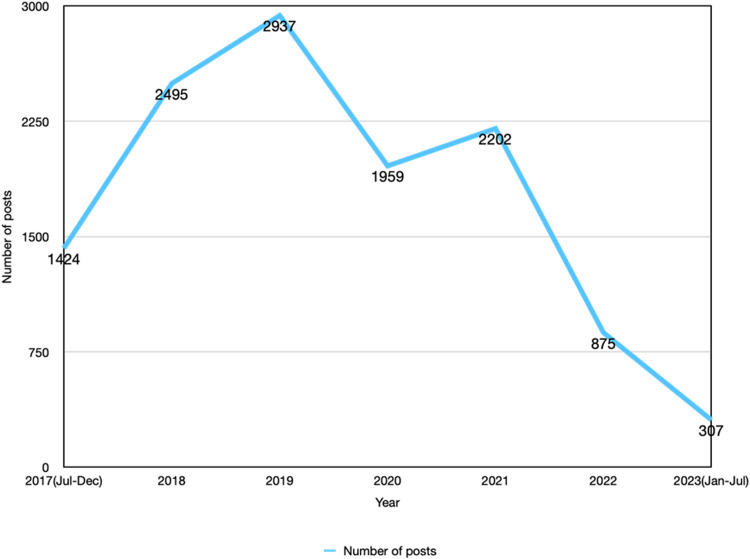
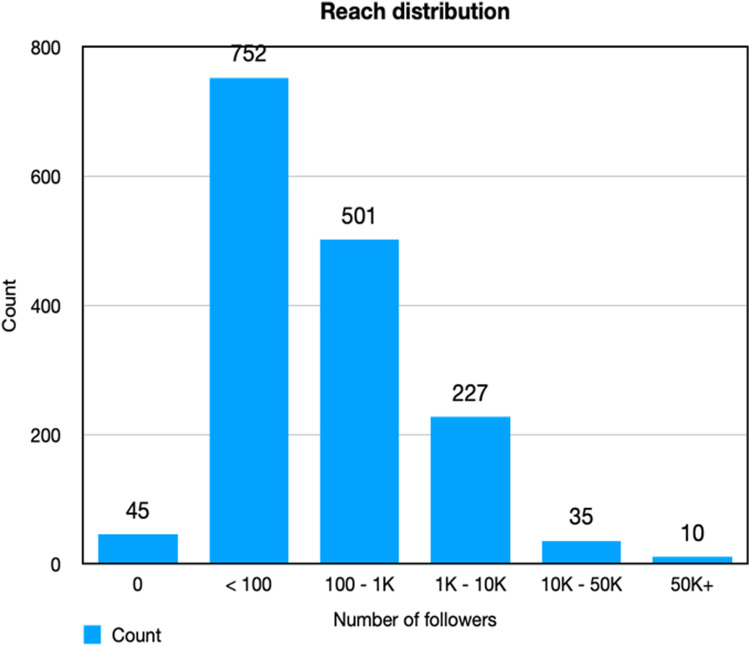
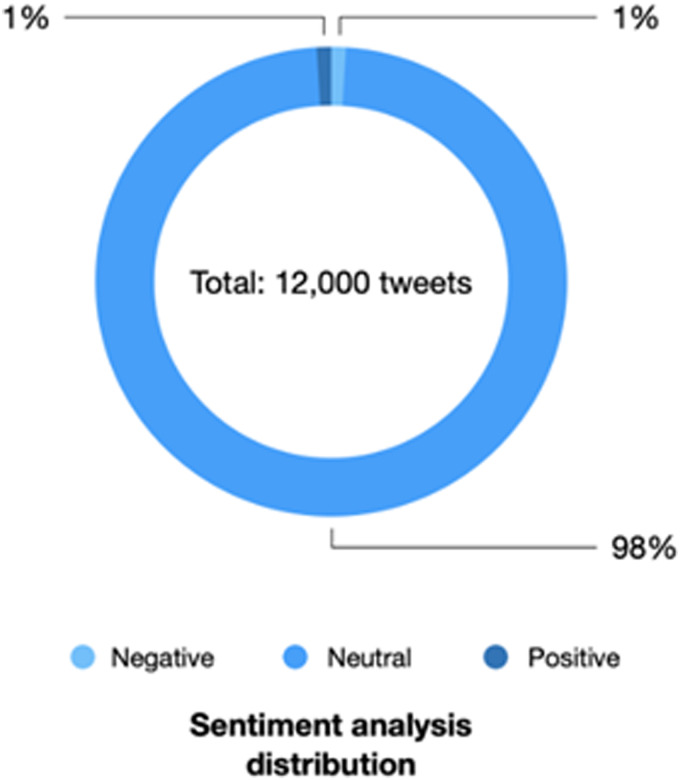
Introduction: Social media plays a significant role in fostering communities around health and wellness. The hashtag #PCOSweightloss has become a pivotal forum on the platform X, where individuals exchange experiences, share information, and motivate each other concerning weight loss strategies connected with Polycystic Ovary Syndrome (PCOS). Objective: This study aims to analyze the trends of #PCOSweightloss on X to gain insights into the social media metrics, including overall hashtag reach, key themes, and potential influence on management practices of PCOS. Methods: Fedica research analytics tool ( https://fedica.com ) was utilized to automatically evaluate quantitatively the posts on the platform X containing #PCOSweightloss from July 1st, 2017 to July 1st, 2023. Results: During the defined period, 1570 users shared 12,200 posts on X, gathering 2,967,001 views. The highest number of posts originated from the United States (38.6%), followed by India (30.6%) and the United Kingdom (10.6%). Top co-occurring hashtags associated with #PCOSweightloss included #PCOS, #healthyfood, #pcosmood and #diabetes. Physicians were key contributors to the discourse, contributing to 30% of the ten most engaging posts and 20% of the top ten influencers. Sentiment analysis revealed a predominant neutral sentiment (98%), while 1% each revealed positive and negative sentiments. Conclusion: Our study affirms the substantial presence of #PCOSweightloss in the PCOS discourse on X. The involvement of physicians is particularly noteworthy, as it emphasizes the importance of expert-guided discussions in the online health discourse. On the background of geographical variances and the challenge of engaging a wider audience due to the limited follower counts of many participants, there is a clear opportunity for further community engagement and outreach. The prevailing neutral tone showcases a community engaged primarily in an informational exchange, setting the stage for more profound discussions of novel PCOS weight loss strategies.
Overview
The claims and statistics of this paper haven’t been checked yet.
Free: it reads the open-access text and checks the first 5 claims that cite a source we can check. Create a free account to check every claim.
Integrity signals
Registry
Cites
Statistics
Figures
Verification
Claims the paper makes
The claims and statistics of this paper haven’t been checked yet.
Free: it reads the open-access text and checks the first 5 claims that cite a source we can check. Create a free account to check every claim.
Claims other papers make about this one
Each is checked against this paper’s own text: does it say what the citing paper says it does?
The source backs part of the claim, not all of it — or backs it for a different population, condition or comparison.
In the citing paper
“Contrarily, Twitter or X had higher-quality content with physicians contributing most of the discourse [46]”
From Availability and Use of Digital Technology Among Women With Polycystic Ovary Syndrome: Scoping Review (2025) · cites this paper as [46]
Experimental — accuracy not yet measured
Self-check
Percentages, sums and reported differences re-computed from the paper’s own numbers.
The self-check needs the paper’s full text.
Citations
Cites
Teede, H., Deeks, A., & Moran, L. (2010) · BMC Medicine · doi:10.1186/1741-7015-8-41 · Cited by 1,565
Social media use in the United States: implications for health communication
Chou, W.-Y. S., Hunt, Y. M., Beckjord, E. B., Moser, R. P., & Hesse, B. W. (2009) · Journal of Medical Internet Research · doi:10.2196/jmir.1249 · Cited by 1,082
Lifestyle physical activity interventions
Dunn, A. L., Andersen, R. E., & Jakicic, J. M. (1998) · American Journal of Preventive Medicine · doi:10.1016/s0749-3797(98)00084-1 · Cited by 457
Lifestyle management in polycystic ovary syndrome – beyond diet and physical activity
Cowan, S., Lim, S., Alycia, C., Pirotta, S., Thomson, R., Gibson-Helm, M., Blackmore, R., Naderpoor, N., Bennett, C., Ee, C., et al. (2023) · BMC Endocrine Disorders · doi:10.1186/s12902-022-01208-y · Cited by 240
Social Media Role and Its Impact on Public Health: A Narrative Review
Kanchan, S., & Gaidhane, A. (2023) · Cureus · doi:10.7759/cureus.33737 · Cited by 221
Hagg, E., Dahinten, V. S., & Currie, L. M. (2018) · International Journal of Medical Informatics · doi:10.1016/j.ijmedinf.2018.04.010 · Cited by 219
Should all women with PCOS be treated for insulin resistance?
Marshall, J. C., & Dunaif, A. (2012) · Fertility and Sterility · doi:10.1016/j.fertnstert.2011.11.036 · Cited by 217
Liu, J., Wu, Q., Hao, Y., Jiao, M., Wang, X., Jiang, S., & Han, L. (2021) · Human Reproduction · doi:10.1093/humrep/deaa371 · Cited by 203
“The potential of social media in health promotion beyond creating awareness: an integrative review”
Ghahramani, A., de Courten, M., & Prokofieva, M. (2022) · BMC Public Health · doi:10.1186/s12889-022-14885-0 · Cited by 188
The impact of social media influencers on health outcomes: Systematic review
Powell, J., & Pring, T. (2024) · Social Science & Medicine · doi:10.1016/j.socscimed.2023.116472 · Cited by 170
Nutrition Strategy and Life Style in Polycystic Ovary Syndrome—Narrative Review
Szczuko, M., Kikut, J., Szczuko, U., Szydłowska, I., Nawrocka-Rutkowska, J., Ziętek, M., Verbanac, D., & Saso, L. (2021) · Nutrients · doi:10.3390/nu13072452 · Cited by 165
Folkvord, F., Roes, E., & Bevelander, K. (2020) · BMC Public Health · doi:10.1186/s12889-020-09779-y · Cited by 132
Lim, S., Smith, C. A., Costello, M. F., MacMillan, F., Moran, L., & Ee, C. (2019) · BMC Endocrine Disorders · doi:10.1186/s12902-019-0434-8 · Cited by 105
PCOS Physiopathology and Vitamin D Deficiency: Biological Insights and Perspectives for Treatment
Morgante, G., Darino, I., Spanò, A., Luisi, S., Luddi, A., Piomboni, P., Governini, L., & De Leo, V. (2022) · Journal of Clinical Medicine · doi:10.3390/jcm11154509 · Cited by 95
Lie Fong, S., Douma, A., & Verhaeghe, J. (2021) · Journal of Gynecology Obstetrics and Human Reproduction · doi:10.1016/j.jogoh.2020.101894 · Cited by 64
Mousa, S., Brady, Mousa, S., & Mousa (2009) · Drug, Healthcare and Patient Safety · doi:10.2147/dhps.s4388 · Cited by 63
Why are women with polycystic ovary syndrome obese?
Barber, T. M. (2022) · British Medical Bulletin · doi:10.1093/bmb/ldac007 · Cited by 61
Zhang, L., Li, H. T., Shen, L., Fang, Q. C., Qian, L. L., & Jia, W. (2015) · PubMed · doi:10.3967/bes2015.040 · Cited by 57
Hadjiconstantinou, M., Mani, H., Patel, N., Levy, M., Davies, M., Khunti, K., & Stone, M. (2017) · Endocrine Connections · doi:10.1530/ec-17-0053 · Cited by 55
Colwell, K., Lujan, M. E., Lawson, K. L., Pierson, R. A., & Chizen, D. R. (2010) · Journal of Obstetrics and Gynaecology Canada · doi:10.1016/s1701-2163(16)34499-1 · Cited by 51
How to manage weight loss in women with obesity and PCOS seeking fertility?
Hazlehurst, J. M., Singh, P., Bhogal, G., Broughton, S., & Tahrani, A. A. (2022) · Clinical Endocrinology · doi:10.1111/cen.14726 · Cited by 37
Understanding PCOS-related content across social media platforms-a cross-sectional analysis
Naroji, S., John, J., & Gomez-Lobo, V. (2024) · Journal of Pediatric and Adolescent Gynecology · doi:10.1016/j.jpag.2023.10.007 · Cited by 32
Liao, W., Huang, J., Lee, M.-T., Yang, Y., & Wu, C.-C. (2022) · World Journal of Diabetes · doi:10.4239/wjd.v13.i3.240 · Cited by 31
A hashtag recommendation system for twitter data streams
Otsuka, E., Wallace, S. A., & Chiu, D. (2016) · Computational Social Networks · doi:10.1186/s40649-016-0028-9 · Cited by 30
Gomula, J., Warner, M., & Blandford, A. (2024) · BMC Women's Health · doi:10.1186/s12905-024-02993-5 · Cited by 22
Impact of #PsychTwitter in promoting global psychiatry: A hashtag analysis study
Nawaz, F. A., Riaz, M. M. A., Tsagkaris, C., Faisal, U. H., Klager, E., Kletečka-Pulker, M., Kimberger, O., Willschke, H., Khan, N., Sultan, M. A., et al. (2023) · Frontiers in Public Health · doi:10.3389/fpubh.2023.1065368 · Cited by 18
Self-citationMalhotra, K., Pan, C. S. C., Davitadze, M., Team PCOS SEva, & Kempegowda, P. (2023) · Frontiers in Endocrinology · doi:10.3389/fendo.2023.1109141 · Cited by 15
Lordan, R., & Devkota, H. P. (2023) · Exploration of Digital Health Technologies · doi:10.37349/edht.2023.00002 · Cited by 14
Forman, E. M., Butryn, M. L., Chwyl, C., Crane, M. M., Dart, H., Hagerman, C. J., Manasse, S. M., Onu, M. C., Sun, J., Veling, H., et al. (2022) · Contemporary Clinical Trials · doi:10.1016/j.cct.2022.107010 · Cited by 9
The top social media influencers in obstetrics and gynecology on twitter
Ghaith, S., Dyre, L. J., Vasilev, D. V., & Wasson, M. (2023) · Archives of Gynecology and Obstetrics · doi:10.1007/s00404-023-07079-5 · Cited by 9
Research works printed but not linked: 3
- Polycystic Ovary Syndrome [Internet]. Available from: https://www.acog.org/clinical/clinical-guidance/practice-bulletin/articles/2018/06/polycystic-ovary-syndrome. [cited 2024 Apr 27].
- Matin M Joshi T Greger M, et al. Use of #NutritionFacts to promote evidence-based nutrition information: X (formerly Twitter) hashtag analysis study. Front Public Health [Internet 2023 Dec 6 [cited 2024 Apr 27]; 11, Available from: https://www.frontiersin.org/journals/public-health/articles/10.3389/fpubh.2023.1255706/full. PMC10734685 38131024 · doi:10.3389/fpubh.2023.1255706/full
- Nyst A. Search Engine Journal. 2023 [cited 2023 Dec 12]. 134 Social Media Statistics You Need To Know For 2023. Available from: https://www.searchenginejournal.com/social-media-statistics/480507/.
Cited by
Wright, P. J., Burts, C., Harmon, C., & Corbett, C. F. (2025) · JMIR Infodemiology · doi:10.2196/68469 · Cited by 8
“%) included information about online platforms: YouTube (Google) [43] and TikTok (ByteDance), Instagram (Meta), Reddit [45], and X, formerly known as Twitter [42,46].”
#NeuroTwitter: A Hashtag Analysis Study of Global Neurology Conversations on X
Hasan, A., Asif, M., Ahadi, A., Atanasov, A. G., Mickael, M., Ławiński, M., Arshad, Z., Kashyap, R., & Nawaz, F. A. (2025) · Cureus · doi:10.7759/cureus.84691 · Cited by 1
“This realm of study has evolved into a valuable source of information for monitoring health-related topics and understanding prominent patterns in the global healthcare landscape [1,4,5].”
Self-citationExamining the Representation of Polycystic Ovary Syndrome (PCOS) on Social Media: A Scoping Review
Kumari, S., & Raj, P. (2026) · Humanities & Social Sciences Reviews · doi:10.18510/hssr.2026.1412
Role of Gut Microbiota in Menstrual Dysregulation in Polycystic Ovary Syndrome
Gayaki, U., Madireddy, L., & Nishane, D. (2026) · International Conference on AI-Driven Smart Systems and Ubiquitous Computing (ICAUC) · doi:10.1109/icauc68182.2026.11441138
Hak, K. J., Leszczyńska, K. M., Wieczorek, M. T., Mitan, A. M., Tomaszewska, A. M., Kańska, K. T., Krawczyk, K., Jasiński, J. L., Krzysztofik, A., & Napierała, W. (2026) · International Journal of Innovative Technologies in Social Science · doi:10.31435/ijitss.1(49).2026.5190
“Similarly, on the text-based platform X (formerly Twitter), big data analysis by Afaq et al. (2025) analyzed over 12,200 posts surrounding the #PCOSweightloss hashtag.”
Metadata
- Authors
- Afaq, M., Vashisht, K., Al-Dhoon, A., Abraham, D., Atanasov, A. G., Matin, M., Arshad, Z., Kashyap, R., & Nawaz, F. A.
- Affiliations
- Global Remote Research Scholars Program, St Paul, MN, USA
- Atrium Health Wake Forest Baptist (US)
- Institute of Genetics and Animal Biotechnology of the Polish Academy of Sciences (PL)
- Shifa International Hospital (PK)
- WellSpan Health (US)
- Corresponding author
- Arshad, Zara
- Venue
- DIGITAL HEALTH
- Publisher
- SAGE Publications
- Published
- 2025-01
- Volume
- 11
- Pages
- 20552076251314100-20552076251314100
- ISSN
- 2055-2076 (ISSN-L)
- PMC
- PMC11780629
- OpenAlex
- W4406947260
- Cited by
- 6
- References
- 26
- Citations by year
- 2026: 4 · 2025: 2
- FWCI
- 6.74
- Type
- journal article
- Language
- en
- Open access
- gold
- doi.org
- Licence
- Locations
- Digital Health (publishedVersion, cc-by-nc-nd)
- PubMed Central (publishedVersion, cc-by-nc-nd)
- PubMed (publishedVersion)
- DOAJ (DOAJ: Directory of Open Access Journals) (submittedVersion, cc-by-sa)
- Topics
- Social Sciences › Health › Social Media in Health Education
- Health Sciences › Medicine › Reproductive Medicine › Ovarian function and disorders
- Health Sciences › Health Professions › General Health Professions › Health Literacy and Information Accessibility
- Keywords
- polycystic ovary syndrome, weight loss, social media discourse, hashtag analysis, Twitter, online health communities, physician engagement, sentiment analysis
About these checks
Registry, retraction, Cites and statistics results are computed, not judged, with one exception: a printed reference that no index lists is read once by a model before it counts as a citation error. Claims are extracted by a model and kept only when their quote appears verbatim in the text; each cited source is then checked, with a model’s help, for whether it says what the claim relies on. Those verdicts can be wrong — read the claim’s quote and the cited source before relying on one.
Statistics and arithmetic are recomputed, not judged.
Confidence bands are shown only for fields calibrated on our annotated test set. None is calibrated yet, so no band is shown.
What counts as a claim ›How we measure confidence ›How we check this ›
Are you an author, or do you see a problem with this page? Request a review
Data sources
Bibliographic data: Semantic Scholar, OpenAlex, Crossref.
Contains information from the Semantic Scholar Academic Graph Datasets, made available under the ODC Attribution License (ODC-BY 1.0).
Semantic Scholar’s data is described in: Kinney, R., et al. (2023). The Semantic Scholar Open Data Platform. arXiv:2301.10140.
