

Comparison of PHQ-9 and PHQ-2 as Screening Tools for Depression and School Related Stress in Inner City Adolescents
Open accessThe DOI matches its Crossref record; 26 of the 26 references it cites were found in a registry or an index.
Abstract
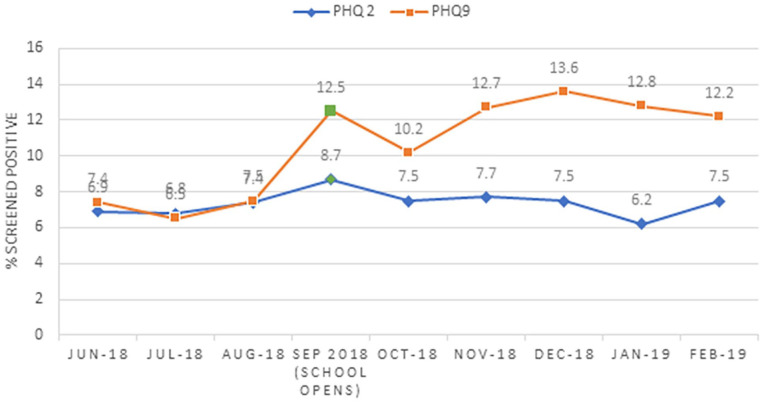
Background: Major depressive disorder is associated with significant morbidity and mortality in adolescents. Suicide is one of the leading causes of mortality between 15 and 19 years. Both AAP and USPSTF recommend routine depression screening of adolescents. Patient Health Questionnaire-2 (PHQ-2) and Patient Health Questionnaire-9 (PHQ-9) are widely used in primary care practice, however, PHQ-2 does not screen for suicidality. School-related factors are known to affect adolescent mental health. Purpose: To compare PHQ-2 and PHQ-9 for depression screening in adolescents, with respect to age, gender, chronic illness over the course of 9 months. Methods: As a QI initiative, we compared screening results in our inner-city pediatric practice using PHQ-2 and PHQ-9 from Jun’18 to Feb’19. EMR of 2364 patients 12 to 21 years were reviewed. We considered the PHQ-2 score of ≥2 and PHQ-9 of ≥10 as positive. Pre-existing chronic medical and mental illnesses were noted. Results: Of these 61.5% of patients were females, 95% were Black/Hispanic, and 96% were insured by Medicaid. About 10.6% of PHQ-9 tests were positive whereas 7.4% PHQ2 were positive. Logistic regression was performed to ascertain the effects of age, gender, and chronic illness. Females were more likely to have a positive screen, as were patients with chronic illness. Age had no effect on the outcome. The screening yield for both tests was comparable in the summer months. PHQ9 yield increased while schools were in session while PHQ 2 remained stable. Conclusion: PHQ9 is superior as a screening test compared to PHQ2. Repeat screening should be targeted toward patients with chronic medical conditions and/or mental health diagnoses. PHQ9 may be better at screening for school-related stress.
Overview
The claims and statistics of this paper haven’t been checked yet.
Free: it reads the open-access text and checks the first 5 claims that cite a source we can check. Create a free account to check every claim.
Integrity signals
Registry
Cites
Statistics
Figures
Verification
Claims the paper makes
The claims and statistics of this paper haven’t been checked yet.
Free: it reads the open-access text and checks the first 5 claims that cite a source we can check. Create a free account to check every claim.
Claims other papers make about this one
Each is checked against this paper’s own text: does it say what the citing paper says it does?
The cited source says what the claim attributes to it.
In the citing paper
“This could be because of limitations associated with the choice of self-report questionnaire (i.e., PHQ-2). 68”
From Virtual psychoeducation for improvement of pain catastrophizing in pediatric presurgical patients and caregivers: a proof-of-concept study (2023) · cites this paper as [68]
Self-check
Percentages, sums and reported differences re-computed from the paper’s own numbers.
The self-check needs the paper’s full text.
Citations
Cites
The PHQ-9: Validity of a brief depression severity measure
Kroenke, K., Spitzer, R. L., & Williams, J. B. W. (2001) · Journal of General Internal Medicine · doi:10.1046/j.1525-1497.2001.016009606.x · Cited by 44,910
Case-finding instruments for depression: Two questions are as good as many
Whooley, M. A., Avins, A. L., Miranda, J., & Browner, W. S. (1997) · Journal of General Internal Medicine · doi:10.1046/j.1525-1497.1997.00076.x · Cited by 1,826 · cited 1×
“01 Age, median (range) 16 (12-21) 16 (12-21) 17 (12-21) .”
Monitoring Depression Treatment Outcomes With the Patient Health Questionnaire-9
L??we, B., Un??tzer, J., Callahan, C. M., Perkins, A. J., & Kroenke, K. (2004) · Medical Care · doi:10.1097/00005650-200412000-00006 · Cited by 1,354 · cited 1×
“01 Age, median (range) 16 (12-21) 16 (12-21) 17 (12-21) .”
Mood disorders in children and adolescents: an epidemiologic perspective
Kessler, R. C., Avenevoli, S., & Ries Merikangas, K. (2001) · Biological Psychiatry · doi:10.1016/s0006-3223(01)01129-5 · Cited by 1,181
Children's Mental Health Service Use Across Service Sectors
Burns, B. J., Costello, E. J., Angold, A., Tweed, D., Stangl, D., Farmer, E. M. Z., & Erkanli, A. (1995) · Health Affairs · doi:10.1377/hlthaff.14.3.147 · Cited by 1,145
Richardson, L. P., McCauley, E., Grossman, D. C., McCarty, C. A., Richards, J., Russo, J. E., Rockhill, C., & Katon, W. (2010) · Pediatrics · doi:10.1542/peds.2010-0852 · Cited by 806 · cited 1×
“01 Age, median (range) 16 (12-21) 16 (12-21) 17 (12-21) .”
Suicide and Youth: Risk Factors
Bilsen, J. (2018) · Frontiers in Psychiatry · doi:10.3389/fpsyt.2018.00540 · Cited by 584 · cited 1×
“The logistic regression model was statistically significant χ2(4) = 46.”
Suicide Risk and Mental Disorders
Brådvik, L. (2018) · International Journal of Environmental Research and Public Health · doi:10.3390/ijerph15092028 · Cited by 483
Olfson, M., Blanco, C., Wang, S., Laje, G., & Correll, C. U. (2014) · JAMA Psychiatry · doi:10.1001/jamapsychiatry.2013.3074 · Cited by 449
Zuckerbrot, R. A., Cheung, A., Jensen, P. S., Stein, R. E. K., Laraque, D., GLAD-PC STEERING GROUP, Levitt, A., Birmaher, B., Campo, J., Clarke, G., et al. (2018) · Pediatrics · doi:10.1542/peds.2017-4081 · Cited by 446
Research works printed but not linked: 1
- Substance Abuse and Mental Health Services Administration. DSM-5 Changes: Implications for Child Serious Emotional Disturbance. Table 9, DSM-IV to DSM-5 Major Depressive Episode/Disorder Comparison. Substance Abuse and Mental Health Services Administration (US); 2016. Accessed August 30, 2021. https://www.ncbi.nlm.nih.gov/books/NBK519712/table/ch3.t5/ 30199184
Cited by
Mental disorders at the beginning of adolescence: Prevalence estimates in a sample aged 11-14 years
Scheiner, C., Grashoff, J., Kleindienst, N., & Buerger, A. (2022) · Public Health in Practice · doi:10.1016/j.puhip.2022.100348 · Cited by 65
“5% of adolescents screening positive for depressive symptoms is in line with findings from before the pandemic [65] and with a recent longitudinal German study [59].”
ResultLi, X., Jin, W., Han, L., Chen, X., & Li, L. (2025) · Child and Adolescent Psychiatry and Mental Health · doi:10.1186/s13034-025-00908-2 · Cited by 32
“It found that the probability of a positive screen with the PHQ-9 was 1.4 times higher than with the PHQ-2 [64].”
InfluentialSleep deprivation and suicide risk among minoritized US adolescents
Joseph, V. A., Kreski, N. T., & Keyes, K. M. (2023) · BMC Psychiatry · doi:10.1186/s12888-023-05074-3 · Cited by 26
“To our knowledge, current screening tools for the suicidality of Black and Hispanic adolescents include depression screeners such as the Patient Health Questionnaire (PHQ)-9 and PHQ-2 [26].”
MethodMental Health Among Sexual and Gender Minority Youth Incarcerated in Juvenile Corrections
Clark, K. A., Harvey, T. D., Hughto, J. M. W., & Meyer, I. H. (2022) · PEDIATRICS · doi:10.1542/peds.2022-058158 · Cited by 26
Oyenubi, A., Kim, A. W., & Kollamparambil, U. (2022) · Journal of Affective Disorders · doi:10.1016/j.jad.2022.04.072 · Cited by 22
Ajayi, A. I., Chamdimba, E., Sawadogo, N., Gitahi, N., Tarnagda, A. M., Ilboudo, A. K., Munthali, A., Thakwalakwa, C., Otukpa, E. O., Ushie, B. A., et al. (2023) · Reproductive Health · doi:10.1186/s12978-023-01588-x · Cited by 22
Xu, B., Chen, C., & Wang, D. (2024) · Psychology Research and Behavior Management · doi:10.2147/prbm.s451889 · Cited by 20
Kurniawan, D., Fitriawan, A. S., Susanti, B. A. D., Firdaus, I., Suparmanto, G., Kafil, R. F., Wulandari, A. N., Setyaningsih, W. A. W., Puspitarini, Z., & Wijoyo, E. B. (2024) · Middle East Current Psychiatry · doi:10.1186/s43045-024-00429-2 · Cited by 20
“The PHQ-9 is a standardized self-rated instrument widely validated and used as a tool for screening for depression in different age groups including adolescents, both in clinical and non-clinical settings [39].”
MethodVilela-Estrada, A. L., Villarreal‐Zegarra, D., Toyama, M., Carbonel, A., Fung, C., Carbonetti, F. L., Hidalgo-Padilla, L., Sureshkumar, D. S., Uribe-Restrepo, J. M., Olivar, N., et al. (2025) · Journal of Affective Disorders · doi:10.1016/j.jad.2025.02.088 · Cited by 17
Network Analysis of Depressive Symptomatology in Underweight and Obese Adults
Ramos‐Vera, C., Serpa‐Barrientos, A., Vallejos-Saldarriaga, J., & Saintila, J. (2022) · Journal of Primary Care & Community Health · doi:10.1177/21501319221096917 · Cited by 17
Implementing youth participatory action research at a continuation high school
Lárez, N. A., Sharkey, J. D., Frattaroli, S., de Avila, E. B., & Medina, A. (2023) · Health Services Research · doi:10.1111/1475-6773.14190 · Cited by 16
“4% of their sample met screening criteria on the PHQ-2.(31) While it is possible that screening rates for depression were higher in our study sample because students were screened during the pandemic and most previous studies were conducted before COVID-19, the rates are nonetheless high.”
InfluentialJENKINS, J. H., Sánchez, G., Miller, E. A., Allande, N. I. S., Urano, G., & Pryor, A. J. (2022) · International Journal of Social Psychiatry · doi:10.1177/00207640221140282 · Cited by 16
“Our review of the literature shows that the PHQ-9 and GAD-7 adult scales are often used inaptly with child and adolescent populations (Anand et al., 2021; Mossman et al., 2017; Richardson et al., 2010; Tiirikainen et al., 2019; Tsai et al., 2014; Walter et al., 2020).”
MethodHuang, B.-W., Guo, P.-H., Liu, J., Leng, S. X., & Wang, L. (2022) · World Journal of Psychiatry · doi:10.5498/wjp.v12.i11.1323 · Cited by 12
Wang, H., Du, H., Guan, Y., Zhong, J., Li, N., Pan, J., & Yu, M. (2024) · JMIR Public Health and Surveillance · doi:10.2196/50996 · Cited by 11
“The PHQ-9, widely used among adolescents [29-32], is a brief scale designed to screen for symptoms of major depressive disorder within the past 2 weeks based on the codes of the Diagnostic and Statistical Manual of Mental Disorders, Fifth Edition .”
MethodTang, H., Zhang, Z., Chen, H., Chen, H., Chen, X., Li, S., Ye, Y., & Zhou, J. (2024) · Asian Journal of Psychiatry · doi:10.1016/j.ajp.2024.104136 · Cited by 11
Leung, C. Y., Kyung, M., & Weiss, S. J. (2024) · Journal of Affective Disorders · doi:10.1016/j.jad.2024.08.053 · Cited by 11
Liu, Y., Li, S., Deng, T., Li, L., Wei, R., Zhang, Y., Ou, J., Tao, F., & Wan, Y. (2024) · Environmental Research · doi:10.1016/j.envres.2024.120100 · Cited by 11
Wang, H., Bragg, F., Guan, Y., Zhong, J., Li, N., Pan, J., & Yu, M. (2023) · Frontiers in Public Health · doi:10.3389/fpubh.2023.1138152 · Cited by 10
Loades, M. E., Perry, G., & Marshall, N. (2025) · JMIR Mental Health · doi:10.2196/72077 · Cited by 9
Yu, Y., Wang, D. B., Du, M., Wu, A. M. S., Chen, J. H., Yen, S. H. Y., Zhang, G., Xu, D., & Lau, J. T. F. (2025) · BMC Psychiatry · doi:10.1186/s12888-025-07308-y · Cited by 8
“[5]and Indian (10.76”
InfluentialMedical students’ mental health state during pandemic COVID-19 in Indonesia
Primatanti, P. A., Turana, Y., Sukarya, W. S., Wiyanto, M., & Duarsa, A. B. S. (2023) · Bali Medical Journal · doi:10.15562/bmj.v12i2.4104 · Cited by 7
Yu, Y., Chen, J. H., Wu, A. M. S., Zhang, G., Xu, D., Lyu, X., Wang, D. B., Du, M., & Lau, J. T. F. (2025) · Journal of Affective Disorders · doi:10.1016/j.jad.2025.120220 · Cited by 7
Intergenerational Mobility in Depression and Anxiety in IndiaPreprint
Hervé, J., Mani, S., Behrman, J. R., Laxminarayan, R., & Nandi, A. (2025) · SSRN Electronic Journal · doi:10.2139/ssrn.5118634 · Cited by 6
Wellen, B. C. M., Wright, N. M., Bickford, M. A., Bakken, E. H., & Riley, A. R. (2023) · Frontiers in Psychiatry · doi:10.3389/fpsyt.2023.1241642 · Cited by 5
“The PHQ-9 and its adaptation for adolescents possess strong psychometric properties and has demonstrated utility in pediatric settings (23– 26).”
BackgroundMethodZachariades, F., Maras, D., Mervitz, D., Martelli, B., Prayal-Brown, A., Hayawi, L., Barrowman, N., & Lamontagne, C. (2023) · Canadian Journal of Anesthesia/Journal canadien d anesthésie · doi:10.1007/s12630-023-02583-3 · Cited by 4
Community Teens’ COVID-19 Experience: Implications for Engagement Moving Forward
Stiles‐Shields, C., Reyes, K. M., Lennan, N., Zhang, J., Archer, J., Julion, W. A., & Shalowitz, M. U. (2023) · Journal of Clinical Psychology in Medical Settings · doi:10.1007/s10880-023-09975-z · Cited by 4
“…contexts of multiple experiences in recent years (e.g., pandemic, social justice/Black Lives Matter movements) might not be reflected by scores on commonly administered questionnaires (e.g., administration of the Patient Health Questionnaire 2 or 9 at primary care appointments; Anand et al., 2021).”
Chokroverty, L. (2024) · Pediatrics in Review · doi:10.1542/pir.2024-006479 · Cited by 3
Martinez, M. P., Chow, T., Lin, J. C., Becker, D., Tsai, Y., Velasquez, B., Wong, C., & Xiang, A. H. (2025) · Journal of Affective Disorders · doi:10.1016/j.jad.2025.121017 · Cited by 2
Jiang, Y., Peng, T., Wang, N., Peng, J., Tan, X., & Liu, Y. (2026) · Scientific Reports · doi:10.1038/s41598-026-44776-y · Cited by 2
“Both scales have demonstrated good reliability and validity 88,89,91 .”
Cocozza, V., Sickbert, L., Kenny, T., Espinola, D. C., Welsh, S. K., Turner, Z., & Pieroni, K. P. (2023) · Military Medicine · doi:10.1093/milmed/usad373 · Cited by 2
Chokroverty, L. (2024) · Pediatrics in Review · doi:10.1542/pir.2022-005688 · Cited by 2
Validation of the PHQ-4 as a unidimensional screener in 191,519 Australian children and adolescents
Lushington, K., Washer, S., Wicking, P., Wicking, A., & Dorrian, J. (2026) · Journal of Affective Disorders · doi:10.1016/j.jad.2026.121216 · Cited by 1
Ma, Y.-L., Fu, X., Chen, Y., & Zeng, S.-X. (2026) · World Journal of Psychiatry · doi:10.5498/wjp.v16.i3.113125 · Cited by 1
Picardi, A., Fagnani, C., Gigantesco, A., Toccaceli, V., Stazi, M. A., & Medda, E. (2023) · Frontiers in Psychiatry · doi:10.3389/fpsyt.2023.954737 · Cited by 1
Adolescence Mental Health in School and University
Permana, I., & Susanti, H. (2024) · Frontiers research topics · doi:10.3389/978-2-8325-5237-7 · Cited by 1
Young, M. A., Whitehead, M., Modi, A. C., Smolyansky, B. H., Stark, L. J., & McClure, J. M. (2024) · Evidence-Based Practice in Child and Adolescent Mental Health · doi:10.1080/23794925.2024.2405907 · Cited by 1
“…scores at T1 among adolescents and young adults (compared to preschool and school-aged children), biological females (Alegría et al., 2015; Ali et al., 2019; Richardson et al., 2010), and patients receiving public insurance benefits (compared to private; Anand et al., 2021; Peverill et al., 2021).”
Suicide and Depression Screening for Gender Diverse Youth in Pediatric Primary Care
Dover, G. M., Wright, N. M., Wellen, B. C. M., Moyer, D. N., & Riley, A. R. (2025) · Clinical Practice in Pediatric Psychology · doi:10.1177/21694826251319273 · Cited by 1
“The Patient Health Questionnaire-9 (PHQ-9) is a screening tool for symptoms of depression (Anand et al., 2021).”
Ighaede-Edwards, I. G., Allogo, I. F. N., Xiaoqun, L. I. U., Bounda, G., David-Olawade, A. C., & Olawade, D. B. (2025) · Research Square · doi:10.21203/rs.3.rs-5751576/v1 · Cited by 1
Vulnerability in adolescence: prevalence, pandemic impact and prevention
Scheiner, C. (2024) · Online Publication Service of Würzburg University (Würzburg University) · doi:10.25972/opus-35164 · Cited by 1
Huang, B.-W., Guo, P.-H., Liu, J., Leng, S. X., & Wang, L. (2022) · World Journal of Psychiatry · doi:10.5498/wjp.v12.i11.1324
Os efeitos do yoga em pacientes oncológicos
Batista, L. P., Oliveira, G. R., Ramos, F. C., Dias, C. D. S., Passos, X. S., & de Morais, F. D. (2022) · Brazilian Journal of Health Review · doi:10.34119/bjhrv5n6-252
Sidi, A., Kiio, M., Mwangi, N., Olum, M., Githinji, G., Maina, K., Kithinji, C., Kaloki, F., Temmerman, M., & Manguro, G. (2024) · Child Abuse & Neglect · doi:10.1016/j.chiabu.2024.106690
Palakshappa, D., Ray, K. N., Schweiberger, K. A., Berkowitz, S. A., & Hanmer, J. (2025) · Clinical Pediatrics · doi:10.1177/00099228251372311
The effect of bupropion on smoking cessation and smokers behavior: a randomized controlled study
Radwan, A. A., Mansour, Y. M., Alsawi, H. E. F., & Torky, M. (2025) · Egyptian Journal of Chest Diseases and Tuberculosis · doi:10.4103/ecdt.ecdt_1_25
Fann, E. M. M. (2025) · Carolina Digital Repository (University of North Carolina at Chapel Hill) · doi:10.17615/441p-5n71
Sánchez, G. (2025) · eScholarship (California Digital Library)
Schatz, P., Womble, M. N., Durfee, K. J., Jennings, S., Mahajan, L., Johnson, J., Stephenson, K. L., & Elbin, R. J. (2026) · Developmental Neuropsychology · doi:10.1080/87565641.2026.2621375
“%) of concussed youth athletes endorsed mild-to-severe depression symptoms (35% mild, 13% moderate, 3% moderate-to-severe, and <1% severe), exceeding general adolescent population rates (Anand et al., 2021; Shorey et al., 2022).”
Subramanian, S., O’Rourke, K., Fournier, A. P., Zerbe, A., Donenberg, G. R., Emerson, E. M., Garofalo, R., John-Stewart, G. C., Kuhns, L. M., Mwangwa, F., et al. (2026) · Global Implementation Research and Applications · doi:10.1007/s43477-026-00225-6
“The PHQ-2 score ranges from 0 to 6 and we classified those with two or more points as show - ing signs of depression (Anand et al., 2021).”
Mock, D. M. (2024) · Montana State University ScholarWorks (Montana State University)
Nowlen, M. A., Williamson, A., & Temkit, M. (2026) · Journal of Pediatric and Adolescent Gynecology · doi:10.1016/j.jpag.2026.04.005
Ding, P., & Wang, J. (2026) · Frontiers in Nutrition · doi:10.3389/fnut.2026.1826577
Ramachandiran, A. K., & Valera, E. M. (2026) · Journal of Interpersonal Violence · doi:10.1177/08862605261447035
“…performance varies across populations from different sociodemographic backgrounds, suggesting that the measure may be sensitive to group-specific patterns of symptom expression (Anand et al., 2021; Gigantesco et al., 2021; Sedeeq et al., 2022; Slavin et al., 2020; Villarreal-Zegarra et al., 2023).”
IMPLEMENTATION OF DEPRESSION SCREENING IN PATIENTS WITH CARDIOVASCULAR DISEASE
Kumari, R. (2026) · Carolina Digital Repository (University of North Carolina at Chapel Hill) · doi:10.17615/x7p1-kz31
Ratti, M., & Gordon, L. P. (2026) · Journal of Obstetrics and Gynaecology Canada · doi:10.1016/j.jogc.2026.103456
Nafia Farzana Chowdhury, D. T. C., Mahmud, A., Rahman, W., & Islam, M. (2025) · South Eastern European Journal of Public Health
Xu, T., Ding, R., Lin, C., Zhang, Q., & Ding, P. (2026) · Frontiers in Nutrition · doi:10.3389/fnut.2026.1908874
“In the present study, a total score ≥ 2 was used to identify depressive symptoms (36, 37).”
Wang, H., Bragg, F., Guan, Y., Zhong, J., Li, N., Pan, J., & Yu, M. (2023) · doi:10.3389/fpubh.2023.1138152.s001
Metadata
- Authors
- Anand, P., Bhurji, N., Williams, N., & Desai, N.
- Affiliations
- Kings County Hospital Center (US)
- Corresponding author
- Anand, Paridhi
- Venue
- Journal of Primary Care & Community Health
- Publisher
- SAGE Publications
- Published
- 2021-01
- Volume
- 12
- Pages
- 21501327211053750-21501327211053750
- ISSN
- 2150-1319 (ISSN-L)
- 2150-1327
- PMC
- PMC8679043
- OpenAlex
- W4200359141
- Cited by
- 49
- References
- 26
- Citations by year
- 2026: 10 · 2025: 10 · 2024: 10 · 2023: 11 · 2022: 8
- FWCI
- 4.94
- Type
- journal article
- Language
- en
- Open access
- gold
- doi.org
- Licence
- Locations
- Journal of Primary Care & Community Health (publishedVersion, cc-by-nc)
- PubMed Central (publishedVersion, cc-by-nc)
- PubMed (publishedVersion)
- DOAJ (DOAJ: Directory of Open Access Journals) (submittedVersion, cc-by-sa)
- Topics
- Social Sciences › Psychology › Clinical Psychology › Child and Adolescent Psychosocial and Emotional Development
- Health Sciences › Medicine › Psychiatry and Mental health › Mental Health Treatment and Access
- Social Sciences › Psychology › Experimental and Cognitive Psychology › Anxiety, Depression, Psychometrics, Treatment, Cognitive Processes
- Keywords
- PHQ-9, PHQ-2, depression screening, adolescents, academic stress, chronic disease, screening yield, gender differences, seasonal variation, suicide risk
- MeSH terms
- Patient Health Questionnaire, Adolescent, Child, Depression, Major Depressive Disorder, Female, Humans, Infant, Mass Screening, Surveys and Questionnaires, Schools
About these checks
Registry, retraction, Cites and statistics results are computed, not judged, with one exception: a printed reference that no index lists is read once by a model before it counts as a citation error. Claims are extracted by a model and kept only when their quote appears verbatim in the text; each cited source is then checked, with a model’s help, for whether it says what the claim relies on. Those verdicts can be wrong — read the claim’s quote and the cited source before relying on one.
Statistics and arithmetic are recomputed, not judged.
Confidence bands are shown only for fields calibrated on our annotated test set. None is calibrated yet, so no band is shown.
What counts as a claim ›How we measure confidence ›How we check this ›
Are you an author, or do you see a problem with this page? Request a review
Data sources
Bibliographic data: Semantic Scholar, OpenAlex, Crossref.
Contains information from the Semantic Scholar Academic Graph Datasets, made available under the ODC Attribution License (ODC-BY 1.0).
Semantic Scholar’s data is described in: Kinney, R., et al. (2023). The Semantic Scholar Open Data Platform. arXiv:2301.10140.
