

Creating Dementia-Friendly Communities for Social Inclusion: A Scoping Review
Open accessThe DOI matches its Crossref record; 31 of the 31 references it cites were found in a registry or an index.
Abstract
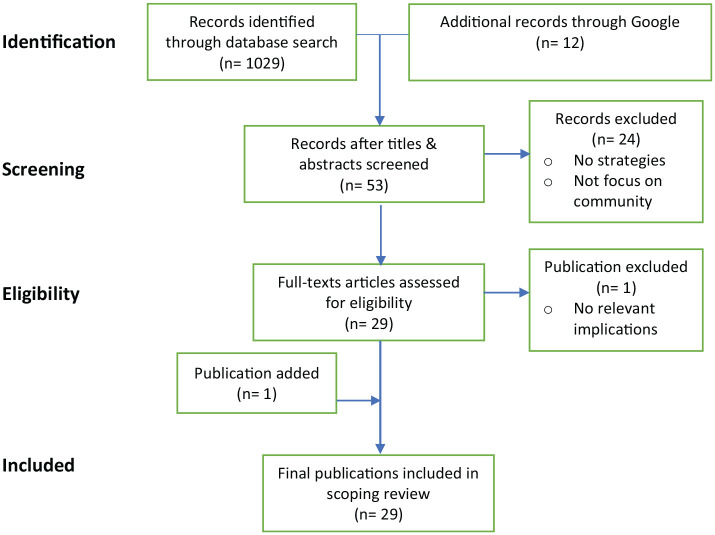
Aims: This scoping review explores key strategies of creating inclusive dementia-friendly communities that support people with dementia and their informal caregiver. Background: Social exclusion is commonly reported by people with dementia. Dementia-friendly community has emerged as an idea with potential to contribute to cultivating social inclusion. Methods: This scoping review follows the Joanna Briggs Institute scoping review methodology and took place between April and September 2020. The review included a three-step search strategy: (1) identifying keywords from CINAHL and AgeLine; (2) conducting a second search using all identified keywords and index terms across selected databases (CINAHL, AgeLine, MEDLINE, PsycINFO, Web of Science, ProQuest, and Google); and (3) hand-searching the reference lists of all included articles and reports for additional studies. Results: Twenty-nine papers were included in the review. Content analysis identified strategies for creating dementia-friendly communities: (a) active involvement of people with dementia and caregivers (b) inclusive environmental design; (c) public education to reduce stigma and raise awareness; and (d) customized strategies informed by theory. Conclusion: This scoping review provides an overview of current evidence on strategies supporting dementia-friendly communities for social inclusion. Future efforts should apply implementation science theories to inform strategies for education, practice, policy and future research.
Overview
The claims and statistics of this paper haven’t been checked yet.
Free: it reads the open-access text and checks the first 5 claims that cite a source we can check. Create a free account to check every claim.
Integrity signals
Registry
Cites
Statistics
Figures
Verification
Claims the paper makes
The claims and statistics of this paper haven’t been checked yet.
Free: it reads the open-access text and checks the first 5 claims that cite a source we can check. Create a free account to check every claim.
Claims other papers make about this one
Each is checked against this paper’s own text: does it say what the citing paper says it does?
In the citing paper
“Hung and colleagues 174 found that the active involvement of PWLE in the design of such support provided a sense of value and autonomy.”
From The Lancet Commission on ending stigma and discrimination in mental health (2022) · cites this paper as [174]
Self-check
Percentages, sums and reported differences re-computed from the paper’s own numbers.
The self-check needs the paper’s full text.
Citations
Cites
Damschroder, L. J., Aron, D. C., Keith, R. E., Kirsh, S. R., Alexander, J. A., & Lowery, J. C. (2009) · Implementation Science · doi:10.1186/1748-5908-4-50 · Cited by 14,496 · cited 1×
“For example, future projects should consider applying an established framework such as the Consolidated Framework for Implementation Research (CFIR) to optimize process and outcome evaluations (Damschroder et al., 2009).”
MethodDementia friendly initiatives: A state of the science review
Hebert, C. A., & Scales, K. (2019) · Dementia · doi:10.1177/1471301217731433 · Cited by 158 · cited 3×
“Public awareness and education were identified as an essential strategy to target stigma within the general community (Buckner et al., 2019; Harris & Caporella, 2014; Hebert & Scales, 2019).”
BackgroundNewman, K., Wang, A. H., Wang, A. Z. Y., & Hanna, D. (2019) · BMC Public Health · doi:10.1186/s12889-019-7837-3 · Cited by 143 · cited 1×
“Social inclusion refers to characteristics of (a) social integration, (b) social support, and (c) access to resources (Newman et al., 2019).”
BackgroundDementia‐friendly community initiatives: An integrative review
Shannon, K., Bail, K. S., & Neville, S. J. (2018) · Journal of Clinical Nursing · doi:10.1111/jocn.14746 · Cited by 138 · cited 19×
“Inclusive Environmental Design Environmental design that considers the unique needs of people with dementia and their informal caregivers can meaningfully contribute to DFCs (Dean et al., 2015b; Fleming et al., 2017; Gaber et al., 2019; GilmartinThomas et al., 2017; Prior, 2012; Shannon et al., 2019; Wiersma, 2008).”
BackgroundMethodInfluentialDementia Friendly, Dementia Capable, and Dementia Positive: Concepts to Prepare for the Future
Lin, S.-Y., & Lewis, F. M. (2015) · The Gerontologist · doi:10.1093/geront/gnu122 · Cited by 130
Phillipson, L., Hall, D., Cridland, E., Fleming, R., Brennan-Horley, C., Guggisberg, N., Frost, D., & Hasan, H. (2019) · Dementia · doi:10.1177/1471301218754455 · Cited by 101 · cited 1×
“Purposeful connection, engaging in meaningful activities with other people, are important to a person with dementia and their families/care providers (Phinney et al., 2016).”
Background‘Dementia-friendly communities’ and being dementia friendly in healthcare settings
Lin, S. (2016) · Current Opinion in Psychiatry · doi:10.1097/yco.0000000000000304 · Cited by 100
Dementia-friendly communities: challenges and strategies for achieving stakeholder involvement
Heward, M., Innes, A., Cutler, C., & Hambidge, S. (2016) · Health & Social Care in the Community · doi:10.1111/hsc.12371 · Cited by 99 · cited 22×
“Within studies evaluating the activities of existing DFCs, education and raising awareness were identified as the most common activities performed by DFCs (Buckner et al., 2019).”
BackgroundInfluentialFrom social network to safety net: Dementia-friendly communities in rural northern Ontario
Wiersma, E. C., & Denton, A. (2016) · Dementia · doi:10.1177/1471301213516118 · Cited by 88 · cited 21×
“Within studies evaluating the activities of existing DFCs, education and raising awareness were identified as the most common activities performed by DFCs (Buckner et al., 2019).”
BackgroundInfluentialDementia Friendly Communities in England: A scoping study
Buckner, S., Darlington, N., Woodward, M. C., Buswell, M., Mathie, E., Arthur, A. J., Lafortune, L., Killett, A., Mayrhofer, A. M., Thurman, J., et al. (2019) · International Journal of Geriatric Psychiatry · doi:10.1002/gps.5123 · Cited by 86 · cited 10×
“Within studies evaluating the activities of existing DFCs, education and raising awareness were identified as the most common activities performed by DFCs (Buckner et al., 2019).”
BackgroundInfluential
Research works printed but not linked: 4
- Mitchell L. (2012). Breaking new ground: The quest for dementia friendly communities. Housing Learning and Improvement Network, 6.
- Peters M. Godfrey C. Khalil H. McInerney P. Parker D. Soares C. (2015). The Joanna Briggs Institute Reviewers’ manual: 2015 edition/supplement. Joanna Briggs Institute.
- Phillipson L. Hall D. Cridland E. (2016). Dementia friendly kiama pilot project evaluation. Kiama Municipal Council.
- Webster D. (2016). Dementia-Friendly Communities Ontario: A Multi-Sector Collaboration to Improve Quality of Life for People Living With Dementia and Care Partners Ontario. The Alzheimer Society of Ontario.
Cited by
2024 Alzheimer's disease facts and figures
(2024) · Alzheimer's & Dementia · doi:10.1002/alz.13809 · Cited by 2,536
The Lancet Commission on ending stigma and discrimination in mental health
Thornicroft, G., Sunkel, C., Alikhon Aliev, A., Baker, S., Brohan, E., el Chammay, R., Davies, K., Demissie, M., Duncan, J., Fekadu, W., et al. (2022) · The Lancet · doi:10.1016/s0140-6736(22)01470-2 · Cited by 748
“Hung and colleagues 174 found that the active involvement of PWLE in the design of such support provided a sense of value and autonomy.”
Background2025 Alzheimer's disease facts and figures
(2025) · Alzheimer's & Dementia · doi:10.1002/alz.70235 · Cited by 474
Social sustainability of communities: A systematic literature review
Wang, K., & Ke, Y. (2024) · Sustainable Production and Consumption · doi:10.1016/j.spc.2024.04.031 · Cited by 77
Characteristics of dementia-friendly hospitals: an integrative review
Manietta, C., Purwins, D., Reinhard, A.-S., Knecht, C., & Roes, M. (2022) · BMC Geriatrics · doi:10.1186/s12877-022-03103-6 · Cited by 36
“Background Dementia-friendly initiatives are becoming more and more common in a variety of settings, such as dementiafriendly communities [1], prisons [2], the arts [3], environmental design [4] and healthcare [5] and targeted in national dementia plans [6, 7].”
BackgroundKrier, D., de Boer, B., Hiligsmann, M., Wittwer, J., & Amieva, H. (2023) · Journal of the American Medical Directors Association · doi:10.1016/j.jamda.2023.03.024 · Cited by 35
Burley, C. V., Casey, A., Chenoweth, L., & Brodaty, H. (2022) · International Psychogeriatrics · doi:10.1017/s1041610222000849 · Cited by 20
“Momentum is increasing for a focus on improving how others treat people living with dementia, for using person-centered approaches in care and support, and for reducing stigma and discrimination (Chenoweth et al., 2021a; 2021b; Bacsu et al., 2022; Hung et al., 2021).”
BackgroundWidyastuti, R. H., Sahar, J., Rekawati, E., & Kekalih, A. (2023) · Nurse Media Journal of Nursing · doi:10.14710/nmjn.v13i2.55729 · Cited by 39
“The strategies can include national dementia campaigns, the use of social media, changing public attitudes towards dementia through television advertisements on national channels, and early education about dementia (Hung et al., 2021; World Health Organization, 2015).”
BackgroundCraig, S. G., O’Halloran, P. D., Mitchell, G., Stark, P., & Wilson, C. B. (2024) · BMC Geriatrics · doi:10.1186/s12877-024-05343-0 · Cited by 17
“Alternatively, other studies delve into the priorities of individuals with dementia and their caregivers, emphasising factors such as fostering social connections and promoting acceptance of dementia within the community [4, 15, 32, 33].”
BackgroundMethodAssessment tools for measurement of dementia-friendliness of a community: A scoping review
Díaz, L. G., Durocher, E., Gardner, P. M., McAiney, C. A., Mokashi, V., & Letts, L. J. (2022) · Dementia · doi:10.1177/14713012221090032 · Cited by 18
Aldrich, R. M., Rudman, D. L., Fernandes, K., Nguyen, G., & Larkin, S. (2023) · Journal of Occupational Science · doi:10.1080/14427591.2023.2234382 · Cited by 19
Smeets, B., Janssen, N., Peetoom, K. K. B., Boots, L. M. M., Bakker, C., & de Vugt, M. E. (2024) · Aging & Mental Health · doi:10.1080/13607863.2024.2345132 · Cited by 17
“To achieve this, launching a public awareness campaign focused on this theme could be essential, aligning well with the goal of creating a dementia-friendly society by raising awareness and providing education about YOD and subsequently reducing stigma (Hung et al., 2021).”
BackgroundOrganizational Characteristics of Senior Centers and Engagement in Dementia-Friendly Communities
Scher, C. J., Somerville, C., Greenfield, E. A., & Coyle, C. E. (2023) · Innovation in Aging · doi:10.1093/geroni/igad050 · Cited by 10
“…organizations more broadly, which demonstrates that organizational capacity—conceptualized as “the ability of an organization to fulfill its mission” and consisting of both “financial and human resources”—is enhanced through the process of bridging social capital (Igalla et al., 2020, p. 605).”
BackgroundLiving Well with Dementia: Feeling Empowered through Interaction with Their Social Environment
Ziebuhr, B., Zanasi, M., Aguado, Y. B., Losada, R., Dening, T., Tournier, I., Niedderer, K., Diaz, A., Druschke, D., de Almeida, R. M. R., et al. (2023) · International Journal of Environmental Research and Public Health · doi:10.3390/ijerph20126080 · Cited by 15
Mfene, X. P., & Pillay, B. J. (2023) · Dementia · doi:10.1177/14713012231165112 · Cited by 11
Irani, E., Wang, F. “., Meyer, K., Moore, S. E., & Ding, K. (2023) · Journal of Aging and Health · doi:10.1177/08982643231209089 · Cited by 11
“Therefore, our fi ndings have policy implications for creating and expanding dementia-friendly communities to promote social participation (Hung et al., 2021).”
Wang, J., Zhao, Y., Cui, Y., Ding, Y., Xing, Y., & Li, X. (2024) · Geriatric Nursing · doi:10.1016/j.gerinurse.2024.02.003 · Cited by 8
Craig, S. G., Mitchell, G., O’Halloran, P. D., Stark, P., & Wilson, C. B. (2023) · BMC Geriatrics · doi:10.1186/s12877-023-04090-y · Cited by 8
“The influence of established DFCs, and emergence of new DFCs, is particularly important given the impact of the global Coronavirus pandemic on social contact within many communities and organisations [17].”
BackgroundScher, C. J., & Greenfield, E. A. (2023) · Geriatrics · doi:10.3390/geriatrics8020045 · Cited by 7
“, inclusive environmental design and public education to reduce dementia-related stigma) [28], and dementia-friendly efforts to improve the built environment (e.”
BackgroundNoguchi, T., Fujihara, S., Ide, K., Jeong, S., Saito, T., Kondo, K., & Ojima, T. (2025) · Journal of Applied Gerontology · doi:10.1177/07334648251352306 · Cited by 6
“Given the growing number of individuals with dementia living in the community, dementia-friendly communities (DFC) should be increasingly considered (Altzeheimer ’ s Disease International, 2016; Hung et al., 2021).”
Bressan, V., Snijder, A., Hansen, H., Koldby, K., Andersen, K. D., Allegretti, N., Porcu, F., Marsillas, S., García, A., & Palese, A. (2022) · International Journal of Environmental Research and Public Health · doi:10.3390/ijerph191610335 · Cited by 6
“The meaningful involvement of PwD and their relatives into the development of community activities, initiatives and strategies is recommended to ensure these approaches are applicable, valuable and usable [7].”
BackgroundInfluentialNguyen, A. N., Nguyen, B. T., Nguyen, B. T., Nguyễn, B. T. T., Nguyen, N. T. A., Dang, N. T., Nguyen, A. T. P., Nguyen, A. T., Pham, T., Mantyh, W. G., et al. (2023) · Psychogeriatrics · doi:10.1111/psyg.13068 · Cited by 6
“44,45 Moreover, interventions that promote social engagement may also be effective in addressing social isolation and stigma associated with dementia, 46 which can pose substantial barriers to care and support.”
BackgroundCheung, E. S. L., & Zhang, Z. (2024) · Research on Aging · doi:10.1177/01640275241234372 · Cited by 5
“One emerging topic of discussion in environmental gerontological research is dementia-friendly communities and neighborhoods (Buckner et al., 2018; Gan et al., 2022; Hung et al., 2021; Maki et al., 2020; Wu et al., 2019).”
Background“GO” to move toward dementia‐friendly communities: A pilot study
Iizuka, A., Ura, C., Yamashita, M., Ito, K., Yamashiro, M., & Okamura, T. (2024) · Brain and Behavior · doi:10.1002/brb3.3581 · Cited by 4
“Basedonthis,acommunitydevelopmenteffortknownasa“Demen-tia Friendly Community (DFC)” is spreading (Hung et al., 2021; Wu et al., 2019).”
Ioannidis, G., Hillier, L. M., Fehr, P., Renault, W., Robins, K., Mouriopoulos, O., Burnett, M., Gibbs, T., Letts, L. J., & Παπαϊωάννου, Α. (2024) · Educational Gerontology · doi:10.1080/03601277.2024.2425759 · Cited by 7
“…is much support for the authentic involvement of people living with dementia in developing dementia-friendly communities as they can play an vital role in increasing awareness of the realities of living with dementia to dispel myths that perpetuate stigma (Herrmann et al., 2018; Hung et al., 2021).”
Promoting cultural change towards dementia friendly communities: a multi-level intervention in Japan
Tsuda, S., Inagaki, H., Okamura, T., Sugiyama, M., Ogawa, M., Miyamae, F., Edahiro, A., Ura, C., Sakuma, N., & Awata, S. (2022) · BMC Geriatrics · doi:10.1186/s12877-022-03030-6 · Cited by 5
Parkinson, L., Sullivan, K. A., & Graham, K. (2022) · Dementia · doi:10.1177/14713012221106328 · Cited by 5
“A fear of diagnosis, the inability to recognise a person with dementia and negative perceptions of dementia in the community can contribute to the marginalisation of people with dementia and their carers (Ebert et al., 2020; Hung et al., 2021; World Health Organisation, 2017).”
BackgroundPhysical Activity Inclusion in Dementia-Friendly Communities: A Mixed Methods Study
Hadley, R., Mathie, E., Pike, E. C. J., & Goodman, C. M. (2024) · Journal of Aging and Physical Activity · doi:10.1123/japa.2022-0371 · Cited by 5
“International initiatives, such as dementia-inclusive societies, aim to enable people living with dementia to remain engaged in usual daily life (Alzheimer ’ s Disease International, 2017; Hung et al., 2021; World Dementia Council, 2020).”
Social Determinants of Health for Alzheimer's Disease and Other Dementias
Joshi, P., & Tampi, R. R. (2024) · Psychiatric Annals · doi:10.3928/00485713-20240618-05 · Cited by 10
Seetharaman, K., Chaudhury, H., Mahmood, A. N., Phinney, A., & Ward, R. (2024) · Planning Practice and Research · doi:10.1080/02697459.2024.2425249 · Cited by 5
“…design have been a focus of DFC-related research suggesting that dementia-inclusive design of community spaces has the potential to support out-of-home mobility and wayfinding and health and well-being of people living with dementia (Hebert & Scales, 2019; Gan et al ., 2021; Hung et al ., 2021).”
Tiemensma, M. D., Andersen, P. T., Meijering, L., & Sturge, J. L. (2024) · SSM - Qualitative Research in Health · doi:10.1016/j.ssmqr.2024.100448 · Cited by 4
Tsuda, S., Matsumoto, H., Takehara, S., Yabuki, T., & Hotta, S. (2023) · BMC Geriatrics · doi:10.1186/s12877-023-04025-7 · Cited by 5
“Enhancing support resources at an individual level will further complement social-level strategies such as Dementia Friendly Communities, which are designed to provide safe and inclusive communities for people with dementia to participate in and contribute to, where family members can have peace of mind [25].”
BackgroundLow, L., Gresham, M. D., Phillipson, L., Jeon, Y., Hall, D. V., Tan, A. C. W., Wong, N., & Brodaty, H. (2023) · BMC Health Services Research · doi:10.1186/s12913-023-10347-4 · Cited by 9
“The cam-paigns typically involve people living with dementia and carers, inclusive environmental design and public education to reduce stigma and raise awareness [21, 22].”
BackgroundChoi, N. G., Zhou, Y., & Marti, C. N. (2025) · Research on Aging · doi:10.1177/01640275251380531 · Cited by 3
“Finally, building dementia-friendly communities with accessible public spaces and transportation can further promote social inclusion and community participation (Hung et al., 2021).”
Making space at the table: Engaging participation of people with dementia in community development
Phinney, A., Macnaughton, E., Wiersma, E. C., Sutherland, N., Marchese, C., Cochrane, D., & Monteiro, A. (2023) · International Journal of Geriatric Psychiatry · doi:10.1002/gps.5984 · Cited by 5
Partnerships, Public Health, and Rural Older Adults—Examined Through the Lens of Dementia
Arora, K. (2023) · Public Policy & Aging Report · doi:10.1093/ppar/prad017 · Cited by 3
van Beek, A. P. A., Portegijs, S., Groenewegen, P., Huygens, M., & Völker, B. (2025) · BMC Geriatrics · doi:10.1186/s12877-025-05948-z · Cited by 2
“…residential areas see people with dementia, possibly greet them and see them interact with other people, makes people with dementia familiar again, with may lead to more positive attitudes towards dementia , which is in turn is a critical factor for ‘dementia friendly societies’ (see [13, 15, 21]).”
Nouri, M., & Chaudhury, H. (2025) · Cities & Health · doi:10.1080/23748834.2025.2520165 · Cited by 2
“Consistent with equity-oriented dementia research, people living with dementia identified as non-visible minority generally had greater access to social networks, culturally resonant spaces, and community resources that facilitated more frequent and meaningful engagement (Hung et al .”
Zheng, Y., Tang, P. K., Zhao, Y., Song, M., Hu, H., & Ung, C. O. L. (2025) · BMJ Open · doi:10.1136/bmjopen-2025-102523 · Cited by 2
“Such research findings will be highly useful to inform the optimisation and execution of the MDP. 44 Figure 2 An overview of the dementia care model after the launch of the dementia policy in Macao.”
Murray, C. M., de la Perrelle, L., Mart, K., Baranoff, J. A., Richards, G., Hernandez, G. R., & Berndt, A. (2025) · Dementia · doi:10.1177/14713012251383967 · Cited by 2
“Because health is derived from a combination of physical, social, economic and contextual factors, the need to prevent social isolation and promote social support and well-being are becoming increasingly recognized (Chatterjee et al., 2018; Clements-Cort´es & Yip, 2020; Hung et al., 2021).”
Leone, C., Winterton, R., & Blackberry, I. (2025) · Wellbeing Space and Society · doi:10.1016/j.wss.2025.100289 · Cited by 2
Solutions to inequalities in dementia diagnosis and care: A systematic review
Giebel, C. M., Talbot, C. V., Waters, B., Hitchen, J., Rushton, F., Volkmer, A., Szcześniak, D. M., & Robinson, L. (2026) · International Psychogeriatrics · doi:10.1016/j.inpsyc.2026.100198 · Cited by 2
Driving decision-making among older adults with dementia in Taiwan: A longitudinal study
Ho, M., Chien, H.-W., Tsai, W.-C., Chi, Y.-J., Tang, L., Traynor, V., Liu, M. F., & Chang, H. (2022) · Collegian Journal of the Royal College of Nursing Australia · doi:10.1016/j.colegn.2022.04.007 · Cited by 2
Stevens, M., Matosevic, T., Suárez‐Pinilla, M., Pais, S., Rossor, M. N., & Knapp, M. R. J. (2023) · BMC Public Health · doi:10.1186/s12889-023-16592-w · Cited by 4
“However, parallel developments are the emergence of ideas and guidance for dementia-friendly communities [41] and dementia-inclusive societies [42].”
BackgroundDelfa-Lobato, L., Torruella, M. F., Querol, A. G., & Guàrdia‐Olmos, J. (2024) · Sustainability · doi:10.3390/su16135531 · Cited by 4
“Promotion of active participation of participants [9,80].”
Morton, T. A., Evans, S., Swift, R., Bray, J., Frost, F., Russell, C., Brooker, D., Wong, G., & Hullah, N. (2024) · Aging & Mental Health · doi:10.1080/13607863.2024.2372058 · Cited by 2
“As with the wider DFC landscape (Hung et al., 2021), more attention is needed regarding how MCs or similar DFIs might serve people with dementia from a wider variety of socio-economic, ethnic and cultural backgrounds than they tend to currently.”
Biglieri, S., Bochenek, J., Abdalla, S., Hartt, M. D., Lopez, K. J., Keil, R., & Weldrick, R. (2024) · Journal of Urban Affairs · doi:10.1080/07352166.2024.2372027 · Cited by 4
“● Captures everyday life, behavioral responses to different real-life stimuli, and perceptions of place (Hung et al., 2021; Odzakovic et al., 2018).”
Implementation of the Macao dementia policy: a scoping review for the way forward
Tang, P. K., Cen, Z., Zheng, Y., Shi, J., Hu, H., & Ung, C. O. L. (2024) · Frontiers in Public Health · doi:10.3389/fpubh.2024.1400172 · Cited by 3
“One important gap could be the insufficient involvement of younger caregivers, individuals from different backgrounds and the perspective of individuals with more various severity of dementia symptoms to take into account their needs and experiences (113).”
BackgroundSu, J. J., Tsui, K. Y., Lam, S. C., Yang, L., Chong, D., Wong, E. M. L., Suen, L. K. P., & Kwan, R. Y. C. (2024) · Nurse Education Today · doi:10.1016/j.nedt.2024.106532 · Cited by 4
How to Encourage the Public to Help People With Dementia in the Community: A Scoping Review
Zhi, S., Li, R., Fang, S., Gao, S., Song, D., Wu, Y., Zhong, Q., Jin, C., Zhang, Y., Song, H., et al. (2024) · Journal of Advanced Nursing · doi:10.1111/jan.16698 · Cited by 3
Phillipson, L., Caiels, J., Smith, L., & Towers, A. (2025) · BMC Geriatrics · doi:10.1186/s12877-024-05613-x · Cited by 2
“It is essential then, to understand more about how public health approaches, such as the creation of aged and dementia friendly environments are also be important to the quality of life of people with dementia living at home [40].”
Developing an Instructional Design-Based Dementia Education Program
Ishimaru, M., Nagata, A., Sato, T., Sakai, A., Suzuki, S., & Kubota, K. (2022) · Gerontology and Geriatric Medicine · doi:10.1177/23337214221134874 · Cited by 2
Wittek, M., Voß, H., Kiefer, A., Wiloth, S., & Schmitt, E. (2022) · Journal of Public Health · doi:10.1007/s10389-022-01744-w · Cited by 3
Social Isolation, Third Places, and Precarious Employment Circumstances: A Scoping Review
Rudman, D. L., & Aldrich, R. M. (2022) · doi:10.5206/otpub.2022.54 · Cited by 3
Engagement of Persons with Dementia in Public Consultations: Process Evaluation
Díaz, L. G., Durocher, E., Gardner, P. M., McAiney, C. A., & Letts, L. J. (2023) · Journal of Community Engagement and Scholarship · doi:10.54656/jces.v15i2.449 · Cited by 1
Challenges and Gaps in Promoting Inclusive Spaces: A Study Based on Interviews
Lourenço, F. R., Oliveira, R., & Tymoshchuk, O. (2024) · Lecture notes in computer science · doi:10.1007/978-3-031-61356-2_8 · Cited by 1
Caring across generations: Perspectives on brain health from India and Africa
Dasgupta, J., & Matshabane, O. P. (2025) · Developments in neuroethics and bioethics · doi:10.1016/bs.dnb.2025.02.004 · Cited by 1
Home Caregivers of Elderly People: Perceptions and Quality of Life
Genaro, L. E., Marconato, J. V., Júnior, A. V., Saliba, T. A., & Rosell, F. L. (2025) · Geriatrics · doi:10.3390/geriatrics10030061 · Cited by 4
“Currently, family caregivers, although well intentioned, are not adequately supported in acquiring the necessary knowledge and skills to address the autonomous activities inherent in home care [43,44].”
Dementia friendly communities: A concept analysis
Yu, X., Wang, J., Qin, S., Du, E., Yin, Y., Shan, E., & Li, X. (2025) · Archives of Psychiatric Nursing · doi:10.1016/j.apnu.2025.151895 · Cited by 1
Morganti, F. (2025) · IntechOpen eBooks · doi:10.5772/intechopen.1011741 · Cited by 1
Hung, L., Shen, Z., Cheung, J., Lam, M., Lam, J., Wu, T., Wu, R., Fong, A., Xiao, M., Singh, R., et al. (2025) · PLoS ONE · doi:10.1371/journal.pone.0335679 · Cited by 1
“She had previously worked with the first author on several research projects (e.g., [33,34]).”
Chen, X., Lee, C., & Wang, W. (2025) · The Gerontologist · doi:10.1093/geront/gnaf256 · Cited by 3
Heins, P., Kohl, G., Neven, A., Verhey, F. R. J., de Vugt, M. E., & Boots, L. M. M. (2025) · Aging & Mental Health · doi:10.1080/13607863.2025.2590083 · Cited by 1
Aging and Caring Architecture: A Theoretical Approach from the Ethics of Care
González-Fernández, I., & Pérez-Moreno, L. C. (2026) · Architecture · doi:10.3390/architecture6010015 · Cited by 1
Promoting Design Thinking Through an Interprofessional Education Workshop Focused on Dementia Care
Hamler, N., Vyas, D., DelNero, T., Alibrando, K., Bains, R., Beaudoin, J., Hamler, N., & Fischer-Shemer, N. (2026) · American Journal of Pharmaceutical Education · doi:10.1016/j.ajpe.2026.101970 · Cited by 1
EDUCATIONAL SPACE OF CONTINUOUS EDUCATION OF TEACHERS: A FACILITATING APPROACH
Lebedyk, L., & Стрельніков, В. Ю. (2023) · doi:10.54055/pzly2440 · Cited by 1
Kamenova, D., Arkhypova, S., & Dimitrova, V. V. (2023) · doi:10.54055/tnrn5941 · Cited by 1
The Creation of Dementia-Friendly Communities
Luk, S. C. Y. (2023) · Springer eBooks · doi:10.1007/978-981-99-0872-1_7 · Cited by 2
Creating an Age-Friendly Environment Across the Ecosystem
Fulmer, T. T., & Huang, J. (2024) · SpringerBriefs in public health · doi:10.1007/978-3-031-68361-9_1 · Cited by 1
Garden EngAGEment: Cultivating Cultures of Care Through Artful Place-Making
Kerber, A., Guarrasi, I., Chiou, H. S., Ehmke, S., Oeding, K., & Sekimoto, S. (2024) · Health Communication · doi:10.1080/10410236.2024.2433288 · Cited by 1
“They also demonstrate the importance of developing physical and social environments that support the meaningful inclusion of people with AD/OADs, and underscore the potential for intergenerational relationships to shift attitudes and stereotypes surrounding dementia (Hung et al., 2021).”
Schichel, M. C. P. (2022) · Research Publications (Maastricht University) · doi:10.26481/dis.20220930ms · Cited by 2
Neuropsychiatric symptoms in dementia: the psychosocial context
Tan, E. Y. L. (2022) · Research Publications (Maastricht University) · doi:10.26481/dis.20221104et · Cited by 1
Schichel, M. C. P., Veenstra, M. Y., Kempen, G. I. J. M., de Vugt, M. E., & Verhey, F. R. J. (2022) · World Medical & Health Policy · doi:10.1002/wmh3.514 · Cited by 2
YORDANOVA, S. (2023) · doi:10.54055/lbyr6300
FUNDAMENTALS OF THE INNOVATICS OF HIGHER EDUCATION
Romanovskyі, O., & Романовська, Ю. Ю. (2023) · doi:10.54055/dxjq3629
EDUCATION SYSTEM: FOREIGN EXPERIENCE
Knodel, L., & Polyova, L. V. (2023) · doi:10.54055/ined7234
CONTINUING EDUCATION OF SOCIAL WORKERS IN THE POST-NON-CLASSICAL PERSPECTIVE: FOREIGN EXPERIENCE
Arkhypova, S., & Stavkova, S. (2023) · doi:10.54055/ompo1395
TYPES OF INNOVATIONS IN THE HIGHER EDUCATION SPHERE
Romanovska, O. O., & Makhdi, M. E. (2023) · doi:10.54055/xqpm8764
Rose, K. (2023) · Elsevier eBooks · doi:10.1016/b978-0-443-18813-8.00009-8
Low, L., Gresham, M. D., Phillipson, L., Jeon, Y., Hall, D. V., Tan, A. C. W., Wong, N., & Brodaty, H. (2023) · Research Square · doi:10.21203/rs.3.rs-2887624/v1
Tolson, D., Ritchie, L., Smith, M. S., Brown, M., & Tolson, S. (2023) · Housing Care and Support · doi:10.1108/hcs-10-2021-0028
Portegijs, S., van Beek, A. P. A., van Tuyl, L. H. D., & Wagner, C. (2024) · BMC Health Services Research · doi:10.1186/s12913-024-10765-y · Cited by 1
“The CFIR has been used regularly as a theoretical framework within long-term care studies and was combined with varying research methods [36, 41–43] and is especially well suitable to evaluate dementia-friendly initiatives [10].”
BackgroundMethodInfluentialEngaging People with Dementia in Community Art Activities: The Perspective of Art Collaborators
Bazooband, A., Courtney‐Pratt, H., Doherty, K., & Tierney, L. (2024) · Health & Social Care in the Community · doi:10.1155/2024/9921792
Creating Dementia-Friendly Environment
Kejžar, A. (2024) · Springer eBooks · doi:10.1007/978-3-030-68127-2_451-1
A University’s Role in Developing a Regional Network of Dementia Friendly Communities
Reyes, L. S., Ehlman, M. C., Leahy, S., & Lawrence, R. (2025) · International Journal of Environmental Research and Public Health · doi:10.3390/ijerph22050721
“Universities also work to make the campus and events more generally dementia-friendly [42] or offer various research support [29] to show the effectiveness of community-established programs that support people affected by dementia and other resources [43].”
Moser, S. J., & Weil‐Dubuc, P. (2025) · Revue française d éthique appliquée · doi:10.3917/rfeap.016.0017
CHUI, C. H.-K., Lu, S., Chan, O. F., Cheung, J. C.-S., Chiu, T. Y., & Lum, T. Y. S. (2025) · Research on Aging · doi:10.1177/01640275251370237
“Less attention has been given to the role of broader community stakeholders — such as residents, non-pro fi t organizations, local businesses, and institutions — in contributing to DFC development (Hung et al., 2021).”
Shatnawi, E., Steiner, G. Z., Caballero, G. E., Stojcevska, I., Vu, T. H., Pham, N. H. T., Morrison, N., DiGiacomo, M. L., Dadich, A., Karamacoska, D., et al. (2025) · Dementia · doi:10.1177/14713012251364326
“The suggestions for a dementia-friendly community intervention aligned with established principles that aim to reduce stigma, promote social participation, and improve quality of life through education and environmental modi fi cations (Hung et al., 2021; Shannon et al., 2019).”
Balvert, S. C. E., de Vries, R., Dröes, R., Visser, L. N. C., & Milders, M. V. (2025) · Research Square · doi:10.21203/rs.3.rs-6863817/v1
LetheVR: A First-Person Serious Game for Empathy and Public Understanding of Dementia
Nie, C., Ding, D., Wu, C., Chen, S., & Li, Z. (2025) · IEEE Transactions on Games · doi:10.1109/tg.2025.3613758 · Cited by 1
“These difficulties are further compounded by the persistent social stigma surrounding dementia, manifested in discriminatory language, social exclusion, and unequal access to services [32], [33], [34].”
Boakye, A., Martin, D., Girling, L., Gordon, K., & Splaine, M. (2025) · Planning Practice and Research · doi:10.1080/02697459.2025.2563866
Harney, O., Cardon, G., Ch, J., Finnegan, E. A., Smyth, S., Quinn, M., Hennessy, M., O'Reilly, C., Quinn, E., & Houghton, C. (2025) · HRB Open Research · doi:10.12688/hrbopenres.14242.1
Shrivastava, S. R., Bobhate, P. S., & Kinkar, J. S. (2025) · International journal of Nutrition Pharmacology Neurological Diseases · doi:10.4103/ijnpnd.ijnpnd_118_25
Public Health Interventions to Reduce Stigma Associated with Alzheimer’s Disease
Shrivastava, S. R., Bobhate, P. S., Tiwade, Y. R., & Joshi, A. (2025) · International journal of Nutrition Pharmacology Neurological Diseases · doi:10.4103/ijnpnd.ijnpnd_24_25
Additional file 4 of Characteristics of dementia-friendly hospitals: an integrative review
Manietta, C., Purwins, D., Reinhard, A.-S., Knecht, C., & Roes, M. (2022) · Figshare · doi:10.6084/m9.figshare.19947702
Additional file 2 of Characteristics of dementia-friendly hospitals: an integrative review
Manietta, C., Purwins, D., Reinhard, A.-S., Knecht, C., & Roes, M. (2022) · Figshare · doi:10.6084/m9.figshare.19947696
Portegijs, S., van Beek, A. P. A., van Tuyl, L. H. D., & Wagner, C. (2024) · Figshare · doi:10.6084/m9.figshare.25367494
Metadata
- Authors
- Hung, L., Hudson, A., Gregorio, M., Jackson, L., Mann, J., Horne, N., Berndt, A., Wallsworth, C., Wong, L., & Phinney, A.
- Affiliations
- University of British Columbia (CA)
- Vancouver Coastal Health (CA)
- Corresponding author
- Hudson, Allison
- Venue
- Gerontology and Geriatric Medicine
- Publisher
- SAGE Publications
- Published
- 2021-01
- Volume
- 7
- Pages
- 23337214211013596-23337214211013596
- ISSN
- 2333-7214 (ISSN-L)
- PMC
- PMC8127744
- OpenAlex
- W3161507480
- Cited by
- 123
- References
- 31
- Citations by year
- 2026: 20 · 2025: 27 · 2024: 29 · 2023: 28 · 2022: 19
- FWCI
- 3.43
- Type
- journal article
- Language
- en
- Open access
- gold
- doi.org
- Licence
- Locations
- Gerontology and Geriatric Medicine (publishedVersion, cc-by-nc)
- PubMed Central (publishedVersion, cc-by-nc)
- PubMed (publishedVersion)
- DOAJ (DOAJ: Directory of Open Access Journals) (submittedVersion, cc-by-sa)
- Funders
- michael smith foundation for health research (18 773)
- Topics
- Health Sciences › Medicine › Psychiatry and Mental health › Dementia and Cognitive Impairment Research
- Social Sciences › Life-span and Life-course Studies › Aging, Elder Care, and Social Issues
- Health Sciences › Medicine › Geriatrics and Gerontology › Geriatric Care and Nursing Homes
- Keywords
- dementia-friendly communities, social inclusion, social exclusion, people with dementia, informal caregivers, stigma reduction, public education, community-based intervention, implementation science
About these checks
Registry, retraction, Cites and statistics results are computed, not judged, with one exception: a printed reference that no index lists is read once by a model before it counts as a citation error. Claims are extracted by a model and kept only when their quote appears verbatim in the text; each cited source is then checked, with a model’s help, for whether it says what the claim relies on. Those verdicts can be wrong — read the claim’s quote and the cited source before relying on one.
Statistics and arithmetic are recomputed, not judged.
Confidence bands are shown only for fields calibrated on our annotated test set. None is calibrated yet, so no band is shown.
What counts as a claim ›How we measure confidence ›How we check this ›
Are you an author, or do you see a problem with this page? Request a review
Data sources
Bibliographic data: Semantic Scholar, OpenAlex, Crossref.
Contains information from the Semantic Scholar Academic Graph Datasets, made available under the ODC Attribution License (ODC-BY 1.0).
Semantic Scholar’s data is described in: Kinney, R., et al. (2023). The Semantic Scholar Open Data Platform. arXiv:2301.10140.
