

Structured Development of Learning and Assessment Tasks to Prevent Generative AI Misuse and Enhance AI Literacy in the Faculty in Physiotherapy Education
Open accessThe DOI matches its Crossref record; 35 of the 36 references it cites were found in a registry or an index; 29 of the 46 sources its claims cite were checked for support.
Abstract
Objective: The rapid emergence of generative artificial intelligence (GAI) in higher education necessitates redesign of learning activities and assessments to uphold academic integrity and foster AI literacy. This article presents a structured approach to developing educational strategies that mitigate GAI misuse while enhancing students’ understanding of GAI, with a focus on collaborative faculty engagement and curricular adaptation in physiotherapy education. Methods: Using the Quality Implementation Framework (QIF), we conducted a comprehensive review of all courses within a Swedish physiotherapy program employing a problem-based learning (PBL) model. Faculty-wide, time-bound development initiatives were implemented, including targeted AI literacy training. A student survey was conducted to assess GAI usage patterns and perceptions. Results: Assessment formats were adapted to emphasize clinical reasoning and critical thinking, reducing opportunities for GAI misuse. Standardized guidelines on acceptable GAI use were integrated across all courses. The survey results 2 months after implementation indicated diverse usage patterns: 13% of students reported daily use of GAI, while 24% had never used it. Additionally, 42% felt adequately informed about GAI. Faculty AI literacy and confidence improved through structured group work and feedback, supporting the integration of AI-related tasks into the curriculum. Conclusions: The systematic approach using QIF and PBL, expert support, faculty champions, problem-solving strategies, and feedback, enabled meaningful curricular changes within 4 months. The variability in student GAI use underscores the need for equitable AI literacy education. This approach not only reduced the risk of GAI misuse but also enhanced faculty preparedness, offering a scalable model for other health sciences programs.
Overview
CoChat Summary
TL;DR
This paper describes a structured Quality Implementation Framework (QIF)-guided, problem-based learning (PBL) initiative in a Swedish physiotherapy program to adapt learning and assessment tasks to reduce generative AI (GAI) misuse and enhance AI literacy. After a 4-month implementation, assessment tasks were revised and a student survey showed varied GAI use (13% daily, 24% never) and only 42% feeling adequately informed.
Key findings
- Assessment formats were adapted across all courses to emphasize clinical reasoning and critical thinking, with standardized guidelines on acceptable GAI use integrated; meaningful curricular changes were achieved within 4 months.
- In the student survey, 123 of 224 physiotherapy students (55%) responded: 13% reported daily GAI use, 43% weekly, 23% monthly, and 24% never; 42% felt they received sufficient information on permitted GAI use, and 49% found the study guide clear on permitted/prohibited use.
- Brainstorming ideas was the most common GAI use, with only 29% never using it for this; 66% never used GAI to write questions to oneself, 61% never used it to rewrite/improve written texts for submission, and 76% never used it to generate new texts for submissions.
- Faculty AI literacy and confidence improved through structured group work, feedback, and course-specific adaptations; course directors identified remaining vulnerable assessment tasks and proposed further adaptations.
Methods
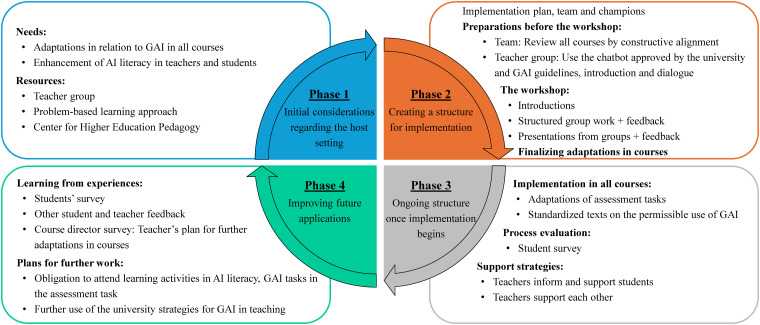
- Design: a quality improvement/implementation project using the QIF’s 4 phases, reported according to SQUIRE-EDU, in a Swedish physiotherapy program using a PBL model.
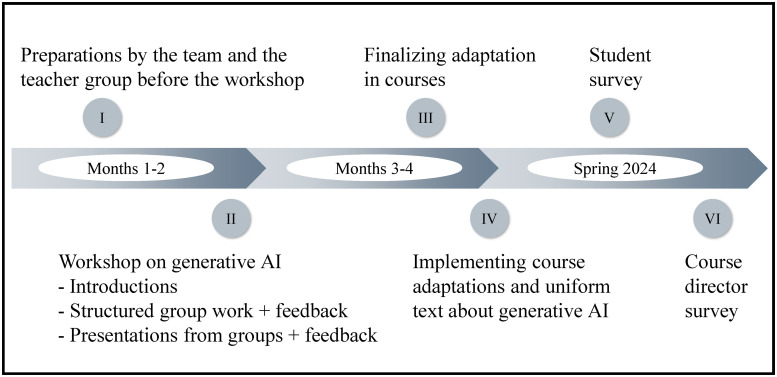
- Data/sample: all courses were reviewed using a constructive alignment matrix; a 4-month implementation plan included a 2-day faculty workshop, clinical champions, standardized GAI guidelines, and a mid-spring 2024 student survey (123/224 respondents, 55%) plus an end-of-semester course director survey.
- Analysis: descriptive survey percentages and grouped open-ended student responses; no inferential statistical testing is reported.
Limitations
- Stated in the paper: the student survey questions were not validated, the response rate was 55%, and there was no structured evaluation of AI literacy among teachers; future research should use validated assessments.
- Evident from the text: the initiative was conducted in a single physiotherapy program using PBL, with no comparison or control group, and outcomes rely largely on self-report/perception and descriptive data.
- Evident from the text: follow-up was limited to one semester, with a 1-year follow-up student survey only planned; the paper suggests transferability to other programs but does not empirically test it.
Model-written summary. Check it against the paper before relying on it.
Integrity signals
Registry
Cites
Statistics
Figures
Verification
Claims the paper makes
25 Valid · 2 Not valid · 11 Not checked · 64 Own results and interpretations
At least one cited source doesn’t support this claim or points to a different paper, and none confirmed it — see the verdicts below.
In the paper
“Yet, current plagiarism detection tools often fail to identify AI-generated text. 2”
§ Structured Development of Learning and Assessment Tasks to Prevent Generative AI Misuse and Enhance AI Literacy in the Faculty in Physiotherapy Education > Introduction
What the sources say
- Disputedcites [2] Cotton DRE Cotton PA Shipway JR. Chatting and cheating: ensuring academic integrity in the era of ChatGPT. Innov Educ Teach Int. 2024; 61(2): 228– 239. doi: 10.1080/14703297.2023.2190148 sourceExperimental — accuracy not yet measured
The section 'How can academics prevent students plagiarising using ChatGPT?' recommends plagiarism-detection tools as a way to help identify chatbot-written work. The Discussion adds that Turnitin would show high similarity between AI-generated submissions using similar prompts. The paper does not characterize such tools as often failing to identify AI-generated text. (LLM, conf=0.79)
Checked by a reasoning model — may be wrong.
plain- Asserted: passes — The authors put it forward as true.
- Checkable: passes — It can be checked against evidence.
- Load-bearing: passes — The paper’s conclusions depend on it.
- Based: passes — The paper gives a reason why it holds.
- Disputed
Every source the paper cites for this claim was checked and supports it.
In the paper
“Overreliance on GAI in medical education poses a risk of declining critical thinking and clinical decision-making skills. 9”
§ Structured Development of Learning and Assessment Tasks to Prevent Generative AI Misuse and Enhance AI Literacy in the Faculty in Physiotherapy Education > Introduction
What the sources say
- Supportedcites [9] Jeyaraman MKS Jeyaraman N Nallakumarasamy A Yadav S Bondili SK. ChatGPT in medical education and research: a boon or a bane? Cureus. 2023; 15(8): e44316. doi: 10.7759/cureus.44316 PMC10536401 37779749 source
The Abstract states that overreliance on technology in medical education could lead to a decline in critical thinking and clinical decision-making skills. The Review also warns that medical trainees may make clinical judgments without using their own judgment. No page number is available in our copy. (LLM, conf=0.95)
plainstates a possible cause- Asserted: passes — The authors put it forward as true.
- Checkable: passes — It can be checked against evidence.
- Load-bearing: passes — The paper’s conclusions depend on it.
- Based: passes — The paper gives a reason why it holds.
- Supported
Every source the paper cites for this claim was checked and supports it.
In the paper
“While co-designing learning experiences with students—recommended in AI-enhanced education 35 —has not yet been implemented, the survey findings, together with student-teacher interactions and course evaluations, have informed current adaptations.”
§ Structured Development of Learning and Assessment Tasks to Prevent Generative AI Misuse and Enhance AI Literacy in the Faculty in Physiotherapy Education > Discussion > Student use of GAI and Implications for Teaching and Learning Design
What the sources say
- Supportedcites [35] Carvalho L Martinez-Maldonado R Tsai Y-S Markauskaite L De Laat M. How can we design for learning in an AI world? Comput Educ: Artif Intell. 2022; 3: 100053. doi: 10.1016/j.caeai.2022.100053 source
The citation is attached to the recommendation to co-design learning experiences with students, not to the citing authors’ account of their survey findings or adaptations. Section 7 (Concluding remarks) proposes using ACAD to frame co-design discussions in which educators and learners work together. (LLM, conf=0.92)
plainstates a cause- Asserted: passes — The authors put it forward as true.
- Checkable: passes — It can be checked against evidence.
- Load-bearing: unclear — It is unclear whether the paper’s conclusions depend on it.
- Based: passes — The paper gives a reason why it holds.
- Supported
The cited sources support only part of this claim — read each source’s verdict below.
In the paper
“In the Faculty of Medicine and Health Sciences, students are likely to encounter GAI in future professional roles—as users, translators, or even developers of AI tools.”
§ Structured Development of Learning and Assessment Tasks to Prevent Generative AI Misuse and Enhance AI Literacy in the Faculty in Physiotherapy Education > Introduction
What the sources say
- Partly supportedcites [11] Ng FYC Thirunavukarasu AJ Cheng H, et al. Artificial intelligence education: an evidence-based medicine approach for consumers, translators, and developers. Cell Rep Med. 2023; 4(10): 101230. doi: 10.1016/j.xcrm.2023.101230 37852174 PMC10591047 sourceExperimental — accuracy not yet measured
The Introduction and “Delivering AI teaching for healthcare trainees” sections describe future healthcare professionals as consumers, translators, or developers of medical AI, with most expected to be consumers. The paper does not make that prediction specifically about students in the named Faculty of Medicine and Health Sciences, and its three-role framework concerns medical AI broadly rather than GAI specifically. (LLM, conf=0.85)
hedged- Asserted: passes — The authors put it forward as true.
- Checkable: passes — It can be checked against evidence.
- Load-bearing: passes — The paper’s conclusions depend on it.
- Based: passes — The paper gives a reason why it holds.
- Partly supported
Every source the paper cites for this claim was checked and supports it.
In the paper
“We have previously reported that physiotherapy students acknowledge the benefits of GAI, but also express concerns about its impact on learning quality.”
§ Structured Development of Learning and Assessment Tasks to Prevent Generative AI Misuse and Enhance AI Literacy in the Faculty in Physiotherapy Education > Introduction
What the sources say
- Supportedcites [5] Lindbäck Y Schröder K Engström T Valeskog K Sonesson S. Generative artificial intelligence in physiotherapy education: great potential amidst challenges—a qualitative interview study. BMC Med Educ. 2025; 25(1): 603. doi: 10.1186/s12909-025-07106-w 40275241 PMC12020151 source
The Results describe physiotherapy students’ views on GAI’s advantages and their concerns about its impact on learning. The Discussion likewise reports that students saw GAI as supporting learning while identifying disadvantages, including over-reliance. (LLM, conf=0.94)
plain- Asserted: passes — The authors put it forward as true.
- Checkable: passes — It can be checked against evidence.
- Load-bearing: unclear — It is unclear whether the paper’s conclusions depend on it.
- Based: passes — The paper gives a reason why it holds.
- Supported
27 more claims · 2 with their cited sources checked
Create a free account to see all 102 claims and to verify the 2 references still open.
- Probably not a substantial claim. 49
- It may state two separate claims as one. 47
Self-check
Percentages, sums and reported differences re-computed from the paper’s own numbers.
Rated minor: it would not touch a result — a value no result rests on, a p-value that stays on the same side of the significance level, or a conflict that is clerical, resolved elsewhere in the paper, or outside its own findings.
In the paper
“| Neither high nor low degree | 31 | (24) |”
§ Structured Development of Learning and Assessment Tasks to Prevent Generative AI Misuse and Enhance AI Literacy in the Faculty in Physiotherapy Education > Results > QIF Phase 3: Ongoing Structure Once Implementation Begins
Reported 24 · recomputed 25.203252
Rated minor: it would not touch a result — a value no result rests on, a p-value that stays on the same side of the significance level, or a conflict that is clerical, resolved elsewhere in the paper, or outside its own findings.
In the paper
“| Weekly | 52 | (43) |”
§ Structured Development of Learning and Assessment Tasks to Prevent Generative AI Misuse and Enhance AI Literacy in the Faculty in Physiotherapy Education > Results > QIF Phase 3: Ongoing Structure Once Implementation Begins
Reported 43 · recomputed 42.276423
Citations
Cites
(1999) · Cited by 28,356
The updated consolidated framework for implementation research based on user feedback
Damschroder, L. J., Reardon, C. M., Widerquist, M. A. O., & Lowery, J. (2022) · Implementation Science · doi:10.1186/s13012-022-01245-0 · Cited by 4,452
What is AI Literacy? Competencies and Design Considerations
Long, D., & Magerko, B. (2020) · Proceedings of the 2020 CHI Conference on Human Factors in Computing Systems · doi:10.1145/3313831.3376727 · Cited by 3,241
Chatting and cheating: Ensuring academic integrity in the era of ChatGPT
Cotton, D. R. E., Cotton, P. A., & Shipway, J. R. (2024) · Innovations in Education and Teaching International · doi:10.1080/14703297.2023.2190148 · Cited by 3,087
Problem-Based Learning: An Approach to Medical Education
Engle, K. K. (1981) · The American Journal of Occupational Therapy · doi:10.5014/ajot.35.8.539b · Cited by 2,140
Effects of problem-based learning: a meta-analysis
Dochy, F., Segers, M., Van den Bossche, P., & Gijbels, D. (2003) · Learning and Instruction · doi:10.1016/s0959-4752(02)00025-7 · Cited by 1,713 · cited 5×
“For example, reviewing drafts or incorporating peer review before submission helps identify AI-generated content while also facilitating deeper understanding and feedback skills 32 — also core elements of PBL. 16 Similarly, requiring students to submit audio re fl ections or apply knowledge in case-based scenarios enha…”
InfluentialThe Quality Implementation Framework: A Synthesis of Critical Steps in the Implementation Process
Meyers, D. C., Durlak, J. A., & Wandersman, A. (2012) · American Journal of Community Psychology · doi:10.1007/s10464-012-9522-x · Cited by 1,102 · cited 6×
“The use of frameworks, such as the QIF framework, 13 is recommended to guide implementation processes 26 and it provided structure, helped identify needs, resources, and supported strategies for successful implementation.”
InfluentialNilsen, P., & Bernhardsson, S. (2019) · BMC Health Services Research · doi:10.1186/s12913-019-4015-3 · Cited by 1,014
The challenge of problem-based learning
Taylor, I., & Burgess, H. (1997) · Cited by 698
In search of artificial intelligence (AI) literacy in teacher education: A scoping review
Sperling, K., Stenberg, C.-J., McGrath, C., Åkerfeldt, A., Heintz, F., & Stenliden, L. (2024) · Computers and Education Open · doi:10.1016/j.caeo.2024.100169 · Cited by 498
Ten recommendations for using implementation frameworks in research and practice
Moullin, J. C., Dickson, K. S., Stadnick, N. A., Albers, B., Nilsen, P., Broder-Fingert, S., Mukasa, B., & Aarons, G. A. (2020) · Implementation Science Communications · doi:10.1186/s43058-020-00023-7 · Cited by 488 · cited 1×
“The use of frameworks, such as the QIF framework, 13 is recommended to guide implementation processes 26 and it provided structure, helped identify needs, resources, and supported strategies for successful implementation.”
Constructive alignment in university teaching
Kandlbinder, P. (2014) · Cited by 479
Trullàs, J. C., Blay, C., Sarri, E., & Pujol, R. (2022) · BMC Medical Education · doi:10.1186/s12909-022-03154-8 · Cited by 473 · cited 14×
“PBL methodology enhances social abilities, problem-solving capabilities, self-directed learning, and communication skills.”
InfluentialOgrinc, G., Armstrong, G. E., Dolansky, M. A., Singh, M. K., & Davies, L. (2019) · Academic Medicine · doi:10.1097/acm.0000000000002750 · Cited by 263 · cited 1×
“The reporting of this study conforms to the Standards for QUality Improvement Reporting Excellence in Education statement (SQUIRE-EUD) 17 (see Supplemental Material).”
Assessing Health Students' Attitudes and Usage of ChatGPT in Jordan: Validation Study
Sallam, M., Salim, N. A., Barakat, M., Al-Mahzoum, K., Al-Tammemi, A. B., Malaeb, D., Hallit, R., & Hallit, S. (2023) · JMIR Medical Education · doi:10.2196/48254 · Cited by 234 · cited 1×
“37 Additionally, there may be a disparity between students who pay for advanced ChatGPT and those who do not.”
The Role of Large Language Models in Medical Education: Applications and Implications
Safranek, C. W., Sidamon-Eristoff, A. E., Gilson, A., & Chartash, D. (2023) · JMIR Medical Education · doi:10.2196/50945 · Cited by 233 · cited 2×
“Brainstorming ideas emerged as the most common use of GAI in both our survey, and in previous research among medical students, 10 also described as commonly used in our focus group study on students.”
Flipped classroom in higher education: a systematic literature review and research challenges
Baig, M. I., & Yadegaridehkordi, E. (2023) · International Journal of Educational Technology in Higher Education · doi:10.1186/s41239-023-00430-5 · Cited by 229 · cited 1×
“This approach resembles students ’ preparation before teaching activities, 28 to enhance motivation, improve discussions and deepen knowledge.”
Farazouli, A., Cerratto-Pargman, T., Bolander-Laksov, K., & McGrath, C. (2024) · Assessment & Evaluation in Higher Education · doi:10.1080/02602938.2023.2241676 · Cited by 219
Developing capacity for change
Meyer, C. B., & Stensaker, I. G. (2006) · Journal of Change Management · doi:10.1080/14697010600693731 · Cited by 202
McGrath, C., Cerratto Pargman, T., Juth, N., & Palmgren, P. J. (2023) · Computers and Education: Artificial Intelligence · doi:10.1016/j.caeai.2023.100139 · Cited by 195
Morena, A., Gaias, L. M., & Larkin, C. (2022) · Frontiers in Health Services · doi:10.3389/frhs.2022.896885 · Cited by 139 · cited 2×
“The clinical cham-pions, addressed implementation barriers 19 and prepared course-speci fi c presentations for the workshop.”
How can we design for learning in an AI world?
Carvalho, L., Martinez-Maldonado, R., Tsai, Y.-S., Markauskaite, L., & De Laat, M. (2022) · Computers and Education: Artificial Intelligence · doi:10.1016/j.caeai.2022.100053 · Cited by 128
Ng, F. Y. C., Thirunavukarasu, A. J., Cheng, H., Tan, T. F., Gutierrez, L., Lan, Y., Ong, J. C. L., Chong, Y. S., Ngiam, K. Y., Ho, D., et al. (2023) · Cell Reports Medicine · doi:10.1016/j.xcrm.2023.101230 · Cited by 113
Clinical Reasoning as a Core Competency
Connor, D. M., Durning, S. J., & Rencic, J. J. (2020) · Academic Medicine · doi:10.1097/acm.0000000000003027 · Cited by 96 · cited 3×
“7 The alignment between students ’ natural use of GAI and core educational strategies suggests a valuable opportunity to integrate AI tools in ways that reinforce essential academic and clinical reasoning skills.”
Triola, M. M., & Rodman, A. (2025) · Academic Medicine · doi:10.1097/acm.0000000000005963 · Cited by 92
Ashcraft, L. E., Goodrich, D. E., Hero, J., Phares, A., Bachrach, R. L., Quinn, D. A., Qureshi, N., Ernecoff, N. C., Lederer, L. G., Scheunemann, L. P., et al. (2024) · Implementation Science · doi:10.1186/s13012-024-01369-5 · Cited by 89 · cited 2×
“A team-based approach is associated with improved outcomes 20 and is better suited to understand and address end-user needs, offering diverse perspectives.”
Ganjavi, C., Eppler, M., O’Brien, D., Ramacciotti, L. S., Ghauri, M. S., Anderson, I., Choi, J., Dwyer, D., Stephens, C., Shi, V., et al. (2024) · PLOS Digital Health · doi:10.1371/journal.pdig.0000596 · Cited by 73
McGuier, E. A., Kolko, D. J., Aarons, G. A., Schachter, A., Klem, M. L., Diabes, M. A., Weingart, L. R., Salas, E., & Wolk, C. B. (2024) · Implementation Science · doi:10.1186/s13012-024-01381-9 · Cited by 70 · cited 1×
“20,21 The implementation team developed the time-bound to 4-month implementation plan (Figure 2).”
ChatGPT in Medical Education and Research: A Boon or a Bane?
Jeyaraman, M., K, S. P., Jeyaraman, N., Nallakumarasamy, A., Yadav, S., & Bondili, S. K. (2023) · Cureus · doi:10.7759/cureus.44316 · Cited by 58
Felten, P., Forsyth, R., & Sutherland, K. A. (2023) · Teaching and Learning Inquiry · doi:10.20343/teachlearninqu.11.20 · Cited by 48 · cited 1×
“34 Our approach to supporting AI literacy includes structural planning, collaborative group work, and feedback on theoretical, practical and ethical aspects.”
Clinical reasoning: Challenges of interpretation and practice in the 21st century
Higgs, J., & Jensen, G. M. (2019) · Cited by 43
Change in a culture of collegiality and consensus-seeking: a double-edged sword
McGrath, C., Roxå, T., & Bolander Laksov, K. (2019) · Higher Education Research & Development · doi:10.1080/07294360.2019.1603203 · Cited by 38 · cited 1×
“All these factors, a collegial culture, a clear direction for the development initiatives, and strong pedagogical leadership 30,31 are factors known to drive successful educational development.”
Student peer review as a process of knowledge creation through dialogue
Reddy, K., Harland, T., Wass, R., & Wald, N. (2021) · Higher Education Research & Development · doi:10.1080/07294360.2020.1781797 · Cited by 36 · cited 1×
“…or incorporating peer review before submission helps identify AI-generated content while also facilitating deeper understanding and feedback skills 32 — also core elements of PBL. 16 Similarly, requiring students to submit audio re fl ections or apply knowledge in case-based scenarios enhances…”
Lindbäck, Y., Schröder, K., Engström, T., Valeskog, K., & Sonesson, S. (2025) · BMC Medical Education · doi:10.1186/s12909-025-07106-w · Cited by 22
Self-citationClinical Reasoning: The Missing Core Competency in Physical Therapist Education and Practice
Furze, J. A., Black, L., McDevitt, A. W., Kobal, K. L., Durning, S. J., & Jensen, G. M. (2022) · Physical Therapy · doi:10.1093/ptj/pzac093 · Cited by 16 · cited 1×
“8 Overreliance on GAI in medical education poses a risk of declining critical thinking and clinical decision-making skills.”
Ohlsson, L., Abrandt Dahlgren, M., Kågedal, K., Setterud, H., & Tamás, É. (2024) · Journal of Problem Based Learning in Higher Education · doi:10.54337/ojs.jpblhe.v12i1.8316 · Cited by 3
Research works printed but not linked: 1
- Fixsen D Naoom S Blase K Friedman R Wallace F. Implementation research: a synthesis of the literature. In Louis de la Parte Florida Mental Health Institute, National Implementation Research Network. Tamps, FL: University of South Florida (FMHI Pubication #231); 2005, 78.
Cited by
Integrating Artificial Intelligence in Systemic Therapy: Strategies for Effective Clinical Practice
Hertlein, K. M., & Rajaei, A. (2026) · International Journal of Systemic Therapy · doi:10.1080/2692398x.2026.2633648 · Cited by 2
Almulla, A. A., Alduais, A. M. S., & Almulla, M. O. (2026) · Journal of Disability Research · doi:10.57197/jdr-2026-0937
Feng, T., & Zhou, W. (2026) · International Conference on Computer Science and Technologies in Education (CSTE) · doi:10.1109/cste69562.2026.11649589
“By emphasizing process data, human-AI collaboration,[5] and oral defense, we can re-establish the validity and equity of learning outcome assessments.”
Non-automatable cognitive skills in higher education in the age of generative AI
Jog, S. (2026) · Frontiers in Education · doi:10.3389/feduc.2026.1827610
Metadata
- Authors
- Lindbäck, Y., Valeskog, K., Schröder, K., & Sonesson, S.
- Affiliations
- Linköping University (SE)
- Corresponding author
- Lindbäck, Yvonne
- Venue
- Journal of Medical Education and Curricular Development
- Publisher
- SAGE Publications
- Published
- 2025-09
- Volume
- 12
- Pages
- 23821205251378794-23821205251378794
- ISSN
- 2382-1205 (ISSN-L)
- PMC
- PMC12441287
- OpenAlex
- W4414233335
- Semantic Scholar
- e4cf0615a7d7456e2be841854ce8d568cda1c019
- Cited by
- 4
- References
- 35
- Citations by year
- 2026: 4
- FWCI
- 0.96
- Type
- journal article
- Language
- en
- Open access
- gold
- doi.org
- Licence
- cc-by
- creativecommons.org/licenses/by/4.0/ (vor)
- journals.sagepub.com/page/policies/text-and-data-mining-license (tdm)
- Locations
- Journal of Medical Education and Curricular Development (publishedVersion, cc-by)
- Europe PMC (PubMed Central) (publishedVersion, cc-by)
- PubMed (publishedVersion)
- PubMed Central (publishedVersion, cc-by)
- Diva portal (Dalarna University Library) (submittedVersion, other-oa)
- DOAJ (DOAJ: Directory of Open Access Journals) (submittedVersion, cc-by-sa)
- Funders
- Faculty of Medicine and Health Sciences, Linköping University
- Topics
- Health Sciences › Medicine › Health Informatics › Artificial Intelligence in Healthcare and Education
- Social Sciences › Education › Artificial Intelligence in Education
- Social Sciences › Education › Innovations in Medical Education
- Keywords
- generative AI, AI misuse prevention, AI literacy, physiotherapy education, academic integrity, assessment redesign, problem-based learning, faculty development, student use of AI, clinical reasoning, critical thinking, curriculum adaptation
About these checks
Registry, retraction, Cites and statistics results are computed, not judged, with one exception: a printed reference that no index lists is read once by a model before it counts as a citation error. Claims are extracted by a model and kept only when their quote appears verbatim in the text; each cited source is then checked, with a model’s help, for whether it says what the claim relies on. Those verdicts can be wrong — read the claim’s quote and the cited source before relying on one.
The claim verdicts this report counts are experimental: their accuracy is not yet measured.
A language model drew the claims from the paper on 2026-10-10, under version 3 of the claim definition (model deepseek-v4.1-flash, prompt extract-v3).
A second model labelled each claim on 2026-10-10 (model jev-1.13-20260917, definition revision gold-guideline-v0.2).
Cited sources are checked with a language model’s help (gpt-6-sol).
Statistics and arithmetic are recomputed, not judged.
Confidence bands are shown only for fields calibrated on our annotated test set. None is calibrated yet, so no band is shown.
What counts as a claim ›How we measure confidence ›How we check this ›
Are you an author, or do you see a problem with this page? Request a review
Data sources
Bibliographic data: Semantic Scholar, OpenAlex, Crossref.
Contains information from the Semantic Scholar Academic Graph Datasets, made available under the ODC Attribution License (ODC-BY 1.0).
Semantic Scholar’s data is described in: Kinney, R., et al. (2023). The Semantic Scholar Open Data Platform. arXiv:2301.10140.
