

Fosgonimeton in mild-to-moderate Alzheimer's disease
Open accessThe DOI matches its Crossref record; 29 of the 29 references it cites were found in a registry or an index; none of the 23 sources its claims cite is checked for support yet.
Abstract
Background: Fosgonimeton, a small-molecule positive modulator of the neurotrophic hepatocyte growth factor (HGF) system, was studied in participants with Alzheimer's disease (AD). Objective: To assess the efficacy and safety of fosgonimeton in AD. Methods: LIFT-AD was a randomized, placebo-controlled, Phase 2/3 trial (NCT04488419; 23Jun2020), the primary analysis (N = 287) included participants with mild-to-moderate AD not receiving concomitant acetylcholinesterase inhibitors (AChEIs) randomized 1:1 to daily subcutaneous fosgonimeton 40 mg or placebo. The primary endpoint, the Global Statistical Test (GST) score, combined ADAS-Cog11 and ADCS-ADL23. Secondary endpoints included ADAS-Cog11, ADCS-ADL23, and NfL. Exploratory endpoints included plasma biomarkers of AD. Safety included all dosed participants, including those receiving and not receiving AChEIs or randomized to fosgonimeton 70 mg (N = 549). Results: The trial did not achieve its primary or secondary endpoints; between-group difference in the least-square mean change (SE) from baseline to Week 26 in the GST score was −0.08 (0.10) (p = 0.70), −0.70 (0.77) (p = 0.35) in ADAS-Cog11, and +0.67 (0.92) (p = 0.61) in ADCS-ADL23. This showed small differences favoring fosgonimeton versus placebo. Nominally significant changes in plasma biomarkers were observed in p-τ217 only. Fosgonimeton had an acceptable safety profile. Serious AEs were balanced between groups (4.2% fosgonimeton, 6.9% placebo). More participants in the fosgonimeton group (14.2%) discontinued due to AEs versus placebo (4.6%), mostly from injection site reactions. Conclusions: Fosgonimeton did not significantly improve ADAS-Cog11 or ADCS-ADL23 versus placebo. However, the consistently observed non-significant improvements favoring fosgonimeton suggests potentially relevant biological activity with fosgonimeton and that positive modulation of HGF signaling may impact components of the pathophysiologic processes of neurodegenerative diseases.
Overview
CoChat Summary
TL;DR
In LIFT-AD, a Phase 2/3 randomized placebo-controlled trial, fosgonimeton 40 mg did not significantly improve the primary composite GST score or secondary ADAS-Cog11/ADCS-ADL23 endpoints in mild-to-moderate Alzheimer’s disease participants not receiving AChEIs. Non-significant improvements favoring fosgonimeton were seen across clinical endpoints, p-tau217 showed a nominally significant change, and safety was acceptable but with more injection-site-related discontinuations.
Key findings
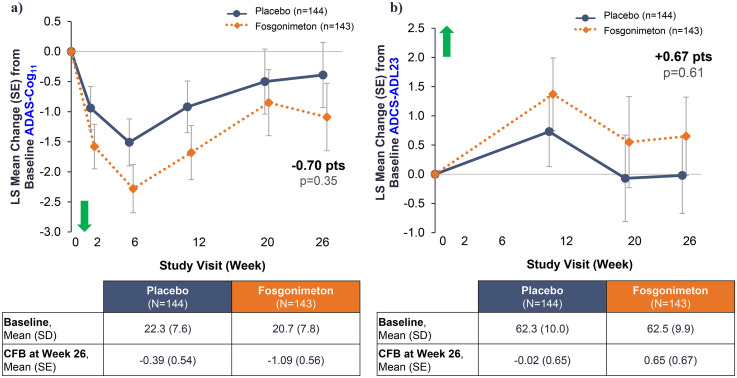
- The trial did not achieve its primary or secondary endpoints: between-group difference in least-square mean change (SE) from baseline to Week 26 was −0.08 (0.10) (p = 0.70) for GST score, −0.70 (0.77) (p = 0.35) for ADAS-Cog11, and +0.67 (0.92) (p = 0.61) for ADCS-ADL23 in the primary analysis population (N = 287).
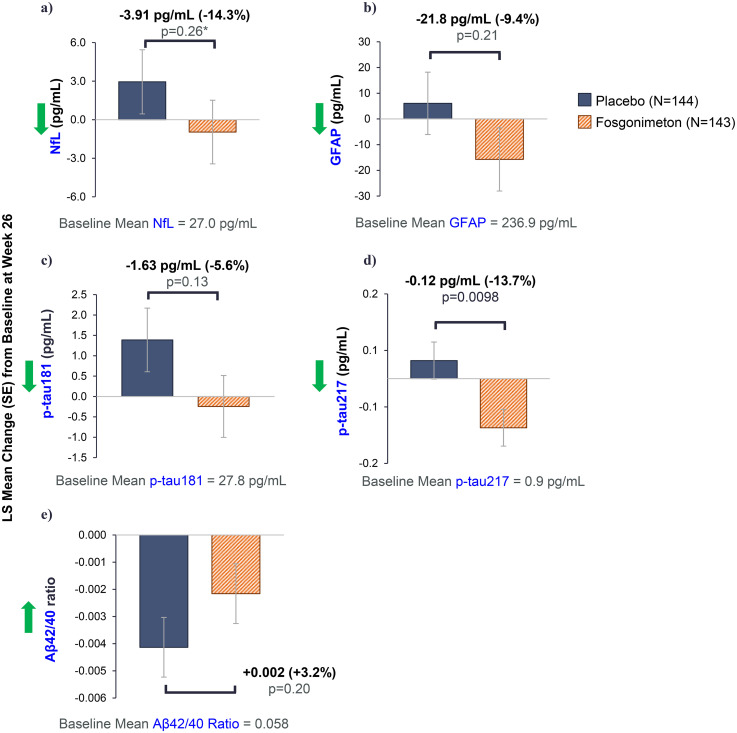
- Plasma NfL, a secondary endpoint, changed by −0.96 (2.48) pg/mL with fosgonimeton versus +2.95 (2.49) pg/mL with placebo (difference −3.91 (3.46), p = 0.26); p-tau217 showed a nominally significant percent change versus placebo (−13.7%, p < 0.01), while GFAP (−9.4%, p = 0.21) and p-tau181 (−5.6%, p = 0.13) did not.
- Safety was generally acceptable: serious AEs were balanced (4.2% fosgonimeton, 6.9% placebo), but more fosgonimeton participants discontinued due to AEs (14.2%) versus placebo (4.6%), mostly from injection site reactions; TEAEs occurred in 78.1% of fosgonimeton 40 mg, 87.9% of 70 mg, and 60.6% of placebo.
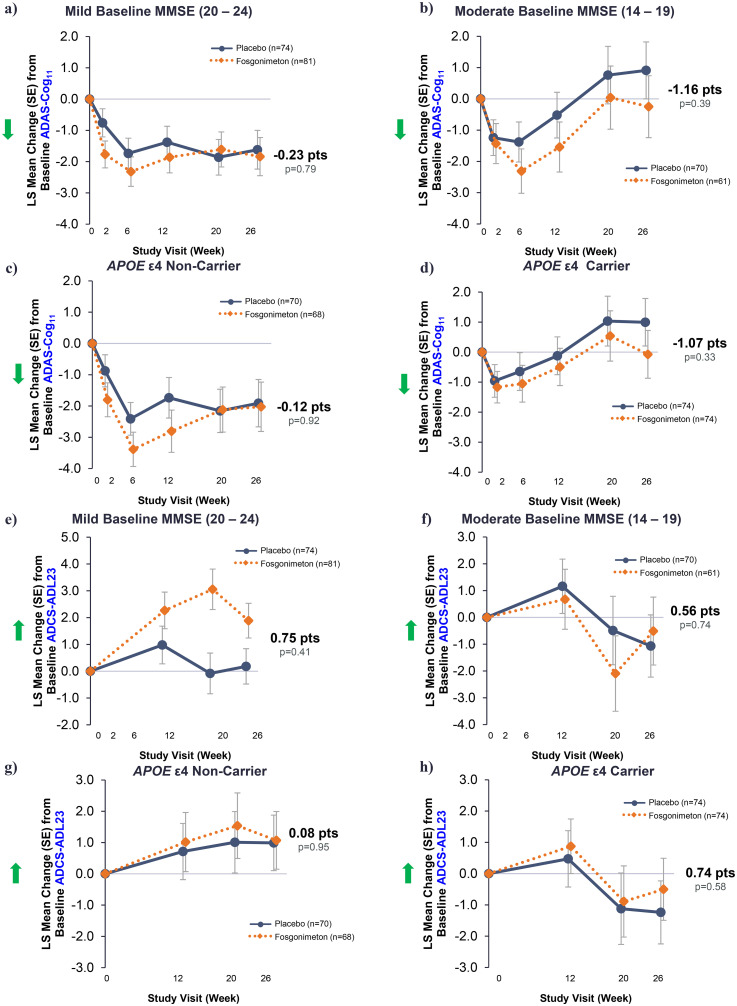
- In non-significant subgroup analyses, moderate AD and APOE ε4 carriers showed larger directional differences favoring fosgonimeton: ADAS-Cog11 differences of −1.16 (1.33) points (p = 0.39) and −1.07 (1.09) points (p = 0.33), and ADCS-ADL23 differences of +0.56 (1.68) points (p = 0.74) and +0.74 (1.34) points (p = 0.58), respectively.
Methods
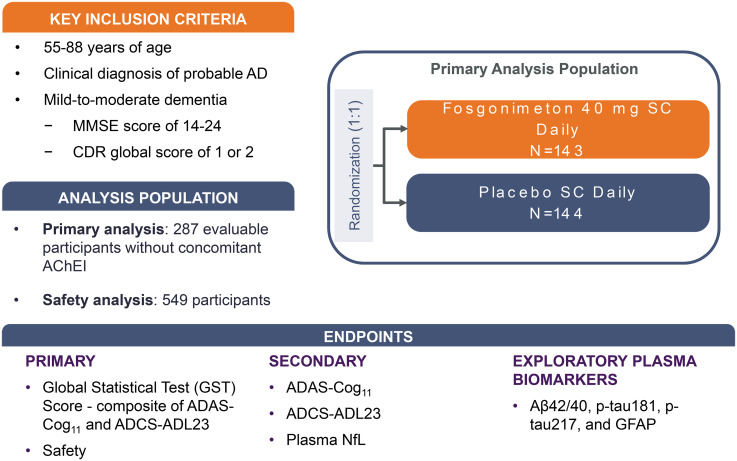
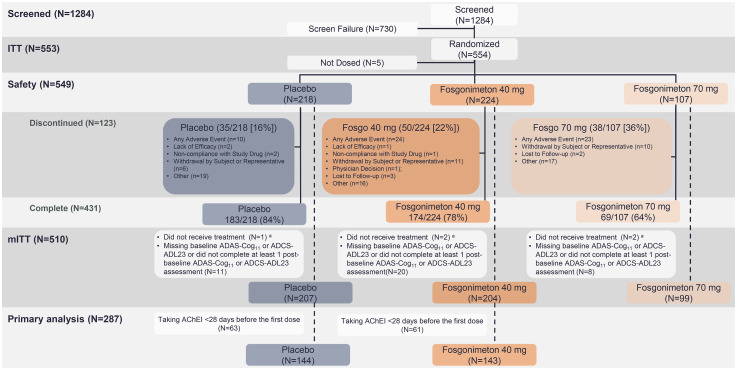
- LIFT-AD (NCT04488419) was a multicenter, randomized, double-blind, placebo-controlled, 26-week trial conducted at 90 US sites in participants aged 55–85 with probable AD, MMSE 14–24, and CDR 1–2; the primary analysis population (N = 287) excluded concomitant AChEIs and randomized 1:1 to daily subcutaneous fosgonimeton 40 mg or placebo, while the mITT population was N = 510 and the safety population was N = 549 (including fosgonimeton 70 mg and AChEI users).
- The primary endpoint was the Global Statistical Test (GST) score, a composite of change from baseline z-scores in ADAS-Cog11 and ADCS-ADL23 at Week 26; secondary endpoints included ADAS-Cog11, ADCS-ADL23, and plasma NfL, with exploratory plasma biomarkers GFAP, p-tau181, p-tau217, and Aβ42/40.
- Efficacy was analyzed using mixed models for repeated measures (MMRM); plasma biomarkers were assessed with Quanterix Simoa assays; safety included all dosed participants.
Limitations
- Paper-stated: the lack of placebo decline was unexpected and may reflect a trial population with milder disease progression than historical trials, a shorter 26-week duration, a majority (85%) with CDR = 1 and baseline mean ADAS-Cog11 of 21.5, possible bias from daily subcutaneous injections contributing to a large placebo effect, and no biomarker confirmation at enrollment under 2011 NIA-AA probable AD criteria.
- Paper-stated: primary and secondary endpoints were not met, and most subgroup and biomarker findings were non-significant except for the nominally significant p-tau217 result.
- Evident from the text: the primary analysis was limited to fosgonimeton 40 mg and participants not receiving AChEIs, while 70 mg randomization was discontinued and efficacy for 70 mg was only pooled in the mITT population; injection site reactions drove more discontinuations in fosgonimeton groups.
Model-written summary. Check it against the paper before relying on it.
Integrity signals
Registry
Cites
Statistics
Figures
Verification
Claims the paper makes
0 Valid · 0 Not valid · 14 Not checked · 92 Own results and interpretations
A result the paper reports from its own data — it cites no other source for it, so there is none to check. The quote shows it is in the paper.
In the paper
“A nominally significant percent change from baseline at Week 26 was observed in p-tau217 when compared to placebo, a biomarker associated with Aβ burden (−13.7%; p < 0.01) (Figure 5).”
§ Fosgonimeton in mild-to-moderate Alzheimer's disease > Results > Plasma biomarker outcomes
plain- Asserted: passes — The authors put it forward as true.
- Checkable: passes — It can be checked against evidence.
- Load-bearing: unclear — It is unclear whether the paper’s conclusions depend on it.
- Based: passes — The paper gives a reason why it holds.
None of the sources cited for this claim have been checked yet.
In the paper
“In the subgroups with moderate dementia or APOE ε4 carrier status, a modest decrease in plasma NfL concentrations was observed in the fosgonimeton group, in contrast to an increase in concentration observed in the placebo group”
§ Fosgonimeton in mild-to-moderate Alzheimer's disease > Results > Plasma biomarker outcomes
plainstates an association- Asserted: passes — The authors put it forward as true.
- Checkable: passes — It can be checked against evidence.
- Load-bearing: unclear — It is unclear whether the paper’s conclusions depend on it.
- Based: passes — The paper gives a reason why it holds.
A result the paper states — it cites no source for it, so there is none to check. The quote shows it is in the paper.
In the paper
“As a result, the magnitude of difference between fosgonimeton and placebo is greater in these two subgroups compared to participants with mild AD and APOE ε4 non-carriers.”
§ Fosgonimeton in mild-to-moderate Alzheimer's disease > Results > Clinical efficacy outcomes
plainstates an association- Asserted: passes — The authors put it forward as true.
- Checkable: passes — It can be checked against evidence.
- Load-bearing: unclear — It is unclear whether the paper’s conclusions depend on it.
- Based: passes — The paper gives a reason why it holds.
A result the paper reports from its own data — it cites no other source for it, so there is none to check. The quote shows it is in the paper.
In the paper
“Both placebo and fosgonimeton participants in the + AChEI subgroups experienced a worsening in cognition and function, as measured by the ADAS-Cog11 and ADCS-ADL23 at Week 26. (Table 4).”
§ Fosgonimeton in mild-to-moderate Alzheimer's disease > Results > Clinical efficacy outcomes
plain- Asserted: passes — The authors put it forward as true.
- Checkable: passes — It can be checked against evidence.
- Load-bearing: unclear — It is unclear whether the paper’s conclusions depend on it.
- Based: passes — The paper gives a reason why it holds.
A result the paper reports from its own data — it cites no other source for it, so there is none to check. The quote shows it is in the paper.
In the paper
“and −1.07 (1.09) points (p = 0.33) among APOE ε4 carriers.”
§ Fosgonimeton in mild-to-moderate Alzheimer's disease > Results > Clinical efficacy outcomes
plain- Asserted: passes — The authors put it forward as true.
- Checkable: passes — It can be checked against evidence.
- Load-bearing: unclear — It is unclear whether the paper’s conclusions depend on it.
- Based: passes — The paper gives a reason why it holds.
47 more claims
Create a free account to see all 106 claims and to verify the 23 references still open.
- It may state two separate claims as one. 37
- The quote only partly states this claim. 1
- Probably not a substantial claim. 25
Self-check
Percentages, sums and reported differences re-computed from the paper’s own numbers.
Each contradiction between two passages listed here was confirmed by an independent check.
Rated minor: it would not touch a result — a value no result rests on, a p-value that stays on the same side of the significance level, or a conflict that is clerical, resolved elsewhere in the paper, or outside its own findings.
In the paper
§ Fosgonimeton in mild-to-moderate Alzheimer's disease > Results > Plasma biomarker outcomes
“−22.3% (LSM (SE) −1.68 (1.97) pg/mL; p = 0.40)) among APOE ε4 carriers”
§ Fosgonimeton in mild-to-moderate Alzheimer's disease > Results > Plasma biomarker outcomes
“| CFB, % | 28.7 | 4.6 | −24.1 | −5.7 | −11.1 | −5.4 |”
Rated minor: it would not touch a result — a value no result rests on, a p-value that stays on the same side of the significance level, or a conflict that is clerical, resolved elsewhere in the paper, or outside its own findings.
In the paper
§ Fosgonimeton in mild-to-moderate Alzheimer's disease > Methods > Outcome measures
“Aβ negative or required further confirmatory testing; < 0.62 pg/mL”
§ Fosgonimeton in mild-to-moderate Alzheimer's disease > Results > Plasma biomarker outcomes
“participants with baseline plasma p-tau217 levels <0.63 pg/mL were classified as Aβ negative”
Rated minor: it would not touch a result — a value no result rests on, a p-value that stays on the same side of the significance level, or a conflict that is clerical, resolved elsewhere in the paper, or outside its own findings.
In the paper
§ Fosgonimeton in mild-to-moderate Alzheimer's disease > Results > Plasma biomarker outcomes
“In the subgroups with moderate dementia or APOE ε4 carrier status, a modest decrease in plasma NfL concentrations was observed in the fosgonimeton group, in contrast to an increase in concentration observed in the placebo group”
§ Fosgonimeton in mild-to-moderate Alzheimer's disease > Results > Plasma biomarker outcomes
“| NfL, pg/mL | 7.29 (4.88) | 1.03 (4.90) | −6.26 (6.87) p = 0.36 | −1.70 (1.56) | −3.38 (1.44) | −1.68 (1.97) p = 0.40 |”
Citations
Cites
Folstein, M. F., Folstein, S. E., & McHugh, P. R. (1975) · Journal of Psychiatric Research · doi:10.1016/0022-3956(75)90026-6 · Cited by 88,282
McKhann, G. M., Knopman, D. S., Chertkow, H., Hyman, B. T., Jack, C. R., Kawas, C. H., Klunk, W. E., Koroshetz, W. J., Manly, J. J., Mayeux, R., et al. (2011) · Alzheimer's & Dementia · doi:10.1016/j.jalz.2011.03.005 · Cited by 18,657
NIA‐AA Research Framework: Toward a biological definition of Alzheimer's disease
Jack, C. R., Bennett, D. A., Blennow, K., Carrillo, M. C., Dunn, B., Haeberlein, S. B., Holtzman, D. M., Jagust, W., Jessen, F., Karlawish, J., et al. (2018) · Alzheimer's & Dementia · doi:10.1016/j.jalz.2018.02.018 · Cited by 10,537
A New Clinical Scale for the Staging of Dementia
Hughes, C. P., Berg, L., Danziger, W., Coben, L. A., & Martin, R. L. (1982) · British Journal of Psychiatry · doi:10.1192/bjp.140.6.566 · Cited by 7,056
Lecanemab in early Alzheimer's disease
van Dyck, C. H., Swanson, C. J., Aisen, P., Bateman, R. J., Chen, C., Gee, M., Kanekiyo, M., Li, D., Reyderman, L., Cohen, S., et al. (2023) · New England Journal of Medicine · doi:10.1056/nejmoa2212948 · Cited by 5,678
Self-citationA new rating scale for Alzheimer's disease
(1984) · American Journal of Psychiatry · doi:10.1176/ajp.141.11.1356 · Cited by 4,175
The neuropathological diagnosis of Alzheimer's disease
DeTure, M. A., & Dickson, D. W. (2019) · Molecular Neurodegeneration · doi:10.1186/s13024-019-0333-5 · Cited by 3,329
Donanemab in Early Symptomatic Alzheimer Disease: The TRAILBLAZER-ALZ 2 Randomized Clinical Trial
Sims, J. R., Zimmer, J. A., Evans, C. D., Lu, M., Ardayfio, P., Sparks, J., Wessels, A. M., Shcherbinin, S., Wang, H., Monkul Nery, E. S., et al. (2023) · JAMA · doi:10.1001/jama.2023.13239 · Cited by 2,932
Revised criteria for diagnosis and staging of Alzheimer's disease: Alzheimer's Association Workgroup
Jack, C. R., Andrews, J. S., Beach, T. G., Buracchio, T., Dunn, B., Graf, A., Hansson, O., Ho, C., Jagust, W., McDade, E., et al. (2024) · Alzheimer's & Dementia · doi:10.1002/alz.13859 · Cited by 2,803
An Inventory to Assess Activities of Daily Living for Clinical Trials in Alzheimerʼs Disease
Galasko, D., Bennett, D., Sano, M., Ernesto, C., Thomas, R., Grundman, M., & Ferris, S. (1997) · Alzheimer Disease & Associated Disorders · doi:10.1097/00002093-199700112-00005 · Cited by 1,194
Research works printed but not linked: 1
- Leqembi (lecanemab-irmb) injection, for intravenous use [package insert]. New Jersey: Eisai Inc., 2023.
Metadata
- Authors
- Porsteinsson, A. P., Sabbagh, M., Tariot, P. N., Church, K. J., San Martin, J., Ooi, K.-B. C., Daggett, S., Hale, M. D., Holub, R., & Moebius, H. J.
- Affiliations
- University of Rochester Medicine (US)
- Barrow Neurological Institute (US)
- University of Arizona (US)
- Athira Pharma (United States) (US)
- Athira Pharma, Inc.
- Neurological Associates Albany, Albany, NY, USA
- Corresponding author
- Ooi, Kai-Bin C
- ORCID
- Venue
- Journal of Alzheimer's Disease Reports
- Publisher
- SAGE Publications
- Published
- 2025-01
- Volume
- 9
- Pages
- 25424823251405817-25424823251405817
- ISSN
- 2542-4823 (ISSN-L)
- PMC
- PMC12701236
- OpenAlex
- W4417362219
- Semantic Scholar
- a2378cf02250f4639d3fd499bfca933abce3656e
- Cited by
- 0
- References
- 29
- FWCI
- 0.00
- Type
- journal article
- Language
- en
- Open access
- diamond
- doi.org
- Licence
- cc-by-nc
- creativecommons.org/licenses/by-nc/4.0/ (vor)
- journals.sagepub.com/page/policies/text-and-data-mining-license (tdm)
- Locations
- Journal of Alzheimer s Disease Reports (publishedVersion, cc-by-nc)
- PubMed Central (publishedVersion, cc-by-nc)
- PubMed (publishedVersion)
- DOAJ (DOAJ: Directory of Open Access Journals) (submittedVersion)
- Topics
- Life Sciences › Neuroscience › Cellular and Molecular Neuroscience › Alzheimer's disease research and treatments
- Health Sciences › Medicine › Psychiatry and Mental health › Dementia and Cognitive Impairment Research
- Health Sciences › Medicine › Pharmacology (medical) › Cholinesterase and Neurodegenerative Diseases
- Keywords
- Alzheimer's disease, hepatocyte growth factor, HGF signaling, neurotrophic factors, mild to moderate Alzheimer's disease, cognitive function, activities of daily living, neurofilament light chain, plasma biomarkers, drug safety, subcutaneous administration, acetylcholinesterase inhibitors, treatment discontinuation, injection site reactions
About these checks
Registry, retraction, Cites and statistics results are computed, not judged, with one exception: a printed reference that no index lists is read once by a model before it counts as a citation error. Claims are extracted by a model and kept only when their quote appears verbatim in the text; each cited source is then checked, with a model’s help, for whether it says what the claim relies on. Those verdicts can be wrong — read the claim’s quote and the cited source before relying on one.
A language model drew the claims from the paper on 2026-11-27, under version 3 of the claim definition (model deepseek-v4.1-flash, prompt extract-v3).
A second model labelled each claim on 2026-11-27 (model jev-1.13-20260917, definition revision gold-guideline-v0.2).
Statistics and arithmetic are recomputed, not judged.
Confidence bands are shown only for fields calibrated on our annotated test set. None is calibrated yet, so no band is shown.
What counts as a claim ›How we measure confidence ›How we check this ›
Are you an author, or do you see a problem with this page? Request a review
Data sources
Bibliographic data: Semantic Scholar, OpenAlex, Crossref.
Contains information from the Semantic Scholar Academic Graph Datasets, made available under the ODC Attribution License (ODC-BY 1.0).
Semantic Scholar’s data is described in: Kinney, R., et al. (2023). The Semantic Scholar Open Data Platform. arXiv:2301.10140.
