

The DOI matches its Crossref record; 1 of the 1 references it cites were found in a registry or an index.
Implementation and outcomes of complementary therapies in hospice care: an integrative review
Open accessAbstract
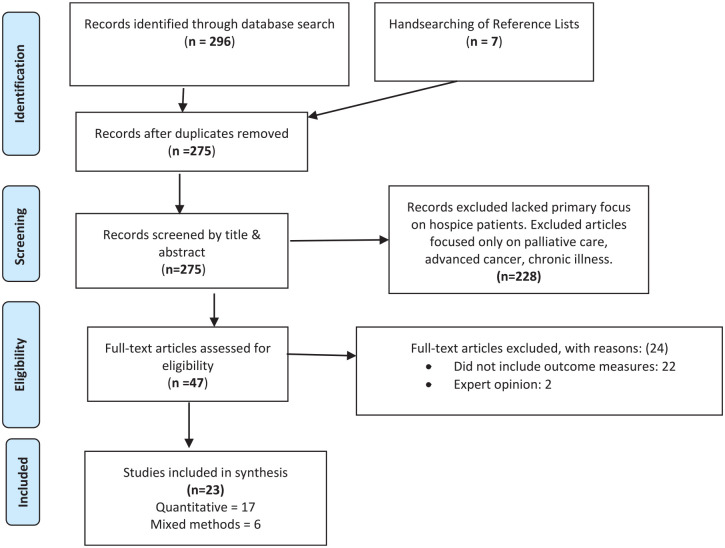
Complementary therapies are increasingly integrated into hospice care, emphasizing the need to examine the evidence regarding implementation and effects on end-of-life outcomes. This review synthesizes the evidence regarding the implementation of complementary therapies and effects on end-of-life outcomes in hospice care. Whittemore and Knafl’s five-step integrative review process was applied. Using predefined search terms, research-based articles between 2006 and 2020 were reviewed. Twenty-three quantitative/mixed method studies conducted across eight countries met the final review criteria. Most commonly used complementary therapies were music, biofield therapies (reiki, therapeutic touch), and massage therapy. Most studies reported significant findings on physical symptoms (pain, dyspnea, fatigue, gastrointestinal symptoms, agitation) and/or psychosocial/spiritual symptoms (anxiety, depression, spirituality, well-being, quality of life); 40% of studies had both significant and nonsignificant findings. Methodological limitations included study design (few randomized controlled trials), small sample size, high attrition rate, lack of racial/ethnic diversity, unstandardized intervention implementation, and multiple outcome measurement instruments. Complementary therapies are promising components of hospice care; however, rigorous studies are needed to validate the effect on end-of-life outcomes and determine the most efficacious implementation. Complementary therapy studies face challenges consistent with end-of-life research; however, efforts to design rigorous trials and address methodological issues are required to enhance the state of the science.
Overview
The claims and statistics of this paper haven’t been checked yet.
Run the check — free, no account needed. It reads the open-access text and checks the sources it cites.
Integrity signals
Registry
Cites
Statistics
Figures
Verification
Claims the paper makes
The claims and statistics of this paper haven’t been checked yet.
Run the check — free, no account needed. It reads the open-access text and checks the sources it cites.
Claims other papers make about this one
Each is checked against this paper’s own text: does it say what the citing paper says it does?
The source backs part of the claim, not all of it — or backs it for a different population, condition or comparison.
In the citing paper
“Twenty-three quantitative or mixed-method studies across eight countries were included.”
From Psychosocial and Integrative Oncology: Interventions Across the Disease Trajectory. (2023) · cites this paper as Dingley et al. 2021
Experimental — accuracy not yet measuredThe source backs part of the claim, not all of it — or backs it for a different population, condition or comparison.
In the citing paper
“but although there were a few adequately powered RCTs, overall study quality was not very high.”
From Psychosocial and Integrative Oncology: Interventions Across the Disease Trajectory. (2023) · cites this paper as Dingley et al. 2021
Experimental — accuracy not yet measuredThe cited source says what the claim attributes to it.
In the citing paper
“This literature was summarized in a 2021 review, which synthesized the evidence regarding the implementation of complementary therapies on end-of-life outcomes in hospice care”
From Psychosocial and Integrative Oncology: Interventions Across the Disease Trajectory. (2023) · cites this paper as Dingley et al. 2021
The cited source says what the claim attributes to it.
In the citing paper
“Most studies reported significant findings on physical symptoms (pain, dyspnea, fatigue, gastrointestinal symptoms, agitation) and/or psychosocial/spiritual symptoms (anxiety, depression, spirituality, well-being, QL)”
From Psychosocial and Integrative Oncology: Interventions Across the Disease Trajectory. (2023) · cites this paper as Dingley et al. 2021
The cited source says what the claim attributes to it.
In the citing paper
“Most commonly used complementary therapies were music, biofield therapies (reiki, therapeutic touch), and massage therapy.”
From Psychosocial and Integrative Oncology: Interventions Across the Disease Trajectory. (2023) · cites this paper as Dingley et al. 2021
1 more claim about this paper
Create a free account to see every claim other papers make about this one.
Self-check
Percentages, sums and reported differences re-computed from the paper’s own numbers.
The self-check needs the paper’s full text.
Citations
Cites
A Pilot Study on Effectiveness of Music Therapy in Hospice in Japan
Nakayama, H., Kikuta, F., & Takeda, H. (2009) · Journal of Music Therapy · doi:10.1093/jmt/46.2.160 · Cited by 67
Research works printed but not linked: 47
- Institute of Medicine, Approaching death: improving care at the end of life
- Institute of Medicine, 2015, Dying in America: improving quality and honoring individual preferences near the end of life
- 10.7326/0003-4819-135-4-200108210-00011 · DOI
- 10.1001/jama.280.18.1569 · DOI
- Tindle HA, 2005, Altern Ther Health Med, 11, 42
- 10.1016/S0885-3924(00)00190-1 · DOI
- 10.1177/104990910201900506 · DOI
- 10.1177/104990910302000312 · DOI
- 10.3122/jabfm.2014.04.130238 · DOI
- 10.1016/j.jagp.2017.08.001 · DOI
- 10.1097/NJH.0000000000000060 · DOI
- 10.1177/1534735415589984 · DOI
- 10.1093/annonc/mdi110 · DOI
- 10.1177/104990910602300206 · DOI
- 10.1016/j.ctim.2006.01.009 · DOI
- 10.1017/S1478951508000436 · DOI
- Ventola CL., 2010, Pharm Ther, 35, 461
- Improving end-of-life care, 2004, NIH Consens State Sci Statements, 21, 1
- 10.1016/j.jpainsymman.2018.07.016 · DOI
- 10.1590/1518-8345.4213.3377 · DOI
- 10.1590/s1980-220x2020025103709 · DOI
- Clarke TC, 2015, Natl Health Stat Report, 79, 1
- 10.1111/j.1365-2648.2005.03621.x · DOI · Paper page
- Melnyk BM, 2015, Evidence-based practice in nursing & healthcare: a guide to best practice
- 10.1371/journal.pmed.1000097 · DOI · Paper page
- 10.1089/jpm.2015.0503 · DOI
- 10.1089/jpm.2007.0193 · DOI
- 10.1093/jmt/47.1.53 · DOI
- 10.1017/S1478951513000564 · DOI
- 10.1177/1049909111429327 · DOI
- 10.1093/jmt/44.2.113 · DOI
- 10.1089/jpm.2013.0295 · DOI
- 10.1177/082585970902500204 · DOI
- 10.7326/0003-4819-149-6-200809160-00003 · DOI
- 10.1016/j.jpainsymman.2015.02.022 · DOI
- 10.2190/OM.67.1-2.z2 · DOI
- 10.1089/acm.2011.0277 · DOI
- 10.1136/bmjspcare-2017-001421 · DOI
- 10.1089/jpm.2012.0150 · DOI
- 10.1177/1049909116630973 · DOI
- 10.7812/TPP/07-124 · DOI
- 10.1016/j.explore.2015.06.001 · DOI
- 10.12968/ijpn.2009.15.1.37947 · DOI
- 10.12968/ijpn.2012.18.2.69 · DOI
- 10.1017/S1478951511000587 · DOI
- 10.1136/bmjspcare-2018-001510 · DOI
- 10.1111/ecc.12381 · DOI
Cited by
Psychosocial and Integrative Oncology: Interventions Across the Disease Trajectory.
Carlson, L. E. (2023) · Annual Review of Psychology · doi:10.1146/annurev-psych-032620-031757 · Cited by 56
Metadata
- Authors
- Dingley, C., Ruckdeschel, A., Kotula, K., & Lekhak, N.
- Affiliations
- University of Nevada, Las Vegas (US)
- University of Mississippi (US)
- Corresponding author
- Dingley, Catherine
- Venue
- Palliative Care and Social Practice
- Publisher
- SAGE Publications
- Published
- 2021-01
- Volume
- 15
- Pages
- 26323524211051753-26323524211051753
- ISSN
- 2632-3524 (ISSN-L)
- PMC
- PMC8552400
- OpenAlex
- W3209995685
- Cited by
- 16
- References
- 1
- Citations by year
- 2026: 5 · 2025: 5 · 2024: 3 · 2023: 2 · 2022: 1
- FWCI
- 0.27
- Type
- journal article
- Language
- en
- Open access
- gold
- doi.org
- Licence
- Locations
- Palliative Care and Social Practice (publishedVersion, cc-by-nc)
- Europe PMC (PubMed Central) (publishedVersion, other-oa)
- PubMed Central (publishedVersion, cc-by-nc)
- PubMed (publishedVersion)
- Digital Scholarship - UNLV (University of Nevada Reno) (submittedVersion, cc-by-nc)
- DOAJ (DOAJ: Directory of Open Access Journals) (submittedVersion, cc-by-sa)
- Topics
- Health Sciences › Medicine › Public Health, Environmental and Occupational Health › Palliative Care and End-of-Life Issues
- Health Sciences › Medicine › Public Health, Environmental and Occupational Health › Palliative and Oncologic Care
- Health Sciences › Medicine › Complementary and alternative medicine › Complementary and Alternative Medicine Studies
- Keywords
- complementary therapy, hospice care, end-of-life care, music therapy, biofield energy healing, Reiki, therapeutic touch, massage, symptom management, pain, dyspnea, fatigue, gastrointestinal symptoms, agitation, anxiety, depression, spirituality, quality of life, implementation
About these checks
Registry, retraction, Cites and statistics results are computed, not judged, with one exception: a printed reference that no index lists is read once by a model before it counts as a citation error. Claims are extracted by a model and kept only when their quote appears verbatim in the text; each cited source is then checked, with a model’s help, for whether it says what the claim relies on. Those verdicts can be wrong — read the claim’s quote and the cited source before relying on one.
Statistics and arithmetic are recomputed, not judged.
Confidence bands are shown only for fields calibrated on our annotated test set. None is calibrated yet, so no band is shown.
What counts as a claim ›How we measure confidence ›How we check this ›
Are you an author, or do you see a problem with this page? Request a review
Data sources
Bibliographic data: Semantic Scholar, OpenAlex, Crossref.
Contains information from the Semantic Scholar Academic Graph Datasets, made available under the ODC Attribution License (ODC-BY 1.0).
Semantic Scholar’s data is described in: Kinney, R., et al. (2023). The Semantic Scholar Open Data Platform. arXiv:2301.10140.
