

A systematic review of measures of implementation players and processes: Summarizing the dearth of psychometric evidence
Open accessThe DOI matches its Crossref record; 91 of the 91 references it cites were found in a registry or an index.
Abstract
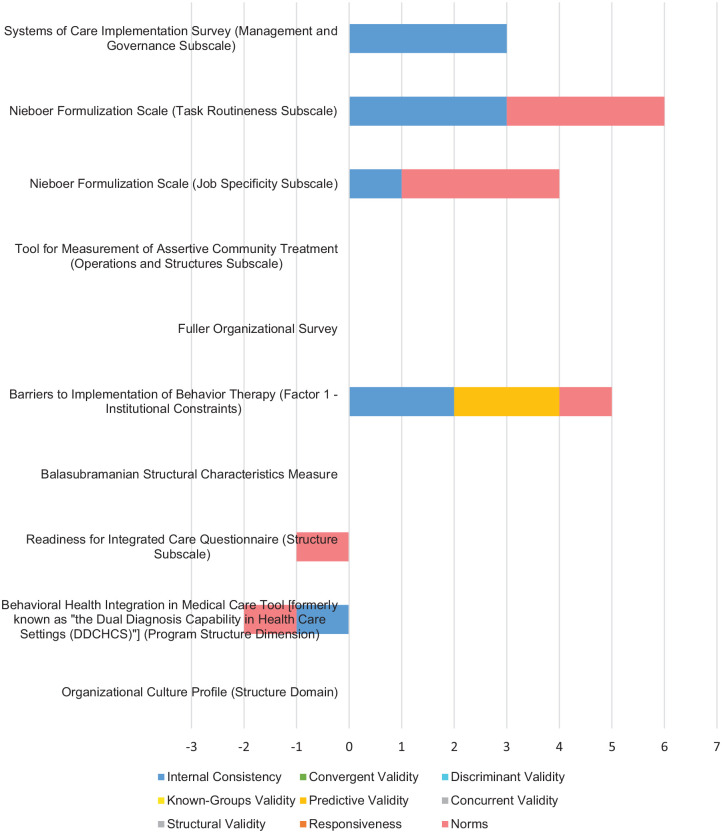
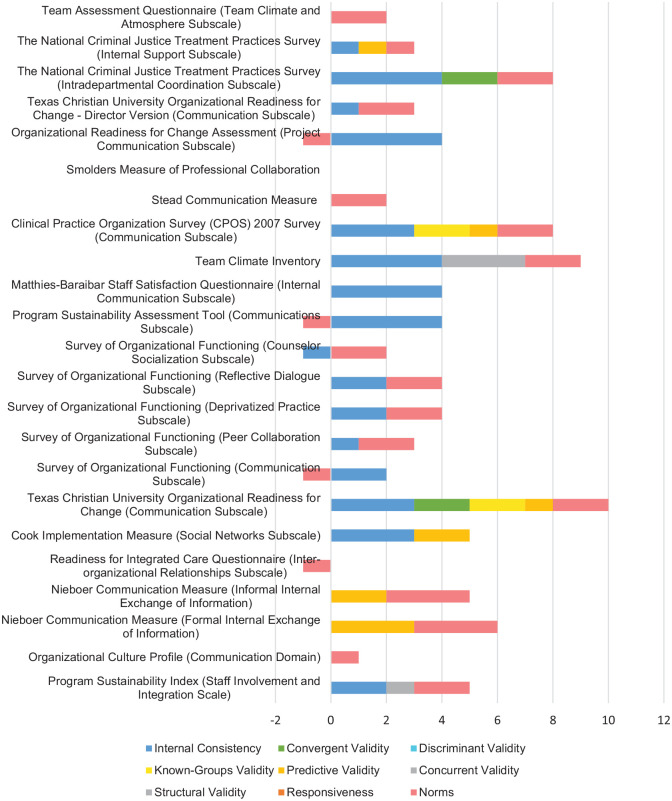
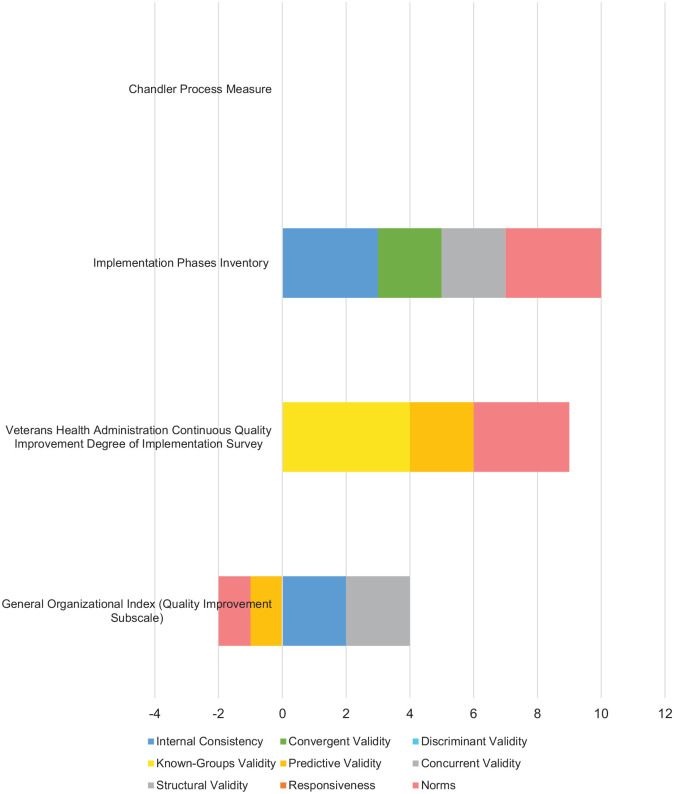
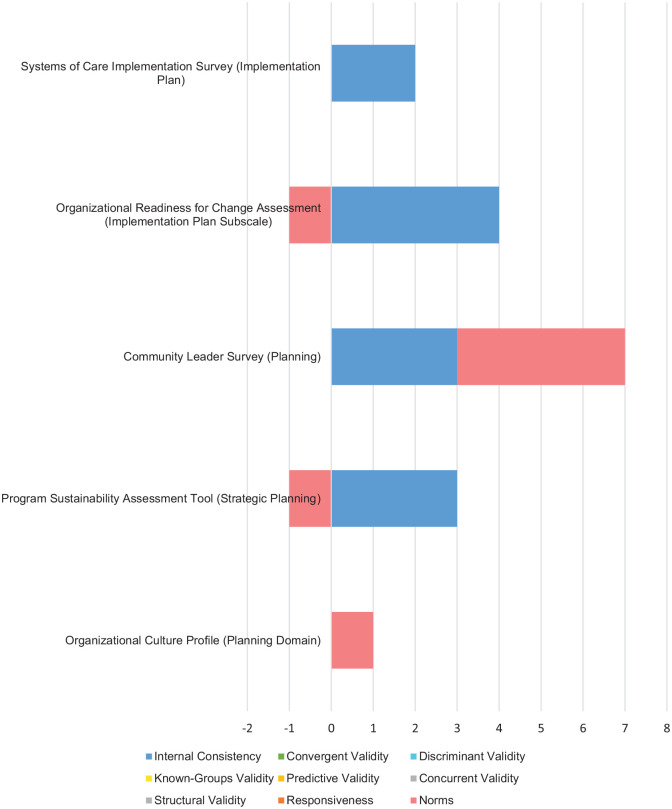
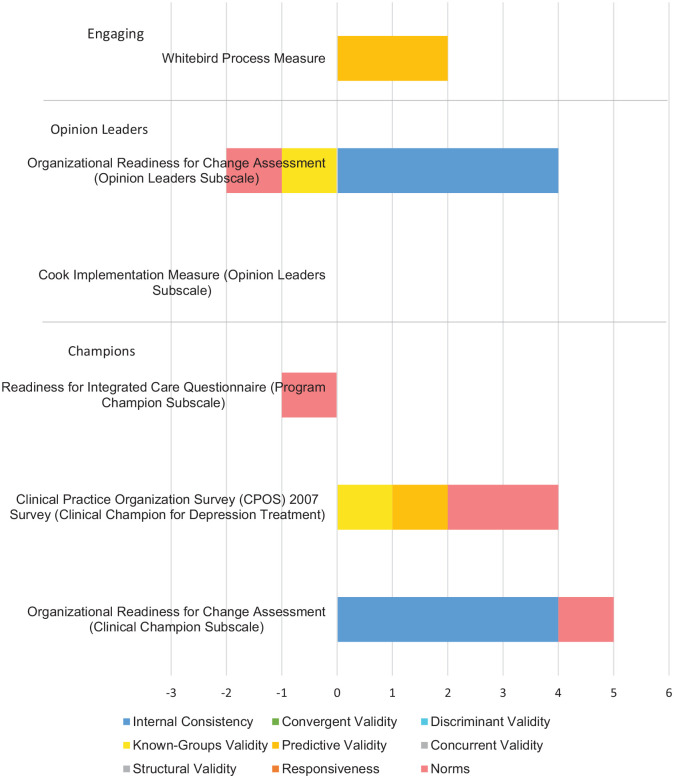
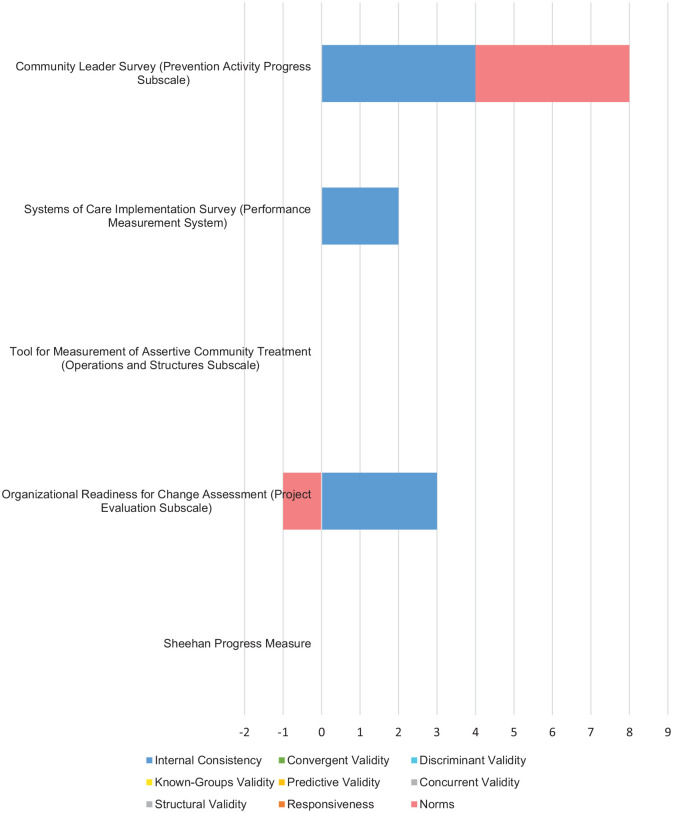
Background: Measurement is a critical component for any field. Systematic reviews are a way to locate measures and uncover gaps in current measurement practices. The present study identified measures used in behavioral health settings that assessed all constructs within the Process domain and two constructs from the Inner setting domain as defined by the Consolidated Framework for Implementation Research (CFIR). While previous conceptual work has established the importance social networks and key stakeholders play throughout the implementation process, measurement studies have not focused on investigating the quality of how these activities are being carried out. Methods: The review occurred in three phases: Phase I, data collection included (1) search string generation, (2) title and abstract screening, (3) full text review, (4) mapping to CFIR-constructs, and (5) “cited-by” searches. Phase II, data extraction, consisted of coding information relevant to the nine psychometric properties included in the Psychometric And Pragmatic Rating Scale (PAPERS). In Phase III, data analysis was completed. Results: Measures were identified in only seven constructs: Structural characteristics ( n = 13), Networks and communication ( n = 29), Engaging ( n = 1), Opinion leaders ( n = 5), Champions ( n = 5), Planning ( n = 5), and Reflecting and evaluating ( n = 5). No quantitative assessment measures of Formally appointed implementation leaders, External change agents, or Executing were identified. Internal consistency and norms were reported on most often, whereas no studies reported on discriminant validity or responsiveness. Not one measure in the sample reported all nine psychometric properties evaluated by the PAPERS. Scores in the identified sample of measures ranged from “-2” to “10” out of a total of “36.” Conclusions: Overall measures demonstrated minimal to adequate evidence and available psychometric information was limited. The majority were study specific, limiting their generalizability. Future work should focus on more rigorous measure development and testing of currently existing measures, while moving away from creating new, single use measures. Plain Language Summary: How we measure the processes and players involved for implementing evidence-based interventions is crucial to understanding what factors are helping or hurting the intervention’s use in practice and how to take the intervention to scale. Unfortunately, measures of these factors—stakeholders, their networks and communication, and their implementation activities—have received little attention. This study sought to identify and evaluate the quality of these types of measures. Our review focused on collecting measures used for identifying influential staff members, known as opinion leaders and champions, and investigating how they plan, execute, engage, and evaluate the hard work of implementation. Upon identifying these measures, we collected all published information about their uses to evaluate the quality of their evidence with respect to their ability to produce consistent results across items within each use (i.e., reliable) and if they assess what they are intending to measure (i.e., valid). Our searches located over 40 measures deployed in behavioral health settings for evaluation. We observed a dearth of evidence for reliability and validity and when evidence existed the quality was low. These findings tell us that more measurement work is needed to better understand how to optimize players and processes for the purposes of successful implementation.
Overview
The claims and statistics of this paper haven’t been checked yet.
Free: it reads the open-access text and checks the first 5 claims that cite a source we can check. Create a free account to check every claim.
Integrity signals
Registry
Cites
Statistics
Figures
Verification
Claims the paper makes
The claims and statistics of this paper haven’t been checked yet.
Free: it reads the open-access text and checks the first 5 claims that cite a source we can check. Create a free account to check every claim.
Claims other papers make about this one
Each is checked against this paper’s own text: does it say what the citing paper says it does?
The cited source says what the claim attributes to it.
In the citing paper
“Systematic reviews of implementation context measures have been conducted, all of which have found significant gaps and signal the continued need for measure validation and development [89–95].”
From The updated consolidated framework for implementation research based on user feedback (2022) · cites this paper as [95]
Self-check
Percentages, sums and reported differences re-computed from the paper’s own numbers.
The self-check needs the paper’s full text.
Citations
Cites
Damschroder, L. J., Aron, D. C., Keith, R. E., Kirsh, S. R., Alexander, J. A., & Lowery, J. C. (2009) · Implementation Science · doi:10.1186/1748-5908-4-50 · Cited by 14,496 · cited 6×
“The Consolidated Framework for Implementation Research (CFIR; Damschroder et al., 2009) comprises 37 constructs believed to predict, moderate, or mediate implementation factors.”
BackgroundMethodInfluentialSelf-citationValente, T. W. (2003) · Genetics in Medicine · doi:10.1097/01.gim.0000061743.67794.c4 · Cited by 13,723
Proctor, E., Silmere, H., Raghavan, R., Hovmand, P., Aarons, G., Bunger, A., Griffey, R., & Hensley, M. (2011) · Administration and Policy in Mental Health and Mental Health Services Research · doi:10.1007/s10488-010-0319-7 · Cited by 8,721 · cited 1×
“…defined by the Exploration, Adoption/Preparation, Implementation, Sustainment (EPIS) model (Aarons et al., 2011); and (9) if any implementation outcomes were assessed (i.e., acceptability, appropriateness, adoption, cost, feasibility, fidelity, penetration, sustainability; (Proctor et al., 2011).”
Diffusion of Innovations in Service Organizations: Systematic Review and Recommendations
GREENHALGH, T., ROBERT, G., MACFARLANE, F., BATE, P., & KYRIAKIDOU, O. (2004) · The Milbank Quarterly · doi:10.1111/j.0887-378x.2004.00325.x · Cited by 7,448 · cited 1×
“The CFIR was developed based on a review of 500 published sources across 13 research areas (Greenhalgh et al., 2004) and 18 additional sources to centralize and unify this myriad of frameworks, create consistent language, and minimize overlap and redundancies.”
MethodMaking sense of implementation theories, models and frameworks
Nilsen, P. (2015) · Implementation Science · doi:10.1186/s13012-015-0242-0 · Cited by 4,447 · cited 1×
“To this end, valid measurement begins with a strong theoretical base (Nilsen, 2015).”
BackgroundScale Development: Theory and Applications.
Xie, Y., & DeVellis, R. F. (1992) · Contemporary Sociology · doi:10.2307/2075704 · Cited by 3,635 · cited 1×
“Studies may “economize” measurement in an attempt to reduce burden and/or generate more data; however, unknown measure reliability could lead to meaningful information not being collected (DeVellis, 2003).”
BackgroundAdvancing a Conceptual Model of Evidence-Based Practice Implementation in Public Service Sectors
Aarons, G. A., Hurlburt, M., & Horwitz, S. M. (2011) · Administration and Policy in Mental Health and Mental Health Services Research · doi:10.1007/s10488-010-0327-7 · Cited by 3,240 · cited 2×
“Descriptive information was collected on: (1) whether the construct was defined; (2) number of uses; (3) number of items; (4) country of origin; (5) setting administered; (6) level of analysis; (7) population assessed; (8) stage of implementation defined by the Exploration, Adoption/Preparation, Implementation, Sustai…”
BackgroundTerwee, C. B., Mokkink, L. B., Knol, D. L., Ostelo, R. W. J. G., Bouter, L. M., & de Vet, H. C. W. (2012) · Quality of Life Research · doi:10.1007/s11136-011-9960-1 · Cited by 1,978 · cited 2×
“…approach was adopted to offer a less negative assessment of each property by considering all empirical uses instead of the commonly used “worst score counts” approach (Lewis et al., 2015; Terwee et al., 2012) where only the one lowest performing article was considered in cases of multiple ratings.”
MethodCurrent Concepts in Validity and Reliability for Psychometric Instruments: Theory and Application
Cook, D. A., & Beckman, T. J. (2006) · The American Journal of Medicine · doi:10.1016/j.amjmed.2005.10.036 · Cited by 1,745 · cited 2×
“Afterall, “science is measurement” (Siegel, 1964) and our confidence in knowledge gained depends on how reliable (i.e., consistency across administrations) and valid (i.e., quality of inferences or claims) measures are (D. A. Cook & Beckman, 2006).”
BackgroundAarons, G. A. (2004) · Mental Health Services Research · doi:10.1023/b:mhsr.0000024351.12294.65 · Cited by 1,272 · cited 2×
“One such measure, the Evidence-based Practice Attitudes Scale (EBPAS; (Aarons, 2004), has established national norms (Aarons et al.”
Background
Cited by
The updated consolidated framework for implementation research based on user feedback
Damschroder, L. J., Reardon, C. M., Widerquist, M. A. O., & Lowery, J. (2022) · Implementation Science · doi:10.1186/s13012-022-01245-0 · Cited by 4,452
Self-citationRobinson, C., & Damschroder, L. J. (2023) · Implementation Science Communications · doi:10.1186/s43058-022-00380-5 · Cited by 60
Self-citationLeveraging implementation science to advance antibiotic stewardship practice and research
Livorsi, D. J., Drainoni, M., Reisinger, H. S., Nanda, N., McGregor, J. C., Barlam, T. F., Morris, A. M., & Szymczak, J. E. (2021) · Infection Control and Hospital Epidemiology · doi:10.1017/ice.2021.480 · Cited by 51
Madrigal, L., Manders, O. C., Kegler, M. C., Haardörfer, R., Piper, S., Blais, L. M., Weber, M. B., & Escoffery, C. (2022) · Implementation Science Communications · doi:10.1186/s43058-022-00350-x · Cited by 34
Pilar, M. R., Jost, E., Walsh‐Bailey, C., Powell, B. J., Mazzucca, S., Eyler, A. A., Purtle, J., Allen, P. M., & Brownson, R. C. (2022) · Implementation Research and Practice · doi:10.1177/26334895221141116 · Cited by 30
“Additionally, there was a number of “home-grown,” single-use measures identified in this sample, which has been reported in previous measures reviews (Dorsey et al., 2021; Mettert et al., 2020; Proctor et al., 2011; Stanick et al., 2021).”
BackgroundOverconsumption: A Systematic Literature Review and Future Research Agenda
Kumar, S., Kathuria, G., & Malhotra, D. (2025) · International Journal of Consumer Studies · doi:10.1111/ijcs.70026 · Cited by 18
McLoughlin, G. M., Walsh‐Bailey, C., Singleton, C. R., & Turner, L. R. (2022) · Frontiers in Public Health · doi:10.3389/fpubh.2022.984130 · Cited by 13
Garneau, H. C., Cheng, H. L., Kim, J. P., Magid, M. A., Chin-Purcell, L., & McGovern, M. P. (2025) · Implementation Science Communications · doi:10.1186/s43058-025-00726-9 · Cited by 9
“The existing instruments available that evaluate single constructs of context use different rating scales, not allowing for the pooling of data across projects [21].”
Santesson, A. H. E., Holmberg, R. G., Bäckström, M., Gustafsson, P., Jarbin, H., & Perrin, S. G. (2024) · BMC Health Services Research · doi:10.1186/s12913-024-11934-9 · Cited by 8
“National norms are available for the United States of America (USA) that can be used for benchmarking across countries [19, 21, 22].”
Zhao, J., Chen, W., Bai, W., Zhang, X., Hui, R., Chen, S., Fontaine, G., Wei, X., Zhang, N., & Graham, I. D. (2025) · Systematic Reviews · doi:10.1186/s13643-025-02786-3 · Cited by 7
“…contrast, some areas, like the investigation of implementation mechanisms [33, 34], the development of measurement instruments for implementation outcomes [35, 36], the alignment of implementation science with health equity [37] and clinical quality improvement [38], lack comprehensive exploration.”
Santesson, A. H. E. (2025) · Lund University Publications (Lund University) · Cited by 2
Proceedings from the Fourth Annual Conference of the Norwegian Network for Implementation Research
Thøgersen, D. M., Rasmussen, L. P., Rømuld, I. W., & Engell, T. (2025) · Global Implementation Research and Applications · doi:10.1007/s43477-025-00147-9 · Cited by 1
“Theoretical development and conceptually and psychometrically sound measurements are instrumental in moving implementation science forward (Dorsey et al., 2021 ).”
Turnbull, A. E., Zhang, S., Colantuoni, E., Bhattacharya, S., Hochberg, C. H., Moale, A. C., & Kerlin, M. P. (2025) · CHEST Journal · doi:10.1016/j.chest.2025.08.026 · Cited by 1
McNeil, R., McGrath, R. L., Ackland, K., Oates, R.-K., Woodhart, L., & Wright, K. (2025) · BMJ Open · doi:10.1136/bmjopen-2025-105353 · Cited by 1
Nguyen, O. T., Vo, S. D., Nguyen, D., Katoju, S. V., Kunta, A. R., Ford, J. H., Hong, Y.-R., Perkins, R., Tabriz, A. A., & Turner, K. (2025) · Implementation Science Communications · doi:10.1186/s43058-025-00826-6 · Cited by 1
Factor selection in configurational comparative analysis – guidance for implementation researchers
Caci, L., Blum, K., Clack, L., & Albers, B. (2026) · Implementation Science Communications · doi:10.1186/s43058-026-00981-4 · Cited by 1
“This challenge, noted in previous research [32, 33], is particularly important to REVERSE, since most existing measures originated in the United States, potentially representing values and norms that fundamentally differ from those characterizing Eastern and Southern Europe.”
Updated Consolidated Framework for Implementation Research
島津太一, 齋藤, 順., 小田原, 幸., 奥山, 絢., & 安福, 祐. (2025) · Institutional Repositories DataBase (IRDB)
SQUIRES, J. E., Graham, I. D., Santos, W. J., de Cândido, L. K., Watkins, V. J., Greenough, M. J., Hutchinson, A. M., the ICON Team, Backman, C., Bergström, A., et al. (2026) · Health Research Policy and Systems · doi:10.1186/s12961-026-01507-z
McLoughlin, G. M., Walsh-Bailey, C., Singleton, C. R., & Turner, L. (2022) · doi:10.3389/fpubh.2022.984130.s001
Metadata
- Authors
- Dorsey, C. N., Mettert, K. D., Puspitasari, A. J., Damschroder, L. J., & Lewis, C. C.
- Affiliations
- Kaiser Permanente Washington Health Research Institute (US)
- Mayo Clinic (US)
- VA Ann Arbor Healthcare System (US)
- Corresponding author
- Dorsey, Caitlin N
- Venue
- Implementation Research and Practice
- Publisher
- SAGE Publications
- Published
- 2021-01
- Volume
- 2
- Pages
- 26334895211002474-26334895211002474
- ISSN
- 2633-4895 (ISSN-L)
- PMC
- PMC9978628
- OpenAlex
- W3144193208
- Cited by
- 15
- References
- 91
- Citations by year
- 2026: 1 · 2025: 6 · 2024: 1 · 2023: 1 · 2022: 5 · 2021: 1
- FWCI
- 0.41
- Type
- journal article
- Language
- en
- Open access
- gold
- doi.org
- Licence
- Locations
- Implementation Research and Practice (publishedVersion, cc-by-nc)
- PubMed Central (publishedVersion, cc-by-nc)
- PubMed (publishedVersion)
- DOAJ (DOAJ: Directory of Open Access Journals) (submittedVersion, cc-by-sa)
- Funders
- National Institute of Mental Health (R01MH106510)
- Topics
- Health Sciences › Health Professions › General Health Professions › Health Policy Implementation Science
- Health Sciences › Nursing › Research and Theory › Health Education and Validation
- Health Sciences › Health Professions › General Health Professions › Health Sciences Research and Education
- Keywords
- implementation research, Consolidated Framework for Implementation Research, psychometric properties, opinion leaders, implementation champions, stakeholder networks, social networks, implementation leadership, implementation planning, implementation evaluation, behavioral health
About these checks
Registry, retraction, Cites and statistics results are computed, not judged, with one exception: a printed reference that no index lists is read once by a model before it counts as a citation error. Claims are extracted by a model and kept only when their quote appears verbatim in the text; each cited source is then checked, with a model’s help, for whether it says what the claim relies on. Those verdicts can be wrong — read the claim’s quote and the cited source before relying on one.
Statistics and arithmetic are recomputed, not judged.
Confidence bands are shown only for fields calibrated on our annotated test set. None is calibrated yet, so no band is shown.
What counts as a claim ›How we measure confidence ›How we check this ›
Are you an author, or do you see a problem with this page? Request a review
Data sources
Bibliographic data: Semantic Scholar, OpenAlex, Crossref.
Contains information from the Semantic Scholar Academic Graph Datasets, made available under the ODC Attribution License (ODC-BY 1.0).
Semantic Scholar’s data is described in: Kinney, R., et al. (2023). The Semantic Scholar Open Data Platform. arXiv:2301.10140.
