

Community-based control of Aedes aegypti by adoption of eco-health methods in Chennai City, India
Open accessThe DOI matches its Crossref record; 22 of the 23 references it cites were found in a registry or an index.
Abstract
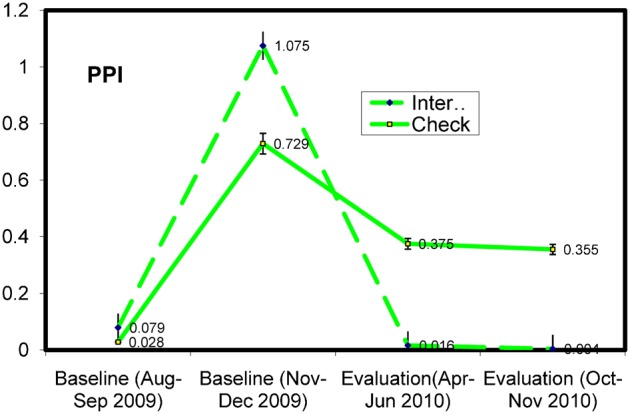
BACKGROUND: Dengue is highly endemic in Chennai city, South India, in spite of continuous vector control efforts. This intervention study was aimed at establishing the efficacy as well as the favouring and limiting factors relating to a community-based environmental intervention package to control the dengue vector Aedes aegypti. METHODS: A cluster randomized controlled trial was designed to measure the outcome of a new vector control package and process analysis; different data collection tools were used to determine the performance. Ten randomly selected intervention clusters (neighbourhoods with 100 houses each) were paired with ten control clusters on the basis of ecological/entomological indices and sociological parameters collected during baseline studies. In the intervention clusters, Aedes control was carried out using a community-based environmental management approach like provision of water container covers through community actors, clean-up campaigns, and dissemination of dengue information through schoolchildren. The main outcome measure was reduction in pupal indices (pupae per person index), used as a proxy measure of adult vectors, in the intervention clusters compared to the control clusters. RESULTS: At baseline, almost half the respondents did not know that dengue is serious but preventable, or that it is transmitted by mosquitoes. The stakeholder analysis showed that dengue vector control is carried out by vertically structured programmes of national, state, and local administrative bodies through fogging and larval control with temephos, without any involvement of community-based organizations, and that vector control efforts were conducted in an isolated and irregular way. The most productive container types for Aedes pupae were cement tanks, drums, and discarded containers. All ten intervention clusters with a total of 1000 houses and 4639 inhabitants received the intervention while the ten control clusters with a total of 1000 houses and 4439 inhabitants received only the routine government services and some of the information education and communication project materials. The follow-up studies showed that there was a substantial increase in dengue understanding in the intervention group with only minor knowledge changes in the control group. Community involvement and the partnership among stakeholders (particularly women's self-help groups) worked well. After 10 months of intervention, the pupae per person index was significantly reduced to 0·004 pupae per person from 1·075 (P = 0·020) in the intervention clusters compared to control clusters. There were also significant reductions in the Stegomyia indices: the house index was reduced to 4·2%, the container index to 1·05%, and the Breteau index to 4·3 from the baseline values of 19·6, 8·91, and 30·8 in the intervention arm. CONCLUSION: A community-based approach together with other stakeholders that promoted interventions to prevent dengue vector breeding led to a substantial reduction in dengue vector density.
Overview
The claims and statistics of this paper haven’t been checked yet.
Free: it reads the open-access text and checks the first 5 claims that cite a source we can check. Create a free account to check every claim.
Integrity signals
Registry
Cites
Statistics
Figures
Verification
Claims the paper makes
The claims and statistics of this paper haven’t been checked yet.
Free: it reads the open-access text and checks the first 5 claims that cite a source we can check. Create a free account to check every claim.
Claims other papers make about this one
Each is checked against this paper’s own text: does it say what the citing paper says it does?
The source backs part of the claim, not all of it — or backs it for a different population, condition or comparison.
In the citing paper
“Similarly, in an ‘eco-health’ study in India [73], the mean difference was significantly reduced for all metrics: BI -4.66 (-5.89, -3.43), HI -17.10 (-22.16, -12.04) and CI -12.30 (-15.31, -9.29).”
From Is Dengue Vector Control Deficient in Effectiveness or Evidence?: Systematic Review and Meta-analysis (2016) · cites this paper as [73]
Experimental — accuracy not yet measuredThe cited source says what the claim attributes to it.
In the citing paper
“A number of randomised controlled studies have demonstrated significant impacts on vector indices [47, 48, 73, 83, 101](Fig 5) even though the methods of intervention varied considerably between the studies.”
From Is Dengue Vector Control Deficient in Effectiveness or Evidence?: Systematic Review and Meta-analysis (2016) · cites this paper as [73]
Self-check
Percentages, sums and reported differences re-computed from the paper’s own numbers.
The self-check needs the paper’s full text.
Citations
Cites
Aedes aegypti and Aedes aegypti-Borne Disease Control in the 1990s: Top Down or Bottom Up
Gubler, D. J. (1989) · The American Journal of Tropical Medicine and Hygiene · doi:10.4269/ajtmh.1989.40.571 · Cited by 405
Kroeger, A., Lenhart, A., Ochoa, M., Villegas, E., Levy, M., Alexander, N., & McCall, P. J. (2006) · BMJ · doi:10.1136/bmj.332.7552.1247 · Cited by 255
Self-citationArunachalam, N., Tana, S., Espino, F., Kittayapong, P., Abeyewickreme, W., Wai, K. T., Tyagi, B. K., Kroeger, A., Sommerfeld, J., & Petzold, M. (2010) · Bulletin of the World Health Organization · doi:10.2471/blt.09.067892 · Cited by 245
Self-citationERLANGER, T. E., KEISER, J., & UTZINGER, J. (2008) · Medical and Veterinary Entomology · doi:10.1111/j.1365-2915.2008.00740.x · Cited by 221
Community involvement in dengue vector control: cluster randomised trial
Vanlerberghe, V, Toledo, M. E., Rodriguez, M., Gomez, D., Baly, A., Benitez, J. R., & Van der Stuyft, P. (2009) · BMJ · doi:10.1136/bmj.b1959 · Cited by 160
Editorial: Towards a global dengue research agenda
Farrar, J., Focks, D., Gubler, D., Barrera, R., Guzman, M. G., Simmons, C., Kalayanarooj, S., Lum, L., McCall, P. J., Lloyd, L., et al. (2007) · Tropical Medicine & International Health · doi:10.1111/j.1365-3156.2007.01838.x · Cited by 159
Self-citationNam, V. S., Yen, N. T., Holynska, M., Reid, J. W., & Kay, B. H. (2000) · The American journal of tropical medicine and hygiene · doi:10.4269/ajtmh.2000.62.5 · Cited by 125
Dengue Disease Spectrum among Infants in the 2001 Dengue Epidemic in Chennai, Tamil Nadu, India
Kabilan, L., Balasubramanian, S., Keshava, S. M., Thenmozhi, V., Sekar, G., Tewari, S. C., Arunachalam, N., Rajendran, R., & Satyanarayana, K. (2003) · Journal of Clinical Microbiology · doi:10.1128/jcm.41.8.3919-3921.2003 · Cited by 85
Self-citationLeontsini, E., Gil, E., Kendall, C., & Clark, G. G. (1993) · Transactions of the Royal Society of Tropical Medicine and Hygiene · doi:10.1016/0035-9203(93)90120-f · Cited by 80
Intersectoral coordination in Aedes aegypti control. A pilot project in Havana City, Cuba
Sanchez, L., Perez, D., Pérez, T., Sosa, T., Cruz, G., Kouri, G., Boelaert, M., & Van der Stuyft, P. (2005) · Tropical Medicine & International Health · doi:10.1111/j.1365-3156.2004.01347.x · Cited by 72
Research works printed but not linked: 3
- 8. Madarieta SK Salarda A Benabaye MRS Bacus MB Tagle JR Use of permethrin-treated curtains for control of Aedes aegypti, in the Philippines. Dengue Bull. 1999 23 51 4
- 10. Socheat D Chanta N Setha T Hoyer S Chang MS Nathan MB The development and testing of water storage jar covers in Cambodia. Dengue Bull. 2004 28 8 12
- 13. Alio AY Isap A Delfini LF Neng W Shu-sen W Using fish against mosquito-borne diseases. World Health Forum. 1985 6 320 1
Cited by
A Critical Assessment of Vector Control for Dengue Prevention
Achee, N. L., Gould, F., Perkins, T. A., Reiner, R. C., Morrison, A. C., Ritchie, S. A., Gubler, D. J., Teyssou, R., & Scott, T. W. (2015) · PLOS Neglected Tropical Diseases · doi:10.1371/journal.pntd.0003655 · Cited by 458
Bowman, L. R., Donegan, S., & McCall, P. J. (2016) · PLOS Neglected Tropical Diseases · doi:10.1371/journal.pntd.0004551 · Cited by 449
Andersson, N., Nava-Aguilera, E., Arosteguí, J., Morales-Perez, A., Suazo-Laguna, H., Legorreta-Soberanis, J., Hernandez-Alvarez, C., Fernandez-Salas, I., Paredes-Solís, S., Balmaseda, A., et al. (2015) · BMJ · doi:10.1136/bmj.h3267 · Cited by 225
Dengue: knowledge gaps, unmet needs, and research priorities
Katzelnick, L. C., Coloma, J., & Harris, E. (2017) · The Lancet Infectious Diseases · doi:10.1016/s1473-3099(16)30473-x · Cited by 211
Environmental methods for dengue vector control – A systematic review and meta-analysis
Buhler, C., Winkler, V. F., Runge‐Ranzinger, S., Boyce, R. M., & Horstick, O. (2019) · PLoS neglected tropical diseases · doi:10.1371/journal.pntd.0007420 · Cited by 164
Metadata
- Authors
- Arunachalam, N., Tyagi, B. K., Samuel, M., Krishnamoorthi, R., Manavalan, R., Tewari, S. C., Ashokkumar, V, Kroeger, A., Sommerfeld, J., & Petzold, M.
- Affiliations
- Centre for Research in Medical Entomology (IN)
- Corresponding author
- Arunachalam, Natarajan
- Venue
- Pathogens and Global Health
- Publisher
- Informa UK Limited
- Published
- 2012-12
- Volume
- 106
- Issue
- 8
- Pages
- 488-496
- ISSN
- 2047-7724 (ISSN-L)
- 2047-7732
- PMC
- PMC3541894
- OpenAlex
- W2137293995
- Semantic Scholar
- 422140cd5f67e518fdab3f6ba1492e64e641bf9c
- Cited by
- 137
- References
- 23
- Citations by year
- 2026: 8 · 2025: 8 · 2024: 11 · 2023: 15 · 2022: 15 · 2021: 19 · 2020: 12 · 2019: 10 · 2018: 6 · 2017: 13 · 2016: 5 · 2015: 7 · 2014: 7 · 2013: 1
- FWCI
- 15.77
- Type
- journal article
- Language
- en
- Open access
- hybrid
- doi.org
- Licence
- cc-by
- Locations
- Pathogens and Global Health (publishedVersion, cc-by)
- Europe PMC (PubMed Central) (publishedVersion, cc-by)
- PubMed Central (publishedVersion, cc-by)
- PubMed (publishedVersion)
- LSTM Online Archive (Liverpool School of Tropical Medicine) (submittedVersion)
- Funders
- World Bank Group
- World Health Organization
- UNICEF
- International Development Research Centre
- Topics
- Health Sciences › Medicine › Public Health, Environmental and Occupational Health › Dengue and Mosquito Control Research
- Health Sciences › Medicine › Public Health, Environmental and Occupational Health › Mosquito-borne diseases and control
- Health Sciences › Medicine › Public Health, Environmental and Occupational Health › Malaria Research and Control
- Keywords
- Aedes aegypti, dengue vector control, ecohealth, community-based environmental management, container breeding sites, clean-up campaigns, school-based health education, community participation, women's self-help groups, stakeholder analysis, dengue knowledge, Chennai, larval control, fogging, temephos
- MeSH terms
- Aedes, Animals, Child, Community Health Services, Dengue, Disease Reservoirs, Female, Gender Identity, Humans, India, Insect Vectors, Health Knowledge, Attitudes, Practice, Male, Mosquito Control, Pupa, Rain, Seasons, Urban Health, Water Microbiology, Water Supply, Health Behavior, Ecosystem, Waste Management
About these checks
Registry, retraction, Cites and statistics results are computed, not judged, with one exception: a printed reference that no index lists is read once by a model before it counts as a citation error. Claims are extracted by a model and kept only when their quote appears verbatim in the text; each cited source is then checked, with a model’s help, for whether it says what the claim relies on. Those verdicts can be wrong — read the claim’s quote and the cited source before relying on one.
Statistics and arithmetic are recomputed, not judged.
Confidence bands are shown only for fields calibrated on our annotated test set. None is calibrated yet, so no band is shown.
What counts as a claim ›How we measure confidence ›How we check this ›
Are you an author, or do you see a problem with this page? Request a review
How to cite
Cite CoChat for the checks on this page, and the paper for its own findings.
- This page
- CoChat. (2026). Citation check: Community-based control of Aedes aegypti by adoption of eco-health methods in Chennai City, India. https://app.cochat.ai/papers/10.1179/2047773212y.0000000056
- The paper
- Arunachalam, N., Tyagi, B. K., Samuel, M., Krishnamoorthi, R., Manavalan, R., Tewari, S. C., Ashokkumar, V, Kroeger, A., Sommerfeld, J., & Petzold, M. (2012). Community-based control of Aedes aegypti by adoption of eco-health methods in Chennai City, India. Pathogens and Global Health. https://doi.org/10.1179/2047773212y.0000000056
Data sources
Bibliographic data: Semantic Scholar, OpenAlex, Crossref.
Contains information from the Semantic Scholar Academic Graph Datasets, made available under the ODC Attribution License (ODC-BY 1.0).
Semantic Scholar’s data is described in: Kinney, R., et al. (2023). The Semantic Scholar Open Data Platform. arXiv:2301.10140.
