

The DOI matches its Crossref record; 3 of the 3 references it cites were found in a registry or an index.
A 20-year perspective on the International Fanconi Anemia Registry (IFAR)
Abstract
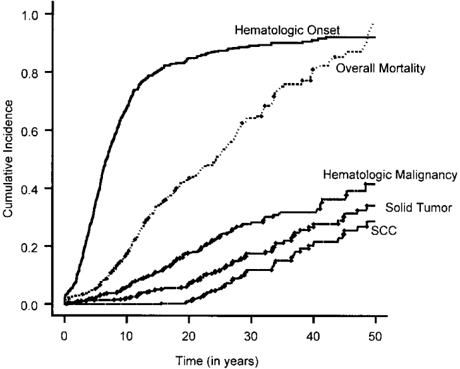
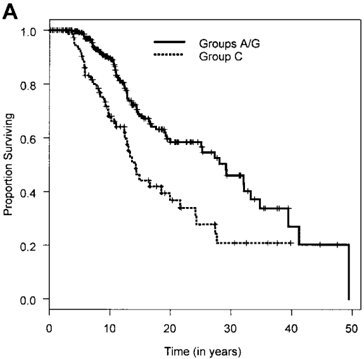
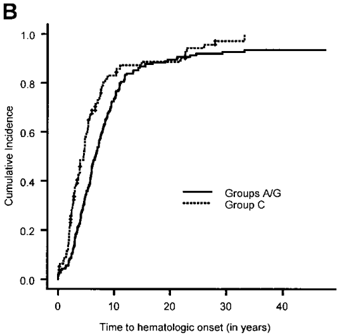
Fanconi anemia (FA) is an autosomal recessive disorder characterized by cellular hypersensitivity to DNA cross-linking agents and cancer predisposition. Recent evidence for the interactions of ataxia-telangiectasia mutated protein ATM and breast cancer susceptibility proteins BRCA1 and BRCA2 (identified as FANCD1) with other known FA proteins suggests that FA proteins have a significant role in DNA repair/recombination and cell cycle control. The International Fanconi Anemia Registry (IFAR), a prospectively collected database of FA patients, allows us the unique opportunity to analyze the natural history of this rare, clinically heterogeneous disorder in a large number of patients. Of the 754 subjects in this study, 601 (80%) experienced the onset of bone marrow failure (BMF), and 173 (23%) had a total of 199 neoplasms. Of these neoplasms, 120 (60%) were hematologic and 79 (40%) were nonhematologic. The risk of developing BMF and hematologic and nonhematologic neoplasms increased with advancing age with a 90%, 33%, and 28% cumulative incidence, respectively, by 40 years of age. Univariate analysis revealed a significantly earlier onset of BMF and poorer survival for complementation group C compared with groups A and G; however, there was no significant difference in the time to hematologic or nonhematologic neoplasm development between these groups. Multivariate analysis of overall survival time shows that FANCCmutations (P = .007) and hematopoietic stem cell transplantation (P = < .0001) define a poor-risk subgroup. The results of this study of patients registered in the IFAR over a 20-year period provide information that will enable better prediction of outcome and aid clinicians with decisions regarding major therapeutic modalities.
Overview
The claims and statistics of this paper haven’t been checked yet.
Run the check — free, no account needed. It reads the open-access text and checks the sources it cites.
Integrity signals
Registry
Cites
Statistics
Figures
Verification
Claims the paper makes
The claims and statistics of this paper haven’t been checked yet.
Run the check — free, no account needed. It reads the open-access text and checks the sources it cites.
Claims other papers make about this one
Each is checked against this paper’s own text: does it say what the citing paper says it does?
In the citing paper
“In addition, the risk of myelodysplasia or acute myeloid leukemia (AML) is markedly increased, with an AML incidence of 33% by age 40[2,3].”
From Finding the needle in the hay stack: Hematopoietic stem cells in Fanconi anemia (2009) · cites this paper as [2]
In the citing paper
“Bone marrow failure occurs nearly universally with a median age of onset of eight years and remains the primary cause of morbidity and mortality in FA.”
From Finding the needle in the hay stack: Hematopoietic stem cells in Fanconi anemia (2009) · cites this paper as [2]
In the citing paper
“By age 40, 90% of FA patients will have developed bone marrow failure [2].”
From Finding the needle in the hay stack: Hematopoietic stem cells in Fanconi anemia (2009) · cites this paper as [2]
Self-check
Percentages, sums and reported differences re-computed from the paper’s own numbers.
The self-check needs the paper’s full text.
Citations
Cites
Nonparametric Estimation from Incomplete Observations
Kaplan, E. L., & Meier, P. (1958) · Journal of the American Statistical Association · doi:10.1080/01621459.1958.10501452 · Cited by 39,158
Interaction of the Fanconi Anemia Proteins and BRCA1 in a Common Pathway
Garcia-Higuera, I., Taniguchi, T., Ganesan, S., Meyn, M. S., Timmers, C., Hejna, J., Grompe, M., & D'Andrea, A. D. (2001) · Molecular Cell · doi:10.1016/s1097-2765(01)00173-3 · Cited by 1,198
Biallelic Inactivation of BRCA2 in Fanconi Anemia
Howlett, N. G., Taniguchi, T., Olson, S., Cox, B., Waisfisz, Q., de Die-Smulders, C., Persky, N., Grompe, M., Joenje, H., Pals, G., et al. (2002) · Science · doi:10.1126/science.1073834 · Cited by 1,149
Research works printed but not linked: 42
- Auerbach, 2002, Fanconi anemia., 317
- Joenje, 2001, The emerging genetic and molecular basis of Fanconi anaemia., Nat Rev Genet., 2, 446, 10.1038/35076590 · DOI
- Alter, 1998, The bone marrow failure syndromes., 237
- Auerbach, 1989, International Fanconi Anemia Registry: relation of clinical symptoms to diepoxybutane sensitivity., Blood., 73, 391, 10.1182/blood.V73.2.391.391 · DOI
- Giampietro, 1997, Diagnosis of Fanconi anemia in patients without congenital malformations: an International Fanconi Anemia Registry study., Am J Med Genet., 68, 58, 10.1002/(SICI)1096-8628(19970110)68:1<58::AID-AJMG11>3.0.CO;2-N · DOI
- Strathdee, 1992, Evidence for at least four Fanconi anaemia genes including FACC on chromosome 9., Nat Genet., 1, 196, 10.1038/ng0692-196 · DOI
- Joenje, 2000, Complementation analysis in Fanconi anemia: assignment of the reference FA-H patient to group A., Am J Hum Genet., 67, 759, 10.1086/303067 · DOI
- Timmers, 2001, Positional cloning of a novel Fanconi anemia gene, FANCD2., Mol Cell., 7, 241, 10.1016/S1097-2765(01)00172-1 · DOI
- Strathdee, 1992, Cloning of cDNAs for Fanconi's anaemia by functional complementation., Nature., 356, 763, 10.1038/356763a0 · DOI
- The Fanconi Anemia/Breast Cancer Consortium, 1996, Positional cloning of the Fanconi anaemia group A gene., Nat Genet., 14, 324, 10.1038/ng1196-324 · DOI
- Lo Ten Foe, 1996, A cDNA for the major Fanconi anemia gene, FAA., Nat Genet., 14, 320, 10.1038/ng1196-320 · DOI
- De Winter, 1998, The Fanconi anemia group G gene is identical with human XRCC9., Nat Genet., 20, 281, 10.1038/3093 · DOI
- De Winter, 2000, The Fanconi anaemia gene FANCF encodes a novel protein with homology to ROM., Nat Genet., 24, 15, 10.1038/71626 · DOI
- De Winter, 2000, Isolation of a cDNA representing the Fanconi anemia complementation group E gene., Am J Hum Genet., 67, 1306, 10.1016/S0002-9297(07)62959-0 · DOI
- Alter, 1996, Fanconi's anemia and malignancies., Am J Hematol., 53, 99, 10.1002/(SICI)1096-8652(199610)53:2<99::AID-AJH7>3.0.CO;2-Z · DOI
- Lustig, 1995, Head and neck carcinoma in Fanconi's anaemia: report of a case and review of the literature., Eur J Cancer B Oral Oncol., 31B, 68, 10.1016/0964-1955(94)00044-5 · DOI
- Levran, 1997, Sequence variation in the Fanconi anemia gene FAA., Proc Natl Acad Sci U S A., 94, 13051, 10.1073/pnas.94.24.13051 · DOI
- Toshiyasu, 2002, Convergence of the Fanconi anemia and ataxia telangiectasia signaling., Cell., 109, 459, 10.1016/S0092-8674(02)00747-X · DOI
- Auerbach, 1994, Diagnosis of Fanconi anemia by diepoxybutane analysis., 8.7.1
- Auerbach, 1991, Leukemia and preleukemia in Fanconi anemia patients: a review of the literature and report of the International Fanconi Anemia Registry., Cancer Genet Cytogenet., 51, 1, 10.1016/0165-4608(91)90002-C · DOI
- Giampietro, 1993, The need for more accurate and timely diagnosis in Fanconi anemia: a report from the International Fanconi Anemia Registry., Pediatrics., 91, 1116, 10.1542/peds.91.6.1116 · DOI
- Butturini, 1994, Hematologic abnormalities in Fanconi anemia: an International Fanconi Anemia Registry study., Blood., 84, 1650, 10.1182/blood.V84.5.1650.1650 · DOI · Paper page
- Gillio, 1997, Phenotypic consequences of mutations in the Fanconi anemia FAC gene: an International Fanconi Anemia Registry study., Blood., 90, 105, 10.1182/blood.V90.1.105 · DOI
- Wajnrajch, 2001, Evaluation of growth and hormonal status in patients referred to the International Fanconi Anemia Registry., Pediatrics., 107, 744, 10.1542/peds.107.4.744 · DOI
- Alter, 2000, Fanconi anemia: myelodysplasia as a predictor of outcome., Cancer Genet Cytogenet., 117, 125, 10.1016/S0165-4608(99)00159-4 · DOI
- Gray, 1988, A class of K-sample tests for comparing the cumulative incidence of a competing risk., Ann Stat., 16, 1141, 10.1214/aos/1176350951 · DOI
- Verlander, 1995, Carrier frequency of the IVS4 + 4 A→T mutation of the Fanconi anemia gene FAC in the Ashkenazi Jewish population., Blood., 86, 4034, 10.1182/blood.V86.11.4034.bloodjournal86114034 · DOI
- Auerbach, 2001, Genetic classification of African-American Fanconi anemia patients in the International Fanconi Anemia Registry (IFAR) [abstract]., Blood., 98, 216a
- Auerbach, 2003, Spectrum of sequence variation in the FANCG gene: an International Fanconi Anemia Registry (IFAR) study., Hum Mutat., 21, 158, 10.1002/humu.10166 · DOI
- Hanenberg, 2002, Phenotypic correction of primary T cells from patients with Fanconi anemia with retroviral vectors as a diagnostic tool., Exp Hematol., 30, 410, 10.1016/S0301-472X(02)00782-8 · DOI
- Kupfer, 1997, The Fanconi aneamia proteins, FAA and FAC, interact to form a nuclear complex., Nat Genet., 17, 487, 10.1038/ng1297-487 · DOI
- Garcia-Higuera, 2000, The Fanconi anemia proteins FANCA and FANCG stabilize each other and promote the nuclear accumulation of the Fanconi anemia complex., Blood., 96, 3224, 10.1182/blood.V96.9.3224 · DOI
- de Winter, 2000, The Fanconi anemia protein FANCF forms a nuclear complex with FANCA, FANCC, and FANCG., Hum Mol Genet., 9, 2665, 10.1093/hmg/9.18.2665 · DOI
- Siddique, 2001, Function of the Fanconi anemia pathway in Fanconi anemia complementation group F and D1 cells., Exp Hematol., 29, 1448, 10.1016/S0301-472X(01)00754-8 · DOI
- Kutler, 2003, High incidence of head and neck squamous cell carcinoma (HNSCC) in patients with Fanconi anemia (FA)., Arch Otolaryngol., 129, 106, 10.1001/archotol.129.1.106 · DOI
- The Breast Cancer Linkage Consortium, 1999, Cancer risks in BRCA2 mutation carriers., J Natl Cancer Inst., 91, 1310, 10.1093/jnci/91.15.1310 · DOI
- Cleton-Jansen, 1999, Mutation analysis of the Fanconi anaemia A gene in breast tumours with loss of heterozygosity at 16q24.3., Br J Cancer., 79, 1049, 10.1038/sj.bjc.6690168 · DOI
- Swift, 1980, Reassessment of cancer predisposition of Fanconi anemia heterozygotes., J Natl Cancer Inst., 65, 863
- Kennedy, 1982, Multiple squamous-cell carcinomas in Fanconi's anemia., Cancer., 50, 811, 10.1002/1097-0142(19820815)50:4<811::AID-CNCR2820500432>3.0.CO;2-I · DOI
- Boice, 1981, Cancer following medical irradiation., Cancer., 47, 1081, 10.1002/1097-0142(19810301)47:5+<1081::AID-CNCR2820471305>3.0.CO;2-3 · DOI
- Hawkins, 1987, Incidence of second primary tumours among childhood cancer survivors., Br J Cancer., 56, 339, 10.1038/bjc.1987.200 · DOI
- Deeg, 1996, Malignancies after marrow transplantation for aplastic anemia and Fanconi anemia: a joint Seattle and Paris analysis of results in 700 patients., Blood., 87, 386, 10.1182/blood.V87.1.386.386 · DOI
Cited by
Biallelic mutations in PALB2 cause Fanconi anemia subtype FA-N and predispose to childhood cancer
Reid, S., Schindler, D., Hanenberg, H., Barker, K., Hanks, S., Kalb, R., Neveling, K., Kelly, P., Seal, S., Freund, M., et al. (2007) · Nature Genetics · doi:10.1038/ng1947 · Cited by 642
Self-citationExit from dormancy provokes DNA-damage-induced attrition in haematopoietic stem cells
Walter, D., Lier, A., Geiselhart, A., Thalheimer, F. B., Huntscha, S., Sobotta, M. C., Moehrle, B., Brocks, D., Bayindir, I., Kaschutnig, P., et al. (2015) · Nature · doi:10.1038/nature14131 · Cited by 619
The BRCA1-interacting helicase BRIP1 is deficient in Fanconi anemia
Levran, O., Attwooll, C., Henry, R. T., Milton, K. L., Neveling, K., Rio, P., Batish, S. D., Kalb, R., Velleuer, E., Barral, S., et al. (2005) · Nature Genetics · doi:10.1038/ng1624 · Cited by 370
Self-citationStem Cell Collection and Gene Transfer in Fanconi Anemia
Kelly, P. F., Radtke, S., Kalle, C. V., Balcik, B., Bohn, K., Mueller, R., Schuesler, T., Haren, M., Reeves, L., Cancelas, J. A., et al. (2007) · Molecular Therapy · doi:10.1038/sj.mt.6300033 · Cited by 180
Self-citationHematopoietic stem cell defects in mice with deficiency of Fancd2 or Usp1
Parmar, K., Kim, J., Sykes, S. M., Shimamura, A., Stuckert, P., Zhu, K., Hamilton, A., Deloach, M. K., Kutok, J. L., Akashi, K., et al. (2010) · Stem Cells · doi:10.1002/stem.437 · Cited by 113
Metadata
- Authors
- Kutler, D. I., Singh, B., Satagopan, J., Batish, S. D., Berwick, M., Giampietro, P. F., Hanenberg, H., & Auerbach, A. D.
- Affiliations
- From the Memorial Sloan-Kettering Cancer Center, New York, NY; The Rockefeller University, New York, NY; and the Department of Pediatric Hematology and Oncology, Heinrich Heine University Medical Center, Düsseldorf, Germany.
- Venue
- Blood
- Publisher
- American Society of Hematology
- Published
- 2003-02-15
- Volume
- 101
- Issue
- 4
- Pages
- 1249-1256
- ISSN
- 1528-0020
- 0006-4971
- Cited by
- 618
- References
- 3
- Language
- en
About these checks
Registry, retraction, Cites and statistics results are computed, not judged, with one exception: a printed reference that no index lists is read once by a model before it counts as a citation error. Claims are extracted by a model and kept only when their quote appears verbatim in the text; each cited source is then checked, with a model’s help, for whether it says what the claim relies on. Those verdicts can be wrong — read the claim’s quote and the cited source before relying on one.
Statistics and arithmetic are recomputed, not judged.
Confidence bands are shown only for fields calibrated on our annotated test set. None is calibrated yet, so no band is shown.
What counts as a claim ›How we measure confidence ›How we check this ›
Are you an author, or do you see a problem with this page? Request a review
