

g(HbF): a genetic model of fetal hemoglobin in sickle cell disease
Open accessThe DOI matches its Crossref record; 24 of the 24 references it cites were found in a registry or an index.
Abstract
Key Points: The 3 established HbF genetic loci can be summarized into 1 quantitative variable, g(HbF), in SCD and influence markers of SCD severity. g(HbF) provides a quantitative marker for the genetic component of HbF% variability, potentially useful in genetic and clinical studies in SCD.
Overview
The claims and statistics of this paper haven’t been checked yet.
Free: it reads the open-access text and checks the first 5 claims that cite a source we can check. Create a free account to check every claim.
Integrity signals
Registry
Cites
Statistics
Figures
Verification
Claims the paper makes
The claims and statistics of this paper haven’t been checked yet.
Free: it reads the open-access text and checks the first 5 claims that cite a source we can check. Create a free account to check every claim.
Claims other papers make about this one
Each is checked against this paper’s own text: does it say what the citing paper says it does?
The source backs part of the claim, not all of it — or backs it for a different population, condition or comparison.
In the citing paper
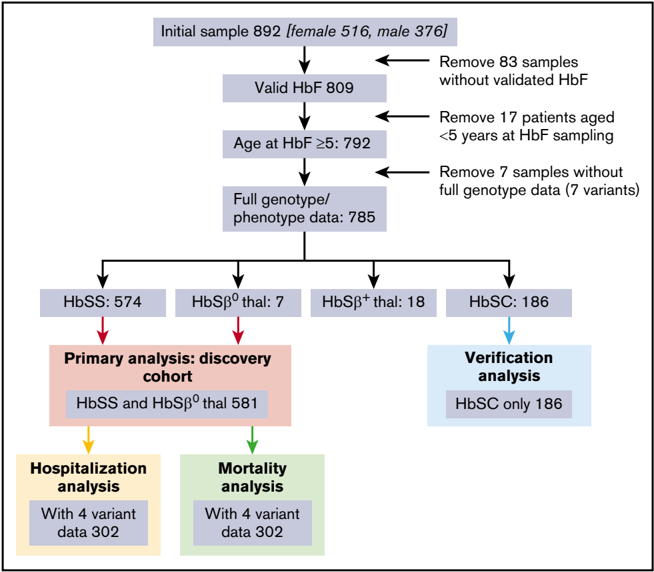
“Four markers representing the 3 HbF QTL, rs654815 and rs1427407 in BCL11A, rs66650371, the 3-bp deletion in MYB, and rs7482144 in the HBG2 promoter, accounted for 21.8% of HbF variability in 581 HbS homozygotes and patients with HbSb 0 thalassemia.”
From Fetal hemoglobin in sickle cell anemia (2020) · cites this paper as [31]
Experimental — accuracy not yet measuredThe cited source says what the claim attributes to it.
In the citing paper
“Similar results were found in 186 patients with compound heterozygosity for HbS and HbC genes (HbSC) disease and 994 Tanzanian HbS homozygotes.31”
From Fetal hemoglobin in sickle cell anemia (2020) · cites this paper as [31]
Self-check
Percentages, sums and reported differences re-computed from the paper’s own numbers.
The self-check needs the paper’s full text.
Citations
Cites
Mortality in sickle cell disease. Life expectancy and risk factors for early death
Platt, O. S., Brambilla, D. J., Rosse, W. F., Milner, P. F., Castro, O., Steinberg, M. H., & Klug, P. P. (1994) · New England Journal of Medicine · doi:10.1056/nejm199406093302303 · Cited by 3,320 · cited 1×
“HbF levels affect the severity of SCD; patients with higher levels of HbF have fewer complications and live longer.(1,2) We tested the influence of g(HbF) on hospitalization rate in HbSS/HbSb patients and detected tentative association (N 5 304, b 5 0.”
BackgroundPain in Sickle Cell Disease: Rates and Risk Factors
Platt, O. S., Thorington, B. D., Brambilla, D. J., Milner, P. F., Rosse, W. F., Vichinsky, E., & Kinney, T. R. (1991) · New England Journal of Medicine · doi:10.1056/nejm199107043250103 · Cited by 1,546 · cited 2×
“High fetal hemoglobin (HbF) levels are clinically beneficial in sickle cell disease (SCD), being associated with longer survival(1) and lower pain rates.(2) Patients with SCD have higher HbF levels compared with nonaffected adults and, within SCD, HbF levels are higher in hemoglobin SS (HbSS) compared with HbSC indivi…”
BackgroundAn Erythroid Enhancer of BCL11A Subject to Genetic Variation Determines Fetal Hemoglobin Level
Bauer, D. E., Kamran, S. C., Lessard, S., Xu, J., Fujiwara, Y., Lin, C., Shao, Z., Canver, M. C., Smith, E. C., Pinello, L., et al. (2013) · Science · doi:10.1126/science.1242088 · Cited by 653
Lettre, G., Sankaran, V. G., Bezerra, M. A. C., Araújo, A. S., Uda, M., Sanna, S., Cao, A., Schlessinger, D., Costa, F. F., Hirschhorn, J. N., et al. (2008) · Proceedings of the National Academy of Sciences · doi:10.1073/pnas.0804799105 · Cited by 561
Labie, D., Pagnier, J., Lapoumeroulie, C., Rouabhi, F., Dunda-Belkhodja, O., Chardin, P., Beldjord, C., Wajcman, H., Fabry, M. E., & Nagel, R. L. (1985) · Proceedings of the National Academy of Sciences · doi:10.1073/pnas.82.7.2111 · Cited by 234
HBS1L-MYB intergenic variants modulate fetal hemoglobin via long-range MYB enhancers
Stadhouders, R., Aktuna, S., Thongjuea, S., Aghajanirefah, A., Pourfarzad, F., van IJcken, W., Lenhard, B., Rooks, H., Best, S., Menzel, S., et al. (2014) · Journal of Clinical Investigation · doi:10.1172/jci71520 · Cited by 209
Self-citationGenetic Etiologies for Phenotypic Diversity in Sickle Cell Anemia
Steinberg, M. H. (2009) · The Scientific World JOURNAL · doi:10.1100/tsw.2009.10 · Cited by 203
The -158 site 5' to the G gamma gene and G gamma expression
Labie, D., Dunda-Belkhodja, O., Rouabhi, F., Pagnier, J., Ragusa, A., & Nagel, R. (1985) · Blood · doi:10.1182/blood.v66.6.1463.1463 · Cited by 135
The effect of fetal hemoglobin on the survival characteristics of sickle cells
Franco, R. S., Yasin, Z., Palascak, M. B., Ciraolo, P., Joiner, C. H., & Rucknagel, D. L. (2006) · Blood · doi:10.1182/blood-2005-09-008318 · Cited by 119 · cited 1×
“One component of HbF variability relates to the expanded erythron secondary to chronic hemolysis, and preferential survival of HbF-containing red cell precursors (F cells).(4,5) A second component is the innate ability for HbF synthesis based on genetic variants at 3 quantitative trait loci: BCL11A on chromosome 2p, H…”
BackgroundFarrell, J. J., Sherva, R. M., Chen, Z.-Y., Luo, H.-Y., Chu, B. F., Ha, S. Y., Li, C. K., Lee, A. C. W., Li, R. C. H., Li, C. K., et al. (2011) · Blood · doi:10.1182/blood-2010-11-317081 · Cited by 117
Genome Wide Association Study of Fetal Hemoglobin in Sickle Cell Anemia in Tanzania
Mtatiro, S. N., Singh, T., Rooks, H., Mgaya, J., Mariki, H., Soka, D., Mmbando, B., Msaki, E., Kolder, I., Thein, S. L., et al. (2014) · PLoS ONE · doi:10.1371/journal.pone.0111464 · Cited by 105
Self-citationSebastiani, P., Solovieff, N., Hartley, S. W., Milton, J. N., Riva, A., Dworkis, D. A., Melista, E., Klings, E. S., Garrett, M. E., Telen, M. J., et al. (2010) · American Journal of Hematology · doi:10.1002/ajh.21572 · Cited by 102
Genetics of fetal hemoglobin in Tanzanian and British patients with sickle cell anemia
Makani, J., Menzel, S., Nkya, S., Cox, S. E., Drasar, E., Soka, D., Komba, A. N., Mgaya, J., Rooks, H., Vasavda, N., et al. (2011) · Blood · doi:10.1182/blood-2010-08-302703 · Cited by 101
Self-citationBhatnagar, P., Purvis, S., Barron-Casella, E., DeBaun, M. R., Casella, J. F., Arking, D. E., & Keefer, J. R. (2011) · Journal of Human Genetics · doi:10.1038/jhg.2011.12 · Cited by 90
Wonkam, A., Ngo Bitoungui, V. J., Vorster, A. A., Ramesar, R., Cooper, R. S., Tayo, B., Lettre, G., & Ngogang, J. (2014) · PLoS ONE · doi:10.1371/journal.pone.0092506 · Cited by 89
Bae, H. T., Baldwin, C. T., Sebastiani, P., Telen, M. J., Ashley-Koch, A., Garrett, M., Hooper, W. C., Bean, C. J., DeBaun, M. R., Arking, D. E., et al. (2012) · Blood · doi:10.1182/blood-2012-06-432849 · Cited by 84
A genetic score for the prediction of beta-thalassemia severity
Danjou, F., Francavilla, M., Anni, F., Satta, S., Demartis, F. R., Perseu, L., Manca, M., Sollaino, M. C., Manunza, L., Mereu, E., et al. (2014) · Haematologica · doi:10.3324/haematol.2014.113886 · Cited by 59
Quinn, C. T., Smith, E. P., Arbabi, S., Khera, P. K., Lindsell, C. J., Niss, O., Joiner, C. H., Franco, R. S., & Cohen, R. M. (2016) · American Journal of Hematology · doi:10.1002/ajh.24562 · Cited by 55
Cardoso, G. L., Diniz, I. G., da Silva, A. N. L. M., Cunha, D. A., da Silva, J. S., Uchôa, C. T. C., dos Santos, S. E. B., Trindade, S. M. S., Cardoso, M. D. S. D. O., & Guerreiro, J. F. (2014) · Blood Cells Molecules and Diseases · doi:10.1016/j.bcmd.2014.07.006 · Cited by 53
Milton, J. N., Gordeuk, V. R., Taylor, J. G., Gladwin, M. T., Steinberg, M. H., & Sebastiani, P. (2014) · Circulation Cardiovascular Genetics · doi:10.1161/circgenetics.113.000387 · Cited by 40
Nkya, S. W., Makani, J., Mmbando, B. P., Thein, S. L., Menzel, S., & Cox, S. E. (2014) · American Journal of Hematology · doi:10.1002/ajh.23859 · Cited by 34
Self-citationLeonardo, F. C., Brugnerotto, A. F., Domingos, I. F., Fertrin, K. Y., de Albuquerque, D. M., Bezerra, M. A. C., Araujo, A. S., Saad, S. T. O., Costa, F. F., Menzel, S., et al. (2016) · British Journal of Haematology · doi:10.1111/bjh.13961 · Cited by 33
Self-citationNkya, S. W., Mgaya, J., Singh, T., Mariki, H., Rooks, H., Soka, D., Mmbando, B. P., Thein, S. L., Barrett, J. C., Makani, J., et al. (2015) · BMC Medical Genetics · doi:10.1186/s12881-015-0148-3 · Cited by 28
Self-citationGlobal Genetic Architecture of an Erythroid Quantitative Trait Locus,HMIP-2
Menzel, S., Rooks, H., Zélénika, D., Nkya, S. W., Gnanakulasekaran, A., Drašar, E., Cox, S. E., Liu, L., Masood, M., Silver, N., et al. (2014) · Annals of Human Genetics · doi:10.1111/ahg.12077 · Cited by 26
Self-citation
Cited by
Fetal hemoglobin in sickle cell anemia
Steinberg, M. H. (2020) · Blood · doi:10.1182/blood.2020007645 · Cited by 136
Emerging genetic therapy for sickle cell disease
Orkin, S. H., & Bauer, D. E. (2019) · Annual Review of Medicine · doi:10.1146/annurev-med-041817-125507 · Cited by 119
Determinants of severity in sickle cell disease
Rees, D. C., Brousse, V. A. M., & Brewin, J. N. (2022) · Blood Reviews · doi:10.1016/j.blre.2022.100983 · Cited by 110
Self-citationFetal Hemoglobin in Sickle Hemoglobinopathies: High HbF Genotypes and Phenotypes
Steinberg, M. H. (2020) · Journal of Clinical Medicine · doi:10.3390/jcm9113782 · Cited by 89
Genetic modifiers of fetal haemoglobin in sickle cell disease
Menzel, S., & Thein, S. L. (2019) · Molecular Diagnosis & Therapy · doi:10.1007/s40291-018-0370-8 · Cited by 50
Self-citation
Metadata
- Authors
- Gardner, K., Fulford, T., Silver, N., Rooks, H., Angelis, N., Allman, M., Nkya, S., Makani, J., Howard, J., Kesse-Adu, R., Rees, D. C., Stuart-Smith, S., Yeghen, T., Awogbade, M., Sangeda, R. Z., Mgaya, J., Patel, H., Newhouse, S., Menzel, S., & Thein, S. L.
- Affiliations
- National Health Service (GB)
- University of Cambridge (GB)
- King's College London (GB)
- Muhimbili University of Health and Allied Sciences (TZ)
- Guy's Hospital (GB)
- Department of Haematology, Guy’s and St Thomas’ Hospitals NHS Foundation Trust, London, United Kingdom;
- King’s College Hospital National Health Service (NHS) Foundation Trust, London, United Kingdom;
- University Hospital Lewisham (GB)
- Corresponding author
- Menzel, Stephan
- Thein, Swee Lay
- ORCID
- Venue
- Blood Advances
- Publisher
- American Society of Hematology
- Published
- 2018-02-01
- Volume
- 2
- Issue
- 3
- Pages
- 235-239
- ISSN
- 2473-9529 (ISSN-L)
- 2473-9537
- PMC
- PMC5812320
- OpenAlex
- W2786744849
- Semantic Scholar
- a8a2a3212c26e52e737792864f9440da71daece9
- Cited by
- 43
- References
- 24
- Citations by year
- 2026: 2 · 2025: 7 · 2024: 2 · 2023: 2 · 2022: 9 · 2021: 3 · 2020: 10 · 2019: 1 · 2018: 7
- FWCI
- 2.98
- Type
- journal article
- Language
- en
- Open access
- gold
- doi.org
- Licence
- cc-by-nc-nd
- Locations
- Blood Advances (publishedVersion, cc-by-nc-nd)
- PubMed Central (publishedVersion)
- PubMed (publishedVersion)
- Research Portal (King's College London) (publishedVersion, other-oa)
- DOAJ (DOAJ: Directory of Open Access Journals) (submittedVersion)
- Funders
- National Institute for Social Care and Health Research (MR/K006584/1)
- Wellcome Trust (MR/K006584/1)
- Cancer Research UK
- National Institute for Health and Care Research
- British Heart Foundation
- King's College London
- University College London
- Shire
- Versus Arthritis
- Medical Research Council (MR/K006584/1, K006584/1, G0001249)
- Engineering and Physical Sciences Research Council
- Economic and Social Research Council
- Fogarty International Center (D43TW009343)
- Topics
- Health Sciences › Medicine › Genetics (clinical) › Hemoglobinopathies and Related Disorders
- Life Sciences › Biochemistry, Genetics and Molecular Biology › Biochemistry › Hemoglobin structure and function
- Health Sciences › Medicine › Hematology › Blood groups and transfusion
- Keywords
- fetal hemoglobin, sickle cell disease, quantitative genetic models, disease severity markers
- MeSH terms
- Adolescent, Adult, Aged, Aged, 80 and over, Alleles, Anemia, Sickle Cell, Child, Child, Preschool, England, Fetal Hemoglobin, Genotype, Hemoglobin, Sickle, Humans, Middle Aged, Models, Genetic, Genetic Variation, Young Adult, Genetic Loci
About these checks
Registry, retraction, Cites and statistics results are computed, not judged, with one exception: a printed reference that no index lists is read once by a model before it counts as a citation error. Claims are extracted by a model and kept only when their quote appears verbatim in the text; each cited source is then checked, with a model’s help, for whether it says what the claim relies on. Those verdicts can be wrong — read the claim’s quote and the cited source before relying on one.
Statistics and arithmetic are recomputed, not judged.
Confidence bands are shown only for fields calibrated on our annotated test set. None is calibrated yet, so no band is shown.
What counts as a claim ›How we measure confidence ›How we check this ›
Are you an author, or do you see a problem with this page? Request a review
Data sources
Bibliographic data: Semantic Scholar, OpenAlex, Crossref.
Contains information from the Semantic Scholar Academic Graph Datasets, made available under the ODC Attribution License (ODC-BY 1.0).
Semantic Scholar’s data is described in: Kinney, R., et al. (2023). The Semantic Scholar Open Data Platform. arXiv:2301.10140.
