

Bidirectional relationships of comorbidity with obstructive sleep apnoea
Open accessThe DOI matches its Crossref record; 137 of the 138 references it cites were found in a registry or an index.
Abstract
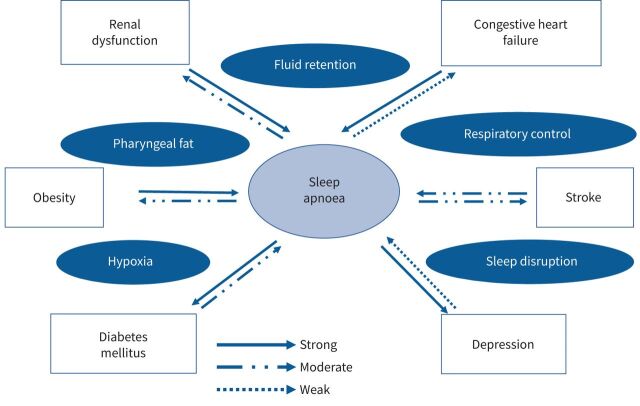
Obstructive sleep apnoea (OSA) is frequently associated with comorbidities that include metabolic, cardiovascular, renal, pulmonary and neuropsychiatric. There is considerable evidence that OSA is an independent risk factor for many of these comorbidities but, more recently, there is evidence that some of these comorbidities may predispose to the development of OSA. Thus, there is growing evidence of a bidirectional relationship between OSA and comorbidity, especially for heart failure, metabolic syndrome and stroke. Potential mechanisms of bidirectional relationships differ in individual comorbidities with fluid retention and redistribution being especially important in heart failure and end-stage renal disease, whereas neural mechanisms may be more important in diabetes mellitus and stroke. The evidence for other comorbidities, such as hypertension and atrial fibrillation, support these being more a consequence of OSA with limited evidence to support a bidirectional relationship. The present review explores the evidence for such bidirectional relationships with a particular perspective on comorbidities that may predispose to OSA. The impact of therapy in bidirectional relationships is also reviewed, which highlights the clinical importance of accurate diagnosis. This aspect is especially true of COPD, where the identification of co-existing OSA has important implications for optimum therapy.
Overview
The claims and statistics of this paper haven’t been checked yet.
Free: it reads the open-access text and checks the first 5 claims that cite a source we can check. Create a free account to check every claim.
Integrity signals
Registry
Cites
Statistics
Figures
Verification
Claims the paper makes
The claims and statistics of this paper haven’t been checked yet.
Free: it reads the open-access text and checks the first 5 claims that cite a source we can check. Create a free account to check every claim.
Claims other papers make about this one
Each is checked against this paper’s own text: does it say what the citing paper says it does?
The cited source says what the claim attributes to it.
In the citing paper
“there is growing evidence of bidirectional relationships between OSA and comorbidity, especially for heart failure, metabolic syndrome, and stroke.”
From Obstructive sleep apnea: transition from pathophysiology to an integrative disease model (2022) · cites this paper as Gleeson & McNicholas, 2022
The cited source says what the claim attributes to it.
In the citing paper
“Renal disease and OSA have a bi‐directional relationship (Gleeson & McNicholas, 2022).”
From Obstructive sleep apnea: transition from pathophysiology to an integrative disease model (2022) · cites this paper as Gleeson & McNicholas, 2022
Self-check
Percentages, sums and reported differences re-computed from the paper’s own numbers.
The self-check needs the paper’s full text.
Citations
Cites
Prospective Study of the Association between Sleep-Disordered Breathing and Hypertension
Peppard, P. E., Young, T., Palta, M., & Skatrud, J. (2000) · New England Journal of Medicine · doi:10.1056/nejm200005113421901 · Cited by 4,973
Marin, J. M., Carrizo, S. J., Vicente, E., & Agusti, A. G. (2005) · The Lancet · doi:10.1016/s0140-6736(05)71141-7 · Cited by 4,678
Nieto, F. J. (2000) · JAMA · doi:10.1001/jama.283.14.1829 · Cited by 3,369
The Triad of Sleep Apnea, Hypertension, and Chronic Kidney Disease: A Spectrum of Common Pathology
Aziz, F., & Chaudhary, K. (2017) · Cardiorenal Medicine · doi:10.1159/000450796 · Cited by 3,267
CPAP for Prevention of Cardiovascular Events in Obstructive Sleep Apnea
McEvoy, R. D., Antic, N. A., Heeley, E., Luo, Y., Ou, Q., Zhang, X., Mediano, O., Chen, R., Drager, L. F., Liu, Z., et al. (2016) · New England Journal of Medicine · doi:10.1056/nejmoa1606599 · Cited by 2,101
Gottlieb, D. J., Yenokyan, G., Newman, A. B., O'Connor, G. T., Punjabi, N. M., Quan, S. F., Redline, S., Resnick, H. E., Tong, E. K., Diener-West, M., et al. (2010) · Circulation · doi:10.1161/circulationaha.109.901801 · Cited by 1,551
Yeghiazarians, Y., Jneid, H., Tietjens, J. R., Redline, S., Brown, D. L., El-Sherif, N., Mehra, R., Bozkurt, B., Ndumele, C. E., Somers, V. K., et al. (2021) · Circulation · doi:10.1161/cir.0000000000000988 · Cited by 1,431
Obstructive Sleep Apnea–Hypopnea and Incident Stroke: The Sleep Heart Health Study
Redline, S., Yenokyan, G., Gottlieb, D. J., Shahar, E., O'Connor, G. T., Resnick, H. E., Diener-West, M., Sanders, M. H., Wolf, P. A., Geraghty, E. M., et al. (2010) · American Journal of Respiratory and Critical Care Medicine · doi:10.1164/rccm.200911-1746oc · Cited by 1,269
Obstructive sleep apnoea syndrome
Lévy, P., Kohler, M., McNicholas, W. T., Barbé, F., McEvoy, R. D., Somers, V. K., Lavie, L., & Pépin, J.-L. (2015) · Nature Reviews Disease Primers · doi:10.1038/nrdp.2015.15 · Cited by 1,235
Self-citationDepression in sleep disturbance: A review on a bidirectional relationship, mechanisms and treatment
Fang, H., Tu, S., Sheng, J., & Shao, A. (2019) · Journal of Cellular and Molecular Medicine · doi:10.1111/jcmm.14170 · Cited by 1,141
Research works printed but not linked: 2
- Wilcox I, McNamara SG, Collins FL, et al. “Syndrome Z”: the interaction of sleep apnoea, vascular risk factors and heart disease. Thorax 1998; 53: Suppl. 3, S25– SS8. PMC1765908 10193357
- 10.1056/NEJM200303273481327 · doi:10.1056/nejm200303273481327
Cited by
Items 101–200 of 203
Li, E., Ai, F., Wen, K., Tong, Y., Tang, P., Wen, H., & Guo, B. (2026) · BMC Public Health · doi:10.1186/s12889-026-27834-y · Cited by 2
“Psychological distress is common in OSA and may interact with sleep complaints through bidirectional pathways [12].”
Shyamsukha, B., Nimonkar, S. V., Belkhode, V. M., Paul, P., & Godbole, S. (2023) · Journal of Family Medicine and Primary Care · doi:10.4103/jfmpc.jfmpc_2310_22 · Cited by 2
“Obstructive sleep apnea (OSA) is defined as recurrent pharyngeal collapse while sleeping, which significantly reduces airflow (apnea or hypopnea) and causes intermittent blood gas abnormalities (hypoxemia and hypercapnia) as well as sympathetic nervous system activation.[1] This syndrome is frequently associated with…”
BackgroundWang, X., Wang, X., Liao, Z.-X., Zhao, Y., Wei, C., & Gong, L. (2023) · Sleep and Biological Rhythms · doi:10.1007/s41105-023-00481-1 · Cited by 3
“Growing evidence revealed that some of these comorbidities may also contribute to the development of OSA [10, 11], and some are crucial contributors to increased mortality in patients with OSA [12].”
Cheng, E. T. W., Au, C. T., Chan, R. N. C., Chan, J. W. Y., Chan, N. Y., Wing, Y. K., Li, A. M., Lam, E., & Chan, K. C. C. (2024) · SLEEP Advances · doi:10.1093/sleepadvances/zpae048 · Cited by 2
“Individuals with SDB are at a higher risk of developing cardiometabolic complications, namely elevated BP, increased adiposity, insulin resistance, and deranged lipid profile [9, 27–29].”
BackgroundDalmases, M., Sánchez‐de‐la‐Torre, M., Martínez, D., Mínguez, O., Vaca, R., Pascual, L., Águilà, M., Gràcia‐Lavedan, E., Benitez, I. D., Pinilla, L., et al. (2024) · Archivos de Bronconeumología · doi:10.1016/j.arbres.2024.07.018 · Cited by 1
Kang, S. Y., Kim, J. H., & Kim, Y. (2024) · Journal of Clinical Medicine · doi:10.3390/jcm13226702 · Cited by 3
“…known to mediate cardiovascular complications [10,25] Given the potential for a vicious cycle due to the bidirectional relationship between OSA and cardiometabolic comorbidities, it is necessary to implement simultaneous interventions targeting both OSA and CVH components to achieve good CVH [40].”
Chinese herbal medicine for obstructive sleep apnoea: a systematic review with meta-analysis
Birling, Y., Wu, Y. F., & Rahimi, M. M. (2024) · Sleep And Breathing · doi:10.1007/s11325-024-03194-y · Cited by 2
Salinas, G. D., Cerenzia, W., Coleman, B., Thorndike, F. P., Edington, S., & Riney, H. (2025) · Frontiers in Sleep · doi:10.3389/frsle.2024.1534441 · Cited by 2
Wang, F., Ren, H., Zhao, W., Liu, Y., & Chen, A. (2025) · HORMONES · doi:10.1007/s42000-025-00643-5 · Cited by 2
Ryan, S. (2024) · Elsevier eBooks · doi:10.1016/b978-0-323-99967-0.00323-9 · Cited by 2
Ni, Y., & Zhou, Y. (2024) · Sleep And Breathing · doi:10.1007/s11325-024-03154-6 · Cited by 3
Park, M. J., Kim, G., Kang, S. J., Han, K., Cho, J. H., & Choi, J. H. (2025) · Journal of rhinology · doi:10.18787/jr.2025.00012 · Cited by 3
“Furthermore, OSA interacts bidirectionally with inflammatory airway disorders, complicating their clinical management [9,10].”
Peng, K., Zhang, N., Liu, Q., Xiao, A., Wang, K., & Zhang, H. (2025) · Quantitative Imaging in Medicine and Surgery · doi:10.21037/qims-24-1830 · Cited by 1
“These conditions may exacerbate the effects of hypoxia and contribute to the overall pathology, potentially confounding our findings (20).”
Giorgi, F. D., Desideri, M., Nano, V. L., Ingrao, P., Meschi, C., Cappiello, C., Palano, E., Carrozzi, L., & Bonsignore, M. R. (2025) · Sleep And Breathing · doi:10.1007/s11325-025-03358-4 · Cited by 2
Han, L., Liu, J., Xu, J., Li, X., & Chen, R. (2025) · Sleep And Breathing · doi:10.1007/s11325-025-03425-w · Cited by 1
Obstructive Sleep Apnea and Orofacial Myofunctional Profile in Adults: A Cross-Sectional Study
Yang, X., Xie, S., Wen, Y., & Chen, J. (2025) · Nature and Science of Sleep · doi:10.2147/nss.s545762 · Cited by 1
“2 The most commonly identified daytime consequence of OSA is sleepiness, which can lead to impaired quality of life, increased road traffic accidents, and a significant burden of healthcare and financial.”
InfluentialThe role of mouth tape for CPAP use in patients with mouth breathing and OSA
Meksukree, A., Pitipanyakul, S., Laohavinij, W., Chaitusaney, B., Chirakalwasan, N., Hirunwiwatkul, P., & Charakorn, N. (2025) · Journal of Clinical Sleep Medicine · doi:10.5664/jcsm.11870 · Cited by 1
Howarth, T. P., Hallworth, T., Huang, H. C., Roy, A., Saad, H. B., Garg, H., BaHammam, A. S., & Heraganahally, S. S. (2025) · Current Pulmonology Reports · doi:10.1007/s13665-025-00391-2 · Cited by 2
“It is beyond the scope of this paper to further elaborate on this aspect, though they are well described in previous literature [93].”
Øverland, E. V., Waaraas, A., Lundetræ, R. S., Lehmann, S., Saxvig, I. W., & Bjorvatn, B. (2025) · Frontiers in Sleep · doi:10.3389/frsle.2025.1632662 · Cited by 1
“OSA is associated with other diseases such as cardiovascular events, hypertension, diabetes mellitus type 2, mental illness, obesity, and reduced quality of life (Javaheri et al., 2017; Gleeson and McNicholas, 2022; Slowik et al., 2022).”
Mandloi, S., DeKloe, J., Kaki, P. C., Shah, R., Estephan, L. E., Naimi, B. R., Boon, M. S., & Huntley, C. T. (2025) · Annals of Otology Rhinology & Laryngology · doi:10.1177/00034894251388836 · Cited by 1
Comorbidity in patients with obstructive sleep apnea. Part 1. General issues
Викторович, А. М., Tyutyunov, N. N., Novikov, M. Y., Kiselev, A. R., & Drapkina, O. M. (2025) · Russian Journal of Preventive Medicine · doi:10.17116/profmed20252811194 · Cited by 2
Zhang, M., Du, H., Zhou, Q., Yao, Y., & Li, L. (2026) · Diabetes Metabolic Syndrome and Obesity · doi:10.2147/dmso.s571891 · Cited by 1
Chinese Guidelines for the Diagnosis and Surgical Treatment of Adult Obstructive Sleep Apnea (2024)
Working Group of Guideline for the Diagnosis and Surgical Treatment of Adult OSA, & Editorial Board of Chinese Journal of Otorhinolaryngology Head and Neck Surgery (2026) · World Journal of Otorhinolaryngology - Head and Neck Surgery · doi:10.1002/wjo2.70070 · Cited by 3
Михайловна, М. И., Berdina, O. N., Андреевна, П. А., & Shirokov, A. A. (2026) · The European Physical Journal Special Topics · doi:10.1140/epjs/s11734-025-02116-7 · Cited by 2
“This disease may affect a patient’s health, including an increased risk of cardiovascular disease [11], diabetes mellitus, early aging, and dementia [12–15].”
Peker, Y., Hjälm, H. H., Glantz, H., Pıhtılı, A., & Thunström, E. Ö. (2026) · Sleep Medicine · doi:10.1016/j.sleep.2026.108991 · Cited by 1
Chen, D., Zhang, X., Liu, C., Li, Y., & Hu, W. M. (2026) · Frontiers in Medicine · doi:10.3389/fmed.2026.1850790 · Cited by 1
“Studies have found a positive association between the two conditions (16).”
Comparative analysis of brain activity correlations in obstructive sleep apnea
Egorov, E. N., Викторович, А. М., Orlova, A. A., Guyo, G. A., Novikov, M. Y., & Киселев, А. (2026) · The European Physical Journal Special Topics · doi:10.1140/epjs/s11734-026-02428-2 · Cited by 1
Gruber, B., Benning, L., Bousraou, Z., Somaini, D., & Schwarz, E. I. (2026) · European Respiratory Review · doi:10.1183/16000617.0192-2026 · Cited by 1
Rahul, S., Avetisyan, G., & Aakash, P. (2022) · International Journal of Clinical Cardiology · doi:10.23937/2378-2951/1410264 · Cited by 1
Perioperative management of Obstructive Sleep Apnoea: Present themes and future directions
Chambers, T., Bamber, H., & Singh, N. (2023) · Current Opinion in Pulmonary Medicine · doi:10.1097/mcp.0000000000001012 · Cited by 5
Ambulatory diagnosis of sleep-disordered breathing: Pushing out the boundaries
McNicholas, W. T. (2023) · Med · doi:10.1016/j.medj.2023.11.009 · Cited by 1
Self-citationAliusef, M. H., Churylina, A. V., Mitiuriaeva, I. O., & Gnyloskurenko, G. V. (2023) · Eastern Ukrainian Medical Journal · doi:10.21272/eumj.2023;11(4):430-441 · Cited by 1
Relationship between obstructive sleep apnea and pulmonary hypertension: past, present and future
Lenka, J., Foley, R. J., Metersky, M. L., & Salmon, A. (2024) · Expert Review of Respiratory Medicine · doi:10.1080/17476348.2024.2345684 · Cited by 2
“The cardiovascular, metabolic, neurocognitive, and psychiatric consequences of OSA are well established in literature [1–3].”
BackgroundResearch Progress in the Pathogenesis of Obstructive Sleep Apnea in the Elderly
陈, 宇. (2024) · Advances in Clinical Medicine · doi:10.12677/acm.2024.1492445 · Cited by 1
Chen, Q., Lai, H., Chen, Y., Peng, Z., Wu, S., & Liu, D. (2025) · Scientific Reports · doi:10.1038/s41598-025-99612-6 · Cited by 1
Social jetlag and obstructive sleep apnea severity: A retrospective study based on polysomnography
Wu, S., Peng, M., Zuo, Y., Wang, M., Feng, Z., Wang, H., Sun, M., Gu, J., Wang, X., Han, F., et al. (2025) · Sleep Medicine · doi:10.1016/j.sleep.2025.106722 · Cited by 2
Tsai, C.-Y., Liu, W., Hsu, W.-H., Majumdar, A., Stettler, M. E. J., Lee, K.-Y., Cheng, W.-H., Wu, D., Lee, H., Kuan, Y., et al. (2022) · doi:10.2196/preprints.43544 · Cited by 1
Obstructive Sleep Apnea in Patients with Comorbidities and Neck Cancer-Clinical ReviewPreprint
Kiss, B., Neagoș, C. M., Jimborean, G., Katalin, S., Szathmáry, M., & Neagoş, A. (2023) · Preprints.org · doi:10.20944/preprints202310.1068.v1 · Cited by 1
長谷川, 昌., 渡邉, 祐., 西尾, 美., 佐生, 奈., 天野, 至., & 川勝, 正. (2012) · 学術講演会論文集
(2023) · European Respiratory Society eBooks · doi:10.1183/9781849841641.chapter5
Identification of high-risk patients
McNicholas, W. T. (2023) · European Respiratory Society eBooks · doi:10.1183/9781849841641.008922
Self-citationRyan, S. (2023) · European Respiratory Society eBooks · doi:10.1183/9781849841641.008822
Nguyễn, V. Đ., Cấn, T. H., & Nguyễn, D. B. (2023) · Tạp chí Y học Việt Nam · doi:10.51298/vmj.v527i1b.5740 · Cited by 1
“OSA có xu hướng ảnh hưởng lên nam nhiều hơn nữ ở độ tuổi trung niên, khi ở giai đoạn tiền mãn kinh, có xu hướng bằng nhau về tỷ lệ mắc ở nam và nữ [4], [5].”
Chaplynska, N., Rudnyk, V. T., Havrysh, T., Symchych, K., & Skrypnyk, L. (2023) · Family medicine European practices · doi:10.30841/2786-720x.2.2023.282491
Nara-Sauceda, J., Moreno-Pacheco, M., & Patiño-García, J. (2024) · Archivos de cardiología de México · doi:10.24875/acm.23000078 · Cited by 4
“…de que esta sea un factor que participe en la génesis, descontrol y severidad de la enfermedad cardiovascular, probablemente en una doble vía 62 , se vuelve necesaria una participación más activa del car-diólogo clínico en el diagnóstico y tratamiento de este trastorno por el riesgo…”
BackgroundWang, R., Bao, Y., Song, P., & Dang, Y. (2024) · Sleep And Breathing · doi:10.1007/s11325-024-03012-5 · Cited by 1
Nara-Sauceda, J., Moreno-Pacheco, M., & Patiño-García, J. (2024) · Archivos de cardiolog�a de M�xico (English ed Internet) · doi:10.24875/acme.m24000481 · Cited by 1
“…that this is a factor that participates in the genesis, dysregulation, and severity of cardiovascular disease, probably in a dual pathway 62 , a more active participation of the clinical cardiologist in the diagnosis and management of this disorder is of paramount importance due to the…”
Cor Pulmonale por Apnea del Sueño y Obesidad: Mecanismos y Diagnóstico. Revisión de la Literatura
Ecuador, U. T. D. M., & Vinces-Mosquera, J. Y. (2024) · Polo del Conocimiento · doi:10.23857/pc.v9i8.7755
Hrytsenko, Y., Spitzer, B., Wang, H., Bertisch, S. M., Taylor, K. D., Garcia‐Bedoya, O., Ramos, A. R., Daviglus, M. L., Gallo, L. C., Isasi, C. R., et al. (2024) · medRxiv · doi:10.1101/2024.09.10.24313336
Burdened breaths: The influence of depression on obstructive sleep apnea
Wang, X., Song, S.-M., & Yue, H. (2024) · World Journal of Psychiatry · doi:10.5498/wjp.v14.i9.1411
Liu, J., Chen, Z., & Cai, D. (2024) · Cardiology · doi:10.1159/000541360
“OSA and HF exhibit numerous shared risk factors and comorbidities, including obesity [7], diabetes [8], depression [9, 10], and other CVD [11, 12], which may cause confounding bias in observational studies [13].”
Apneia obstrutiva do sono em gestantes: impactos e complicações fetais – uma revisão de literatura
Rosso, C. D. F., Endler, A. T., Guidi, C. L., da Rosa, L. S., Ghedin, L. D. S., Zurlo, M. G. P., & Peixoto, F. H. D. S. (2024) · Brazilian Journal of Health Review · doi:10.34119/bjhrv7n9-370
Mao, Y., Li, Q., Zou, X., Zhong, Z., Ouyang, Q., Gan, C., Yi, F., Luo, Y., Cheng, Z., & Yao, D. (2024) · Nature and Science of Sleep · doi:10.2147/nss.s489288
“2,4,5 In addition, OSA patients often have excessive daytime sleepiness (EDS), fatigue, and cognitive impairments.”
Apnea obstructiva del sueño: enfoques emergentes desde la fisioterapia
Torres‐Castro, R., Ribeiro, D. K., Larrateguy, S., & Cisternas, A., V (2024) · Fisioterapia · doi:10.1016/j.ft.2024.12.001
Luyster, F. S., & Strollo, P. J. (2025) · SLEEP · doi:10.1093/sleep/zsaf036
“OSA is associated with increased risk for various medical and psychiatric disorders, thus making it frequently comorbid with other conditions [2].”
Research progress on the clinical subtyping of obstructive sleep apnea hypopnea syndrome.
Gao, L., Peng, Y., & Ouyang, R. (2024) · PubMed Central · doi:10.11817/j.issn.1672-7347.2024.240252 · Cited by 1
Rincón-Hernández, J., Tuta-Quintero, E., Faizal-Gómez, K., Bastidas, A., Granados-Burgos, C., González, A. F. C., Castro, L. P. L., Riveros, S. G. T., Barajas, D. A. R., Montoya, P. S., et al. (2025) · Science Progress · doi:10.1177/00368504251335196 · Cited by 1
“8,10,16,17 16 – 18 This bidirectional link complicates the independent evaluation of their effects, highlighting the complexity of their therapeutic management.”
InfluentialDrug-induced sleep endoscopy (DISE): a retrospective review in Western Australian children
Friedland, Y. D., Blokland, R., & Vijayasekaran, S. (2025) · Australian Journal of Otolaryngology · doi:10.21037/ajo-24-55
Sleep-Related Breathing Disorders II: Clinical Management
Sawyer, A. M., Watach, A. J., Saconi, B., & Clark, L. (2025) · Oxford University Press eBooks · doi:10.1093/oxfordhb/9780197602751.013.24
Knapik, J. J., Caldwell, J. A., Steelman, R. A., Trone, D. W., & Lieberman, H. R. (2025) · Sleep Medicine · doi:10.1016/j.sleep.2025.106707
Gomboc, T., Hriberšek, M., & Delakorda, M. (2025) · SSRN Electronic Journal · doi:10.2139/ssrn.5370372
Hrytsenko, Y., Spitzer, B., Wang, H., Bertisch, S. M., Taylor, K. D., Garcia‐Bedoya, O., Ramos, A. R., Daviglus, M. L., Gallo, L. C., Isasi, C. R., et al. (2025) · Communications Medicine · doi:10.1038/s43856-025-01107-y
“Furthermore, results from previous studies have shown a bidirectional association between T2D and OSA 8,16,63,64 .”
Ji, K. (2025) · Sleep Medicine Research · doi:10.17241/smr.2025.03041
“Emerging evidence suggests that SDB exists on a continuum between obstructive and central phenotypes [2,6], especially in patients with cardiopulmonary or neurological comorbidities [2,7].”
Sforza, M., Castelnuovo, A., Marelli, S., Salibba, A., & Castronovo, V. (2025) · Elsevier eBooks · doi:10.1016/b978-0-443-28938-5.00013-1 · Cited by 2
Bajpai, M. (2025) · The Journal of the American Dental Association · doi:10.1016/j.adaj.2025.09.016
Xue, G.-Z., Zhao, X., Ge, C., Reng, X., & Ba, M.-Q. (2025) · European journal of medical research · doi:10.1186/s40001-025-03377-7
“OSA, a systemic disease, is closely related to many complications, such as cardiovascular disease, metabolic disorders, and neurological and psychiatric disorders [3, 4].”
Liu, S., Wang, H., Wen, X., Hu, Y., Du, F., Hou, H.-Y., Zhao, Q., & Cong, J. (2025) · Echocardiography · doi:10.1111/echo.70358
“OSA and HTN demonstrate a bidirectional relationship, with each disorder potentiating the risk of developing its counterpart [2].”
Research advances in the association between Irisin and obstructive sleep apnea
Luyao, S., Chao, W., Pan, L., & Jinxiang, G. (2025) · Sleep And Breathing · doi:10.1007/s11325-025-03550-6
He, Y., Wang, J., Wen, Y., Yi, B., & Wang, Y. (2025) · Experimental Gerontology · doi:10.1016/j.exger.2025.112980
Ragnoli, B., Pochetti, P., Chiazza, F., Bertelegni, C., Azzolina, D., & Malerba, M. (2025) · Advances in respiratory medicine · doi:10.3390/arm93060054
Dyball, D. M., Waldron, M., Schofield, S. J., Williamson, G., Bennett, A. N., Boos, C. J., Bull, A. M. J., Cullinan, P., & Fear, N. T. (2025) · Sleep Medicine · doi:10.1016/j.sleep.2025.108717
Chen, X., Zhen, L., Ai, H., Que, B., Fan, J., Wang, X., Yan, Y., Li, S., Zhang, Z., Zhou, Y., et al. (2024) · Figshare · doi:10.6084/m9.figshare.24820067
Bailer, M., Stein, E. M., Sprügel, M. I., Mestermann, S., Spitzer, P., Utz, J., Zirlik, S., Fuchs, F. S., & Kornhuber, J. (2024) · Figshare · doi:10.6084/m9.figshare.26982115
Chen, X., Zhen, L., Ai, H., Que, B., Fan, J., Wang, X., Yan, Y., Li, S., Zhang, Z., Zhou, Y., et al. (2023) · Figshare · doi:10.6084/m9.figshare.26654221
Chen, X., Zhen, L., Ai, H., Que, B., Fan, J., Wang, X., Yan, Y., Li, S., Zhang, Z., Zhou, Y., et al. (2023) · Figshare · doi:10.6084/m9.figshare.26654227
Bailer, M., Stein, E. M., Sprügel, M. I., Mestermann, S., Spitzer, P., Utz, J., Zirlik, S., Fuchs, F. S., & Kornhuber, J. (2024) · Figshare · doi:10.6084/m9.figshare.26982118
Chen, X., Zhen, L., Ai, H., Que, B., Fan, J., Wang, X. W., Yan, Y., Li, S., Zhang, Z., Zhou, Y., et al. (2023) · Figshare · doi:10.6084/m9.figshare.26654224
Chen, X., Zhen, L., Ai, H., Que, B., Fan, J., Wang, X., Yan, Y., Li, S., Zhang, Z., Zhou, Y., et al. (2023) · Figshare · doi:10.6084/m9.figshare.24819617
OBSTRUCTIVE SLEEP APNEA AND ITS IMPACT ON ATHLETES AND SPORTS PERFORMANCE – THE REVIEW
Wiechnik, K., Wrona, J., Kaźmierczyk, A., Kęsik, J., Madycka, D., Michta, K., Słaboń, M., Stępniak, K., Telega, W., & Wójcik, A. (2025) · International Journal of Innovative Technologies in Social Science · doi:10.31435/ijitss.3(47).2025.3812
“12 Data from small human studies suggest fluctuations in blood pressure can influence upper airway tone by demonstrating inhibitory changes on electromyogram (EMG).”
Chun Kwan, O., Chan, R. N., Chan, K. P., Wu, H., Lam, F. M., Lee, H. H., Chow, E., Luk, A. O. Y., Ronald, C. W., Wing, Y. K., et al. (2025) · Primary care diabetes · doi:10.1016/j.pcd.2025.12.003
The association between hypoxic burden and blood pressure in patients with obstructive sleep apnea
Zhuang, Z., Wang, D., Su, X., Zhou, Y., Gan, Q., Wu, K., Zhao, D., 龙发, & Zhang, N. (2025) · Open Medicine · doi:10.1515/med-2025-1346
Development and validation of a diagnostic model for obstructive sleep apnea
Wu, F., Yu, S., Xu, P.-J., Zhang, X., He, R.-J., Guo, Y.-N., Yan, L.-Z., Wang, C., & Xu, Y.-H. (2026) · Sleep And Breathing · doi:10.1007/s11325-026-03581-7
Pang, L., Du, S., Wu, S., Xian, Q., Zeng, Z., Guo, D., Zhong, M., Song, L., Huang, Z., Liu, Y., et al. (2026) · Respiratory Medicine · doi:10.1016/j.rmed.2026.108760
Impact of smoking on obstructive sleep apnea: a retrospective study
Arbat, A. P., Gandhasiri, D., Chourasia, S. R., Deshpande, P. S., & Bakamwar, S. I. (2026) · Monaldi Archives for Chest Disease · doi:10.4081/monaldi.2026.3624
Zou, A., You, H., & Xiao, J. (2026) · Frontiers in Pharmacology · doi:10.3389/fphar.2026.1811794
“…practice, OSA is highly prevalent after stroke, and adherence to positive airway pressure therapy may modify recovery and long-term vascular risk, although definitive outcome trials remain challenging (Yeghiazarians et al., 2021; Dharmakulaseelan and Boulos, 2024; Gleeson and McNicholas, 2022).”
Zhang, M., Li, C., Wang, X., Liu, R., Chen, Q., & Wu, C. (2026) · Future Science OA · doi:10.1080/20565623.2026.2636257
Zhao, X., & Zhao, W. (2026) · Patient Preference and Adherence · doi:10.2147/ppa.s581913
Hammeken, K., Jensen, C. J., & Jensen, M. M. (2026) · Klinisk Sygepleje · doi:10.18261/ks.40.3.6
Capilupi, F., Condoleo, V., Severini, G., Armentaro, G., Pelaia, C., Gareri, I., Loiacono, P., Scarcelli, M. R., Maruca, F., Panza, A., et al. (2026) · Biomedicines · doi:10.3390/biomedicines14061187
Goodman, M. O., Alex, R. M., Sands, S. A., Azarbarzin, A., Batool‐Anwar, S., Pavlova, M. K., Epstein, L. J., Redline, S. S., & Cade, B. E. (2026) · medRxiv · doi:10.64898/2026.05.20.26352336
Paradis, S., Blachot‐Minassian, B., Bouyon, S., Boutin, A., Mohamadi, A., Vial, G., Arnaud, C., & Belaïdi, E. (2026) · Comprehensive physiology · doi:10.1002/cph4.70152
Kjeldsen, M. H., Hvilsom, G. B., Kørvel-Hanquist, A., Wienecke, T., & Homøe, P. (2026) · European Archives of Oto-Rhino-Laryngology · doi:10.1007/s00405-026-10363-0 · Cited by 1
Wong, S., Kendzerska, T., & Mak, M. S. B. (2026) · Brain Sciences · doi:10.3390/brainsci16080799
“OSA is commonly comorbid with obesity, hypertension, type 2 diabetes, atrial fibrillation, and depression, relationships that are often bidirectional [2].”
Polysomnographic characteristics of obstructive sleep apnea in obese patients
Bakhareva, T. А., Belov, A. M., & Baranova, I. A. (2026) · PULMONOLOGIYA · doi:10.18093/0869-0189-2026-36-4-678-684
Zhou, P., Zhou, S., Ma, J., & Wang, G. (2026) · Pulmonology · doi:10.1080/25310429.2026.2719420
Birgec, B. K., Toprak, B., & Mullen, A. B. (2026) · Biosensors · doi:10.3390/bios16080454
“Untreated OSA is independently associated with severe cardiovascular and metabolic comorbidities, alongside cognitive dysfunction and mood disorders [2,3,5–7].”
Aneni, E. C., Pena, C. J., Ahmed, O., & Otite, F. O. (2026) · Journal of the American Heart Association · doi:10.1161/jaha.125.045805
“7 OSA is an independent risk factor for incident and recurrent stroke.”
Luo, F., & Xie, R. (2026) · Journal of Biosciences and Medicines · doi:10.4236/jbm.2026.148020
Hu, G., Sun, X., & Xie, C. (2026) · Frontiers in Neurology · doi:10.3389/fneur.2026.1899982
“These associations reflect shared pathophysiological mechanisms, particularly endothelial dysfunction and systemic inflammation, underlying both vascular disease and sleep-disordered breathing (44).”
Solelhac, G., Imler, T., Marchi, N. A., Baillieul, S., Broecke, S. V. D., Caetano, G., Heiniger, G., Waeber, A., Ericson, I., Bayon, V., et al. (2026) · EClinicalMedicine · doi:10.1016/j.eclinm.2026.104227
“8,9 Recent studies have shown that up to 30–50% of individuals with OSA report significant insomnia symptoms, and vice versa, highlighting a substantial overlap between the two conditions.”
Influential
Metadata
- Authors
- Gleeson, M., & McNicholas, W. T.
- Affiliations
- University College Dublin (IE)
- Corresponding author
- McNicholas, Walter T.
- Venue
- European Respiratory Review
- Publisher
- European Respiratory Society (ERS)
- Published
- 2022-05-04
- Volume
- 31
- Issue
- 164
- Pages
- 210256
- ISSN
- 0905-9180 (ISSN-L)
- 1600-0617
- PMC
- PMC9488957
- OpenAlex
- W4225390766
- Semantic Scholar
- b99c1c8c0929bca5bab567e5c3417808fe3b6a79
- Cited by
- 203
- References
- 138
- Citations by year
- 2026: 33 · 2025: 63 · 2024: 59 · 2023: 40 · 2022: 7
- FWCI
- 5.81
- Type
- journal article
- Language
- en
- Open access
- diamond
- doi.org
- Licence
- Locations
- European Respiratory Review (publishedVersion, cc-by-nc)
- PubMed Central (publishedVersion, cc-by-nc)
- PubMed (publishedVersion)
- DOAJ (DOAJ: Directory of Open Access Journals) (submittedVersion, cc-by-sa)
- Topics
- Health Sciences › Medicine › Physiology (medical) › Obstructive Sleep Apnea Research
- Social Sciences › Psychology › Experimental and Cognitive Psychology › Sleep and related disorders
- Life Sciences › Neuroscience › Endocrine and Autonomic Systems › Neuroscience of respiration and sleep
- Keywords
- obstructive sleep apnea, comorbidities, bidirectional relationship, heart failure, metabolic syndrome, stroke, diabetes mellitus, hypertension, atrial fibrillation, end-stage renal disease, chronic obstructive pulmonary disease, fluid retention, neural mechanisms
- MeSH terms
- Atrial Fibrillation, Heart Failure, Humans, Comorbidity, Sleep Apnea, Obstructive, Stroke
About these checks
Registry, retraction, Cites and statistics results are computed, not judged, with one exception: a printed reference that no index lists is read once by a model before it counts as a citation error. Claims are extracted by a model and kept only when their quote appears verbatim in the text; each cited source is then checked, with a model’s help, for whether it says what the claim relies on. Those verdicts can be wrong — read the claim’s quote and the cited source before relying on one.
Statistics and arithmetic are recomputed, not judged.
Confidence bands are shown only for fields calibrated on our annotated test set. None is calibrated yet, so no band is shown.
What counts as a claim ›How we measure confidence ›How we check this ›
Are you an author, or do you see a problem with this page? Request a review
Data sources
Bibliographic data: Semantic Scholar, OpenAlex, Crossref.
Contains information from the Semantic Scholar Academic Graph Datasets, made available under the ODC Attribution License (ODC-BY 1.0).
Semantic Scholar’s data is described in: Kinney, R., et al. (2023). The Semantic Scholar Open Data Platform. arXiv:2301.10140.
