

Importance of Aspergillus spp. isolation in Acute exacerbations of severe COPD: prevalence, factors and follow-up: the FUNGI-COPD study
Open accessThe DOI matches its Crossref record; 33 of the 33 references it cites were found in a registry or an index.
Abstract
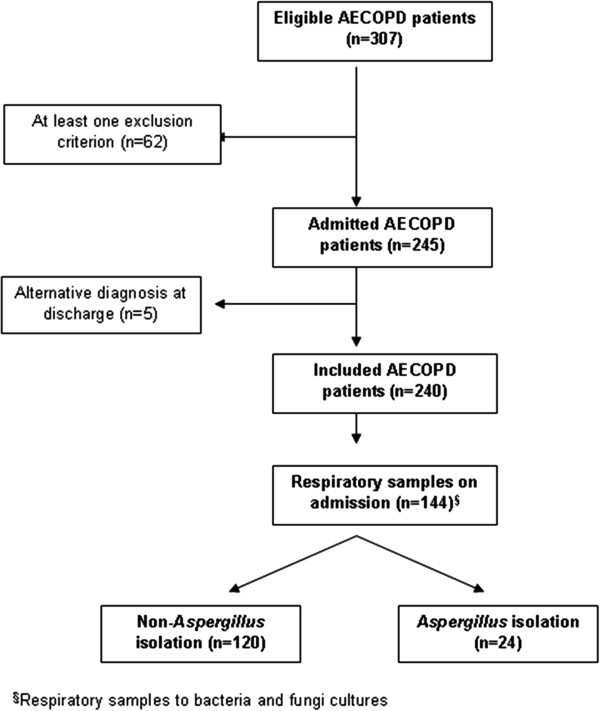
BACKGROUND: Acute exacerbations of COPD (AECOPD) are often associated with infectious agents, some of which may be non-usual, including Aspergillus spp. However, the importance of Aspergillus spp. in the clinical management of AECOPD still remains unclear. OBJECTIVES: The aims of the study were to analyze the prevalence and risk factors associated with Aspergillus spp. isolation in AECOPD, and to investigate the associated clinical outcomes during a 1-year follow-up period. METHODS: Patients presenting with an AECOPD requiring hospitalization were prospectively included from four hospitals across Spain. Clinical, radiological and microbiological data were collected at admission and during the follow-up period (1, 6 and 12 months after discharge), and re-admissions and mortality data collected during the follow-up. RESULTS: A total of 240 patients with severe AECOPD were included. Valid sputum samples were obtained in 144 (58%) patients, and in this group, the prevalence of Aspergillus spp. isolation was 16.6% on admission and 14.1% at one-year follow-up. Multivariate logistic-regression showed that AECOPD in the previous year (OR 12.35; 95% CI, 1.9-29.1; p < 0.001), concurrent isolation of pathogenic bacteria (OR 3.64; 95% CI 1.65-9.45, p = 0.001) and concomitant isolation of Pseudomonas aeruginosa (OR 2.80; 95% IC, 1.81-11.42; p = 0.001) were the main risk factors for Aspergillus spp. isolation. CONCLUSIONS: The main risk factors for Aspergillus spp. isolation were AECOPD in the previous year and concomitant isolation of Pseudomonas aeruginosa. However, although Aspergillus spp. is often isolated in sputum samples from patients with AECOPD, the pathogenic and clinical significance remains unclear.
Overview
The claims and statistics of this paper haven’t been checked yet.
Free: it reads the open-access text and checks the first 5 claims that cite a source we can check. Create a free account to check every claim.
Integrity signals
Registry
Cites
Statistics
Figures
Verification
Claims the paper makes
The claims and statistics of this paper haven’t been checked yet.
Free: it reads the open-access text and checks the first 5 claims that cite a source we can check. Create a free account to check every claim.
Claims other papers make about this one
Each is checked against this paper’s own text: does it say what the citing paper says it does?
In the citing paper
“Early studies (23, 561, 562) have shown that A. fumigatus can be isolated from up to 20% of COPD patients.”
From Aspergillus fumigatus and Aspergillosis in 2019 (2019) · cites this paper as [562]
Self-check
Percentages, sums and reported differences re-computed from the paper’s own numbers.
The self-check needs the paper’s full text.
Citations
Cites
Antibiotic Therapy in Exacerbations of Chronic Obstructive Pulmonary Disease
ANTHONISEN, N. R., MANFREDA, J., WARREN, C. P. W., HERSHFIELD, E. S., HARDING, G. K. M., & NELSON, N. A. (1987) · Annals of Internal Medicine · doi:10.7326/0003-4819-106-2-196 · Cited by 2,492
Severe acute exacerbations and mortality in patients with chronic obstructive pulmonary disease
Soler-Cataluna, J. J. (2005) · Thorax · doi:10.1136/thx.2005.040527 · Cited by 1,931
COPD exacerbations: Defining their cause and prevention
Wedzicha, J. A., & Seemungal, T. A. (2007) · The Lancet · doi:10.1016/s0140-6736(07)61382-8 · Cited by 1,370 · cited 1×
“Overall, these microbial agents account for the etiology of 75% of AECOPD, particularly in Anthonisen Type I exacerbations [6].”
BackgroundSEEMUNGAL, T., HARPER-OWEN, R., BHOWMIK, A., MORIC, I., SANDERSON, G., MESSAGE, S., MacCALLUM, P., MEADE, T. W., JEFFRIES, D. J., JOHNSTON, S. L., et al. (2001) · American Journal of Respiratory and Critical Care Medicine · doi:10.1164/ajrccm.164.9.2105011 · Cited by 1,018
The pathobiology of Aspergillus fumigatus
Latgé, J.-P. (2001) · Trends in Microbiology · doi:10.1016/s0966-842x(01)02104-7 · Cited by 546
Fungi and allergic lower respiratory tract diseases
Knutsen, A. P., Bush, R. K., Demain, J. G., Denning, D. W., Dixit, A., Fairs, A., Greenberger, P. A., Kariuki, B., Kita, H., Kurup, V. P., et al. (2012) · Journal of Allergy and Clinical Immunology · doi:10.1016/j.jaci.2011.12.970 · Cited by 482
Invasive pulmonary aspergillosis in patients with chronic obstructive pulmonary disease
Bulpa, P., Dive, A., & Sibille, Y. (2007) · European Respiratory Journal · doi:10.1183/09031936.00062206 · Cited by 466
Underlying conditions in chronic pulmonary aspergillosis including simple aspergilloma
Smith, N. L., & Denning, D. W. (2011) · European Respiratory Journal · doi:10.1183/09031936.00054810 · Cited by 449 · cited 1×
“Patients with severe COPD who often receive broad-spectrum antibiotics and corticosteroids are now acknowledged to be one of the main risk groups for pulmonary aspergillosis [10,11].”
BackgroundMiravitlles, M., Espinosa, C., Fernández-Laso, E., Martos, J. A., Maldonado, J. A., & Gallego, M. (1999) · Chest · doi:10.1378/chest.116.1.40 · Cited by 445
Guinea, J., Torres-Narbona, M., Gijón, P., Muñoz, P., Pozo, F., Peláez, T., de Miguel, J., & Bouza, E. (2010) · Clinical Microbiology and Infection · doi:10.1111/j.1469-0691.2009.03015.x · Cited by 397
Cited by
Aspergillus fumigatus and Aspergillosis in 2019
Latgé, J.-P., & Chamilos, G. (2019) · Clinical Microbiology Reviews · doi:10.1128/cmr.00140-18 · Cited by 1,400
The role of acute and chronic respiratory colonization and infections in the pathogenesis of COPD
Leung, J. M., Tiew, P. Y., Mac Aogáin, M., Budden, K. F., Yong, V. F. L., Thomas, S. S., Pethe, K., Hansbro, P. M., & Chotirmall, S. H. (2017) · Respirology · doi:10.1111/resp.13032 · Cited by 196
Pathophysiological aspects of Aspergillus colonization in disease
Gago, S., Denning, D. W., & Bowyer, P. (2018) · Medical Mycology · doi:10.1093/mmy/myy076 · Cited by 135
Denning, D. W., Perlin, D. S., Muldoon, E. G., Colombo, A. L., Chakrabarti, A., Richardson, M. D., & Sorrell, T. C. (2017) · Emerging Infectious Diseases · doi:10.3201/eid2302.152042 · Cited by 95
The Human Respiratory Microbiome: Current Understandings and Future Directions
Zhao, L., Luo, J., Ali, M. K., Spiekerkoetter, E. F., & Nicolls, M. R. (2023) · American Journal of Respiratory Cell and Molecular Biology · doi:10.1165/rcmb.2022-0208tr · Cited by 102
Metadata
- Authors
- Huerta, A., Soler, N., Esperatti, M., Guerrero, M., Menendez, R., Gimeno, A., Zalacaín, R., Mir, N., Aguado, J. M., & Torres, A.
- Affiliations
- Centro de Investigación Biomédica en Red de Enfermedades Respiratorias (ES)
- Hospital Universitari i Politècnic La Fe (ES)
- Hospital de Cruces (ES)
- Pfizer (Spain) (ES)
- Venue
- Respiratory Research
- Published
- 2014-02-11
- Volume
- 15
- Issue
- 1
- Pages
- 17-17
- ISSN
- 1465-9921 (ISSN-L)
- 1465-993X
- PMC
- PMC3996133
- OpenAlex
- W2127228892
- Cited by
- 63
- References
- 33
- Citations by year
- 2026: 6 · 2025: 6 · 2024: 5 · 2023: 2 · 2022: 3 · 2021: 5 · 2020: 6 · 2019: 11 · 2018: 6 · 2017: 4 · 2016: 6 · 2015: 2 · 2014: 1
- FWCI
- 3.48
- Type
- journal article
- Language
- en
- Open access
- gold
- doi.org
- Licence
- cc-by
- Locations
- Respiratory Research (publishedVersion, cc-by)
- Europe PMC (PubMed Central) (publishedVersion, cc-by)
- PubMed Central (publishedVersion, cc-by)
- PubMed (publishedVersion)
- Dipòsit Digital de la Universitat de Barcelona (Universitat de Barcelona) (submittedVersion, cc-by)
- Funders
- Pfizer
- Instituto de Salud Carlos III
- Topics
- Health Sciences › Medicine › Pulmonary and Respiratory Medicine › Chronic Obstructive Pulmonary Disease (COPD) Research
- Health Sciences › Medicine › Pulmonary and Respiratory Medicine › Asthma and respiratory diseases
- Health Sciences › Medicine › Infectious Diseases › Antifungal resistance and susceptibility
- Keywords
- Aspergillus, COPD exacerbations, severe COPD, sputum microbiology, Pseudomonas aeruginosa, risk factors, prevalence, hospitalization, hospital readmission, mortality
- MeSH terms
- Acute Disease, Aged, Aged, 80 and over, Aspergillus, Female, Follow-Up Studies, Humans, Male, Prospective Studies, Risk Factors, Severity of Illness Index, Cohort Studies, Prevalence, Pulmonary Disease, Chronic Obstructive
About these checks
Registry, retraction, Cites and statistics results are computed, not judged, with one exception: a printed reference that no index lists is read once by a model before it counts as a citation error. Claims are extracted by a model and kept only when their quote appears verbatim in the text; each cited source is then checked, with a model’s help, for whether it says what the claim relies on. Those verdicts can be wrong — read the claim’s quote and the cited source before relying on one.
Statistics and arithmetic are recomputed, not judged.
Confidence bands are shown only for fields calibrated on our annotated test set. None is calibrated yet, so no band is shown.
What counts as a claim ›How we measure confidence ›How we check this ›
Are you an author, or do you see a problem with this page? Request a review
How to cite
Cite CoChat for the checks on this page, and the paper for its own findings.
- This page
- CoChat. (2026). Citation check: Importance of Aspergillus spp. isolation in Acute exacerbations of severe COPD: prevalence, factors and follow-up: the FUNGI-COPD study. https://app.cochat.ai/papers/10.1186/1465-9921-15-17
- The paper
- Huerta, A., Soler, N., Esperatti, M., Guerrero, M., Menendez, R., Gimeno, A., Zalacaín, R., Mir, N., Aguado, J. M., & Torres, A. (2014). Importance of Aspergillus spp. isolation in Acute exacerbations of severe COPD: prevalence, factors and follow-up: the FUNGI-COPD study. Respiratory Research. https://doi.org/10.1186/1465-9921-15-17
Data sources
Bibliographic data: Semantic Scholar, OpenAlex, Crossref.
Contains information from the Semantic Scholar Academic Graph Datasets, made available under the ODC Attribution License (ODC-BY 1.0).
Semantic Scholar’s data is described in: Kinney, R., et al. (2023). The Semantic Scholar Open Data Platform. arXiv:2301.10140.
