

The DOI matches its Crossref record; 35 of the 36 references it cites were found in a registry or an index.
Biologically induced mineralization of dypingite by cyanobacteria from an alkaline wetland near Atlin, British Columbia, Canada
Open accessAbstract
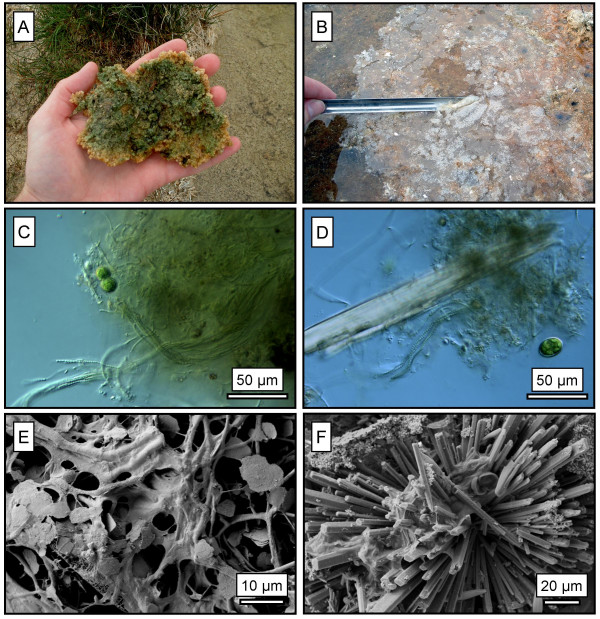
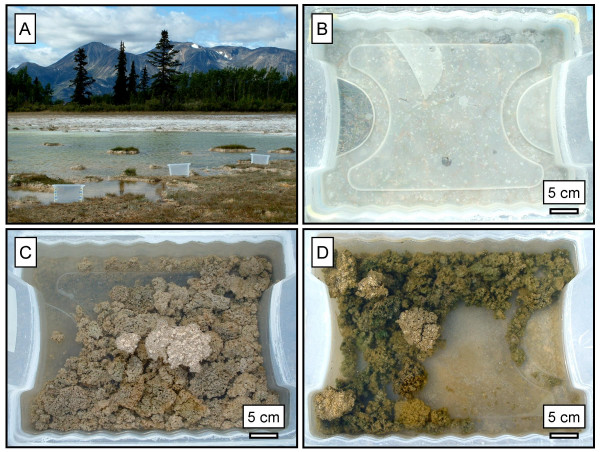
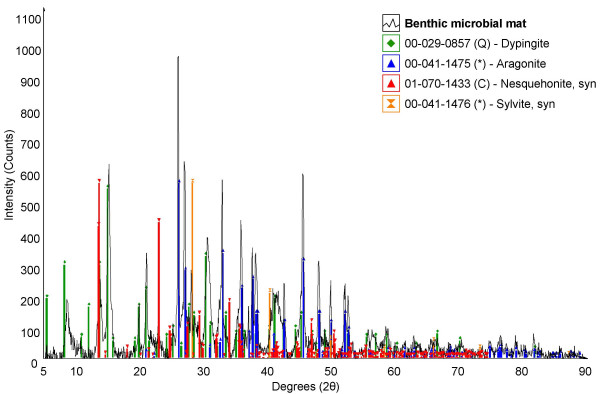
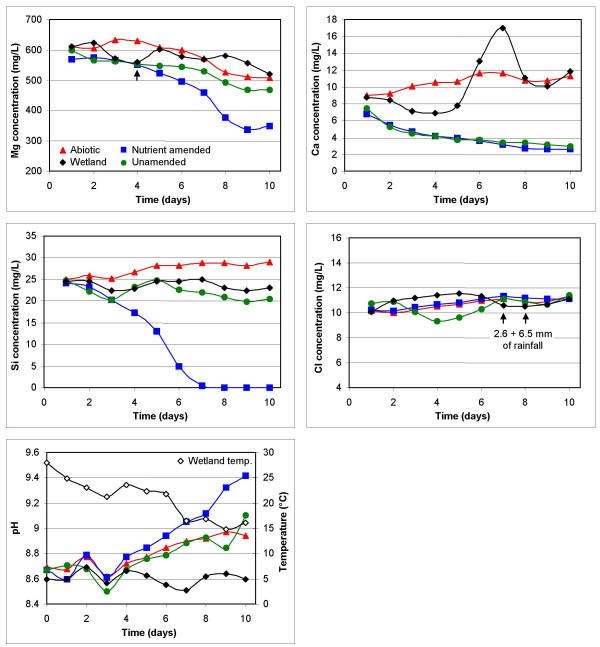
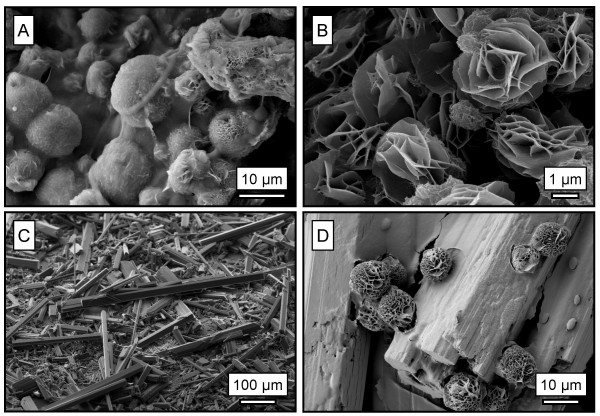
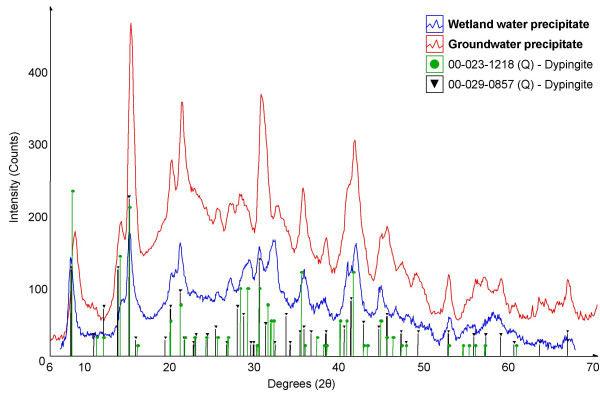
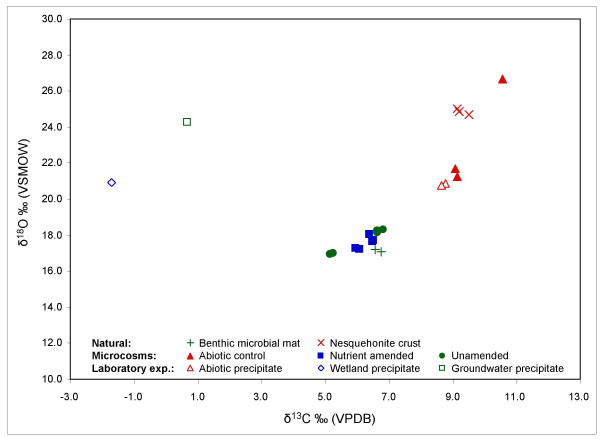
Background: This study provides experimental evidence for biologically induced precipitation of magnesium carbonates, specifically dypingite (Mg 5(CO 3)4(OH)2·5H 2 O), by cyanobacteria from an alkaline wetland near Atlin, British Columbia. This wetland is part of a larger hydromagnesite (Mg 5(CO 3)4(OH)2·4H 2 O) playa. Abiotic and biotic processes for magnesium carbonate precipitation in this environment are compared. Results: Field observations show that evaporation of wetland water produces carbonate films of nesquehonite (MgCO 3·3H 2 O) on the water surface and crusts on exposed surfaces. In contrast, benthic microbial mats possessing filamentous cyanobacteria (Lyngbya sp.) contain platy dypingite (Mg 5(CO 3)4(OH)2·5H 2 O) and aragonite. Bulk carbonates in the benthic mats (δ 13 C avg. = 6.7‰, δ 18 O avg. = 17.2‰) were isotopically distinguishable from abiotically formed nesquehonite (δ 13 C avg. = 9.3‰, δ 18 O avg. = 24.9‰). Field and laboratory experiments, which emulated natural conditions, were conducted to provide insight into the processes for magnesium carbonate precipitation in this environment. Field microcosm experiments included an abiotic control and two microbial systems, one containing ambient wetland water and one amended with nutrients to simulate eutrophic conditions. The abiotic control developed an extensive crust of nesquehonite on its bottom surface during which [Mg 2+] decreased by 16.7% relative to the starting concentration. In the microbial systems, precipitation occurred within the mats and was not simply due to the capturing of mineral grains settling out of the water column. Magnesium concentrations decreased by 22.2% and 38.7% in the microbial systems, respectively. Laboratory experiments using natural waters from the Atlin site produced rosettes and flakey globular aggregates of dypingite precipitated in association with filamentous cyanobacteria dominated biofilms cultured from the site, whereas the abiotic control again precipitated nesquehonite. Conclusion: Microbial mats in the Atlin wetland create ideal conditions for biologically induced precipitation of dypingite and have presumably played a significant role in the development of this natural Mg-carbonate playa. This biogeochemical process represents an important link between the biosphere and the inorganic carbon pool.
Overview
The claims and statistics of this paper haven’t been checked yet.
Run the check — free, no account needed. It reads the open-access text and checks the sources it cites.
Integrity signals
Registry
Cites
Statistics
Figures
Verification
Claims the paper makes
The claims and statistics of this paper haven’t been checked yet.
Run the check — free, no account needed. It reads the open-access text and checks the sources it cites.
Claims other papers make about this one
Each is checked against this paper’s own text: does it say what the citing paper says it does?
In the citing paper
“Exposing these biological samples to dilute acid while observing under a light microscope generated visible bubbles of CO 2 (Figure 2f,i), thereby determining the presence of submicron-scale grains of carbonate minerals amongst non-carbonate grains [51].”
From Strategizing carbon-neutral mines: A case for pilot projects (2014) · cites this paper as [51]
In the citing paper
“Experimental studies by Power et al. [51] and Shirokova et al. [119] have demonstrated cyanobacterially-mediated precipitation of Mg-carbonate minerals from Mg-HCO 3 waters.”
From Strategizing carbon-neutral mines: A case for pilot projects (2014) · cites this paper as [51]
In the citing paper
“In previously unreported results, the consortium used by Power et al. [51] was able to induce carbonate precipitation in experiments using water sourced from the open pit at Clinton Creek.”
From Strategizing carbon-neutral mines: A case for pilot projects (2014) · cites this paper as [51]
Self-check
Percentages, sums and reported differences re-computed from the paper’s own numbers.
The self-check needs the paper’s full text.
Citations
Cites
Parkhurst, D. L., & Appelo, C. A. J. (1999) · doi:10.3133/wri994259 · Cited by 7,727
Microbial carbonates: the geological record of calcified bacterial–algal mats and biofilms
Riding, R. (2000) · Sedimentology · doi:10.1046/j.1365-3091.2000.00003.x · Cited by 1,562 · cited 1×
“In these ancient and in contemporary systems, cyanobacteria are considered to have played a role in carbonate precipitation within oceans, lakes, springs, caves, and soils [1].”
BackgroundSIMPLE CONDITIONS FOR GROWTH OF UNICELLULAR BLUE‐GREEN ALGAE ON PLATES 1, 2
Allen, M. M. (1968) · Journal of Phycology · doi:10.1111/j.1529-8817.1968.tb04667.x · Cited by 1,256
Mineralization of bacterial surfaces
Schultze-Lam, S., Fortin, D., Davis, B. S., & Beveridge, T. J. (1996) · Chemical Geology · doi:10.1016/s0009-2541(96)00053-8 · Cited by 349
WRIGHT, D. T., & WACEY, D. (2005) · Sedimentology · doi:10.1111/j.1365-3091.2005.00732.x · Cited by 300
Sulphate-reducing bacteria induce low-temperature Ca-dolomite and high Mg-calcite formation
Van Lith, Y., Warthmann, R., Vasconcelos, C., & Mckenzie, J. A. (2003) · Geobiology · doi:10.1046/j.1472-4669.2003.00003.x · Cited by 299
Low-temperature thermodynamic model for the system Na2CO3–MgCO3–CaCO3–H2O
Königsberger, E., Königsberger, L.-C., & Gamsjäger, H. (1999) · Geochimica et Cosmochimica Acta · doi:10.1016/s0016-7037(99)00238-0 · Cited by 275
Microbial precipitation of dolomite in methanogenic groundwater
Roberts, J. A., Bennett, P. C., González, L. A., Macpherson, G. L., & Milliken, K. L. (2004) · Geology · doi:10.1130/g20246.2 · Cited by 269
van Lith, Y., Warthmann, R., Vásconcelos, C., & McKenzie, J. A. (2003) · Sedimentology · doi:10.1046/j.1365-3091.2003.00550.x · Cited by 251
Hansen, L. D., Dipple, G. M., Gordon, T. M., & Kellett, D. A. (2005) · The Canadian Mineralogist · doi:10.2113/gscanmin.43.1.225 · Cited by 216
Self-citation
Research works printed but not linked: 1
- Raade G: Dypingite, a new hydrous basic carbonate of magnesium, from Norway. Am Mineral. 1970, 55: 1457-1465.
Cited by
Sorted by citations
A review of mineral carbonation technology in sequestration of CO2
Olajire, A. A. (2013) · Journal of Petroleum Science and Engineering · doi:10.1016/j.petrol.2013.03.013 · Cited by 567
Renuka, N., Guldhe, A., Prasanna, R., Singh, P., & Bux, F. (2018) · Biotechnology Advances · doi:10.1016/j.biotechadv.2018.04.004 · Cited by 533
Accelerated carbonation of brucite in mine tailings for carbon sequestration
Harrison, A. L., Power, I. M., & Dipple, G. M. (2013) · Environmental Science & Technology · doi:10.1021/es3012854 · Cited by 328
Self-citationEnhancing the carbonation of MgO cement porous blocks through improved curing conditions
Unluer, C., & Al‐Tabbaa, A. (2014) · Cement and Concrete Research · doi:10.1016/j.cemconres.2014.02.005 · Cited by 307
Carbon mineralization: From natural analogues to engineered systems
Power, I. M., Harrison, A. L., Dipple, G. M., Wilson, S., Kelemen, P. B., Hitch, M., & Southam, G. (2013) · Reviews in Mineralogy and Geochemistry · doi:10.2138/rmg.2013.77.9 · Cited by 299
Self-citation
Metadata
- Authors
- Power, I. M., Wilson, S., Thom, J. M., Dipple, G. M., & Southam, G.
- Affiliations
- Western University (CA)
- University of British Columbia (CA)
- Corresponding author
- Power, Ian M
- Venue
- Geochemical Transactions
- Published
- 2007-12-05
- Volume
- 8
- Issue
- 1
- Pages
- 13-13
- ISSN
- 1467-4866 (ISSN-L)
- PMC
- PMC2213640
- OpenAlex
- W2040268201
- Cited by
- 165
- References
- 36
- Citations by year
- 2026: 8 · 2025: 11 · 2024: 8 · 2023: 9 · 2022: 14 · 2021: 9 · 2020: 10 · 2019: 9 · 2018: 7 · 2017: 11 · 2016: 13 · 2015: 5 · 2014: 12 · 2013: 11 · 2012: 8
- FWCI
- 3.80
- Type
- journal article
- Language
- en
- Open access
- gold
- doi.org
- Licence
- cc-by
- Locations
- Geochemical Transactions (publishedVersion, cc-by)
- Europe PMC (PubMed Central) (publishedVersion, cc-by)
- PubMed Central (publishedVersion, cc-by)
- PubMed (publishedVersion)
- DOAJ (DOAJ: Directory of Open Access Journals) (submittedVersion, cc-by-sa)
- Scholarship@Western (Western University) (submittedVersion)
- Funders
- University of British Columbia
- Natural Sciences and Engineering Research Council of Canada
- Topics
- Physical Sciences › Environmental Science › Environmental Engineering › Microbial Applications in Construction Materials
- Physical Sciences › Earth and Planetary Sciences › Paleontology › Paleontology and Stratigraphy of Fossils
- Physical Sciences › Materials Science › Biomaterials › Calcium Carbonate Crystallization and Inhibition
- Keywords
- dypingite, magnesium carbonate precipitation, cyanobacteria, microbial mats, nesquehonite, hydromagnesite, playa, Lyngbya, aragonite, carbonate isotopes, hypomagnesemia, eutrophication, microcosm experiments, biofilm
About these checks
Registry, retraction, Cites and statistics results are computed, not judged, with one exception: a printed reference that no index lists is read once by a model before it counts as a citation error. Claims are extracted by a model and kept only when their quote appears verbatim in the text; each cited source is then checked, with a model’s help, for whether it says what the claim relies on. Those verdicts can be wrong — read the claim’s quote and the cited source before relying on one.
Statistics and arithmetic are recomputed, not judged.
Confidence bands are shown only for fields calibrated on our annotated test set. None is calibrated yet, so no band is shown.
What counts as a claim ›How we measure confidence ›How we check this ›
Are you an author, or do you see a problem with this page? Request a review
