

The structural and content aspects of abstracts versus bodies of full text journal articles are different
Open accessThe DOI matches its Crossref record; 33 of the 33 references it cites were found in a registry or an index.
Abstract
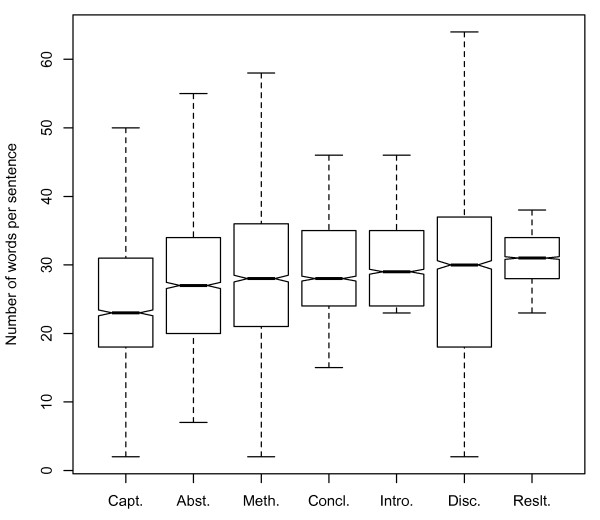
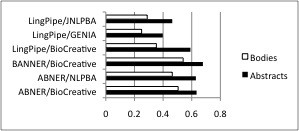
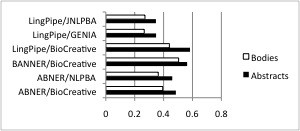
BACKGROUND: An increase in work on the full text of journal articles and the growth of PubMedCentral have the opportunity to create a major paradigm shift in how biomedical text mining is done. However, until now there has been no comprehensive characterization of how the bodies of full text journal articles differ from the abstracts that until now have been the subject of most biomedical text mining research. RESULTS: We examined the structural and linguistic aspects of abstracts and bodies of full text articles, the performance of text mining tools on both, and the distribution of a variety of semantic classes of named entities between them. We found marked structural differences, with longer sentences in the article bodies and much heavier use of parenthesized material in the bodies than in the abstracts. We found content differences with respect to linguistic features. Three out of four of the linguistic features that we examined were statistically significantly differently distributed between the two genres. We also found content differences with respect to the distribution of semantic features. There were significantly different densities per thousand words for three out of four semantic classes, and clear differences in the extent to which they appeared in the two genres. With respect to the performance of text mining tools, we found that a mutation finder performed equally well in both genres, but that a wide variety of gene mention systems performed much worse on article bodies than they did on abstracts. POS tagging was also more accurate in abstracts than in article bodies. CONCLUSIONS: Aspects of structure and content differ markedly between article abstracts and article bodies. A number of these differences may pose problems as the text mining field moves more into the area of processing full-text articles. However, these differences also present a number of opportunities for the extraction of data types, particularly that found in parenthesized text, that is present in article bodies but not in article abstracts.
Overview
The claims and statistics of this paper haven’t been checked yet.
Free: it reads the open-access text and checks the first 5 claims that cite a source we can check. Create a free account to check every claim.
Integrity signals
Registry
Cites
Statistics
Figures
Verification
Claims the paper makes
The claims and statistics of this paper haven’t been checked yet.
Free: it reads the open-access text and checks the first 5 claims that cite a source we can check. Create a free account to check every claim.
Claims other papers make about this one
Each is checked against this paper’s own text: does it say what the citing paper says it does?
The cited source says what the claim attributes to it.
In the citing paper
“As quoted from Cohen, Johnson, Verspoor, Roeder and Hunter [83]: ' Full-text articles can also present other challenges, such as the recognition and clean-up of embedded tags, non-ASCII characters, tables and figures, and even the need to convert from PDF to textual format. Access to full text is an especially troublesome issue ' [83] .”
From Automation of systematic literature reviews: A systematic literature review (2021) · cites this paper as [83]
In the citing paper
“[13,14,83] describe that this is because titles and abstracts are significantly different from full-texts.”
From Automation of systematic literature reviews: A systematic literature review (2021) · cites this paper as [83]
Self-check
Percentages, sums and reported differences re-computed from the paper’s own numbers.
The self-check needs the paper’s full text.
Citations
Cites
Jurafsky, D. S., & Martin, J. (2000) · Cited by 4,132
Accurate unlexicalized parsing
Klein, D., & Manning, C. D. (2003) · Proceedings of the 41st Annual Meeting on Association for Computational Linguistics - ACL '03 · doi:10.3115/1075096.1075150 · Cited by 3,008 · cited 1×
“6) ([30]) to a subsection of the CRAFT corpus.”
BackgroundA Simple Algorithm for Identifying Negated Findings and Diseases in Discharge Summaries
Chapman, W. W., Bridewell, W., Hanbury, P., Cooper, G. F., & Buchanan, B. G. (2001) · Journal of Biomedical Informatics · doi:10.1006/jbin.2001.1029 · Cited by 1,118 · cited 1×
“We looked at the incidence of negation because like conjunction, handling negation is a perennial problem in natural language processing [18-21].”
BackgroundProceedings of the AMIA Symposium
Schulz, S., Daumke, P., Smith, B., & Hahn, U. (2005) · Cited by 606
Overview of BioCreAtIvE: critical assessment of information extraction for biology
Hirschman, L., Yeh, A., Blaschke, C., & Valencia, A. (2005) · BMC Bioinformatics · doi:10.1186/1471-2105-6-s1-s1 · Cited by 530 · cited 1×
“In the very recent past, the TREC Genomics [10] and BioCreative competitions [11,12] have led to a large increase in work on full-text articles.”
BackgroundFriedman, C., Kra, P., Yu, H., Krauthammer, M., & Rzhetsky, A. (2001) · Bioinformatics · doi:10.1093/bioinformatics/17.suppl_1.s74 · Cited by 507
BANNER: AN EXECUTABLE SURVEY OF ADVANCES IN BIOMEDICAL NAMED ENTITY RECOGNITION
LEAMAN, R., & GONZALEZ, G. (2007) · Biocomputing 2008 · doi:10.1142/9789812776136_0062 · Cited by 479
ABNER: an open source tool for automatically tagging genes, proteins and other entity names in text
Settles, B. (2005) · Bioinformatics · doi:10.1093/bioinformatics/bti475 · Cited by 468
Procedure for quantitatively comparing the syntactic coverage of English grammars
Klavans, J., Liberman, M., Marcus, M., Roukos, S., Santorini, B., Strzalkowski, T., Abney, S., Flickenger, S., Gdaniec, C., Grishman, C., et al. (1991) · Proceedings of the workshop on Speech and Natural Language - HLT '91 · doi:10.3115/112405.112467 · Cited by 432
Mutalik, P. G., Deshpande, A., & Nadkarni, P. M. (2001) · Journal of the American Medical Informatics Association · doi:10.1136/jamia.2001.0080598 · Cited by 249
Research works printed but not linked: 4
- Nakov PI Schwartz AS Hearst MA Citances: Citation sentences for semantic analysis of bioscience text SIGIR'04 Workshop on Search and Discovery in Bioinformatics 2004
- Goldin I Chapman W Learning to detect negation with 'not' in medical texts Proceedings of the ACM SIGIR 2003
- Gasperin C Karamanis N Seal R Annotation of anaphoric relations in biomedical full-text articles using a domain-relevant scheme Proceedings of DAARC 2007 2007
- Alias-i LingPipe 3.1.2 2008
Cited by
Items 101–183 of 183
Analysis of conference abstract-to-publication rate in UK orthopaedic research
Collier, T., Roadley-Battin, M., Darlow, C., Chant, P., Hing, C. B., & Smith, T. O. (2018) · BMJ Evidence-Based Medicine · doi:10.1136/ebmed-2017-110831 · Cited by 10
Unsupervised learning and natural language processing highlight research trends in a superbug
Méndez-Cruz, C.-F., Rodríguez-Herrera, J., Varela-Vega, A., Mateo-Estrada, V., & Castillo-Ramírez, S. (2024) · Frontiers Artif. Intell. · doi:10.3389/frai.2024.1336071 · Cited by 4
Text Mining of Protein Phosphorylation Information Using a Generalizable Rule-Based Approach
Torii, M., Arighi, C. N., Wang, Q., Wu, C. H., & Vijay‐Shanker, K. (2013) · ACM International Conference on Bioinformatics, Computational Biology, and Health Informatics (ACM-BCB) · doi:10.1145/2506583.2506619 · Cited by 9
“One motivation to redesign the RLIMS-P system was to adapt it to full-text article mining [8].”
BackgroundLi, Y., Gao, Y., & Lu, X. (2023) · Journal of Quantitative Linguistics · doi:10.1080/09296174.2023.2263249 · Cited by 9
“Studies of the syntactic features of RA abstracts have focused on individual linguistic constituents, such as sentences (e.g. Cohen et al., 2010; Hartley, 1994; Nida, 1992; Orasan, 2001; Posteguillo, 1999; Whissell, 1997), clauses (e.g. Hyland & Tse, 2005; Swales & Feak, 2009), and phrases (e.g.…”
BackgroundScientific registers and disciplinary diversification: a comparable corpus approach
Teich, E., Degaetano‐Ortlieb, S., Kermes, H., & Lapshinova‐Koltunski, E. (2013) · Cited by 8
Cross-Domain Evaluation of Edge Detection for Biomedical Event Extraction.
Ramponi, A., Plank, B., & Lombardo, R. (2020) · IT University Of Copenhagen (IT University of Copenhagen) · Cited by 8
Rodriguez‐Esteban, R. (2017) · Elsevier eBooks · doi:10.1016/b978-0-12-809633-8.12372-6 · Cited by 8
Indexing important drugs from medical literature
Alharbey, R., Kim, J. I., Daud, A. Y., Song, M., Alshdadi, A. A., & Hayat, M. K. (2022) · Scientometrics · doi:10.1007/s11192-022-04340-7 · Cited by 10
“Mann–Whitney U Wilcox test reported 2.97 drug mentions per 1000 words in abstracts and 2.21 drug mentions per 1000 words in the article body (Cohen et al., 2010).”
BackgroundMethodInfluentialBarriers to Open Access Publishing: Views from the Library Literature
Forrester, A. (2015) · Publications · doi:10.3390/publications3030190 · Cited by 9
“Other investigations have also shown that when using text mining methods, abstracts have different structural and content characteristics from article bodies even when the abstracts are similarly structured [49,50].”
BackgroundRiedel, M. C., Salo, T., Hays, J. S., Turner, M. D., Sutherland, M. T., Turner, J. A., & Laird, A. R. (2019) · Frontiers in Neuroscience · doi:10.3389/fnins.2019.00494 · Cited by 7
“In addition, within the context of text-mining in genetics literature, structural differences existed between abstract-only and full article text, with longer sentences and increased parenthesized material in the article text (Cohen et al., 2010).”
BackgroundLinguistic Analysis of the bioRxiv Preprint LandscapePreprint
Nicholson, D. N., Rubinetti, V., Hu, D., Thielk, M., Hunter, L. E., & Greene, C. S. (2021) · bioRxiv (Cold Spring Harbor Laboratory) · doi:10.1101/2021.03.04.433874 · Cited by 8
Self-citationKorn, D., Pervitsky, V., Bobrowski, T., Alves, V. M., Schmitt, C., Bizon, C., Baker, N., Chirkova, R. Y., Cherkasov, A. R., Muratov, E. N., et al. (2021) · Journal of Chemical Information and Modeling · doi:10.1021/acs.jcim.1c01285 · Cited by 6
MeSH-based dataset for measuring the relevance of text retrieval
Kim, W. G., Yeganova, L. E., Comeau, D. C., Wilbur, W. J., & Lu, Z. (2018) · Workshop on Biomedical Language Processing (BioNLP) · doi:10.18653/v1/w18-2320 · Cited by 6
“While a number of studies have pointed out the benefits of full text for various text mining tasks (Cohen, Johnson, Verspoor, Roeder, & Hunter, 2010; Westergaard, Stærfeldt, Tønsberg, Jensen , & Brunak, 2018), combining these two resources for information retrieval is not a trivial endeavor.”
BackgroundGopalan, S., & Devi, S. L. (2016) · International Conference on Computational Linguistics · Cited by 9
Semantic annotation of biological concepts interplaying microbial cellular responses
Carreira, R., Carneiro, S., Pereira, R., Rocha, M., Rocha, I., Ferreira, E. C., & Lourenço, A. M. G. (2011) · BMC Bioinformatics · doi:10.1186/1471-2105-12-460 · Cited by 5
“Although such segments hold a limited amount of information [26], this fact did not represent an actual research constraint as much had to be done in terms of training algorithms and building models.”
BackgroundCiteME: Can Language Models Accurately Cite Scientific Claims?
Press, O., Hochlehnert, A., Prabhu, A., Udandarao, V., Press, O., & Bethge, M. (2024) · arXiv · doi:10.48550/arxiv.2407.12861 · Cited by 4
“Furthermore, these benchmarks typically frame citation attribution as a retrieval task from a small set of pre-selected papers where only paper titles and abstracts can be viewed, not the full paper’s content important for citation attribution [22, 50].”
BackgroundProtein2Text: Resampling Mechanism to Translate Protein Sequences into Human-Interpretable Text
Jararweh, A., Macaulay, O., Arredondo, D., Hu, Y., Tafoya, L. E., Virupakshappa, K., & Sahu, A. D. (2025) · Conference of the North American Chapter of the Association for Computational Linguistics: Human Language Technologies (NAACL-HLT) · doi:10.18653/v1/2025.naacl-industry.68 · Cited by 8
“This is likely because introduction sections usually present new information that was not necessarily mentioned in the abstract (Cohen et al., 2010).”
Potential and Pitfalls of Domain-Specific Information Extraction at Web Scale
Rheinländer, A., Lehmann, M., Kunkel, A., Meier, J., & Leser, U. (2016) · ACM SIGMOD International Conference on Management of Data (SIGMOD) · doi:10.1145/2882903.2903736 · Cited by 4
“Differences in sentence lengths between the four corpora are also significant, confirming previous findings from [6] regarding Medline abstracts and PMC full texts.”
ResultSciPuRe: a new Representation of textual data for entity identification from scientific publications
Lentschat, M., Buche, P., Dibie-Barthélemy, J., & Mathieu Roche, A. (2020) · International Conference on Web Intelligence, Mining and Semantics · doi:10.1145/3405962.3405978 · Cited by 4
Text mining for modeling of protein complexes enhanced by machine learning
Badal, V. D., Kundrotas, P. J., & Vakser, I. A. (2020) · Bioinformatics · doi:10.1093/bioinformatics/btaa823 · Cited by 4
Finding Keystone Citations for Constructing Validity Chains among Research Papers
Fu, Y., Schneider, J., & Blake, C. L. (2021) · International World Wide Web Conference (WWW) · doi:10.1145/3442442.3451368 · Cited by 4
“One limitation of this dataset is that it is from abstracts, whose language styles may differ from that of the full text of a research paper [5].”
BackgroundYeganova, L. E., Kim, W. G., Comeau, D. C., Wilbur, W. J., & Lu, Z. (2021) · Workshop on Biomedical Language Processing (BioNLP) · doi:10.18653/v1/2021.bionlp-1.27 · Cited by 4
“A number of studies have pointed out the benefits of full text for a range of text mining tasks (Cejuela et al., 2014; Cohen, Johnson, Verspoor, Roeder, & Hunter, 2010; J. Kim, Kim, Han, & Rebholz-Schuhmann, 2015; Westergaard, Stærfeldt, Tønsberg, Jensen , & Brunak, 2018) and demonstrated improved…”
BackgroundLentschat, M., Buche, P., Dibie-Barthélemy, J., & Mathieu Roche, A. (2021) · International Journal of Intelligent Information and Database Systems · doi:10.1504/ijiids.2021.10042229 · Cited by 4
“Moreover, since different sections of scientific articles contain different pieces information (Cohen et al., 2010), it could be interesting to take different contexts into account in the data representation process.”
BackgroundFelizardo, K. R. (2012) · Digital Library of Theses and Dissertations (Universidade de São Paulo) · doi:10.11606/t.55.2012.tde-18072012-102032 · Cited by 6
Wagner, M., Vicinus, B., Muthra, S., Richards, T. A., Linder, R., Frick, V. O., Groh, A., Rubie, C., & Weichert, F. (2016) · Computers in Biology and Medicine · doi:10.1016/j.compbiomed.2016.03.016 · Cited by 3
Musella, L., Castro, A. A., Lai, X., Widmann, M., & Vera, J. (2025) · PLoS Computational Biology · doi:10.1371/journal.pcbi.1012745 · Cited by 4
“Since other authors have shown that the proportion of gene mentions does not significantly differ between abstracts and full-body texts [71], we only mine the abstracts for gene mentions.”
A new method to extract n-Ary relation instances from scientific documents
Lentschat, M., Buche, P., Dibie-Barthélemy, J., & Roche, M. (2022) · Expert Systems with Applications · doi:10.1016/j.eswa.2022.118332 · Cited by 5
“…example, in the automatic extraction of keywords (Shah et al., 2003), where the assessment of different sections may give different results, but also in the extraction of named entities in the medical domain, where the results may vary significantly according to the sections (Cohen et al., 2010).”
BackgroundCohen, K. B., & Demner-Fushman, D. (2014) · Natural language processing · doi:10.1075/nlp.11.03ch3 · Cited by 3
Experiences from Developing the Domain-Specific Entity Search Engine GeneView.
Thomas, P. E., Starlinger, J., & Leser, U. (2013) · Cited by 3
Topic Classification of Public Sector Accounting Research: A BERT-Based Approach
Kuroki, M., & Hirose, Y. (2026) · Journal of Emerging Technologies in Accounting · doi:10.2308/jeta-2024-019 · Cited by 4
Cohen, K. B., & Demner‐Fushman, D. (2014) · Natural language processing · doi:10.1075/nlp.11.06ch6 · Cited by 3
Cohen, K. B., & Demner-Fushman, D. (2014) · Natural language processing · doi:10.1075/nlp.11.09ch9 · Cited by 2
Understanding human disease knowledge through text mining
Rodriguez‐Esteban, R. (2016) · Cambridge University Press eBooks · doi:10.1017/cbo9780511989421.004 · Cited by 4
Yepes, A. J., & Verspoor, K. M. (2022) · International Workshop on Health Text Mining and Information Analysis (LOUHI) · doi:10.18653/v1/2022.louhi-1.4 · Cited by 3
“Full text is more challenging compared to citations, consistent with findings on other tasks (Cohen et al., 2010), and mostly due to the higher proportion of focus entities in citations.”
ResultSelf-citationMakkaoui, O. (2014) · theses.fr (ABES) · doi:10.70675/7edae622zb0baz4a64z8d96zd1ad325b7b9f · Cited by 4
ResidueFinder: extracting individual residue mentions from protein literature
Becker, T. E., & Jakobsson, E. (2021) · Journal of Biomedical Semantics · doi:10.1186/s13326-021-00243-3 · Cited by 1
Thompson, P., Ananiadou, S., Basinas, I., Brinchmann, B. C., Cramer, C., Galea, K. S., Ge, C., Georgiadis, P., Kirkeleit, J., Kuijpers, E., et al. (2024) · PLoS ONE · doi:10.1371/journal.pone.0307844 · Cited by 1
“Although there is likely to be some overlap in their information content, abstracts and full paper sections have been shown to vary in terms of their language structure [81].”
BackgroundTextual content and academic journals selectivity: A case of economic journals
Baranowski, P., & Wójcik, S. (2026) · Journal of Informetrics · doi:10.1016/j.joi.2026.101797 · Cited by 1
Papi, A., Khalaji, D., Rizi, H. A., Shabani, A., & Hassanzadeh, A. (2014) · Journal of Education and Health Promotion · doi:10.4103/2277-9531.131913 · Cited by 1
“[18] Also, Cohen and associates’ research showed that aspects of structure and content differed markedly between article abstracts and bodies.[19] The rate commitment to using active verbs conformed with ISO 214 standard in 34.”
BackgroundParenthetical Classification for Information Extraction
Maarouf, I. E., & Villaneau, J. (2012) · HAL · Cited by 1
Biomedical literature mining for pharmacokinetics numerical parameter collection
Rocha, L. M., & Wang, Z. P. (2013) · Cited by 2
The Odyssey of publications during residency–the much needed yet challenging journey
Vignesh Narayan, R., & Dogra, S. (2022) · Cosmoderma · doi:10.25259/csdm_10_2022 · Cited by 1
Searching Through Scientific PDF Files Supported by Bi-clustering of Key Terms Matrices
Łancucki, R., Foszner, P., & Polański, A. (2017) · Advances in intelligent systems and computing · doi:10.1007/978-3-319-67792-7_15 · Cited by 1
Pushing the boundaries of deep parsing
MacKinlay, A. (2012) · Minerva Access (University of Melbourne) · Cited by 1
Text mining for metabolic reaction extraction from scientific literature
Risse, J. E. (2014) · doi:10.18174/299524 · Cited by 1
sprynger: Scriptable bibliometrics using a Python interface to Springer Nature
Herrmann, N. A., & Rose, M. E. (2025) · SoftwareX · doi:10.1016/j.softx.2025.102186 · Cited by 1
Czarnecki, J. (2015) · Birkbeck Institutional Research Online (BiRO) - Theses · doi:10.18743/pub.00040135 · Cited by 1
Łancucki, R., & Polański, A. (2015) · Advances in intelligent systems and computing · doi:10.1007/978-3-319-23437-3_21
Mining the biomedical literature
Mihăilă, C., Batista-Navarro, R., Alnazzawi, N., Kontonatsios, G., Korkontzelos, I., Rak, R., Thompson, P., & Ananiadou, S. (2015) · Research Explorer (The University of Manchester)
5. Information retrieval/document classification
Cohen, K. B., & Demner‐Fushman, D. (2014) · Natural language processing · doi:10.1075/nlp.11.05ch5
7. Ontologies and computational lexical semantics
Cohen, K. B., & Demner‐Fushman, D. (2014) · Natural language processing · doi:10.1075/nlp.11.07ch7
11. Corpus construction and annotation
Cohen, K. B., & Demner‐Fushman, D. (2014) · Natural language processing · doi:10.1075/nlp.11.11ch11
Integration and visualization of scientific big data to aid systems biology research
Binder, J. X. (2014) · heiDOK (Heidelberg University) · doi:10.11588/heidok.00017110
Similarity Analysis on Unstructured Text Using Dependency Trees in Biomedical Domain
Palakurthi, N. V. S. (2017) · CU Scholar (University of Colorado Boulder)
Linking Arabic social media based on similarity and sentiment
Alhazmi, S. (2016) · Research Explorer (The University of Manchester)
Mottin, L. (2019) · ArODES (HES-SO (https://www.hes-so.ch/)) · doi:10.13097/archive-ouverte/unige:118269
Exploiting Latent Features of Text and Graphs
Sybrandt, J. (2020) · TigerPrints (Clemson University)
Loskot, P. (2021) · arXiv (Cornell University) · doi:10.48550/arxiv.2101.10554 · Cited by 1
“The emergence of open access publications has enabled more reliable keyword identification using full-text articles than assuming only the abstracts [22,23].”
BackgroundKathy McKeown Interviews Bonnie Webber
Webber, B. (2021) · Computational Linguistics · doi:10.1162/coli_a_00393
“…a statement of the objectives of the work, the methods used in the work, the results that were obtained, and then a discussion of the results with respect to the objectives (Lin et al. 2006; Mizuta et al. 2006; Hirohata et al. 2008; Agarwal and Yu 2009; Cohen et al. 2010; Liakata et al. 2010).”
MethodUsing R to develop a corpus of full-text journal articles
Anderson, B. S., Bani-Yaghoub, M., Kantheti, V., & Curtis, S. (2023) · Journal of Information Science · doi:10.1177/01655515231171362
“Major structural and content differences have been detected when comparing full-text articles to abstracts [19].”
Text Mining Applications for Biomedicine
Rodriguez‐Esteban, R. (2024) · Elsevier eBooks · doi:10.1016/b978-0-323-95502-7.00245-1
Cohen, K. B., & Demner-Fushman, D. (2014) · Natural language processing · doi:10.1075/nlp.11.02ch2
Cohen, K. B., & Demner-Fushman, D. (2014) · Natural language processing · doi:10.1075/nlp.11.prelim
Cohen, K. B., & Demner-Fushman, D. (2014) · Natural language processing · doi:10.1075/nlp.11.toc
Cohen, K. B., & Demner-Fushman, D. (2014) · Natural language processing · doi:10.1075/nlp.11.c10
Cohen, K. B., & Demner-Fushman, D. (2014) · Natural language processing · doi:10.1075/nlp.11.lof
Cohen, K. B., & Demner-Fushman, D. (2014) · Natural language processing · doi:10.1075/nlp.11.ack
Cohen, K. B., & Demner-Fushman, D. (2014) · Natural language processing · doi:10.1075/nlp.11.08ch8
Cohen, K. B., & Demner-Fushman, D. (2014) · Natural language processing · doi:10.1075/nlp.11.refs
Cohen, K. B., & Demner-Fushman, D. (2014) · Natural language processing · doi:10.1075/nlp.11.index
Cohen, K. B., & Demner-Fushman, D. (2014) · Natural language processing · doi:10.1075/nlp.11.04ch4
Text Mining miRNA-gene Interactions for the mx-plore PlatformPreprint
Joppich, M., Klein, S., & Zimmer, R. (2025) · bioRxiv (Cold Spring Harbor Laboratory) · doi:10.1101/2025.01.22.634367
Can AI Tell More than the Available Abstracts?
Zhou, H., & Huan, X. (2024) · International Conference on Sustainable Technology and Engineering (i-COSTE) · doi:10.1109/i-coste63786.2024.11024734
“Second, the structural and content aspects of abstracts differ significantly from full-text articles [20].”
Evaluation of Cell Line Suitability for Disease Specific Perturbation Experiments
Biryukov, M., Antony, P. M. A., Krishna, A., May, P., & Trefois, C. (2015) · Studies in classification, data analysis, and knowledge organization · doi:10.1007/978-3-662-44983-7_26
Additional file 1 of ResidueFinder: extracting individual residue mentions from protein literature
Becker, T. E., & Jakobsson, E. (2021) · Figshare · doi:10.6084/m9.figshare.15033220
Evidence synthesis methods to enhance climate policy evaluation for IPCC assessments
Döbbeling-Hildebrandt, N. (2024) · White Rose eTheses Online (University of Leeds, The University of Sheffield, University of York) · Cited by 1
Fagerlund, S. (2022) · Doria (University of Helsinki) · Cited by 1
Leitao, R., Podpečan, V., Cunha, L., Vazquez, C., David, F., Imbert, C., Symanczik, S., Sousa, J. P., Bünemann, E. K., Debeljak, M., et al. (2026) · Geoderma · doi:10.1016/j.geoderma.2026.117890 · Cited by 1
Edmond, J. (2026) · Metrics · doi:10.3390/metrics3030019
“While the differences between the language of article full texts and that of article abstracts have been well documented [13], the differences that have been discovered, such as sentence length and presence of parentheticals, are not particularly relevant for the questions of how authorship is…”
Research writing in the sciences and humanities: The readability issue
Leong, A. P. (2026) · ExELL · doi:10.51558/2303-4858.2026.14.1.21
Gerner, L. M. A. (2012) · Research Explorer (The University of Manchester)
Metadata
- Authors
- Cohen, K. B., Johnson, H. L., Verspoor, K., Roeder, C., & Hunter, L. E.
- Affiliations
- University of Colorado Boulder (US)
- University of Colorado Anschutz (US)
- Corresponding author
- Cohen, K Bretonnel
- Venue
- BMC Bioinformatics
- Published
- 2010-09-29
- Volume
- 11
- Issue
- 1
- Pages
- 492-492
- ISSN
- 1471-2105 (ISSN-L)
- PMC
- PMC3098079
- OpenAlex
- W2075322787
- Semantic Scholar
- 17a4cf66d4b87ac4a8e768b9f5e6c8b13acaff6b
- Cited by
- 174
- References
- 33
- Citations by year
- 2026: 3 · 2025: 4 · 2024: 6 · 2023: 4 · 2022: 8 · 2021: 12 · 2020: 9 · 2019: 6 · 2018: 9 · 2017: 10 · 2016: 8 · 2015: 13 · 2014: 32 · 2013: 14 · 2012: 27
- FWCI
- 6.52
- Type
- journal article
- Language
- en
- Open access
- gold
- doi.org
- Licence
- cc-by
- creativecommons.org/licenses/by/2.0 (tdm)
- Locations
- BMC Bioinformatics (publishedVersion, cc-by)
- PubMed Central (publishedVersion, cc-by)
- PubMed (publishedVersion)
- Minerva Access (University of Melbourne) (submittedVersion, other-oa)
- DOAJ (DOAJ: Directory of Open Access Journals) (submittedVersion)
- Funders
- National Institute of General Medical Sciences (R01GM083649)
- U.S. National Library of Medicine (R01LM008111, R01LM009254, 1 R01LM010120-D1, R01LM010120)
- Topics
- Health Sciences › Medicine › Health Informatics › Biomedical Text Mining and Ontologies
- Physical Sciences › Computer Science › Artificial Intelligence › Advanced Text Analysis Techniques
- Social Sciences › General Social Sciences › Computational and Text Analysis Methods
- Keywords
- biomedical text mining, part-of-speech tagging, PubMed Central
- MeSH terms
- Abstracting and Indexing, Natural Language Processing, Terminology as Topic, Periodicals as Topic, MEDLINE, Information Storage and Retrieval
About these checks
Registry, retraction, Cites and statistics results are computed, not judged, with one exception: a printed reference that no index lists is read once by a model before it counts as a citation error. Claims are extracted by a model and kept only when their quote appears verbatim in the text; each cited source is then checked, with a model’s help, for whether it says what the claim relies on. Those verdicts can be wrong — read the claim’s quote and the cited source before relying on one.
Statistics and arithmetic are recomputed, not judged.
Confidence bands are shown only for fields calibrated on our annotated test set. None is calibrated yet, so no band is shown.
What counts as a claim ›How we measure confidence ›How we check this ›
Are you an author, or do you see a problem with this page? Request a review
Data sources
Bibliographic data: Semantic Scholar, OpenAlex, Crossref.
Contains information from the Semantic Scholar Academic Graph Datasets, made available under the ODC Attribution License (ODC-BY 1.0).
Semantic Scholar’s data is described in: Kinney, R., et al. (2023). The Semantic Scholar Open Data Platform. arXiv:2301.10140.
