

The DOI matches its Crossref record; 34 of the 34 references it cites were found in a registry or an index.
Deterministic global optimization algorithm based on outer approximation for the parameter estimation of nonlinear dynamic biological systems
Open accessAbstract
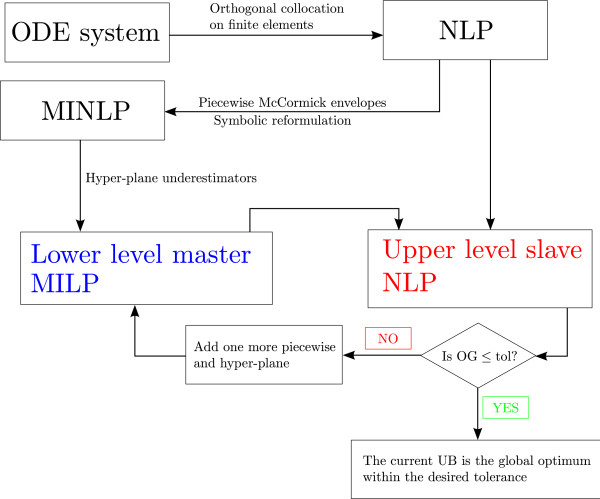
Background: The estimation of parameter values for mathematical models of biological systems is an optimization problem that is particularly challenging due to the nonlinearities involved. One major difficulty is the existence of multiple minima in which standard optimization methods may fall during the search. Deterministic global optimization methods overcome this limitation, ensuring convergence to the global optimum within a desired tolerance. Global optimization techniques are usually classified into stochastic and deterministic. The former typically lead to lower CPU times but offer no guarantee of convergence to the global minimum in a finite number of iterations. In contrast, deterministic methods provide solutions of a given quality (i.e., optimality gap), but tend to lead to large computational burdens. Results: This work presents a deterministic outer approximation-based algorithm for the global optimization of dynamic problems arising in the parameter estimation of models of biological systems. Our approach, which offers a theoretical guarantee of convergence to global minimum, is based on reformulating the set of ordinary differential equations into an equivalent set of algebraic equations through the use of orthogonal collocation methods, giving rise to a nonconvex nonlinear programming (NLP) problem. This nonconvex NLP is decomposed into two hierarchical levels: a master mixed-integer linear programming problem (MILP) that provides a rigorous lower bound on the optimal solution, and a reduced-space slave NLP that yields an upper bound. The algorithm iterates between these two levels until a termination criterion is satisfied. Conclusion: The capabilities of our approach were tested in two benchmark problems, in which the performance of our algorithm was compared with that of the commercial global optimization package BARON. The proposed strategy produced near optimal solutions (i.e., within a desired tolerance) in a fraction of the CPU time required by BARON.
Overview
The claims and statistics of this paper haven’t been checked yet.
Free: it reads the open-access text and checks the first 5 claims that cite a source we can check. Create a free account to check every claim.
Integrity signals
Registry
Cites
Statistics
Figures
Verification
Claims the paper makes
The claims and statistics of this paper haven’t been checked yet.
Free: it reads the open-access text and checks the first 5 claims that cite a source we can check. Create a free account to check every claim.
Claims other papers make about this one
Each is checked against this paper’s own text: does it say what the citing paper says it does?
In the citing paper
“Deterministic approaches for global optimization in dynamic systems [107,108] can guarantee the global optimality of the solution, but the associated computational effort increases very rapidly with problem size.”
From Reverse engineering and identification in systems biology: strategies, perspectives and challenges (2014) · cites this paper as [108]
Self-check
Percentages, sums and reported differences re-computed from the paper’s own numbers.
The self-check needs the paper’s full text.
Citations
Cites
McCormick, G. P. (1976) · Mathematical Programming · doi:10.1007/bf01580665 · Cited by 2,281
Program DYNAFIT for the Analysis of Enzyme Kinetic Data: Application to HIV Proteinase
Kuzmič, P. (1996) · Analytical Biochemistry · doi:10.1006/abio.1996.0238 · Cited by 1,495
Mendes, P., & Kell, D. (1998) · Bioinformatics · doi:10.1093/bioinformatics/14.10.869 · Cited by 676
Biegler, L. T., & Grossmann, I. E. (2004) · Computers & Chemical Engineering · doi:10.1016/j.compchemeng.2003.11.003 · Cited by 593
?BB: A global optimization method for general constrained nonconvex problems
Androulakis, I. P., Maranas, C. D., & Floudas, C. A. (1995) · Journal of Global Optimization · doi:10.1007/bf01099647 · Cited by 465
On the optimization of differential‐algebraic process systems
Cuthrell, J. E., & Biegler, L. T. (1987) · AIChE Journal · doi:10.1002/aic.690330804 · Cited by 450
Global optimization for the synthesis of integrated water systems in chemical processes
Karuppiah, R., & Grossmann, I. E. (2006) · Computers & Chemical Engineering · doi:10.1016/j.compchemeng.2005.11.005 · Cited by 437
Nonlinear Programming: Theory, Algorithms and Applications
McCormick, G. P. (1968) · Medical Entomology and Zoology · Cited by 304
Novel metaheuristic for parameter estimation in nonlinear dynamic biological systems
Rodriguez-Fernandez, M., Egea, J. A., & Banga, J. R. (2006) · BMC Bioinformatics · doi:10.1186/1471-2105-7-483 · Cited by 278 · cited 10×
“Note that this dynamic model has lack of practical identifiability, as reported in Rodriguez-Fernandez et al [4].”
BackgroundMethodInfluentialSelf-citationSmith, E. M. B., & Pantelides, C. C. (1999) · Computers & Chemical Engineering · doi:10.1016/s0098-1354(98)00286-5 · Cited by 263
Research works printed but not linked: 2
- Cizniar M, Salhi D, Fikar M, Latifi M: A MATLAB package for orthogonal collocations on finite elements in dynamic optimisation. Proc 15 Int Conference Process Control, Volume 5 058f-058f.
- Hunter W, McGregor J: The estimation of common parameters from several responses: Some actual examples. Unpublished Report. 1967.
Cited by
Reverse engineering and identification in systems biology: strategies, perspectives and challenges
Villaverde, A. F., & Banga, J. R. (2014) · Journal of The Royal Society Interface · doi:10.1098/rsif.2013.0505 · Cited by 229
Optimization-Based Power and Energy Management System in Shipboard Microgrid: A Review
Xie, P., Guerrero, J. M., Tan, S., Bazmohammadi, N., Vasquez, J. C., Mehrzadi, M., & Al-Turki, Y. (2022) · IEEE Systems Journal · doi:10.1109/jsyst.2020.3047673 · Cited by 177
Robust and efficient parameter estimation in dynamic models of biological systems
Gábor, A., & Banga, J. R. (2015) · BMC Systems Biology · doi:10.1186/s12918-015-0219-2 · Cited by 175
Benchmarking optimization methods for parameter estimation in large kinetic models
Villaverde, A. F., Fröhlich, F., Weindl, D., Hasenauer, J., & Banga, J. R. (2019) · Bioinformatics · doi:10.1093/bioinformatics/bty736 · Cited by 161
Parameter identifiability analysis and visualization in large-scale kinetic models of biosystems
Gábor, A., Villaverde, A. F., & Banga, J. R. (2017) · BMC Systems Biology · doi:10.1186/s12918-017-0428-y · Cited by 153
Metadata
- Authors
- Miró, A., Pozo, C., Guillén-Gosálbez, G., Egea, J. A., & Jiménez, L.
- Affiliations
- Universitat Rovira i Virgili (ES)
- Venue
- BMC Bioinformatics
- Published
- 2012-05-10
- Volume
- 13
- Issue
- 1
- Pages
- 90-90
- ISSN
- 1471-2105 (ISSN-L)
- PMC
- PMC3536584
- OpenAlex
- W2040571528
- Cited by
- 41
- References
- 34
- Citations by year
- 2026: 1 · 2025: 5 · 2024: 1 · 2023: 4 · 2022: 4 · 2021: 2 · 2020: 2 · 2019: 3 · 2018: 3 · 2017: 5 · 2016: 2 · 2015: 2 · 2014: 2 · 2013: 5
- FWCI
- 3.45
- Type
- journal article
- Language
- en
- Open access
- gold
- doi.org
- Licence
- cc-by
- Locations
- BMC Bioinformatics (publishedVersion, cc-by)
- PubMed Central (publishedVersion, cc-by)
- PubMed (publishedVersion)
- Rovira & Virgili repository (submittedVersion, cc-by)
- DOAJ (DOAJ: Directory of Open Access Journals) (submittedVersion)
- Repository for Publications and Research Data (ETH Zurich) (submittedVersion, cc-by)
- ETH Zürich Research Collection (cc-by)
- Funders
- Ministerio de Ciencia e Innovación
- Topics
- Physical Sciences › Mathematics › Numerical Analysis › Advanced Optimization Algorithms Research
- Physical Sciences › Computer Science › Artificial Intelligence › Metaheuristic Optimization Algorithms Research
- Physical Sciences › Engineering › Control and Systems Engineering › Process Optimization and Integration
- Keywords
- parameter estimation, deterministic global optimization, outer approximation, mixed-integer linear programming, nonconvex nonlinear programming, orthogonal collocation, ordinary differential equations, hierarchical decomposition, multiple local minima
- MeSH terms
- Bicyclic Monoterpenes, Algorithms, Computer Simulation, HIV, Humans, Isomerism, Models, Biological, HIV Protease, HIV Protease Inhibitors, Nonlinear Dynamics, Monoterpenes
About these checks
Registry, retraction, Cites and statistics results are computed, not judged, with one exception: a printed reference that no index lists is read once by a model before it counts as a citation error. Claims are extracted by a model and kept only when their quote appears verbatim in the text; each cited source is then checked, with a model’s help, for whether it says what the claim relies on. Those verdicts can be wrong — read the claim’s quote and the cited source before relying on one.
Statistics and arithmetic are recomputed, not judged.
Confidence bands are shown only for fields calibrated on our annotated test set. None is calibrated yet, so no band is shown.
What counts as a claim ›How we measure confidence ›How we check this ›
Are you an author, or do you see a problem with this page? Request a review
How to cite
Cite CoChat for the checks on this page, and the paper for its own findings.
- This page
- CoChat. (2026). Citation check: Deterministic global optimization algorithm based on outer approximation for the parameter estimation of nonlinear dynamic biological systems. https://app.cochat.ai/papers/10.1186/1471-2105-13-90
- The paper
- Miró, A., Pozo, C., Guillén-Gosálbez, G., Egea, J. A., & Jiménez, L. (2012). Deterministic global optimization algorithm based on outer approximation for the parameter estimation of nonlinear dynamic biological systems. BMC Bioinformatics. https://doi.org/10.1186/1471-2105-13-90
Data sources
Bibliographic data: Semantic Scholar, OpenAlex, Crossref.
Contains information from the Semantic Scholar Academic Graph Datasets, made available under the ODC Attribution License (ODC-BY 1.0).
Semantic Scholar’s data is described in: Kinney, R., et al. (2023). The Semantic Scholar Open Data Platform. arXiv:2301.10140.
