

The DOI matches its Crossref record; 58 of the 58 references it cites were found in a registry or an index.
Novel metaheuristic for parameter estimation in nonlinear dynamic biological systems
Open accessAbstract
Background: We consider the problem of parameter estimation (model calibration) in nonlinear dynamic models of biological systems. Due to the frequent ill-conditioning and multi-modality of many of these problems, traditional local methods usually fail (unless initialized with very good guesses of the parameter vector). In order to surmount these difficulties, global optimization (GO) methods have been suggested as robust alternatives. Currently, deterministic GO methods can not solve problems of realistic size within this class in reasonable computation times. In contrast, certain types of stochastic GO methods have shown promising results, although the computational cost remains large. Rodriguez-Fernandez and coworkers have presented hybrid stochastic-deterministic GO methods which could reduce computation time by one order of magnitude while guaranteeing robustness. Our goal here was to further reduce the computational effort without loosing robustness. Results: We have developed a new procedure based on the scatter search methodology for nonlinear optimization of dynamic models of arbitrary (or even unknown) structure (i.e. black-box models). In this contribution, we describe and apply this novel metaheuristic, inspired by recent developments in the field of operations research, to a set of complex identification problems and we make a critical comparison with respect to the previous (above mentioned) successful methods. Conclusion: Robust and efficient methods for parameter estimation are of key importance in systems biology and related areas. The new metaheuristic presented in this paper aims to ensure the proper solution of these problems by adopting a global optimization approach, while keeping the computational effort under reasonable values. This new metaheuristic was applied to a set of three challenging parameter estimation problems of nonlinear dynamic biological systems, outperforming very significantly all the methods previously used for these benchmark problems.
Overview
The claims and statistics of this paper haven’t been checked yet.
Run the check — free, no account needed. It reads the open-access text and checks the sources it cites.
Integrity signals
Registry
Cites
Statistics
Figures






Verification
Claims the paper makes
The claims and statistics of this paper haven’t been checked yet.
Run the check — free, no account needed. It reads the open-access text and checks the sources it cites.
Claims other papers make about this one
Each is checked against this paper’s own text: does it say what the citing paper says it does?
The cited source says what the claim attributes to it.
In the citing paper
“For example, scatter search has proved to be a very efficient method when the local search phase is performed by a specialized local method [114,116].”
From Reverse engineering and identification in systems biology: strategies, perspectives and challenges (2014) · cites this paper as [114]
In the citing paper
“Therefore, based on the current status of the NP issue [111], approximate methods (such as stochastic algorithms and metaheuristics) are a more attractive alternative for problems of realistic size [112–114].”
From Reverse engineering and identification in systems biology: strategies, perspectives and challenges (2014) · cites this paper as [114]
Self-check
Percentages, sums and reported differences re-computed from the paper’s own numbers.
The self-check needs the paper’s full text.
Citations
Cites
Storn, R., & Price, K. (1997) · Journal of Global Optimization · doi:10.1023/a:1008202821328 · Cited by 29,569 · cited 1×
“Our tests and comparisons indicate that DE [28] and SRES [29] are one of the most competitive algorithms, with the additional advantage of being able to handle arbitrary constraints if needed.”
MethodSystem Identification: Theory for the User
Lennart Ljung, A. (1987) · Cited by 17,690
Nonlinear Regression Analysis and Its Applications
Bates, D. M., & Watts, D. G. (1988) · Wiley Series in Probability and Statistics · doi:10.1002/9780470316757 · Cited by 3,979
Ljung, L. (1999) · Wiley Encyclopedia of Electrical and Electronics Engineering · doi:10.1002/047134608x.w1046 · Cited by 3,778
Stochastic ranking for constrained evolutionary optimization
Runarsson, T. P., & Yao, X. (2000) · IEEE Transactions on Evolutionary Computation · doi:10.1109/4235.873238 · Cited by 1,807 · cited 1×
“Our tests and comparisons indicate that DE [28] and SRES [29] are one of the most competitive algorithms, with the additional advantage of being able to handle arbitrary constraints if needed.”
MethodSNOPT: An SQP Algorithm for Large-Scale Constrained Optimization
Gill, P. E., Murray, W., & Saunders, M. A. (2002) · SIAM Journal on Optimization · doi:10.1137/s1052623499350013 · Cited by 1,587 · cited 1×
“ The user can choose a number of different local solvers such us SQP methods like fmincon (The MathWorks Inc.), SOLNP [34], SNOPT [ 35 ], direct methods like Nomad [36] for the cases of very noisy data, and others specifically designed for parameter estimation problems such as N2FB/DN2FB [37].”
MethodProgram DYNAFIT for the Analysis of Enzyme Kinetic Data: Application to HIV Proteinase
Kuzmič, P. (1996) · Analytical Biochemistry · doi:10.1006/abio.1996.0238 · Cited by 1,495 · cited 2×
“This problem consists of the estimation of a number of rate constants of a model for the reaction mechanism of irreversible inhibition of HIV proteinase as originally studied by Kuzmic [52] (Figure 7).”
MethodHEURISTICS FOR INTEGER PROGRAMMING USING SURROGATE CONSTRAINTS
Glover, F. (1977) · Decision Sciences · doi:10.1111/j.1540-5915.1977.tb01074.x · Cited by 1,363
Identification of parametric models : from experimental data
Walter, É., & Pronzato, L. (1997) · Cited by 1,197
Parameter estimation in biochemical pathways: a comparison of global optimization methods
Moles, C. G., Mendes, P., & Banga, J. R. (2003) · Genome Research · doi:10.1101/gr.1262503 · Cited by 858 · cited 4×
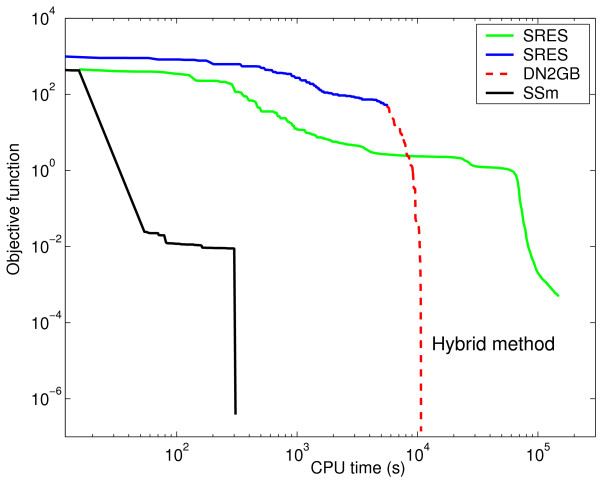
“In short, using SSm we have reduced the computation time from two days [19] to a couple of minutes, while ensuring robustness.”
BackgroundMethodInfluentialSelf-citation
Research works printed but not linked: 3
- Ye Y: Interior algorithms for linear, quadratic and linearly constrained non-linear programming. PhD thesis. Department of ESS, Stanford University; 1987.
- Dolan ED, Moré JJ, Munson TS: Benchmarking optimization problems with COPS 3.0. Technical Report ANL/MCS-TM-273. Argonne National Laboratory 2004.
- Hunter WG, McGregor JF: The Estimation of Common Parameters from Several Responses: Some Actual Examples. In Unpublished Report. The Department of Statistics. University of Winsconsin; 1967.
Cited by
On Identifiability of Nonlinear ODE Models and Applications in Viral Dynamics
Miao, H., Xia, X., Perelson, A. S., & Wu, H. (2011) · SIAM Review · doi:10.1137/090757009 · Cited by 610
“[92, 93] proposed an alternative approach for practical identifiability analysis of ODE models by examining the correlations between model parameters.”
MethodInfluentialStructural identifiability of systems biology models: a critical comparison of methods
Chis, O.-T., Banga, J. R., & Balsa-Canto, E. (2011) · PLoS ONE · doi:10.1371/journal.pone.0027755 · Cited by 448
“Local analyses are based on the computation of local sensitivities, the Fisher Information Matrix, the covariance matrix, or the Hessian of the least-squares function [14,15].”
MethodSelf-citationPenas, D. R., González, P., Egea, J. A., Doallo, R., & Banga, J. R. (2017) · BMC Bioinformatics · doi:10.1186/s12859-016-1452-4 · Cited by 385
“Scatter search is a promising metaheuristic that in sequential implementations has been shown to outperform other state of the art stochastic global optimization methods [35, 44–50].”
BackgroundSelf-citationSystems biology: parameter estimation for biochemical models
Ashyraliyev, M., Fomekong‐Nanfack, Y., Kaandorp, J. A., & Blom, J. G. (2009) · The FEBS Journal · doi:10.1111/j.1742-4658.2008.06844.x · Cited by 323
Lessons Learned from Quantitative Dynamical Modeling in Systems Biology
Raue, A., Schilling, M., Bachmann, J., Matteson, A., Schelke, M., Kaschek, D., Hug, S., Kreutz, C., Harms, B. D., Theis, F. J., et al. (2013) · PLoS ONE · doi:10.1371/journal.pone.0074335 · Cited by 306
“SSmGO is part of the toolbox Scatter Search for Global Optimization for Matlab [20,21].”
Method
Metadata
- Authors
- Rodriguez-Fernandez, M., Egea, J. A., & Banga, J. R.
- Affiliations
- Consejo Superior de Investigaciones Científicas (ES)
- Corresponding author
- Banga, Julio R
- ORCID
- Banga, Julio R
- Venue
- BMC Bioinformatics
- Published
- 2006-11-02
- Volume
- 7
- Issue
- 1
- Pages
- 483-483
- ISSN
- 1471-2105 (ISSN-L)
- PMC
- PMC1654195
- OpenAlex
- W1600765471
- Cited by
- 278
- References
- 58
- Citations by year
- 2026: 8 · 2025: 2 · 2024: 9 · 2023: 8 · 2022: 10 · 2021: 10 · 2020: 9 · 2019: 10 · 2018: 22 · 2017: 16 · 2016: 13 · 2015: 15 · 2014: 25 · 2013: 18 · 2012: 12
- FWCI
- 16.34
- Type
- journal article
- Language
- en
- Open access
- gold
- doi.org
- Licence
- cc-by
- Locations
- BMC Bioinformatics (publishedVersion, cc-by)
- PubMed (publishedVersion)
- DIGITAL.CSIC (Spanish National Research Council (CSIC)) (submittedVersion)
- DOAJ (DOAJ: Directory of Open Access Journals) (submittedVersion, cc-by-sa)
- Funders
- Xunta de Galicia
- Topics
- Physical Sciences › Computer Science › Artificial Intelligence › Metaheuristic Optimization Algorithms Research
- Life Sciences › Biochemistry, Genetics and Molecular Biology › Molecular Biology › Gene Regulatory Network Analysis
- Physical Sciences › Engineering › Control and Systems Engineering › Control Systems and Identification
- Keywords
- parameter estimation, model calibration, metaheuristic optimization, scatter search, global optimization, black-box models, systems biology, parameter identifiability
- MeSH terms
- Bicyclic Monoterpenes, Algorithms, Computers, Models, Chemical, Models, Theoretical, Numerical Analysis, Computer-Assisted, Software, Stochastic Processes, Models, Statistical, HIV Protease Inhibitors, Nonlinear Dynamics, Computational Biology, Monoterpenes, Systems Biology
About these checks
Registry, retraction, Cites and statistics results are computed, not judged, with one exception: a printed reference that no index lists is read once by a model before it counts as a citation error. Claims are extracted by a model and kept only when their quote appears verbatim in the text; each cited source is then checked, with a model’s help, for whether it says what the claim relies on. Those verdicts can be wrong — read the claim’s quote and the cited source before relying on one.
Statistics and arithmetic are recomputed, not judged.
Confidence bands are shown only for fields calibrated on our annotated test set. None is calibrated yet, so no band is shown.
What counts as a claim ›How we measure confidence ›How we check this ›
Are you an author, or do you see a problem with this page? Request a review
How to cite
Cite CoChat for the checks on this page, and the paper for its own findings.
- This page
- CoChat. (2026). Citation check: Novel metaheuristic for parameter estimation in nonlinear dynamic biological systems. https://app.cochat.ai/papers/10.1186/1471-2105-7-483
- The paper
- Rodriguez-Fernandez, M., Egea, J. A., & Banga, J. R. (2006). Novel metaheuristic for parameter estimation in nonlinear dynamic biological systems. BMC Bioinformatics. https://doi.org/10.1186/1471-2105-7-483
Data sources
Bibliographic data: Semantic Scholar, OpenAlex, Crossref.
Contains information from the Semantic Scholar Academic Graph Datasets, made available under the ODC Attribution License (ODC-BY 1.0).
Semantic Scholar’s data is described in: Kinney, R., et al. (2023). The Semantic Scholar Open Data Platform. arXiv:2301.10140.
