

The DOI matches its Crossref record; 1 of the 1 references it cites were found in a registry or an index.
Population substructure in Cache County, Utah: the Cache County study
Overview
The claims and statistics of this paper haven’t been checked yet.
Run the check — free, no account needed. It reads the open-access text and checks the sources it cites.
Integrity signals
Registry
Cites
Statistics
Figures
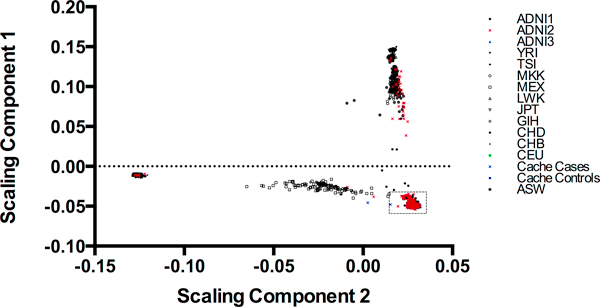
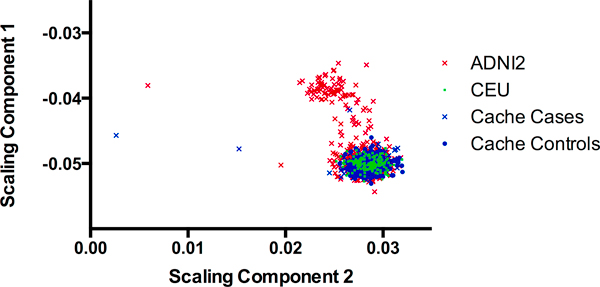
Verification
Claims the paper makes
The claims and statistics of this paper haven’t been checked yet.
Run the check — free, no account needed. It reads the open-access text and checks the sources it cites.
Claims other papers make about this one
Each is checked against this paper’s own text: does it say what the citing paper says it does?
The cited source says what the claim attributes to it.
In the citing paper
“Recent analyses confirm that these data are representative of the general European-American population [22].”
From Linkage, whole genome sequence, and biological data implicate variants in RAB10 in Alzheimer’s disease resilience (2017) · cites this paper as [22]
Self-check
Percentages, sums and reported differences re-computed from the paper’s own numbers.
The self-check needs the paper’s full text.
Citations
Cites
Alzheimer's Disease Neuroimaging Initiative (ADNI)
Petersen, R. C., Aisen, P. S., Beckett, L. A., Donohue, M. C., Gamst, A. C., Harvey, D. J., Jack, C. R., Jagust, W. J., Shaw, L. M., Toga, A. W., et al. (2010) · Neurology · doi:10.1212/wnl.0b013e3181cb3e25 · Cited by 2,572
Research works printed but not linked: 12
- Breitner JC, Wyse BW, Anthony JC, Welsh-Bohmer KA, Steffens DC, Norton MC, Tschanz JT, Plassman BL, Meyer MR, Skoog I: APOE-epsilon4 count predicts age when prevalence of AD increases, then declines: the Cache County Study. Neurology. 1999, 53: (2):321-331. · DOI · Paper page
- O'Brien E, Rogers AR, Beesley J, Jorde LB: Genetic structure of the Utah Mormons: comparison of results based on RFLPs, blood groups, migration matrices, isonymy, and pedigrees. Hum Biol. 1994, 66: (5):743-759.
- McLellan T, Jorde LB, Skolnick MH: Genetic distances between the Utah Mormons and related populations. Am J Hum Genet. 1984, 36: (4):836-857.
- Jorde LB: The genetic structure of the Utah Mormons: migration analysis. Hum Biol. 1982, 54: (3):583-597.
- International HapMap C: The International HapMap Project. Nature. 2003, 426: (6968):789-796.
- Purcell S, Neale B, Todd-Brown K, Thomas L, Ferreira MA, Bender D, Maller J, Sklar P, de Bakker PI, Daly MJ: PLINK: a tool set for whole-genome association and population-based linkage analyses. Am J Hum Genet. 2007, 81: (3):559-575. · DOI · Paper page
- Falush D, Stephens M, Pritchard JK: Inference of population structure using multilocus genotype data: linked loci and correlated allele frequencies. Genetics. 2003, 164: (4):1567-1587. · DOI
- Guerreiro R, Wojtas A, Bras J, Carrasquillo M, Rogaeva E, Majounie E, Cruchaga C, Sassi C, Kauwe JS, Younkin S: TREM2 variants in Alzheimer's disease. The New England journal of medicine. 2013, 368: (2):117-127. · DOI · Paper page
- Peterson D, Munger C, Crowley J, Corcoran C, Cruchaga C, Goate AM, Norton MC, Green RC, Munger RG, Breitner JC: Variants in PPP3R1 and MAPT are associated with more rapid functional decline in Alzheimer's disease: The Cache County Dementia Progression Study. Alzheimers Dement. 2013
- Ridge PG, Maxwell TJ, Corcoran CD, Norton MC, Tschanz JT, O'Brien E, Kerber RA, Cawthon RM, Munger RG, Kauwe JS: Mitochondrial Genomic Analysis of Late Onset Alzheimer's Disease Reveals Protective Haplogroups H6A1A/H6A1B: The Cache County Study on Memory in Aging. PLoS ONE. 2012, 7: (9):e45134- · DOI
- Gonzalez J, Schmutz C, Munger C, Perkes A, Gustin A, Peterson M, MTW E, Norton MC, Tschanz JT, Munger RG: Assessment of TREM2 R47H association with Alzheimer's disease in a population-based sample: The Cache County Study. Neurobiology of Aging. 2013
- Ebbert MT, Ridge PG, Wilson AR, Sharp AR, Bailey M, Norton MC, Tschanz JT, Munger RG, Corcoran CD, Kauwe JS: Population-based Analysis of Alzheimer's Disease Risk Alleles Implicates Genetic Interactions. Biological psychiatry. 2013
Cited by
Sorted by citations
Initiative, F. T. A. D. N., Ridge, P. G., Karch, C. M., Hsu, S., Arano, I., Teerlink, C. C., Ebbert, M. T. W., Gonzalez Murcia, J. D., Farnham, J. M., Damato, A. R., et al. (2017) · Genome Medicine · doi:10.1186/s13073-017-0486-1 · Cited by 83
Self-citation
Metadata
- Authors
- Sharp, A. R., Ridge, P. G., Bailey, M. H., Boehme, K. L., Norton, M. C., Tschanz, J. T., Munger, R. G., Corcoran, C. D., Kauwe, J. S., & (ADNI), A. D. N. I.
- Venue
- BMC Bioinformatics
- Published
- 2014-05
- Volume
- 15
- Issue
- S7
- ISSN
- 1471-2105
- PMC
- PMC4110730
- Cited by
- 6
- References
- 1
- Language
- en
About these checks
Registry, retraction, Cites and statistics results are computed, not judged, with one exception: a printed reference that no index lists is read once by a model before it counts as a citation error. Claims are extracted by a model and kept only when their quote appears verbatim in the text; each cited source is then checked, with a model’s help, for whether it says what the claim relies on. Those verdicts can be wrong — read the claim’s quote and the cited source before relying on one.
Statistics and arithmetic are recomputed, not judged.
Confidence bands are shown only for fields calibrated on our annotated test set. None is calibrated yet, so no band is shown.
What counts as a claim ›How we measure confidence ›How we check this ›
Are you an author, or do you see a problem with this page? Request a review
